Friday, June 7, 2013

Midwest Statebirding Trip, May 2013, Part 1 of 4 - Magee Marsh, Ohio

Each year I take an extended birding trip to some part of the country to work on my local statelists.  This year I thought I would make it a trip to the Midwest to include my first ever stops at spring migrant hotspots of Magee Marsh in Ohio and Point Pelee in Ontario.  Plus I would add a trip to upper Michigan to see Kirtland’s Warbler which is only on my lifelist based on a supposed heard bird more than 40 years ago.  And of course I needed to work on my statelists and ON province list.  Although I am ABA reportable in OH and IN, my totals were only 3 over the threshold in OH and 8 over the IN threshold.  I like to be at least 15 over the threshold, so I needed at least 12 new statebirds in OH and 7 more in IN.  I was already 16 over the MI threshold, but there were still a number of statebird possibilities for me there too.  And finally, my ON list was only 147, including only 5 species of warblers, so the potential new birds in ON were significant.  As always I spent many hours in planning and research, using e-bird, a MI birdfinding guide, various on-line site guides, and input from very knowledgeable birders in ON, OH, and IN.  I would come up with an itinerary that would get me to locations with a lot of statebirding potential, albeit requiring quite a number of miles on the rental car.

This is the first of four parts of my blog for my Midwest statebirding trip – the Ohio portion.  The next three parts will summarize the Ontario, Michigan, and Indiana portions of my trip.
  
Day 1 – Magee Marsh and Nearby Northwest OH
Weather – Highs in the 90s, humid, strong southerly winds, scattered strong thunderstorms

I started Day 1 pre-dawn in hopes of finding some nocturnal species along the causeway to Magee Marsh.  As I started down the road I rolled down the windows and was overwhelmed with song  – principally Yellow Warblers, even though it was still 30 minutes before dawn.  But one “peent” from a nearby Woodcock gave me my first OH statebird.  Out on the causeway the marshes were extensive both to the east and west, and full of geese and mallards, along with marsh wren calls.  One distant “quonk” of a Black-Crowned Night Heron was my only observation of this species, but good enough for OH statebird #2.  I now have this species in each Lower 48 state except lightly-birded Montana. 


By now numerous Willow Flycatchers were calling from the brush, and Yellow Warblers were abundant.  Then a couple Trumpeter Swans flew around the marsh as if in courtship (#3), and even flew less than 20 ft right over my head.  I would later see a flock of 6 more.  I had hoped for Virginia Rails and Common Gallinules along the causeway, but had no rails and only a couple calling Coots.  So although birding was good on the causeway, I was anxious to get to the boardwalk area of Magee Marsh, and start looking for passerines.

As I turned the last bend into the parking lot I noticed a flock of birds sitting in the road – 5 Swainson’s Thrushes and 3 White-Crowned Sparrows were oblivious to me.  That was a good start.  I parked close to the western end of the boardwalk and the trees were full of Blackpoll song, with a few others sprinkled in.  So it all seemed promising – I was hopeful that the strong southerly winds the night before could have resulted in a nice fallout.  I spent the next 6 hours slowly walking along the boardwalk, mostly letting the birds come to me as they passed through the trees.  I ended up with 18 species of warblers with highest numbers being Blackpolls and Yellows, and all the eastern Empids.  One local I talked to said it was “slow” and another said it was “dead” – imagine what it would have been on a good day.  I picked up 7 new statebirds –
·         #4 – Wilson’s Warbler – several including a number in song
·         #5 – Alder Flycatcher – quite a number of birds calling
·         #6 – Northern Waterthrush – 1 late bird skulking in a wet area
·         #7 – Screech Owl – other birders pointed out a perched bird sleeping on a high branch actually quite out in the open
·         #8 – Bay-Breasted Warbler – several males and females, some in song
·         #9 – Philadelphia Vireo – 1 noted in a Tweet which I was able to refind (yes the Magee birders post tweets when they find good birds)
·         #10 – Black-billed Cuckoo – 1 calling bird

A couple of my statebird maps are inserted below.  Alder Flycatcher which I’ve now seen in most of its breeding states but only a few in migration. 


And Bay-breasted Warbler where I’ve got good coverage in the northeastern US but still need it many states as a migrant.


One target I hoped for was Connecticut Warbler which I missed by no more than 10 minutes, despite 45 minutes of time staring into a thicket hoping it might return.  I left at 12:30 and was very happy with my tally of 83 species though it was already in the upper 80s and humidity was climbing.

Next stops were along the causeway and at ponds at Black Swamp and the Migratory Bird Center trying for marshbirds.  But the highlight was this amazingly life-like sculpture of a pair of Bald Eagles on their nest. 


I next headed to Ottawa NWR to check out the possibilities.  Much of the refuge is accessible by auto tour which is only open a couple days a month – and not while I was there.  Some impoundments are accessible by foot, but it was already above 90 and humid, and I decided to pass on a long walk in the sun with limited potential.  Next I headed to Metzger Marsh but again struck out on my targets.  Next stop was a Sedge Wren/Henslow’s Sparrow spot reported in e-bird just south of Magee Marsh.  When I got to the spot identified in e-bird there were no fields with suitable habitats.  Did the birder put in the wrong spot on the map?  That was frustrating.

After a quick dinner I headed to Oak Openings where I had earmarked a number of possible statebirds.  First stop was a field for Henslow’s Sparrows.  Unfortunately I had heard that the field had been cut last year, but I still hoped one might have returned this year.  But when I arrived the field was grassy and well-suited for the grasshopper and field sparrows and meadowlarks that I found, and had no real shrubby habitat for Henslow’s.  I then spent quite a bit of time trying for Hooded Warbler which is supposed to be quite common in the park – but with no success.  And attempts for a recently reported Clay-colored Sparrow and a Worm-eating Warbler were negative.  Though a very late Blue-headed Vireo was still present.  At dusk I heard a Whip-poor-will (#11) which at least gave me one statebird for the park.  My map of Whip-poor-will sightings is really spotty – mostly a function of limited nighttime birding in most states.


I ended the day with 112 species and 11 statebirds – a good start to the trip.

Day 2 – Magee Marsh
Weather – Highs in the 90s, humid, strong southerly winds, scattered strong thunderstorms

This day was forecasted to be just as hot as yesterday, with strong southerly winds.  So again I hoped for a nice fallout, though wasn’t looking forward to another day of heat and humidity.  I started at dawn at an advertised site for sedge wren including 2 on e-bird the week before – the Stange Prairie on the southwest corner of Ottawa NWR.  The site was very dry – too dry for Sedge Wren in my mind.  I did have a number of yellowthroats giving their calls that are a bit reminiscent of Sedge Wren – a tick followed by a buzzy trill.  Wonder if they were the source of the recent e-bird sighting.

Then off to the Magee Marsh boardwalk.  There was some bird song when I arrived but a lot less than yesterday.  I only spent 2 hours in the woods, and didn’t see anything new for my list, though did get a few species I didn’t have the day before.  As I came out of the woods to get ready to leave I noticed a number of birders with binocs trained to the sky.  I asked what they were looking at and they said White Pelicans – I got on the flock of 5 just before they wheeled out of sight.  My map of states with White Pelican tells two stories – out west I’ve seen this common bird in virtually every state.  And thrughout the east it’s a regular vagrant, and I’ve seen them in quite a number of states.  

  
The pelicans were statebird #12, and a good one for OH – so I met my OH objective.  Though I had hoped for more.  A post to the local listserve that morning mentioned nearby Henslow’s, so as I was heading out of Magee I contacted the birder, got the location, and arrived at a very nice prairie managed for songbirds.  But it was midday, really hot, and the wind was blowing at 15-25 mph.  If I had only known about this spot earlier I would have been there at dawn.  I got Grasshopper and Field Sparrows, Bobolinks, and Meadowlarks, but no Henslow’s. 

I ended the OH part of my trip with 118 species and 12 new statebirds in a day and a half.  Pretty good given the hot weather and lack of a good migrant fallout.

Saturday, May 11, 2013

Spectacular New Mexico Migrant Fallout, May 2013

I had about a half day of free time as part of a business trip to Midland, TX, and started to wonder if that would be enough time to get into New Mexico and work on that state list.  The stateline is only 90 minutes from Midland, so if I stayed in the southeast corner of NM I should have enough time to try for at least few new statebirds.  But now the question was whether there would be any worthwhile places to bird just across the stateline.  Lea County is the southeastern-most county in NM, and the NM birdfinding guide did suggest some locations in that county.  But they seemed to be a bit marginal.  I reached out to some local birding contacts, and although they offered a couple sites to try, they stressed that birding Lea County can be bleak.  I put together a very modest list of just 4 possible new statebirds that were regular in the area - Scaled Quail, Scissor-tailed Fly, Bronzed Cowbird, and Common Grackle, with only the Scissor-tail being likely.  Plus there was the possibility to get lucky with some passerine and shorebird migrants coming through.  Though again the problem would be finding suitable habitat in this very arid location.  I planned my stops to especially focus on possible migrant traps, hoping to get lucky both with the migrants and the local nesters I needed.  As I completed my planning I felt like I would be very happy with 5 new birds for my NM list.

By getting a slightly earlier flight than originally planned I was able to arrive in NM just an hour before sunset before my planned morning of birding.  So I decided to go to the closest migrant trap – a cemetery outside of Eunice – to try to get a little headstart on the birding adventure.  The birdfinding guide suggested that this area could be good for Scissor-tails and Bronzed Cowbirds, and surrounded by Quail habitat, so it seemed like a good place to start.  It was actually a very nice spot, with many deciduous trees and conifers, and several acres in size.  But there were very few migrants there (3 Audubon’s Warblers), though the cemetery was full of bird song – principally House Finches and Western Kingbirds.  Plus a couple Blue Grosbeaks, and a family of Curve-billed Thrashers were nice.  But the highlight was a sapsucker that got away – one flew in from the desert directly over my head and disappeared in the trees.  Despite a lot of searching, I could not refind it.  The field guide maps suggest a Red-naped could winter in southeast NM, but this was too late for a wintering sapsucker I would think.  And a Yellow-bellied could possibly be that far west as a migrant.  Either species would be a good bird for southeast NM in May.  But it will just go down as a Sapsucker, sp.  So no new statebirds and very few migrants on an evening stop even though I was in good habitat.  Plus on my ride west from Midland I hadn’t seen any Scissor-tailed Flycatchers at all – the only likely bird on my target list.  Now I was starting to rethink my trip.  Although I could get lucky and get at least a few new birds, a strikeout on the first stop had me wondering.  With no real guaranteed birds, I could actually finish this short trip with no new birds at all.

The plan for the next day was to start at dawn at a potential migrant trap which was a small roadside rest stop in Maljamar.  Then I would work my way back toward Midland for my afternoon meetings.  The rest stop is a small park-like site, about an acre and a half in size, but full of well-watered trees, and surrounded by desert.  I arrived at Maljamar about 30 minutes before dawn and was overwhelmed by the raucous calls of Western Kingbirds.  Although at first I thought they were just nesters, I soon realized that there were way too many for such a small park.  The next thing I noticed in the dim early light was a large wading bird that made several attempts to land in the trees – it turned out to be a Black-crowned Night-Heron.  What was that bird doing in the middle of the desert?  Maybe I was in for a good morning fallout!  As the light improved, I noticed a couple thrushes on the ground.  In the dim light I identified a couple Hermit Thrushes, and the first of an estimated 5 Swainson’s Thrushes (#1 new statebird for NM). 

Soon after the 6 AM sunrise I started hearing warbler chips from the trees – small waves of 3-5 birds seemed to be working their way northward through the rest stop, and then flying out to the desert.  Most would stop in native brush just outside the rest stop, or fly back in to the trees.  So I situated myself on the north side of the rest stop and tried for glimpses of the migrants as they passed by.  The first thing I noticed was 3’ tall bush with 3 male Western Tanagers – nice!  Then a few Wilson’s Warblers and the first of many Yellow Warblers (#2).  NM was my last state for Yellow Warbler – my 13th bird in all the mainland US states and DC.


A couple minutes later I found a bush “adorned” with Audubon’s Warblers and a Cassin’s Vireo (#3).  A bit later I noticed a number of birds perched in a small bush – I counted 3 orioles, a couple Audubon’s, and then a gorgeous male Rose-Breasted Grosbeak (#4).  A minute later a male Indigo Bunting landed out in the desert – not a new statebird but spectacular plumage.  I then turned back to the rest stop and saw some movement in a pine tree.  Although several got away before I could ID them, one was more cooperative and turned out to be a male Northern Parula (#5).  Wow!  It wasn’t even 6:30 yet and I had already found 2 pretty rare birds for NM.  NM is now my 2nd state seeing Parula as a rarity away from the east.


The next hour or so featured even more migrants.  I would watch them fly in from the desert, land in the trees for a short time, and then they would fly back out into the desert.  The most common (and most vocal) birds were Bullock’s Orioles and Western Kingbirds, and the most common warbler being Audubon’s.  I also had a calling Scrub Jay at one point, which is apparently another rarity for the area.  The next three new statebirds weren’t nearly as rare.  #6 was a lone Common Grackle that I first heard call from the trees, and then saw it fly out to the desert.  #7 was the first of several MacGillivray’s Warblers – interesting that there were none of these earlier on.  And #8 was the first of two Warbling Vireos.  My statebird map for Warbling Vireo pretty closely matches the range maps for this species – I’ve seen it in only a few southeast states though most all the other states.


Later I found a Rose-breasted Grosbeak sitting in the same spot in the same bush as earlier.  But this one was a different bird - a young male and not quite in full alternate plumage – ho hum, just another Rose-breast.  A few minutes later I found both grosbeaks sitting next to each other in a deciduous tree. 

The next two statebirds were quite a bit more exciting.  At 7:30 I noticed some movement in some thick pines when I caught a glimpse of the side of a small bird with a yellowish wash.  My first thought was it was going to be another Cassin’s Vireo.  But then I saw it’s head – it was a White-eyed Vireo! (#9)  Likely the rarest of all the rarities I would find that day.  It was most cooperative, offering long views as it foraged 15 ft up in the pine.  Don’t think I’ve ever seen a White-eye that high off the ground.  I would end up seeing it 15 minutes later in just about the same spot.  The next new statebird never even made it to the rest stop – a calling Catbird a short distance out in the desert (#10). 

It was now 8:30 and I was way behind schedule with lots of other stops on my itinerary.  But each time I tried to leave I would see a new bird that I hadn’t found earlier.  I even had my car keys in hand when I found a group of 3 buntings – 2 Indigos and a Lazuli (#11).  I actually even got in my car and began to pull out when I decided I shouldn’t leave quite yet.  Good thing too – just afterwards a pair of Bronzed Cowbirds flew in for a drink (#12).  I’ve now seen Bronzed Cowbird throughout the southwest and a few Gulf Coast states.


In 2 hours in this 1-acre oasis I had 49 species including several rarities.  My tallies are conservative since it was hard to say how many birds flew out to the desert and returned.  And many warblers escaped without ID.  But here are my best guesses on numbers –
·         Western Kingbird – 50 (plus 1 Cassin’s Kingbird)
·         Bullock’s Oriole – 50
·         4 Vireo species – 2 Plumbeous, 2 Warbling, 1 Cassin’s, 1 White-eyed
·         7 Warbler Species - 60 Yellow-rumps (including 1 Myrtle), 20 Yellows, 8 Wilson’s, 5 Orange-crowns, 5 MacGillivrays, 1 Yellowthroat, 1 Parula
·         3 Flycatchers – 3 Ash-throated, 3 Western Pewees, 1 Say’s Phoebe
Then there were the odds and ends like small flocks of Yellow-headed Blackbirds, Great-tailed Grackles, Siskins, American Goldfinches, Chipping Sparrows, etc.

Next stop was at a nearby oasis called Conoco Pond – this appeared to be a natural artesian pond with tules and surrounded by some deciduous trees.  With a quick walk into the pond I heard another Catbird calling from the brush and a handful of migrants in the trees.  The first warbler I spotted was a Nashville (#13) – I saw 2 others later.  The trees had a number of Yellow-rumps, Wilson’s, and Orange-crowns, along with Western Tanagers and Orioles here and there.  I bet this spot was hopping at dawn as well.  One area had a number of White-crowned Sparrows foraging on the ground, which were joined by a single Clay-colored Sparrow (#14).  As I was turning the car around to leave I noticed a bird in the trees a short distance ahead with a lemon-yellow wash below.  Thinking it was just another tanager I looked at it in the binocs through the windshield and realized it was warbler/vireo sized.  So I hopped and got great views of a Philadelphia Vireo (#15)!  Another rarity.  What a day.  My Philly Vireo map is really spotty – it’s not an easy bird in most of the east let alone as a rarity in the west.


Next stop was off to Chaparral Park in Lovington.  This is a large town park with a number of widely spaced trees and a lake.  I was way behind on my schedule so wasn’t planning to spend too much time there, and was pretty much thinking I had found all the migrant passerine species I was likely to get for the day.  So I headed to the lake to try for shorebirds.  I scanned the water’s edge and only found a few Spotted Sandpipers.  But then I noticed a smaller darker bird at the waterline – bobbing up and down – it was a Northern Waterthrush (#16), giving me great views to make sure it wasn’t a Louisiana.  After high fiving myself over finding yet another rarity, I realized there were a number of warblers in the trees overhead – mostly Audubon’s, Yellows, Wilson’s and Orange-crowns.  I was about to leave the lake when I saw some movement ahead in a reasonably bare tree – and without binoculars I realized it was a Black-and-White Warbler (#17).  A beautiful male that was searching for food on the bark of the branches.  NM is now my 3rd western state for this eastern species.


Now I was really leaving the lake and flushed 2 small peeps which returned to land virtually at my feet – 2 Semipalmated Sandpipers (#18).  They were later joined by a Western and a couple Leasts for good comparisons.

The next stop was to be the Lovington sewage treatment plant adjacent to the park.  But the gate was closed – too bad since that is supposed to be the best shorebird habitat in the county.  While I was standing at the gate wondering if there was some other access point, 2 Black-necked Stilts flew out of the plant.  Oh well, next time. 

I decided to skip the Eunice cemetery which was to be the next stop since I was there the day before without much luck, and Stephen’s Park in Eunice.  Instead I headed to the southeast corner of the state and the town of Jal, which is to be the best area for Scissor-tailed Flycatchers.  Sure enough a few miles north of Jal I saw a couple along the wires (#19).  I’ve now seen NM in each of the states in its regular breeding range, along with FL as a wintering bird, TN and KY as an expanding breeder, and MD and MA as a regular eastern vagrant.


The last stop was the Jal town park, which like Chaparral Park has a few trees and a good-sized lake.  The first place I headed to was the lake again to look for shorebirds.  En route I walked past the obligatory flock of domestic ducks and geese, but stopped in my tracks when I noticed a wild Snow Goose in the flock.  And it was next to a wild White-fronted Goose (#20).  I was able to get this photo holding my iPhone up to my binoculars.  Quite a number of times now I've found late lingering migrant geese in with domestic ducks/geese in town parks.  Also at the park was one lone Least Tern.  Although not a new statebird for me, a good one for NM. 


In my roughly 5 hours of birding I saw 88 species, 20 of which were new for my NM statelist.  And of course many of them were rarities for this location.  What a day!  And now with 252 on my NM list, I’m just 12 shy of the recent ABA reporting threshold for the state.

Saturday, April 27, 2013

“Bell’s” Sparrow, “Belding’s” Sparrow, and 1 Countable Statebird in California, April 2013

There are probably a lot of birders who don’t typically think of Bell’s and Belding’s Sparrows, and maybe don’t realize that they are subspecies of Sage and Savannah Sparrows, respectively.  I’ve never seen either of these subspecies, though I’ve seen other subspecies of Sage and Savannah Sparrows in multiple states, including the “Large-Billed” Savannah Sparrow in inland CA.  Although neither Bell’s nor Belding’s are separate species at this point, there is a proposal within the ABA to split the coastal Bell’s from the inland subpsecies of the Sage Sparrow.  And who knows what may happen with the Belding’s Sparrow some day.  So with a business trip to southern CA and a little free time on my hands, I thought I’d try to track down both of these sparrows in hopes that they may someday be new countable species.

Bell’s Sparrow is a non-migratory bird of the chaparral in southern and central CA.  Reviews of this year’s e-bird sightings revealed very few recent posts.  Looking back into late spring and summer of 2012 (after the inland race would have migrated away) there were a number of Bell’s Sparrow posts from various locations in the Angeles National Forest northeast of LA.  So although there were no 2013 posts from this area, I hoped that this would be a regular location for them and they would be there again this year.  The first place I targeted was the Chilao campground and adjacent helipad where multiple Bell’s had been reported in 2012.  I arrived at the campground at dawn only to find that the wind was howling.  As a result, although I was in good habitat, there was almost no bird song and few birds visible.  A Hermit Warbler and several Acorn Woodpeckers were nice, but no Bell’s.  I then went to the more exposed helipad site and it was even windier – no birds there at all. 

Plan B consisted of some locations along a nearby road in the National Forest where 2012 posts in June looked to be from someone doing a BBS survey – locations were a half mile apart with 5 minutes stops at each site.  And Bell’s were seen at 6 of these locations.  I was able to recreate that birder’s locations based on mile markers on the road, and stopped at the first 3 spots where he had had Bell’s.  With much less wind, and pretty good chaparral habitat, I was very optimistic.  But although there were a number of passerine migrants at each stop, I found no Bell’s.  When I arrived at the fourth stop I heard a Wrentit calling as soon as I got out of the call.  That’s my first Wrentit in decades – I obviously don’t spend much time in this habitat.  I played some tape for the sparrow with no luck, and instead spent some time looking at the migrants in the area.  Then I played some more tape, heard a distant sharp chip note, and noticed a sparrow fly in to perch on a nearby bush – it was a Bell’s Sparrow.  It was soon joined by another bird, and I watched them forage on the ground for quite a while.  A minute later I could hear a Bell’s Sparrow singing in the distance as well.  After 3 hours of searching that was a most satisfying set of observations.  E-bird comes through again!

On the way to my work meetings that day I passed by a nearby location where Hooded Mergansers had been reported.  Hooded Merg is one of the more common birds I need for my CA statelist so it’s a gap I’d like to fill.  One e-bird post mentioned the mergs were in the NE corner of the lake which narrowed my search.  After a short walk I found two female-plumaged birds swimming on the lake.  That was CA statebird #354 (not counting the Bell’s Sparrow of course).  I guess I was due for an easy one.  In my statebird map below I now have Hooded Merg in all but 3 western states.


Also at the lake were 2 late Ross’ Geese.  There were very tame and cooperative as indicated by this picture I took with my phone (with no magnification).  I’ve seen late spring and summering Ross’s Geese mixed in with local tame waterfowl in a number of locations in the west.


The next day I had some time in the early morning to try for the Belding’s Sparrow.  This race is a non-migratory bird of the southern CA coastal marshes.  E-bird had several sightings of this race at the Ballona Wetlands which is a coastal marsh just a bit north of LAX.  I arrived there in the early morning and realized this marsh was in an urban setting with very limited access.  Plus I wasn’t sure exactly where I was going.  I made one stop and realized I was in the wrong spot.  A few minutes later I found the correct location, but it took me an additional 10 minutes to finally find a place to park.  The site was a nice freshwater wetlands fed by reclaimed wastewater, with a trail around the perimeter.  I started walking around the site and saw a good mix of typical marsh birds, but the only sparrows were Songs.  Complicating my search was that the sprinklers came on around about a third of the site so I couldn’t get to the marsh in those locations.  (I didn’t want to get covered with a spray of reclaimed water!)  I had made it around almost the entire marsh when I started to second guess my strategy.  Why would a Savannah Sparrow be living in a freshwater cattail marsh?  That is so atypical for the Savannah Sparrows I know elsewhere in the country that live in grasslands.  So I looked at my Sibley field guide and realized that Belding’s are in salt water marshes, not freshwater marshes.  And I immediately noticed that there was a nice salt water marsh to the west of the Ballona Wetlands site.  So I started to focus on that area and soon heard a distant call that matched the tape.  A few minutes later I walked into the marsh and could hear 4 singing birds and had a close visual of one bird – quite a bit darker than the Savannahs I see elsewhere.  Belding’s it is!  Another successful search though certainly not an easy one.  It sure would have been easier if the e-bird sightings had been more specific about where the Belding’s were located – in the saltwater marsh to the west and not actually at the Ballona Wetlands at all.  In my e-bird post I made sure to include details on the location of these birds.

Someday maybe Bell’s and Belding’s will be new life birds for me.  And at that point new CA statebirds as well.

Tricolored Heron, Rhode Island, April 2013

I chased after Tricolored Heron in Rhode Island on two different occasions in 2012 but came up empty both times.  So when a Tricolored was reported from the marshes of Galilee in April 2013 I sure wanted to go after this one.  The bird was first seen on Friday afternoon but the news didn’t get out till that night.  The next question is would it remain into the weekend or did I miss my chance?  One early morning Saturday post was negative, but a positive sighting came across in mid morning.  So there was hope. 

I finally was able to break away at 3 PM I embarked on my 2-hour drive to the RI coast with cautious optimism.  But my hopes were significantly diminished at about 4 PM when I got a report of a negative post from someone at 3 PM.  Should I turn around and cut my losses, or continue on?  I decided that the bird might still be around and just challenging to locate, so I decided to continue to the RI coast.  And even if it wasn’t being very cooperative I would still have 2 hours of sunlight to wait for it to appear.  And then things changed again at 4:30 – I received another report that the bird was seen again at 4.  I sure was glad I didn’t turn around based on the earlier report. 

At 5 I finally arrived at the eastern edge of the marshes along Galilee Escape Road where all the sightings of the bird had occurred.  But there were no waders there at all.  Another birder arrived a couple minutes later and told me he had been in the area most of the day and hadn’t found the bird.  Suddenly it wasn’t looking so good after all.  Now my thoughts turned to trying to figure out where the bird could be going when it’s not there in the marsh.  I then scanned the western part of the marsh in the distance and found a number of Great Egrets in that area, so maybe the Tricolored was over that end too.  After a short drive I was over at the western edge of the marsh and found a couple Great Egrets near the road.  Before I could pick up the binocs I noticed a smaller dark wader in one of the pools.  It was the Tricolored Heron!  As you can see in my phone-scoped picture below, this bird could blend into the background so it’s not surprising that it wasn’t easy to find.  Plus I bet many birders were concentrating their searches in the other part of the marsh where all the other sightings had been.


Finally after 3 attempts I could add Tricolored Heron to my RI list –third time was the charm!  That is #305 for me in RI.  And in my statebird map below, I now have seen Tricolored in every state touching the Atlantic and the Gulf except for NY – plus I’ve seen it inland in Arkansas.


Saturday, March 30, 2013

Northern New Mexico - 35 New Statebirds, March 2013

With a business trip in the Rockies I was able to add a little extra birding time to work on my New Mexico state list.  My NM list was just at 197, I had never been to northern NM, and had done only limited winter birding in NM, so there were quite a number of possibilities for me.  Although my initial planning concentrated on birding the Sandia Mountains including the Rosy-Finches, I soon realized that there would be many other possibilities in the general area.  So I expanded my research, reached out to some local birders for advice, and put together a plan where I hoped for about 21 new statebirds.  But this included a number of wintering birds that could have moved north by then, so I would have to get lucky with some late wintering individuals in order to reach or exceed my goal.  Another complication was that the area has been under an extreme drought for a couple years, so some of the wetland areas might actually be dry now, obviously limiting my chances on waterbirds.

My first stop was at Maxwell NWR in northern NM, with targets being a number of prairie and water birds.  The first bird I saw at the refuge was a shrike that turned out to be a late adult Northern Shrike (statebird #1).  Later on I found several Loggerheads, providing good comparisons.  With a quick stop at the headquarters I found out that only Lake 13 had any water, and many of the waterfowl had already moved on.  Undeterred, I made my way to Lake 13 where I quickly found the first of several Bald Eagles (#2).  The lake was full of waterfowl – principally a good mix of dabblers and some Canada Geese.  But before I could start my search through the waterfowl I noticed some Greater Yellowlegs on the far shore.  When I starting scanning the shoreline with my scope I noticed a number of smaller passerines flitting about – Horned Larks at first, then joined by a number of Longspurs.  Even at several hundred yards I could tell they were Chestnut-collared Longspurs – I estimated 100 birds (#3).  Couldn’t pick out any other longspur species at that distance though.  In my statebird map below, I’ve now seen Chestnut-collared in 5 states as a migrant/wintering bird and 3 in its breeding territory.
 

Next with a scan of the waterfowl I found 2 white geese that turned out to be Ross’s (#4) and 2 male Common Mergansers (#5).  There were also a number of gulls there – 65 Ring-bills and 1 adult and 1 second cycle California which are pretty good for NM. 

Then with a drive around the refuge I ran into many migrating Mountain Bluebirds (#6) and the first of several Downy Woodpeckers for the trip (#7).  Now I only need Downy in AZ for a clean sweep of all the continental US states.  One of my last birds was a sub-adult Golden Eagle – not a new statebird but a great bird nonetheless.  A key miss was Magpie which is resident in the area.  And I guess I was too late for the Tree Sparrows and Lapland Longspurs that are supposed to winter there.


Next stop was nearby Stubblefield Lake – though I forgot to ask at the refuge if it still had water so I wasn’t sure if the trip would be for naught.  En route to Stubblefield I flushed another Golden Eagle and saw several other Bald Eagles.  When I arrived at the lake there was only a bit of water left, but it was teeming with waterfowl.  Mixed in with 22 Common Mergs were 2 Red-breasted Mergansers (#9) which were a bit of a surprise.  A quick stop at Spring Lake to the south yielded no more statebirds, but it did have the only Eared Grebes and Western Grebe for the trip.

Next stop would be Santa Fe.  En route along I-25 while going through a nice area of pinyon-juniper habitat I saw a bird perched atop one of the pines that even at highway speeds was an obvious Pinyon Jay (#9).  That was lucky!  Pinyon Jays can be pretty tough to find, so I’m happy to have seen them now in 6 states. 


The key target in Santa Fe was a private feeding station that has had a group of Common Grackles all winter.  I was able to get the location of the feeding station from e-bird, but had no access to the feeders.  I decided to go to the spot anyway, and hoped to be lucky with the grackles.  When I arrived I found a Great-tailed Grackle and a number of typical feeder birds, but no Common Grackles.  I had to come back through Santa Fe later on the trip so maybe I’d stop by there again.

Next I headed to Albuquerque, with the first stop being the Rio Grande Nature Center, not only for birding, but also to get some local advice for the targets in the park and the Sandias.  I arrived at 4:30 just before it closed at 5, so I spent much of that time getting some very helpful information.  Before they closed I was able to see the staked-out male Hooded Merganser at the pond on the refuge (#10) – a sweep of the mergs for the day!  And I found a cooperative Black-capped Chickadee (#11) with Mountain Chickadees.  My states with Black-caps cover most of its range with the exception of ND where my list is still less than 100, and some where it has a very limited range.


Next stop was the Tingley Beach and fishing area where Neotropic Cormorants had been reported off and on.  The Neotropics turned out to be quite easy there – I had 18 perched in one tree at one point (#12).  Also had a Double-crested for good comparison.  That was my 6th state for Neotropics – a bird that is expanding in the west.  The Common Goldeneyes that had spent the winter there had moved on though.


Now it was almost dusk and I headed back to the Rio Grande Nature Center to try for Western Screech-Owl.  I played some “tape” (actually played the BirdTunes app recording) but had no luck.  Although I struck out on the last bird of the day, it had been a most successful day.

The next morning I started my day pre-dawn en route up to Sandia Crest.  The New Mexico birdfinding guide mentioned that Saw-whets are possible just uphill from the Capulin Spring Campground.  So I pulled over near the campground entrance and played some tape.  Just a few seconds later a Saw-whet responded (#13).  On these trips I feel like I’ve been successful with nightbirds if I can get even just one new statebird tick – so I guess I was successful with the nightbirds on this trip.  Then I headed up to the crest at 10,600+ feet especially to try for the Rosy-Finches.  The latest news was although the restaurant at the crest was closed, the Rosy-Finches were still coming to the feeders.  I quickly found the 2 feeders in the dim pre-sunrise light and positioned the car so I could view them from the driver’s seat if need be.  But then I noticed that the feeders looked empty, so I walked up to both and they were completely picked clean – not a seed to be seen in or under either feeder!  They must have been empty for some time.  Are visiting birders supposed to bring seed to fill the feeders?  My hopes for Rosy-Finches were dashed.  But I decided to stick around until sunrise in hopes that some of the other high altitude finches might be around.  While standing there in the 26 degree chill (underdressed I’m afraid), a flock of 50-60 Rosy-Finches appeared over the restaurant, circled a few times, then disappeared back over the cliff on the other side.  Not nearly close enough to ID as to species, but certainly Rosy-Finch sp.  Then I noticed a few Juncos coming in below the feeders, so maybe there was hope that the finches too would return remembering when the feeders used to have seed.  A bit later I heard some finch-like song that I didn’t recognize coming from the edge of the parking lot.  A minute later 3 chunky finches flew overhead and landed in the pines at the restaurant – Pine Grosbeaks (#14) – good birds for NM!  And although my statebird map looks pretty spotty, it’s starting to match the typical range for this bird.


When I stopped looking at the grosbeaks I noticed there was a bird sitting on one of the feeders – a Black Rosy-Finch (#15).  It flew to the ground and fed in the parking lot with some juncos for a while.  Over the next 90 minutes small groups of 2-8 Rosy-Finches came in, briefly checked out the very empty feeders, then flew back over the cliff.  During that time I was able to see 2 Brown-caps (#16) and 1 Gray-Crowned (#17), the rest being Blacks.  Given the lack of food at the feeders I felt very lucky.

Next search was for Three-Toed Woodpeckers just below the crest.  I had gotten local information about a pair nesting a short distance away.  During a brief 15-minute walk I heard a Hairy, and a Downy-like call (could that one have been Three-toed?).  But I was getting pretty cold and headed back to the car.  En route uphill back to the car I was definitely feeling the effects of the altitude, and didn’t know if I should go slower to catch my breath or faster to get into the warm car.  I decided on the latter, and could hardly breathe when I got inside the car.  With ears ringing and short of breath I decided I should get down off the mountain as soon as I could.  A few hundred feet downhill I came upon a flock of siskins “gritting” in the road – I guessed easily 100 birds.  While scanning through them I found a couple Red Crossbills also in the road (#18), which soon grew to 20 birds.  I got some OK phonescoped photos of some of the more photogenic males perched nearby as well as some in the road. 


While watching the Crossbills I heard some singing finches nearby which turned out to be Cassin’s Finches (#19).  That was quite a nice stop.  My Cassin’s finch coverage now pretty closely matches its typical range.  Then less than a mile down the mountain a pair of woodpeckers flew over the road and landed nearby.  I hopped out and saw that they were Three-toed Woodpeckers (#20).  I didn’t make any other stops on the way down, instead riding slowly with the windows down.  Siskins were abundant on the entire ride – I was never out of earshot of singing birds.  And Cassin’s Finches were singing at multiple spots.  That gave me 8 new statebirds from the mountains – and some pretty good ones too.


Next stop was at the Tijeras Ranger Station in the foothills on the south side of the Sandias.  While walking a nice loop trail through sage and pinyon-juniper habitat I found 2 of my targets – a pair of Juniper Titmice (#21) and several Townsend’s Solitaires (#22).  That’s just about my last likely state for Juniper Titmouse.  And now I had already exceeded my goal for the trip with a lot of birding to come.  However, no luck with Sage Thrashers that had been seen there earlier in the month.


Then on to nearby Tres Pistolas Canyon for some dry foothills birding.  Before I got to the trailhead I heard a thrasher singing that turned out to be the first of several Curve-billed Thrashers (#23).  Somehow I had missed that one in southeastern NM last year so it was good to finally check this one off.  That was my only statebird for this spot, but I enjoyed seeing many Scrub Jays and hearing numerous Townsend Solitaires in full song.

Next I was heading south of Albuquerque en route to Bosque del Apache NWR.  Along the way there was a spot where Burrowing Owls were reported on e-Bird.  The spot was just called “Grasslands” with no details, so I hoped the location had been selected correctly in e-Bird.  I arrived at the spot which turned out to be an area for a future development – paved roads built but no houses.  I started to scan the area and found a couple prairie dogs, so I was optimistic I was in the right spot.  Then with a bit more scanning I found 2 Burrowing Owls looking at me from their hole (#24).  That’s the third state where I’ve added this species to my statelist based solely on e-Bird data (NM, ID, NV).  E-Bird can be really valuable for a lot of these searches, though not always.  It seems information on e-Bird can be more focused on identification and less on providing specific locations and tips on finding the bird.

Then onto Bosque del Apache.  There had been no recent posts from the refuge on e-Bird nor the listserve, so my first stop was at the refuge headquarters to get some updates.  Some white geese were still around, so that gave me hope for Snow Geese, and the Harris’ Sparrow last reported at their feeder a week ago was still around too.  (That was a surprise – would have thought no e-Bird sightings for over a week meant it was gone.)  I walked over to the window to see the feeding station and found a couple Gambel’s Quail (#25), and within 30 seconds found the Harris’ Sparrow (#26) feeding with a number of White-crowns.  The map of my Harris’ states really depicts its penchant for vagrancy – in addition to seeing it in states in its typical central US wintering range, I’ve now seen it in 3 western and 4 northeastern states as a rarity.


Then out on the refuge I found the flock of white geese which I estimated to be 670 birds.  Although the first birds I saw were Snow Geese (#27), I realized that most were Ross’s – perhaps 400 of them.  That was by far the most Ross’ I’ve seen in one flock or in one day for that matter.  A large flock of Tree Swallows was also feeding over that same impoundment, and it took me the better part of 20 minutes looking through them to finally find an early Violet-Green (#28), filling in one of my last states for that species.  That was the last of my new statebirds for the refuge, as I was unsuccessful in finding a pair of Carolina Wrens that had been wintering on the refuge.  Though I did have 7 species of shorebirds there (including an early Western Sandpiper).  That gave me another exciting day with 16 new statebirds, and 85 species for the day.


The next morning I started pre-dawn at Embudito Canyon on the west side of the Sandias with Scaled Quail being my key target.  This was a beautiful spot which featured numerous Canyon Towhees, gorgeous Black-throated Sparrows, and Curve-billed Thrashers, but no gallinaceous birds.  Best I could do was some Gambel’s Quail at a feeder back in suburbia.  I had spent some time trying for Scaled Quail in southern NM last year – guess it’s my nemesis bird for NM.  En route through Albuquerque I stopped at a wintering spot for a Peregrine Falcon, but I think it already headed north.  With 2 consecutive misses I wondered if my statebird luck was running out.

Next stop was back at the Rio Grande Nature Center to try for Eastern Bluebirds, which I was told are now nesting there.  It had gotten pretty windy, so I was a bit concerned about finding them.  But I went to a spot suggested by the folks at the Nature center and quickly found a flock of 4 birds (#29).  That fills one of my last gaps for Eastern Bluebird in my statebird map.  And I guess I was back on track.


I bid farewell to Albuquerque and headed north with a stop yet again in Santa Fe to try for the Common Grackles.  But I only saw the typical feeder birds, so didn’t waste much time and headed north of Santa Fe toward the Ohkay Owingeh Fishing Lakes.  En route I had a flyover Black-billed Magpie (#30) – I would eventually see 9 others later in the day.  Although this was on the southern edge of its range, should would have hated to miss such a showy bird that is typically easy to see across the western part of the country (that was my 14th state for this species). 


I got to the fishing lakes, parked at the gate, and started the ½ mile walk into the area.  There I ran into another birder who knew the area very well.  He asked if I could ID small dark geese, and he pointed out what turned out to be 2 Cackling Geese (#31) in with some Canadas.  Earlier in the day he had some Common Goldeneyes on the river (and even some Barrow’s there earlier in the month), but we could only find Buffleheads.  He suggested another option would be to look for the Goldeneyes up river as I headed up north.

The next planned stop was up to Eagle Nest Lake State Park, and en route decided to try for Goldeneyes where the river paralleled the roadway.  On my second stop sure enough I found a Common Goldeneye (#32) in the river with some Buffleheads.  Then up to the beautiful area with Eagle Nest Lake.  The lake was in a bowl with several square miles of grasslands, surrounded by mountains covered in conifers.  I had lots of raptors around the lake and grasslands including 9 Bald Eagles, 1 Golden Eagle, and 1 late Rough-legged Hawk (#33).  With the exception of the upper Midwest where I’ve done no winter birding, I’ve now seen Rough-legs in most or its regular states.


The lake itself was 99% frozen, but the small portion that was open had quite a number of waterfowl including a pair of Greater Scaup (#34) – another good bird for NM, along with a Common Goldeneye and 28 Common Mergs.  One adult California Gull was a good find.

The last stop of the trip was on a bit of a whim to try for Dipper.  I needed Dipper for my statelist, but wasn’t thinking I would get into the right habitat on this trip.  But I did an e-Bird search and found that a Dipper had been reported recently from Cimarron Canyon State Park which was just to the east of Eagle Nest Lake and along my route.  So everything was falling into place.  However, the state park was a long narrow park in the canyon, with likely lots of potential Dipper habitat.  The e-Bird location was shown as being at the western end of the state park, so I decided to make a quick try at that west end.  I got to the western edge of the park, played a bit of tape, and a Dipper flew right to me (#35).  What a great way to end a great trip!

That gave me 35 new statebirds, way over my goal of 21.  And although I did miss a few of the local wintering species that had been reported earlier in the month, with my late trip I was able to add at least a couple as early spring migrants.  And for my statebird maps, filling in NM sure has a bigger visual impact than finding a new statebird in one of the smaller northeast states.  Plus I had a very respectable 120 species for the trip (all entered into e-Bird).  Now with 232 species on my NM statelist, that's my 44th state with more than 200 species, and I’m slowly getting closer to that very high ABA reportable threshold of 264.  (Or at least that used to be the threshold when the ABA still had thresholds.)  There are quite a number of possible breeding birds in northern NM that I still need for my list – maybe a summer trip there might be enough to get over that reportable threshold.

Tuesday, March 26, 2013

Fieldfare in Massachusetts, March 2013

Viet and Petersen’s “Birds of Massachusetts”, published in 1993, is a great book that not only summarizes the regular nesters and migrants of MA, but also documents the amazing collection of rarities that have been seen in the state over the years.  Included in the book is a summary of a Fieldfare seen for over a week in April 1986 in eastern MA, before my time in New England.  I don’t know how many times I’ve read that summary over the years, trying to imagine how amazing that sighting must have been for such an extreme US rarity.  And I could only dream about what it would be like to see this one in ABA region.  Little did I know that lightning would strike a second time in the spring of 2013.

It was a Sunday in mid-March and I had checked my e-mail numerous times during the day as I always do hoping for a report of some rarity to chase after, but with no luck.  But then after dinner I checked my e-mail again and quickly noticed a post with the word “Fieldfare” in the subject line.  The 5 seconds it took to open that message on my iPhone seemed like an eternity – not only was a Fieldfare seen that day in a flock of Robins, but it was around much of the day seen by a number of birders who “got the call”.  Plus it was in Carlisle, MA, just 40 minutes from my house and less than 15 minutes from work.  Unfortunately I’m not in those birding circles to get a call about the bird, and the first e-mail about the bird wasn’t posted until late in the day.  So I could only read about this megararity after the fact.  Would it stick around like the 1986 bird, or was it just passing through with a migrant Turdus flock only to be somewhere in Maine or the Maritimes by Monday?

Since the Fieldfare’s location was so close to my office, I planned to go to work on Monday morning and then run out of the office if there was word that the bird was still around.  En route to work I checked my e-mails (while safely sitting at a redlight!), and there was a post that the bird was respotted at 7 AM.  So with only a slight diversion of my route I was in Carlisle at the bird’s location before 8 – along with at least 30 other carloads of birders.  After a short walk I was in the fields where the bird had been reported on Sunday and saw a group of about 50 birders up ahead.  I joined the group and got word that they had the Fieldfare perched atop a very tall white pine in the next field over at least 200 yards away – too far away for binoculars.  There were only 3 scopes among the 50 birders, so I stood in line and eventually got a scope view of a bird that was 95% obscured by pine needles – hardly satisfying and frankly not identifiable.  Then after a couple minutes the bird flew, and even at that distance binocular views showed that the bird was robin-sized and shaped, but very pale (almost white) below.  I guess that clinched it for the ID, but still just miserable views.  Eventually the Fieldfare came in to feed on small red berries (winterberries maybe?), within 10 feet of the ground, and about 50 yards away.  Great views were had by all as the bird perched, fed, and flew from one location to another.  To me the bird was most remarkable in flight – at 50 yards even without binoculars the pale breast and white wing linings really made the bird stand out.  It was also interesting that the Fieldfare was very difficult to find when perched because it blended into its surroundings, whereas the Robins really stood out.  By the way the Robins it was with all seemed to be of the Newfoundland race with very bright red chests.

Fieldfare was ABA Lifer number 735, and Lower 48 Lifer number 712 for me.  And it was a world lifer for me as well – I have seen Redwing, Song Thrush, Blackbird, and Mistle Thrush in Europe, but never Fieldfare.  And number 402 for my MA list.

One other interesting tidbit – this Fieldfare was located just about 8 miles NNE of the 1986 Fieldfare found in the neighboring town of Concord.  Who would have thought that this area would be such a hotspot for Fieldfares!

Monday, March 25, 2013

Solitary Sandpiper and Ovenbird in California, March 2013

While on a business trip to southern California I realized I would have an afternoon free, so I decided to plan for a bit of birding to try to add some statebirds to my CA list.  My CA list was at 351, which is pretty good for an easterner I guess, with only a few rarities.   So since winter birding in CA usually features a number of rarities, many of which stick around for a while, I was hopeful there would be at least a few to chase after.  With a bit of research on the CA listserves and e-bird I found quite a number of eastern rarities in the area.  I could try for a couple at dawn before work that day, and then mapped out an afternoon with an additional 6 target birds as possible new statebirds.

I started predawn at a park with an overwintering Parula Warbler and Red-naped Woodpecker.  With good directions I got to the right locations for the birds, but couldn’t find either one.  No worries though, as I had 6 more to try for in the afternoon.  Then with work done at 1:30 I started my afternoon birding route.  My first stop was a park with an overwintering Eastern Phoebe.  My directions weren’t the best, and it took me an extra 15 minutes to find the right part of the park, but I eventually found the spot, but only found Black Phoebes.  Hmm, thought that one was pretty likely.  Next stop was a small park with 3 overwintering targets – Solitary Sandpiper, Ovenbird, and Least Flycatcher.  I quickly found the Solitary Sandpiper in a small retention basin.  And then got to the spot where the Ovenbird was typically seen and I was lucky enough to found it quickly as well.  But I spent the next 45 minutes trying for the Least Flyc unsuccessfully.  Next stop was a park with a Palm Warbler.  But despite good microdirections, I couldn’t find the warbler.  The last stop was a small suburban park with a very reliable Dusky-Capped Flycatcher.  I arrived about 5 PM and found the park full of families playing ball, having picnics, playing music, etc.  I spent a half-hearted 20 minutes there before I gave up on seeing the bird in all the hullabaloo going on in the park. 

That gave me only 2 out of my 8 targets – I usually do much better than that.  I think part of the reason for my lack of success is that I relied more on e-Bird and less on the listserves than I normally do.  It seems that the e-Bird sightings are less likely to have the microdirections and details as to how to find the birds than in listserve posts.  So as a result maybe I didn’t have the best locations for some of these.  Plus, on e-Bird I don’t think you can report that you did not see a given bird.  So if the most recent sighting of a bird on e-Bird was a week ago, you don’t know if others have looked for it unsuccessfully in the last week, or if others found it but just didn’t report it to e-Bird.  Of course you don’t always see negative posts on the listserves either, but at least it’s possible to report that you looked for something and didn’t see it, or saw it on your umpteenth try.  My takeaway is that I need to continue to use both e-Bird and the listserves on these statebirding trips, but don’t rely on e-Bird too much by itself.

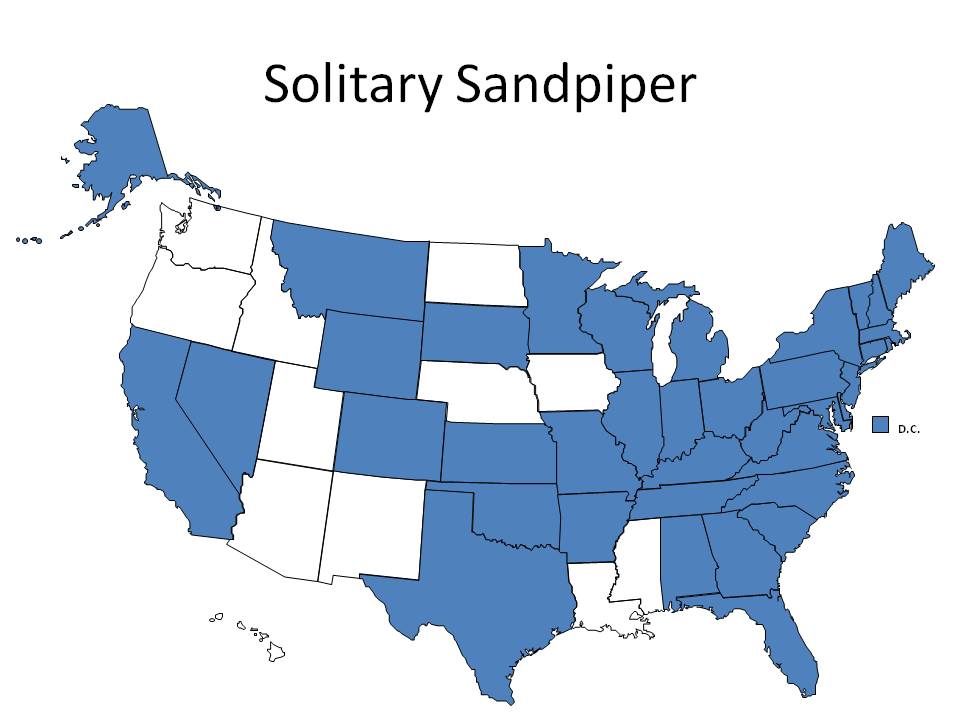
My statebird maps for Solitary Sandpiper and Ovenbird are inserted below.  Solitary is a rarity to look for in the southwest, and now CA is my second state (following NV) where I’ve seen it outside its typical range.  Though I still need it as a more regular migrant in 5 central states.  By comparison, Ovenbird isn’t necessarily known as much of a western vagrant, and CA is my first state for this species as a rarity.  And I need that one too in a number of states in its more normal range.