Tuesday, September 16, 2014

Sedge Wren, Stilt Sandpiper, and Ruddy Turnstone in Vermont, September, 2014


As the Summer of 2014 progressed a number of possible statebirds were reported in northwest VT.  First came the report of a pair of Sedge Wrens likely nesting in Middlebury.  Then came word of a drawdown of one impoundment at Dead Creek with 1 and then 2 Stilt Sandpipers – and who knows what other rare shorebirds that might be attracted to these flats in the future.  Then there was the big news of a Brown Booby on Lake Champlain.  Unfortunately the Booby disappeared (more accurately became unreliable though still on the Lake) before I could get there.  Finally came repeated reports of a pair of Ruddy Turnstones in St. Albans.  That was more than enough critical mass to make the 3 ½ hour trek to the northwest part of VT.  This time, unlike most of my other trips, I decided to get a motel room in the area the night before my birding day to avoid having to make the 7-hour round-trip drive in one day. 

I had timed my trip to be a day before the next front in hopes that the shorebirds wouldn’t have moved on yet.  And I received excellent details from VT birders for locations for the Wren, Stilt, and Turnstone.  So I was pretty optimistic that I might get the Stilt and Turnstone.  The Wren, however, was another story.  It was last reported 11 days earlier, and it was getting really late for even these late nesters to still be sticking around their apparent nesting spot.  Sedge Wrens are reported in late summer in northwest VT most every year, and although I had tried for them twice before, I waited too long both times.  I was worried that I might be too late for this third try as well.

I was able to leave early enough to get to the Wren location in the evening of the first day.  With perfect directions I quickly found the correct tall grass field where they had spent the latter half of the summer.  It was very still and quiet, so I listened intently for their characteristic call and song, but with no luck.  So I walked off the road to get to the edge of the “their” field and listened some more, but only heard a distant Red-bellied Woodpecker.  I know Sedge Wrens are very tape-responsive, so I made a couple short imitations of their call note, and almost instantly heard one note coming from the field.  Then I heard another call from a short distance away.  This second bird popped out in the open at the field’s edge and gave me distant but good looks.  Success!  VT is only my fourth New England state for Sedge Wren.  My statebird map below also shows that I have a number of gaps in this species’ normal summering and wintering ranges.


The next morning I met up with long-time birding friend Hank Kaestner and we headed to the Brilyea Access portion of Dead Creek WMA to try for the Stilt Sandpipers.  After a short walk we were at the upper reaches of the impoundment where the drawdown was occurring.  There wasn’t a lot of habitat, but we quickly found numerous Yellowlegs (almost all Lessers), a handful of peeps, and a couple Semi Plovers - though no Stilts.  We walked off the trail to get a different view of the flats but still no Stilts.  We continued walking east to get different views, and tried really hard to turn the Yellowlegs into Stilts, but to no avail.  We finally made it to a point of land and the farthest east we could walk to get a final view of the flats.  We were now looking almost directly into the sun, so viewing wasn’t the best.  Despite the glare I spotted a Stilt Sandpiper in the distance, along with a second bird and then a third one.  A pair of Short-billed Dowitchers were feeding with them, along with some of the ever-present Lesser Yellowlegs.  A nice group of birds for comparisons of size and shape, as well as feeding habits.  VT was my last New England state for this species - my 228th in each of the 6 states.  I’ve seen Stilt Sandpiper in most of its regular US range as a migrant, and a couple states as a rarity.


Hank and I next went on to Charlotte Town Beach for another shorebird search, and also for a quick lake watch.  There were 40 Killdeer and 1 Semi Sand on the shore, but nothing else.  We spent a bit of time looking over the lake but the sole highlights were a small number of Common Terns and Bonaparte’s Gulls flying down the lake.  The skies were starting to look threatening, so rather than continue on the lake watch, I decided to head north to the St. Albans Bay Town Park to try for the Turnstones.

After a short drive I arrived in St. Albans which is about as far northwest as you can get and still be in VT, and in the US for that matter.  There is a sandy beach at the Town Park which apparently is normally favored by swimmers and dog walkers.  But this year an algae bloom had fouled the beach and caused the town to close it.  As a result, not only were there no people and dogs to bother the shorebirds, but the decaying algae on the beach had attracted lots of shorebird food.  There had been good numbers of shorebirds there for several weeks, including the 2 Ruddy Turnstones.  I got to the edge of the beach and began to scan the narrow patch of habitat with my binocs.  I found a number of Yellowlegs and a couple flocks of peeps, but no Turnstones.  Then on another scan I noticed a large dark shorebird just a short distance away – a winter plumaged Ruddy Turnstone.  Another scan revealed a second bird, along with 2 Baird’s Sandpipers that hadn’t been reported there in the past.  I got these phonescoped photos of one of the Turnstones.

Not so easy to pick out the brown bird amongst the brown algae
Easier to spot in profile

Like the Stilt Sand, VT was the last of the New England states for me for Turnstone – number 229.  And VT was my second inland state for this otherwise common coastal species.  Though I still need it in OR.


With 3 VT statebirds on the trip that gives me 264 for VT, and 1,980 for New England.  I’m closing in on the magic 2,000!

Saturday, September 6, 2014

Gull-billed Tern, Plum Island, MA, August 2014


Gull-billed Tern is one of the most common birds in MA that I haven’t seen.  Although it’s certainly not a common bird, it is reported at least annually in recent years, with most sightings occurring in and around Plum Island, and to a lesser extent on the Cape.  I had chased after this species twice at Plum Island – in 2010, and in July this year following Hurricane Arthur.  In both cases my timing was miserable as I was there the first day after the target bird was last seen. 

Fast forward to August 2014 – I was watching my e-mail on a Saturday afternoon when a post came across that a Gull-billed Tern had just been spotted at Stage Island Pool at Plum Island.  If I could leave right then I would be Stage Island Pool within 90 minutes of the sighting.  But I had home commitments and probably shouldn’t head out.  I could give it a try Sunday morning, but then I would run the risk that I would miss yet another Gull-billed Tern in MA by a day.  After a couple minutes of soul searching, I decided I needed to stay at home and would have to delay the trip to tomorrow.  I continued to watch the listserve as the day progressed but there were no other posts of the bird on Saturday.  So I wondered if it even stuck around that day, let alone whether it would be still be around for me on Sunday.

I arrived at Plum Island at 7 with pretty low expectations.  I made a couple quick stops while heading south down the island, watching for terns along the salt marsh just in case the Gull-billed was foraging in the marshes.  I arrived at the north end of Stage Island Pool by 7:30 and did a quick scan of the flats.  There were good numbers of shorebirds, cormorants, geese, and waders, but no terns.  And despite another more detailed scan there were still no terns.  With no terns at all on the island so far, it sure didn’t seem very likely that the Gull-billed was still around. 

There was just one more place to check - Sandy Point – where terns and shorebirds will frequently roost on the beach.  As I headed toward Sandy Point I noticed several birders on the observation platform at the south end of Stage Island Pool.  I don’t think I’ve seen birders on that platform in years, so I decided to see what they might have – “bird the birders” as I say.  When I got up there I asked if they had anything good and they said they had the Gull-billed Tern.  I put my scope up and instantly found the Tern in the distance on the flats.  That was the same area I scanned just a few minutes earlier so it must have just flown in.  Over the next few minutes we watched it feed low over the Pool in classic Gull-billed Tern style – flying 5-10 feet over the water with slow deep wingbeats, frequently looking straight down, and occasionally dropping to the top of the water though not diving.  I also picked out a Baird’s Sandpiper and a Long-billed Dowitcher in the south end of Stage Island Pool.  A bit later we all drove to the north end of Stage Island Pool and got much closer views of the Tern, and got this phonescoped picture.


We also had a Red-necked Phalarope swimming in the water in front of the Tern.  That was a nice collection of shorebirds for one location and a classic Plum Island experience.

That was my first Gull-billed Tern for New England – species number 427 for New England.  And it was number 404 for me in MA.  In my statebird map below I’ve seen this species in all of its normal range except for GA, and now MA as a rarity.


Wednesday, September 3, 2014

Marbled Godwit in RI, and Wilson’s Phalarope in CT, August 2014

With a free day coming up I started to review possible statebirding possibilities, and my thoughts quickly went to a very reliable Wilson’s Phalarope that had been seen for several days in Guilford, CT.  And with a little more digging I found a couple reports of a Marbled Godwit at Quicksand Pond in the southeastern corner of RI in Little Compton.  Though since the Godwit reports were a bit cryptic (for instance not saying where the bird was being seen at Quicksand Pond), and the most recent report was a couple days old, I was a bit worried about whether to give that one a try.  But since I had some time available, I decided to put a few miles on the car and try for both birds. 

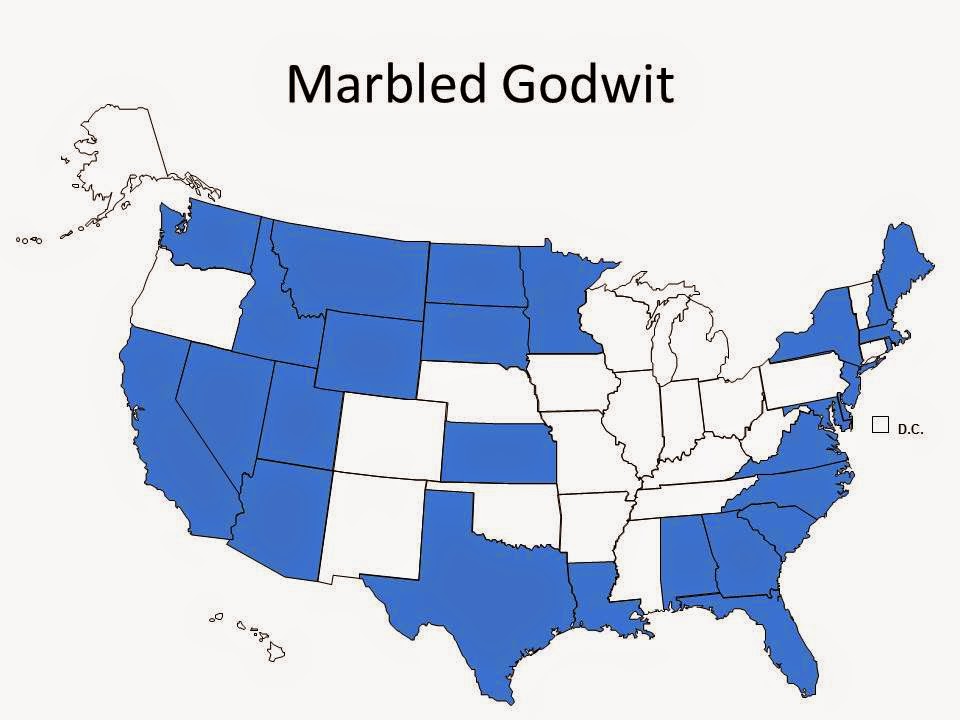
I arrived at the Little Compton beach just west of Quicksand Pond at about 7:30, early enough to not have to pay to park at the town beach.  Now the challenge was to try to locate the Godwit in this very large pond with considerable mudflats.  As I approached the southwest corner of the Pond I noticed several shorebirds along the edge.  I did a quick scan and found several Dowitchers and a few peeps, but nothing else of interest.  Then I looked to the east and found several more peeps, but still no large shorebirds.  I didn’t see any other mudflats in the immediate area, and started to worry about my chances.  Then farther off to the northeast I noticed a distant flock of maybe 200 gulls standing in shallow water.  I scoped through these birds and got brief glimpses of a smaller, darker bird walking among the gulls.  After a few seconds it came out into the open and it was the Marbled Godwit.  I ran into a couple local birders a couple minutes later and they said the Godwit had not been seen the day before.  I guess I got pretty lucky.  That was number 314 for me in RI, and my fourth New England state for this species (see my statebird map below).  I’ve now seen it in most coastal states in its migration and wintering range, many of the states in its inland breeding range, and a few inland states as a migrant.


I spent a little more time at Quicksand Pond looking for other shorebirds and found a number of peeps near the southeast corner close to the outlet of the pond.  I was about to leave the site when I looked up and noticed a Royal Tern fly right over my head coming in off the ocean.  I watched it fly around the northern stretch of the pond for a while but then lost it in the distance.  Not a new statebird for me, but a good bird for RI.

I headed back to the car and then drove west to Guilford, CT to try for the Wilson’s Phalarope.  This bird had been seen very reliably right along the road at the edge of Leete’s Island saltmarsh for several days, and was seen that morning, so I was quite optimistic.  When I arrived another birder was already there with a scope.  She said she had just arrived and hadn’t found the bird yet.  I wasn’t too disappointed (yet), and started to scan the flats.  There were numerous peeps and a few Yellowlegs, but no Phalarope.  I continued to scan, picked out a Baird’s and pointed it out to the other birder, but still couldn’t find the Phalarope.  Now I was beginning to worry since all the posts had mentioned how cooperative the bird had been right along the road.  I started to look farther out in the marsh and realized that there was quite a bit of habitat with good numbers of peeps.  Maybe it was just out of sight at this point.  I scanned some more and a medium-sized shorebird with a white rump flew through my scope field.  I watched it land and it was indeed the Wilson’s Phalarope.  I got this phonescoped photo of the bird as it fed.
 

That was number 312 for me in CT, which was my last New England state for Wilson’s Phalarope – my 227th species in each New England state.  And in my statebird map (below), I’ve seen this species throughout most of its normal range in the west and a number of eastern states as a rarity.


Saturday, August 30, 2014

Reportable in Nevada – But only Barely – With Trip to Reno/Carson City, August 2014


Before we get to the successful trip to NV, a little background on the reason for my trip is in order.  For many years I’ve had a goal of being ABA reportable in each of the Lower 48 states plus DC.  Recently the ABA stopped publishing those thresholds, which had been defined as half the number of species ever seen in that state.  But since the thresholds would slowly increase as new species are added to the statelist, I’ve decided to revise that goal somewhat to be 15 over the last ABA published threshold.  That buffer should keep me safely above the “half the state list total” for many years.  I’m now rapidly closing in on those goals, with just 5 states below the old threshold, and 11 more reportable but less than 15 over the threshold. 

Now onto NV - NV is one of my 5 states below threshold (just 11 below), and for some time I’ve been thinking about a trip to the northeastern part of the state to try for the Himalayan Snowcock as a lifebird.  Plus there would be quite a number of other possible statebirds for me in that part of the state.  But would a trip to that area be enough to not only add the 11 birds I need to reach the old threshold, but also the buffer of 15 more?  I spent a little time on eBird and with range maps and realized that getting 26 new statebirds in one short trip to the northeast corner would be unlikely.  So to put together a plan to efficiently get 26 new birds in NV, I developed lists of possible targets for each key part of the state (southern NV near Las Vegas, western NV near Reno and Carson City, and of course northeastern NV), and for each season (winter, summer, and migration).  There were possible targets in each region and each season, but the fewest were near Las Vegas.  And there were a number in Reno/Carson City not likely in the northeast corner.  So I concluded that I would need a trip to the Reno/Carson City area in addition to an eventual trip to the northeast to reach my goal.

With an upcoming trip to the San Francisco area in August I started to wonder if a short side trip to the Reno/Carson City area could be a worthwhile addition.  The key feature of this area is a thin sliver of the Sierras and the only part of the state to try for a number of high mountain species.  Plus there could be a number of shorebirds I could try for near peak shorebird migration time.  I checked my lists and figured I could get 7 or 8 new statebirds with a day of birding in that part of the state.  So now with a possible critical mass, I decided to put a plan together.  I had birded Reno/Carson City in May 2012, and had connected with a couple excellent birders there.  In preparing for this trip I re-contacted one local birder, Rob Lowry, who gave me some great advice and offered to go with me to try for 3 of my targets – Rufous Hummingbird, Barn Owl, and Poorwill. 

With a midday arrival at SFO, and after a 4 hour drive, I finally arrived in the Lake Tahoe area a little before dinner time.  My first stop was at Van Sickle Bi-State Park which truly is partly in CA and partly in NV.  It was critical to know where the stateline was since my key target there, Pileated Woodpecker, had been reported from an area very close to the stateline.  I arrived between thunderstorms, and spent some time in and around the Pileated area.  Despite no luck with the target bird, there were a number of other woodpeckers including Red-naped Sapsucker and Hairy’s.  Then I noticed a pair of woodpeckers in the distance which were juvenile Williamson’s Sapsuckers – another of my targets.  But which state were they in?  I checked my map and GPS location, and realized they were in NV but only by about 20 yards – statebird #1.  NV was my 9th state for this species.


I wanted to bird the area longer, but a succession of thunderstorms complete with hail made me retreat back to the safety of my car.  After about 30 minutes I decided to head east out of the mountains to get away from the storms, and made my way to the riparian area of Carson Valley.  One of my targets there was Sandhill Crane, which is a regular migrant but rare nester.  With just 1-2 pairs in a large area, it would be a needle-in-a-haystack kind of search.  But on my first stop to scan a pasture area I spotted a pair in the distance - #2.  A short distance ahead I came upon a flooded field and stopped to check for shorebirds.  Although there were no shorebirds I spotted a hawk perched on a nearby post which at first glance looked like a young Red-shouldered Hawk.  Not one on my radar screen, I checked the field guide to be sure, and it was indeed a Red-shoulder (#3).  I would end up seeing another immature and an adult Red-shoulder in the area the next day, not bad for a species that is a rare nester in the area.  My statebird map pretty well matches the range for this species (with the exception of the gap in IA). 

 
Now I was on to Rob Lowry’s house to team up with him to try for Poorwill and Barn Owl.  But first there was a stop to check his feeders which were loaded with migrant Rufous Hummingbirds (#4).  Then we were off to Brunswick Canyon Road through the desert foothills.  Although our trip was delayed a bit by a flat tire, we heard 2 Poorwills at dusk and then saw 11 more in the road on the way back to town (#5).  Easily the most Poorwills I’ve seen and heard in a day.  And then we went on to what was supposed to be the last stop at Carson River Park for the stakeout Barn Owls that had nested there.  But a spotlight on the favorite perch of the last remaining juvenile bird to leave the nest came up empty – though it was there the day before!  We spent a bit more time scanning the nearby fields but with no luck.  As we drove back to town, Rob thought we might try one more spot where Barn Owls had been in the past.  We played some tape and a bird flew right in (#6).  I’ve never tried to use tapes to attract Barn Owls before – I’ve got to give that a try in the future to fill in some of the gaps in my statebird map.


Six statebirds in just a couple hours birding was a great way to start the trip.  And with just 5 to reach reportable, I was hopeful that I could reach threshold the next day.  But Rob mentioned that recent stops at the best shorebird spots had been very slow, so it certainly wouldn’t be a given to get 5 more on day 2.

I started the second day at dawn high in the mountains at Tahoe Meadows with hopes for a number of montane targets.  Although I didn’t add any statebirds there, birding was excellent, starting with at least 100 Clark’s Nutcrackers flying high overhead in small groups, all heading north.  There were also resident White-breasted Nuthatches which someday could be a new species - “Slender-billed” Nuthatch.  Other notables were White-headed Woodpeckers, numerous Cassin’s Finches, Western Pewees, Steller’s Jays, Audubon’s Warblers, etc. 

Next stop was at the Chimney Beach area on the eastern side of Lake Tahoe.  Rob had given me micro-directions for Pacific Wren which were perfect – I had two quick glimpses of this skulker along a willow-lined streambed (#7).  And while walking back to the car I heard a loud woodpecker in the distance – a Pileated (#8).  I would hear Pileated calls 4 more times in the next 5 minutes.  This was a great stop for these two species which only nest in this very isolated location in NV.  It’s also interesting to look at the range of the Pileated Woodpecker which closely matches my statebird map – regular throughout the east and in the Sierras and other far west mountains but not in the Rockies.


Then I was back into Carson Valley to try for American Bittern that had been reported several times recently on eBird.  But a long, hot walk along the river at River Fork Ranch came up empty.  Nor did I find Golden Eagle which is a regular in the area, though there were numerous raptors in site throughout my walk.  During this stop Rob called me to say that Washoe Lake, one of my planned shorebirds spots, had none of my targets.  At least that would save me some time, though I had sure hoped to get something there.

So the next stop was the south end of Pyramid Lake in the desert to the northeast, where the Truckee River empties into this large body of water.  On my 90-minute drive to the lake I kept tabs on very threatening clouds to my south and west.  And when they broke in on the radio to announce a severe thunderstorm warning for a storm to my immediate south and heading my way, it certainly piqued my attention.  When I finally arrived at the lake the storms were only a short distance away, and they had picked up very strong southerly winds that were sand blasting me as I got out of the car.  I was surprised to run into another birder who was leaving just as I arrived.  He said it was slow, but mentioned Red-necked Phalaropes, Snowy Plovers, and Baird’s Sandpipers – all 3 were on my target list.  So although that was not as good as I had hoped, those 3 would at least put me at the magic reportable threshold.  So I figured I needed to find all 3 of them quickly and get back to the car before the storms arrived.

Looking down from the parking lot to the south end of the lake revealed an impressive picture of dozens of acres of salt flats, extensive muddy shoreline, and many acres of shallow lake water – a classic Great Basin lake. 
 
South end of Pyramid Lake looking north - check out the impending storm!
Luckily the wind was at my back as I stared out to the lake, because looking into the wind would have been next to impossible.  A quick binocular scan showed that the shoreline and shallow lake were full of Canada Geese and waders, and there were small groups of shorebirds moving along the extensive mudflats.  But with so many acres to scope, and the storm on the doorstep, where do I start?  I made the quick walk to the lake level and first keyed in on a large flock of birds bouncing around on the water thinking they might be Phalaropes – but instead they were Coots.  Next I decided to scope the shoreline and soon noticed a group of 5 Phalaropes just offshore.  I first wrote them off as Wilson’s (distant birds, scope bouncing in the wind, etc.), but when I spotted a group of 3 Wilson’s a few seconds later, I went back to the first flock and realized they were Red-necked (#9).  I continued to scan the beach and kept seeing small flocks of shorebirds but most were in constant movement as if they were being spooked by a falcon.  One small group I keyed in on were peeps that I thought could have been Baird’s.  As they kept flying along the flats one eventually left the flock and landed a short distance away – it was indeed a Baird’s (#10).  Some western gaps on my statebird map are bit surprising for this bird that is especially found in the central and western states.


Now I needed to find Snowy Plovers, and turned my attention to the salt flats where it took me less than a minute to find several adult and juvenile Snowy’s running along the flats (#11).  In less than 10 minutes I had my 3 likely targets.  With no rain or thunder yet, I spent a few more minutes scanning the area, and found good numbers of dark Ibises (presumably White-faced), some Snowy Egrets, fair numbers of Avocets and Stilts, a scattering of peeps and Long-billed Dowitchers, and 3 Caspian Terns.  And rather than continuing to take my chances with the impending storm, I high-tailed it back to the car and considered it a successful stop.  Just a couple minutes’ later I encountered torrential rains that undoubtedly caused flash flooding in the area – I got out just in time. 

That gave me 242 for NV – the old ABA reportable threshold.  NV is my 45th state at or above the threshold.  And 7 of my 11 new statebirds are not likely in the northeast part of the state, so I hope that a summer trip there will not only yield the Snowcock but also 14 other statebirds to reach my goal of 15 over the threshold.

With a bit of research I found that the official NV list as of 12/27/13 was at 492.  So if the ABA was still publishing thresholds at half the state total, the present threshold would be 246.  Although not surprisingly higher than the old threshold, it’s still well below my somewhat arbitrary buffer of 15 over the threshold at 257.  So my modified goal looks like a safe goal for some time to come.