Showing posts with label Vermont. Show all posts

Saturday, October 27, 2018

Blue Grosbeak, Brattleboro, VT, October 2018


Each year I make a trip to southeast VT in the early fall to look for sparrows and late warblers.  I almost made the trip to VT a week earlier, but literally at the last moment I changed my plans and headed to Maine instead, where I had a successful search for Prothonotary Warbler.  I made the right choice, right?  Then again, who knows what I may have found if I had stuck with my original plans to go to VT. 
So when my schedule opened up a week later I found myself once again thinking about possible statebirds in VT.  It wasn’t too late to give it another try, so I made my plans to make my regular annual trip to southeast VT.  I have 4 key targets on these trips – Orange-crowned Warbler, Gray-cheeked Thrush, Blue Grosbeak, and Lark Sparrow.  None of these are very likely, and certainly the last two are real long shots.  And only one of the 4 had been spotted recently – there was an Orange-crowned reported in the area a week earlier.  As a result these are almost always truly speculative trips.  But my stops are designed to be in good habitat for one or more of these species, and I was successful on my 2016 trip in finding a Connecticut Warbler which was another of my targets at the time.  So I was always optimistic that I might find one of my targets.  And if not, I’d still have fun birding in good habitat.
I was out of the house by 6:30 and arrived at my first stop at the Brattleboro marina on this crisp clear morning just before 8.  There is a large cornfield next to the marina, and the perimeter can be good for sparrows and dicky birds in the brush.  This site did not disappoint, with an estimated 230 sparrows of 8 species, 4 warbler species, and a late Indigo Bunting.  And overhead I watched as a Merlin and Peregrine passed by.  But despite spending more than 2 hours in great habitat, I couldn’t scare up any of my target birds. 
Next I was on to the Brattleboro Retreat Meadows, where a goldenrod/aster field has always looked like a great spot for Orange-crowned.  But this year the field had been cut, and habitat was limited to say the least.  The best birds were 3 early Wigeon in the flock of Canada Geese in the backwaters of the river. 
The Harris Hill ski jump area was my next stop.  There is a large open field at the base of the ski jump, and the perimeter has yielded good numbers of sparrows and warblers in the past, including my Connecticut 2 years earlier.  My routine here is to walk the perimeter “clockwise”, starting at the southern edge.  But this time I found almost no birds at all.  As I reached the southwest corner I found a few sparrows, and these birds were joined by a few others along the western wooded edge.  At one point I caught a glimpse of yellowish color in the brush, but it only turned out to be a late Magnolia instead of my hoped-for Orange-crowned.
By the time I reached the base of the ski jump most of the flock had moved up the hill along the edge.  I was tempted to follow them up the hill but I figured I had already seen most of them.  Just then a bird flew out from the edge directly overhead.  I got it in my binocs and as I watched it head to the north my initial thought was it was a large sparrow.  But the color wasn’t quite right – it seemed to have some chestnut shades below.  Luckily I was able to track it to the distant treeline and it landed in the open.  It was a chunky bird, uniformly chestnut brown.  Could it be a Blue Grosbeak?  Although it was very distant, I thought I could see a large bill.  Then I started to hear the characteristic loud “chink” calls.  I watched it perched in the tree for at least a minute, and tried to temper my excitement.  Was it big enough to be my target?  Was the bill large enough?  I was starting to second guess myself and lean toward just another Indigo when the bird flew from the northern edge of the clearing, and I watched it disappear into the brush near the southwest corner.  It took me just a couple minutes to get back there, but there were no birds in sight.  On a lark, I decided to play some tape of Blue Grosbeak call notes – no response.  Then a minute later I looked up and there was a female-plumaged Blue Grosbeak right in front of me!
Finally with close views I could see all the field marks – uniformly chestnut brown, rusty wing bar, massive grayish bill.  And it was calling again – giving those distinctive “chink” call notes.  I watched it for several minutes before it flew back toward the base of the ski jump.  This was an extreme rarity for VT, so I quickly went to my phone to call local birders – unfortunately I just got Hector Galbraith’s voice mail but was able to talk to Dave Johnston.  Dave said he’d be over in 15 minutes. 
While waiting for Dave to arrive I tried to re-find the Grosbeak so I could hopefully show it to him.  I headed back toward the base of the ski jump where I last saw it and found a few sparrows but little else.  Then I spotted a couple sparrows pop up from the grasses to the right to perch on top of a fence that surrounds the base of the ski jump.  I scanned the fence and saw a Song Sparrow, then another Song, then – there was the Blue Grosbeak!  As it continued to sit in the open all I could think of was that I wish I had brought my camera.  Lately I’ve taken a few photos holding my phone up to my binocs, and they’ve come out pretty well when the bird has perched still for a while.  So I gave it a try this time, and got these 3 pretty nice shots -


Shortly after taking these photos the bird dropped back down into the grass.  Luckily after Dave arrived we re-found the Grosbeak, including once seeing it perched back up on the fence.  Always nice to share a rarity.
Not surprisingly my later stops were uneventful by comparison.  It’s interesting to note that my last stop was at the Stebbins Road stump dump, which has always been on my itinerary because it has hosted Blue Grosbeak in the past.  Needless to say that’s now one less target to hope for in my future fall trips to southeast VT.
In my Blue Grosbeak statebird map below, the dark blue states are those where I’ve seen this species.  The cross-hatched states are those in its regular range where I still need it as a statebird – just a few more to go. 

On the other hand, VT and all the other New England states are outside its normal range.  And most notably, this was only the 8th Blue Grosbeak record for VT (per eBird), 5 accepted historical records and now 3 from this decade 

  • 5/84 - Norwich - noted in eBird as "1st accepted" state record
  • 8/84 - Winhall - "2nd accepted
  • 5/85 - Newbury - "hypothetical - 3rd accepted"
  • 5/96 - Shaftsbury - "3rd accepted"
  • 5/96 - Danby - same bird apparently entered into eBird at 2 locations - "4th accepted"
  • 6/97 - West Arlington - "5th accepted"
  • 10/10 - Vernon - 2 birds found by Dave Johnston at the Stebbins Road stump dump
  • 10/11 - Vernon - same bird perhaps returning from the previous year?
And now -
  • 10/18 - Brattleboro
This was #282 for my VT list, and the 248th species I’ve seen in each of the 6 New England states.  

I really like my fall trips to southeast VT!


Saturday, December 23, 2017

King Eider, Lake Champlain, VT (and NY), November, 2017


Either Eider is a rarity in VT, so when a female Common Eider was reported in mid-November at the Champlain Bridge on Lake Champlain that really got my attention.  Then later in the day came additional posts that the bird was actually a King Eider.  And then a couple days later the news got even better - a pair of King Eiders, a female and young male, were spotted a short distance to the north from the DAR State Park in Addison.  King Eider is an exceptionally rare bird in Vermont, with sightings not surprisingly mostly coming from Lake Champlain.  There are only 5 records in eBird since 1990, with the most recent being birds seen at two different spots on the lake in 2006.  Given how rare this species is in this inland state, it sure would be great to chase after them.  But that’s more than 3 ½ hours from home which is beyond my normal driving distance, so I decided to pass on them.

As the days progressed, sightings of the Eiders continued both on the listserve and eBird- they were sticking around!  And with each additional post I got more and more interested in trying for them.  Then finally I decided to make the run up there, opting to get a rental car (using one of my free days), rather than putting all those miles on my car.  Now I needed to do some research to get the micro-directions.  All the recent sightings were similar – the pair of Eiders were sticking closely together, and they were most often associating with a flock of about 30 Long-tailed Ducks.  (Those are rare birds for VT as well, though not nearly as rare as the Eiders.)  Seemed easy enough – look for the Long-tailed Ducks and you would find the Eiders, right?  One challenge was the reports from the day before my trip said the Eiders were way out on the lake, maybe in NY waters.  As a result I was less worried about finding my target birds than I was in finding them in VT (I already have King Eider for my NY list).

The day of my trip finally arrived and the weather was quite good – not too cold and only light breezes from the south.  That should make for good viewing conditions even if the birds were far out on the lake.  I arrived at the closed gate to DAR (the park is closed this time of year), parked on the shoulder, and started the short walk to the lake.  Although there was another person in the park, he wasn’t a birder, so I was on my own.  I set up my scope and casually scanned the lake but could only find a small flock of Mallards.  I scanned 2 or 3 more times, each time looking more closely than the previous search, but still came up empty. 

My vantage point next to a picnic shelter a short distance above the lake gave me a great view of most of the lake, but I couldn’t see too far to the north.  I remembered passing a sign for a trail to the shore, so I decided to take that trail to see if it gave me a different viewing angle.  The trail ended right at the shoreline, and it gave me views directly west and most importantly to the north, so I was hopeful I would find my targets.  Though now down low to the lake meant I had to deal with some heat shimmer.  But despite my different viewing angle, my scans again were not only negative for the Eiders, but I found no waterfowl at all.  Then finally on the next scan I thought I noticed tiny white dots far out on the water.  I concentrated on this area and eventually realized these were the reported flock of Long-tailed Ducks – so the Eiders couldn’t be far away.  After a couple more anxious minutes of peering across the lake I finally noticed a couple larger brown ducks close to the Long-tails.  They were really far away, but eventually I got some details on the birds, including the orange bill of the young male, and confirmed they were indeed the King Eiders.  Amazing that they were still around more than 2 weeks after first being seen off DAR.  Success, but - they were so far out that I thought that they were in NY and not VT. 

The birds were slowly making their way to the south which should make them visible from my original viewing spot.  And from that higher vantage point I would have less heat shimmer to deal with so maybe that was now the better vantage point.  So I headed back to the first spot and eventually re-found the Eiders.  Viewing was indeed better from here, and the Eiders were not only swimming south, but also a bit to the east.  Three other birders arrived, and I was able to get them on the birds, though the extreme distance made it difficult.  Over the next 30 minutes the birds continued to move a bit south and east, and all of us agreed the Eiders were eventually in VT waters, though still pretty far out.  I could finally check King Eider off my VT list.  But perhaps the crowning moment of my visit was when a group of high school students arrived on a science field trip and we were able to get all of them on the birds.  Even though they likely didn’t appreciate how rare these birds were, their reactions when they finally spotted the birds in the scopes were priceless.

King Eider was #281 for my VT list, and the 247th species I’ve seen in each of the 6 New England states.  I’ve also seen this species in 5 other northeast states as well as in AK (see my statebird map below).


As a postscript, I and the other birders at DAR that morning started to theorize about why the Eiders had stayed in this area so long.  And also why such a large flock of rare Long-tailed Ducks were in the area as well.  The local birders suggested that this spot must be a good feeding area for Zebra Mussels.  Perhaps this is also why a large flock of diving ducks typically congregates here most winters as freeze-up approaches.  So the Zebra Mussels may be an unfortunate invader to Lake Champlain, but at least they attract some good diving ducks to the state.

Monday, September 25, 2017

“Pelagic” Birding in VT (and NY) on Lake Champlain, September 2017

Pelagic – adjective; of, relating to, or living or occurring in the open sea.

That is the definition of the word “pelagic” in the Merriam-Webster dictionary.  There’s certainly no “open sea” in VT.  But one of the key birding attractions in VT in fall is to hope to see pelagic birds on Lake Champlain.  Although landlocked, Lake Champlain attracts quite a nice collection of typically “open sea” birds like Jaegers, Kittiwakes, Sabine’s Gulls, and even rarer species.  Many think the pelagic birds seen on Lake Champlain have passed down the St. Lawrence seaway and eventually make their way to the lake on their southbound migration routes.  Or perhaps these birds are just taking an overland route south and are at least momentarily attracted to pelagic-like, almost normal, habitat at this large body of water.  In any case, these are exciting rarities to try for especially in this landlocked state.

Passage of the pelagics is especially associated with certain weather conditions.  Typically they are seen following a frontal passage on northwest winds.  They are often spotted from shore, with a preferred location being the Charlotte Town Beach.  I have done a few lake-watches from this spot in the past but have not had any success, mostly because my trips haven’t coincided with the passage of the fronts. 

Plus in the last few years, Allan Strong has set up boat trips on Lake Champlain to look for pelagics.  The first of these trips occurred in October 2013 a day after a front, with remarkable success.  I added 3 statebirds to my VT list that day – Little Gull, Red Phalarope, and “Jaeger, sp.” (an unidentified bird at considerable distance).  Plus there was a tremendous passage of geese, ducks, loons, and grebes that day.  The next trip was in September 2015, when summer-like weather resulted in next to no migration and no pelagics.  That’s the nature of pelagic birding in general, and more specifically pelagic birding in VT.

The next boat trip was planned for early September of 2017, timed to be at the peak of Jaeger migration.  Luckily I would be able to squeeze it in between business trips, so I signed up to go.  My plan was to arrive in the area the evening before, get a hotel in Burlington, and be ready to go on the boat the next day.  And since the boat didn’t leave the dock until 9:30, I could spend a couple hours at the Charlotte Town Beach doing an early morning lake watch before heading to the boat.  Plus as the trip neared it appeared that I could arrive early enough to do a bit of land birding the evening before, with the key target being Orange-crowned Warbler which continues to elude me in VT. 

My plans were set – now I just needed to hope for the right weather conditions.  As the pelagic neared, the weather forecasts were looking promising.  The day before the trip would be showery, preceding the passage of a cold front overnight, followed by northwesterly breezes the day of the pelagic.  I would have preferred the winds to be a bit stronger after the front, but I would take it.

I arrived in northern VT the evening before the pelagic, with just enough time to bird the Whitney Creek area in Addison.  This spot has nice brushy undergrowth that has featured quite a number of Orange-crowned Warblers over the years.  Luckily the rain had stopped just before I arrived.  But despite lots of spishing and playing a bit of tape, there were few migrants of any type, and certainly no Orange-crown.  It was a long shot, but still worth the try since I don’t often get to this Orange-crown hot spot in northwestern VT.

The next morning I arrived at the Charlotte Town Beach on Lake Rd. just as it was getting light.  Skies were partly cloudy, and there were light breezes out of the northwest.  Visibility was quite good, though there was a bit of heat shimmer coming off the water.  All things considered, pretty nice viewing conditions.


I sat on a bench at the park and started my scans.  Unfortunately it was quite slow.  I spotted occasional flocks of Cormorants heading south, and the ever-resent Ring-billed Gulls milling about, but little else.  Three continuing Sanderlings on the beach were nice.  But certainly not my targets.  A little later my VT birding friend Hank Kaestner arrived to join in the scans, but we continued to come up empty.

But just then I spotted a medium-sized dark bird rise up off the water a short distance out.  It was flying much more tern-like than an immature Herring Gull – the only other option for an all dark Larid – it was a Jaeger!  But what species?  Both of us followed the bird for a couple minutes, and during most of this time the bird lazily flew around the lake, sometimes even rising quite high and soaring out over the water.  At one point it chased a Ring-bill and it was a bit smaller than the Gull.  All the while we could hardly see any white in the base of the primaries, and the bird was very sleek-bodied.  I was now starting to think that this could be a Long-tailed Jaeger.  After the bird flew north out of site, we started to compare notes.  In addition to my observations, Hank also commented that this bird was more gray than brown and rufous seen on Parastics and Pomarines.  We both agreed that this was indeed a Long-tailed Jaeger.  Not bad for the only pelagic bird I saw on the lakewatch.

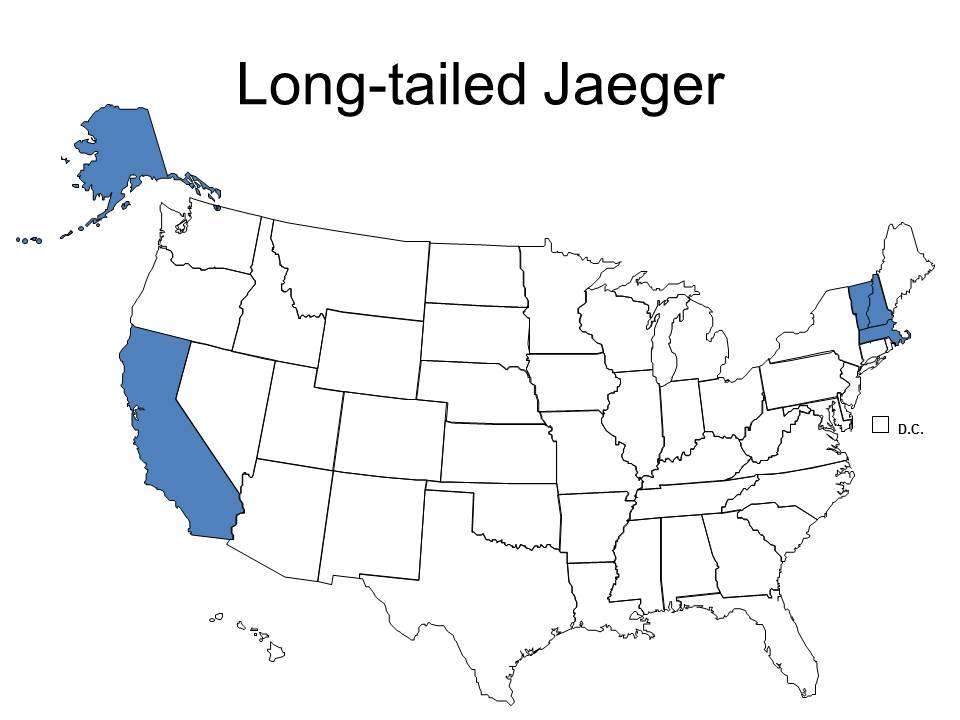
I’ve now seen Long-tailed Jaeger in only 5 states – in AK as a breeder; in CA, NH, and MA on pelagic trips, and now from shore in VT (see my statebird map below).  And although new for my VT list, it replaces my earlier “Jaeger, sp.” sighting, so no net addition on my list.


Then it was off to the boat trip, where I was joined by about 10 other birders all keenly hoping for more pelagic species.  The trip started pretty slowly, with a few migrant flocks of Cormorants and Canada Geese, but no other obvious migrants.  We passed by a few feeding flocks of gulls, in each case hoping to find a Jaeger in their midst, but to no avail.  Although there was a breeze out of the northwest, it must have been too light to usher in our pelagic targets.

A bit later the boat made its way toward the middle of Lake Champlain just a bit east of the VT/NY stateline.  We continued to come by a few feeding flocks of gulls, with some of those gulls coming over to the boat to feed on the chum Allan was throwing.  And then in one of the gull flocks I spotted a gull with large white triangular wing patches – Sabine’s Gull!!!  I soon got the rest of the boat on this immature bird, and we successfully chased it a bit farther west where we got close looks as it fed.  And then the bird became attracted to the chum and came over right next to the boat.  Birders with nice cameras and lenses got amazing photos of the Sabine’s – I got these miserable shots just holding up my cell phone.


We continued to watch the bird as it flew a bit farther west eventually getting into NY waters.  One of the rare times where one single bird has passed over a stateline giving me ticks in two different states - #280 for me in VT and #282 for NY.  I’ve seen Sabine’s Gull only twice before in the in East (in MA and NH), plus once in AK.  And my personal Sabine’s jackpot was seeing flocks of hundreds of birds while on my sole CA pelagic trip years ago.


Later on in the trip I spotted a distant immature Jaeger flying by to the west.  Although we tried to chase after it, we couldn’t refind the bird, which would unfortunately have to stay as another “Jaeger, Sp.” – and likely in NY waters.  Though while trying to refind the Jaeger we did come up with a late Black Tern, which would turn out to be the last bird of interest for the trip. 

Although we didn’t have many pelagics on the trip, the Sabine’s was quite amazing.  And of course the Long-tailed Jaeger from shore was special too.  The other Jaegers will have to wait till another time.

Sunday, June 18, 2017

Little Blue and Tricolored Herons, VT, May 2017


On April 27th there was a most intriguing post on the VT listserve that someone had sighted not one but two Tricolored Herons at Lake Bomoseen.  That is an extremely rare species for VT, with perhaps just 2 prior records in the state.  I was a bit skeptical at first, but follow-up posts confirmed the ID.  I don’t normally chase after birds that far away (these were nearly 3 hours from home) so I only casually monitored the updates.

Then on May 2nd came a post that an adult Little Blue Heron was spotted in Shelburne – not quite as rare as the Tricolored but still very rare in VT.  That spot too was beyond my normal chasing distance (a bit more than a 3 hour one-way drive).  But could I justify one trip to go after both herons?  Several posts that day and the next suggested the Little Blue might be quite reliable.  I rechecked the Tricolored posts and 1, and sometimes 2, were still being seen reasonably reliably.  I looked at the maps, and it would require a lot of driving – 7 hours total.  But that’s less than the driving distance for one trip each for two rarities 2 hours away (8 hours total).  So with that admittedly twisted logic I decided I could justify the long trip to go after these 2 rarities.

The next morning I was out the door early and heading toward Lake Bomoseen in Castleton.  One Tricolored and occasionally 2 birds were being seen at a small park at Crystal Beach.  When I arrived at the park there was another birder there, but no herons were in sight.  He said he saw the target bird a few minutes earlier, and showed me his excellent photos of the bird as it foraged just a few feet away.  Some recent reports had mentioned watching a bird fly a short distance to the north and out of sight.  In doing my research I had noticed that most of the lake had no marshy habitat at all except for the small immediate area at and north of Crystal Beach.  So I bet myself that the bird was at most just a couple hundred yards to the north though certainly out of view from the park.

Now what to do?  Sit tight and wait for one or both birds to return, or try to find it just to the north?  I decided to head north to look for where the bird had gone, and I traded phone numbers with the other birder who stayed at the beach – so we had both areas covered.  But access to the north was very limited behind houses along the lake.  Luckily I found a trail along the lake edge behind the houses and I didn’t feel like I was trespassing too much.  And within just a couple minutes a heron flew right in front of me – it was the Tricolored.  I got this phonescoped photo of the heron as it began to forage in a small cove nearby. 

 
VT was only my second inland state for this typically coastal species (see my statebird map below).

 
A few minutes later I was back in the car and was driving north heading to Shelburne Bay to try for the Little Blue.  This rarity was being seen in a relatively small marsh along the LaPlatte River.  Most sightings appeared to be from a hiking trail called the TiHaul Trail adjacent to the marsh.  That seemed straightforward enough.  But as I walked south down the trail and neared the marsh I met 3 birders coming back who did not find the heron.  They took me down a side-trail with a different view of the marsh but still no luck.  Though we did get spectacular views of this juvenile Great Horned Owl. 


So I decided to head back to the TiHaul Trail to wait to see if the bird would return.  On my way back I noticed two birders quite a distance farther down the trail staring intently into the marsh.  Did they have the target bird?  As I continued down the trail I met those birders coming back – they had indeed spotted the bird, and gave me specific directions to the spot farther south than its normal location.  Within a couple minutes I reached the spot they described, but couldn’t find the bird.  Where did it go?  Did I get the directions wrong?  But then I changed my location a bit allowing me to search a portion of the marsh out of view initially, and there was the Little Blue Heron in the distance. 


And with a bit of hiking off the trail I was able to get this much closer look at the bird. 


That's two really nice rarities in one day in VT.  Good thing I talked myself into making the trip.

VT was my last New England state for both Tricolored and Little Blue Herons, giving me 245 species in all 6 states.  And now my VT statelist stands at 279.

Wednesday, March 22, 2017

Trumpeter Swan and Short-eared Owl (Finally!), Vermont, March 2017


Short-eared Owl has been a nemesis bird for me in VT for years.  Not only because I’ve tried for it twice unsuccessfully over the years – after all there are lots of birds I’ve tried for but missed throughout New England.  But more importantly, it is the most common bird that I still need not only for my VT list, but for any of my 6 New England statelists.  Worst yet, since the bird is regular in northwestern VT in the colder months, it appears in my eBird VT Needs Alerts most every winter day.  Every time one of those Needs Alert e-mails show up in my in-box I cringe – It’s as if the Owls are taunting me. 

So if it’s that common, why haven’t I tried for it more than I already have?  The problem lies in its location – the Short-eared Owl’s regular spot over the last several years has been at Gage Road in Addison, VT.  That’s a 3 ½ hour one-way drive from home – well beyond my normal 2 ½ hour limit to chase after new ticks for New England.  The two times I have tried for the Owl I’ve combined it with searches for other targets in the general area, though that hasn’t exactly gotten me anywhere so far.

And that is what led to my next search for my nemesis Short-eared Owl in March 2017.  It all started when I began to see posts about a Trumpeter Swan being seen in Brandon, VT.  My first thought was to not pay any attention to it.  Not because I doubted the ID, but instead because it was about 3 hours away.  Plus the bird was undoubtedly from the introduced Ontario population that many states haven’t yet recognized as countable birds.  But then additional posts mentioned the bird was not banded, and it was the second VT state record.  That meant that VT had already accepted a previous record again likely from the introduced population.  With that issue behind me, I quickly thought about combining an attempt for the Swan with another try for the Short-ear.  A search on eBird showed no reports of the Short-ears in about 2 weeks, but I wasn’t too worried about whether they were still around.  So although it would be a lot of driving, I guess I could justify a trek to northwestern VT given there were 2 targets for the trip. 

Then again just a month earlier I made a similar trip to the central coast of Maine – 2 targets each were farther away than my typical chase distance.  But together I justified an overnight trip to give them a try.  But I missed them both!  Hopefully the results of my VT trip would be better.

My plan was to leave home late morning, try for the Swan early to mid-afternoon, then make my way north to Addison later in the day for an attempt at the Owls at dusk.  The only potential complication was the weather.  A strong arctic cold front was to arrive overnight, but that would be well after I would leave Addison.  So the temperature wasn’t the problem.  Instead the issue was that there could be snow squalls in the area in advance of the front, though the forecasts that morning reduced the chance of any snow to just 40%.  But I figured as long as I kept an eye on the weather maps I’d be OK.  Besides, if I delayed my trip to the next day it would brutally cold and windy after the front passed through, making a search for the Owls really difficult.  So my plans were set.

I left my house on time, and arrived in Brandon about 2 PM.  The Swan was being seen in a flooded field south of a railroad overpass along Route 73 just west of “downtown” Brandon.  With those pretty specific directions I was confident I would quickly find the right location.  But as I crested the railroad tracks all I could see to the south was trees.  Where was the flooded field?  I continued to slowly drive to the west down the overpass and only then looking back could I see a wetlands with open water.  I parked on the west side of the overpass, and planned to walk back to the east to get a closer view.  As I was getting the scope out of the car I looked back toward the wetlands and could see a large white “lump” in the water.  I put it in my binocs and it was indeed a sleeping Swan.  Undoubtedly it was my target bird, but I wanted to get a better view. 

I walked back to the east up the overpass and set up my scope.  But the Swan was still sleeping – giving these not-so-photogenic views. 


Luckily I had quite a bit of time to wait for the bird to wake up.  After a few minutes the bird briefly picked up its head, and I was lucky to snap this phonescoped picture confirming the ID as the second VT state record of Trumpeter Swan.


VT is my 17th state for this species, many of which are associated with reintroduction efforts across the country (see my statebird map below).


It was only 2:30, and sunset wasn’t until 5:53.  I was only about an hour’s drive from the Owl location, and it was sunny and nearly 40 degrees.  So everything was looking good.  But as I started my drive north I could see dark clouds up ahead, and the wind started picking up.  A few minutes later it started to snow, and then I hit a snow squall complete with limited visibility in heavy snow, which was blowing horizontally and was now sticking to the roads.  (What happened to that 40% chance of snow forecast?)  But squalls are typically short-lived, and soon I was north of the narrow but strong snow band, and again I wasn’t too worried about the weather.

It was snowing lightly when I reached the western end of Gage Road, and I began to reacquaint myself with the area.  Gage Road dead-ends in a set of farmers’ fields, some planted in pasture grass and some in corn, with just an occasional hedgerow, and an old barn complex a short distance to the north.  With the exception of a few shallow ditches, the area is very flat, allowing for a nearly unobstructed 360 degree view of 200 acres of potential Short-eared Owl feeding area.  And past reports have mentioned the Owls throughout the area.  So as sunlight waned you would need to scan the entire area for foraging Owls.

But sunset was still nearly 2 hours away.  Rather than going to bird somewhere else nearby, I instead decided to stay at the Gage Road fields to see if I could find an Owl before dusk.  Short-ears will spend the daylight hours roosting on the ground, especially in protected areas such as ditches.  So I decided to walk along some of the shallow ditches in the area in hopes of finding one at its roosting location.  It seemed like the best location might be a dry stream bed just southeast of the barn toward the north.  But that area was posted, and I didn’t want to push my luck.  In fact most all the fields in the area were posted.  That meant I was limited to just walking right along Gage Road.  About 30minutes later I had walked the shallow ditches adjacent to the entire length of the road, but with no luck.  Though on my walk I did have 3 Rough-legged Hawks (including 1 dark phase), 2 Red-tails, and a Harrier. 

The Harrier is important because they fill almost the exact same ecological niche as Short-ears, only of course at a different time of day.  Plus both species will roost in the same locations.  So a field over which a Harrier is flying at dusk could well be the same one from which a Short-ear will emerge a few minutes later.

Another tidbit on finding Short-eared Owls is that with overcast skies Short-ears will come out earlier than normal.  So with the cloudy skies I decided to sit in my car and start scanning the fields, even though it was still 90 minutes before sunset.  It continued to snow at various rates the entire time, only occasionally heavy enough to reduce visibility, so the weather wasn’t likely to create any issues for me.  Despite dozens of 360 degree scans I couldn’t find an Owl.  As it was getting close to sunset I noticed a Harrier in the distance just north of the barn.  I quickly drove up there to get a closer look but the Harrier was gone.  Had it sat down for the night?  And if it did, was there going to be a Short-ear appearing in the same area?  I was thinking of relocating to the barn area for my sunset search, but the barn buildings would block about a third of the fields I had hoped to scan, so I went back to my original spot.

It was now 15 minutes before sunset so time to scan in earnest.  No more of that wimpy scanning from the warmth of my car.  The wind had died down a bit (10-15 mph from the northwest), the temp was in the upper 20s, and it was only flurrying.  So all things considered, not too bad for early March.  But scan after scan yielded no birds at all, except for a pair of Ravens passing by.  When I reached sunset I started to worry a bit.  Then it was 10 minutes after sunset and I worried some more.  Was this going to be yet another negative search for my nemesis bird in VT?

Then at 15 minutes past sunset on a scan to the north I noticed some movement low over the ground immediately east of the barn.  A few seconds later I got a second look at the floppy moth-like flight of a Short-eared Owl!  I continued to watch it fly around the dry stream bed near the barn that had caught my attention earlier.  And this was next to the field where the Harrier had likely roosted for the night.  My initial thoughts to find this bird were confirmed.  I watched the bird forage low over the field east of the barn, and then followed it as it moved north and east farther away.  After about 5 minutes I lost the bird in the distance – now a third of a mile to the north in the waning light.  I had finally gotten my VT (and New England) nemesis bird!

The Trumpeter Swan and Short-eared Owl were #276 and #277 for my VT statelist.  Plus the Owl was the 243rd species I’ve seen in each of the 6 New England states.  My statebird map for the Owl is quite spotty – I still need this species in many states within its range.  Though in FL I have seen the Caribbean race of Short-eared Owl – maybe it will be split into a separate species someday.


As a postscript –  Although the snow didn’t cause any problems for me in finding the Owl, I changed my route home to a somewhat longer one on I-89 rather than taking the back roads likely to be snowy or icy.  But it turns out even the interstate was quite treacherous, with 2 large accidents that closed the highway along my route back.  What could have been a 3 ½ hour drive home turned out to be 5 hours instead.  It would have been even worse sitting in those backups if I hadn’t seen both of my targets.

Unfortunately I have a lot of experience on long drives home after not seeing my target(s).  Earlier I mentioned a recent trip to ME where I justified a trip beyond my normal 2 ½ hour chasing distance because, just like this VT trip, there were 2 targets to chase.  However, unlike this trip, I came up empty in my search for both of my ME targets (Bullock’s Oriole and Mew Gull).  For whatever reason, my success rate for the longer distance chases in ME is miserable – only 43%.  By comparison, chases in VT over those similar distances have a success rate of 72%.  Another point of comparison is that my hit rate for all of New England over the last 2 years has been 68%.  What’s with those distant ME birds?

Saturday, September 24, 2016

Six Quebec Province Birds, but a Frustrating Experience with a Possible Lifebird, September, 2016


Two of the last three years there have been organized “pelagic” boat trips on Lake Champlain with key targets including Jaegers, Kittiwake, Sabine’s Gull, and the like.  I need all those birds for my VT (and NY) state lists so I’ve signed up for each trip when it has been scheduled.  This year a trip was scheduled for mid-September, the typical peak time for many of these species on Lake Champlain.  Within an hour I had registered and sent in my check. 

Since I don’t get to northwest VT very often, I planned to use the boat trip as an excuse to do some additional birding in the area.  As the trip neared I watched eBird and the listserve for potential targets, and salivated over a report of a Buff-breasted Sandpiper about a week before the trip.  The bird was found at the mouth of Dead Creek in Highgate in the far northwestern tip of VT, but was only reported one day.  Then again there were no subsequent negative reports, so I tried to be optimistic that a stop there a week later could be fruitful.  Plus an Orange-crowned Warbler was reported at Whitney Creek – one of the best spots in all of VT for that species and also for Connecticut Warbler.  So although the Orange-crown would certainly be long gone by the time I got there, maybe it could be replaced by another one.

With no other targets reported in VT, and the Buffie spot being in far northern VT just 3 miles from the Canadian border, I decided to check Quebec reports to see if there might be some targets there as well.  I was pretty happy with my existing Quebec list of 190.  So much so that when leaving Quebec after my last birding trip there I thought that my Quebec birding days were behind me.  But I’m glad I set up an eBird Quebec Needs Alert prior to this trip, because there were numerous shorebirds I needed that were reported from Baie Missisquoi just a short distance north of the US border, and less than 6 miles from Highgate as the sandpiper flies.  Apparently the region-wide drought had caused the lake level to drop enough to cause mudflats to form at the north end of the bay, attracting a diverse group shorebirds.  In the last couple days before my trip birders had spotted 10 species I needed for my list - 8 species of shorebirds, Caspian Tern, and Peregrine Falcon.  Plus there were a couple other targets like Solitary Sandpiper and Golden Plover reported recently a short distance to the north.  More than enough targets to justify yet another trip across the border into Quebec.

But just as I was getting excited about some Quebec province birding and a couple possible long shots in VT, I got an e-mail saying the boat trip was cancelled.  Although I was tempted to cancel my trip as well, I decided to keep the rest of my plans, and replace the boat trip with a lake watch from shore.  So my itinerary would begin with a stop at Highgate around midday of Day 1, followed by an afternoon in Quebec.  I would start Day 2 at dawn doing a lake watch from Charlotte Town Beach, and then make a stop at Whitney Creek to try for Orange-crowns and Connecticuts on the way home.

Day 1

Although I left the house a bit before 8 I didn’t make it to Highgate until close to noon.  Scoping the mudflats from Shipyard Road is quite a challenge as the flats are a ¼ to ½ mile away, complicated that day by quite a bit of heat shimmer.  I scanned the habitat for nearly an hour hoping against hope to find the Buff-breasted, but to no avail.  Though I did have some other pretty good shorebirds there– 4 Black-bellied Plovers, a Sanderling, and 2 Short-billed Dowitchers. 

I left at 1, and within 15 minutes I had passed through the border crossing and had made my way to Baie Missisquoi.  I wasn’t quite sure where to go to bird there, but soon realized I needed to make my way into a “campground” consisting of a number of mobile homes.  I checked in with the host of the park who spoke just barely enough English to explain where to park.  After a short walk I was at the edge of the extensive mudflats, only to see several people kiteboarding (flying kites connected to surfboards) right at the edge of the flats.  I did a quick look around and didn’t see any shorebirds at all.  Had the kiteboarders scared off all the shorebirds?  I then noticed a couple birders a short distance away and asked them for updates.  They said the numbers of birds had been way down from yesterday, though earlier there were at least a few around, including both Dowitchers, Stilt Sandpipers, and Red-necked Phalaropes.  But a Peregrine had come through and flushed all the birds away.  My heart sank – although the shorebirds had been great there for more than a week, they must have known I was coming and had moved on just in time for my trip.

I then looked over to the east and saw 3 other birders with scopes walking toward us.  And with a quick binoc scan in that direction I noticed a distant group of Yellowlegs feeding in the shallow water.  So I started walking in that direction with the first 2 birders I talked with.  As we were heading in that direction a flock of about 30 shorebirds flew by looking for a place to land.  Even without binocs I picked out several Sanderlings in the flock (Quebec bird #1) as they wheeled past.  They landed right in front of us, and the small flock included 11 Sanderlings, and 6 White-rumped Sandpipers (#2) – both numbers were higher than reported in previous days.  Then I noticed a lone Red-necked Phalarope spinning in the shallows right next to them (#3).  Small numbers, but great to pick up 3 new birds nonetheless.

We then continued to walk toward the Yellowlegs flock to the east, and ran into another small flock of shorebirds which included 2 more Sanderlings, 8 more White-rumps, and another Red-necked Phalarope, along with our first Pectoral.  Then up ahead we spotted a flock of peeps on the rocky shoreline farther to the east.  Just as we were starting to look through that flock a Peregrine flew by low over the water (#4), flushing shorebirds from all around us.  A number of small peeps flew right past us, including one larger one that turned out to be a Baird’s Sandpiper (#5).  Baird’s was also new for my Canada list - #357.  Although I was initially unhappy to have the Peregrine flush the shorebirds, it was new for my list, plus it flushed another new species that we hadn’t spotted yet.  So not a bad thing afterall.

We looked back to the rocky shoreline where the peep flock had been and all those birds had hunkered down instead of flying when the Peregrine passed by.  Slowly they started to perk up and walk around again, and we counted 40 Leasts and Semi Sands, along with a Pectoral.  At that point, with all those small peeps around, I wondered why no one had reported a Western Sandpiper yet from this location.  And just then I spotted a small peep in the rocks with a drooping bill.  Only the head was visible (the rest of the bird was hidden by a rock) so I didn’t want to jump to any conclusions yet.  With a few more steps I got a different angle on the bird, seeing dark legs, and rusty scapulars on an otherwise brownish mantle – a Western Sandpiper (#6).  After I got the other birders on this bird, we all continued to walk toward the east and amazingly all these peeps, including the Western, walked within 10 feet of us.

Finally we were nearing the Yellowlegs flock and I set up my scope to scan through the birds.  One of the first birds I looked at had a much longer bill with a bit of a droop at the end.  With a bit of study the bird turned out to be the Long-billed Dowitcher reported earlier.  And the flock included 3 Stilt Sandpipers as well.  Though the Dowitcher and Stilts were rarities for Quebec, I had seen both of them a couple years earlier at Sainte-Martine, Quebec.  (I would have been happier if the Dowitcher had been the much more common Short-billed which I still need for my Quebec list.) 

As we returned to the cars I kept my eyes open for a Caspian Tern that might pass by.  And I kept watching for more little groups of shorebirds.  But I struck out on both.  Although both the total number of shorebirds, and number of species, were way down from reports earlier in the week, and even just the previous day, I was still happy to have seen 13 shorebird species at this location, including several rarities.  And of course it was great to add 6 new birds to my Quebec list – which is now at 196.

I spent the next couple hours making stops at other parts of the bay, and a couple places to the north, and only added Killdeer as my 14th shorebird species that day in Quebec.  And including the Black-bellied Plovers and Short-billed Dowitchers I had earlier in VT (wish I could have seen them in Quebec - I need both of them for my Quebec list!) that gave me 16 shorebirds for the day.  Very nice totals for these inland locations.

Day 2

I started the day at first light at Charlotte Town Beach, the recommended location from which to do a lake watch in VT.  Winds had been light out of the northwest the night before, but were dead calm now.  Not the best conditions to see pelagic birds in VT, since your best chances of seeing them are when there is a stiff breeze from the north or northwest.  But at least there weren’t winds from the south.  As the sun rose I got these spectacular views of the morning clouds and the NY mountains in the background.


If only the birds were as spectacular.  I spent about 2 hours at the lake, and only spotted a few migrant flocks of Cormorants, a flock of Mallards, and 2 single Caspian Terns passing by.  (Where were those Caspians when I needed them in Quebec?)  Chances are even if the boat had gone out that morning we probably wouldn’t have seen much more.  Will I ever be able to time one of my fall trips to Lake Champlain to coincide with a good day of migration?  So with the lakewatch being so slow, I called it quits early at about 8 AM to head to Whitney Creek.  It was still early enough in the morning that maybe I could run into a few migrants there, not to mention my key targets - Orange-crowned and Connecticut Warblers. 

When I arrived at Whitney Creek another birder was just coming out of the trail.  I asked him how he did – he said it was a bit slow, but 15 minutes earlier he had had a brief glimpse of an Orange-crowned Warbler.  I spent the next 2 hours scouring the area with no luck.  If only I had left Charlotte a few minutes earlier.  Ugh…

But there was an even bigger disappointment to come…  That evening after getting back home I opened my most recent Quebec Needs Alert and saw that there were numerous reports of a Common Ringed Plover that day.  I figured they must have come from far northern Quebec, until I opened one of the reports and found that the bird was at Baie Missisquoi.  Not only had I birded this same spot the previous day, but the Plover had spent the entire day there no more than an hour’s drive north of where I birded most unsuccessfully that day in VT.  It would have been a life bird!  Then I started to wonder if the Ringed Plover was present the day I was there, but just overlooked.  But since most all of the birds I saw were not found there the next day when the Plover was spotted, I imagine the bird was just a 1-day wonder. 

So although I’m happy to have added 6 birds to my Quebec province list, with a slightly different “alignment of the stars” I not only could have added a bird to my VT list but a life bird as well.