This is the second of 3 posts summarizing my trip to Newfoundland. Days 5 through 8 are described in this post. Days 1 through 4 are detailed in the previous post and Days 9 through 11 are in the next post.
Day 5 - June 25 – Codroy Valley – Periods of heavy rain and wind, highs in the 50s
The forecasted heavy rain was supposed to hold off until mid-morning giving me just enough time to do some landbirding. The first stop was at Broom Point Rd. which is well known for southern warblers. A 2-hour walk resulted in 10 warbler species, including one singing Blackburnian. But I couldn’t turn any of the 6 high-pitched Black-and-whites into a Bay-breasted. Other notable birds were 2 different Olive-sided Flycatchers, 2 Blue-headed Vireos, and 8 Swainson’s Thrushes, along with a nice 9 Black-throated Green Warblers. A flyover pair of Common Mergansers was a surprise.
I could see rain in the distance to the south, but I hoped I could squeeze in a stop at O’Regans a bit farther east before the rain started. I parked the car and walked east along the road initially not finding too much. A flyover Great Blue Heron was a nice addition for this specialty of southwestern Newfoundland. Up ahead I could see a small cow pasture which seemed out of place compared to the wooded habitat in the area. When I first got to this area I could hear a buzzy rising song in the distance that sounded like Black-throated Blue - but it was distant and I needed to get closer to the bird to verify the ID of this potential rarity. As I got closer I could hear what sounded like a BT Blue south of the road. Then it stopped singing. A few seconds later I heard a Parula singing about 100 m farther to the east, so I thought that perhaps the Parula was just earlier singing a song that sounded like BT Blue. But then the BT Blue sang again – there were indeed 2 different birds, both a rare Parula and an even rarer Black-throated Blue. I continued to hear both sing, south of the road. Then I spotted a small bird flying across the road to the north and I was lucky enough to get it in my binocs – it was the BT Blue. Within a few seconds a second BT Blue was also singing on the north side of the road. A minute or two later the Parula flew over the road and I watched it join the BT Blues on the north side of the road as well. I ended up with visuals and song of the Parula, visual and song of one BT Blue, and song only of the 2nd BT Blue. An amazing spot for these rarities! Unfortunately despite more than 15 minutes of waiting while I could hear all 3 birds singing back in the woods, I wasn’t able to get additional views of these rarities. As I walked back to the car I had a Goshawk in the distance – a nice ending for this stop.
I was now back in the car and driving along with my windows open listening for birds as I drove. I heard a group of Robins squawking in the distance, as if they had found a predator – maybe an owl. I made my way to the noise and found a small flock of Robins, along with several other birds, all complaining about something in the trees. I got very close to the spot, flushing a Ruffed Grouse along the way, but couldn’t spot what the birds were yelling about. Then there was a quick burst of movement, with the briefest view of a small bird flying off, with the entire flock chasing after it. Maybe a Boreal or a Saw-whet Owl? One that got away.
The next stop was the Wetlands Trail and Interpretation Center. Just as it started to rain I spotted the long-staying Shoveler behind the Interpretation Center. With umbrella in hand I had another Great Blue, 3 more Red-winged Blackbirds, and another Goshawk on the trail. All things considered not too bad given the wet conditions.
The rain was really coming down, so it was time to switch to birding from the car. My first stop was the Codroy Valley Cottage Country where a hummingbird was spotted at their feeder the previous day. I sat in the car watching the feeder for about 45 minutes with no luck. So next I was off to Codroy Valley Provincial Park, to look for any waterfowl and shorebirds that might be around. In the wind-blown rain I could see a distant flock of a remarkable 80 Red-breasted Mergansers either standing on a sand bar, or swimming in the shallows nearby. And mixed in was my first Greater Scaup of the trip. I wanted to spend more time looking through the flock for other species but I was looking directly into the rain, so I had to cut it short. I also wanted to check out the inner beach area especially to see if I could find the pair of Piping Plovers that were likely breeding there. But again I was looking into the wind-blown rain so luckily I spotted the Plovers quickly, and could close the car window right away.
It was still just early afternoon, and I had hoped to do more birding in the area. But the strong wind and rain continued. Time for a seawatch! I headed a short distance to the north to the lighthouse at Cape Anguille to see what might be passing by. Luckily I could position the car to allow me to look out over water and stay reasonably dry, and visibility was pretty good. Within a few minutes I had a Sooty Shearwater fly north, followed by another Sooty. Soon thereafter it was followed by a Great Shearwater – although it was distant I could see if was generally dark gray above, with darker tail and head, and pale below. Then a minute later another shearwater passed by which was uniformly brown above, and pale below. It was too far away to tell bill color. If I were back home on the New England coast I would have just nonchalantly concluded this was a Cory’s Shearwater. But that would be quite a rarity for Newfoundland, so given the distance and lack of photo, I ended up entering it as a “Shearwater, sp.” in eBird. I stayed for about another hour and only had a few Gannets pass by, with a few Eiders and Guillemots feeding near-shore. So given the general lack of birds, I decided I should move on.
But where to go next, especially given the weather conditions? I checked my weather app and saw that the rain wasn’t as heavy to the north. And tomorrow’s forecast was for a cold heavy rain, or maybe even snow. My planned stops the next morning were in Stephenville Crossing, about a 90-minute ride to the north. So maybe I should try to hit some of those stops yet this afternoon to avoid the heavier precipitation tomorrow.
But first I would make one more quick stop at Codroy Valley PP to see if I could get any better (and drier!) views of the inner and outer beaches. I crossed the bridge and successfully positioned my car to look downwind to the outer beach where a small flock of gulls were roosting in the distance. A quick scan revealed just the normal species. Then I looked beyond the gull flock and spotted a single tern standing on the beach. It had a black bill! Couldn’t be – that would mean it would be quite a rarity. I looked closer and sure enough its bill was black, along with a full black cap making it an adult in alternate plumage. The most likely black-billed tern would be Roseate, but my bird wasn’t pale enough, and the tail would need to be a lot longer. Then I realized it also had black legs. As I continued to look at it through the scope I just kept saying “Wow”, because I knew that a tern in breeding plumage with black legs and black bill would have to be really rare. It was too pale mantled for Bridled or Sooty, making it either a Sandwich or Gull-billed. Then as the bird turned its head I thought I saw a yellow tip to the bill, and the bill was relatively thin and long. Eventually several more views showed the yellow tip to the black bill – it was a Sandwich Tern! I took many phonescoped photos of limited quality given the distance and heavy rain, but the best photos show enough details to confirm the ID. In a word – Wow! Here are a couple of the “best” phonescoped photos taken through the wind and rain.


And to get an idea of the distance to the bird, here is a shot of the distant sand bar without any magnification.


Next I was off to Stephenville Crossing where the key targets were Willet and Black-headed Gull – was this indeed the only nesting location for Black-headed in North America? As I went further north the rain did indeed slow to a drizzle as expected, though a heavy drizzle, so it looked like I made the correct decision to leave the heavy rain in the Codroy Valley. As I neared the estuary the first of 3 Osprey flew overhead, so I could finally check that one off. But the pond to the south of the Gut was devoid of birds. I then headed east on Mattis Point Road to give me a different angle on the estuary to avoid looking into the wind and rain. I found one Greater Yellowlegs, and a few distant Herring and Great Black-backed Gulls, but little else. I next thought about birding from the old railroad bridge, but that would mean looking into the east over the estuary right into the wind and rain.
What to do? I headed north across the bridge (the new one that is), and was able to find an old paved road that was east of the present road. I found a couple spots where the road abutted the wetlands, and luckily ran into 3 different Willets foraging in the grasses. Are these regular summering birds breeding here? But still no Black-headed Gulls – I had now scanned most of the estuary and the exposed flats and had come up empty. I thought they would be reasonably common here. I remembered an eBird hotspot in the northwest portion of the estuary which was north of the areas I had searched. After a quick drive I was at this spot, and looked to the south and was able to pick out two adult Black-headed Gulls in with a number of Ring-bills walking on the flats.
That was a nice way to end the day, with 71 species for the day and now 117 species on my Newfoundland list. Plus many of my birds were eBird rarities – 22 of the 36 sightings on the daily eBird Rarity report were my sightings! And after 17,800 steps and 7.9 miles, I had walked 38.8 miles in my first 4 days of birding in the province.



What a great
stop, and glad that I was able to add it to my itinerary.
Day 6 - June
26 – Wind, heavy rain and snow (!),
highs in the 30’s
Although I
started the day in Stephenville near the southwestern corner of Newfoundland, I
had to make my way toward Fortune in south-central Newfoundland from which my
ferry to St. Pierre would depart the next morning. My hotel that night was in Marystown –a long
8-hour drive from Stephenville. It was
pouring down rain in Stephenville, and the forecast was for more of the same
all day long, so I guess this would be a good day to drive rather than
bird. But I did make a couple quick
stops in Stephenville Crossing first – finding a nice flock of 35 Scaup sp.
(likely Greaters) in the distance from Mattis Point, and another Black-headed Gull
in the northwestern estuary.
As I started
my drive north I noticed the rain was mixed with snow, and then it turned to
all snow. The temperature on the car
thermometer kept dropping, until it actually reached 0 degrees C. The grass and trees were covered in a layer
of snow, and the road was slushy in places.
Ugh.

I was
thinking of making another quick stop at the Deer Lake sewage impoundments
which were right along the way, but not in the rain and snow. But amazingly, the precipitation stopped as I
got into Deer Lake, so I made a quick stop at the impoundments, adding 3
Green-winged Teal (3 males) to my province list. Interesting that I made 3 stops over 4 days
at these impoundments and the mix of waterfowl was different each time.
The next
potential stop was in Glovertown at the Ken Diamond Memorial Park to try for
Palm Warblers – 4 had been reported there a couple weeks earlier. Again the birding gods were looking kindly on
me since it was just drizzling heavily when I reached the area, so I decided to
make a quick stop. When I got out of the
car to get my rain suit on I quickly noticed a bigger problem – the wind was
howling! I spent about an hour walking
the trails in the park through nice boggy habitat that would be great for Palm
Warblers, but undoubtedly due to the strong winds and heavy drizzle I was only
able to find several sparrows and a couple Yellowthroats. I had driven right by this area on the 22nd
when the weather was much better – if I had stopped that day I would have
likely found the Palms.
The long
drive and miserable weather meant I only walked 7,700 steps and 3.3 miles that
day, and added just 2 species to my province list – now at 119.
While eating
dinner that night I received an e-mail saying my ferry to St. Pierre the next
morning had been canceled due to the bad weather. If I had known that earlier I wouldn’t have
made the long drive down the peninsula. Although
I guess I could take the 7:30 PM ferry that same day (though that was not
mentioned as an option in the e-mail), the weather forecast for the day I was
to return was just as bad. Would that
ferry end up being canceled as well? Who
knows when I would be able to get back to Newfoundland. After quite a bit of deliberations I decided
to cancel my trip to St. Pierre altogether, and take advantage of the 2 extra
days of time in Newfoundland to make stops at a couple areas not on my original
itinerary – Terra Nova National Park, and the Cape St. Mary’s seabird colony. Plus the extra time could make for some more
leisurely birding.
Day 7 - June
27 – AM – cloudy and windy. PM - Sunny, highs in the 60s
With my
ferry canceled, and a bit more time on my hands, I slept in a bit and even ate
breakfast. At 9 AM just as I was leaving
my hotel to begin my birding day I got an e-mail that the 9 AM ferry was back
on, but delayed to 11 AM. But I had
already moved on mentally, and made hotel reservations for the extra nights in
Newfoundland. For better or worse, St.
Pierre was in my rear-view mirror.
Since I was
already far south down the peninsula, Alvan suggested I make a couple stops
nearby. My first stop was at Frenchman’s
Cove. I hoped the rough weather might
result in some wind-blown coastal birds but a short seawatch did not yield
any. Though in a quick woodland stop I
found a most cooperative pair of Pine Grosbeaks (aren’t male PIGR’s amazing?),
and several Boreal Chickadees. Then I
headed to L’Anse au Loup T and found a nice collection of 3 Least Sandpipers
and 10 Greater Yellowlegs feeding in seaweed-covered rocks. Two more Caspian Terns were nice here as
well.
Next I was
off to Terra Nova NP, with my first stop being Sandy Pond where a recent post
included 2 Palm Warblers – a second chance to try for this species now that I
wasn’t going to St. Pierre. I arrived in
the late afternoon hopeful that bird song will have picked up for the day. There was a really nice trail around the
large beaver pond, with a portion in spruce bog habitat that looked ideal for
Palms. The first part was through
woodlands which were unfortunately pretty quiet. When I got to the bog song picked up quite a
bit with Swamp, Savannah, and Lincoln’s Sparrows and Yellowthroats
dominating. But no Palms yet. I got to another portion of the bog and heard
some sharp chipping, and with a bit of spishing attracted a Palm Warbler
carrying a dragonfly. As I continued
around the trail an Olive-sided Flycatcher called in the distance, as did a
Gray Jay. A very nice walk.
The last 2
remaining realistic possibilities for new boreal species for my province list
were Black-backed Woodpecker and White-winged Crossbill. Both were possible in Terra Nova, though
without specific locations for either species my strategy was to just spend as
much time as possible in appropriate habitat and cross my fingers. To that end, after dinner I tried to do a
walk on the Louil Hills trail, but mosquitoes were intense. The best I could do was to find a cooperative
pair of Pine Grosbeaks.
My day ended
with 2 new species for my province list (now at 121), and a reasonable 13,900
steps and 5.8 miles walked.
Day 8 - June
28 – Partly cloudy, highs in the 60s
My initial
plan was to take a dawn hike on a woodland trail, but at the last minute I
shifted my attention to an area to the north called Anchor Brook where two
recent eBird posts included all 3 Scoter species and a number of alcids. With the extra time I decided to give this
spot a try in the early morning. The
first thing I did when I arrived was to do a quick scan of the coast with my
binoculars but didn’t find any Scoters.
Photos on at least 1 eBird post showed that the Scoter flocks were quite
close, so I was a bit worried. But then
with a scope scan I picked out a very distant tight flock of all dark ducks –
now the challenge was to ID them at this distance. I was really struggling with IDs until a
portion of the group took off and flew to the west out of sight showing white
wing patches. And then a bit later a
small flock of Scoters flew into the flock – these had no white wing patches and
a few had white hind-necks indicating that at least some of these were Surf
Scoters. Later another small group took
off which also had no white in the wings but I couldn’t see any head
colorations. After about 45 minutes of
trying to ID this distant flock I decided I had 45 White-wings, 11 Surf, 5
Surf/Blacks, and 20 Scoter, sp. That was
a bit frustrating since others recently had Black Scoters in the area, and some
I couldn’t ID might well have been Blacks.
Now I turned
my attention to scanning the ocean in general and soon began to pick out
fly-bys of large alcids, but the vast majority (an estimate of 30) were just
too far to ID. One group of 4 were close
enough that I could ID as Common Murres, and there was 1 Razorbill quite close
on the water. So again a bit frustrating
since I still needed Thick-billed Murre for my province list.
But perhaps
the best sighting for this location was of a large iceberg in the
distance. It’s visible (but just barely)
on the horizon in this picture.

After a
short drive I was back at Terra Nova and took a 2-hour hike on the Newman
Campground Trail. Unfortunately no luck
with my boreal Woodpecker and Crossbill targets, but had some nice birds like
yet another “rare” Olive-sided Flycatcher, a Goshawk, and a family of 4 Gray
Jays. The most common species was
White-throated Sparrow (10), and the most common warbler was Black-and-white
(6).
I really
enjoyed my hikes in these boreal habitats, but it was time to shift gears and
head to the coast of the Avalon Peninsula to look for seabirds. My next stop would be Cape St. Mary’s and the
seabird nesting colony there with large numbers of Gannets, Kittiwakes,
Thick-billed and Common Murres, and Razorbills.
This spot was not on my original itinerary since it is a bit far to get
to, and each species would be feasible elsewhere, but with my extra time I
would be able to spend much of the afternoon there. My targets here were Horned Lark and American
Pipit nesting in the grasses/tundra in the area, Thick-billed Murres, and Great
Cormorants all reported in recent eBird reports. The first bird I saw when I got out of the
car when I arrived was a Horned Lark – a nice start. I went inside the visitor center and spoke to
a very helpful naturalist inside who gave me great tips to find all of my
remaining targets.
I started my
short walk to the nesting colony and had at least 5 more Horned Larks along the
trail. Then I heard the two-note “pip –
it” call of a Pipit as it rose up a grass-covered portion of the cliff, just as
the park naturalist described. Next target
was to look for the mixed flock of roosting Cormorants, and found “the” rock
they like to roost on, again just as the naturalist said. The only challenge I had was to get a view of
the rock down by the water line without getting too close to the edge of the
cliff. Eventually I safely got this
distant photo showing 2 Greats with several Double-cresteds.

The next
target was Thick-billed Murre.
Interestingly each species had specific portions of the cliffs where
they preferred to nest, and the naturalist showed me the preferred location for
the Thick-bills. And sure enough that’s
where they were, as shown in this picture.

I quickly
had all my targets, so now I could just enjoy my time watching the birds in the
nesting colony. I took a number of
phonescoped photos of various portions of the colonies, including these shots
of the Gannets.


Then there
were close Common Murres, including this “Bridled” Common Murre.

And there
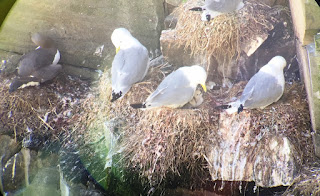
were nearby Kittiwakes including this one with a chick.

And this
lone Razorbill in an area that was dominated by Common Murres.

On my way
back I stopped in the visitor center to thank the naturalist. While I was there I asked about Short-eared
Owl and Willow Ptarmigan. The naturalist
suggested a couple key areas for each one, with the Short-eared most likely at
dusk and the Ptarmigan most likely to be calling pre-dawn. Ordinarily it would have been impossible to
be there both at dusk and the next dawn, but my hotel was just 5 minutes from
the park. So after dinner I was back to
try for the Owls after sunset, but without success.
I ended Thursday with 128 species in Newfoundland and 13,800 steps/5.8 miles walked.


