Monday, November 12, 2012

Post Sandy Birding #3 – White Pelican in CT, November 2012

One of the more unexpected fallouts of Hurricane Sandy were a significant number of White Pelicans reported in New England – one in ME, 3 in NH, 2 in MA, and several sightings of at least 1 in CT.  I’ve only had White Pelican in MA, so all those other sightings are pretty exciting.  But most are of flybys or are otherwise not readily chaseable.  But one seemed to be quite reliable at Rocky Neck State Park in CT.  So I called my NH birding buddy Denny Abbott early in the morning and told him of the pelican sighting - he needed it for CT too.  So we hatched a plan that if the bird was seen again that morning we would make the trek south.  And sure enough the bird was reported early in the morning on the listserve, so within a few minutes Denny, Davis Finch, and I were heading south. 

With excellent directions from some local birders we went right to the correct spot in the park and instantly saw the bird.  It was sleeping in the marsh, apparently in the same spot it had been for a couple days.  Was it sick or injured due to the storm?  I’ve inserted below a couple less than exciting phone-scoped photos. 


I’ve seen White Pelican in most central and western states where it’s pretty easy to find (but what’s up with OR?), and I’ve seen it in a number of eastern states where it’s a regular wanderer. 

Post-Sandy Birding #2 – Western Kingbird, Yellow-throated Warbler, Cave Swallows – Rhode Island, November 2012

This is the second year in a row when a close brush by a hurricane has brought some good birds to New England.  Most of the best birds were seen along the CT and RI coastlines and the MA islands, including a Magnificent Frigatebird seen on the coast at the RI/MA stateline for 2 consecutive days.  That would be a key target for most New England birders – including my NH friends Denny Abbott and Davis Finch.  A Brown Pelican had also been seen there.  So we planned to meet at a park-and-ride pre-dawn and get to the RI coast by first light.

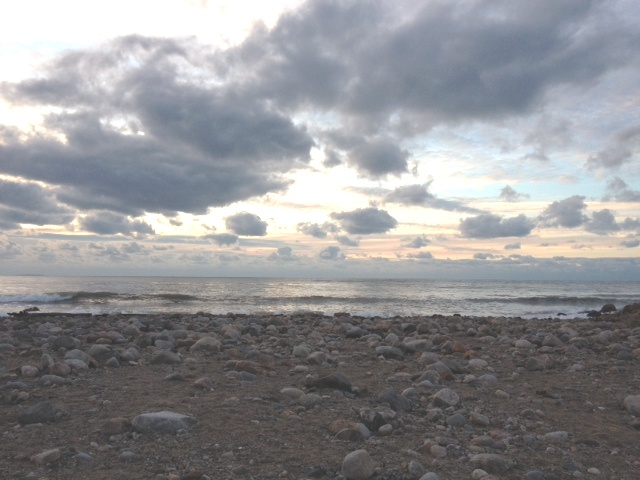
We arrived a bit before 7 AM to a spectacular sunrise, and started our vigil to await the Frigatebird.  Note all the rocks in the foreground which were pushed ashore by the hurricane. 


After a couple hours with no Frigatebird we took a walk to the east to Quicksand Pond, a large freshwater lake just barely west of the MA/RI stateline.  Soon after we arrived I picked out 1 and then 3 more distant swallows which I was able to identify as Caves.  Good birds in any New England state, though I already had them in RI.  But I need them in MA – and these birds were just a few hundred yards west of the state line and heading east.  I continued to follow them to the eastern edge of the lake when they gained a bit of altitude and I unfortunately lost sight of them.  I continued to scan the lake but they were gone so they must have gone into MA airspace.  But I never saw them in MA so can’t add them to my list.  One that got away…

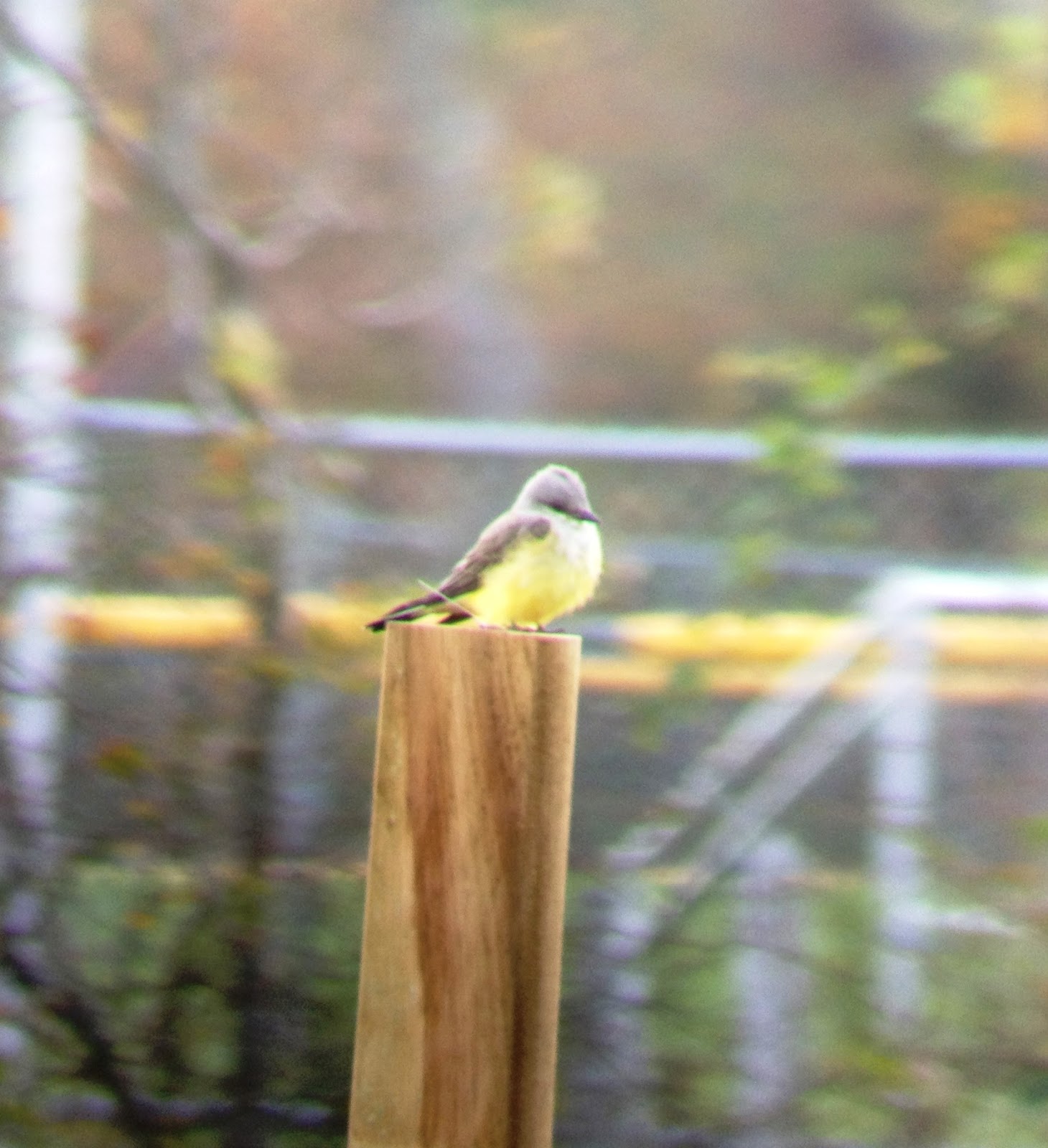
There was nothing else of interest on the coast, but there seemed to be a lot of birds moving well out to sea.  So we thought we might head to a south facing peninsula like Point Judith to check out the seabird migration.  Just after we left I got a call from local RI birder Jan St. Jean that she had just found a Western Kingbird just a short distance away in Tiverton.  A couple minutes later we caught up to Jan and she had the kingbird perched on a post along the road.  It was a most cooperative bird providing great phone-scoping opportunities.  A statebird for me and for Davis, but not for Denny.


RI is my third New England state with Western Kingbird (though I’ve also chased after it unsuccessfully in CT and ME).  I now have it in most every western state in its regular range (though OR is an obvious gap), and now 5 eastern states as a vagrant.  And Western Kingbird was #300 for me in RI!
We were just about to get back on the road when Jan got a call of a Cave Swallow at the south end of Scarborough Beach State Park in Narragansett.  A short ride later we were at the park but had no swallow.  We decided to leave the park and head to Point Judith.  But just as we did, Jan called again and said she had found a Cave Swallow at the north end of the park.  So we turned around and within a couple minutes we got great looks at a Cave Swallow right overhead, along with a Tree and 3 Barn Swallows.  A statebird for Davis, but not for Denny or me.

It was now early afternoon and we were starting to run short on time.  We discussed the options, but Denny didn’t care which choice we made because, as he put it, “There are no statebirds for me to go for.”  To which Davis reminded Denny that he shouldn’t be so negative.  Instead of heading south to Point Judith we headed north to Barrington to try for a Ruff that had been reliable for a number of days, but had not been reported since the hurricane. 

About 20 minutes after we left Scarborough Jan called yet again – there was a Yellow-throated Warbler at Scarborough within a few feet of where we had the swallows!  That would be a RI statebird for all of us!  So we turned around made our way back to Scarborough yet again.  As we arrived we could see Jan in the distance so I called her to get the micro-directions.  As she was directing us to a small group of pines here comes a small bird flying out of those trees to another couple pines – it was the Yellow-throated Warbler!  We got great views but only for a minute or so before it flew off toward another set of pines in the distance.  If we had been more than a few seconds later the bird might have flown off to that other part of the park and we might have missed it.  I’m sure Denny was happy to eat his words about not being able to get a new statebird.

That was my fifth New England state for Yellow-throated Warbler – but only my second away from a winter feeder.  I’ve now seen this species through most of its range though it would be nice to fill the gaps in NY and IN.
 

Thursday, November 8, 2012

Rufous Hummingbird, Biddeford, ME, and Post-Sandy Birding #1 – October 2012

While away on a business trip some posts started coming in about a Selasphorus hummingbird at a feeder in Biddeford, ME.  And a couple posts were suggesting it might not be the expected Rufous – some leaning toward Broad-tailed.  I have no Selasphorus hummers of any kind in Maine, so obviously worth a try for the bird.  But would it stay until I returned from my trip? 

And then there’s the issue of whether it would survive through Hurricane Sandy.  The hurricane battered the Maine coast with lots of wind and rain though certainly nothing like down on the NY, NJ and CT coasts.  The night of the storm I contacted the local homeowners with the hummingbird and they said they did not see it that day.  Was the wind just too strong for this little bird?  So thinking the bird might be gone, I decided to bird along the coast elsewhere the day after the storm looking for wind-blown birds. 

While driving north to head to the coast the morning after the storm I got a call from the homeowners – the hummer was back!  Needless to say I changed my course, and an hour later was at their front yard looking at the feeder.  After about a 20-minute wait I heard a sharp chip note and soon thereafter the hummingbird arrived to feed.  I had good long views of the bird from the back, and although I never saw the tail spread, I never saw any orange at all in the tail feathers.  Hmm…  Regardless of my possible ID, the bird was banded a couple days later and was confirmed as a Rufous Hummingbird.

After leaving the feeding station I began my search for storm-tossed birds.  Two stops in Biddeford yielded a couple large flocks of gulls but nothing of interest.  Then during an hour-long seawatch at the Cliff House in Ogunquit I saw mostly the normal fall seabird migrants, though a Laughing Gull was very late and perhaps blown north by the storm.  I also had the briefest view of a storm-petrel just before it disappeared behind a large swell never to be seen again.  Next stop was Cape Neddick where the first bird I saw was a very late bedraggled male Black-throated Blue Warbler – was this a storm bird?  With nothing else of interest in the thickets, and the road to Nubble Light closed due to the storm, I began to head home.  But one last check of the listserves mentioned a Leach’s Storm-Petrel at inland Lake Massabesic in NH.  With one more change in course I was at the lake with several other birders watching this poor confused bird bobbing around on the lake waters.  Not a NH statebird, but a great inland sighting none the less.

My statebird map for Rufous Hummingbird is inserted below.  I have now seen Rufous in each New England state (my 215th species in each of these 6 states), as well as five other eastern and Gulf Coast states as a winter vagrant.

Monday, October 29, 2012

35 Statebirds in Carlsbad, New Mexico – October 2012

With a business trip to Texas I was able to add a couple days to work on my New Mexico statelist.  I last birded in NM in 1995 (before Eurasian Collared Doves invaded), and my statelist was just 162.  To minimize travel time I targeted southeast NM within a short drive of Carlsbad.  Then with the help of e-bird I came up with a long list of potential targets that included a number of eastern birds that barely get to NM, desert residents, some late lingering migrants, and hopefully a few early winterers.  So with excellent help from some local birding experts, and review of the NM birdfinding guide, I mapped out a 2-day itinerary to maximize my statebirding potential.  Not surprisingly for this semi-arid location, many of the best spots would be oases and other riparian locations.  Here are the highlights of my trip, with new statebirds in bold -

Day 1
·        Just S of Loving – 2 Harris’ Hawks on a telephone pole
·        Loving – Eurasian Collared Dove (of course I had them everywhere during the trip).  NM was my 35th state for ECD (see map below)
·        Pond on 285 just N of Loving – 2 Dunlin, 1 Long-billed Dowitchers, 8 Least Sandpipers, along with 2 Wilson’s Phalaropes
·        Fields N of Loving – several flyover Sandhill Cranes.  3 Inca Doves at a house N of town.  I now have Inca Dove in all its regular southwestern states.  Fields were loaded with White-crowned Sparrows but not much else of interest.  In fact White-crowns were very common everywhere - at one location I found a flock of 200 birds.

·         6-Mile Dam – an excellent spot not mentioned in the birdfinding guide.  Statebirds were – 4 Virginia Rails calling, 1 Sora calling, numerous Marsh Wrens, 2 Swamp Sparrows, 3 Pied-billed Grebes, and a couple flyover Brewer’s Blackbirds.  Below the dam there was one calling Black-tailed Gnatcatcher plus 2 Eastern Phoebes (including one fighting with a Black Phoebe – not too many places in the country where that could happen!).  That pushes my E Phoebe sightings a bit to the SW now covering all the normal range of this common bird.
 
      ·        Private yard – 1 Blue Jay, along with 2 late Rufous Hummingbirds.
·        Avalon Reservoir – perhaps 2,000 waterfowl including Lesser Scaup, Canvasback, Redhead, 1 Clark’s Grebe, Eared Grebe, and 1 California Gull with a flock of Ring-bills, plus a flyover Merlin.  A flock of 500 cowbirds and Brewer’s Blackbirds was notable on the wires.  My Lesser Scaup sighting fills the next to last gap in my statebird map – I need to work on my paltry MT list!

·        Back to 6-mile Dam – thanks to a tip from a local birder I had a Barn Owl fly out of the dam structure illuminated by the light of the nearly full moon!  My Barn Owl states are really spotty – tough to get this one without local knowledge of a stakeout.

Day 2
·        Rattlesnake Springs – this desert oasis is described as one of the best birding locations in the state.  Unfortunately it was very slow the day I was there.  I started pre-dawn (29 degrees – brrr!) and the first 3 birds I had were a flyover Snipe, a calling Great Horned Owl, and a flock of Turkeys.  Migrants were limited to a number of Hermit Thrushes and some Yellow-rumps.  Only other statebirds were 2 White-throated Sparrows and 2 Brown Thrashers which are key winter targets for this site.  Likely the best highlight was a prolonged look at a Bobcat.
·        Carlsbad Caverns entrance road – I was hoping for quail or thrashers, but with no luck.  I did have 2 Brewer’s Sparrows, 1 Rufous-crowned Sparrow, and 1 Black-throated Sparrow.  Also had very close views of 4 Bighorn Sheep – including a family with young crossing the road right in front of me.
·        Brantley State Park– first stop was along the Pecos River below the dam – nothing of interest here except for a pair of flyover Greater Yellowlegs
·        Brantley SP Campground Access Road – This was an unplanned stop, but I decided to check out the campground in hopes of finding a feeder full of thrashers and quail at one of the camp sites.  Alas, there were no feeders.  But a cooperative Black-throated Sparrow was a nice consolation.  Then on a whim I went down to the boat ramp to see what might be around and had some good birds - 1 Western Sandpiper, 1 Baird’s Sandpiper, 1 Semipalmated Plover, about 15 Least Sandpiper, 4 Avocets, and 2 Greater Yellowlegs, all walking among a flock of pipits.  On the other side of the lake 1 Franklin’s Gull was mixed in with the Ring-bills.  My Western Sandpiper map shows pretty good coverage in the west and southeast, though spotty coverage in the Midwest.  For Franklin’s Gull, by comparison, my sightings are throughout the central part of the country with some vagrants in the east.

·        Brantley SP Cheapskate Point – several flocks of waterfowl included 4 Bufflehead.  Also had 8 more Leasts and 1 Greater Yellowlegs
·        Avalon Reservoir – wanted to give the waterfowl one more pass-through thinking that maybe I missed something the day before.  Although I didn’t pick out anything new in the rafts of ducks, I did find 2 Horned Grebes by themselves diving along the far shoreline.  Plus a Merlin passed over the reservoir – was this the same one I saw the day before?

I ended up with 109 species, including 35 new statebirds, putting my state list up to 197.  That’s still a long way from the ABA reportable threshold of 264, but getting closer.

Wood Sandpiper, Rhode Island, October 2012

On Friday evening a post came across that there was a very late Tricolored Heron at Marsh Meadows in Jamestown – a bird I need for my RI list.  But since I was busy all day Saturday I made little more than a mental note of it.  But then came a post on Saturday morning that a Wood Sandpiper was found at the same spot.  The post came out within minutes of the first sighting, and I checked my e-mail within minutes of the posting, so I couldn’t have received the information in a more timely manner.  Problem was I couldn’t break free that day, and Sunday morning was going to be just as busy.  Would it stick around till Sunday afternoon?  Although there were times on Saturday when the bird would disappear, it was seen near the end of the day.  And with an early Sunday morning siting I was cautiously optimistic that I would be able to see the bird that afternoon.  And maybe even the heron!

When I arrived there were at least 75 birders milling around, but no one had seen the sandpiper since the early morning sighting.  I only had a couple hours to wait for the bird, so my optimism began to wane.  While waiting for the sandpiper to hopefully reappear, I scanned across the marsh to look for the Tricolored Heron with no luck (it was last seen in the early morning too).  While scanning I noticed two birders way out on the other side of the marsh to the east seemingly concentrating on something practically at their feet.  Maybe they just had a cooperative Saltmarsh Sparrow or something.  But after a couple minutes they were still there and occasionally seemed to wave back toward the road.  Then came word that they did indeed have the sandpiper.  So I joined the rest of the birders to make a 5-minute trek out along the edge of the marsh to the east - and there was the Wood Sandpiper in a salt panne not more than 30 ft away.  It appeared to be oblivious to the 75 birders all staring at it just a few feet away.  Great views of a tremendous bird!

I eventually made my way back to the road and did a couple more scans for the Tricolored.  Found lots of Great Egrets and a few Great Blues but no Tricolored.  If I could only get one new RI statebird that day I’m glad it was the Wood Sandpiper. 

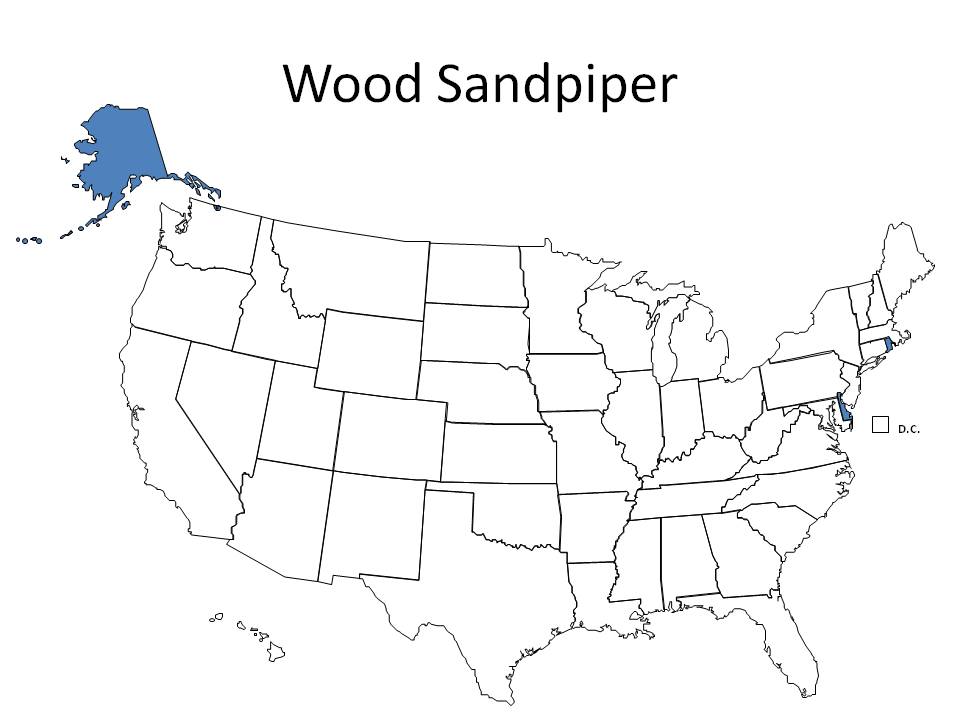
That was my third sighting of Wood Sandpiper in the US – one on the Pribilofs, one in DE a few years ago, and now a first record for RI.

Friday, October 19, 2012

Bell’s Vireo, Gray-Cheeked Thrush, and Wheatear in Maine, October 2012

No I didn’t get all of these in 1 day – but I only needed 2 consecutive days to get all 3 of these new Maine statebirds.  And what a pair of days of birding it was!  October seems to be THE month for rarities in New England.  Planning for the trip started with a call on Sunday from my birding friend from NH Denny Abbott that he had a pair of Gray-Cheeked Thrushes at Fort Foster, ME – a new ME statebird for him, and it would be new for me as well.  Unfortunately I couldn’t get out that day.  But, I was going to be able to take Monday off from work and could give them a try.  Plus there was a report from Friday and Saturday of a Bell’s Vireo and Rufous Hummingbird on Monhegan Island.  It’s feasible to get there and back in a day, so I was tempted to give that a try.  But a post from Monhegan on Sunday said that both birds were gone.  And to make things even more interesting Sunday evening there was a report of yet another Bell’s Vireo on the mainland farther up the coast in Dresden.  That would be a new Maine bird for both of us.  So now there were 2 targets to try for.

I came by Denny’s house at dawn and we took the short trip to Fort Foster.  There were a fair number of migrants around, but the only Catharus thrushes we could find were a couple Hermits.  So we made it a brief stop and headed up to Green Point Farm Wildlife Management Area to try for the Bell’s Vireo.  While en route an e-mail came across the listserve that said the Vireo was seen well at 9 AM that morning.  Although it was good news that the bird was still around, Denny and I both realized that if we had gone straight to Green Point Farm we would have been there at about 9, and maybe could have had a good chance to see the bird with other birders.  On the bright side, the new posting had much better directions than the one from the day before (see location at the end of this blog).  So maybe that was a blessing afterall. 

When we arrived at about 11:30 we easily found the location listed on that morning’s e-mail.  As soon as we got out of the car we realized that we were in an area full of acres of low brushy habitat which seemed ideal for a Bell’s Vireo.  And the area was full of birds.  As we unsuccessfully combed through the sparrows and warblers flitting through the brush we both realized that finding the Vireo might be a “needle in a haystack” proposition – just so many birds and so much habitat.  But a few minutes later I got a brief and partial view of a small yellow-green bird.  Sure seemed like it could have had the right fieldmarks, but the sighting certainly was less than satisfactory.  We stayed in that same spot for a while but didn’t see the bird again.  So we moved a bit farther down the path to look through another flock of birds.  Just then the Bell’s Vireo popped into the open as it foraged low in the brush.  We both got great views of the bird off and on for 5 minutes though we kept our distance so as not to harass it.  A couple photos are inserted below, blown up a bit since we were pretty far away for my 500 mm lens.  As we walked back to the car, Denny and I both said we were surprised to have found this bird and felt very lucky to have added this extreme rarity to our Maine lists.  Plus, it turns out that if it hadn’t been for the 9 AM post we would have gone to the wrong location, so stopping at Fort Foster first turned out to quite advantageous.


Maine is my second New England state for Bell’s Vireo (see my statebird map below).  Otherwise the map pretty much matches this species’ normal range in the Midwest and the Southwest. 

It was only Noon, and we had our key target.  So what do we do next?  I suggested heading down to Portland’s Evergreen Cemetery to try for some migrants.  After a short drive we arrived at the back of the cemetery and began to walk along the paths through the woods seeing very few migrants.  But things picked up and we started to find pockets of late warblers.  And as we turned one corner near the edge of the cemetery I got a glimpse of a Catharus thrush on the ground.  Several brief glimpses were inconclusive for an ID, but then it hopped up to a low perch and I got satisfactory views of a Gray-Cheeked Thrush!  Second new statebird for the day.  The state map for my Gray-Cheek sightings is pretty spotty – it’s not an easy one to find in migration in much of its range. 
That evening after I got home I checked the listserve and saw a late post of a Wheatear seen earlier in the day on the coast in Kennebunk.  We drove right past Kennebunk on the way home – if we had only known.  So early the next day I was back out trying to add a New England statebird.  I arrived at the location and found several birders already there with the bird in their scopes.  Can’t be easier than that.  I got some pretty good phone-scoped photos of this very cooperative bird.  Although the second photo is a bit fuzzy, it shows the white base of the tail.


Maine was my fourth New England state for Wheatear, which is a regular fall vagrant. 


Thursday, October 4, 2012

Clay-Colored Sparrow, Common Gallinule, Sora in Connecticut – October 2012

It has seemed like forever since I had added a new statebird to any of my New England lists.  In reality it was back on back on July 28th when I saw the Red-billed Tropicbird in Maine, which meant I was in one of my biggest dry spells for adding New England statebirds.  During much of this time I was in a period of lots of travel for work, so I couldn’t easily break free to chase after some local birds.  So when my travel schedule finally lightened up, I decided to go after a couple rarities seen for about a week in CT – 2 Clay-colored Sparrows on the coast and a Common Gallinule at the White Memorial in northwestern CT.  Though of course when rarities have been around for a while, I always wonder if I have waited too long to go after them.  And right on cue, the day before my trip a birder was not able to find the 2 sparrows at their coastal location.  But with a little more research I found another post of a Clay-Colored in central CT – now 3 days old but worth a try since it was almost on my route to the Gallinule spot.  Plus I’ve been told that the marshes at the White Memorial can be good for Sora – my biggest nemesis bird in CT.  So that gave me 3 possible statebirds to try for.  And with excellent micro-directions from several local CT birders, I was excited to finally get back to New England statebirding.

I arrived at Nod Road in Simsbury at 9 AM where the Clay-colored Sparrow had been reported earlier.  Although there were no sparrows in sight, I noticed a weedy field a short distance to the north that could be good for sparrows.  I headed over there and started to flush quite a number of Savannahs and a few Songs, and decided to try to push them toward some brush where they would hopefully tee up and give cooperative views.  This seemed to work as more and more headed to the bushes, giving at least brief views before disappearing into the thicket.  At one point I got a brief view of a Spizella sparrow before it dropped back into the field.  Could that have been it?  I walked closer to the spot where it dropped in and flushed it out again.  It perched in the open giving great views – it had a strong white supercilium and moustache but it had a pretty strong reddish cap (though with a white median stripe).  In the field I decided the reddish cap meant it had to be a Chipping in winter plumage.  I continued to work the field, and later got a Vesper Sparrow and a late Magnolia Warbler, but nothing else of interest.  The next morning while looking at the field guides I realized that the Spizella wasn’t a Chipping at all but was indeed the Clay-Colored.  It’s embarrassing to get the ID wrong, but I guess better to be conservative then to incorrectly conclude that you found a rarity.  My map for Clay-Colored Sparrow below shows an interesting story – I’ve seen it in a number of central US states where this species is a common migrant or nester, as well as quite a number of states where it is an accidental migrant or wintering bird including 5 New England states. 

My next stop was Little Pond in the White Memorial in Litchfield.  With excellent directions I headed to the gallinule spot, set up the scope, and almost instantly found the bird swimming at the edge of the cattails.  I was pretty lucky on this one since others had mentioned it took up to 2 hours to get the bird in view.  A distant but identifiable phone-scoped picture (with the scope at 50X) is inserted below – you’ll likely need to click on the picture and then expand it to see the bird.  The pale gray throat and head indicates it’s an immature bird.

That was number 300 for my CT statelist – my 8th state with at least 300 species.  It also gives me a sweep of the 6 New England states for Common Gallinule which is diminishing in the northeast.  And the map of the states where I’ve seen this bird pretty well matches its range – Southeast, Midwest, and Southwest – though I still have a few gaps to fill. 

Then on to try for my nemesis bird – the Sora.  The marsh throughout the northern end of Little Pond was full of cattails, which should be ideal for Sora.  I played a bit of tape and instantly saw the cattails move just a short distance away.  But no visuals and no calls.  I walked a bit farther down the boardwalk and played a little more tape with no luck.  So I walked back to my original spot and a Sora flushed from the marsh right next to the boardwalk!  And I noticed some more movement a short distance away and got a visual on a second Sora.  Pretty exciting since I don’t think they had been reported from the spot recently.  A distant calling Virginia Rail and 3 Marsh Wrens chattering in the marsh completed the experience.  My Sora map is a bit spotty – this is a pretty common bird across the US so I don’t have many excuses for missing it in most states (except for MT and ND where my lists are puny).  And Sora is now my 214th species that I’ve seen in each of the 6 New England states.

That was 3 New England statebirds in one morning - good way to end a dry spell!