Showing posts with label Connecticut. Show all posts

Wednesday, January 23, 2019

Yellow-headed Blackbird, Storrs, CT, January 2019


The last time I was at the University of Connecticut campus in Storrs was November 28, 2010 when I successfully chased after a Northern Lapwing - a life bird for me at the time.  The Lapwing was foraging in the fields around Horsebarn Hill.  Little did I know that I would be back to that same spot some 8 years later chasing after another rarity – Yellow-headed Blackbird.  The Blackbird certainly wasn’t a lifer, but it was somewhat of a nemesis bird for me in CT, having chased after this species in CT three times before.

 It all started on New Year’s Day when a post came across that a Yellow-headed Blackbird was found in flock of Starlings and Cowbirds at Horsebarn Hill.  I couldn’t break free that day, nor the next for that matter.  But luckily the bird was re-found multiple times on the 1st and 2nd.  Several posts included location details, and even though my last trip there was more than 8 years ago, I could picture exactly where the Blackbird was being seen.  The bird was seen in flocks of Starlings and Cowbirds, with posted photos showing the birds in pasture grasses which cover many acres throughout this area – the same grasslands that attracted the Lapwing back in 2010.

With morning and late afternoon appointments on the 3rd, I had a 2-hour window to look for the Blackbird in the early afternoon.  I got out of my morning appointment and checked my e-mails for updates – unfortunately there was just one post and it was from a birder asking for updates.  There were no reports of the bird from that morning at all.  Ugh…  But I decided to head to Storrs anyway to give it a try.

As I pulled onto Horsebarn Hill Road I quickly spotted a large flock of Starlings milling around the large red barns on the right side of the road.  Since the posts had mentioned mixed Cowbird/Starling flocks I was hopeful that I wouldn’t have to wade through the many thousands of Starlings at the barns.  But at the edge of the parking lot I saw a small group of Cowbirds foraging in the grass, so I spent a bit of time looking through that flock.  But it was just Cowbirds.  Hopefully the bird was in another flock farther to the east.

I drove a bit farther along the road and noticed a couple birders out in the field.  Maybe they had the Blackbird - “bird the birders” as I always say.  I walked over to them and sure enough they had just seen the target bird in a flock of Cowbirds.  So the Yellow-headed Blackbird was still around, but the Cowbird flock was no longer in the field.  Now we had to re-find the flock. 

With just a bit of scanning I spotted a flock of about 500 Cowbirds a short distance away.  Was this the right flock?  We anxiously looked through the birds as they fed in the field.  But the grasses were quite tall, mostly obscuring the birds as they foraged.  They were almost constantly in motion, so I mostly watched as birds popped out of the grass to move to other parts of the flock.  As the seconds grew into minutes, I flashed back to my previous trips looking for Yellow-headed Blackbird in CT, spending hours poring through blackbird flocks unsuccessfully searching for patches of yellow in a sea of all dark birds.  But just then I did indeed spot a flash of yellow – I finally had the Yellow-headed Blackbird!  I continued to bird the area for the next hour, and although the cowbird flock was in view most of that time, I only re-spotted the Yellow-headed a few times, and only had it in view for perhaps a total of a minute.  You wouldn’t think it would be that difficult to spot, but in all fairness this was a female or immature so the yellow was limited and wasn’t that bright.  Plus there was no white in the wings to look for in flight.

I took a few photos of the Cowbird flock with my iPhone, including this one through my windshield from the warmth of my car.


I didn’t realize it until I looked at the photo on my computer, but amazingly I was lucky enough to snap the shot when the Yellow-headed was visible near the right side of the flock.  Here’s a cropped version of the previous photo.


And all of these sightings were within a couple hundred yards from the spot where I had the Lapwing in 2010.

As a side note - a photographer from the Willimantic Chronicle was at the site as well, taking a couple pictures of the blackbird flock as well as the birders - 


My 5 minutes of fame I guess. 

Yellow-headed Blackbird was number 333 for my CT state list.  As shown in my statebird map below, I’ve now seen this species in the east as a rarity in 4 states (FL, CT, MA, and NH), and throughout almost all of its normal range in the central and western US.  The 3 cross-hatched states are the last ones in that regular range (though barely) where I still need this species.


Saturday, October 6, 2018

Roseate Spoonbill, First State Record, Milford, CT, September 2018


Just 3 weeks after the Wood Stork and Neotropic Cormorant showed up in NH, and the Great Black Hawk appeared in Maine, a Roseate Spoonbill was spotted way up in Sebec, ME.  This first state record was apparently very reliably seen starting on August 27 on a small farm pond far from the coast.  Although I would have loved to go after the Spoonbill, Sebec would be a nearly 5-hour one-way drive for me.  So despite my temptations, I never went to chase after it.

While reviewing posts on the ME listserve one day I noticed a report that the Spoonbill was no longer being found at its usual location.  It was last seen on September 9 after 14 days of daily sightings.  I always wonder if these long-lost species find their way back home, or whether they continue to head even further in the wrong direction.  For instance the Great Black Hawk was spotted leaving its southern ME home-away-from-home flying northeast out to sea – perhaps its next stop was even farther afield in Nova Scotia or Newfoundland.

But back to the Spoonbill…  Then amazingly 8 days later on September 17 came a report of a Roseate Spoonbill on the CT coast – yet another first state record!  Was it the ME bird or yet another Spoonbill visiting New England?  Unlike the ME bird, this one wasn’t very sedentary.  It was first reported on the Stratford side of the Housatonic River at Raven Pond, then it would not be found at all for a time, despite numerous birders searching from land and by boat.  Then the Spoonbill seemed to prefer Wheeler Marsh visible from the Audubon Coastal Center at Milford Point, though it would also return to Raven Pond especially to join a nighttime Egret roost there, and would be seen elsewhere in Stratford as well.  It was still covering a pretty large area. 

Unlike the ME bird, this one was within my chasing distance, “only” 2 ½ hours from home.  So I definitely wanted to give it a try.  Unfortunately I was too busy to head out, so I needed it to stick around a few days until I could finally break free early on Saturday morning the 22nd.  Luckily its wanderings had become more predictable by now.  It would typically show up at Wheeler Marsh soon after sunrise, and then be seen sporadically at the marsh during the day.  A complication was that it would often be seen flying into the marsh only to drop in and disappear out of view for hours.  So you had to keep a close eye out for it.  Friday morning the bird appeared at 7:40 AM, so I planned to arrive at the Milford Audubon Center no later than 7 AM the next day to give it a try.  That meant a 4:30 AM departure – anything for a rarity!

Luckily there was next to no traffic as I made my way to the CT coast early on Saturday morning.  As I arrived at the Audubon Center a few minutes before 7 I could see about 10 birders already on site.  There had been no sightings yet that morning, though one birder had the Spoonbill there in the marsh the night before all the way up until nearly total darkness.  Maybe our target never left the marsh the night before and was right out in front of us hidden by the marsh vegetation. 

By 7:40, the time it arrived the day before, there were at least 20 birders on site scoping the marsh, but to no avail.  You wouldn’t think a large pink wading bird would be so difficult to find.  As 7:40 came and went I mentioned to everyone that the yesterday’s 7:40 tide would be duplicated today at about 8:30 – so maybe that would be the more likely time for it to return.  We all had to stay optimistic, right?  At least while we were waiting I spotted at least 1 “Western” Willet – perhaps soon to be a separate species.

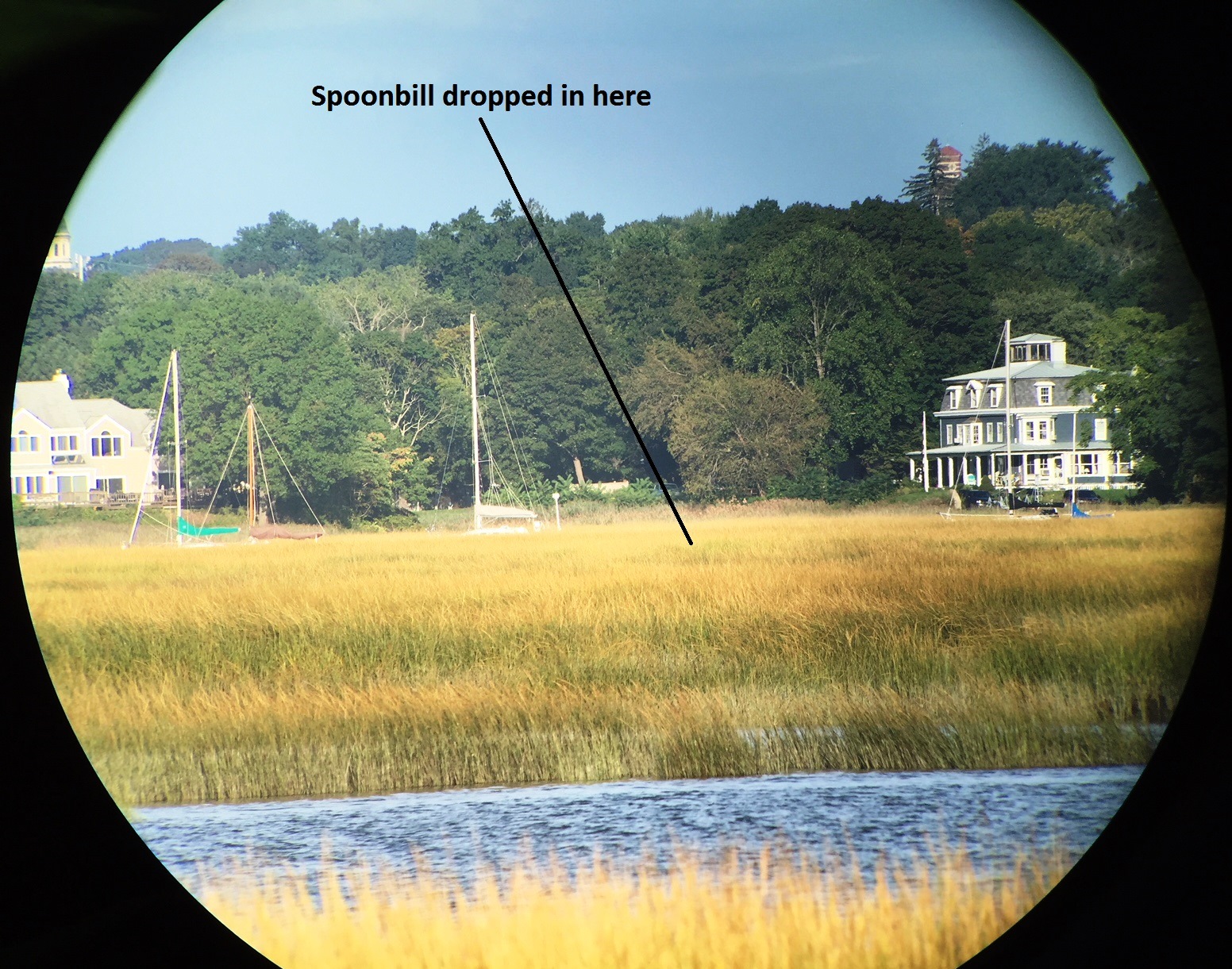
And then at 8:28 one of the birders yelled – “I have the Spoonbill!”  There it was flying over the marsh at a considerable distance coming in from the west.  At first it was quite high, then it slowly got lower to the marsh, circled a couple times, then dropped in out of site.  Although it was quite distant the whole time, and total viewing time was maybe only 30 seconds, everyone was able to see all the fieldmarks including of course the pink color and the large spatulate bill.  Good enough for a state “tick” – though if it had been a lifebird I would have wanted a better view.  Here is a picture of the marsh where it dropped in, perhaps nearly a mile away.


Roseate Spoonbill was #332 for me in CT, and the 440th species I’ve seen anywhere in the 6 New England states.  CT was only my 4th state for this species typically only found in the deep south.

 
It turns out that comparison of photos of the ME and CT birds revealed that they were the same individual.  Amazingly, 8 days after leaving Sebec, ME it was re-found in Stratford and Milford, CT, some 345 miles away “as the Spoonbill flies”.  Wonder if it took a direct route and passed over NH and MA on the way.  In fact, if it flew on a straight line it would have passed nearly directly over my house here in Pepperell, MA.  I guess I didn’t look up at the right time. 

“But wait there’s more…”  There were also reports of Spoonbills all across the Midwest and Northeast this year, including IN, OH, WV, PA, MD, NJ, NY and DE.  And it turns out that the ME and CT bird was also the one spotted at the Walkill River NWR along the NJ / NY line from July 22 to August 5.  And then there was a Spoonbill spotted in southeastern Quebec on August 7.  Was this also the same bird?  Unfortunately the photos weren’t of sufficient quality to tell.  This was only 85 miles northwest of its Sebec, ME location where it was first spotted 20 days later – certainly a feasible trip.  But the Quebec spot is 375 miles northeast of its NJ/NY location – could it have traveled that far is just 2 days?  I guess we’ll never know for sure. 

It has truly been an amazing year for vagrant Roseate Spoonbills!

Sunday, September 2, 2018

A First State Record and Three Pelagic Species in One Day in CT, August 2018

It all started with an absolutely amazing set of sightings in Long Island Sound off the CT coast.  First there were reports of a large number of Shearwaters at the eastern end of the Sound, with Great, Cory’s and Sooty Shearwaters seen in record numbers from the New London-Orient Point ferry.  Unfortunately I couldn’t break free to get out on the ferry during that time.  And when I finally could get out, the Shearwaters had mostly moved on.  The best I could do was add Great Shearwater to my NY list on one leg of one of these ferry trips. 
Then came CT reports of multiple Parasitic Jaegers seen from land, principally from Hammonasset Beach State Park.  And several of these reports included an occasional Shearwater.  All sightings were apparently associated with feeding frenzies including hundreds, if not thousands, of Terns.  I didn’t try chasing after these birds since the sightings were a bit hit or miss, apparently depending on whether there were schools of fish nearby to attract these pelagic species. 
All in all, this was perhaps an unprecedented set of pelagic sightings in Long Island Sound.  Unfortunately one that I hadn’t been able to experience.
That is until a report of a Black-bellied Whistling-Duck in Essex, CT came across the listserve.  Photos confirmed the ID of this first state record, and many birders were able to see this most cooperative bird later that same day.  When the bird continued to cooperate the next morning, though seen in multiple spots in the immediate vicinity, I cleared my schedule to be able to make the trip to Essex on Day 3.  And since Hammonasset was within 30 minutes of Essex, I could combine the 2 locations into one trip with lots of statebird potential. 
But as I was piecing together the directions to the spots where the Whistling-Duck had been seen, I noticed a post that a birder watched it fly north around Noon and he did not refind it.  I posted to the listserve asking for other updates and unfortunately only received negative reports.  I tried to remain positive that it would return since vagrant BBWDs will often stay in one spot for quite a while, and decided to keep with my plans.  And just before closing the computer that night a post came across that the bird returned at 6:30 PM.  The chase was on!
I was out of the house before 6, arriving in downtown Essex by 7:45.  The Whistling-Duck seemed to prefer a small tidal pool in a suburban backyard at the corner of Ferry and Pratt Streets, so that was my first destination.  As I drove down Ferry Street nearing the intersection I looked to the left toward the pool and there was a lone duck standing in the lawn at the edge of the pool – it was the Black-bellied Whistling Duck.  I parked on Pratt Street and got crippling views of this extreme rarity, including these phonescoped shots as it fed in the mud.


CT was my 9th state for this species, most of which as a vagrant.


I was happy that my first target was so cooperative because I needed to move on to Hammonasset to try for my next objectives – pelagics on the Sound.  Within a half hour I was at the park gate and realized this was the first time I had ever been there “in season” requiring an entrance fee.  The $15 day pass seemed steep, but I hoped it would be worthwhile.
Minutes later I was at Meig’s Point and walked up to the observation platform.  Two birders were already there, and they mentioned they had just had a couple Jaegers.  And one birder had a Cory’s Shearwater.  That made me hopeful for what might lie ahead, though I wished I could have been there a bit earlier.  With a first scope scan I could see a large flock of Terns flying low over the water – we had a feeding frenzy with critical mass for the pelagics.  And sure enough within a couple minutes I picked out a slim Jaeger which was very most likely a Parasitic.  Then I spotted another, and another, and soon had a group of 6 Jaegers all in one scope field!  Over the next 45 minutes the feeding frenzy continued nearly directly off the point, and we had at least one Jaeger in sight nearly the entire time.  And we all agreed that at least a few we could positively ID as Parasitics, with all the others most likely Parasitics as well.  CT was my 12th state for this species – I only need it in VT to complete the sweep of all 6 New England states.


Over the next couple hours the feeding frenzy would die down, and sometimes completely stop.  And then a few minutes later we would find the big flock of Terns a short distance to the east or west, again accompanied by multiple Jaegers.  I conservatively reported 6 Parasitics in my eBird checklist, since I had 6 in view at once, but the total could well have been more.  Then there was one that got away - at one point I spotted a Jaeger to the west of us, and watched it fly by eventually out of sight to the east.  It was not associating with any of the Terns as all the other Jaegers were, and was apparently just migrating through the area.  Most interestingly, I could not see any white in the primaries.  Could it have been a Long-tailed?  Unfortunately it was too far away for a definitive ID of these very tricky species.
By 11 the activity had slowed dramatically and the other two birders left the point.  I thought about calling it quits myself, very content to have found my second CT statebird for the day.  But then another couple birders arrived, and I decided to stay a bit longer to compare notes.  A little later one of those birders spotted a Shearwater flying west.  Although it was distant we could ID it as a Great.  Finally had my first Shearwater for CT after many unsuccessful trips on the Ferry.  And then a bit later while searching through another Tern flock I spotted another Shearwater gliding by – this one was a Cory’s.  A few minutes later I spotted another Great actively feeding in the Tern flock.  Amazing!  Good thing I didn’t leave earlier!
My statebird maps for Great and Cory’s Shearwaters are very similar – all the coastal states from NY north, plus a few mid-Atlantic states.  I’ve also seen both species in Nova Scotia and Newfoundland.


On a comparatively minor note, I also had excellent results with Black Terns during my seawatch.  In my last hour there twice I had a single flyby of a Black Tern heading west, once had a pair heading west, and twice I spotted a group of 4 birds feeding in with the Common Terns.  I initially reported 8 Black Terns for the morning, only counting the group of 4 once.  But later I was notified that 8 would be a new record for a single location in CT, so I decided to be overly conservative and revised the total to just 4.  Those were only my second Black Terns for the state.
I guess the $15 entrance fee to Hammonasset was a worthwhile investment after all.
A first CT state record, then not 1 but 3 pelagic species all from land.  That brings my CT statelist to 331.  What a day!

Wednesday, July 27, 2016

Ruff in Stratford, CT, July 2016


Although Ruff is a rarity anywhere in New England, it is becoming more regular along the coast.  And some of these birds will stick around for a while.  For example, there were 3 Ruff sightings in CT and RI in the first half of 2016 alone –
  • Weekapaug, RI - 4/28 - 5/2
  • Milford Point, CT – 5/2 – 7
  • Sandy Point, CT – 5/14
Although I was able to see the RI bird, both of the CT birds were far enough away that I couldn’t quite justify chasing after them.  Though in each case the multiple posts on the listserve and on eBird sure made me think about reconsidering my self-imposed driving distance limit for rarity chasing.

Then in July came yet another report of a Ruff, this one in Stratford, in a small marsh behind the animal control building.  As with the earlier birds, there were excellent details on the listserve and regular updates.  And although the driving distance to Stratford is a bit farther that I would like, this bird seemed to be very reliable, and not tide dependent.  And perhaps just as important – I had some spare time available to chase after it.  The stars had finally aligned to chase after a CT Ruff!

I left in the early morning on the 4th day of this bird’s stay, crossing my fingers that it would still be around by the time I had finally convinced myself to go for it.  As I arrived at the animal control parking lot I could see the small marsh and mudflat up ahead that the bird had been calling home for the last several days.  It wasn’t much to speak of – seemingly marginal habitat, and the most common bird on the mudflat was the many Starlings walking about.  But for whatever reason it had been appealing to the Ruff and the Yellowlegs it was typically seen with.

As I set up my scope all the Starlings took off out of the wetlands.  Although normally that might not be a bad thing, I worried that whatever chased off the Starlings might have chased the Ruff away as well.  A post from the previous day mentioned that the bird was only seen as a flyover, so it was coming and going from the site at least a little bit.  On my first quick scan the only shorebirds I found were a few Killdeer.  Then I spent some time scrutinizing the phragmites in the back of the marsh which the target bird seemed to favor – but still no Ruff and not even the Yellowlegs it was typically accompanying.  Over the next couple minutes a few Ibis and Snowy Egrets dropped in, so I thought maybe the Ruff and Yellowlegs might fly in too.  But the only additional activity I saw for the next several minutes were more Starlings milling about.

Then I went back to scanning the frags at the back of the marsh – and all of a sudden there was a Yellowlegs.  And a few seconds later I saw a bit of movement amongst the vegetation – seconds later the Ruff walked out into the open.  They must have been there the whole time, but just not visible from my vantage point.  I got these couple miserable phonescoped pictures of the bird in the distance through the heat shimmer, including one with its Yellowlegs pal.


Glad to finally check that one off my CT list so I don’t have to be frustrated by any more posts about Ruff sightings in the future.

Ruff was number 328 for me in CT, which is my 8th northeast state for this species.  Plus I can’t forget the beautiful male white Ruff I saw in breeding plumage in Barrow, AK a few years ago.


Saturday, April 9, 2016

California Gull, Hammonasset Beach State Park, Madison, CT, March 2016


The CT coastline has numerous great spots for “gulling”.  And one of the best times to go gulling on the coast can be when plankton feeding occurs in spring.  Each spring I anxiously watch the CT listserve hoping for sightings of large flocks of Bonaparte’s which sometimes include a Little Gull – the last regular rare gull I need for my CT statelist.  However, chasing after spring rare gulls on the CT coast can be challenging - the best plankton feeding spots seem to vary somewhat from year to year, and a good day at one spot one day could be followed few gull sightings at that same location the next day.  Hence a key reason I still haven’t successfully chased after a Little Gull in CT.

The spring 2016 CT gull sightings started not with large numbers of Bonaparte’s but instead a report of a Mew Gull at Hammonasset Beach State Park.  I had a Mew Gull in Southbury, CT in 2014 so didn’t need to chase this one for my CT statelist.  But then a second Mew was spotted, and this one was the first CT record of the even rarer mainland US subspecies some call a “Short-billed” Gull.  As a candidate for a split someday I was tempted to go chase after it.  But free time was limited so I decided to forego the chase.

Then the next day a somewhat cryptic e-mail was posted on the CT listserve titled – “Cali-type Gull Hammo-3:50”.  I didn’t recognize the observer’s name, and no details were included, so didn’t want to get too excited about the bird just yet.  Then Mark Szantyr posted that he saw the photo and confirmed the ID as the first CT state record of California Gull.  But the bird was not refound later that day in the large flock of 4-5,000 gulls plankton feeding at Hammo, so I questioned how chaseable it might be.  That is until the next day when the California was spotted early and often throughout the day, along with the continuing Mew Gulls.  And numerous photos of the immature California were posted, improving my chances of being able to pick out the target bird in a big gull flock.  The chase was on.

The next day I was able to take some time off and was at Hammonasset by mid-morning.  When I arrived there were at least a dozen birders looking out on the gull flock on the water and the beach.  Unfortunately there were no more than just 150 birds in view.  And the birders reported that although the California had been seen earlier in the morning, it had not been spotted for some time.  Now with a much smaller flock of gulls at Hammo I worried that the target bird had moved on with the rest of the flock to a better feeding location.  Was this another example of the plankton feeding locations changing on a daily basis?  A couple birders kept trying to turn immature Ring-bills into the California with no luck.  Then someone mentioned to check out another bird at the back of the flock.  I panned in that general direction and instantly picked out the target California Gull.  I guess didn’t need to stress out after all.

I stayed at the park for the next several hours, and the California was seen off and on much of that time.  And most of the time the bird was quite cooperative, allowing me to get these passable phonescoped photos.


Unfortunately the Mew Gulls did not return while I was there, but at least I don’t need that one for my CT statelist based on the present counting rules.  Though I still need Little Gull for CT.

California Gull was #327 for my CT statelist.  And it was my second New England state for this species – I found an adult California in MA back in 1994.  Plus of course I’ve seen it in numerous western states (see my statebird map below).


Saturday, January 30, 2016

Ross’s Goose, Ellington, CT, January 2016


I was on my way back home from a business trip when I got a call from CT birder Mark Szantyr that a Ross’s Goose was found that day in CT.  It was only the third CT state record for this species, and CT was the New England last state where I needed Ross’s.  So I really wanted to get this bird.  The challenge was I had heavy commitments at home, and at best had only a small window to chase after it in 2 days. 

The key question was – would it stick around?  The bird was first found in the afternoon swimming in a mill pond with many Canada Geese.  The next day it was reported in the same mill pond but only in the early morning.  After that it and most of the other geese flew off to points unknown.  But thankfully the goose flock was re-found a couple miles away feeding in a corn field.  Amazingly, Pink-footed and White-fronted were also found in with the Canadas – but I didn’t need those two for my CT list.  The Ross’s stayed with that flock during the day, and then all the birds left and headed back to the mill pond that afternoon.  So it looked like the target bird had a routine – roosting on the pond late afternoon, overnight , and early morning, then feeding in a nearby cornfield during the day.

The next day was my only chance to try for the Ross’s so I was happy to see an early morning post that the Ross’s was in the mill pond.  And then a late morning post came across that it was now feeding in its favorite cornfield.  With that confirmation I started my 1 hr 45 min ride to Ellington.  Although typically I prefer at least a little bit of a search when pursuing a new statebird (I’ve always said an hour of searching time might be ideal), this time I was hoping to see the bird right away given my limited availability.  I crossed my fingers that when I arrived there would be a birder or two at the spot, and ideally on the bird. 

As I got close to the field I could see at least a dozen cars pulled over on the side of the road.  And there were maybe 20 birders with scopes pointed toward the cornfield.  Within seconds I had parked the car and walked scope in hand over to the birders.  Quickly I had confirmation that they had the bird in the field, though it wasn’t visible at the time.  I started to scan the field and was blown away by the number of Canadas – maybe 4,000-5,000 birds.  Since I was looking for a white goose in a sea of dark geese and dark soil, you would think the bird would really stand out.  But the smaller Ross’s can easily hide behind a larger Canada.  Plus there were some small dips in the field that concealed some of the birds.  I figured out the direction everyone was looking, and stared intently into the Canadas in that area.  Within a minute I caught a glimpse of white, and then the bird walked out into the open, albeit briefly.  Success!  The bird was very distant, and not very cooperative, but I got this phonescoped photo of the bird among the Canadas –


Ross’s Goose was number 326 for me in CT, and the 239th species that I’ve seen in each New England state.  And CT is the 29th state where I’ve seen this expanding species.