Saturday, March 2, 2013

2 North Carolina Statebirds, February 2013

With a quick trip to central North Carolina I had only a little time for some local statebirding.  My NC list is pretty good at 249, so there aren’t a lot of easy gaps to fill.  But with a little research on e-Bird and the Carolinas listserve I identified 2 possible targets seen nearby recently – Rusty Blackbird including a recurring flock of 200 birds in a Durham office park of all places, and Mute Swan with a flock of 5 breeding in a lake in the Raleigh suburbs. 

Rusty Blackbird has been a bit of nemesis bird for me in NC, which is a pretty common wintering bird there.  I had a likely sighting of Rustys in a swamp 20 years ago but only got a brief view of the flock so decided to be safe and not check them off.  Little did I know that despite a number of winter trips to NC since that time I still would need them for my state list.  So it’s probably one of the more common birds I haven’t seen in NC. 

Mute Swan is a different story.  I remember seeing them on each trip to Chincoteague on the VA coast years ago.  But there are no Mute Swan reports on e-Bird there yet in 2013.  However there are small numbers of Mutes reported on e-Bird from the VA tidewater in 2013.  In NC there are some 2012 sightings on e-bird in the central part of the state and on the coast, but none in 2013.  Are they in decline in the region?  But just before my trip there was a report of 5, including immature birds, from a lake near Raleigh.  Needless to say it will be important to try to determine if they are wild birds.  In any case, certainly worthwhile to check them out.

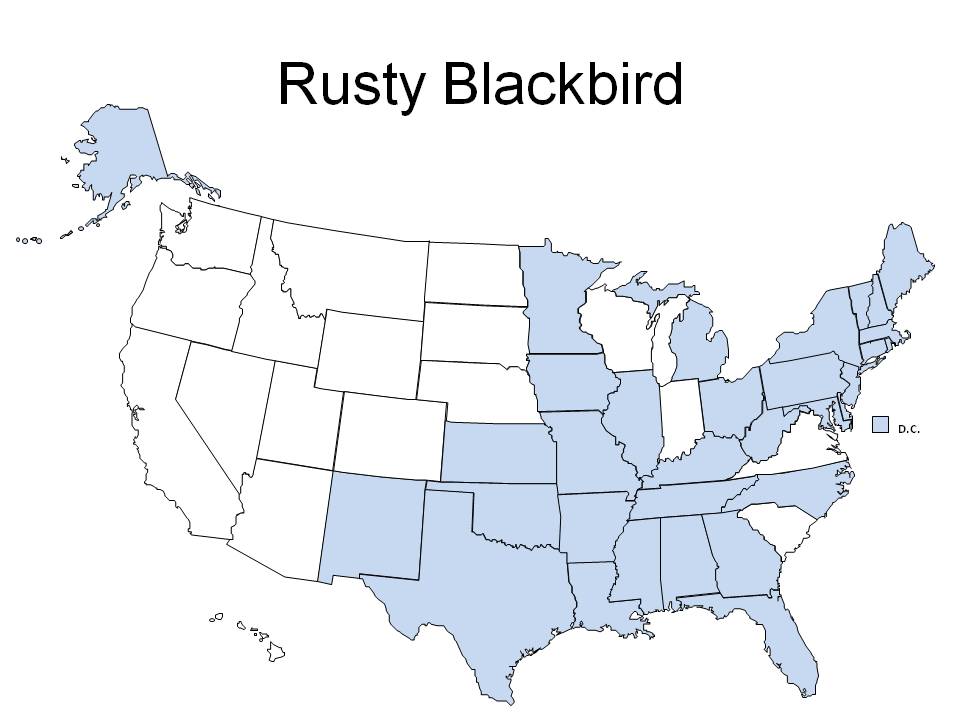
My first birding stop was the large office park where the Rusty Blackbirds were reported.  When I got there I realized why the Rustys were hanging out there – the park was full of wet wooded swamps – perfect habitat for Rustys.  I drove around the park once without seeing any blackbirds.  But on my second lap I saw a distant flock of birds perched in some tree tops.  The entire group was Rustys – maybe 200 of them.  That was remarkably easy, especially given my lack of success in the past.  But in my state bird map below, it looks like I still need to have some similar success in SC and VA to get better coverage of this species in its wintering range.


A short drive later I was at Lochmere Lake where the Mute Swans had been reported.  The lake is a long, skinny manmade lake, more than a mile long and less than 1,000 feet wide, surrounded by suburban houses.  When I arrived at the dam I quickly found 2 adult Mute Swans, and 3 white farm ducks a short distance away.  Although the swans were not pinioned, they still could be dependent on homeowners for feeding.  But I then looked farther up the lake, and in addition to a number of Ruddy Ducks, I found an immature Swan at least ½ mile up the lake.  If all these birds were dependent on a feeder close to where the farm ducks were, why would a bird be a ½ mile away?  And the young bird was either born at this lake, or was part of a family group that bred elsewhere and flew into this protected lake.  The recent report at this sighting was of 5 birds, 2-3 being immatures.  I could only see the lower portion of the lake, so maybe the others were even farther from the dam that day, and even farther from those farm ducks.  Sure seems feasible to be wild birds, so I decided to count them.  I’ve now seen Mute Swans throughout the northeast and mid-Atlantic states, along with a number of Midwest states.  


That gives me 251 in North Carolina – my 17th state with at least 250.  And as is often the case with statebirding, I spent more time researching the statebirding potential than I spent in actually birding in the area. 

Monday, February 18, 2013

LeConte’s Sparrow, Concord, MA, February 2013

I was away on a business trip when the first post came out on the listserve that a LeConte’s Sparrow was found feeding on a cleared shoulder of a small suburban road in Concord.  A few years back I had tried for a LeConte’s in MA found at Great Meadows NWR (also in Concord amazingly).  I think I heard that bird calling from the cattails where it had been reported, but could never get a visual on it.  So I was very interested in trying to see this newly reported bird and fill that gap in my MA statelist.  It was reported to be very tame, and easily found by everyone that posted.  The problem was I wouldn’t be home for 3 more days – would the bird hang around that long?  And if it did stick around, and if my late afternoon flight back home was on time, I would be able to get to the bird’s location en route back from the airport with about an hour of sunlight to spare.  And then there’s the third “if” - if the bird was cooperative then I should be able to see it that afternoon.

The bird truly did stick around, and was reported the morning of the day I came back home.  And my flight was actually early, so everything was falling into place.  I arrived at the spot and saw 6 birders up ahead standing along the roadside – with binoculars and monster lenses apparently trained on the bird.  Amazingly they were practically looking down at their feet.  I walked up and realized the bird was no more than 5 feet away from me, crawling mouse-like under grasses on the road shoulder.  After a few seconds there was movement in the grasses, and I got amazing views of the head and back of the bird.  What a gorgeous little bird!  All things considered it turned out to be one my easiest New England statebirds in some time.  There was no need to stress about it afterall. 

MA is my second New England state for LeConte’s having seen one in Maine in 2010.  I also found and photographed one in Wyoming some years ago – one of only a handful of sightings for that state.  And I’ve also seen LeConte’s in 5 central states in its normal winter and breeding ranges.


Saturday, February 9, 2013

Northern Lapwing, Little Compton, Rhode Island, February 2013

As a next chapter to the amazing Lapwing story this winter following Superstorm Sandy, two Lapwings were reported in Little Compton, RI in early February.  Unfortunately they were reported by a worker at a farm within a very large complex of fields on private land with next to no access.  Birders were limited to viewing only a portion of these fields from the shoulder of SR-77.  Apparently the birds were principally being seen about a quarter mile from SR-77, in a portion of the fields which cannot be seen from the road.  So the lucky birders that saw these birds were those that happened to be along the public road during the rare times when the birds ventured into fields close to the road.  A couple days after they were first seen, my good birding buddy, Denny Abbott, and I decided to head down to Little Compton in hopes of being two of those lucky birders.  And just in case our luck wasn’t too good, we were prepared to spend the whole day there. 

We arrived at 9:30 with no Lapwings in site.  Worse than that, we were disappointed when we realized what little acreage was actually visible from the road.  Undaunted, we donned all our layers of winter clothes and were ready to wait them out.  At one point we had a flyby of 3 Killdeer - we got all excited because there had been a report that the Lapwings were with Killdeer.  But still no Lapwings.  A number of birders came and went during the day, including a couple that had seen 1 or 2 quite close to the road in previous days.  They were luckier than us.  But a couple others mentioned that the birds were not seen the previous day at all.  Ugh.  We finally called it quits at 4 PM and retreated to the car to warm up and head home.  That meant 2 consecutive days with no sightings – had they moved on?

The next day there was a report of a sighting from late in the day, so they were still around afterall.  So Denny and I decided to give it another try the following day, but only if there was a positive report.  And sure enough, around noon the next day, a report was posted of one Lapwing near the road.  So Denny and I instantly hit the road and were back at the spot by about 3 PM – but no Lapwings.  While we were there we talked to some local birders that came by and pieced together a timeline that showed that there were no sightings since at least 12:30.  Another disappointment.  Undeterred we continued our vigil.  We were about to leave at 4:20 when amazingly we were able to get one sighting of a Lapwing quite far from the road.  Perseverance, and a lot of luck, really paid off. 

That was my third New England state for Lapwing, and the second one (after MA) this winter.


And now for a little speculation on the Lapwings this winter.  Many feel that these birds were blown off-course from their normal Europe-to-Africa migration by the huge wind field of Superstorm Sandy.  Since Sandy’s passage, Lapwings have been reported in the US in ME, MA (initially 5 and still 2 remain on Nantucket), RI (2), NY (2), NJ (3), MD, VA, and GA, and in Canada in NS and NL.  Plus who knows how many more are around that haven’t been spotted yet by birders.  It seems a bit odd that these RI birds would have first showed up in the area in February.  With the hundreds and hundreds of acres of pasture in Little Compton alone, they could have easily been somewhere in the town since last Fall but not reported till now.  And the next question is whether Lapwings might actually end up breeding somewhere in the US or Canada this year.  I found the following information on the timing of their breeding season from http://www.arkive.org/lapwing/vanellus-vanellus -  During February, males begin to perform display flights over breeding territories in which they climb steeply upwards before tumbling down close to the ground. Between March and early July, three or four well-camouflaged eggs are laid in a scrape on the ground.  Maybe we should start watching for them to start their display flights soon.  Time will tell.

Monday, February 4, 2013

6 New Colorado Statebirds, January 2013

A particularly heavy travel schedule for work of late had become quite trying and tedious, with no time for birding during those trips.  So as my third trip to Denver in 4 weeks came up, I decided to try to see if I could squeeze in at least a little time to fill some gaps in my CO statelist.  With 266 birds on my CO list I don’t need too many regular birds, but I was hopeful that at least a few less common birds might be staked out in the greater Denver area.  The CO listserve is a good one, including an updated statewide RBA every couple days with sightings separated by county.  So as long as you know which counties are in your area, a little research on the listserve can be a big help in planning a statebirding trip to CO. 

So I opened up the CO listserve and quickly saw that there were a number of potential statebirds being seen in and around Denver, and many had been present for some time.  Now the question was whether I could have time to try for them.  Based on my initial work plans it looked like I might have an entire morning free, along with a couple early morning hours on a second day.  So I set up my plans to pursue 6 potential stakeout statebirds.  During my free morning I would start at dawn in Fort Collins at a spot with both Redpolls (including a first state record for Hoary), then head south to Lower Hoffman Lake for Trumpeter Swans, then farther south to Valmont Reservoir for Tundra Swans.  Then in my free early morning I would start at dawn at a Red Rocks Park feeder for a Golden-crowned Sparrow and then a quick stop at a marsh at the Wheatridge Greenbelt park for a Swamp Sparrow.  All in all a very doable schedule.

When I arrived in Denver one of the first things that happened was my work schedule changed, and now my free morning was going to be consumed by meetings.  Ugh!  Hate it when work gets in the way of birding.  So now I needed to rethink my schedule.  That would mean there would be no chance to get up to Fort Collins for both redpolls, but there was a feeder in Wheatridge with a small flock of Common Redpolls that I could squeeze into a lunch break instead.  And maybe I could get to the lakes with the Swans either at the end of a work day, or at dawn before work started.  So maybe I could still squeeze in attempts for 5 targets.

As the first day’s work neared an end, it looked like we might be done at 4:30, and sunset was 5:10 so a 30-minute drive to try for the Trumpeters could be feasible, though with little time to spare for searching for the birds.  As I left the office the light snow that was falling that afternoon was just ending, so I hit the highway and quickly got to Lower Hoffman Lake.  But it was surrounded by a suburban subdivision, so it took me a few minutes to find access.  When I finally got access to the lake, all I could see was ice.  Had to be some open water somewhere.  Eventually I found a different access point and saw some open water.  Sure enough there was a Trumpeter Swan in with quite a number of dabbling and diving ducks.  And as the light waned, large flocks of geese flew into the lake to roost on the ice.  This included several Cackling Geese – one was calling as it flew in with the Canadas.  This was my 12th state for Trumpeter Swan – aided by the big reintroduction program and their subsequent expanded breeding success.


 The next day my work meetings started at 8 AM, but with sunrise about 7, I figured I could get to Valmont Reservoir before work to try for the Tundra Swans.  I had been there back in 2007 to take in the spectacular gull show that occurs in winter evenings as gulls descend into an overnight roost on the open water of this power plant reservoir.  I arrived at 7 (even though an overnight snow made the drive challenging) but couldn’t find an access point on the north side of the lake.  But then I remembered that in 2007 we accessed the lake from the east, so I headed there and was able to drive toward the edge of the lake.  As soon as I parked I noticed a flock of at least 500 gulls circling low directly overhead.  I started scanning through the flock and quickly found a small white-winged gull – either a first year Thayer’s or an Iceland.  I watched it for at least 60 seconds – it had a thin all dark bill, never saw any darker coloration to the primaries or secondaries, and its tail was only slightly darker at the tip than at the base.  So although I never saw the bird from above, I concluded it was an Iceland Gull.  This or another Iceland was seen at Valmont the next day.  CO is now my third Midwest or West state for Icelands, in addition to seeing them in 11 states in the northeast,.  And that was my 10th gull species for CO – not bad for a state in the Rockies.


Next my attention turned to the Tundra Swans.  From the car I could see only a small portion of the reservoir, but no large white birds (just 3 large dark birds which were immature Bald Eagles).  So I started to walk over toward the lake and soon found quite a bit of open water and a flock of Canada Geese.  And then with a slightly different angle I found the flock of 12 Tundra Swans at the edge of the ice.  After a quick walk back to the car I was able to drive to work with and got to my meeting with just a couple minutes to spare.  Although my statebird map for Tundra Swan is a bit spotty, it’s pretty well filled in for the eastern and western migration and wintering populations. 


The next target was the Redpoll flock coming to a feeder in Wheatridge.  I only had a small window of time over lunch before having to go back to work, so I needed the redpolls to be pretty cooperative.  After a quick MacDonald’s stop I arrived at the house, but there were no birds present.  But luckily only 10 minutes later a mixed flock of finches flew into trees next door – Goldfinches, House Finches, and a couple Redpolls.  Soon the flock dropped into the feeding station and was joined by 30 or more other finches.  There were about 8 Common Redpolls in the flock, including one where the red pigment was replaced by orange.  This bird was also quite pale, but had a light tan rump, and a couple dark undertail coverts.  It was most likely just a Common Redpoll with some pigment issues.  Although CO was my 13th state for this species, my statebird map is pretty spotty except in the Northeast.


The next morning I had 2 free daylight hours of birding time before heading to the airport.  So I left the hotel before dawn to head to the beautiful Red Rocks Park, and specifically the Trading Post where a Golden-crowned Sparrow had been visiting a feeding station for most of the winter.  It was 20 degrees and quite breezy when I arrived (I was definitely underdressed for that windchill) but there were many birds at the feeders.  Most were juncos, and I counted 6 different races – Pink-sided, Oregon, Gray-headed, White-winged, Slate-colored, and Cassiar.  It was quite a show.  After about 15 minutes the Golden-crowned showed up (a nice adult bird), though it was only in view for about a minute before running back into the adjacent brush.  I waited for another 45 minutes but it not reappear, so I guess I was lucky.  By the way the “White-winged” Juncos were only my second in the west.  I mention “in the west” because I had a junco at my feeder in Massachusetts a couple years ago that had white wingbars but I guess it was more likely an aberrant Slate-colored than a White-wing.  That was my 5th state for Golden-crowned Sparrow, and my first as a rarity away from its normal range. 


The last stop was the Wheatridge Greenbelt which is a linear suburban park along a river that flows through the Denver suburbs.  There was a post from about 10 days earlier about a Swamp Sparrow in a cattail marsh, with very specific directions to the location.  So although the post was a little old, I thought I’d give it a try in hopes that this was a wintering bird.  I got to the park at about 8:30, and although the temperature was up to 25 degrees the wind had increased, so the wind chill was likely even lower.  A short walk later I was at the cattail marsh where the sparrow had been spotted – everything was completely frozen and the wind was howling.  But a Song Sparrow was chipping in the marsh so I had some hope.  Swamp Sparrows can be very tape-responsive, and I had planned to bring along my MP-3 play and speakers.  Unfortunately I forgot to pack them (doh!), so the night before I went to the Xeno Canto website and had picked out one recording of call notes and one of songs that I could play from my iPhone.  I started to play the call note recording and almost instantly had the bird respond.  The bird eventually appeared and gave me brief views before it went back to its hiding places in the frozen cattails.  Luckily that only took a couple minutes because I was really getting cold.  I’ve now picked up Swamp Sparrow in a number of western states as a rarity –maybe it’s easier to find as a rarity than other species.  On the way back to the car I found a Snipe along the edge of the open water along the river – didn’t expect that one in January in Denver. 


So that gave me 6 new statebirds, putting my CO state list at 272.  Certainly was fun to be able to see so many of my target birds - plus finding a rarity - even though my birding time was so limited. 

Thursday, January 24, 2013

Connecticut Hoary Redpoll and Bullock's Oriole - January 2013

Back in December I made 2 unsuccessful attempts for a Bullock's Oriole that had been sporadically visiting a feeder in Ellington, CT.  But the oriole kept coming to the feeder, and with each post about the bird on the CT listserve, my interest in going after it kept increasing.  And then a couple Hoary Redpolls were reported in a big redpoll flock in Winchester, CT.  So that was more than enough to justify a trip to Connecticut to go after my first New England statebirds for 2013.  The oriole had apparently become a bit more reliable (though just barely) in the mid-late afternoon, so I decided to go for the redpolls in the morning, and then the oriole in the afteroon.

At mid-morning I arrived at the address for the redpolls - a birder's house who invited everyone to his backyard for close views.   But there were no birds of any type at the feeders.  I waited a few minutes and still no birds.  But in the distance I started to hear some redpoll call notes, and tracked them down in the general direction of a farm house across the road.  Soon I could tell that I had found the flock - there was a virtual cloud of redpolls flying around the backyard of the farmhouse, apparently visiting a feeder behind the house out of view - maybe 150 birds total.  The flock would occasionally fly into a tree behind the house, offering distant scope views.  At one point I picked out a very pale bird, and with all white undertail coverts, but my view wasn't the best.  A few minutes later they all took off and were milling around the area.  So I returned to the backyard of the first house in hopes that they would come there and provide close views.  But still no birds at all at the feeder (was there a Cooper's nearby?).  Again I heard the birds in the distance and watched them return to the farm house across the road.  A couple minutes later they took off and all landed at the top of a bare deciduous tree.  I scanned through the flock with binoculars and quickly picked out a very pale bird.  Then after putting the scope on it I was able to see most all the fieldmarks - white undertail coverts, pale back including broad white wingbars, white rump, and limited barring on the sides.  Even though it was too far away to see the shorter bill, I concluded this was a female Hoary. 

CT was my 5th New England state for Hoary Redpoll - I only need it in Maine.  Plus I have it in MD, WI, and NY as a rarity and on its breeding grounds in the tundra of AK.  Then again, recent studies published on the internet suggest that there is only one redpoll species afterall.  See - blog.aba.org/2013/01/open-mic-redpolls.html   But for now ABA counts 2 redpolls, so I will too.


With one down and one to go, I headed to Ellington to try for the oriole.  I arrived at 12:30 to start my vigil.  There were a fair number of sparrows and other feeder birds around, but no oriole.  All along I had been thinking that the oriole must be coming to one or more other feeders in the area - it couldn't just be living on food from an occasional visit at this one feeder.  But where were those other feeders?  The homeowner came out and mentioned that it had sometimes been associating with House Sparrows.  There had been quite a number of them coming to the feeder in each of my 3 visits there, but I had never seen an oriole with them.  At about 2:30, with no birds at all at the feeder, I was beginning to think I was going to get skunked again.  Then in the distance I heard some House Sparrow call notes, and since nothing was at this feeder, I decided to track them down.  It only took a couple minutes but I found another feeding station a short distance to the north in the backyard of a house.  In addition to the House Sparrows there must have been 50 other birds at the feeder.  Did I find that other feeder where the oriole was spending much of its time?  I really wanted to stay and watch for the oriole, but directly behind the feeders was the back of a house.  So not wanting to get arrested because someone thought I was peering into their windows, I reluctantly left and returned to the original feeding station.

When I returned there were a few sparrows at the feeder but not much else.  Then a few minutes later I got a brief glimpse of a bird drop in from above the house - it seemed bigger that a sparrow and reasonably pale - could it have been the oriole?  A minute later I got a glimpse of a larger bird on the ground a bit obscured by arborvitae bushes next to the feeder.  I got a 1-second view of the bird in my binocs and it was likely the oriole.  A bit later it was back on the ground and my 3-second view confirmed it was the target bird!  I only had one more view of the bird, and although this one was still brief, I got to see the bird well.  So after 9 hours of waiting over 3 trips, I finally saw the Bullock's Oriole, though only for 3 brief views that maybe totalled 10 seconds.  Good thing it wasn't a lifer.

I now have Bullock's in MA and CT in New England, plus as a winter feeder bird in PA.  And of course in a lot of western states in its normal range.


Saturday, January 19, 2013

Arizona Weekend - Nutting's Flycatcher and Rosy-Faced Lovebirds, January 2013


With work trips on consecutive weeks to Denver and California, I decided to stay out west over the intervening weekend and chase after some potential lifebirds.  As of early December there were 3 possible targets – a White-tailed Wagtail near Los Angeles, the returning Falcated Duck in central CA (the same one I tried for but missed in Feb. 2012), and the returning Nutting’s Flycatcher in western AZ.  As the trip neared the Wagtail disappeared, and then the Falcated Duck did too.  Argh…  But then the new ABA checklist came out and the Rosy-faced Lovebird was added based on an established population in Phoenix.  So that meant there were still 2 potential lifebirds to try for.  I contacted my good birding friend Denny Abbott, invited him to come along, and we planned our trip to try for the 2 lifebirds in AZ.  And since the CA targets had disappeared, we had time to work on our AZ statelists.  I contacted a number of local AZ birders, and got great advice not only to look for the Lovebirds, but also to get updates on some of my statebird targets.  Many thanks to all those local AZ birders!  Along with excellent eBird data, we were ready for our trip. 

Day 1 -  Arizona’s “West Coast” along the Colorado River

The key target for this part of the trip was the Nutting’s Flycatcher.  We arrived at Mile Marker 2 on Planet Ranch Road at the Bill Williams River NWR at 7:15 (30 minutes before dawn) to start our search.  It was a nippy 28 degrees so we were concerned that the bird might not start its day very early.  Soon after we got there two birders from PA arrived and joined in the hunt.  At 7:50 we heard the first “weep” call of the Nutting’s – about 150 yards east of mile marker 2 and off to the north in the riparian habitat.  There were few other birds calling in the area, so this one really stood out.  In the next 10 minutes we heard it call 2-3 more times.  And then at 8 AM we observed the bird flying over the road to the south, and it disappeared in the small amount of brush between the road and the cliff.  Over the next 60 minutes the bird called occasionally and was in view frequently though intermittently.  It was generally no more than 5 feet off the ground.  During this time it worked its way west toward mile marker 2.  At about 9 AM we saw the bird fly back to the north across the road and out of site toward the northwest.  A life bird for all of us and my first statebird!  There were few other birds in the area, though we did have Canyon and Rock Wrens, Black-tailed Gnatcatchers, and a Phainopepla.

Our next stop was the Bill Williams River delta at the NWR headquarters building.  Virtually the first birds we saw were a large flock of Common Goldeneye (statebird #2) with a small number of Barrow’s Goldeneyes (statebird #3) mixed in.  On my Barrow’s map below I have now seen this species in many of its typical western and northeastern locations, not to mention WI. 
 I then started scanning for some of the other unusual waterfowl that had been reported from the area.  Other common waterfowl were Clark’s and Western Grebes, and Greater Scaup, with a few Eared Grebes and Canvasbacks mixed in.  After quite a bit of scanning a flock of 200 Common Mergansers flew in, including 1 Red-breasted Merganser (statebird #4).  A little later I was able to pick out a Horned Grebe quite a distance away (statebird #5).  But no luck with the scoters and Long-tailed Duck reported earlier.

So we headed north toward Lake Havasu City to search for some of the rarer waterfowl reported there.  First stop was Rotary Park where both white geese had been reported.  But we could not find any white geese at all.  Did we look in the right places?  There was a pond in the adjacent golf course that we couldn’t figure out how to get to – wonder if they could have been there.  We then scoped Thompson Bay and found 3 loons swimming together – all three were similar in body shape but the one was only 2/3 the size of the others – they were 2 Commons and 1 Pacific Loon.  Not a statebird for me, but a good bird nonetheless.

Next we made several stops along the south, west, and north edges of the peninsula.  Only the water to the north had significant numbers of waterfowl, but almost all were really far away.  Best birds were a flock of 7 Common Loons.

We then headed back south and made another stop at the Bill Williams River delta to try for the scoters.  After a little scanning I was able to pick out 2 immature-plumaged White-winged Scoters at some distance (statebird #6).  Wonder where they were in the morning?  My statebird map for White-winged Scoter has an interesting pattern of virtually all the east and west coast states along with a scattering of inland states.
On a whim we decided to make one last stop before heading back to Phoenix - in the agricultural fields south of Parker to try for Sandhill Cranes.  A number of them had been reported in mid-December on eBird, but there were no recent posts.  We slowly drove south of Parker on Mohave Rd. hoping to see cranes standing in the fields.  About 11 miles south of town I noticed 3 Sandhills flying over the road.  We pulled over and watched them land and join 2 others in an adjacent field – statebird #7.  I wouldn’t have known to look for these birds there if it hadn’t been for eBird. 

Day 2 - Phoenix

The key target of the day was the Rosy-faced Lovebird – recently countable per the ABA.  A number of birders had given me advice as to where to look for them, with 3 suggesting Encanto Park as the number one location.  So we decided to make that the spot to start our day.  We arrived a bit before dawn and parked between the playground and boat house as suggested.  A couple minutes after we arrived we heard the first call notes of the Lovebirds a short distance away.  We walked toward a group of tall palm trees and heard more call notes.  Then I spotted one sitting in the open on a nearby bare deciduous tree.  It was soon joined by several others, and within 30 minutes there were 15 sitting together in the tree.  We could also see 10 birds sitting in another bare deciduous tree – 25 in view at once.  And there were several others calling in nearby trees.  Over the next hour we were almost constantly hearing and seeing Lovebirds.  Interestingly, we saw 2 that had different plumages – one had bright yellow instead of green wings, and one lacked the rosy-red face coloration.  Lifebird #2 and statebird #8.  As we walked around the park I noticed a large goose overhead – it was a White-fronted – statebird #9.  We later saw it in the park’s manmade lake.  An excellent start to the day!

Next stop was Greenwood Cemetery where 2 White-throated Sparrows had been reported with White-crowns in Area 7.  With the help of a map from the cemetery office we quickly drove to Area 7, and within a minute of leaving the car I started to hear White-crown call notes.  We tracked the calls down to a thick oak tree which was full of White-crowns.  After a couple minutes of looking through the tree we could only find White-crowns.  But then another sparrow flew in and it was one of the White-throats – statebird #10.  In addition to their normal range, I’ve now seen White-throats in a couple western states.
Next stop was the Gilbert Water Ranch where several rarities had been reported.  This park was loaded with birds – both landbirds and waterbirds.  The trails were full of Curve-billed Thrashers, Abert’s Towhees, and Yellow-rumped Warblers.  Notable birds at the ponds were 3 Hooded Mergs and a Common Merg, a number of Long-billed Dowitchers and Least Sands and a Snipe.  The first rarity we went after was a Parula Warbler which we found as soon as we got to the correct spot (my 2nd for AZ).  The stakeout Winter Wren didn’t cooperate though.  Then we went to a spot where a Rufous-backed Robin had been sporadically seen.  Although we had no luck with the robin, we got brief glimpses of a Swamp Sparrow (state bird #11), and a Sora at the same location. 

The next rarity we were off to chase after was a Red-breasted Sapsucker, which apparently is quite a rarity for AZ.  (En route to the sapsucker spot we had a number of Lovebirds flying around the parking lot of a pharmacy in Mesa.)  We had pretty good details for the location of the bird at the Pebble Beach Recreation site within the Tonto National Forest.  But when we arrived I noticed there were quite a number of mature trees that a sapsucker could be visiting, so I wasn’t too optimistic.  However when we stepped up to the first tree at the edge of the recreational area a small woodpecker flew out – it was the Sapsucker! (statebird #12).  We got good looks at the bird over the next 5 minutes as it perched and flew between trees.

The last stop of the day was Camelback Lake in Scottsdale where Ross’ Geese had been reported.  We heard from other local birders that this can be a good spot for Cackling Geese too.  When we pulled up to the edge of the lake the flock of white geese was right below us – 3 Snows and 5 Ross’ (statebird #13).  My statebird map for Ross’ Goose is a pretty good representation of their typical US range.
 The lake had several hundred Canadas, and with quite a bit of searching we eventually found 1 or maybe 2 Cackling Geese mixed in (statebird #14).  While we were looking over the geese we heard frequent Lovebird calls from across the road and saw 1-3 birds in flight several times.

Day 3 - Phoenix

We started pre-dawn at Tres Rios Wetlands which is a remarkable spot at the edge of the Phoenix wastewater treatment plant.  At dawn the sky was filled with Neotropical Cormorants, White-faced Ibis and other waders, dabbling ducks, and yellow-headed and red-winged blackbirds, all coming out of evening roosts.  Our targets were principally a number or rarities that had been reported there, but I only got one – a calling Red-shouldered Hawk (statebird #15).  I also finally saw a Greater Yellowlegs in AZ (statebird #16) – my shorebird list for AZ is pretty awful.  Adding AZ on my statebird map puts me one step closer to filling in the entire country.  And although there were no other statebirds for me, we had a great time at this site which was just loaded with birds. 
Last stop of the trip was the Glendale Recharge Ponds to try to fill a few more gaps in my shorebird list.  This site has quite a reputation for rarities, though none had been reported recently.  We found shorebirds in 3 different impoundments, including over 500 Least Sandpipers and 300 Long-billed Dowitchers.  We were able to pick out about 6 Westerns and 2 Dunlin (statebird #17) in with the Leasts, and had a Peregrine Falcon come in to grab lunch.  A nice end to the trip.

By the Numbers…

I tallied 125 species on the trip.  The two key targets were the Nutting’s Flycatcher and Rosy-Faced Lovebirds which were Life Birds #733 and 734.  And my 17 statebirds puts my AZ state list up to 292, finally putting me safely above the ABA threshold.
2012 Birding Year in Review

My 2012 birding year was once again pretty exciting, featuring 9 new ABA lifers, great results in New England, and 2 new ABA reportable states. 

By far the highlight of the birding year was a 2-week trip to Alaska, featuring extended stops in Anchorage, and my first ever trips to Nome and Barrow.  This tremendous trip featured seeing all 5 of my target life birds (Arctic Loon, Yellow Wagtail, Bristle-thighed Curlew, Bluethroat, and Spectacled Eider), and a number of rarities like Ivory Gull, Red-necked Stint, Curlew Sandpiper, Slaty-backed Gull, and an amazing breeding plumaged white Ruff.  I was also able to get 42 new statebirds that gave me 209 for my Alaska statelist.  That’s nowhere near the ABA threshold of 253, but enough to let me join the Alaska 200 club.


My other successful trip to try for a lifer was to the Rio Grande Valley for the Golden-Crowned Warbler that was being seen at the Frontera Audubon Sanctuary.  I got the warbler within 10 minutes of arriving at Frontera, and spent the rest of the weekend enjoying the local specialties, including seeing what was likely the same Black-vented Oriole that I saw last year.  It was at a Bentsen SP feeding station which was loaded with birds like Green Jays and Altamira Orioles – I don’t think I’ll ever be able to say that I’ve seen enough Green Jays. 

On the downside, not all my trips were successful.  I went on 2 different 1-day trips specifically targeting reasonably reliable lifebirds which unfortunately decided to not cooperate for me.  The first was a Chaffinch coming to a feeder in NJ in January.  The second was the Falcated Duck in CA in February which was seen every day for 3 months except the day I was there and the day before.

My big statebirding trip in 2012 was a May trip to southern NV and southwest UT with my good birding friend David Donsker.  The southwest corner of UT has many desert species that you cannot get anywhere else in UT, so this is a must location for a UT statelister.  I added 31 new UT statebirds which put me safely over the ABA reportable threshold – my 40th reportable state.  In NV I added 22 new statebirds, to give me 215.  That’s still pretty far from the 242 threshold, but that was only my 4th trip to the state.  Our last day in NV featured an absolutely amazing fallout at the Corn Creek oasis north of Las Vegas.  In addition to huge numbers of many regular migrants we had several rarities including 1-2 Indigo Buntings, a Rose-breasted Grosbeak, a Black-and-White Warbler, and a Hepatic Tanager.  We finished with 183 species for the entire trip.

Distant male Rose-breasted Grosbeak

Cooperative Bendire's Thrasher - framed by Joshua Tree

I also had a number of shorter statebirding trips, typically a day or 2 added to a pre-planned business trip.  These included –

  • Southeastern IA in March – I had only been to Iowa once before, and with a paltry statelist of 135 I had lots of potential.  I ended up with 109 species, 43 were new for my list.  Highlights included only my second ever Eurasian Tree Sparrows and Gray Partridges, and several rarities including a flock of White-winged Crossbills, and Thayer’s, Lesser Black-backed and Great Black-backed Gulls on the Mississippi River.  The Great Black-back even flew into IL air space so I added it to both statelists.
  • Reno, NV area in June – this was a part of the state that I’ve only barely birded, so again lots of target birds.  Although I only had a short day of birding in the area, I added 16 species to my list, including several that you can only get in this part of NV such as close-up looks (my best ever!) at Mountain Quail, White-headed Woodpecker, Williamson’s Sapsucker, and the colony of NV Tricolored Blackbirds.  Also had a visual on a Pygmy Owl (only my second seen bird).  With a statelist at 231, I’m only 11 away from reportable – maybe just 1 more NV trip to go?
  • Southeastern Ontario in July – With a family trip to Buffalo, NY I decided to add a day of birding in Ontario.  My ON list was just 102, so adding 45 new species was not too surprising, though 13 species of shorebirds along the rocky shorelines of Lake Erie weren’t expected.
  • Southeastern ID in September – I was just 19 short of reportable before my trip, even though I had birded ID for just 5 days.  My shorebird list was limited, so I spent a lot of time at mudflats though admittedly my trip was past the peak of shorebird migration.  I added 21 statebirds (8 of them shorebirds), making it my 41st reportable state.  My 124 species included the South Hills race of the Red Crossbill – an endemic that may someday be determined to be a separate species.
  • Southeastern NM in October – NM had been another state where I had done quite limited birding in the past with a statelist of only 162 before my trip.  I ended up with 109 species, including 35 new statebirds.  That’s still a long way from the ABA reportable threshold of 264, but getting closer.  Several of my statebirds were eastern species near the western limits of their ranges, including White-throated Sparrow, Swamp Sparrow, and Brown Thrasher.  At one location I had Eastern Phoebes interacting with a Black Phoebe – not too many places where that can happen.
On all my trips I received tremendous help from local birders.  Many thanks to all you out there you gave me great advice!  And I’ve really gotten into using eBird to help me find my targets – it’s a great resource.

And of course there’s my New England birding, where I continue on my long-term quest to reach 2,000 statebirds.  2012 was a good year for me with 37 ticks, giving me a total of 1,931.  Four of my New England statebird totals reached magic thresholds during the year –
  • MA – reached exactly 400 – my 2nd state of at least 400
  • CT and RI – both reached 300 – 8th and 9th states with at least 300
  • VT – reached 250
Perhaps my most satisfying new statebird was also a lifer – Red-billed Tropicbird off the coast of Maine.  That was my 4th try for this bird that had been coming to off-shore islands each year since 2006.  This trip required a ferry from the mainland and then a 12-mile trip in a lobster boat to reach Seal Island where we got excellent looks at this wayward bird. 


Another key highlight of the New England year was Superstorm Sandy and all the birds potentially blown off-course by the massive windfield of this storm.  Birds I added to my local statelists possibly brought in by Sandy included Lapwings and a Little Egret in MA, and White Pelican in CT.  

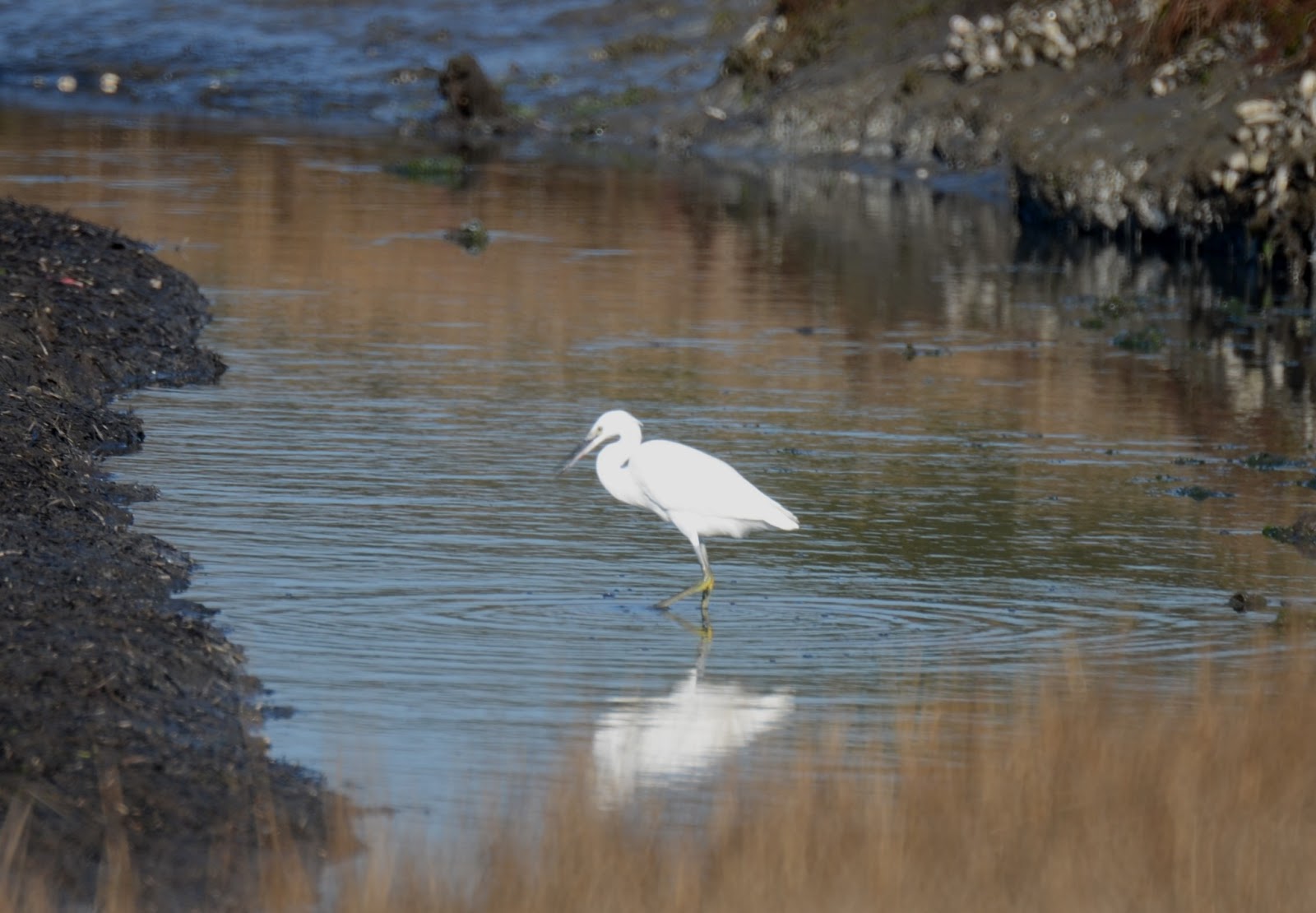
Im. Little Egret

Here’s the year by the numbers -

Lifebirds -
  • 9 new ABA and 4 Lower 48 lifebirds –
    • Golden-crowned Warbler – Frontera Audubon, TX
    • Tropical Mockingbird at Sabine Woods in TX (hopefully the experts will conclude it is a countable bird)
    • Arctic Loon, Yellow Wagtail, Bristle-thighed Curlew, and Bluethroat in Nome and Spectacled Eider in Barrow, AK
    • Red-billed Tropicbird in ME
    • Nanday Parakeet – seen in Tampa in June 2010 and recently added to the ABA list.
  • ABA total now at 732, US at 724, and Lower 48 at 709
Statebirding (my statebird maps with totals for each state is inserted below) -
  • Newly reportable in UT and ID
  • ABA reportable now in 40 states plus DC  
  • 260 statebirds added in 17 states, plus 45 more in Ontario
  • 37 new statebirds in New England – 1931 total ticks now in New England
  • Total Ticks – now at 12,413, with 12,183 of those in the U.S.
  • Added state birds in DC (including finding a rarity – White Ibis) to put a bit more room between my total and the threshold

Statebirding will continue to be my priority in 2013.  I’ll be pursuing my lifelong goal of being reportable in all 50 states plus DC – 10 more to go!  I also need to continue to add statebirds in states where I’m just a bit over the ABA threshold since those thresholds continue to inch up over the years.  I have 12 states where although reportable, my total is less than 10 over the threshold, so not very safe.  Chasing after New England statebirds will continue, though they get harder and require more chasing each year.  My goal is to get to 2,000 – with just 69 to go I’m hoping to be just 3 years away from my reaching my target.  Of course I’ll still chase after lifebirds where feasible. 

As for potential 2013 trips - I have a trip planned for AZ in January where my lifebird targets are the returning Nutting’s Flycatcher and the newly ABA-reportable Rosy-faced Lovebirds.  For my big statebirding trip I’m tentatively planning a June trip to southwest ID, northeast NV, eastern OR, and eastern WA.  If all goes well after the trip I could be reportable in NV and OR, and have a lot of room between my totals and the ABA thresholds for WA and ID.  Then there are my regular business trips to various spots around the country, with hoped-for trips into NM, KS, and OK.  Hopefully 2013 will be just as exciting as 2012!