Showing posts with label Black-backed Woodpecker. Show all posts

Wednesday, June 25, 2025

Manitoba – The Final Frontier, Part 2 of 3, June 2025

When it came time to start planning my big spring 2025 birding trip the destination was quite obvious – it had to be Manitoba.  That was my last state or province that I hadn’t birded extensively.  To paraphrase the Star Trek intro – Manitoba, the final frontier.  (Then again I haven’t yet birded Canada’s more distant and less accessible territories – Nunavut, Northwest, and Yukon.)

With an existing province list of just 61, there were lots of potential new province birds waiting for me in MB.  And if I flew into Grand Forks, ND, I could also fill a few gaps in my MN and ND lists before or after the MB portion of the trip. 

I reached out to my good birding friends Bill and Anita Hooker who went with me on my trip to FL back in January 2025, and they agreed to come along on this trip as well.  It was all coming together.

I spent several months planning the trip, including searching for the best birding hotspots in MB to maximize our species total, and looking for specific one-off targets near Grand Forks in MN and ND.  I came up with a 13-day itinerary where I could add at least 140 species in MB to break 200 for the province, add perhaps only 4 in ND, and hopefully 2 in MN.

This is the second of 3 blog posts summarizing the MB portion of the trip, covering June 2nd through the 5th. 

6/2 – Riding Mountain National Park

Earlier in our trip Brandon birder Gillian Richards connected us with local Riding Mountain birder Ken Kingdon to see if he could help us out in the park.  Better than that, Ken offered to show us around the morning of the 2nd, taking us to multiple stops north along Route 10.   

Our first stop was a short walk along Gray Owl dump road.  Here I added Ruby-crowned Kinglet, Cape May Warbler and Purple Finch.  (MB #165-167)  My Canadian province and territory map for Purple Finch is inserted below.  Provinces where I’ve seen this species are shaded in light blue – I’ve now seen Purple Finch in all 10 provinces.  Cross-hatched jurisdictions are those in the Purple Finch's regular range where I’ve yet to see it.  I’ve never birded in Canada’s three northwestern territories (yet!) so none of these will be shaded in for any of my Canada maps.

However, I missed the Siskins that everyone else heard.  Maybe I was distracted by the buzz of the hordes of mosquitoes.  Hopefully that wouldn’t come back to haunt me.

Next, we continued north to Bead Lakes for a longer walk through excellent boreal habitat.  It proved to be a great spot, with finds like Evening Grosbeak right in the parking lot, Hermit Thrush, Canada Jay, Canada Warbler, Mourning Warbler, Blue-headed Vireo, a heard-only Boreal Chickadee, Black-throated Green Warbler, and a calling Three-toed Woodpecker.  (MB #168-174)  Unfortunately we dipped on Winter Wren and Trumpeter Swan at an adjacent wetlands.  Ken also pointed out this tree to us – a bear had not only removed the bark near the top of the picture, but it had also rubbed on the bark below leaving some dirt behind.

Our next stop was at the far north end of the park at Crawford Creek.   I hadn’t picked out this site for a possible stop when I was planning the trip so I wasn’t sure what the targets might be here.  As we got out of the cars Ken said that this location was a reliable spot for Golden-winged Warblers, and before we left the parking lot we were hearing one singing nearby (MB #175).  We took a short walk and soon reached this classic Golden-winged habitat – an area of young deciduous trees with open grassy and shrubby patches. 

Soon we got visuals on one male with 2 others singing a short distance away.  I had planned to search for this species at a site on the eastern escarpment of the park – I didn’t realize they were at this site as well.   

We turned around and started heading south, soon reaching our next stop at Moon Lake.  Here we added 2 birds - a breeding plumage Bonaparte’s flew by just as we arrived, and we finally found Trumpeters Swans in the distance.  (MB #176-177)  We also took a short hike especially focused on Lincoln’s Sparrow and Wilson’s Warbler but with no luck.

Next we were on to the Boreal Trail, a site that has had quite a number of nice checklists in recent years.  Although the gate was closed, we assumed it was OK to walk in and take a short hike.   And we’re glad we did.  Here I finally heard multiple Pine Siskins, then an Olive-sided Flycatcher singing softly in the distance.  Then we focused on the willows and alders lining this fast-flowing stream and added both Lincoln’s Sparrow and Wilson’s Warbler. 

Then Bill got a brief look at a very dark woodpecker – sure sounded like it could be a Black-backed but we needed better looks.  Eventually we all got great looks at not one but 3 Black-backed Woodpeckers.  Seems early in the year to be a family group.  Could it be a small breeding colony?  (MB #178-182)

Our last stop of the morning was at a marsh just south of the park where Ken had had LeConte’s Sparrows recently.  The marsh and adjacent meadows seemed drier than normal – perhaps too dry for LeConte’s.  We listened intently for a while, and played some tape, but with no luck.  It was actually quite windy now, so we decided to come back in the evening to try again when the winds would hopefully be calmer. 

We thanked Ken for all his help in getting us on some great birds that morning, hoping that we might cross paths again some day.

After a quick lunch we decided to head to the west of the park, first to check out a report of 2 Connecticut Warblers.  Ken said that COWAs were not likely in the park anymore, so we were a bit skeptical.  The checklist area had some good habitat, but we couldn’t scare up a Connecticut. 

Then we were on to the dam at the south end of Lake Audy.  The area was quite birdy, and our first addition was a flock of 25 or so American White Pelicans on the north shore of the lake very far in the distance.  Good thing Pelicans are so large because they could have been as much as 2 miles away!  Much closer were several flyby Forster’s Terns followed by 2 Common Terns.  Six Trumpeter Swans were a nice sighting as they swam by.  (If only a 7th bird had joined them, we’d have had “7 swans a swimming”.)  And minutes later an Osprey and Bald Eagle flew by. (MB #183-186)  Finally, not new for my list, but still a nice find, was this Red-necked Grebe on its floating nest.

And as we drove from Lake Audy we encountered this Bear walking down the road shoulder right past us.  At this distance it’s nice to see the bear from the safety of a car.


That evening we went back to the marsh for another try for LeConte’s Sparrow.  Even though winds had greatly reduced, we still couldn’t turn up a LeConte’s.  Maybe water levels were just too low this year.  Next we planned to head to the area east of Lake Katherine for Woodcocks.  We were a bit early when we arrived in the area, so we headed to Lake Katherine and had a spectacular nighthawk show over the lake.  That was the highlight of the evening because we had no luck with the Woodcocks. 

I ended the day with 22 new species for my province list, bringing my MB total to 186.  Closing in on 200…

6/3 – Riding Mountain NP

This day was focused on sites along Route 19 on the eastern side of Riding Mountain.  My first key stop was at a stream-lined with willows, hoping for looks at Lincoln’s Sparrow or Wilson’s Warbler.  Unfortunately, those targets remained elusive, but I did have a Red-breasted Nuthatch calling in the distance (MB #187).  Ken had told us that the lack of a cone crop in the Park this year meant that Red-breasted Nuthatches (along with Crossbills) were very scarce, so I was happy to get this one.

A bit further down the road I had a Pileated Woodpecker calling in the distance – the first for the trip but not new for my list.  And as I neared Whirlpool Lake I spotted the first of 3 Wild Turkeys ambling along the road shoulder (MB #188).

Soon afterwards I reached Whirlpool Lake and the woodlands near the parking lot were quite birdy, including 13 species of warblers.  Plus this “scruffy” Canada Jay.

And the lake itself was very pretty.

I doubled back to Lake Katherine and did some quick birding along the trails there.  The highlight of this stop was an Olive-sided Flycatcher characteristically perched on top of the tallest dead snag.

Our last stop of the day was along Clear Lake where we heard another Boreal Chickadee though couldn’t get any visuals.  We called it quits early that day, taking the late afternoon off.    


 I finished the day with 2 additional species, bringing my MB list to 188.

6/4 – Riding Mountain, Portage-la-Prairie

The plan for the morning was to bird the East Escarpment of Riding Mountain along Route 361 out of McCreary.  But first we had to take a picture of the formal east entrance to the park.

Our key target along the East Escarpment had been Golden-winged Warbler, but of course we already found this one at the north end of the park.  Our other 2 remaining targets were Indigo Bunting and Eastern Towhee, both near the northern edge of their ranges.  Gillian had suggested a trail to take to find both targets, along with the Golden-winged.  So that trail was our first stop, and almost immediately after getting out of the car at the trailhead we heard a singing Eastern Towhee.  And then seconds later a singing Indigo in this habitat.  That was easy… 

We took a short walk along the trail adding a flyby Ruby-throated Hummingbird (MB #189-191) and an additional Indigo.  We didn’t have any Golden-wings though – good thing we got them earlier.  Though I’m sure we would have birded more of the trail if we still needed this target.

Next we headed to the former ski slope at end of the road.  One of our first observations here was of a mid-sized mammal walking up one of the slopes – perhaps a mink? 

Notable birds here were a cooperative Blackburnian Warbler, and another flyby Hummingbird.  It was interesting to imagine this spot during its skiing hay day.  Our last stop in the area was a short hike on the Oak Ridge Trail, with a half dozen Least Flycatchers being most notable,

After 3 ½ days at Riding Mountain NP, we were off to the Portage-la-Prairie area.  Gillian had helped to connect us with Cal Cuthbert who was a local birding expert in that area.   Not only does he know the area extremely well, he has an amazing property with widely diverse habitats and great birds.  But first, Cal took us to the Portage-la-Prairie landfill which is well-known for its gull flock and the potential for rarities mixed in.  When we arrived, we drove right up on the landfill, and had just an estimated 60 Herrings, 40 Ring-bills, and 10 Franklin’s.  That didn’t seem like enough critical mass to have any rarities, but we quickly picked up at least 4 immature Lesser Black-backed Gulls, 2 adult Californias, and this stunning immature Glaucous photographed by Anita. (MB #192-194)  

MB was my 5th province where I've seen Lesser Black-backed Gull - 4 of which as rarities (the dark blue shaded provinces in my map below).

Plus, we had one bird that I thought was a Thayer’s but eBird reviewers said it was a Herring.  Unfortunately, I didn’t get on the Thayer’s that Cal spotted when we first arrived.

After a most successful time at the landfill, Cal took us to a private location where he had Saw-whet Owls nesting in a nest box.  

We were lucky enough that this juvenile bird was peering out of the box when we arrived (MB #195).

Next Cal took us to the Delta Beach area at the southern end of Lake Manitoba.  Here we witnessed a spectacular shorebird show thanks to Cal taking us to numerous secluded vantage points along the beach.  At each stop along the lake there were hundreds of shorebirds foraging in front of us, and an almost constant movement of birds heading west in waves along the shoreline.  We estimated at least 5,000 birds were included, mostly Semipalmated and White-rumped Sandpipers among the 14 species of shorebirds.  Here’s a typical shot with Semis, White-rumps, and a Sanderling in the foreground, and a pair of Caspian Terns in the background (one Tern is standing directly behind the other – can you see the 4 legs?).

By the end of the afternoon I had added 3 new MB species – 2 Red Knots (MB #196), 2 Caspian Terns (MB #197 – the old ABA reporting threshold for MB), and 32 Black-bellied Plovers (MB #198).  But nearly all were chased away by a Peregrine (MB #199) – at least now we don’t have to spend time trying for that one in downtown Winnipeg. 

We ended up with 101 species for the day, including 14 species added to my province list which now sits at 199.

6/5 – Portage-la-Prairie

We met up with Cal early that morning and he took us to a wet grassy field that had been good for LeConte’s Sparrow in the past. 

Unfortunately, the local drought meant the field was drier than normal, but with the help of some tape we eventually found LeConte’s - in fact we got great views. 

That brought my MB list to 200 – my original goal for the trip.  And we hadn’t even reached Churchill yet.

Then Cal took us to a large lot heavily wooded with mature oak trees at the Young Husband Lodge, in hopes of finding White-breasted Nuthatch.

We not only were successful in finally finding the Nuthatch, but also had views of, and heard, a Great Horned Owl.  And as we were leaving the lot 4 Sandhill Cranes flew overhead.  (MB #201-203)

We went back to Cal’s amazing yard where we walked several trails and ended the visit with some leisurely birding on the back deck.

We bid farewell to Cal, and couldn’t thank him enough for his help and allowing us to visit his amazing property.

The it was off to Winnipeg where I had 3 possible targets – Cooper’s Hawk, Cardinal, and Red-bellied Woodpecker.  All had been seen several times recently at multiple parks in the city, but local directions were limited for almost all of them.  I decided to try Bunn’s Creek Centennial Park as perhaps the best bet, and we headed there for a late afternoon visit.  Unfortunately, we dipped on all 3 targets, but we added an unexpected singing Yellow-bellied Flycatcher (MB #204).

I added 5 to my province list for the day, bringing my MB total to 204. 

Saturday, June 24, 2023

Oregon Portion of the Northwest Sagebrush Country Trip, Part 2 of 2, May-June 2023

This post summarizes the second half of the Oregon portion of my sagebrush country trip starting on Day 5 of the trip.  The previous blog post summarized the first half of the OR part of the trip on Days 2-4.  See my next post for the Washington part of the trip.

Day 5 – May 28 - Idlewild Campground and La Grande

Our plan for Day 5 was to start our day a short distance north at the Idlewild Campground in the Malheur National Forest, starting pre-dawn and then birding there through much of the morning.  The campground and surrounding area were at an elevation of about 5,000 feet in forest dominated by Ponderosa pines.  Needless to say our targets here were quite different from those at the refuge, most notably including 3 woodpecker species – Black-backed and White-headed Woodpeckers and Red-naped Sapsucker.  

But perhaps even more exciting were the nocturnal species often heard near the campground.  This spot was seemingly reliable for Flammulated Owl and Poorwill.  Plus apparently Long-eared Owl was a possibility.  Although sightings of this sensitive species are not detailed in eBird, I noticed a couple nocturnal checklists from the site in previous years mentioning in the details that they heard Flammulateds near where the Long-eareds were heard.  Plus there were occasional Pygmy Owl reports here too.  Certainly a target-rich environment.

We arrived near the entrance to the Idlewild Campground at 4:10 AM, more than an hour before sunrise.  We got out of the car and listened for a while, hearing a Poorwill calling in the distance.  Then we started playing tape for Flammulated Owl, and shortly thereafter had one call in response (OR statebird #26).  That’s only the 4th time I’ve heard this species, following single observations in CA, NV, and UT.  Then we played recordings of the hoots of the Long-eared Owl, and got an almost immediate response of a series of higher-pitched nasal calls that neither of us recognized.  I checked other Long-eared calls on the Sibley app and realized that what we were hearing was a match to the “Harsh hoots (female)” call (OR statebird #27).  I didn’t even know that Long-ears made that call.  My statebird map for this species is a bit unusual.  Although I’ve seen or heard this species in all 5 of the western-most Lower 48 states, and a couple states on the East Coast, I’ve yet to observe it across the vast majority of its range throughout much of the country.

While we were listening to the Owls several Dusky Flycatchers started calling nearby (OR statebird #28).  That was an expected species at this spot, but not necessarily expected to be calling still 45 minutes before sunrise.

We then drove a short distance down NF 2820 on the north side of the campground and came upon a large parking lot for snowmobilers.  We thought this large “clearing” in the forest might be a good location from which to listen for other calling nocturnal birds, so we pulled in to check it out.  We had been out of the car just a short time when I heard what at first I thought was a Snipe winnowing.  But we it was odd to hear a Snipe before dawn, and especially one in the middle of a pine forest.  And then I said “unless it’s a Boreal Owl”.  The bird continued to call every 45 seconds or so, giving a series of short hoots that started soft and got louder, and lacked the metallic quality of a Snipe.  We were shocked to have found a Boreal Owl! (OR statebird #29).  Per “Handbook of Oregon Birds” by Herlyn and Contreras (2009), this species nests near the northeast corner of OR, but is not known to breed this far south in the state.  That’s only my 3rd Boreal Owl, the first 2 being in MA and AK.  What an amazing start to the morning – 4 new statebirds before sunrise!

It was now daylight and time to switch gears to start looking for diurnal birds.  We drove into the campground and started making a slow walk around the campground loop.  The Ponderosa pine habitat is one of my favorites.

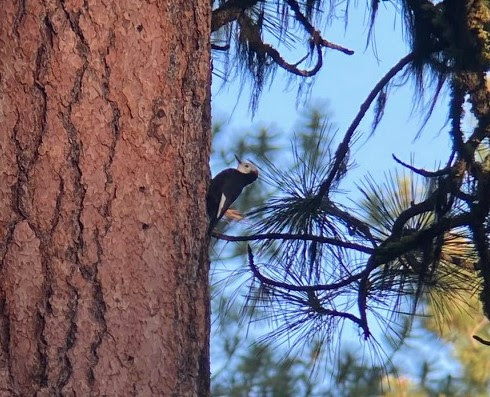
We had only walked a short distance when we heard woodpecker tapping sounds up ahead.  As we approached closer a woodpecker flew by – it was a White-headed Woodpecker (OR statebird #30).  It joined a second bird, and we watched these gorgeous birds for quite a while as they foraged nearby.  Here’s a heavily cropped photo of one of the birds.

We continued our walk around the campground and started to hear a harsh call in the distance that I didn’t recognize.  I played some tape and realized it was a Clark’s Nutcracker (OR statebird #31).  And Merlin confirmed it as well.  I just need this species in 2 more states in its regular range.

We were now walking along the western access road of the campground in just about the only patch of deciduous trees in the area.  I mentioned that this could be a good spot for our Sapsucker target since they prefer aspens.  And just then I noticed some movement in some low trees nearby and spotted a Red-naped Sapsucker (OR statebird #32).  It’s nice when your targets cooperate.

Our next target was Black-backed Woodpecker which had been reported in previous years in a recent burn along NF 2820.  There was a recent burn on the north side of the road near the campground, so we assumed that was the one in question.  We started slowly walking through the burn area – most all the underbrush had burned in the fire, and all the tree trunks were charred though few of the trees were killed.  The area was actually quite birdy, with a number of both Red-breasted and White-breasted Nuthatches, a pair of Western Bluebirds (I need that one in ID later in the trip!), Cassin’s Finches, and “Oregon” Juncos.  Plus we spent some time watching Townsend’s Solitaires as they sang in flight high above the trees.  We didn’t know that that’s their typical approach for singing on territory.

But we had no woodpeckers of any species.  Though most of the charred trees had bark chipped off with piles of bark chips near the base, so we remained hopeful.

We had spent nearly an hour wandering through the forest and were thinking of giving up when we heard a drumming call in the distance.  It was similar to the call on the Sibley app, and Merlin thought it was a Black-backed too, but we needed to be sure.  A recording of the Black-backed call is uploaded to my eBird checklist - ebird.org/checklist/S139676839

We walked closer to the call and eventually a large woodpecker flew in and landed nearby – it was indeed a male Black-backed Woodpecker (OR statebird #33).  We watched it forage on trees nearby and then it just disappeared.  We walked around the last tree it was on and David spotted a nest hole.  Not only had we found a Black-backed Woodpecker, we had found a nest!  A bit later another Black-back called in the distance and this second bird flew in – it was the female. 

A couple minutes later we watched a nest exchange as the male flew out and the female flew in to take his place.  So cool!  Later we had another Black-back on the Summit Trail on the other side of the campground giving us 3 in one morning.

It was now about time to head out, and as we started our drive from Idlewild Campground a Green-tailed Towhee flew by.  A nice way to end our morning.  We had only 31 species in nearly 7 hours of birding at the campground, but we sure had some great birds.

Our hotel that night was in La Grande, 3+ hours to the north.  But along the way we had one target to pursue – Grasshopper Sparrow at the Thief Valley Reservoir.  There were several reports of that species there in previous years, and just a couple so far this year, but locations weren’t very detailed.  So I reached out to one of the birders who had reported the sparrow there this year, Nolan Clements, for some advice.  Nolan provided us excellent input on the best location to find the Grasshopper Sparrows, and offered to help on our other targets as well.  His help would prove to be invaluable on several of these other chases too. 

But first back to the Grasshopper Sparrow – Nolan gave us specific coordinates of the best location, which took us to the edge of a grassy field being grazed by cows.  We walked a short distance along the fence line and played some tape but got no responses. 

We then drove to another part of the field but the grass there was more heavily grazed and didn’t look like it would be as appealing to our target.  In fact, the best habitat seemed to be back where we first stopped, where there was a strip of taller grasses close to the fence.  So we went back there and played more tape.  This time we heard a weak response and then spotted a Grasshopper Sparrow that perched on the fence long enough to allow me to get this digi-binned photo (OR statebird #34).  We should have just stayed at the initial location suggested by Nolan. 


Our last stop of the day was Deal Canyon in La Grande where Nolan suggested we might find Calliope Hummingbird.  We parked at the bottom of Deal Canyon Rd. and started walking up the paved road that took us into the canyon.  The road was quite steep so luckily there were a quite number of birds to look at while we rested along the way to catch our breath.  At one point I spotted an Orange-crowned Warbler in the brush (our only one of the trip), and then spotted a Nashville Warbler in the same patch of brush (OR statebird #35).  We would later have 3 more singing Nashville’s on the way up.  Unfortunately we couldn’t come up with any hummingbirds.  At least the view was nice.


Nolan mentioned that if we missed Calliope at Deal Canyon he could contact his parents who live in La Grande to see if we could look for them at their feeders.  So on our way down I called Nolan and left him a message to see if we could visit their feeders the next day.  But more on that tomorrow.

Yet another day of double-digit new statebirds!

Day 6 -May 29 - La Grande Area

We only had 2 planned stops for the day on the west side of the Wallowa Mountains, which at most would fill about half the day.  So with extra time on our hands I did some more eBird research the night before to see if anything else might be around to chase after.  There was a recent report of Great-tailed Grackle a short distance from town that was confirmed by the eBird reviewer, so that one would be worthwhile to try for.  And just in case we were unable to reach Nolan’s parents I put together a list of other Calliope Hummingbird sightings in the area, though all were at private residences.  That one might take some effort…

Our first stop was the riparian area along Philberg Rd.  That road would dead-end at a parking area and the beginning of a foot trail that would take us into the next hotspot, Rhinehart Canyon, with more riparian habitat.  We had 3 remaining targets possible at both sites – Calliope Hummingbird, Veery, and Catbird.  Though Nolan mentioned that Veery can be difficult in the Canyon but are vocal along Philberg Rd so be sure to drive along slowly with our windows down.

We arrived at the north end of Philberg Rd. at 5 AM just a couple minutes before sunrise and began our slow drive south.  We had come no more than a quarter mile with windows down as Nolan suggested when I heard what I thought was a singing Wood Thrush from the hillside above the road.  We quickly got out of the car and amazingly it was indeed a singing Wood Thrush! (OR statebird #36)  We listened to it singing its “e-o-lay” and similar songs for the next 15 minutes.  A recording of the Wood Thrush is uploaded to my eBird checklist - ebird.org/checklist/S139728975.  Although there are many other birds singing at the time drowning out the Wood Thrush, it is best heard 2 seconds into the recording.

We knew it was a rarity for OR but didn’t know just how rare it was until later – there are only 5 prior accepted records in the state!  This species normally only gets as far west as the eastern portion of the Great Plains.  Interestingly that was my second Wood Thrush as a western vagrant – I photographed a bird in NM years ago.

It was quite anti-climactic, but while we were listening to the Wood Thrush we also had a singing Veery (OR statebird #37).  And minutes later we had the first of many Catbirds, which were one of the most common birds there (OR statebird #38). 

After birding along Philberg Rd. for about an hour we reached the end of the road and the parking lot for the Rhinehart Canyon trail.  We then went on foot and headed south into the canyon.  Catbirds continued to be common, but as Nolan predicted, we had no more Veerys.  Canyon Wrens were common singers from the rocks above us, and the riparian area was quite birdy featuring many Bullock’s Orioles, Black-headed Grosbeaks, Yellow Warblers, Nashville Warblers, and the like. 

Then we reached the bridge that formerly was sturdy enough for vehicles but was now only a footbridge.  Three boulders had been placed at the end of the bridge to prevent anyone from driving onto it, and the foot trail continued along hugging the left edge of the left boulder.  Just as I stepped near the boulder about to get onto the bridge I heard an odd sound that startled me and I quickly stepped back.  From a distance we peered under the boulder and there was a very large head of a rattlesnake.  We thought it might be 5 feet long!  Here’s a picture of the snake tucked in under the boulder.


Since that was the only way onto the bridge and the rest of the trail beyond we decided not to tempt fate and turned around and headed back to the car.  Though it was tough to leave this nice habitat behind.

On our way back to the main road we stopped at the Wood Thrush spot on Philberg Rd. but could no longer hear the Thrush.  Hopefully it was still there for others to hear it later on.

We got back to La Grande and tried calling Nolan again but it once again went to voicemail.  [It turns out that Nolan was birding out of cellphone range at the time.]  We didn’t want to leave town without the Calliope, so we decided to try a couple of the private feeders to see if we might be able to gain access.  One of those feeders where Calliope had been reported was on Morgan Lake Road but it turned out that the feeders were not visible from the road.  I was tempted to knock on the door but the fenced front yard kept me from getting to the door.  Then I noticed a hummingbird feeder across the road, and watched it from a distance for a short while when a male Rufous Hummingbird came in for a visit.  Worried about continuing to stare into people’s backyards with binoculars, I knocked on the front door but no one was home. 

We decided that was enough trying to access private feeders unannounced.  Then David went onto one of his favorite people search websites and potentially found the phone number for Nolan’s parents.  I gave the number a call but could only leave a message, hoping that we had the correct number but apologizing in the message if we had it all wrong.  (If only there was such a thing as a phone book again.)

Then we went off to chase after the recently reported Great-tailed Grackle.  The report came from a wetland a short distance southeast of La Grande along Airport Rd.  The wetlands was very birdy, featuring 9 species of waterfowl and 3 Black-necked Stilts.  And we had the regular Red-winged and Yellow-headed Blackbirds, but no Grackles.  Just then my phone rang and it was Nolan’s father, Steve Clements – we had the correct number after all.  He was fine with us coming by to watch his feeders.  But first he gave us another suggested spot for the Grackle – just around the corner on Wilkinson Lane.  We went over to Wilkinson Lane and ran into a small group of birders at another marsh.  There were once again quite a number of birds there but no Grackle.  They mentioned that the Grackle actually hadn’t been seen there for a few days, and suggested trying another nearby spot, the Grande Hot Springs RV Resort, where one bird (or perhaps the bird) had been reported.  So we took a quick drive over to the RV park but came up empty again. 

We decided it was time to give up on the Great-tailed Grackle, and head to the Clements’ back yard to try for their Calliope.  After a short drive we arrived at Steve’s house and he and his wife greeted us at their backyard gate.  They offered us chairs on the back porch and we started our vigil for our target hummingbird. 

While we waited we mentioned that we had a singing Wood Thrush earlier in the day, to which Steve said something like – “oh you’re the ones that had the Thrush.”  The news had apparently traveled fast, and other birders had already tried unsuccessfully for it after we posted the eBird checklist.  Steve then made a quick call to Trent Bray who is the eBird reviewer for the area, mentioning that we were at his house looking for hummingbirds.  Trent came by a few minutes later and we had an opportunity to describe our sighting to him in person – certainly better than just having the eBird reviewer evaluate our description written down in a checklist.  Trent and Steve were both thinking about trying to re-find the Thrush, and I suggested trying again this evening rather than the next morning in case the bird decided to migrate out of the area overnight. 

But now back to the hummingbirds...

After a short wait a female hummer visited the feeder close to us on the porch.  It most often fed from the far side of the feeder out of view but came around occasionally showing buffy flanks and faint streaking on the throat.  A bit later another female hummingbird arrived, this one lacked the buffy flanks of our first bird and was pumping its tail.  But we couldn’t see a noticeable size difference.  After some discussion we decided the first bird was a Calliope and the second was a Black-chinned, and the size difference was difficult to tell at such a close distance.  Later a hummingbird visited the feeder out in the yard and this one was obviously a smaller Calliope (OR statebird #39).  OR was the last state where I needed this species in its regular range.  I’ve also seen Calliopes in 7 eastern and central states as rarities.

With our target bird out of the way, and some time now on our hands, we had a nice chat with Trent and Steve, especially focused on our trip.  Steve mentioned that he had heard that just after we left the birding group on Wilkinson Lane the Great-tailed Grackle appeared.  We thought about heading out right away to chase after it.  But then Steve said that there was a small colony of Great-tailed Grackles in Ontario, OR.  We would be driving right through Ontario in a couple days on our way from WA back to Boise so we decided to give them a try in a few days instead.  We also talked a bit about our planned walk the next morning at the McCully Creek Trail and Trent and Steve gave us great advice for birding that spot as well.  But now it was time to get back on the road, so we thanked them for all their help as we headed out and wished them good luck on re-finding the Wood Thrush.

It turns out that Trent was able to re-find the Wood Thrush that evening, getting a much better recording of the singing bird than mine.

Our hotel that night was in Enterprise, OR, just over an hour away.  It was still pretty early when we checked in, so we decided to do some scouting for the next day’s walk at McCully Creek Trail.  The trail was on the north side of the Wallowa Mountains just south of the town of Joseph.  The scenery was nothing short of spectacular - this panoramic view just doesn’t do it justice.

There were a couple options for places to park and locations to pick up the trailhead so we were glad to have checked it all out in advance.  And after a bit of exploring we thought we had it figured out and were ready for the next day’s hike.

Day 7 – May 30 - McCully Creek Trail and Drive to Walla Walla

Our plan was to bird McCully Creek Trail on foot for much of the morning before starting to make our way toward Walla Walla for the WA portion of the trip.  The key attractions for this trail are Grouse – all three species of them.  In fact, this spot is among the best in the state for Spruce Grouse.  Plus there is the chance for a number of other boreal species like Pine Grosbeak, Goshawk, 3-toed Woodpecker, etc. 

Given our interest in the Grouse we wanted to be the first ones on the trail, so we arrived at 5 AM, a few minutes before sunrise, and started our hike.  We walked along slowly looking for Grouse both on the ground and perched in the trees.  Soon after we started we heard a drumming Ruffed Grouse – definitely a nice start.  We were picking up a few birds here and there like Mountain Chickadee, both Kinglets, and Hermit and Swainson’s Thrushes.  Then we started to hear low-pitched calls right next to us coming from the spruce underbrush that almost sounded like hoots.  We peered into the brush but it was too thick to see anything.  Whatever was making these sounds was moving because the hoots continued but slowly got farther away.  They sounded somewhat like the hoots of a Long-eared Owl, but that wouldn’t be likely at all this time of day, not to mention unlikely so close to the ground.  We were thinking it could be a Grouse walking on the ground, but the calls didn’t sound anything like any of the calls for any of the three Grouse species provided on the Sibley app.  Eventually the calls stopped and we were left scratching our heads.  We would have to do some research that evening to see if any of the Grouse make calls like these.

But for now, it was back to birding.  We continued up the trail and started picking up singing Fox Sparrows, “Oregon” Juncos, and Pacific Wrens from the underbrush.  And from overhead there were numerous Yellow-rumped and Townsend’s Warblers, Hammond’s Flycatchers, and Warbling Vireos.  Wetter brushy areas featured MacGillivray’s and Wilson’s Warblers.  One of our highlights was finding a couple groups of Chestnut-backed Chickadees – striking birds.  And a singing Olive-sided Flycatcher was a nice addition.  But we found no other boreal species, nor any more Grouse, even though we spent 5 hours on the trail, covering the first 1.5 miles, sometimes hiking through some remaining snow patches.

Although we were a bit disappointed when left the trail, our moods picked up that evening when I went onto xeno-canto.org and played several recordings of the Spruce Grouse.  It turns out one recording of “alarm calls” from northwest Montana was a nearly perfect match to what we heard near the beginning of the trail.  So that evening we decided that our mystery call was indeed from a Spruce Grouse (OR statebird #40).  Although there are a number of states where I’ve yet to see Spruce Grouse in its regular range, I’m very happy to have found this hard-to-see species in 8 states across the country.

On our way to Walla Walla we had one last stop in OR in the Umatilla National Forest near the OR/WA state line.  There was a spot right along the highway where 3-toed Woodpeckers were seen each of the last 2 years.  Although there were no reports in 2023, the eBird locations from 2021 and 2022 were pretty specific so at least we knew where to look.  We started from where the birds had been seen and walked along the road about a quarter mile in each direction but the only woodpecker we found was a Flicker.  Though 4 flyover Red Crossbills were nice consolations.  Soon thereafter we bid farewell to OR and were off to WA!

Days 7-9- Washington 

See my next blog post for the WA portion of our trip on Days 7 through 9.

Day 10 – June 2 - Ontario, OR

We left Walla Walla around sunrise and were on our way to Boise and searches for several targets in ID.  But along the way, we had one last stop to make in OR – in Ontario for the Great-tailed Grackle.  A quick search of eBird showed that there were 2 seemingly reliable spots for them in town – Beck-Kiwanis Park, and the Walmart parking lot.  The park sounded like a much better habitat to bird, so we started our search there.  We pulled into the parking lot for the park and it looked like a typical county park with lawns and scattered trees and some ballfields.  But off to the north we could see a pond and wetlands, likely better habitat for the Grackles.  Before the car had even stopped I spotted a blackbird perched on a footbridge at the wetlands.  I put the bird in my binocs and it was indeed a Great-tailed Grackle (OR statebird #41).  I got this marginal digi-binned photo of the bird in the distance.  

OR was my 17th state for this species which continues to expand its range.

Conclusion

We ended the trip with a whopping 166 species in OR, a testament to that fact that we birded so many different habitats in and around sagebrush country.  And most importantly that included 41 new statebirds, much better than the 28 I hoped for.  That brings my statelist to 290, greatly exceeding both the old ABA reportable threshold (259) as well as my “ABA reportable plus 15” goal (274).  Note that as of May 2023 the official OR statelist stands at 548 – meaning that the new threshold for half of the total would be 274.  Looks like just being 15 over the old threshold isn’t enough to stay above half the statelist total. 

I have now exceeded the old ABA thresholds in all the Lower 48 states and the District of Columbia.  Interesting that both of the OR species that allowed me to reach the ABA threshold (Virginia’s Warbler) and my “ABA reportable plus 15” goal (Rose-breasted Grosbeak) were rarities.  It’s nice when it happens that way.

Here is a link to my eBird Trip Report for the OR portion of our trip –

OR Portion of 2023 Sagebrush Country Trip - eBird Trip Report

Many thanks to Ezra Cohen for his help at Malheur NWR, and northeastern OR birders Nolan and Steve Clements and Trent Bray for all their help on so many of our searches.  And thanks to Steve for allowing us to visit his hummingbird feeders.

Sunday, June 11, 2023

Summary of OR/WA/ID Sagebrush Country Trip, May-June 2023

In January 2016 an armed group of protestors seized and occupied the headquarters of the Malheur National Wildlife Refuge in eastern Oregon.  By the time the occupation was over in February 2016, there was a considerable amount of destruction of the refuge facilities, resulting in closure of the headquarters facilities for months.  Unfortunately, I had planned a summer 2016 birding trip to the sagebrush country in eastern Oregon, eastern Washington, and southern Idaho, to include a lengthy stop at Malheur NWR.  But given the issues at Malheur, I shelved those plans and headed to Alberta and British Columbia that summer instead. 

But my interests in birding eastern OR, eastern WA, and southern ID continued as this was the last large section of the Lower 48 that I had not yet birded.  And a new part of the country for me would equate to considerable statebirding potential.  So after further delays first due to moving, and then due to Covid, I finally got around to scheduling the OR/WA/ID sagebrush country trip for the summer of 2023.  Plus I added a short side-trip to the South Hills of ID for the Cassia Crossbill.  I reached out to birding friend David Donsker who often joins me on these trips, and he agreed to come along. 

But simply adding a lot of statebirds wasn’t my only objective for the trip.  Years ago, the ABA allowed you to report your totals for a given state only if your total exceeded half of the total number of species ever recorded in that state.  Many years ago I had set a goal to be able to report my totals to the ABA in each of the continental 49 states.  Eventually I exceeded those thresholds in each state except one – OR.  Although those ABA reporting thresholds no longer exist, they still represent a logical set of standards to strive for in each state.  And since the state totals inch up over the years as new birds are added to the state list, I set a somewhat arbitrary goal of being 15 over those old ABA thresholds (I call it “ABA plus 15”).  I started the 2023 trip with 249 species in OR, just 10 shy of that old ABA reportable threshold.  So this was certainly a realistic secondary objective for this trip.

After considerable research on-line especially on eBird, and with invaluable advice from a number of local birders, I set up an 11-day itinerary from May 24th to June 3rd, starting in southern ID, then into eastern OR, next into southeastern WA, then back to ID for flights back home from Boise.  With pretty good statelists in ID (224), OR (249), and WA (267), my potential for new statebirds wasn’t too great.  I hoped to add perhaps 8 new birds in ID, 28 in OR, and 12 in WA.  Adding just 48 new statebirds was kind of a low tally for such a long trip, even though this was a new part of the country for me.  But for better or worse, I’m at the point of diminishing returns in my statebirding endeavors.

This blog post presents a brief summary of the entire trip.  My next 3 posts summarize the ID, OR, and WA portions of the trip.

Entire Trip Results, May 24-June 3

David and I were able to find 188 species on the trip as we chased after our targets over numerous, diverse habitats across the region.  A total of 67 of these were new statebirds, well over my target for the trip in each state.  That brings my “Total Ticks” (sum of all my state and province lists) to 15,114.  Here’s a summary of the trip by the numbers –

  • 21 waterfowl species (not bad for a semi-arid region)
  • 7 gallinaceous species
  • 10 raptors
  • 5 owls
  • 7 woodpeckers
  • 10 flycatchers
  • 6 wrens
  • 15 sparrows, and
  • 10 warblers (it was out west after all)

Here is a link to my eBird trip report for the overall trip - ID-OR-WA 2023 Trip - eBird Trip Report

ID Trip Results - May 24-25, June 2-3

We found 112 species in ID, 10 of which were new for my statelist.  That brings my total to 234. Notable was a striking Black-throated Sparrow at Oolite Trail in Owyhee County.  Unfortunately, the sparrow’s dry sagebrush habitat isn’t nearly as attractive as the sparrow.

We also saw at least 4 Prairie Falcons at these canyons at Swan Falls Park in the Snake River Birds of Prey National Conservation Area in Ada County.

A final personal highlight was finally seeing a Say’s Phoebe in ID, this one was at Dedication Point in Ada County.  This sighting was notable because David and I had completed many unsuccessful searches for this species the previous year in the ID panhandle.

Oregon Trip Results, May 26-30, June 2

We tallied 166 species in OR including 41 new statebirds.  That brings my new total to 290, well over the old ABA threshold.  We found 3 rarities – Virginia’s Warbler at Malheur NWR, Boreal Owl at Idlewild Campground in Harney County, and Wood Thrush (only the 6th state record) at Philberg Road in Union County.  We were also able to track down 3 other rarities found by others at Malheur NWR – Least Flycatcher and 2 Rose-breasted Grosbeaks.  The Grosbeaks were most cooperative, as they fed in the same tree where they were first discovered 10 hours earlier!


Interesting that both species that allowed me to reach the ABA reportable goal (Virginia’s Warbler) and my ABA reportable plus 15 goal (Rose-breasted Grosbeak) were rarities.  It’s nice when it happens that way.

Finally, finding a Black-backed Woodpecker nest in a recent burn next to the Idlewild Campground was very exciting.  Here’s the female just before it replaced the male on the nest likely incubating eggs.


Washington Trip Results, May 30-June 2

We found 112 species in WA, 16 of which were new for my statelist, increasing my total to 283.  Notable were a Gray Partridge in Walla Walla and an out-of-place Chukar in sagebrush in Benton County, nicely illuminated at dawn in this picture.

A final highlight was several Green-tailed Towhees singing from isolated patches of thick brush on slopes below Biscuit Ridge in Walla Walla County – just about the only spot to find them in all of WA.  One was singing from the brush in the middle of this picture.  And the scenery was nice as well!