Showing posts with label Evening Grosbeak. Show all posts

Wednesday, June 25, 2025

Manitoba – The Final Frontier, Part 2 of 3, June 2025

When it came time to start planning my big spring 2025 birding trip the destination was quite obvious – it had to be Manitoba.  That was my last state or province that I hadn’t birded extensively.  To paraphrase the Star Trek intro – Manitoba, the final frontier.  (Then again I haven’t yet birded Canada’s more distant and less accessible territories – Nunavut, Northwest, and Yukon.)

With an existing province list of just 61, there were lots of potential new province birds waiting for me in MB.  And if I flew into Grand Forks, ND, I could also fill a few gaps in my MN and ND lists before or after the MB portion of the trip. 

I reached out to my good birding friends Bill and Anita Hooker who went with me on my trip to FL back in January 2025, and they agreed to come along on this trip as well.  It was all coming together.

I spent several months planning the trip, including searching for the best birding hotspots in MB to maximize our species total, and looking for specific one-off targets near Grand Forks in MN and ND.  I came up with a 13-day itinerary where I could add at least 140 species in MB to break 200 for the province, add perhaps only 4 in ND, and hopefully 2 in MN.

This is the second of 3 blog posts summarizing the MB portion of the trip, covering June 2nd through the 5th. 

6/2 – Riding Mountain National Park

Earlier in our trip Brandon birder Gillian Richards connected us with local Riding Mountain birder Ken Kingdon to see if he could help us out in the park.  Better than that, Ken offered to show us around the morning of the 2nd, taking us to multiple stops north along Route 10.   

Our first stop was a short walk along Gray Owl dump road.  Here I added Ruby-crowned Kinglet, Cape May Warbler and Purple Finch.  (MB #165-167)  My Canadian province and territory map for Purple Finch is inserted below.  Provinces where I’ve seen this species are shaded in light blue – I’ve now seen Purple Finch in all 10 provinces.  Cross-hatched jurisdictions are those in the Purple Finch's regular range where I’ve yet to see it.  I’ve never birded in Canada’s three northwestern territories (yet!) so none of these will be shaded in for any of my Canada maps.

However, I missed the Siskins that everyone else heard.  Maybe I was distracted by the buzz of the hordes of mosquitoes.  Hopefully that wouldn’t come back to haunt me.

Next, we continued north to Bead Lakes for a longer walk through excellent boreal habitat.  It proved to be a great spot, with finds like Evening Grosbeak right in the parking lot, Hermit Thrush, Canada Jay, Canada Warbler, Mourning Warbler, Blue-headed Vireo, a heard-only Boreal Chickadee, Black-throated Green Warbler, and a calling Three-toed Woodpecker.  (MB #168-174)  Unfortunately we dipped on Winter Wren and Trumpeter Swan at an adjacent wetlands.  Ken also pointed out this tree to us – a bear had not only removed the bark near the top of the picture, but it had also rubbed on the bark below leaving some dirt behind.

Our next stop was at the far north end of the park at Crawford Creek.   I hadn’t picked out this site for a possible stop when I was planning the trip so I wasn’t sure what the targets might be here.  As we got out of the cars Ken said that this location was a reliable spot for Golden-winged Warblers, and before we left the parking lot we were hearing one singing nearby (MB #175).  We took a short walk and soon reached this classic Golden-winged habitat – an area of young deciduous trees with open grassy and shrubby patches. 

Soon we got visuals on one male with 2 others singing a short distance away.  I had planned to search for this species at a site on the eastern escarpment of the park – I didn’t realize they were at this site as well.   

We turned around and started heading south, soon reaching our next stop at Moon Lake.  Here we added 2 birds - a breeding plumage Bonaparte’s flew by just as we arrived, and we finally found Trumpeters Swans in the distance.  (MB #176-177)  We also took a short hike especially focused on Lincoln’s Sparrow and Wilson’s Warbler but with no luck.

Next we were on to the Boreal Trail, a site that has had quite a number of nice checklists in recent years.  Although the gate was closed, we assumed it was OK to walk in and take a short hike.   And we’re glad we did.  Here I finally heard multiple Pine Siskins, then an Olive-sided Flycatcher singing softly in the distance.  Then we focused on the willows and alders lining this fast-flowing stream and added both Lincoln’s Sparrow and Wilson’s Warbler. 

Then Bill got a brief look at a very dark woodpecker – sure sounded like it could be a Black-backed but we needed better looks.  Eventually we all got great looks at not one but 3 Black-backed Woodpeckers.  Seems early in the year to be a family group.  Could it be a small breeding colony?  (MB #178-182)

Our last stop of the morning was at a marsh just south of the park where Ken had had LeConte’s Sparrows recently.  The marsh and adjacent meadows seemed drier than normal – perhaps too dry for LeConte’s.  We listened intently for a while, and played some tape, but with no luck.  It was actually quite windy now, so we decided to come back in the evening to try again when the winds would hopefully be calmer. 

We thanked Ken for all his help in getting us on some great birds that morning, hoping that we might cross paths again some day.

After a quick lunch we decided to head to the west of the park, first to check out a report of 2 Connecticut Warblers.  Ken said that COWAs were not likely in the park anymore, so we were a bit skeptical.  The checklist area had some good habitat, but we couldn’t scare up a Connecticut. 

Then we were on to the dam at the south end of Lake Audy.  The area was quite birdy, and our first addition was a flock of 25 or so American White Pelicans on the north shore of the lake very far in the distance.  Good thing Pelicans are so large because they could have been as much as 2 miles away!  Much closer were several flyby Forster’s Terns followed by 2 Common Terns.  Six Trumpeter Swans were a nice sighting as they swam by.  (If only a 7th bird had joined them, we’d have had “7 swans a swimming”.)  And minutes later an Osprey and Bald Eagle flew by. (MB #183-186)  Finally, not new for my list, but still a nice find, was this Red-necked Grebe on its floating nest.

And as we drove from Lake Audy we encountered this Bear walking down the road shoulder right past us.  At this distance it’s nice to see the bear from the safety of a car.


That evening we went back to the marsh for another try for LeConte’s Sparrow.  Even though winds had greatly reduced, we still couldn’t turn up a LeConte’s.  Maybe water levels were just too low this year.  Next we planned to head to the area east of Lake Katherine for Woodcocks.  We were a bit early when we arrived in the area, so we headed to Lake Katherine and had a spectacular nighthawk show over the lake.  That was the highlight of the evening because we had no luck with the Woodcocks. 

I ended the day with 22 new species for my province list, bringing my MB total to 186.  Closing in on 200…

6/3 – Riding Mountain NP

This day was focused on sites along Route 19 on the eastern side of Riding Mountain.  My first key stop was at a stream-lined with willows, hoping for looks at Lincoln’s Sparrow or Wilson’s Warbler.  Unfortunately, those targets remained elusive, but I did have a Red-breasted Nuthatch calling in the distance (MB #187).  Ken had told us that the lack of a cone crop in the Park this year meant that Red-breasted Nuthatches (along with Crossbills) were very scarce, so I was happy to get this one.

A bit further down the road I had a Pileated Woodpecker calling in the distance – the first for the trip but not new for my list.  And as I neared Whirlpool Lake I spotted the first of 3 Wild Turkeys ambling along the road shoulder (MB #188).

Soon afterwards I reached Whirlpool Lake and the woodlands near the parking lot were quite birdy, including 13 species of warblers.  Plus this “scruffy” Canada Jay.

And the lake itself was very pretty.

I doubled back to Lake Katherine and did some quick birding along the trails there.  The highlight of this stop was an Olive-sided Flycatcher characteristically perched on top of the tallest dead snag.

Our last stop of the day was along Clear Lake where we heard another Boreal Chickadee though couldn’t get any visuals.  We called it quits early that day, taking the late afternoon off.    


 I finished the day with 2 additional species, bringing my MB list to 188.

6/4 – Riding Mountain, Portage-la-Prairie

The plan for the morning was to bird the East Escarpment of Riding Mountain along Route 361 out of McCreary.  But first we had to take a picture of the formal east entrance to the park.

Our key target along the East Escarpment had been Golden-winged Warbler, but of course we already found this one at the north end of the park.  Our other 2 remaining targets were Indigo Bunting and Eastern Towhee, both near the northern edge of their ranges.  Gillian had suggested a trail to take to find both targets, along with the Golden-winged.  So that trail was our first stop, and almost immediately after getting out of the car at the trailhead we heard a singing Eastern Towhee.  And then seconds later a singing Indigo in this habitat.  That was easy… 

We took a short walk along the trail adding a flyby Ruby-throated Hummingbird (MB #189-191) and an additional Indigo.  We didn’t have any Golden-wings though – good thing we got them earlier.  Though I’m sure we would have birded more of the trail if we still needed this target.

Next we headed to the former ski slope at end of the road.  One of our first observations here was of a mid-sized mammal walking up one of the slopes – perhaps a mink? 

Notable birds here were a cooperative Blackburnian Warbler, and another flyby Hummingbird.  It was interesting to imagine this spot during its skiing hay day.  Our last stop in the area was a short hike on the Oak Ridge Trail, with a half dozen Least Flycatchers being most notable,

After 3 ½ days at Riding Mountain NP, we were off to the Portage-la-Prairie area.  Gillian had helped to connect us with Cal Cuthbert who was a local birding expert in that area.   Not only does he know the area extremely well, he has an amazing property with widely diverse habitats and great birds.  But first, Cal took us to the Portage-la-Prairie landfill which is well-known for its gull flock and the potential for rarities mixed in.  When we arrived, we drove right up on the landfill, and had just an estimated 60 Herrings, 40 Ring-bills, and 10 Franklin’s.  That didn’t seem like enough critical mass to have any rarities, but we quickly picked up at least 4 immature Lesser Black-backed Gulls, 2 adult Californias, and this stunning immature Glaucous photographed by Anita. (MB #192-194)  

MB was my 5th province where I've seen Lesser Black-backed Gull - 4 of which as rarities (the dark blue shaded provinces in my map below).

Plus, we had one bird that I thought was a Thayer’s but eBird reviewers said it was a Herring.  Unfortunately, I didn’t get on the Thayer’s that Cal spotted when we first arrived.

After a most successful time at the landfill, Cal took us to a private location where he had Saw-whet Owls nesting in a nest box.  

We were lucky enough that this juvenile bird was peering out of the box when we arrived (MB #195).

Next Cal took us to the Delta Beach area at the southern end of Lake Manitoba.  Here we witnessed a spectacular shorebird show thanks to Cal taking us to numerous secluded vantage points along the beach.  At each stop along the lake there were hundreds of shorebirds foraging in front of us, and an almost constant movement of birds heading west in waves along the shoreline.  We estimated at least 5,000 birds were included, mostly Semipalmated and White-rumped Sandpipers among the 14 species of shorebirds.  Here’s a typical shot with Semis, White-rumps, and a Sanderling in the foreground, and a pair of Caspian Terns in the background (one Tern is standing directly behind the other – can you see the 4 legs?).

By the end of the afternoon I had added 3 new MB species – 2 Red Knots (MB #196), 2 Caspian Terns (MB #197 – the old ABA reporting threshold for MB), and 32 Black-bellied Plovers (MB #198).  But nearly all were chased away by a Peregrine (MB #199) – at least now we don’t have to spend time trying for that one in downtown Winnipeg. 

We ended up with 101 species for the day, including 14 species added to my province list which now sits at 199.

6/5 – Portage-la-Prairie

We met up with Cal early that morning and he took us to a wet grassy field that had been good for LeConte’s Sparrow in the past. 

Unfortunately, the local drought meant the field was drier than normal, but with the help of some tape we eventually found LeConte’s - in fact we got great views. 

That brought my MB list to 200 – my original goal for the trip.  And we hadn’t even reached Churchill yet.

Then Cal took us to a large lot heavily wooded with mature oak trees at the Young Husband Lodge, in hopes of finding White-breasted Nuthatch.

We not only were successful in finally finding the Nuthatch, but also had views of, and heard, a Great Horned Owl.  And as we were leaving the lot 4 Sandhill Cranes flew overhead.  (MB #201-203)

We went back to Cal’s amazing yard where we walked several trails and ended the visit with some leisurely birding on the back deck.

We bid farewell to Cal, and couldn’t thank him enough for his help and allowing us to visit his amazing property.

The it was off to Winnipeg where I had 3 possible targets – Cooper’s Hawk, Cardinal, and Red-bellied Woodpecker.  All had been seen several times recently at multiple parks in the city, but local directions were limited for almost all of them.  I decided to try Bunn’s Creek Centennial Park as perhaps the best bet, and we headed there for a late afternoon visit.  Unfortunately, we dipped on all 3 targets, but we added an unexpected singing Yellow-bellied Flycatcher (MB #204).

I added 5 to my province list for the day, bringing my MB total to 204. 

Tuesday, February 23, 2021

First Birding Trip to Eastern Tennessee - Breaking the Ice, Sevier and Jefferson Counties, TN, February 17, 2021

This has been a great winter for Evening Grosbeaks in the south.  Earlier in the winter most sightings were flybys of a small number of birds.  For instance I heard 2 birds fly over my yard on November 8, 2020, and a single bird on November 20.  As the winter progressed small flocks were reported at a few feeding stations here and there.  Several photos of these showy birds were posted on the local listserves providing some nice eye candy.

All the recent reports I noticed were from locations in NC – luckily I no longer needed this one for my NC list.  But then on February 9th Galen Goodrum posted an excellent photo of an Evening Grosbeak he saw in Sevierville, TN.  That was just under 2 hours away.  Since it may be a long time before Evening Grosbeaks irrupt into the area again, this may be my last chance to try to add them to my TN list.  When I moved to the area I had planned on traveling to eastern TN to work on that statelist, with the state line just an hour away.  But I had never quite gotten around to doing the research needed to bird in TN.  Maybe the nearby Grosbeaks would give me the impetus I needed to expand my horizons into TN.

I used to travel to Memphis, TN very frequently for work in the late 90’s and 2000’s.  I birded in the area many times with Jeff Wilson who was the best field birder I’ve ever met – I learned a lot from Jeff.  And along with a couple trips to the eastern part of the state over the years, I had amassed a nice state list of 237.  But of course I still needed Evening Grosbeak, along with a few regular species , not to mention numerous rarities.  As a first step to see what statebird targets might be around not too far from home, I set up an eBird Needs Alert for TN.  Quite a number of “needs” popped up, but many were way too far away.  So I needed to sort the long list to focus on counties that are closest to the NC/TN line.  Luckily there was still a considerable list of targets reasonably close to home.  Then I divided the list into those from counties northwest of me near I-40, and those toward the north near I-26. 

There were recent Evening Grosbeak sightings in both areas, but the more recent ones were from the northern counties.  So I initially leaned toward heading north.  But then several new Grosbeak sightings were posted from the Sevierville site to the northwest, including over 100 birds at one feeder.  So with my top target now looking like it was most likely in Sevierville, I focused my final research on the northwestern counties.  There were 2 additional recent targets in nearby Jefferson county – a Long-tailed Duck was seen for a couple days amazingly in a shallow farm pond along Falcon Road in White Pine.  And along that same road there were numerous reports of Sandhill Cranes – up to 55 from one report.  There was also one cryptic report of a pair of Mute Swans quite close to the Grosbeaks.  I say “cryptic” because the location was not shown accurately in the post, and the details mentioned a site that didn’t quite make sense.  Plus given that the post was now a few days old, I decided to pass on that one.  Lastly, I reached out to Galen and learned a bit more about his Evening Grosbeak sighting.

I had completed my research.  My plan was to first head to Sevierville for my highest priority Evening Grosbeaks, staying as long as needed to hopefully find them.  Then I would head to the Falcon Road area to hope for the Long-tailed Duck and Sandhill Cranes.  Now I needed to choose a day with good weather.  The biggest concern was the potential for snow showers or even heavier snow as I crossed over the mountains into TN.  I picked the 17th as a clear day.  Plus, as a bonus, seasonal temps were predicted.  I checked the eBird reports one last time for the latest updates just before I headed out the door – unfortunately the Long-tailed Duck was not found there on the 16th, and the last Crane report was from the 15th.  My optimism was waning a bit, though I’d be happy if I was just able to find the Grosbeaks.

I left the house predawn on the 17th and neared Sevierville at 8:30.  Photos on eBird reports seemed to suggest the Grosbeaks were coming to feeders on Rex Lane at a house with a large railing across the back deck.  And most sightings were from a location that looked to be a roadside pulloff between houses.  After taking a wrong turn that took me on a scary narrow mountain road, I made it to Rex Lane and came to that roadside pulloff.  Just as I pulled in I noticed some movement in trees right in front of me.  With a quick binocular view even through the distortion of my windshield I could tell I had Evening Grosbeaks.  I hopped out of the car and estimated at least 25 birds in the trees right in front of me.  Here’s a photo of a cooperative bird I took holding my phone up to my binocs.


And I could hear more Grosbeaks calling a short distance uphill.  I looked to the house up above me and there were maybe 50 more birds perched on the porch railing.  I got this tape of the flock as they milled about along the railing  The air was full of their raucous calls too - unfortunately I couldn't get the sound to come across.


 That was amazingly easy!  I stayed for 15 or 20 minutes to take it all in.  It reminded my of my time growing up in Maryland when large flocks like this would descend on my feeders every few years.  But that was a different time some 30 or 40 years ago when the eastern population of the Evening Grosbeak was much more common.  In fact, in April 2016 the Committee on the Status of Endangered Wildlife in Canada (COSEWIC) listed the Evening Grosbeak as a species of Special Concern due to strong population declines occurring mainly in central and eastern Canada.

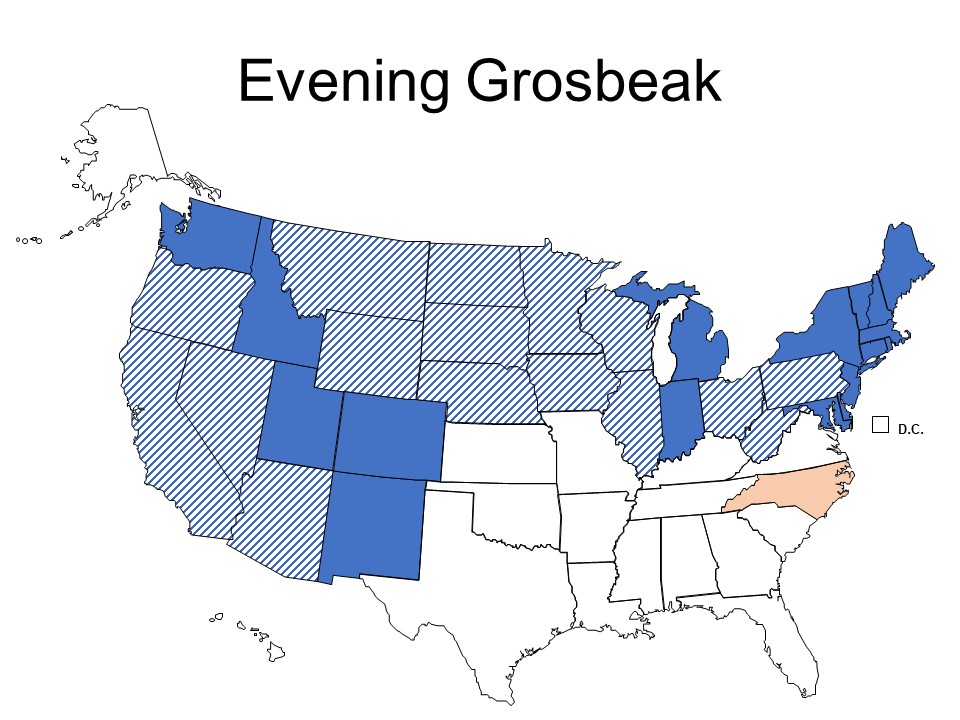
My statebird map for Evening Grosbeak is inserted below – the blue-shaded states are those where I’ve seen this species; the cross-hatched states are those where it is regular but I haven’t yet seen it.  Or at least in the East, those are states where Evening Grosbeak used to be regular.  And now NC and TN are the two tan-shaded states where I’ve seen this species as a rarity.


Next it was off to Falcon Road in Jefferson County.  Although I was happy to have found my top priority target, I was still hopeful that the Long-tailed Duck and Sandhill Cranes might still be around.  Falcon Road cuts through an extensive area of farmland, with several farm ponds nearby.  One eBird report mentioned the Long-tailed Duck was in the “largest pond” – GoogleMaps showed a larger pond adjacent to the road on the west side so I assumed this was the one.  And all recent checklists had good numbers of multiple waterfowl species.  I drove up to what I thought was the key pond and did a quick scan – no waterfowl at all.  I looked more closely and all I could I could fine were a couple Buffleheads.  Perhaps the Long-tailed had indeed moved on.  Or maybe I had the wrong pond – there were other larger ponds a bit farther off the road that could be possible candidates.  I drove a bit farther to the north and came to another pond that was a bit smaller – this one had quite a number of ducks so I was hopeful.  Although I had 7 Shovelers and 23 Green-winged Teal, I could find no diving ducks at all.  It wasn’t looking good. 

There were two ponds on the east side of the road that I had driven by earlier without checking because they were so small.  But with no luck at the larger ponds, I needed to check these last 2 smallest ones.  I turned around and checked the first one – not surprisingly no birds.  Then I got to the next one and saw something floating in the middle.  I put it in my binocs – it was the Long-tailed Duck!  It was close enough that I got this photo holding my phone up to my binocs.


I would have never expected a diving duck on such a small pond.  I guess it too decided this wasn’t the best location because it soon took off and flew back over to its preferred larger pond. 

TN was now the third state where I’ve seen Long-tailed Duck as a rarity, along with CO and NE.  I’ve also seen this species in most of its regular states on the Pacific coast, northeast Atlantic coast, and along the Great Lakes.


Not to be greedy, but now my attention turned to my third target – Sandhill Crane.  There was suitable habitat all around me – rolling hills covered in hayfields and harvested row crops.  I slowly did a 360 scan but didn’t find any tall gray birds walking through the fields.  But with all the hills, there could easily be Cranes nearby that were hiding just out of view.  I drove a bit farther south to get a different angle but again came up empty.  Then I spotted a flock of large birds flying low over one of the fields.  I first thought they were Canada Geese but realized they weren’t quite right.  With a closer look I realized they were Sandhill Cranes – a flock of 9 birds.  They passed over the road and disappeared behind a nearby hill to the west.  A couple minutes later another flock of 15 Cranes flew by, nicely giving their bugling calls - you can see them in the distance near the top of the hill.


 TN was my 38th state for this wide-ranging species, including 12 states on the East Coast where it is a rarity.


That’s 3 for 3 for my targets - what an amazing first trip to eastern TN!  That brings my TN state list to 240. 

Now that I live in western NC, I realize that pursuing statebirds in TN is actually very similar to my old statebirding trips to several New England states when I lived in MA.  Back then it was about an hour drive for me to cross into ME, VT, RI, and CT, and I found many new statebirds in each of those states within 2 hours of home.  So now that I’ve broken the ice for TN birding, I’m looking forward to many more trips to the Volunteer State.  In fact, when researching this trip to the northwest along I-40, I found several other TN targets to the north along I-26.  Hopefully I can make a trip to that part of the state in the near future.

I love statebirding!

Saturday, November 21, 2020

Northern Finch Invasion Yields Rare Evening Grosbeaks, Yard Bird, Hendersonville, NC, November 8, 2020

Each year a forecast of the potential for winter finch irruptions is published by the Finch Research Network.  Although these forecasts are especially focused on Ontario and adjacent states and Canadian provinces, often they can suggest movements in more southern states.  That was definitely the case with the “Winter Finch Forecast 2020-2021” which can be found here - https://finchnetwork.org/winter-finch-forecast-2020.  That forecast certainly caught many birders’ attending with this first sentence– “It looks to be a flight year for several species in the East.”  That would actually turn out to be quite an understatement, particularly for birders here in the Carolinas.  Here are key quotes from that report for several species forecasted to irrupt this winter –

Purple Finch - The worst kept secret, most Purple Finches will migrate south out of Eastern Canada this winter. 

Red Crossbill - Red Crossbills are currently fairly widespread in Central Ontario to southern Maritimes and northeastern states mainly feeding in areas of heavy white pine crop. Red Crossbills should shift southward some as the white pine crop is depleted. 

Redpolls - If the redpolls move on from the Swamp Birch crop, expect a moderate to good flight south out of the boreal forest. 

Pine Siskins - The smaller numbers remaining in the eastern boreal forest should move southward looking for food. 

Evening Grosbeak - Expect flights into southern Ontario, southern Quebec, Maritime Provinces, New York and New England States, with some finches going farther south into the United States. 

Red-breasted Nuthatch - With cone crops in the eastern boreal forest mostly poor, expect this species to continue to move southward. 

The first notable local examples of movements of “winter” finches came while we were actually still in summer – good numbers of Red Crossbills were found feeding on an abundant white pine crop at lower elevations in western NC.  Although not unprecedented, this certainly was outside their more expected spruce/fir forest locations along the highest ridges.  With these movements I was lucky enough to add Red Crossbill to my SC list on 6/30/20 with birds just across the NC stateline, and to my Henderson County NC list on 8/20.  Later I had a rare Red Crossbill farther to the east in Polk County on 11/7/20.  And good numbers of Red-breasted Nuthatches were evident in these same areas, resulting in another addition to my SC list on 9/6/20, as well as a first for my yard list on 9/14/20.  I have no pines near my yard making Red Nuthatches most unexpected.

The next big irrupter was Pine Siskin.  My first Siskin this fall was also a first for my yard on 10/6/20.  And what started as just a couple single flyovers soon expanded to small flocks, and then to even bigger flocks both as flyovers and at my feeders.  I estimated my biggest feeder flock at 50, with total flyovers in a single morning as high as 200.  I took advantage of this irruption to add Siskin to my SC list on 10/20.  However, as of mid-November I’ve been seeing smaller Siskin numbers – perhaps the greatest number of birds has already passed on through the area. 

Then there are the Purple Finches.  My first birds in the yard this fall were on 10/14, and although numbers never got as high as those for the Siskins, a flock of up to 6 continue at my feeder as of mid-November, with numbers of flyovers increasing to the low double digits.  My first PUFIs this “winter” in SC were on 10/20.

That takes us to what is perhaps the ultimate winter finch – Evening Grosbeak.  I grew up in Maryland, developing my birding skills there in the 70’s and 80’s.  During that time Evening Grosbeaks were a regular occurrence many winters, especially at feeding stations.  I remember large flocks descending on my feeders, devouring the sunflower seeds and requiring re-stocking multiple times each day.

However, their eastern populations have plummeted since that time.  Here is a paragraph I wrote for my blog in December 2018 when I was looking for Evening Grosbeaks in New England –

But now 30 or 40 years later, Evening Grosbeak dynamics are a whole different story in the East.  Here in New England, lately they have become a rare occurrence in the northern part of the region, and virtually non-existent in the southern parts.  For instance, throughout most of the southern portion of New England, Evening Grosbeak is now considered to be a rarity in eBird requiring details.  I used to see them as a breeder most every summer at Pawtuckaway State Park in southern NH.  But their numbers have dwindled there over the years, with the last eBird record coming in 2015.  Since moving to New England in 1993, I’ve not seen this species in CT or RI. 

The 2018-2019 Winter Finch Forecast for Evening Grosbeak ominously included this comment –

In April 2016 the Committee on the Status of Endangered Wildlife in Canada (COSEWIC) listed the Evening Grosbeak a species of Special Concern due to strong population declines occurring mainly in central and eastern Canada.

In fact, some Canadian researchers recommended that the eastern populations be listed as endangered.

With their numbers plummeting in the northeast, one can only imagine how rare they have become farther south.  Here is a summary of this species’ distribution from “Birds of North Carolina: their Distribution and Abundance” -

In the latter part of the 1960's and the 1970's, the species made near-regular appearances every other winter, in good numbers, and even in off years, a few were reported. However, the species has undergone a major population decline in recent decades, and there have been relatively few North Carolina reports in the past decade. Many "new" birders have yet to see the species in the state, and it has often been missed by birders conducting Big Years in the state. Fortunately, the winter of 2012-13 produced a mild invasion into the East, with scattered reports again being made in the state. 

Soon after the publication of the 2020-2021 Winter Finch Forecast came a couple southern reports of Evening Grosbeaks – one in TN on 10/26, and another most surprisingly in the FL panhandle on 10/3.  Could these be harbingers of what was to come?  More and more records were soon reported in the Northeast and the Mid-Atlantic.  And then came the first NC report - in Gates County in eastern NC on 11/1.  That was just the beginning…

Then on November 4th came a text from Kevin Burke on the Blue Ridge Birders text group that he had an Evening Grosbeak at feeders in his neighborhood.  Unfortunately, the bird moved on 10 minutes before my arrival in Kevin’s neighborhood.  I spent the next couple hours unsuccessfully waiting for it to return.  Plus a search for a couple hours early the next morning were fruitless.  Then on the 5th came another report of a flyover flock at Beaver Lake. 

So small numbers were definitely passing through the area.  Now I just needed to be lucky enough to be in the right place at the right time.  My strategy was to spend as much time as possible in good habitat and cross my fingers that I would get lucky.  I birded the Mt. Pisgah area along the Blue Ridge Parkway on the morning of 11/6, finding 3 Ruffed Grouse and fair numbers of migrating Siskins and Purple Finches.  But no Grosbeaks, and surprisingly no Red-breasted Nuthatches as well.  Then on the 7th I spent the morning at the Green River Game Lands in Polk County finding a rare Red Crossbill (only the 3rd for the county per eBird), plus a few PUFIs and Siskins.  But again no Grosbeaks.

My plan for the morning of the 8th was to do a “Big Sit” in my yard.  The morning started as most recent days have been with a few flyover Siskins and Purple Finches.  Then at about 7:30 I finally got my target – I heard 2 different Evening Grosbeaks giving their diagnostic “jeer” calls north of my yard.  Both birds continued to call as they flew closer with one moving east of the yard and the other to the west.  I thought they had continued on south until I heard the western bird call one more time a couple minutes later from the tree canopy nearby.  I was hoping that it might come to the feeders but it was not to be.  They were heard-only birds, but certainly good enough for a species whose call I’m very familiar with.  And just for good measure, I had another flyover Grosbeak on 11/20.

Here is the eBird map of recent Evening Grosbeak sightings in the east as of 11/17 – from the sightings in the Mid-Atlantic and Ohio Valley, to that one sighting down in the FL panhandle.  And of course including my sighting on 11/8.  Quite an irruption!

Evening Grosbeak was yard bird #137, and NC statebird #308.  My statebird map for Evening Grosbeak is provided below – the blue-shaded states are those where I’ve seen this species; the cross-hatched states are those where it is regular but I haven’t yet seen it.  Or at least in the East, those are states where Evening Grosbeak used to be regular.  Alas…  And now NC is the single tan-shaded state where I’ve seen this species as a rarity.


Could Redpolls be the next irrupter to be found in the Carolinas this winter?  As of early November, the southernmost reports were from MD.  But then came 2 NC reports - one on 11/13 in Granville County and one on 11/20 not too far away in Avery County.  It’s certainly one to keep your eyes and ears open for. 

Tuesday, December 18, 2018

Evening Grosbeak - Welcoming Back a Long-Lost Friend, Exeter, RI, December 2018


I grew up in Maryland, developing my birding skills there in the 70’s and 80’s.  During that time Evening Grosbeaks were a regular occurrence many winters, especially at feeding stations.  I remember large flocks descending on my feeders, devouring the striped sunflower seeds and requiring re-stocking multiple times each day.

But now 30 or 40 years later, Evening Grosbeak population dynamics are a whole different story in the East.  Here in New England, lately they have become a rare occurrence in the northern part of the region, and virtually non-existent in the southern parts.  For instance throughout most of the southern portion of New England, Evening Grosbeak is now considered to be a rarity in eBird requiring details.  I used to see them as a breeder most every summer at Pawtuckaway State Park in southern NH.  But their numbers have dwindled there over the years, with the last eBird record coming in 2015.  As a wintering bird, since moving to New England in 1993, I’ve not seen this species in CT or RI.  Though admittedly since I had seen them in CT before 1993 I haven’t needed to chase them there.   

But I still needed Evening Grosbeak for my RI statelist, and as a result each winter I’m always on alert for stakeout birds that might be chaseable there.  So it was with considerable excitement that I read the following prediction for Evening Grosbeaks in Ron Pittaway’s “Winter Finch Forecast 2018-2019” – 

Expect a moderate flight south into southern Ontario and the northern states because both conifer and deciduous seed crops are generally low in the Northeast. The best spot to see this striking grosbeak is the feeders at the Visitor Centre in Algonquin Park. At feeders it prefers black oil sunflower seeds. 

Ominously, his forecast ended with this comment –  

In April 2016 the Committee on the Status of Endangered Wildlife in Canada (COSEWIC) listed the Evening Grosbeak a species of Special Concern due to strong population declines occurring mainly in central and eastern Canada. 

[See the postscript at the end of this post with more news about Evening Grosbeak population declines.]

Could this be the year to finally add Evening Grosbeak to my RI list?  And given the population declines, I better focus on this target this winter, because who knows when we all will have another chance to see this species in southern New England (and elsewhere for that matter).  Just as predicted, there were a number of Grosbeak reports throughout New England as Fall progressed.  My first birds were a flyover pair on 10/23 in my neighborhood, followed by a single flyover nearby on 12/6.  But I’m in north-central MA – still more than 40 miles from the RI border as the Grosbeak flies.  A few Grosbeak sightings were being reported to the south, initially especially at hawk watch sites on the CT coast.  Then finally a few reports popped up in RI – most were flybys and a few were birds that stopped albeit only briefly.  On speculation, I made a trip to Buck Hill WMA but came up empty.  Then there were a couple reports from Nicholas Farm Management Area which I chased after without success (though I did have an amazing time with Red Crossbills there!). 

The first somewhat chaseable RI reports came from Burlingame State Park near the coast.  But they were only there for a couple days and I couldn’t break free to go after them.  Then came reports of a flock at feeders on Block Island – but they were gone by the time most of the details came to light.  Ugh… 

Then finally came the break I needed – Evening Grosbeaks were reported for several days at RI Audubon’s Fisherville Brook Wildlife Refuge in Exeter.  And then came a report of up to 20 birds at a feeder a short distance nearby (though the homeowner didn’t allow visitors on her property – not very neighborly of her…).  I reached out to the caretaker at the Fisherville refuge and got permission to visit the property and the feeders the Grosbeaks frequented.  Next I contacted Don Heitzmann who lives nearby, and we planned to meet at the refuge the next morning to search for the Grosbeaks. 

We arrived at 9:30 on 12/14 quite optimistic, and walked down the driveway toward the house listening for our target birds.  But it was pretty quiet so we headed to the feeders in the back.  There we found typical common feeder birds but still no Grosbeaks.  But just a couple minutes later I heard a distant call note of a flyover Evening Grosbeak.  Within a few seconds we watched a female Grosbeak land above us in the top of a bare tree.  Then we heard multiple Grosbeak call notes coming from down the driveway.  We doubled back and soon spotted multiple birds feeding in a pine tree.  The birds were eating poison ivy berries on vines that were climbing up through the pine.  I got these phonescoped photos of birds feeding in the tree (unfortunately the male was a bit obscured).  


A bit later several birds flew to a nearby Juniper and began to eat berries there as well.  Then multiple birds flew behind the house, and a few seconds later we found them feeding on the ground beneath the sunflower feeder.  I got this phonescoped photo by looking through the picket fence into the back yard.


We counted at least 11 birds in the flock.  I had finally gotten Evening Grosbeak in RI!  That was #332 for my RI list, and the 250th species I’ve seen in each of the 6 New England states.   
My statebird map for Evening Grosbeak is provided below – the dark shaded states are those in which I’ve seen this species; the cross-hatched states are those where it is regular but I haven’t yet seen it.  Or at least those are states where Evening Grosbeak used to be regular.  Alas… 


Now a postscript on additional news on Evening Grosbeak populations-  On May 12, 2018, James Westrip posted an article on the BirdLife International Globally Threatened Bird Forum titled "Evening Grosbeak (Hesperiphona vespertina): revise global status?"  Although at the time the species was considered of Least Concern by BirdLife International, he proposed that Evening Grosbeaks should be listed as Endangered.  The criterion cited to place a species in this category is a population reduction of 50% over 3 generations, and one referenced study showed a decline of 65.2% over 3 generations.  He states that the "cause of these decline[s] has not been identified yet, although habitat alteration, disease and control of its insect prey (e.g. Spruce Budworm) have been put forward as potential contributors."  The Evening Grosbeak Species Factsheet on the Birdlife.org website now shows that the species' status has been changed to Vulnerable, defined as "considered to be facing a high risk of extinction in the wild".  Unfortunately very sobering news for this beautiful species. 


Sunday, October 14, 2018

Three Statebirds in Northern New Mexico, September 2018


A rare business trip to northern NM gave me an opportunity to try to fill some gaps in my NM statelist.  My NM list was 284 which was already 20 over the old ABA reportable threshold, but there are almost always at least a few statebird targets to try for.  My work site was in the mountains near the northern edge of the state, and I would fly in and out of Albuquerque.  So I could bird quite a large area and multiple habitats with the help of some vacation time added to the trip.  Most of my past birding in NM had been in the southern and central parts of the state, so I was optimistic that I’d be successful in adding several new birds to my NM statelist.

Surprisingly, my eBird Needs Alert only came up with two key targets in the mountains – Evening Grosbeak and Gray Jay.  Then there was Sage Thrasher which is regular in the sage desert almost throughout the entire area I would be traveling through.  Prairie Falcon was another of my targets which was being reported across the region, but apparently not very reliably sited at any one location.  There were also a number of rarer migrants that were reported passing through at the time, but the only one that seemed to be chaseable was Dickcissel.  Lastly I still needed Western Screech-Owl for the state, so that gave me at least 6 reasonable targets to chase after.

Now to set up the logistics... First I would try for Sage Thrasher Thursday evening after work in Santa Fe.  Although they were more reliable at locations at the far northern edge of the state, that would make for a much longer drive, so I hoped to find them in Santa Fe instead.  Then Friday on my vacation day I would start in the mountains for Gray Jay assuming I found the Thrasher on Thursday.  Otherwise I would need to start near the NM/CO line trying for the Thrasher for a second time before heading to the mountains.  I would swing by Fred Baca Park in Taos along the way where Evening Grosbeaks were reliable, apparently coming to a feeder.  Then I’d head south toward Albuquerque with stops at the Tramway Wetlands for “Mexican” Duck and maybe Prairie Falcon, and at the Los Poblanos Open Space which might be the most reliable spot for Dickcissel.  Then I’d end the day trying for Western Screech-Owl in Albuquerque before my flight out the next morning.

Work ended right on time on Thursday, and I headed to Eldorado at Santa Fe where a small number of Sage Thrashers were reported almost daily at the Gallina Park greenbelt by an apparent local birder Rene Laubach.  With some research I found a map of the greenbelt, and saw numerous trails winding through the high desert scrub in and around a suburban neighborhood.  It was a large area to cover, and given the low numbers of Sage Thrashers reported, I had a feeling it could be a long shot.  But I needed to get this target here today to avoid a 2-hour round-trip drive up to the NM line the next morning.  When I arrived I could see a lot of really nice habitat, though sage was rather limited.  I remembered that most of the western Thrashers will respond to recorded calls, so I would concentrate my search in the patches of sage, playing some tape as well.

Despite my logical plan, nearly an hour into my search I had not found any Thrashers.  Though the fact that it was windy and in the upper 80’s likely didn’t help the situation.  Then I noticed a couple birders walking my way, and amazingly it turned out to be the Laubach’s on their daily walk.  Unfortunately they had not seen any Sage Thrashers yet that evening, but gave me some suggested areas to look for them.  With renewed optimism, I headed to the new locations, and found more extensive sage, but alas no Thrashers.  On a brighter note, the desert was full of migrant sparrows – especially Spizella sparrows.  I ran into numerous flocks which were mostly Brewer’s, but I also picked out Clay-colored and Chipping along the way.  And a Say’s Phoebe and a Cassin’s Kingbird were nice consolations as well.

That meant I would need to start the day Friday far to the north almost to the NM/CO stateline for a second attempt for the Thrasher.  There were 3 recent reports along county roads in the area with up to 15 Sage Thrashers, so I was very hopeful.  I arrived at County Road B-51 just as it was starting to get light – there was sage habitat as far as the eye could see to my north.  The car thermometer said it was a crisp 28 degrees, so I decided to stay in the car a bit longer before trying for my target.  A bit later I stepped out of the car and was serenaded by a Great Horned Owl as I scanned the sage, but to no avail.  I tried playing some tape but still no response.  I repeated my efforts at several more stops down the road but still no birds.  I was now on my 5th stop and was getting worried.  I once again played tape, this time playing Sage Thrasher call notes, and I thought I heard a bird giving the single call note in the distance.  I listened intently but didn’t hear anything.  I played some more tape and heard it again a couple times – did I have my target?  Then up ahead I saw a bird that was the right size fly across the road.  Then a pair of birds popped up on the fenceline along the road edge – it was a pair of Sage Thrashers!  I had to work hard to get just 2 birds; wonder what the other birder did to get 15 Sage Thrashers along this road a couple weeks earlier.

NM was my 13th state for this species – 12 in its normal range plus in MA as a vagrant.  The dark blue shaded states in my statebird map below are those where I’ve seen this species.  The cross-hatched states are those in its regular range where I still need it for my statelists. 


I briefly thought about heading north to CO (the stateline was only 3 miles away), but NM statebirding was my goal for the day.  So I started my hour drive south heading to Fred Baca Park in downtown Taos where Evening Grosbeaks were reported in good numbers on every recent report from this eBird hotspot.  One older report mentioned a feeder at this location, so my plan was to look for a feeding station somewhere in the park and hopefully find some cooperative birds.  I pulled into the parking lot, and as I stepped out the very first bird I heard was an Evening Grosbeak.  After my challenges with the Sage Thrasher I guess I was due for an easy one.  I only spent 15 minutes in the park, and never found any feeders, but found at least 6 Grosbeaks foraging in the trees and even on the lawn right next to the parking lot.

I still need this species in a number of states throughout its regular range (the cross-hatched states in my statebird map below), especially where it is a regular wintering bird.  Not to mention I need it in all those other states throughout the Lower 48 where it can be seen as a rarity in big invasion years.


Next I was off to the Taos ski area to try for the Gray Jay.  Several had been reported from the William’s Lake trail recently, though they were not seen on every trip.  Most reports also included Steller’s Jays, Nutcrackers, and 3-Toed Woodpeckers, so this seemed to be a nice area to bird.  However I was concerned about the elevation - the trailhead is at 10,000 ft and rises from there up to the lake.  You see I am much more prone to altitude sickness than most people, so I need to be extremely cautious hiking at those kinds of elevations.  But knowing my limitations, I felt like I would be OK, especially when an employee of the Carson National Forest that I met at the beginning of the trail gave me 2 suggested locations for the Gray Jay. 

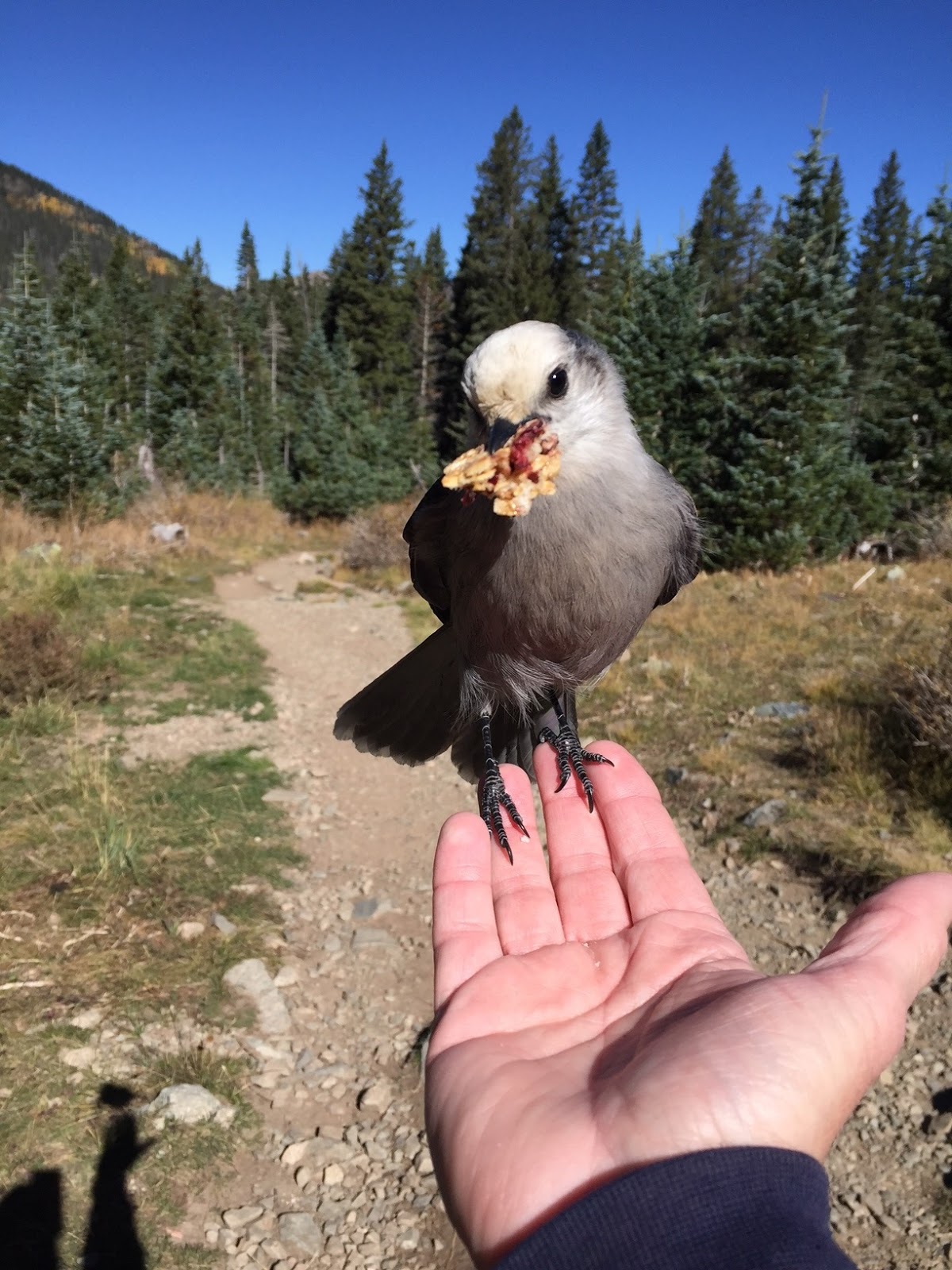
The trail passed through some nice coniferous woodlands, featuring quite a number of Mountain Chickadees, a couple “Gray-headed” and “Pink-sided” Juncos, several Red-breasted Nuthatches, and a couple pairs of Golden-crowned Kinglets.  In the distance a calling Jay seemed to most closely match a Clark’s Nutcracker.  Then I arrived at an old avalanche area which was the first suggested location for the Gray Jay.  They can be very tape responsive, but none responded this time.  Then a little later I reached a talus slope, the next recommended spot, but again no responses.  I went on a bit farther, but was having significant trouble catching my breath.  When my Apple Watch measured my heart rate at 151 I decided I better turn around, unfortunately without my target.  I retraced my route and when I reached the talus slope there were two Gray Jays perched in a tree right in front of me!  I took this picture with my iPhone as one investigated me for handouts.


Then I returned to the avalanche area and there was yet another pair of Jays.  Again these birds were inquisitive, and I took this iPhone photo of one taking a bit of my granola bar out of my hand.


Where were they as I headed up the trail?  NM was my 14th state for Gray Jay; I still need this species in a number of states in its range in the Rockies and Sierras, as well as in WI.


Next I headed down to Albuquerque, with my first stop being the Tramway Wetlands.  The day before a Prairie Falcon was reported from this spot, as was a pair of Mexican Ducks which is considered to be a separate species by some authorities including eBird.  But since I didn’t pack my scope on this trip I wasn’t expecting to have much success picking out this southwestern relative of the Mallard.  Plus I wasn’t sure how to bird this spot.  But when I finally arrived I remembered that I birded this location during my last trip to the area in 2013, and pulled right up to the correct spot to get a view of the wetlands.  And practically right below me were 2 Mexican Ducks in with Mallards and other dabblers.  Unfortunately I couldn’t find a Prairie Falcon despite searching nearby perches.

The next stop was the Los Poblanas Open Space where a couple recent reports included multiple Dickcissels.  But when I arrived it was late afternoon on this bright sunny day with temperatures in the upper 80s (60 degrees warmers than my first stop at dawn).  Not too surprisingly I didn’t see much except for a couple quite tame Roadrunners.

After a quick dinner stop it was time to try for Western Screech-Owl.  There had been a number of recent reports in the area, but none seemed reliable.  And 1 birder mentioned Owls nesting in her Wood Duck box but they had moved on.  So it seemed that my best chance was at the Rio Grande Nature Center.  I had actually tried for Screech-Owl here once before unsuccessfully, so maybe I’d have better luck this time.  But despite playing tape at a number of locations around the perimeter of the site I struck out again.

Although it’s tough to miss the last target of the trip, I still ended up with 73 species, including 3 new NM statebirds.  That brings my statelist to 287.  All in all still a successful trip.