Pelagic
– adjective; of, relating to, or living or
occurring in the open sea.
That
is the definition of the word “pelagic” in the Merriam-Webster dictionary. There’s certainly no “open sea” in VT. But one of the key birding attractions in VT
in fall is to hope to see pelagic birds on Lake Champlain. Although landlocked, Lake Champlain attracts
quite a nice collection of typically “open sea” birds like Jaegers, Kittiwakes,
Sabine’s Gulls, and even rarer species.
Many think the pelagic birds seen on Lake Champlain have passed down the
St. Lawrence seaway and eventually make their way to the lake on their
southbound migration routes. Or perhaps
these birds are just taking an overland route south and are at least
momentarily attracted to pelagic-like, almost normal, habitat at this large
body of water. In any case, these are
exciting rarities to try for especially in this landlocked state.
Passage
of the pelagics is especially associated with certain weather conditions. Typically they are seen following a frontal
passage on northwest winds. They are
often spotted from shore, with a preferred location being the Charlotte Town
Beach. I have done a few lake-watches
from this spot in the past but have not had any success, mostly because my
trips haven’t coincided with the passage of the fronts.
Plus
in the last few years, Allan Strong has set up boat trips on Lake Champlain to
look for pelagics. The first of these
trips occurred in October 2013 a day after a front, with remarkable
success. I added 3 statebirds to my VT
list that day – Little Gull, Red Phalarope, and “Jaeger, sp.” (an unidentified
bird at considerable distance). Plus
there was a tremendous passage of geese, ducks, loons, and grebes that
day. The next trip was in September
2015, when summer-like weather resulted in next to no migration and no
pelagics. That’s the nature of pelagic
birding in general, and more specifically pelagic birding in VT.
The
next boat trip was planned for early September of 2017, timed to be at the peak
of Jaeger migration. Luckily I would be able
to squeeze it in between business trips, so I signed up to go. My plan was to arrive in the area the evening
before, get a hotel in Burlington, and be ready to go on the boat the next
day. And since the boat didn’t leave the
dock until 9:30, I could spend a couple hours at the Charlotte Town Beach doing
an early morning lake watch before heading to the boat. Plus as the trip neared it appeared that I
could arrive early enough to do a bit of land birding the evening before, with
the key target being Orange-crowned Warbler which continues to elude me in
VT.
My
plans were set – now I just needed to hope for the right weather
conditions. As the pelagic neared, the
weather forecasts were looking promising.
The day before the trip would be showery, preceding the passage of a
cold front overnight, followed by northwesterly breezes the day of the
pelagic. I would have preferred the
winds to be a bit stronger after the front, but I would take it.
I
arrived in northern VT the evening before the pelagic, with just enough time to
bird the Whitney Creek area in Addison.
This spot has nice brushy undergrowth that has featured quite a number
of Orange-crowned Warblers over the years.
Luckily the rain had stopped just before I arrived. But despite lots of spishing and playing a
bit of tape, there were few migrants of any type, and certainly no
Orange-crown. It was a long shot, but
still worth the try since I don’t often get to this Orange-crown hot spot in northwestern
VT.
The
next morning I arrived at the Charlotte Town Beach on Lake Rd. just as it was
getting light. Skies were partly cloudy,
and there were light breezes out of the northwest. Visibility was quite good, though there was a
bit of heat shimmer coming off the water.
All things considered, pretty nice viewing conditions.

I
sat on a bench at the park and started my scans. Unfortunately it was quite slow. I spotted occasional flocks of Cormorants
heading south, and the ever-resent Ring-billed Gulls milling about, but little
else. Three continuing Sanderlings on the
beach were nice. But certainly not my
targets. A little later my VT birding
friend Hank Kaestner arrived to join in the scans, but we continued to come up
empty.
But
just then I spotted a medium-sized dark bird rise up off the water a short
distance out. It was flying much more
tern-like than an immature Herring Gull – the only other option for an all dark
Larid – it was a Jaeger! But what species? Both of us followed the bird for a couple
minutes, and during most of this time the bird lazily flew around the lake,
sometimes even rising quite high and soaring out over the water. At one point it chased a Ring-bill and it was
a bit smaller than the Gull. All the
while we could hardly see any white in the base of the primaries, and the bird
was very sleek-bodied. I was now
starting to think that this could be a Long-tailed Jaeger. After the bird flew north out of site, we
started to compare notes. In addition to
my observations, Hank also commented that this bird was more gray than brown
and rufous seen on Parastics and Pomarines.
We both agreed that this was indeed a Long-tailed Jaeger. Not bad for the only pelagic bird I saw on
the lakewatch.
I’ve
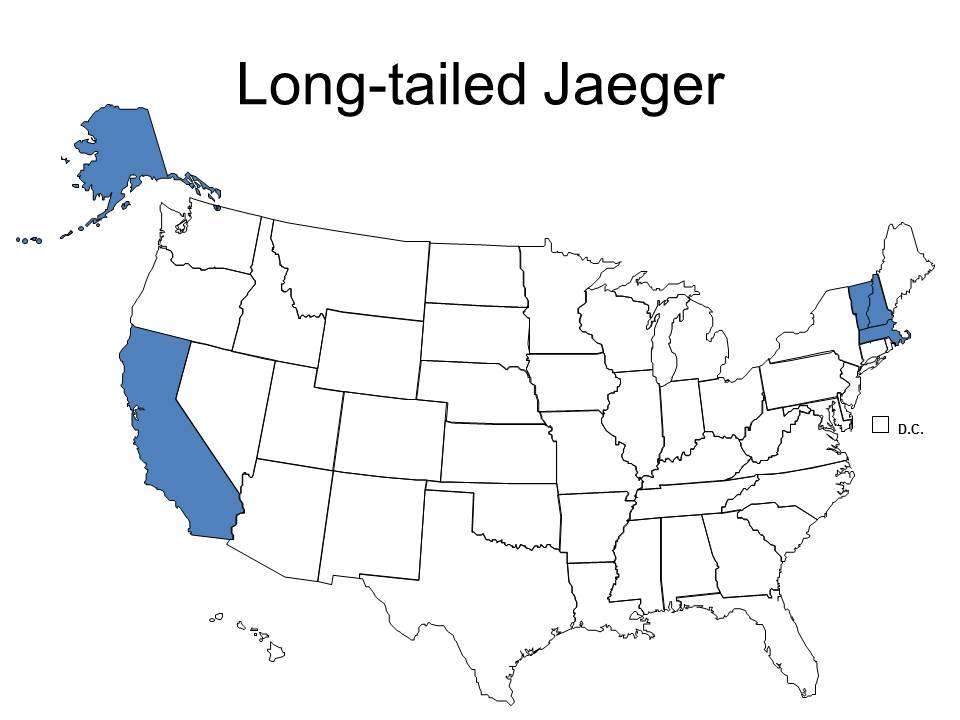
now seen Long-tailed Jaeger in only 5 states – in AK as a breeder; in CA, NH,
and MA on pelagic trips, and now from shore in VT (see my statebird map
below). And although new for my VT list,
it replaces my earlier “Jaeger, sp.” sighting, so no net addition on my list.
Then
it was off to the boat trip, where I was joined by about 10 other birders all
keenly hoping for more pelagic species.
The trip started pretty slowly, with a few migrant flocks of Cormorants
and Canada Geese, but no other obvious migrants. We passed by a few feeding flocks of gulls,
in each case hoping to find a Jaeger in their midst, but to no avail. Although there was a breeze out of the
northwest, it must have been too light to usher in our pelagic targets.
A
bit later the boat made its way toward the middle of Lake Champlain just a bit
east of the VT/NY stateline. We
continued to come by a few feeding flocks of gulls, with some of those gulls
coming over to the boat to feed on the chum Allan was throwing. And then in one of the gull flocks I spotted
a gull with large white triangular wing patches – Sabine’s Gull!!! I soon got the rest of the boat on this
immature bird, and we successfully chased it a bit farther west where we got
close looks as it fed. And then the bird
became attracted to the chum and came over right next to the boat. Birders with nice cameras and lenses got
amazing photos of the Sabine’s – I got these miserable shots just holding up my
cell phone.


We
continued to watch the bird as it flew a bit farther west eventually getting
into NY waters. One of the rare times
where one single bird has passed over a stateline giving me ticks in two
different states - #280 for me in VT and #282 for NY. I’ve seen Sabine’s Gull only twice before in
the in East (in MA and NH), plus once in AK.
And my personal Sabine’s jackpot was seeing flocks of hundreds of birds while
on my sole CA pelagic trip years ago.

Later
on in the trip I spotted a distant immature Jaeger flying by to the west. Although we tried to chase after it, we
couldn’t refind the bird, which would unfortunately have to stay as another
“Jaeger, Sp.” – and likely in NY waters.
Though while trying to refind the Jaeger we did come up with a late Black
Tern, which would turn out to be the last bird of interest for the trip.
Although
we didn’t have many pelagics on the trip, the Sabine’s was quite amazing. And of course the Long-tailed Jaeger from
shore was special too. The other Jaegers
will have to wait till another time.


