Showing posts with label Milford Point. Show all posts

Saturday, October 6, 2018

Roseate Spoonbill, First State Record, Milford, CT, September 2018


Just 3 weeks after the Wood Stork and Neotropic Cormorant showed up in NH, and the Great Black Hawk appeared in Maine, a Roseate Spoonbill was spotted way up in Sebec, ME.  This first state record was apparently very reliably seen starting on August 27 on a small farm pond far from the coast.  Although I would have loved to go after the Spoonbill, Sebec would be a nearly 5-hour one-way drive for me.  So despite my temptations, I never went to chase after it.

While reviewing posts on the ME listserve one day I noticed a report that the Spoonbill was no longer being found at its usual location.  It was last seen on September 9 after 14 days of daily sightings.  I always wonder if these long-lost species find their way back home, or whether they continue to head even further in the wrong direction.  For instance the Great Black Hawk was spotted leaving its southern ME home-away-from-home flying northeast out to sea – perhaps its next stop was even farther afield in Nova Scotia or Newfoundland.

But back to the Spoonbill…  Then amazingly 8 days later on September 17 came a report of a Roseate Spoonbill on the CT coast – yet another first state record!  Was it the ME bird or yet another Spoonbill visiting New England?  Unlike the ME bird, this one wasn’t very sedentary.  It was first reported on the Stratford side of the Housatonic River at Raven Pond, then it would not be found at all for a time, despite numerous birders searching from land and by boat.  Then the Spoonbill seemed to prefer Wheeler Marsh visible from the Audubon Coastal Center at Milford Point, though it would also return to Raven Pond especially to join a nighttime Egret roost there, and would be seen elsewhere in Stratford as well.  It was still covering a pretty large area. 

Unlike the ME bird, this one was within my chasing distance, “only” 2 ½ hours from home.  So I definitely wanted to give it a try.  Unfortunately I was too busy to head out, so I needed it to stick around a few days until I could finally break free early on Saturday morning the 22nd.  Luckily its wanderings had become more predictable by now.  It would typically show up at Wheeler Marsh soon after sunrise, and then be seen sporadically at the marsh during the day.  A complication was that it would often be seen flying into the marsh only to drop in and disappear out of view for hours.  So you had to keep a close eye out for it.  Friday morning the bird appeared at 7:40 AM, so I planned to arrive at the Milford Audubon Center no later than 7 AM the next day to give it a try.  That meant a 4:30 AM departure – anything for a rarity!

Luckily there was next to no traffic as I made my way to the CT coast early on Saturday morning.  As I arrived at the Audubon Center a few minutes before 7 I could see about 10 birders already on site.  There had been no sightings yet that morning, though one birder had the Spoonbill there in the marsh the night before all the way up until nearly total darkness.  Maybe our target never left the marsh the night before and was right out in front of us hidden by the marsh vegetation. 

By 7:40, the time it arrived the day before, there were at least 20 birders on site scoping the marsh, but to no avail.  You wouldn’t think a large pink wading bird would be so difficult to find.  As 7:40 came and went I mentioned to everyone that the yesterday’s 7:40 tide would be duplicated today at about 8:30 – so maybe that would be the more likely time for it to return.  We all had to stay optimistic, right?  At least while we were waiting I spotted at least 1 “Western” Willet – perhaps soon to be a separate species.

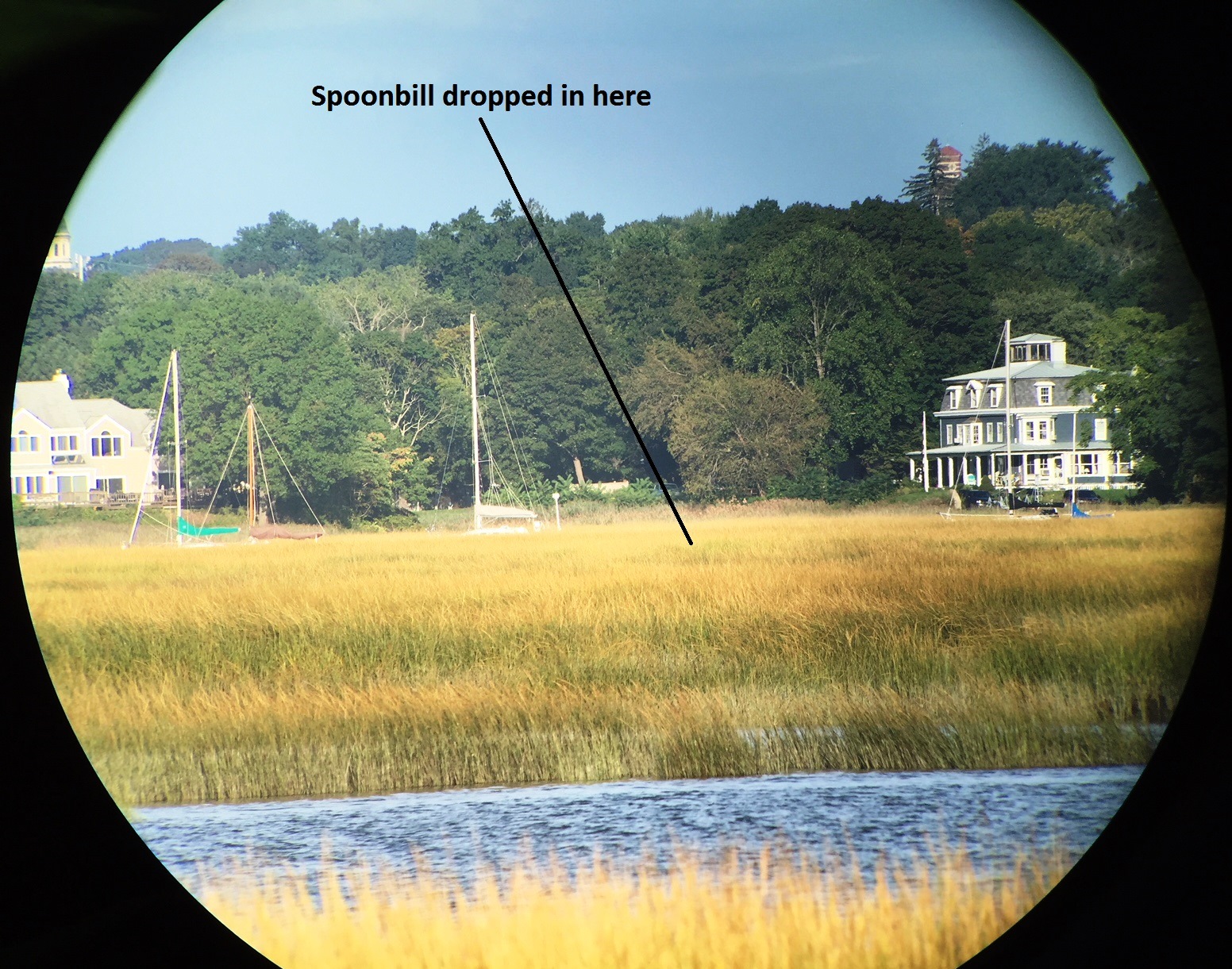
And then at 8:28 one of the birders yelled – “I have the Spoonbill!”  There it was flying over the marsh at a considerable distance coming in from the west.  At first it was quite high, then it slowly got lower to the marsh, circled a couple times, then dropped in out of site.  Although it was quite distant the whole time, and total viewing time was maybe only 30 seconds, everyone was able to see all the fieldmarks including of course the pink color and the large spatulate bill.  Good enough for a state “tick” – though if it had been a lifebird I would have wanted a better view.  Here is a picture of the marsh where it dropped in, perhaps nearly a mile away.


Roseate Spoonbill was #332 for me in CT, and the 440th species I’ve seen anywhere in the 6 New England states.  CT was only my 4th state for this species typically only found in the deep south.

 
It turns out that comparison of photos of the ME and CT birds revealed that they were the same individual.  Amazingly, 8 days after leaving Sebec, ME it was re-found in Stratford and Milford, CT, some 345 miles away “as the Spoonbill flies”.  Wonder if it took a direct route and passed over NH and MA on the way.  In fact, if it flew on a straight line it would have passed nearly directly over my house here in Pepperell, MA.  I guess I didn’t look up at the right time. 

“But wait there’s more…”  There were also reports of Spoonbills all across the Midwest and Northeast this year, including IN, OH, WV, PA, MD, NJ, NY and DE.  And it turns out that the ME and CT bird was also the one spotted at the Walkill River NWR along the NJ / NY line from July 22 to August 5.  And then there was a Spoonbill spotted in southeastern Quebec on August 7.  Was this also the same bird?  Unfortunately the photos weren’t of sufficient quality to tell.  This was only 85 miles northwest of its Sebec, ME location where it was first spotted 20 days later – certainly a feasible trip.  But the Quebec spot is 375 miles northeast of its NJ/NY location – could it have traveled that far is just 2 days?  I guess we’ll never know for sure. 

It has truly been an amazing year for vagrant Roseate Spoonbills!

Monday, November 9, 2015

Caspian Tern and Hudsonian Godwit, Milford Point, CT, October 2015


Some of my favorite birding spots in CT are in Milford and Stratford, but I don’t get to that area often since it is beyond my self-imposed 2-hour drive limit to chase rarities.  So needless to say when a business trip to Milford came up, I decided to take advantage of being in southwest CT and added a vacation day for some local birding.  A couple days before the trip a Painted Bunting was re-found by Tina Green in Westport at the CT Audubon Tree Farm, so that would be an obvious place to start my day.  And then after trying for the Bunting I planned to go to the Quaker Ridge hawkwatch where a number of Golden Eagles had been seen so far this fall.  So that would give me two CT targets to shoot for.

I traded e-mails with Tina Green and she offered to meet me at the farm and show me the exact spot where she had been seeing the Painted Bunting.  Tina had seen the bird 2 consecutive days eating mile-a-minute berries at a location that was some of the first vegetation to be lit and warmed by the rising sun.  So she suggested we start at that spot at dawn and wait for the bird to appear to eat its favorite berries.  When we got there in the pre-dawn light I could see many plants with berries that the Bunting might like to eat.  I was now a bit concerned that this could become a needle-in-a-haystack kind of situation.  Most Painted Buntings seen in New England are birds that show up at feeders in winter, and many stick around for an extended time.  For that reason, CT Audubon had put out a feeder nearby in hopes that the bird would come to the seed.  So if we didn’t see the bird eating natural foods, maybe it might show up at the feeder.

Unfortunately dawn came and went without seeing the bird.  And the feeder had regular visits of Chickadees and Cardinals, but no Bunting.  I spent about 4 hours at the tree farm, and found 55 species at this very birdy spot, including only my second ever Orange-crowned Warbler in CT, but no Painted Bunting.  That was most disappointing given that I had not chased after a semi-reliable Bunting seen the previous winter at a feeder in Stamford – beyond my acceptable chasing distance.  And the winds were out of the south so there was no reason to try for eagles or other raptors at hawkwatches.  So with no other rarities to chase, and work commitments backing up, I decided to head to my Milford hotel early and get to work instead of taking more time off.

It was now late afternoon, and not only had I missed my target bird, but work wasn’t exactly going very well either.  I looked at my watch and it was 3:30.  Milford Point, my favorite birding spot in the area and one of my favorites in all of CT, was only about 15 minutes away.  I asked myself why I was sitting in my hotel room working on a vacation day instead of birding.  So I decided to make a quick run to Milford Point and just do a couple hours of late-day fun birding. 

I arrived at Milford Point and first went to the inland side of the park.  Tide was pretty high, and I didn’t see much except a small flock of Brant.  Then I headed over to the beach to see what gulls and late shorebirds might be around.  At this high tide all the birds were way out on distant sandbars.  I could see a couple birders out that way, so I headed out to join him.  It turned out to be Steve Spector, who I birded with back in February at Silver Sands State Park in Milford to find a stakeout Long-eared Owl, and his wife Charla.  First we spotted a flock of Horned Larks on the nearby spit but no Longspurs.  Then we turned our attention to the distant sandbars where there was a nice collection of shorebirds – principally Black-bellied Plovers, Sanderlings, and Dunlin, plus a nice flock of Oystercatchers.  And of course there were a number of Great Black-backed, Herring, and Laughing Gulls.  I was scanning through the shorebirds hoping to find something else when Charla asked what this gull was with a bright red bill.  It turned out to be a Caspian Tern – new for my CT list.  Thanks Charla!  I got this phonescoped picture of the bird as it rested on the sandbar.


Although Caspian Tern is not a super rarity in CT and is seen every year along the coast, I have never tried to chase after one.  The closest CT coastline is 2 hours away from home, so even if I got news of a sighting in real time, it would take me at least 2 hours to get to the right location.  And in that time the tidal conditions would have changed enough that the bird could well be long gone by the time I arrived.  Similarly, just as with this CT bird, the only Caspian Terns I’ve seen in MA and RI have been birds I’ve run into on my own rather than chasing after.  And I still need this species for ME (see my statebird map below).


Just a couple minutes after spotting the Caspian Tern all the birds suddenly took off, flushed by a Peregrine Falcon.  As the birds milled about looking for spots to land I scanned through them hoping to re-find the Caspian.  At one point a good-sized flock of shorebirds passed through my binocular field.  The flock was mostly Black-bellied Plovers and Dunlin, but then I noticed a larger bird with a white rump and black tail – Hudsonian Godwit!  Another new bird for my CT statelist - #323 for my CT list.  The bird eventually came in pretty close, where I was able to get these phonescoped photos. 


It’s interesting that my pursuit of Hudsonian Godwit in CT has been quite similar to Caspian Tern.  The Godwit is rare but regular as a migrant on the CT coast, but I’ve never chased after one in CT given the same time and tide challenges that I’ve had trying to go after Caspians.  I’ve now seen Hudsonian Godwit in 10 states in the northeast (though I still need it in RI) as a fall migrant, 3 Plains states as a spring migrant, in AK as a breeder, and in WA as a rarity.


Steve made some calls to local birders and several were able to see the bird before nightfall, including ironically Tina Green with whom I started my day in a failed attempt for the Painted Bunting.  Interestingly, the Caspian Tern did not stick around - another one that wouldn't have been chaseable.  Sure didn’t think I would get one, let alone two, new CT statebirds after missing my key target bird.  And not bad for a little light birding late in the day.  Once again Milford Point lives up to its reputation as one of my favorite CT birding spots.  

And one last postscript on the day - although Painted Bunting is much rare than Caspian Tern and Hudsonian Godwit in CT, it is likely the easiest of the 3 to chase after.  I just have to hope that one has an extended stay at a feeder somewhere in eastern CT.

Friday, September 4, 2015

Black Tern, Stratford CT, August 2015


In New England Black Tern is easiest to find during summer at the marshes where it breeds in ME and northern VT.  However, it can be a pretty challenging bird to find elsewhere in New England.  Although a regular migrant in spring and fall mostly along the coasts, it comes through in pretty small numbers and in narrow windows of time.  And they don’t typically stick around so they aren’t very chaseable.  For instance I didn’t add Black Tern to my NH list until September 2011 when several passed by at sea while I was on a pelagic trip.   

The last New England state where I needed Black Tern was CT.  The story in CT was the same as the other coastal states – a regular migrant but typically not sticking around to chase.  And then there was the extra complication that even the closest coastal CT spot was a 2-hour drive away.  So I typically didn’t even give them a second thought when one was reported.  But then in early August quite a large flock of Sterna terns began congregating at the mouth of the Housatonic River between Milford Point and Stratford Point.  And for a couple days in a row a small number of Black Terns were seen in the flock.  Maybe these would finally be chaseable.  Or perhaps others would find their way to the flock attracted to the same conditions causing the Sterna terns to flock there.  So after receiving excellent advice and directions from Patrick Comins and Frank Mantlik who bird the area extensively, I was ready to give it a try. 

I arrived at Stratford Point at 8:30 the next morning at nearly full low tide.  Looking to the north there was a wide expanse of mudflats and literally thousands of Sterna terns – maybe 3,000 in total.  But they were very distant; many were more than ½ mile away (little more than specks using binoculars and still barely identifiable even using a scope).  Always up for a challenge, I started scanning through the flock hoping to pick out a smaller darker one that could be a Black Tern.  But after numerous scans I could only find Common Terns, with a number of shorebirds mixed in.  I was now getting pretty disappointed and decided to pan out over the Sound to see what I might find flying by a bit closer.  And almost as soon as I did I picked out a flock of 4 Black Terns flying quickly out of the mouth of the Housatonic to open waters, as if they were leaving the area.  Success! 

With such a large flock of terns, I was hoping for some other rarities as well.  After all, as they say – “one good tern deserves another”.  But despite another hour plus of scanning I saw nothing new except for a couple Roseates.  And twice I picked out a single Black Tern sitting in the flock on the sand bars.  Here is a very distant phonescoped photo of one of the Blacks.


Black Tern was #319 for me in CT, and the 237th species I have seen in each of the 6 New England states.  I’ve now seen this species in 42 states, only missing it in several Midwestern states and in the Pacific Northwest (see my statebird map below).