While researching birding opportunities near my new home in
the North Carolina mountains I found the website for the Carolina Bird Club
(CBC).
It seemed like a good
organization to join to obtain information on the local birding community and
birding sites.
And then I noticed that
they have multi-day birding meetings in various sites in the Carolinas.
The next one was in the South Carolina Low
Country, centered in Charleston.
The
meeting would include multiple birding trips to hotspots in the vicinity, and
was scheduled for the end of September to coincide with fall migration.
I had birded that region before, but it was
during my college days nearly 40 years ago (yikes!).
Needless to say I could use some birding
updates to the region, and could hopefully make some connections with the local
birders as well.
And then there was the possibility of adding some new SC
statebirds.
With a bit of research on
eBird I realized there would be many statebird possibilities, particularly
given that migration should be in full swing at the time.
I had a number of marsh and shorebird targets
as well as passerine migrants to hope for.
But I actually have better chances at the passerines in western SC not
too far from home, and the marsh and shorebirds are realistically only possible
near the coast.
So where I had the
option I signed up for walks that especially targeted waterbird opportunities.
Though I’ll take the landbirds too if I can
get them.
I hoped for perhaps 5 to 10 new
additions to my SC list - which would be my first new birds in SC since 2003.
As the weekend neared, I started to watch the weather.
Unfortunately the region was experiencing a
heat wave, with temperatures running up to 20 degrees above normal and very dry
conditions.
And that weather would
continue throughout the weekend.
Not
only did that mean hot and humid weather while birding, but it also meant that
passerine migration would be limited, at best.
Though I wasn’t too worried since I was especially hoping for the
waterbirds.
The first organized walk was on Friday morning, 9/27, so I
needed to get to my hotel by Thursday night.
So why not make a couple birding stops on Thursday along the way to my hotel?
My route would take me right by the
Orangeburg Sod Farms.
So although I had
signed up for a walk at this “grasspiper” hotspot on Saturday, I decided to
stop here along the way on Thursday as well, thinking that there could be
different birds moving through on those two days.
I need all the grasspipers for SC so I was
hopeful.
When I arrived at the spot mid-afternoon
the car thermometer said it was 100 degrees, though the dewpoint wasn’t too
bad.
As I scanned the sod I quickly
found a few Killdeer here and there, and then spotted a lone Snipe oddly in a
dry grassy area.
Later I found a lone
Least Sandpiper with some Killdeer, and a flock of about 15 local Horned
Larks.
But nothing else of
interest.
I didn’t think it would be
possible to find 3 species of shorebirds at the sod farm without finding a
statebird.
Notably it was so hot that
many of the Killdeer were lined up in the shade of the center pivot irrigation
devices.
Next I thought I’d head to the coast at Folly Island, hoping
for birds along the beach, as well as some passerine migrants.
Even though I was going to be on the Folly
Island walk on Saturday, the birds could be very different on Thursday.
And after my Thursday visit I especially
hoped that would be true - the only birds on the beach at the east end of the
island at the Lighthouse Inlet were a small group of Laughing Gulls, and the
only migrants were a pair of Prairie Warblers.
I then went to the western end of the island at the County Park and only
had a few Pelicans.
At least a quick look
at a couple perched birds on a dock revealed a Willet of the western race.
One to bank for a potential future
split.
And then on my drive inland to my
hotel I passed by some nice wetlands along the James Island causeway and
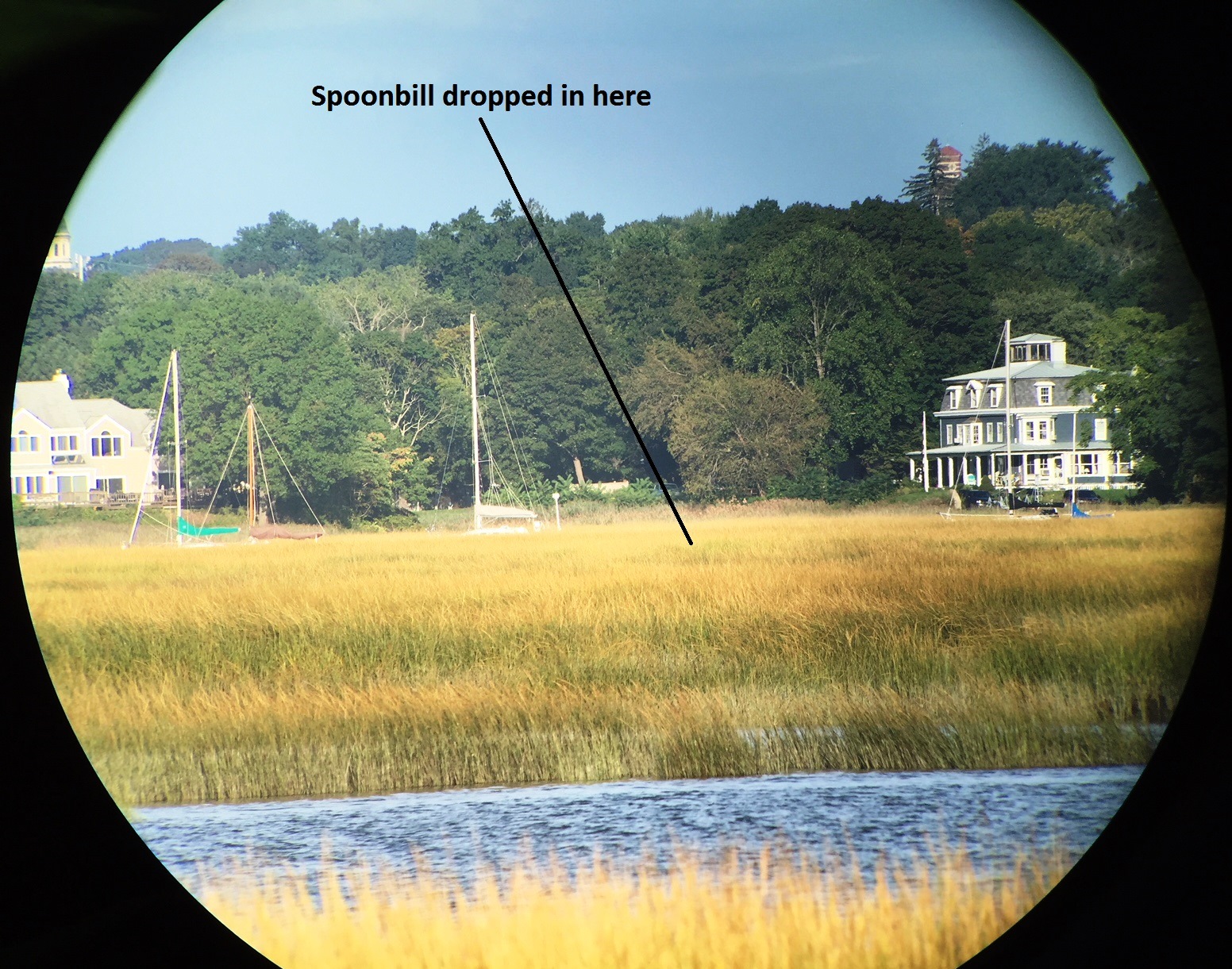
spotted a Roseate Spoonbill passing overhead (new SC statebird #1).
Good thing they are easy to identify overhead
even when driving.
Spoonbills have
expanded up the east coast since my last trips to SC, and are now regular year-round
in the state.
SC was my 5th state for
this species (see my statebird map below) – it’s time to try to add them to the
other southeast coastal states.
Friday was the first day for the official walks, and my
morning trip was to Kiawah Island.
A
bird-banding station at the western end of the island had only had a few
migrants.
But the beach on the eastern
end had regular reports of 2 targets - Reddish Egret and Lesser Black-backed
Gull.
We ran into huge traffic delays
getting to the island, so we missed out on time for landbirding near the
banding station.
So we headed right out
to Kiawah East Beach for the waterbirds.
The vast majority of this island is private with no access, but we were
allowed on the island since we were part of the CBC group.
Access was through the very fancy Ocean Golf
Course, where I was told one round of golf would cost you $500!
After a short walk we were on the beach and
had good sized flocks of terns and gulls.
And with a quick scan I spotted a larger dark-backed gull, though it was
just an adult Great Black-backed Gull.
But not to worry, with a bit more scanning I found another dark-backed
gull – this one was an adult Lesser Black-backed Gull (statebird #2).
SC was my 31st state for this expanding
species.
A bit later we found several Piping Plovers on the beach,
including one that had a leg tag as well as a transmitter and an antenna
sticking out behind the bird.
Interesting
to imagine this little bird carrying that transmitter all the way to its
wintering grounds (and back?).
Unfortunately
I missed the Peregrine as it buzzed the beach scattering the terns and gulls.
A short distance inland from the beach was a large
freshwater pond where the Reddish Egret had been frequenting.
But our initial searches came up negative –
just a Great Blue Heron, two Great Egrets, and a Snowy Egret, though 9 species
of shorebirds were nice.
A bit farther
along the beach one of the birders took a side trip to get a different view of
the pond.
And seconds later he was
waving us over – he had the Reddish Egret.
We all got great views of the bird as it fed in the pond (statebird #3).
As with the Spoonbill, now that I’m in the southeast, I can
search for the Egret in a number of my new “local” states.
As we headed back to the parking lot, I realized that the
Egret was now in view from the driving range.
It was an odd juxtaposition of birding and a very different lifestyle.
The afternoon walk was inland at the Pine Island Unit of the
Santee National Wildlife Refuge.
As we
arrived at the parking lot to meet the leaders they said we had just missed a
Yellow-bellied Flycatcher.
And then as
we started down the trail a birder in front of our group flushed what he identified
as a Whip-poor-will – unfortunately I was farther back with our group.
Two statebird targets missed in just a couple
minutes.
I spent a few minutes trying
for the Whip without success, but did find a nice Woodcock – a species not
often found in fall.
We continued down the trail and flushed 4 Sedge Wrens along
wet trailside ditches.
And later we flushed
a Sora from the edge of the trail.
As we
neared the wetlands along the edge of Lake Marion a small flock of Dowitchers
flew low overhead which turned out to be nice foreshadowing of what lied
ahead.
When we got to the wetlands there
was a small exposed mudflat and I picked out several less-than-cooperative
Snipe.
And then I heard calling shorebirds
overhead – Pectorals I thought.
A couple
seconds later they dropped in and they were indeed Pectorals (statebird #4).
I was able to put both species in the scope
for life views for several birders.
Nice
to get the Pectorals here at the mudflat since I missed them at the sod farm.
That fills a big gap in my statebird map –
just a couple more states to go for this widespread species.
The trail then took us back in the woods where we quickly
found a small flock of passerines.
Most
were difficult to view with backlit conditions and thick vegetation.
But I was finally able to get passable views
of a Tennessee Warbler (statebird #5) – certainly not a rarity but a nice addition
to my SC list, and one of my last states for this species.
Perhaps I can eventually add it to my VA list too now that I’m
in the southeast.
Later along the trail we came to another passerine flock
though they were mostly local breeders.
But then someone spotted an Empidonax nearby.
I was finally able to get on the bird and it
had no appreciable eye-ring, making it either a Willow or Alder.
I need both species for SC – both would be
rare for the area though Willow would be more likely.
So without a firm ID I added it as a “Traill’s”
Flycatcher (statebird #6).
Later a group of birders that went ahead of us ran into a
large migrant flock.
Unfortunately the flock
had mostly dispersed by the time we got there.
Ugh…
Although it was a fun
afternoon, it was a frustrating one where I missed a number of birds that others
reported.
The morning walk on Saturday, 9/28, was back to Folly Island
once again in hopes of birds on the beach and passerine migrants.
Just after the trip started I spotted a
Merlin passing down the beach (statebird #7), and was able to get most of the
birders on the bird.
I still need this
species in a couple of the nearby southeast states.
The walk started off well enough.
But the hot conditions were continuing, with persistent
southern winds limiting migration.
As a
result, little did we know the Merlin was the sole highlight of the walk.
There were next to no birds on the beach, and
few migrants in the woods.
The “lowlight”
was a group of hunters in a boat in the marsh nearby apparently hunting Clapper
Rails.
Is that legal?
With so few birds on the walk, the leader suggested we next
head to Fort Lamar Heritage Preserve to try for passerine migrants.
That turned out to be an excellent idea with
quite a number of migrant flocks in the woods at this site.
I ended up with 9 warbler species, though nothing
new.
And late in the walk I spotted a
thrush which eventually revealed itself to be a Swainson’s (statebird #8).
I just need this species in AZ and NV to fill
out my statebird map.
Later we came upon a commotion where a number of small passerines
were mobbing a small area of leaves in a tree.
We counted no less than 8 Yellow Warblers involved in the melee.
And then on close inspection we also spotted a
Tennessee.
Although we suspected they
were mobbing a Screech Owl, we never saw it, or any other reason, for all their
activity.
Saturday afternoon’s trip was back to the Orangeburg sod
farm hoping for better results than on Thursday.
When we arrived we met the leader who had
already scoped out the farm and alas found no grasspipers except for
Killdeer.
A most cooperative Ground Dove
was nice, as was a singing Painted Bunting and a large family of Blue
Grosbeaks.
But once again it was intolerably
hot and sticky, and with the lack of good birds, not a very pleasant trip.
There was only one trip scheduled for Sunday morning (9/29) –
which was to chase rarities seen the previous 2 days.
But Saturday evening it was announced that
the trip was cancelled because no chaseable rarities had been found.
So since I was free I joined a group of birders
out of the Durham area to bird the Bluff Unit of Santee NWR which had been good
Saturday afternoon for passerines.
Plus it
was roughly on the way home making for a shorter drive when the day was
over.
Unfortunately we only had a few
migrants Sunday morning.
And I was
looking in the wrong direction when the Cape May Warbler was seen by a couple
other birders.
It was nearly noon when I was getting ready to leave, and I
decided to check the Carolinas listserve to see if there was anything to
chase.
I found this message posted at 9
AM, just a couple hours earlier –
“One of the two Limpkins present most of the summer in
Hanahan, South Carolina, was observed at 10 AM this morning at 44 N.
Basilica Dr. by the homeowner. Birders are welcome.” [Note that likely
meant the bird was seen on Saturday, the day before the post]
Limpkin would be a great bird for SC – any chance Hanahan
was nearby?
With a quick search I
realized Hanahan was a suburb of Charleston just over an hour to the south.
Definitely chaseable, but it was the opposite
direction from home, and even a short visit there would delay my return home by
at least 3 hours.
And I was already hot
and feely icky.
In any case, I decided
to call it quits and head home.
If the
post had come out the day before I would have tried for it instead of heading
to Santee.
I ended the trip with about 120 species, 8 of which were new
for my SC statelist, which now stands at 240.
Plus I can add the Western Willet if (when?) it is split in the future.
Pretty nice for my first meeting with the
Carolina Bird Club.
Plus I made some
connections with a few local birders and other local bird clubs.
The next CBC meeting is on the upper SC coast
in January 2020 – chances are I’ll probably attend.