Saturday, March 19, 2016

Southwest Oregon Statebirding, Plus One Great Stop in California, February 2016


Oregon is one of only 4 states where my statelist is still below the old ABA reporting threshold.  And even though I have 218 on my OR list, that’s still a whopping 41 below the threshold.  Oregon’s very high threshold, the 5th highest of all 50 states, is mainly because of all the varied regions and habitats in the state.  As a result, although I have birded quite a bit in OR, since almost all of that time has been in the northwestern part of the state, I still have a long way to go to reach the threshold. 

My single biggest statebirding opportunity in OR would be to spend a few days birding the drier eastern portion of the state.  Because of the very different habitats there compared to northwest OR, there are close to 70 possible statebirds I could try for there.  Although that’s a large target list, I typically only find a few more than half of my possible targets on a trip like that one – in this case my estimate was 37.  That means just one trip to eastern OR may not be enough to reach, and then surpass, the old threshold. 

So what other significant statebirding possibilities could there be for me in OR?  I started doing a bit of research and found out that there were a few OR species that are only seen in the southwestern portion of the state.  The year-round southwest specialties included California Thrasher (I thought this one was endemic to CA), Oak Titmouse, Red-shouldered Hawk, Mockingbird, and Lesser Goldfinch, with summer specialties like Blue-gray Gnatcatcher and Allen’s Hummingbird.  Then there were species I still needed that were only seen in the western portion of the state like Black Phoebe and White-tailed Kite year-round, and White-throated and Swamp Sparrows in the colder months.  Not to mention seabird and shorebird targets only seen on the coast, many most likely in winter.  I figured with this many local specialties I could get at least 10 new OR birds for my list, so there was “critical mass” to justify a trip to southwest OR.

So the next question was how to get there.  My work travels take me to the San Francisco Bay Area every couple of months, and on several of those trips I’ve added some vacation time to bird in the Reno, NV area 4 hours away.  It would be a longer drive to OR (5-6 hours), but still feasible to tack a mini OR vacation onto an upcoming work trip flying in and out of SFO.  Next I needed to decide on whether to go in the winter or the summer.  Going at either time of the year would mean several targets would not be feasible, so each option had pros and cons.  But given that I was anxious to get there, I decided to head to OR on my next SFO trip in February.  Though I was more than a bit concerned about the possibility of rainy conditions in this El Nino winter.

Now it was time for the detailed research.  First I went to eBird and compiled a long list of possibilities, and most likely locations for key targets.  Then I reached out to the OR listserve and received some general guidance for the local specialties.  I noticed that many of my targets in the Medford/Ashland area, including several owls, were being seen by local birder Frank Lospalluto, so I sent him an e-mail requesting some advice.  He replied by offering to go with me to help me search for my local targets, including pre-dawn owling.  I’ve always found statebirding with a local expert is invaluable, especially for owls, so I quickly accepted his offer.  Since I’ll eventually get to eastern OR I wanted to concentrate on those western or southwestern specialties.  So I planned an itinerary spending the first day with Frank in the greater Medford/Ashland area.  Then I would head to the coast for the second day before making my way back to CA.  I figured would have about 28 possible statebirds in those 2 days, though since many were low probabilities, I hoped for maybe 12 new birds for my OR list.  And as the trip neared it looked like my birding days would be between pacific storms, so the forecast was going to cooperate as well. 

Day 1

I met Frank at 4 AM and we headed east of Medford into the mountains in search of four owl species – Saw-whet, Pygmy, Western Screech, and Barred – though I would be happy finding just 2.  Our first several stops for Screech were unsuccessful even though Frank had had success there in the past.  Then at the next stop on Salt Creek Rd. in Eagle Point we had a calling Saw-whet (statebird #1), apparently responding to a Screech Owl call.  OR is only my 14 state for this species even though it is regular throughout much of the country (see my statebird map below).


We made several more stops on Salt Creek Rd. and elsewhere in good habitat, but had no success with the other targets.  By the time we made our way to nearby Lake Creek Rd. it was starting to get light, and despite more good habitat, we couldn’t scare up an owl.  Then as it was almost time to get out the binocs to start searching for daytime birds, we had a Western Screech Owl give a short response to our last bit of owl tape for the day (#2).  It took us almost 3 hours but we had our 2 species of owls.  I’m slowly filling in my statebird map for this western species.


A bit further up Lake Creek Rd. we made our first daytime birding stop, but could only find a few Juncos and Robins.  Frank starting doing a Pygmy Owl imitation and almost instantly we had not 1 but 2 birds respond (#3).  One bird was still calling 10 minutes later when we left this location, which afforded this very nice view of the valley and mountains in the distance.  By the way, the Pygmy Owl was likely calling from the tallest conifer in the distance on the left side of this picture.


With few landbirds in the area, we decided to come down out of the mountains and head for other nearby locations.  Near the bottom of the road we made a quick stop with a nice vista over a riparian area.  Frank quickly picked out a distant Lewis’ Woodpecker which I was lucky enough to get on before it flew off (#4) – not the best of views but there would be more to come.

Next it was off to Agate Lake.  Along the way Frank mentioned that Prairie Falcon was a possibility there, and just then I noticed a mid-sized falcon perched in a roadside tree.  It was just a Merlin, but still a nice bird to add to the day list.  Then as we neared Agate Lake we noticed an even larger falcon perched near the entrance – it was indeed a Prairie Falcon (#5).  That was one I hadn’t even included on my list of possibilities.  I still need this species in several more states in its regular range.


Our next stop was Lower Table Rock, but along the way we picked up the first of several flocks of Lesser Goldfinches (#6), and a flock of Tundra Swans “grazing” in a field.  Lower Table Rock park was a very interesting spot, with groves of oak trees, and patches of low brush and grasses.  Here our targets were Oak Titmouse and California Towhee.  But perhaps most memorable were the Lewis’ Woodpeckers which were everywhere – we saw at least a dozen of these very colorful birds.  Only slightly less common were the Acorn Woodpeckers, attractive in their own right.  But back to the target birds - we heard and then saw several Oak Titmice (#7), and eventually were able to coax several California Towhees into the open (#8) and heard a few more giving their sharp chip notes.  OR is only my second state (after CA) for each of these species. 

Frank next directed us to a spot on Rogue River Road where he has had Red-shouldered Hawks in the past.  Luckily the caretaker for the property was just coming out just as we arrived, and he opened the gate to let us onto the grounds.  After a short walk we made our way to a lush riparian area, where right on cue we soon heard at least 1 calling Red-shouldered Hawk (#9).  My statebird map now pretty well matches the regular range of this species (with the exception of the gap in IA).


We also had a singing Brown Creeper that sounded very different from our eastern birds.  Maybe one to bank pending a split some day?

It was now midday and we started a search of numerous possible valley locations for White-tailed Kite and Mockingbird.  One stop was at Ousterhout Farm where a Mockingbird had been reported each of the last several days.  Frank couldn’t reach the homeowners to gain access to the farm, so we were limited to just viewing the farm from the perimeter.  Unfortunately we came up empty there and at all our other stops for both the Kite and the Mocker.  Though we did find Black Phoebes at two locations (#10).

Then we were off to North Mountain Park in Ashland where Frank had re-found a wintering Swamp Sparrow at the park feeders two days before.  As we neared the park Frank got word that a Pygmy Owl was being seen perched most cooperatively low in a tree in the park.  As we arrived we saw a few birders in the distance with cameras trained into a low conifer.  With a short walk we could see the Pygmy Owl chowing down on a large rodent – by far my best ever view of a Pygmy Owl.


Then we headed to the feeders to try to find the Swamp Sparrow.  It was now mid/late afternoon and we wondered how much time we should spend at the feeders versus heading off to a couple other locations we still needed to get to that day.  After just a couple minutes with no birds at all, soon a small group of mostly Golden-crowned Sparrows arrived.  Just as Frank commented that this group was similar to the group accompanying the Swamp Sparrow a couple days earlier the target bird appeared at the feeder (#11).  OR was one of my last likely states for this species (except for WA perhaps).


With that one pretty quickly under our belts, we headed to Emigrant Lake southeast of Ashland where Frank had seen a Kite most every day that week.  Along the way we heard back from the homeowner at Ousterhoudt Farm who invited us to try for the Mockingbird.  So we planned to quickly check off the nearly sure-fire Kite so we could head right to the farm.  However, the Kite was a no-show despite searches in many different locations around the lake.  Just goes to show you that no bird is ever guaranteed.

As we headed to Ousterhoudt Farm we tried several other locations for Kites with no luck.  Then we got a call that the Mockingbird was once again at the farm.  Minutes later we met the farm owner and he took us right to the bird (#12).  OR was my 44th state for this species (I really need to work on my IA list!).


He also gave us a quick tour of his very birdy property, which included a Barn Owl perched in a nest box – the 5th owl species of the day.

We ended our most successful day with 76 species and 12 new birds for my OR statelist.  Can’t thank Frank enough for all his help!

Day 2

Since we couldn’t find a White-tailed Kite in the Medford/Ashland area, I altered my planned route for Day 2 to head a bit farther north toward Coos Bay where Kites were regular.  Plus I planned to take the back roads en route to Coos Bay where several Kites had been reported recently.  With my new itinerary I came up with a list of 10 additional statebirds that were at least remotely possible that day, but I figured I’d be happy adding just 2.

Despite a couple hours of searching in really nice Kite habitat, once again I came up empty on the Kite.  One interesting stop along the way was at a dairy farm near Norway where a large flock of Doves included numerous hybrid Mourning x Collared Doves.  All had a black ring on the hind-neck.  However some birds had pointed tails like Mourning’s while others had square tails like ECDs.  The mantle of all birds varied from brown like Mourning’s to a bit darker gray than ECDs.  There were also other Doves there that appeared to be pure ECDs – or at least they had such a minor amount of Mourning DNA that they looked like pure ECDs.

My last stop trying for the Kites was at the Ni-Les’tun overlook at Brandon Marsh northeast of Coos Bay.  Although there were no Kites, the parking lot was full of birds, including a surprising Hermit Thrush hopping atop a curb (#13).  Although I would spend quite a bit of time in good Thrush habitat during my 2 days in OR, surprisingly the only one I would see was in this parking lot!  I just need this species in 5 more mainland states to fill in my statebird map.


It was now time to turn around and head back to Route 101 to begin my trek down the coast.  The road was paralleling the Coquille River and I noticed one lone Aechmophorus grebe diving in the river.  With no cars behind me I decided to make a quick stop and check it out.  With a quick binocular view I noticed paler sides and a white face.  Finally it rested on the surface long enough to confirm that it was a Clark’s Grebe (#14). 

My next stop was at Floras Lake where reports earlier in the winter had included 3 of my targets – 1 report each of American Bittern and Snowy Plover, and a few reports of a lone Lapland Longspur but not for several weeks.  As I arrived at the lake and started to put on my boots I could have sworn I heard a distant Bittern.  I walked to the lake edge, and once again thought I heard a Bittern – but couldn’t be sure.  Although I was tempted to check it off I decided to play it safe and not count it.  Next I headed to the short grasses between the lake and the beach where the Longspur had been seen, but with no luck.  Then I headed to the beach to look for the Plover but saw no shorebirds at all.  This wasn’t going well.  On my way back from the beach I noticed two small sparrow-like birds fly in from the south and land in the grasses.  I got brief looks at 1 of the birds before it landed and it looked like a Longspur.  But the view was so brief that I needed to be sure.  I headed to where one bird landed and quickly found a most cooperative male Lapland Longspur in almost full breeding plumage (#15).  I then walked over to the area where the other bird landed and found a second Longspur – either a female or a basic plumaged male.  Who knows if these birds had been there all winter or were just arriving from points south.  My statebird map for this species is still pretty spotty, mostly due to limited winter birding in much of its normal range.


My last set of stops were in Brookings just a few miles from the CA line.  My first target was Allen’s Hummingbird – I was told Brookings was the best spot in the state to try for them.  Specifically I was to check flowers in gardens in Azalea State Park.  Although it was a bit early for them, I was still hopeful.  I found two nice gardens with flowers suitable for hummingbirds, but I could only find an Anna’s Hummer at each spot.  A nice consolation was a flock of Red Crossbills feeding in a tall conifer.

The next stop was at Chetco Point recommended by local birders as a good spot to do a seawatch.  Although I had a fair number of possible seabird targets, the only one that was a realistic possibility was Black-legged Kittiwake.  It was starting to rain lightly when I got to the Point, but visibility was good as I set up my scope.  I had just begun to scan the distant ocean when a closer gull passed through my scope field – it was a Kittiwake (#16).  I stayed at the point for about an hour, and saw several other Kittiwakes.  Interestingly all were flying higher and closer to shore than the larger gulls.  But as expected, I saw none of my other targets.  That completes my statebird map for Black-legged Kittiwake on the Pacific coast – though I still need it in several regular states on the Atlantic.


My last OR stop was to try for Barred Owl in mixed woodlands along Peavine Ridge Road just barely outside of CA.  It was some great habitat, and it was late afternoon on a gray, drizzly day, so I hoped I could coax a response from a Barred Owl.  At one of my first stops I heard a distant series of calls that sounded a lot like Mountain Quail – one I had studied up on prior to the trip.  But they were distant, and I couldn’t quite hear the two-syllable nature of the call.  So I kept trying for Barred Owls with no luck.  I headed back down the ridge for one more try for the owls and heard another series of Quail-like calls – these were much closer and I could hear the two-syllable notes of the Mountain Quail (#17).  Only my 3rd state for this species after CA and NV.  A very nice consolation for missing the owl! 

I ended my 2-day OR trip with 110 species, and an amazing 17 new birds for my statelist – 5 greater than my expected statebird total.  And although I missed 3 western targets (White-tailed Kite, Allen’s Hummer, and White-throated Sparrow), I got several others that were nice bonuses.  That gives me 235 in OR – still 24 short of reportable.  But with an eventual trip to the eastern half of the state, I should be able to exceed the OR threshold by a nice margin.

But as it turned out, my birding time was not over yet…

My hotel that evening was in Arcata, CA, about a 2-hour drive down Route 101.  It was late afternoon as I was heading south through Prairie Creek Redwoods State Park when I noticed two people up ahead on the shoulder with long camera lenses pointing across the road to the north-bound shoulder.  I figured they had spotted a bear or other large mammal so didn’t think too much of it.  Although I went by them at 65 mph, I had enough time to look over to where they were looking and noticed a large owl sitting in a tree on the shoulder.  Luckily I was able to quickly pull over and walked back to the photographers.  They had spotted a Great Gray Owl, or I should say THE Great Gray Owl, that had been seen in the area for the last couple months.  I had heard a little about this bird, but didn’t even know where it was being seen, let alone didn’t know that I would be driving right through the area.  Although many birders had missed this bird during its stay, remarkably I was able to happen on it – though I surely would have missed the bird if the other birders hadn’t been out with their cameras to photograph it.  I got this nice phone-scoped photo of the bird - #381 for me in CA.


Truly an excellent ending to a great birding trip!


Saturday, February 27, 2016

Thirteen Statebirds in Nebraska – “Reportable Plus 15”, January 2016


My annual spring birding trip in 2009 included multiple days in western NE, where with the advice of several local birders, I increased my statelist from a miniscule 124 all the way up to 213.  With an ABA reportable threshold of 225 at the time, I needed another couple short trips to the western end of the state in 2010 to reach and then exceed the threshold, adding 19 more to get to a respectable 232, or 7 over the old ABA threshold. 

The ABA used to calculate the state thresholds as half of the total number of species seen in the state.  Although the thresholds are no longer published by the ABA, with a little web research you can generally find the latest state totals, and calculate a new threshold by dividing that number by 2.  For NE, the statelist as of December 2015 had increased to 461, resulting in a newly calculated threshold of 230.5.  So now my total was only 1.5 over the present threshold, meaning I could be below threshold with the addition of just 4 more species (or splits) in the state.  NE is a good example of why, instead of just aiming to be above the old ABA threshold, I have come up with a goal of being at least 15 over that total in any given state - “reportable plus 15” as I call it.  That should give me a comfortable cushion to stay above threshold for quite a number of years to come.  And to give me that cushion in NE, I needed to get back there to add some more statebirds! 

I don’t get to the region very often, so when a January business trip to Denver came up I started thinking about whether adding a couple vacation days for some western NE birding could yield a sufficient number of statebirds to make it worthwhile.  The closest I’ve been to winter birding in NE was a trip to the state in early November 2010, so I had a pretty long list of at least remotely possible target birds.  But there was a reason why I haven’t done mid-winter birding in NE or most other states in the region - mid-winter weather in the plains can be cold, windy, or snowy, making traveling and even birding difficult if not impossible.  Of course I would have to make my plane arrangements well before I could get any local weather forecasts.  But given that I was only barely above threshold, and that there were numerous possible targets, I decided to add 2 vacation days to the Denver trip and cross my fingers for at least 1 good day of weather.  Plus the Ogallala area with Lake McConaughy and Lake Ogallala was one of my favorite birding spots anywhere across the country, so it would be great to get back there.  I figured if I could get 4 or 5 new birds for NE it would be a successful trip.

Now it was time to do the local research.  The first thing I did was to set up a Needs Alert on eBird, which showed that many of my targets were being seen in the state.  However, the vast majority were from the eastern portions of NE.  Then I turned to the NE listserve which had a fair number of posts from the western part of the state, including sightings of a few of my targets.  Then came posts from the Lake McConaughy and North Platte Christmas Counts where many of my targets were spotted, plus several rarities not even on my target list.  I contacted the count compilers and got great local information or many of their sightings.  But despite initial enthusiasm I realized my trip would be 3-5 weeks after the counts, so these would be very old sightings by the time I got to the area. 

As the trip neared there were few posts from western NE and even fewer possible targets reported.  I also reached out to Kathy DeLara, a birder in Scottsbluff who I had birded with in 2009, and she mentioned that there were reliable sightings of only 2 of my possible targets in her area.  Now I was worried that I might not even get the 4 or 5 new statebirds I was hoping for.  But then the week before my trip there was a listserve post from NE birder Joel Jorgensen who spent a couple days in the Lake McConaughy/Lake Ogallala area.  He found 10 of my targets - now I was pumped!  With microdirections from Joel, I now had a possible target list of 18 birds, though realistically I hoped for about 7 of these as new NE statebirds.  And then I realized I would only need 1 more to reach the “reportable plus 15” goal.  Plus the weather was looking warm and dry for the trip.  So everything was falling into place.

My plan was to leave Denver when work was done around noon on Day 1, and then take a 3-hour drive to Ogallala.  I would bird a few hours in the area till dusk that day, and then again till mid-day on Day 2.  Then I would head east to North Platte and bird there in the afternoon and a few hours in the morning on Day 3.  The last set of stops would be near Scottsbluff, on the way back to Denver that night.  A busy itinerary, but that would give me stops at many good birding spots in the area.

Day 1

Work was over right at noon, so everything was right on schedule as I left Denver.  During the long ride to Ogallala I thought through my target list and realized that if everything fell into place there was a remote chance that I could get 8 or more of my targets even in my short time available that evening.  I had lots of optimism when I arrived in the town of Ogallala, and headed right to a feeder where a White-winged Dove and been seen for much of the winter.  As I arrived the homeowners greeted me at the door and took me into the back yard where the Dove was sleeping on its favorite perch (statebird #1).  NE is at least the 6th state where I’ve seen this species which is prone to vagrancy as a rarity (see my statebird map below).


I spent a few minutes talking with the very friendly homeowners, but then was off to Lake Ogallala just northeast of town.  Lake Ogallala is a small lake just below the enormous Lake McConaughy.  Despite its small size it seems to attract many more waterfowl than the larger lake, including quite a number of rarities for this inland location.  For instance on my November 2010 visit I found all 3 Scoters on Ogallala.  And it is also well-known for quite a diversity of gulls in the winter, especially attracted to fish coming through the tailrace where water is discharged from McConaughy into Ogallala (I had a Lesser Black-back and a California there in November 2010). 

I pulled into the park around Lake Ogallala and went right to the tailrace to take a quick look.  There were only a few Ring-billed and Herring Gulls at the tailrace so I started a quick scan of the lake.  The lake was about half frozen over, but the open water was absolutely full of diving ducks, mostly Scaup and Goldeneye.  And since I needed Common Goldeneye for my NE list, that one was a quick addition (#2).  A large flock of Canada Geese were swimming near the back of the lake, along with even more divers, and 6 Trumpeter Swans (#3).  NE was my 15th state for this expanding re-introduced species which wasn’t even on my target list when I was last in NE in 2009-2010.


Next I started scoping through the divers, first concentrating on the Scaup in search of several Greaters that had been reported.  It didn’t take long before I had several pairs of Greaters mixed in with the more numerous Lessers (#4).  In fact I think there were a fair number of Greaters on the lake.  I only need Greater Scaup in 7 more states for a sweep of the mainland states.


And then my attention was drawn to a Goldeneye that was swimming all by itself.  It was a female and a bit smaller than the other Goldeneyes.  Although it was diving a lot, I kept thinking I was seeing an all-pale bill.  Eventually it stayed on the surface long enough for me to get a good look at its head – it indeed had an all yellow bill and a forward-sloping head shape.  It was a female Barrow’s Goldeneye (#5).  Although a male Barrow’s had been reported from the tailrace recently, no one had reported a female.  NE was my second central US state to find this species as a rarity, not to mention seeing it in 7 states in the northeast.


Next I spent some time scanning through the Canada Geese in hopes of finding one of their rarer cousins.  The flock numbered at least a thousand, with about half swimming in the open and the others standing and sleeping on the banks and in the marshes.  But with such a large flock many birds were frequently hidden behind others, so it took more than just a quick scan to see all the birds.  At one point I noticed a glimpse of pink among the otherwise brown birds on the shore – it was the bill of a White-fronted Goose (#6).  Eventually it walked out from behind the Canadas affording good looks - the second rarity I found that wasn’t recently reported at Lake Ogallala.  It was turning out to be quite a start to the trip, and there was more to come. 

I changed angles to look at the northern part of the lake near the edge of the ice.  Waterfowl were less numerous here, and featured a large flock of Common Mergansers.  Then I spotted a male White-winged Scoter which had been reported recently.  On another scan I noticed a pair of Long-tailed Ducks (#7) swimming right at the ice edge – only 1 had been reported there recently.  NE is my 4th inland state for this typically coastal species.


Having completed a pretty thorough review of the waterfowl finding all my targets and then some, I turned my attention back to the tailrace to look through the gulls.  Recent reports had included a couple Lesser Black-backs and a 3rd-year Glaucous.  Although there were only about 25 gulls there one of the first birds I found was a Lesser, and then a second Lesser appeared – both were 3rd-year birds pretty well into adult plumage except for a bit of a black tail band.  And then I picked out a 1st-year California.  Nice rarities but not new statebirds.

Then I noticed a gull fly overhead that looked pure white below.  My first thought was that this must be the Glaucous reported a week earlier.  But then I realized it was way too small – not too much larger than the Ring-bills.  From above the mantle was the color of an adult gull, and the wings appeared all white, except for only a hint of darker coloration in the primaries (although it took me a long time before I saw any dark feathering at all in the primaries).  The tail was mostly white with a narrow band only slightly darker than the tail near the tip, though there was a thin band of white at the very tip.  The bill was yellow except for a ring, very much like Ring-billed.  Was this a very rare Iceland or the much more expected Thayer’s?  I would think that by the time a Thayer’s is in 3rd year plumage it would have some noticeable darkness in the primaries as it approached the adult plumage that typically has quite dark wing tips.  As I wrote in eBird – “If I were back on the MA coast I would quickly call this an Iceland, bit this is NE...”  I traded e-mails with Joel Jorgensen who had tentatively reported the Glaucous the previous week, and it turned out that this was the same bird he had seen briefly and photographed.  One of Joel’s photos is provided below.


And here’s one of my photos taken with just my iPhone with no magnification.


After further review, and sending Joel’s photos to some gull experts, we agreed that this was a rare Iceland Gull.  That gave me 5 species of gulls even though there were just 25-30 birds present.  NE is my 4th state for Iceland Gull away from the northeast.


And that was statebird #8 for the trip – bringing my NE statelist to 240 – reportable plus 15.  My 36th state reaching that goal (I have 45 states over the ABA threshold).  And amazingly I was just a couple hours into my planned 2+ day trip.

I spent the next 30 minutes at the tailrace hoping for more gulls to arrive, but just kept seeing the same Iceland and Lessers.  Certainly can’t complain about that!  At one point the locks were opened and quite a bit of water was released through the tailrace.  Goldeneyes and Mergansers starting flying in from the lake looking for a quick meal.  Interestingly, almost all were males, including the male Barrow’s reported earlier.  Along with at least a dozen Bald Eagles of various ages, it made for quite a spectacle.

It was now close to sunset and time to head to fields just outside the park where Joel had reported Short-eared Owls the previous week.  With some time to spare before dusk I drove along the road and found what I hoped would be the best spot to be able to scan the fields for these nocturnal birds.  I set up my scope on the shoulder of the road and prepared to wait for dusk.  Just then I noticed a “bump” on a distant fencepost in the middle of the field.  I put my scope on it and it was a Short-eared Owl perched on the post (#9).  As I was looking at it another Short-ear flew through my scope field.  I then scanned with binoculars and saw at least 3 birds flying about, with all this activity starting at least 30 minutes before dusk.  At one point a bird flew to within 30 feet of me seemingly checking me out.  I even heard one of the birds “bark”.  That was by far one of my best experiences with Short-ears.  Given the challenges of finding these birds at dusk, my statebird map is really spotty, having seen this species in just 21 states though it can be seen throughout almost the entire country.


What an amazing start to the trip!  In just 2 hours of birding I had added 9 statebirds, already exceeding my expected total for 2 days of birding.  As a result, I no longer needed to make a trip to Scottsbluff since I had already seen the 2 possible targets there (Common Goldeneye and White-front).  And in fact, since my list of remaining targets was so short, I decided to cut out the last birding day altogether.

Day 2

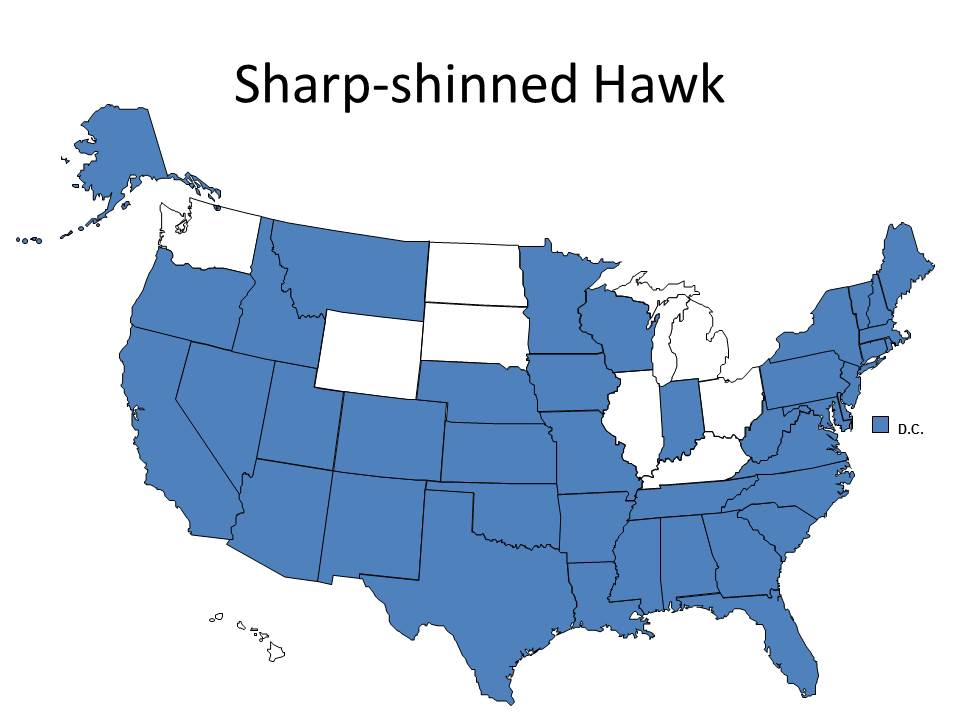
I started at first light at the tailrace at Lake Ogallala hoping for additional gulls.  But with the exception of several Bald Eagles, the tailrace was very quiet.  That is except for the noise of the strong northerly winds that had surprisingly picked up overnight.  I found a spot somewhat out of the wind, and decided to wait it out a bit longer.  At one point I noticed a pair of birds fighting in mid-air over the hills to the south.  One was a Flicker and the other was an Accipter that wasn’t too much larger.  After the two birds separated, I was able to identify the small Accipter as a Sharp-shinned Hawk with its fluttery flight and small head/neck (statebird #10).  That’s another species that I only need in a few more states to fill in the rest of my statebird map.


I eventually gave up on the tailrace, and turned my attention to the waterfowl on the reservoir.  The flock seemed relatively unchanged from yesterday, so I was about to move on when I noticed a lone goose flying into the goose flock – it was a Snow Goose (#11).  I later re-found the White-front in the flock as well.  It’s not surprising that 5 of the 9 remaining states where I still need Snow Goose are across the northern tier where I’ve done little if any birding outside of summer months.


With one last stop on the lake to check out a small group of gulls I found one of yesterday’s Lesser Black-backs and an adult Thayer’s – my 6th gull species even though I saw less than 100 gulls in total over 2 days.

Next I headed up to Lake McConaughy to try for some waterfowl.  Unfortunately I was looking right into the wind, making viewing difficult.  Regardless, I didn’t see a single bird on the water.  Though I did refind yesterday’s Iceland Gull hovering overhead in the updrafts off the dam.

Then it was over to Keystone/Roscoe Road east of Lake Ogallala.  The key target here was a flock of Redpolls that Joel Jorgensen had had at a small cattle ranch there the week before.  As soon as I pulled up to the spot I could hear a lot of Goldfinch chatter, so I moved in closer to the flock to check for other finches.  I estimated there were at least 200 Goldfinches along with a small number of Siskins feeding in the weedy vegetation, but rarely were more than a dozen in view at any time.  Then I heard a couple brief call notes that could have been a Redpoll.  A few minutes later a lone bird flew over my head giving distinct chit-chit calls of the Redpoll (#12).  NE was only my 14th state for this species – another example of missing a rather widespread species by only doing limited mid-winter birding across the country.


My last stop in the area was to bird along the canal below Lake Ogallala in search of Rusty Blackbirds seen by Joel.  Unfortunately I found no blackbirds at all, but a nice consolation was finding a field with about 50 Horned Larks and 1 Lapland Longspur (though alas no Snow Buntings).

It was still early, so I had enough time to head east to the North Platte area to bird some of the hotspots there.  Although I had already found most of my possible targets, there were still some longer shots to try for. 

The first stop was Cody Park where I quickly found the semi-feral and non-countable Trumpeter Swans, and Snow and Ross’s Geese, but found little else besides the many wild Canadas.  Then I took a slow walk around the tennis courts that are surrounded by mature pines and spruces, but didn’t find anything in the conifers.  Nearby North Platte Cemetery had similar planted conifer habitat, including a row of pines full of Sapsucker holes – but there were no Sapsuckers to be seen.  The highlight there was a presumably mated pair of Flickers foraging together – one was “yellow-shafted” and one was “red-shafted”.

Next I was on to Scout’s Rest Ranch where several Rusty Blackbirds had been seen nearly 6 weeks earlier on the Christmas Count.  Just as I pulled into the parking lot 3 Blackbirds flew directly overhead – although I didn’t get great looks at them, they were the right size and shape of Rusty’s, and I saw no shoulder patches or striping suggesting they were Red-wings.  They flew off low to the northwest into an area of swampy woods with wet leaves on the ground – perfect habitat for Rusty’s.  So although I would have hoped for better views, I felt good about adding this bird to my NE statelist (#13).  I now only need Rusty Blackbird in a few more states within its regular range.


As I drove west toward my next stop I noticed a cattle feed lot and a cloud of blackbirds swirling around it.  As I pulled over a large portion of the flock was close to the road, and most were Starlings, though I picked out at least 10-20 Brewer’s Blackbirds in the swirling activity.  Not a new statebird but a nice “write-in” on eBird.

Then I was off to small Bowley’s Pond along the interstate.  It was full of mostly dabbling ducks and geese, including 2 Snow Geese (1 white and 1 blue form), and at least 10 White-fronts.  This would have been a great stop the day before, but those geese were old news now.

My last stops were around the power plant in Sutherland.  Although I didn’t pick out anything new, there were still a few highlights.  The first was at a small lake south of the power plant that was full of Mallards – maybe 5,000 or more.  And interestingy, the vast majority were males!  Check out these photos, first a shot taken of a portion of the lake with my iPhone –


Then a closer phonescoped shot –


Finally I made my way to a cooling pond at Sutherland that has numerous baffles on the surface that are preferred perches for loafing birds.  Here I picked up a few out-of-season birds that were new for the trip– 5 White Pelicans and 2 Double-crested Cormorants.  A nice conclusion to another most successful statebirding trip.

I ended up with 70 species on the trip, including 15 “write-ins” in eBird.  My tally of 13 NE statebirds was way over my hoped-for goal of 7, giving me 245 in NE – 20 over the old ABA threshold.  That should keep me over the threshold for many years to come.