Showing posts with label White-winged Dove. Show all posts

Saturday, February 25, 2023

Five Statebirds on the Georgia Coast While Returning from a Florida Chase, February 5-6, 2023

In January 2023 I had a most successful birding trip to the FL panhandle.  Not only did I see my first new life bird (White Wagtail) in several years, it was also my first trip to FL from my home base in western NC, greatly expanding my horizons for potential trips.  I was now watching the ABA Rarities eBird alerts more frequently, especially focused on potential lifers.  And the most likely “nearby” location for those additional lifers would be in south FL. 

Sure enough late in January I started to notice reports of a Bahama Mockingbird in Cape Canaveral, FL.  I’ve birded south FL a number of times, picking up several rarities there over the years.  But there has never been a Bahama Mockingbird there during any of my trips.  As a result, this species has been a key target for me.  And with this individual being relatively “close”, at only halfway down the peninsula, it was definitely one to chase after.

And of course, there was also statebird potential along my route back home through GA and SC.  My route would take me along the coast, and with a little research, I found no less than 7 statebird targets in GA.  From south to north I hoped for –

  • Bullock’s Oriole coming to a feeder on Jekyll Island,
  • Saltmarsh Sparrow near Jekyll Island (and most anywhere along the coast),
  • Black Duck with Mottled Ducks in Brunswick,
  • Dickcissel coming to feeders in Savannah,
  • A White-winged Dove and a Western Tanager at a feeding station on Tybee Island, and
  • Black Scoters off the north end of Tybee Island. 

That’s lots of potential for just 2 partial days of birding.  As it turns out I only found 2 of 6 targets in FL, though the 2 I found were lifers.  (See my previous blog post detailing the FL portion of the trip.)  To improve my hit rate in GA I reached out to birding friend Diana Churchill who lives in Savannah for local advice.  She gave me excellent tips to help me find my targets, especially in gaining access to all those private feeders.  

This blog post focuses on my GA searches on this trip.  The SC portion of the trip is summarized in my next post.

Day 2 – February 5

After an early morning stop in FL, where I missed both of my targets, my first GA stop was on Jekyll Island for a Bullock’s Oriole.  This bird had been regular at a feeding station through January 18, before disappearing for 2 weeks.  So it never made it to my radar screen as I prepped for my trip.  But then on February 3 the homeowner reported that it had returned.  So now one to chase, though given its recent history, I wasn’t too overly optimistic.  On a positive note, Diana shared with me that all the homeowner’s feeders were in the front yard and visible from the road.  So no specific access was needed.  Unfortunately, I couldn’t find the Oriole despite waiting there for 90 minutes.  In fact, there were no Orioles at all, which is a bit odd for coastal GA feeding stations.  A consolation prize was finding a female Ruby-throated Hummingbird that had not been previously reported there.

Next I had planned to look for Saltmarsh Sparrows in the marshes as I left Jekyll Island.  But it’s easiest to see these Sparrows (and their Seaside and Nelson’s cousins) during the highest tides.  And it was now a falling mid-tide, so not the best conditions.  Since I had a full day in front of me, I decided to pass on this pretty common target, and try for it later on a higher tide.

My day wasn’t exactly starting off very well…

My next stop was a small pond in a suburban neighborhood in Brunswick where a Black Duck had been seen with Mottled Ducks and Mallards.  In preparation for IDing these 3 very similar species, the night before I spent some time brushing up on the key field marks that separate them.  Now I had to figure out how to bird the site since it looked like the pond was surrounded by houses and pretty inaccessible.  But finally I found a couple eBird checklists with pretty explicit descriptions, including the access point at the end of a cul de sac.  I was all set. 

Within seconds of arriving I did a quick binocular scan of the pond and picked out 2 pairs of dabbling ducks.  With closer scope views I could tell all 4 were Mottled Ducks.  I made several more scans, this time with the scope, but found no more waterfowl on the water.  Then I looked over to a grassy bank on the right and noticed a pair of Canada Geese along with another pair of dabblers.  One was much darker than all the others, and with scope views I could confirm the ID as a Black Duck (GA statebird #1).  Not only was it significantly darker, but these pictures show its speculum had no white edges. 


My statebird map for Black Duck is inserted below.  The blue-shaded states are those where I’ve seen this species in its regular range.  Iowa is the last state where I’ve yet to see it where it is a regular species (cross-hatched).  The 3 brown-shaded states are those where I’ve seen Black Duck as a rarity.  Although this species is a rarity on the GA coast, it is a regular wintering species in the northern half of the state.


My original planned next stop was a Savannah feeding station where a Dickcissel was an infrequent visitor (it typically didn’t appear until 4 PM or later).  I was a bit ahead of schedule so I had just enough time to squeeze in one additional brief stop before heading to the feeders.  Since it was an afternoon high tide I thought about trying for Saltmarsh Sparrows, but the tide wasn’t particularly high that day.  I guess they’ll have to wait for another trip.  Instead, I decided to move one of tomorrow’s stops up to today -a trip to the north jetty of Tybee Island for long-staying Black Scoters.  Several eBird pictures showed the Scoters right next to the jetty, which was only a 5-minute walk from the parking lot.  So if all went well a quick visit would give me plenty of time to see the Scoters and still get to the Savannah feeders in time.

I pulled into the parking lot for the Tybee Island Marine Science Center at 2:35, and took the short walk to the north jetty.  Not only were there no Scoters there, the jetty was almost completely underwater due to the high tide and waves.  In hopes that the Scoters were still around and just dispersed on the nearby waters, I did a number of quick scans, but the only waterfowl I could come up with were a small group of Buffleheads and 2 Red-throated Loons.  I would just have to come back the next morning which was my original plan.  I just hoped my 20-minute stay at the jetty didn’t make me too late for the Dickcissel.

The Savannah feeding station was in the back yard of Steve and Sandra Calver.  Once again with Diana Churchill’s help I connected with the Calver’s and they were happy to let me come into their yard to look for the Dickcissel.  They mentioned that the target bird appeared at 4:39 PM the previous day, so I was optimistic that my 3:44 arrival time was early enough.  I settled into one of the chairs they had in the yard, and began to take in the show – they had dozens of feeders that were just full of birds.  I had been there no more than 3 minutes when I spotted a large sparrow feeding on a tube feeder filled with millet – I had my target Dickcissel (GA statebird #2).  In my haste I took these two barely passable out-of-focus digi-binned photos of the bird.


Before I could get the bird in better focus it flew off, with a total viewing time of less than a minute.  Good thing I didn’t spend even just 5 more minutes looking for the Black Scoters on Tybee Island.

I’ve now seen Dickcissel in 13 states along the east coast.  It wasn’t too long ago that they were principally a species of the central US.

Since I had my target bird so quickly I thought about heading off to another spot, but decided to stay longer to enjoy the “show” at the feeders.  The Yellow-rumped Warblers were the most numerous bird there, with at least 5 to 10 there all the time.  Another highlight was an adult male Ruby-throated Hummingbird that stopped in twice.  But undoubtedly my favorites were the Baltimore Orioles.  There were at least 7 of them – 2 adult males, 1 adult female, 2 immature males, and 2 immature females – though there could well have been more.

At one point the immature female Orioles came in together.  Initially I got excited that I had a Bullock’s, but with good looks at both of these 2 birds I could see solid white wingbars and dull heads making them just Baltimores.  But then I noticed another immature female that had a noticeably brighter orange head.  Luckily it came to a jelly feeder giving excellent close looks at the wingbar.  I could see that the leading edge was notched with black feathers giving it a toothed look – I had found a Bullock’s Oriole (GA statebird #3).  Although I missed the stakeout Bullock’s earlier in the day, I had found one of my own.  I alerted the Calvers and they were able to confirm the bird with photographs the next day.

Since moving to NC I’ve seen Bullock’s Oriole as a rarity at feeders in VA, NC, SC, and now GA.

I spent 90 minutes at the Calvers’ feeding station especially focused on the Orioles, and was able to see the Bullock’s come in one more time.  Though the Dickcissel never returned.  What an excellent way to end the day!

Day 3 – February 6

The plan for GA portion of the day was to make 2 stops, both on Tybee Island.  And since I had 2 targets in SC to pursue, and still needed to make my way home that day, I hoped for quick successes in GA.  I started at sunrise at the home of Deb Barreiro (thanks once again to Diana Churchill’s connections) where she hosted a White-winged Dove seen on a nearly daily basis.  The Dove was often found perched overhead in trees at her house, and sometimes coming to her feeder, often with Mourning Doves.  She also formerly had a Western Tanager in her yard.  But since she had not seen that rarity for a week I was much less optimistic about that one.  Soon after I arrived, Deb met me in her yard and we both spent quite a bit of time searching through her trees for perched Doves.  Unfortunately, we didn’t find any Doves of any variety over my 1 hour and 40 minute stay.

At one point she showed me the area where she used to see the Western Tanager - a hedge along the eastern edge of her lot.  While we were standing there we heard a 3-note call that sounded like the chatter of a Western Tanager.  Did we have the bird?  I stayed along the hedge for the next 10 minutes and heard the same call one more time.  Then I got a brief flash of yellow on a larger bird in trees above the hedge.  Then the bird flew up to a palm tree providing excellent views – it was indeed the winter-plumaged adult male Western Tanager (GA statebird #4).  The bird appeared to be eating fruit of the palm trees, as were a flock of roughly 50 Cedar Waxwings.

My statebird map for Western Tanager is actually quite similar to the map for Bullock's Oriole.  I've seen both species throughout their regular western ranges and in a number of states in the east as a rarity.  GA is now the 8th eastern state where I’ve seen Western Tanager as a rarity.

On one of my later searches for the Dove I once again saw the Tanager, this time perched high up in the live oak over the property.  I never would have thought I would end up missing the Dove but seeing the Tanager.  But if I could only see 1 of them, I’m glad it was the rarer of the 2.

Although I wanted to stay longer and wait for the White-winged Dove to appear, I had a full itinerary ahead of me.  Unfortunately, that included another try for the Black Scoters at the north jetty since I missed them the day before.  This time the tide was lower, and the wind was much lighter, so I was more optimistic than the previous day.  I pulled into the parking lot and started the short walk across the dunes toward the jetty.  In the distance I could see exposed jetty rocks and much calmer seas – things were looking up.  And even before I got to the beach I could see a small group of sea ducks swimming right along the jetty.  Even without optics I knew I had my target Black Scoters (GA statebird #5) – 9 of them.  They were often obscured by swells, but I managed these phone-scoped photos of both male and female birds.   


GA was my last Atlantic Coast state for Black Scoter.


What a great way to end the GA portion of my trip!  And with such a quick stop at the jetty I was back on schedule to pursue my SC targets on the way home.

I ended up seeing 5 of the 6 GA target birds I pursued, which was a huge improvement over my success rate of just 2 of 6 targets in FL.  Couldn’t have done it without the help of Diana Churchill, especially in helping me gain access to those private feeding stations.  And now with the addition of 37 GA statebirds since moving to the region in 2019, that brings my GA state total to 270. 

Tuesday, March 29, 2022

One Challenging Statebird and One Easy One in Northeastern Tennessee, March 24, 2022

While monitoring my eBird TN Needs Alert on March 5, 2022 I noticed a report of a White-winged Dove in Bluff City in Sullivan County.  That’s close enough to chase after, but often White-winged Doves that show up in the east don’t stay long.  Plus this bird was coming to a feeder, and although an address was provided, there was no information on whether birders could visit.  So I just wrote it off as an unchaseable rarity. 

But the reports kept coming with at least 1 sighting nearly every day.  And I was able to figure out the homeowner’s name on eBird, and along with the address, I found a phone number for the homeowner with a couple on-line searches.  I wasn’t too excited about calling the homeowner out of the blue though.  So I reached out to a local birding friend that I ran into while chasing a White-winged Scoter in Sullivan County a year ago to see if she had any information on the Dove.  It turned out my friend knew the homeowner and saw the bird on the 20th.  Here were the details – the Dove was coming to the feeding station in the backyard that was not visible from the street.  Although the bird was occasionally seen perched in trees in the front yard, by far the best viewing was from inside the house looking to the feeders in back. 

So of course, I’d need permission from the homeowner to come inside to watch the feeders.  Some birders had been granted access, why not try as well.  My friend offered to contact the homeowner on my behalf to pave the way.  And after that first contact, I sent an e-mail to the homeowner to ask permission.  Here was her reply -

“We are currently getting a little tired of all the attention the bird has caused.  If it were a life bird for you, I would be more encouraging.  The bird is usually here now only once a day, and every day it gets scared away by all the attention.  We would prefer to start giving the bird a  break if possible.  

“All I can say is, if you really want to see the bird, be here at 8:00 a.m.  Please stay in your vehicle as people standing in the street usually scare it away.  Also, please no walking around in our backyard as, again, the bird is very nervous and won't appear when people are standing around.”

I guess birders can love our birds a little too much…

At first, I wasn’t too encouraged about making the long drive if I was limited to just viewing from the road and not directly at the feeders.  But most of the recent sightings mentioned seeing the Dove perched in river birches in the front yard.  So perhaps if I and any other birders who happen to be there stay in our cars, this might be a successful strategy after all.  Game on!

And now that I committed to making the drive to TN, I went back to the Needs Alerts to see if there might be any other targets to pursue nearby.  Sure enough there were several recent sightings of a Mute Swan at Steele Creek Park in Bristol just 20 minutes to the north.  But was it a countable wild bird?  One post mentioned that a well-known nearby feral Swan was still in its regular spot.  And another post mentioned that the park naturalists checked locals who have Swans and no one was missing one.  So they determined it was a wild bird.  Countable it is!

So my plan was to first head to Bluff City and hope to get lucky with the White-winged Dove.  Then head to Steele Creek Park to look for the Mute Swan. 

The morning of the 24th I was out of the house by 6 which had me rolling into Bluff City by 7:45.  I pulled in front of 404 River Chase Cove and positioned my car to give me the best views of the tall birch trees in the front yard.  A few minutes later another car pulled up behind me and luckily both birders stayed in their car.  Not a minute later a pair of Doves flew into the trees – but they were both Mournings.  Several other Mourning Doves flew in a bit later, and after brief stops on the roof or in the trees, all disappeared behind the house presumably heading to the feeders.  Then I noticed another Dove on the roof of the house next door – yet another Mourning, which again dropped out of sight.  Seconds later it was replaced by another Dove.  I put this one in my binoculars and I instantly spotted the white leading edge of the wing – it was my target White-winged Dove!  I got this miserable digi-binned shot where the white on the wing is barely visible. 


The WWDO had appeared at 7:56, and at 7:59 it followed all the other Doves into the backyard out of view.  I waited another 30 minutes hoping to see the bird again but never re-spotted it.  While waiting for it to reappear a Mourning Dove landed on my windshield wiper.  I guess I was being quite enough after all!


My statebird map for White-winged Dove is inserted below.  Blue-shaded states are those where I’ve seen this species in its regular range.  Cross-hatched states are the couple remaining ones in its regular range where I’ve yet to catch up with it.  And the 9 tan states are those where I’ve seen this species as a rarity which is prone to vagrancy. 

Next I was off to the Steele Creek Park to try for the Mute Swan.  I was more optimistic about this one as it had been around for at least 3 weeks.  As I neared the Park driving through a residential community I flushed a flock of sparrows from the road side.  One had white outer tail feathers which I confirmed as a Vesper Sparrow after a short search.  That was a nice find but not new for my TN list. 

Minutes later I entered the Park and headed right to the lake.  I quickly found a couple pairs of Canada Geese but no big white waterfowl.  I walked a short distance to the east to see another portion of the lake and there was the Mute Swan “grazing” on the grass at the water’s edge.  That was easy.  As shown in this digi-binned picture the bird was not banded.  And at one point it stretched its wings which were not pinioned.  Sure seemed wild to me.


TN was my 4th state where I’ve seen Mute Swan as a rarity as it strayed outside of its regular range in the Northeast and Midwest.


While looking at the Swan another birder pulled up.  I mentioned to her that I had just come from seeing the White-winged Dove.  She said she had seen the bird the previous day on her 13th try!  Boy was I lucky.  And speaking of being lucky, I was apparently the last birder to see it as the Dove was not reported after the 24th.  Good thing I didn’t wait till a later day to give a try.

With the addition of 2 nice rarities that brings my TN statelist up to 252.  A fun morning of statebirding!

Wednesday, June 24, 2020

My First Real Rarity for the Yard – White-winged Dove, June 8, 2020

Now that Spring was over and birding in my yard had slowed down quite dramatically, I spent some time thinking about what the next additions to my yard list might be.  When I got to the doves and pigeons, I realized that I still needed Rock Pigeon for the yard list.  Sometimes you’ll see small groups of Rock Pigeons randomly passing overhead in areas where you wouldn’t normally expect them, so perhaps I might get lucky enough to be looking up when 1 or more passed by.  (One of the rare times when you might look forward to being “lucky” to find a Pigeon.)  And then there’s the Eurasian Collared-Dove as a remote possibility.  The only place where they are regular in the area is a small colony at a grain facility in Mills River about 30 minutes away.  Though there are occasional mostly single birds spotted here and there in the vicinity, perhaps wanderers from the Mills River group, or just birds passing through the area.  My best, albeit remote, chance might be to have one visit my feeders along with the wintering flock of Mourning Doves.  Then again, little did I know that the next Columbid for my yard list would be even less likely than these options.

I started my “Big Sit” on my back deck on June 8th just after 6 AM and settled in checking off the regular local nesters.  From the woodlands I heard species like Red-eyed Vireo, Eastern Pewee, Hooded Warbler and Scarlet Tanager.  And from the orchard next door I listened to the nearly non-stop song of the Indigo Bunting, the occasional Field Sparrow, and a distant Canada Goose or 2.  I was particularly interested in watching and listening for the Baltimore Oriole family as the babies seemed to have fledged from the nest in my yard 2 days earlier.  Unfortunately, I didn’t hear or see any Orioles that morning.  All in all it was starting off as just a regular kind of summer morning.

Then at about 7:45 it got really interesting – I heard a call of a White-winged Dove!  It was the 4-note call very similar to the cadence of a Barred Owl.  And the bird was close enough that I could hear the cooing tones of each note.  I’m very familiar with this call, and instantly identified it as a WWDO.  And although I might have expected it to be coming from the orchard below me, it sounded like it could be close enough to be right in my backyard.  Surely it would call again – but the only Dove I could hear was a distant Mourning Dove.  After about 30 minutes I took a walk to the orchard and played some tape, but got no responses.  I spent the next 2 hours on the deck with no further calls.

Two days later I was back on the deck hoping against hope that the Dove would still be around.  And sure enough it called again – twice giving the 4-note call and once a bit later giving the low cooing call.  This time the bird was more distant and calling in the general direction of the orchard.  I spent 45 minutes in the orchard, and another 2 hours on my deck, but didn’t hear, or see, the bird again. 

I had a similar experience on the 13th – two of the 4-note calls at 6:45, and again a couple times at 7:15.  The bird was once again singing in the distance to the northeast, in the general direction of the orchard.  Or could it be in the neighborhood just on the other side of the orchard?  I took a little drive through the area and discovered a pair of feeders in the lots adjacent to the orchard and in roughly the right direction.  Could it be visiting those feeders at least sporadically?  I got permission from the owner at one of the houses and spent 30 minutes watching his feeders with no luck.  This was getting frustrating.

Then on the 14th I thought I’d change my approach.  I started the morning at the feeders in the neighborhood below me rather than on my deck.  I waited for 45 minutes, seeing a fair number of Mourning Doves in the area, but no White-winged Dove. 

It turns out that the 13th would be the last day I heard the bird, despite continued “Big Sits” on my deck on subsequent days.

That was one of my most frustrating birding experiences ever.  I only heard the bird on 3 days over a 6-day period, and each time it called for just a few seconds.  I bet I didn’t hear the bird for more than 30 seconds total on those 3 days combined, despite a total of more than 14 hours of watching/listening on 5 of those days.  Not to mention that I didn’t see the bird at all.  If only it had been as cooperative as the Mourning Doves which were calling frequently during that time.

There are only 2 other eBird records of WWDO in the mountains of NC – interestingly one of these was less than a month earlier on 5/16 in Jackson County.  And a bit farther afield, there was a calling WWDO in northern GA (Forsyth County) on 5/11 this year.  That’s just 125 miles away as the Dove flies.  A mini invasion?

The White-winged Dove was #300 for my NC statelist – the 49th addition since I moved here.  NC is now my 10th state with at least 300 species.  And it was yard bird #128 – my first real rarity for the yard. 

My statebird map for WWDO is inserted below.  The 9 solid blue states are those where I’ve seen this species in its regular range; the 2 cross-hatched states are those remaining states where it’s regular though I’ve yet to see it.  And the 9 tan states are those where I’ve seen this species as a vagrant, a comment on this species’ penchant for vagrancy across much of the country. 


Surely if I was lucky enough to find a White-winged Dove for my yard, Collared-Dove and Rock Pigeon couldn’t be too far behind.  I’m not exactly holding my breath.

Thursday, December 28, 2017

Snowy Search Yields one RI Rarity but not Two, December 2017


With a quick scan of late evening e-mails I noticed reports of a Le Conte’s Sparrow seen that morning in Warren, RI by local resident Tom Seiter.  Three times I’ve chased after Le Conte’s Sparrow in late fall or winter in New England and each time the bird stuck around for a while.  So I was hopeful that this one might too.  I couldn’t head out the next day but could go on the third day, so I closely watched for updates.  Unfortunately the only update that came across was that there was no available parking in the area.  That likely meant that few if any birders gave it a try, so there were no further updates on the status of the Sparrow that day.

Then later that day came a post that there was a White-winged Dove coming to a feeder at the Norman Bird Sanctuary in Middletown, RI – only the 4th record for RI.  With multiple posts during the day it appeared that the Dove was being seen reliably at the feeder.  Middletown is less than a half hour’s drive from Warren, so it would certainly be feasible to chase after both the Le Conte’s and the Dove the next day.  However, White-winged Doves are often 1-day wonders in New England.  Although I’ve seen this species twice in New England which were long-staying birds in MA and CT, I’ve chased after two different birds in NH and two others in ME unsuccessfully.  And there were no positive reports on the Sparrow, though at least that species has a track record of staying around for a while. 

Hmm, what to do…  Despite some misgivings, I decided to try for both birds the next day.  And with a quick e-mail exchange from Tom, he agreed to meet me the next morning to search for the Sparrow, greatly increasing my chances for his bird.  I would start early morning in Warren to try for the Le Conte’s, then head south to the Norman Bird Sanctuary to try for the Dove.  Although I tried to stay positive and hope for 2 new RI birds, I was realistically expecting just 1, and realized that there was more than a fair chance that I could miss both targets. 

As I headed out the door the next morning I made one last check of the forecast - seasonably cold weather, light winds, with maybe a quick hit of an inch of snow in southern RI.  That would certainly be manageable.  Though as I started my drive south I ran into light snow in southern MA.  And by the time I hit northern RI the roads were already white.  When I finally made it to Warren a couple inches had fallen and it was still coming down quite hard.  I made it to Tom’s house and his unplowed road was quite a challenge.  But snow on the roads was likely to be a minor problem compared to looking for a skulking Sparrow with a deep snow cover on the ground.  We walked down to the marsh where Tom had seen the sparrow and now had a good 3 inches of snow covering the ground.  We started to walk along the marsh edges where he had the bird 2 days earlier but with no luck.  We were soon joined by 4 other birders, and all of us first walked along the edges, then trudged through the adjacent marsh, but didn’t see a single bird.  I also tried to play some tape of the Le Conte’s call note (the bird I saw in ME was quite tape responsive) but got no replies.  After about an hour we called it quits.  Maybe the bird was still around and skulking under the new snow.  Or then again, maybe it was just a 1-day wonder.

And speaking of 1-day wonders, as I headed back to my car I checked my e-mails to see if the White-winged Dove had been reported that morning.  But there were no posts at all.  Typically no news was bad news, though I tried to be optimistic - it was still early and maybe the snow had deterred birders from looking for it that morning.  Plus maybe everyone who wanted to add it to their RI state lists had already seen it the day before.  So I called the Sanctuary to ask for updates but they said that no one had looked for the Dove yet.  At least that wasn’t a negative report.  So I started the drive south luckily with just lighter snow falling.

The previous day the Dove was always seen at or above the feeder to the right of the walkway as you headed to the welcome center.  This feeding station was obvious when I got to the Sanctuary, but the only birds in the area were 5 Crows.  So after a quick look I headed in to the main building to check in, and to ask if anyone had seen the Dove yet.  The good news was that the bird had indeed been seen that morning, but it was seen all around the building not just at the feeder at the entrance. 

I headed back out and checked the entrance feeder east of the building but it still just had Crows.  Then I headed around to the south and found another feeding station with a bunch of birds, including a couple Mourning Doves, but no White-winged Dove.  I noticed more activity behind the building to the west, and found yet another feeder with more activity, and another Mourning Dove.  But still no target bird.  Now I understood why the Dove could be seen all around the building.  Now I just needed to re-find it. 

I retraced my steps and returned to the south of the building and watched that feeder for a couple minutes.  Then I noticed a large bird fly in to the top of a tree on the other side of the building.  I knew right away that was a Dove, but it took a few seconds to see enough field marks to confirm it was my target White-winged Dove.  Wonder where it flew in from?  Just a couple seconds later it dropped down out of view near the east feeder.  I headed back there and spotted it again perched above the feeder it frequented yesterday.  Then a couple minutes later it flew back behind the building to the west.  After a bit of searching I spotted the White-winged Dove perched deep inside a honeysuckle thicket just below a Mourning Dove.  I got this photo of both Doves by holding my phone up to my binocs.  Unfortunately the White-winged had just fallen asleep so I missed getting a shot of the bird’s red iris.


Good thing at least one of my targets wasn’t a 1-day wonder!  Though a bit surprising that the target that has a track record of sticking around was the one that couldn’t be re-found.  The White-winged Dove was #328 for me in RI, which was my 17th state for this species.  I’ve now seen it in most of the southwestern and Gulf Coast states in its normal range, and now in several Midwest and New England states where it is a rare but regular vagrant (see my statebird map below).


And on a bigger picture note – that was my Total Tick #14,500.  If you’re unfamiliar with the term, “Total Ticks” is the sum of your state and province lists.  Many years ago I hoped to get to 10,000 Total Ticks but blew by that milestone back in 2003.  More recently I’ve set my eyes on 15,000 – just 500 more to go!

Saturday, February 27, 2016

Thirteen Statebirds in Nebraska – “Reportable Plus 15”, January 2016


My annual spring birding trip in 2009 included multiple days in western NE, where with the advice of several local birders, I increased my statelist from a miniscule 124 all the way up to 213.  With an ABA reportable threshold of 225 at the time, I needed another couple short trips to the western end of the state in 2010 to reach and then exceed the threshold, adding 19 more to get to a respectable 232, or 7 over the old ABA threshold. 

The ABA used to calculate the state thresholds as half of the total number of species seen in the state.  Although the thresholds are no longer published by the ABA, with a little web research you can generally find the latest state totals, and calculate a new threshold by dividing that number by 2.  For NE, the statelist as of December 2015 had increased to 461, resulting in a newly calculated threshold of 230.5.  So now my total was only 1.5 over the present threshold, meaning I could be below threshold with the addition of just 4 more species (or splits) in the state.  NE is a good example of why, instead of just aiming to be above the old ABA threshold, I have come up with a goal of being at least 15 over that total in any given state - “reportable plus 15” as I call it.  That should give me a comfortable cushion to stay above threshold for quite a number of years to come.  And to give me that cushion in NE, I needed to get back there to add some more statebirds! 

I don’t get to the region very often, so when a January business trip to Denver came up I started thinking about whether adding a couple vacation days for some western NE birding could yield a sufficient number of statebirds to make it worthwhile.  The closest I’ve been to winter birding in NE was a trip to the state in early November 2010, so I had a pretty long list of at least remotely possible target birds.  But there was a reason why I haven’t done mid-winter birding in NE or most other states in the region - mid-winter weather in the plains can be cold, windy, or snowy, making traveling and even birding difficult if not impossible.  Of course I would have to make my plane arrangements well before I could get any local weather forecasts.  But given that I was only barely above threshold, and that there were numerous possible targets, I decided to add 2 vacation days to the Denver trip and cross my fingers for at least 1 good day of weather.  Plus the Ogallala area with Lake McConaughy and Lake Ogallala was one of my favorite birding spots anywhere across the country, so it would be great to get back there.  I figured if I could get 4 or 5 new birds for NE it would be a successful trip.

Now it was time to do the local research.  The first thing I did was to set up a Needs Alert on eBird, which showed that many of my targets were being seen in the state.  However, the vast majority were from the eastern portions of NE.  Then I turned to the NE listserve which had a fair number of posts from the western part of the state, including sightings of a few of my targets.  Then came posts from the Lake McConaughy and North Platte Christmas Counts where many of my targets were spotted, plus several rarities not even on my target list.  I contacted the count compilers and got great local information or many of their sightings.  But despite initial enthusiasm I realized my trip would be 3-5 weeks after the counts, so these would be very old sightings by the time I got to the area. 

As the trip neared there were few posts from western NE and even fewer possible targets reported.  I also reached out to Kathy DeLara, a birder in Scottsbluff who I had birded with in 2009, and she mentioned that there were reliable sightings of only 2 of my possible targets in her area.  Now I was worried that I might not even get the 4 or 5 new statebirds I was hoping for.  But then the week before my trip there was a listserve post from NE birder Joel Jorgensen who spent a couple days in the Lake McConaughy/Lake Ogallala area.  He found 10 of my targets - now I was pumped!  With microdirections from Joel, I now had a possible target list of 18 birds, though realistically I hoped for about 7 of these as new NE statebirds.  And then I realized I would only need 1 more to reach the “reportable plus 15” goal.  Plus the weather was looking warm and dry for the trip.  So everything was falling into place.

My plan was to leave Denver when work was done around noon on Day 1, and then take a 3-hour drive to Ogallala.  I would bird a few hours in the area till dusk that day, and then again till mid-day on Day 2.  Then I would head east to North Platte and bird there in the afternoon and a few hours in the morning on Day 3.  The last set of stops would be near Scottsbluff, on the way back to Denver that night.  A busy itinerary, but that would give me stops at many good birding spots in the area.

Day 1

Work was over right at noon, so everything was right on schedule as I left Denver.  During the long ride to Ogallala I thought through my target list and realized that if everything fell into place there was a remote chance that I could get 8 or more of my targets even in my short time available that evening.  I had lots of optimism when I arrived in the town of Ogallala, and headed right to a feeder where a White-winged Dove and been seen for much of the winter.  As I arrived the homeowners greeted me at the door and took me into the back yard where the Dove was sleeping on its favorite perch (statebird #1).  NE is at least the 6th state where I’ve seen this species which is prone to vagrancy as a rarity (see my statebird map below).


I spent a few minutes talking with the very friendly homeowners, but then was off to Lake Ogallala just northeast of town.  Lake Ogallala is a small lake just below the enormous Lake McConaughy.  Despite its small size it seems to attract many more waterfowl than the larger lake, including quite a number of rarities for this inland location.  For instance on my November 2010 visit I found all 3 Scoters on Ogallala.  And it is also well-known for quite a diversity of gulls in the winter, especially attracted to fish coming through the tailrace where water is discharged from McConaughy into Ogallala (I had a Lesser Black-back and a California there in November 2010). 

I pulled into the park around Lake Ogallala and went right to the tailrace to take a quick look.  There were only a few Ring-billed and Herring Gulls at the tailrace so I started a quick scan of the lake.  The lake was about half frozen over, but the open water was absolutely full of diving ducks, mostly Scaup and Goldeneye.  And since I needed Common Goldeneye for my NE list, that one was a quick addition (#2).  A large flock of Canada Geese were swimming near the back of the lake, along with even more divers, and 6 Trumpeter Swans (#3).  NE was my 15th state for this expanding re-introduced species which wasn’t even on my target list when I was last in NE in 2009-2010.


Next I started scoping through the divers, first concentrating on the Scaup in search of several Greaters that had been reported.  It didn’t take long before I had several pairs of Greaters mixed in with the more numerous Lessers (#4).  In fact I think there were a fair number of Greaters on the lake.  I only need Greater Scaup in 7 more states for a sweep of the mainland states.


And then my attention was drawn to a Goldeneye that was swimming all by itself.  It was a female and a bit smaller than the other Goldeneyes.  Although it was diving a lot, I kept thinking I was seeing an all-pale bill.  Eventually it stayed on the surface long enough for me to get a good look at its head – it indeed had an all yellow bill and a forward-sloping head shape.  It was a female Barrow’s Goldeneye (#5).  Although a male Barrow’s had been reported from the tailrace recently, no one had reported a female.  NE was my second central US state to find this species as a rarity, not to mention seeing it in 7 states in the northeast.


Next I spent some time scanning through the Canada Geese in hopes of finding one of their rarer cousins.  The flock numbered at least a thousand, with about half swimming in the open and the others standing and sleeping on the banks and in the marshes.  But with such a large flock many birds were frequently hidden behind others, so it took more than just a quick scan to see all the birds.  At one point I noticed a glimpse of pink among the otherwise brown birds on the shore – it was the bill of a White-fronted Goose (#6).  Eventually it walked out from behind the Canadas affording good looks - the second rarity I found that wasn’t recently reported at Lake Ogallala.  It was turning out to be quite a start to the trip, and there was more to come. 

I changed angles to look at the northern part of the lake near the edge of the ice.  Waterfowl were less numerous here, and featured a large flock of Common Mergansers.  Then I spotted a male White-winged Scoter which had been reported recently.  On another scan I noticed a pair of Long-tailed Ducks (#7) swimming right at the ice edge – only 1 had been reported there recently.  NE is my 4th inland state for this typically coastal species.


Having completed a pretty thorough review of the waterfowl finding all my targets and then some, I turned my attention back to the tailrace to look through the gulls.  Recent reports had included a couple Lesser Black-backs and a 3rd-year Glaucous.  Although there were only about 25 gulls there one of the first birds I found was a Lesser, and then a second Lesser appeared – both were 3rd-year birds pretty well into adult plumage except for a bit of a black tail band.  And then I picked out a 1st-year California.  Nice rarities but not new statebirds.

Then I noticed a gull fly overhead that looked pure white below.  My first thought was that this must be the Glaucous reported a week earlier.  But then I realized it was way too small – not too much larger than the Ring-bills.  From above the mantle was the color of an adult gull, and the wings appeared all white, except for only a hint of darker coloration in the primaries (although it took me a long time before I saw any dark feathering at all in the primaries).  The tail was mostly white with a narrow band only slightly darker than the tail near the tip, though there was a thin band of white at the very tip.  The bill was yellow except for a ring, very much like Ring-billed.  Was this a very rare Iceland or the much more expected Thayer’s?  I would think that by the time a Thayer’s is in 3rd year plumage it would have some noticeable darkness in the primaries as it approached the adult plumage that typically has quite dark wing tips.  As I wrote in eBird – “If I were back on the MA coast I would quickly call this an Iceland, bit this is NE...”  I traded e-mails with Joel Jorgensen who had tentatively reported the Glaucous the previous week, and it turned out that this was the same bird he had seen briefly and photographed.  One of Joel’s photos is provided below.


And here’s one of my photos taken with just my iPhone with no magnification.


After further review, and sending Joel’s photos to some gull experts, we agreed that this was a rare Iceland Gull.  That gave me 5 species of gulls even though there were just 25-30 birds present.  NE is my 4th state for Iceland Gull away from the northeast.


And that was statebird #8 for the trip – bringing my NE statelist to 240 – reportable plus 15.  My 36th state reaching that goal (I have 45 states over the ABA threshold).  And amazingly I was just a couple hours into my planned 2+ day trip.

I spent the next 30 minutes at the tailrace hoping for more gulls to arrive, but just kept seeing the same Iceland and Lessers.  Certainly can’t complain about that!  At one point the locks were opened and quite a bit of water was released through the tailrace.  Goldeneyes and Mergansers starting flying in from the lake looking for a quick meal.  Interestingly, almost all were males, including the male Barrow’s reported earlier.  Along with at least a dozen Bald Eagles of various ages, it made for quite a spectacle.

It was now close to sunset and time to head to fields just outside the park where Joel had reported Short-eared Owls the previous week.  With some time to spare before dusk I drove along the road and found what I hoped would be the best spot to be able to scan the fields for these nocturnal birds.  I set up my scope on the shoulder of the road and prepared to wait for dusk.  Just then I noticed a “bump” on a distant fencepost in the middle of the field.  I put my scope on it and it was a Short-eared Owl perched on the post (#9).  As I was looking at it another Short-ear flew through my scope field.  I then scanned with binoculars and saw at least 3 birds flying about, with all this activity starting at least 30 minutes before dusk.  At one point a bird flew to within 30 feet of me seemingly checking me out.  I even heard one of the birds “bark”.  That was by far one of my best experiences with Short-ears.  Given the challenges of finding these birds at dusk, my statebird map is really spotty, having seen this species in just 21 states though it can be seen throughout almost the entire country.


What an amazing start to the trip!  In just 2 hours of birding I had added 9 statebirds, already exceeding my expected total for 2 days of birding.  As a result, I no longer needed to make a trip to Scottsbluff since I had already seen the 2 possible targets there (Common Goldeneye and White-front).  And in fact, since my list of remaining targets was so short, I decided to cut out the last birding day altogether.

Day 2

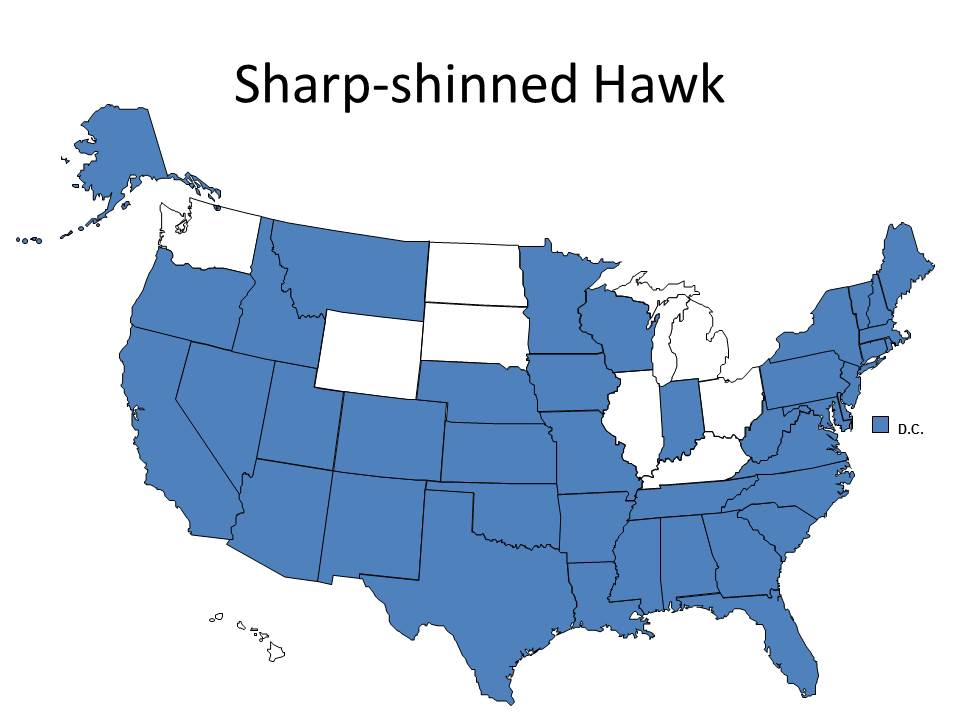
I started at first light at the tailrace at Lake Ogallala hoping for additional gulls.  But with the exception of several Bald Eagles, the tailrace was very quiet.  That is except for the noise of the strong northerly winds that had surprisingly picked up overnight.  I found a spot somewhat out of the wind, and decided to wait it out a bit longer.  At one point I noticed a pair of birds fighting in mid-air over the hills to the south.  One was a Flicker and the other was an Accipter that wasn’t too much larger.  After the two birds separated, I was able to identify the small Accipter as a Sharp-shinned Hawk with its fluttery flight and small head/neck (statebird #10).  That’s another species that I only need in a few more states to fill in the rest of my statebird map.


I eventually gave up on the tailrace, and turned my attention to the waterfowl on the reservoir.  The flock seemed relatively unchanged from yesterday, so I was about to move on when I noticed a lone goose flying into the goose flock – it was a Snow Goose (#11).  I later re-found the White-front in the flock as well.  It’s not surprising that 5 of the 9 remaining states where I still need Snow Goose are across the northern tier where I’ve done little if any birding outside of summer months.


With one last stop on the lake to check out a small group of gulls I found one of yesterday’s Lesser Black-backs and an adult Thayer’s – my 6th gull species even though I saw less than 100 gulls in total over 2 days.

Next I headed up to Lake McConaughy to try for some waterfowl.  Unfortunately I was looking right into the wind, making viewing difficult.  Regardless, I didn’t see a single bird on the water.  Though I did refind yesterday’s Iceland Gull hovering overhead in the updrafts off the dam.

Then it was over to Keystone/Roscoe Road east of Lake Ogallala.  The key target here was a flock of Redpolls that Joel Jorgensen had had at a small cattle ranch there the week before.  As soon as I pulled up to the spot I could hear a lot of Goldfinch chatter, so I moved in closer to the flock to check for other finches.  I estimated there were at least 200 Goldfinches along with a small number of Siskins feeding in the weedy vegetation, but rarely were more than a dozen in view at any time.  Then I heard a couple brief call notes that could have been a Redpoll.  A few minutes later a lone bird flew over my head giving distinct chit-chit calls of the Redpoll (#12).  NE was only my 14th state for this species – another example of missing a rather widespread species by only doing limited mid-winter birding across the country.


My last stop in the area was to bird along the canal below Lake Ogallala in search of Rusty Blackbirds seen by Joel.  Unfortunately I found no blackbirds at all, but a nice consolation was finding a field with about 50 Horned Larks and 1 Lapland Longspur (though alas no Snow Buntings).

It was still early, so I had enough time to head east to the North Platte area to bird some of the hotspots there.  Although I had already found most of my possible targets, there were still some longer shots to try for. 

The first stop was Cody Park where I quickly found the semi-feral and non-countable Trumpeter Swans, and Snow and Ross’s Geese, but found little else besides the many wild Canadas.  Then I took a slow walk around the tennis courts that are surrounded by mature pines and spruces, but didn’t find anything in the conifers.  Nearby North Platte Cemetery had similar planted conifer habitat, including a row of pines full of Sapsucker holes – but there were no Sapsuckers to be seen.  The highlight there was a presumably mated pair of Flickers foraging together – one was “yellow-shafted” and one was “red-shafted”.

Next I was on to Scout’s Rest Ranch where several Rusty Blackbirds had been seen nearly 6 weeks earlier on the Christmas Count.  Just as I pulled into the parking lot 3 Blackbirds flew directly overhead – although I didn’t get great looks at them, they were the right size and shape of Rusty’s, and I saw no shoulder patches or striping suggesting they were Red-wings.  They flew off low to the northwest into an area of swampy woods with wet leaves on the ground – perfect habitat for Rusty’s.  So although I would have hoped for better views, I felt good about adding this bird to my NE statelist (#13).  I now only need Rusty Blackbird in a few more states within its regular range.


As I drove west toward my next stop I noticed a cattle feed lot and a cloud of blackbirds swirling around it.  As I pulled over a large portion of the flock was close to the road, and most were Starlings, though I picked out at least 10-20 Brewer’s Blackbirds in the swirling activity.  Not a new statebird but a nice “write-in” on eBird.

Then I was off to small Bowley’s Pond along the interstate.  It was full of mostly dabbling ducks and geese, including 2 Snow Geese (1 white and 1 blue form), and at least 10 White-fronts.  This would have been a great stop the day before, but those geese were old news now.

My last stops were around the power plant in Sutherland.  Although I didn’t pick out anything new, there were still a few highlights.  The first was at a small lake south of the power plant that was full of Mallards – maybe 5,000 or more.  And interestingy, the vast majority were males!  Check out these photos, first a shot taken of a portion of the lake with my iPhone –


Then a closer phonescoped shot –


Finally I made my way to a cooling pond at Sutherland that has numerous baffles on the surface that are preferred perches for loafing birds.  Here I picked up a few out-of-season birds that were new for the trip– 5 White Pelicans and 2 Double-crested Cormorants.  A nice conclusion to another most successful statebirding trip.

I ended up with 70 species on the trip, including 15 “write-ins” in eBird.  My tally of 13 NE statebirds was way over my hoped-for goal of 7, giving me 245 in NE – 20 over the old ABA threshold.  That should keep me over the threshold for many years to come.