Saturday, March 30, 2013

Northern New Mexico - 35 New Statebirds, March 2013

With a business trip in the Rockies I was able to add a little extra birding time to work on my New Mexico state list.  My NM list was just at 197, I had never been to northern NM, and had done only limited winter birding in NM, so there were quite a number of possibilities for me.  Although my initial planning concentrated on birding the Sandia Mountains including the Rosy-Finches, I soon realized that there would be many other possibilities in the general area.  So I expanded my research, reached out to some local birders for advice, and put together a plan where I hoped for about 21 new statebirds.  But this included a number of wintering birds that could have moved north by then, so I would have to get lucky with some late wintering individuals in order to reach or exceed my goal.  Another complication was that the area has been under an extreme drought for a couple years, so some of the wetland areas might actually be dry now, obviously limiting my chances on waterbirds.

My first stop was at Maxwell NWR in northern NM, with targets being a number of prairie and water birds.  The first bird I saw at the refuge was a shrike that turned out to be a late adult Northern Shrike (statebird #1).  Later on I found several Loggerheads, providing good comparisons.  With a quick stop at the headquarters I found out that only Lake 13 had any water, and many of the waterfowl had already moved on.  Undeterred, I made my way to Lake 13 where I quickly found the first of several Bald Eagles (#2).  The lake was full of waterfowl – principally a good mix of dabblers and some Canada Geese.  But before I could start my search through the waterfowl I noticed some Greater Yellowlegs on the far shore.  When I starting scanning the shoreline with my scope I noticed a number of smaller passerines flitting about – Horned Larks at first, then joined by a number of Longspurs.  Even at several hundred yards I could tell they were Chestnut-collared Longspurs – I estimated 100 birds (#3).  Couldn’t pick out any other longspur species at that distance though.  In my statebird map below, I’ve now seen Chestnut-collared in 5 states as a migrant/wintering bird and 3 in its breeding territory.
 

Next with a scan of the waterfowl I found 2 white geese that turned out to be Ross’s (#4) and 2 male Common Mergansers (#5).  There were also a number of gulls there – 65 Ring-bills and 1 adult and 1 second cycle California which are pretty good for NM. 

Then with a drive around the refuge I ran into many migrating Mountain Bluebirds (#6) and the first of several Downy Woodpeckers for the trip (#7).  Now I only need Downy in AZ for a clean sweep of all the continental US states.  One of my last birds was a sub-adult Golden Eagle – not a new statebird but a great bird nonetheless.  A key miss was Magpie which is resident in the area.  And I guess I was too late for the Tree Sparrows and Lapland Longspurs that are supposed to winter there.


Next stop was nearby Stubblefield Lake – though I forgot to ask at the refuge if it still had water so I wasn’t sure if the trip would be for naught.  En route to Stubblefield I flushed another Golden Eagle and saw several other Bald Eagles.  When I arrived at the lake there was only a bit of water left, but it was teeming with waterfowl.  Mixed in with 22 Common Mergs were 2 Red-breasted Mergansers (#9) which were a bit of a surprise.  A quick stop at Spring Lake to the south yielded no more statebirds, but it did have the only Eared Grebes and Western Grebe for the trip.

Next stop would be Santa Fe.  En route along I-25 while going through a nice area of pinyon-juniper habitat I saw a bird perched atop one of the pines that even at highway speeds was an obvious Pinyon Jay (#9).  That was lucky!  Pinyon Jays can be pretty tough to find, so I’m happy to have seen them now in 6 states. 


The key target in Santa Fe was a private feeding station that has had a group of Common Grackles all winter.  I was able to get the location of the feeding station from e-bird, but had no access to the feeders.  I decided to go to the spot anyway, and hoped to be lucky with the grackles.  When I arrived I found a Great-tailed Grackle and a number of typical feeder birds, but no Common Grackles.  I had to come back through Santa Fe later on the trip so maybe I’d stop by there again.

Next I headed to Albuquerque, with the first stop being the Rio Grande Nature Center, not only for birding, but also to get some local advice for the targets in the park and the Sandias.  I arrived at 4:30 just before it closed at 5, so I spent much of that time getting some very helpful information.  Before they closed I was able to see the staked-out male Hooded Merganser at the pond on the refuge (#10) – a sweep of the mergs for the day!  And I found a cooperative Black-capped Chickadee (#11) with Mountain Chickadees.  My states with Black-caps cover most of its range with the exception of ND where my list is still less than 100, and some where it has a very limited range.


Next stop was the Tingley Beach and fishing area where Neotropic Cormorants had been reported off and on.  The Neotropics turned out to be quite easy there – I had 18 perched in one tree at one point (#12).  Also had a Double-crested for good comparison.  That was my 6th state for Neotropics – a bird that is expanding in the west.  The Common Goldeneyes that had spent the winter there had moved on though.


Now it was almost dusk and I headed back to the Rio Grande Nature Center to try for Western Screech-Owl.  I played some “tape” (actually played the BirdTunes app recording) but had no luck.  Although I struck out on the last bird of the day, it had been a most successful day.

The next morning I started my day pre-dawn en route up to Sandia Crest.  The New Mexico birdfinding guide mentioned that Saw-whets are possible just uphill from the Capulin Spring Campground.  So I pulled over near the campground entrance and played some tape.  Just a few seconds later a Saw-whet responded (#13).  On these trips I feel like I’ve been successful with nightbirds if I can get even just one new statebird tick – so I guess I was successful with the nightbirds on this trip.  Then I headed up to the crest at 10,600+ feet especially to try for the Rosy-Finches.  The latest news was although the restaurant at the crest was closed, the Rosy-Finches were still coming to the feeders.  I quickly found the 2 feeders in the dim pre-sunrise light and positioned the car so I could view them from the driver’s seat if need be.  But then I noticed that the feeders looked empty, so I walked up to both and they were completely picked clean – not a seed to be seen in or under either feeder!  They must have been empty for some time.  Are visiting birders supposed to bring seed to fill the feeders?  My hopes for Rosy-Finches were dashed.  But I decided to stick around until sunrise in hopes that some of the other high altitude finches might be around.  While standing there in the 26 degree chill (underdressed I’m afraid), a flock of 50-60 Rosy-Finches appeared over the restaurant, circled a few times, then disappeared back over the cliff on the other side.  Not nearly close enough to ID as to species, but certainly Rosy-Finch sp.  Then I noticed a few Juncos coming in below the feeders, so maybe there was hope that the finches too would return remembering when the feeders used to have seed.  A bit later I heard some finch-like song that I didn’t recognize coming from the edge of the parking lot.  A minute later 3 chunky finches flew overhead and landed in the pines at the restaurant – Pine Grosbeaks (#14) – good birds for NM!  And although my statebird map looks pretty spotty, it’s starting to match the typical range for this bird.


When I stopped looking at the grosbeaks I noticed there was a bird sitting on one of the feeders – a Black Rosy-Finch (#15).  It flew to the ground and fed in the parking lot with some juncos for a while.  Over the next 90 minutes small groups of 2-8 Rosy-Finches came in, briefly checked out the very empty feeders, then flew back over the cliff.  During that time I was able to see 2 Brown-caps (#16) and 1 Gray-Crowned (#17), the rest being Blacks.  Given the lack of food at the feeders I felt very lucky.

Next search was for Three-Toed Woodpeckers just below the crest.  I had gotten local information about a pair nesting a short distance away.  During a brief 15-minute walk I heard a Hairy, and a Downy-like call (could that one have been Three-toed?).  But I was getting pretty cold and headed back to the car.  En route uphill back to the car I was definitely feeling the effects of the altitude, and didn’t know if I should go slower to catch my breath or faster to get into the warm car.  I decided on the latter, and could hardly breathe when I got inside the car.  With ears ringing and short of breath I decided I should get down off the mountain as soon as I could.  A few hundred feet downhill I came upon a flock of siskins “gritting” in the road – I guessed easily 100 birds.  While scanning through them I found a couple Red Crossbills also in the road (#18), which soon grew to 20 birds.  I got some OK phonescoped photos of some of the more photogenic males perched nearby as well as some in the road. 


While watching the Crossbills I heard some singing finches nearby which turned out to be Cassin’s Finches (#19).  That was quite a nice stop.  My Cassin’s finch coverage now pretty closely matches its typical range.  Then less than a mile down the mountain a pair of woodpeckers flew over the road and landed nearby.  I hopped out and saw that they were Three-toed Woodpeckers (#20).  I didn’t make any other stops on the way down, instead riding slowly with the windows down.  Siskins were abundant on the entire ride – I was never out of earshot of singing birds.  And Cassin’s Finches were singing at multiple spots.  That gave me 8 new statebirds from the mountains – and some pretty good ones too.


Next stop was at the Tijeras Ranger Station in the foothills on the south side of the Sandias.  While walking a nice loop trail through sage and pinyon-juniper habitat I found 2 of my targets – a pair of Juniper Titmice (#21) and several Townsend’s Solitaires (#22).  That’s just about my last likely state for Juniper Titmouse.  And now I had already exceeded my goal for the trip with a lot of birding to come.  However, no luck with Sage Thrashers that had been seen there earlier in the month.


Then on to nearby Tres Pistolas Canyon for some dry foothills birding.  Before I got to the trailhead I heard a thrasher singing that turned out to be the first of several Curve-billed Thrashers (#23).  Somehow I had missed that one in southeastern NM last year so it was good to finally check this one off.  That was my only statebird for this spot, but I enjoyed seeing many Scrub Jays and hearing numerous Townsend Solitaires in full song.

Next I was heading south of Albuquerque en route to Bosque del Apache NWR.  Along the way there was a spot where Burrowing Owls were reported on e-Bird.  The spot was just called “Grasslands” with no details, so I hoped the location had been selected correctly in e-Bird.  I arrived at the spot which turned out to be an area for a future development – paved roads built but no houses.  I started to scan the area and found a couple prairie dogs, so I was optimistic I was in the right spot.  Then with a bit more scanning I found 2 Burrowing Owls looking at me from their hole (#24).  That’s the third state where I’ve added this species to my statelist based solely on e-Bird data (NM, ID, NV).  E-Bird can be really valuable for a lot of these searches, though not always.  It seems information on e-Bird can be more focused on identification and less on providing specific locations and tips on finding the bird.

Then onto Bosque del Apache.  There had been no recent posts from the refuge on e-Bird nor the listserve, so my first stop was at the refuge headquarters to get some updates.  Some white geese were still around, so that gave me hope for Snow Geese, and the Harris’ Sparrow last reported at their feeder a week ago was still around too.  (That was a surprise – would have thought no e-Bird sightings for over a week meant it was gone.)  I walked over to the window to see the feeding station and found a couple Gambel’s Quail (#25), and within 30 seconds found the Harris’ Sparrow (#26) feeding with a number of White-crowns.  The map of my Harris’ states really depicts its penchant for vagrancy – in addition to seeing it in states in its typical central US wintering range, I’ve now seen it in 3 western and 4 northeastern states as a rarity.


Then out on the refuge I found the flock of white geese which I estimated to be 670 birds.  Although the first birds I saw were Snow Geese (#27), I realized that most were Ross’s – perhaps 400 of them.  That was by far the most Ross’ I’ve seen in one flock or in one day for that matter.  A large flock of Tree Swallows was also feeding over that same impoundment, and it took me the better part of 20 minutes looking through them to finally find an early Violet-Green (#28), filling in one of my last states for that species.  That was the last of my new statebirds for the refuge, as I was unsuccessful in finding a pair of Carolina Wrens that had been wintering on the refuge.  Though I did have 7 species of shorebirds there (including an early Western Sandpiper).  That gave me another exciting day with 16 new statebirds, and 85 species for the day.


The next morning I started pre-dawn at Embudito Canyon on the west side of the Sandias with Scaled Quail being my key target.  This was a beautiful spot which featured numerous Canyon Towhees, gorgeous Black-throated Sparrows, and Curve-billed Thrashers, but no gallinaceous birds.  Best I could do was some Gambel’s Quail at a feeder back in suburbia.  I had spent some time trying for Scaled Quail in southern NM last year – guess it’s my nemesis bird for NM.  En route through Albuquerque I stopped at a wintering spot for a Peregrine Falcon, but I think it already headed north.  With 2 consecutive misses I wondered if my statebird luck was running out.

Next stop was back at the Rio Grande Nature Center to try for Eastern Bluebirds, which I was told are now nesting there.  It had gotten pretty windy, so I was a bit concerned about finding them.  But I went to a spot suggested by the folks at the Nature center and quickly found a flock of 4 birds (#29).  That fills one of my last gaps for Eastern Bluebird in my statebird map.  And I guess I was back on track.


I bid farewell to Albuquerque and headed north with a stop yet again in Santa Fe to try for the Common Grackles.  But I only saw the typical feeder birds, so didn’t waste much time and headed north of Santa Fe toward the Ohkay Owingeh Fishing Lakes.  En route I had a flyover Black-billed Magpie (#30) – I would eventually see 9 others later in the day.  Although this was on the southern edge of its range, should would have hated to miss such a showy bird that is typically easy to see across the western part of the country (that was my 14th state for this species). 


I got to the fishing lakes, parked at the gate, and started the ½ mile walk into the area.  There I ran into another birder who knew the area very well.  He asked if I could ID small dark geese, and he pointed out what turned out to be 2 Cackling Geese (#31) in with some Canadas.  Earlier in the day he had some Common Goldeneyes on the river (and even some Barrow’s there earlier in the month), but we could only find Buffleheads.  He suggested another option would be to look for the Goldeneyes up river as I headed up north.

The next planned stop was up to Eagle Nest Lake State Park, and en route decided to try for Goldeneyes where the river paralleled the roadway.  On my second stop sure enough I found a Common Goldeneye (#32) in the river with some Buffleheads.  Then up to the beautiful area with Eagle Nest Lake.  The lake was in a bowl with several square miles of grasslands, surrounded by mountains covered in conifers.  I had lots of raptors around the lake and grasslands including 9 Bald Eagles, 1 Golden Eagle, and 1 late Rough-legged Hawk (#33).  With the exception of the upper Midwest where I’ve done no winter birding, I’ve now seen Rough-legs in most or its regular states.


The lake itself was 99% frozen, but the small portion that was open had quite a number of waterfowl including a pair of Greater Scaup (#34) – another good bird for NM, along with a Common Goldeneye and 28 Common Mergs.  One adult California Gull was a good find.

The last stop of the trip was on a bit of a whim to try for Dipper.  I needed Dipper for my statelist, but wasn’t thinking I would get into the right habitat on this trip.  But I did an e-Bird search and found that a Dipper had been reported recently from Cimarron Canyon State Park which was just to the east of Eagle Nest Lake and along my route.  So everything was falling into place.  However, the state park was a long narrow park in the canyon, with likely lots of potential Dipper habitat.  The e-Bird location was shown as being at the western end of the state park, so I decided to make a quick try at that west end.  I got to the western edge of the park, played a bit of tape, and a Dipper flew right to me (#35).  What a great way to end a great trip!

That gave me 35 new statebirds, way over my goal of 21.  And although I did miss a few of the local wintering species that had been reported earlier in the month, with my late trip I was able to add at least a couple as early spring migrants.  And for my statebird maps, filling in NM sure has a bigger visual impact than finding a new statebird in one of the smaller northeast states.  Plus I had a very respectable 120 species for the trip (all entered into e-Bird).  Now with 232 species on my NM statelist, that's my 44th state with more than 200 species, and I’m slowly getting closer to that very high ABA reportable threshold of 264.  (Or at least that used to be the threshold when the ABA still had thresholds.)  There are quite a number of possible breeding birds in northern NM that I still need for my list – maybe a summer trip there might be enough to get over that reportable threshold.

Tuesday, March 26, 2013

Fieldfare in Massachusetts, March 2013

Viet and Petersen’s “Birds of Massachusetts”, published in 1993, is a great book that not only summarizes the regular nesters and migrants of MA, but also documents the amazing collection of rarities that have been seen in the state over the years.  Included in the book is a summary of a Fieldfare seen for over a week in April 1986 in eastern MA, before my time in New England.  I don’t know how many times I’ve read that summary over the years, trying to imagine how amazing that sighting must have been for such an extreme US rarity.  And I could only dream about what it would be like to see this one in ABA region.  Little did I know that lightning would strike a second time in the spring of 2013.

It was a Sunday in mid-March and I had checked my e-mail numerous times during the day as I always do hoping for a report of some rarity to chase after, but with no luck.  But then after dinner I checked my e-mail again and quickly noticed a post with the word “Fieldfare” in the subject line.  The 5 seconds it took to open that message on my iPhone seemed like an eternity – not only was a Fieldfare seen that day in a flock of Robins, but it was around much of the day seen by a number of birders who “got the call”.  Plus it was in Carlisle, MA, just 40 minutes from my house and less than 15 minutes from work.  Unfortunately I’m not in those birding circles to get a call about the bird, and the first e-mail about the bird wasn’t posted until late in the day.  So I could only read about this megararity after the fact.  Would it stick around like the 1986 bird, or was it just passing through with a migrant Turdus flock only to be somewhere in Maine or the Maritimes by Monday?

Since the Fieldfare’s location was so close to my office, I planned to go to work on Monday morning and then run out of the office if there was word that the bird was still around.  En route to work I checked my e-mails (while safely sitting at a redlight!), and there was a post that the bird was respotted at 7 AM.  So with only a slight diversion of my route I was in Carlisle at the bird’s location before 8 – along with at least 30 other carloads of birders.  After a short walk I was in the fields where the bird had been reported on Sunday and saw a group of about 50 birders up ahead.  I joined the group and got word that they had the Fieldfare perched atop a very tall white pine in the next field over at least 200 yards away – too far away for binoculars.  There were only 3 scopes among the 50 birders, so I stood in line and eventually got a scope view of a bird that was 95% obscured by pine needles – hardly satisfying and frankly not identifiable.  Then after a couple minutes the bird flew, and even at that distance binocular views showed that the bird was robin-sized and shaped, but very pale (almost white) below.  I guess that clinched it for the ID, but still just miserable views.  Eventually the Fieldfare came in to feed on small red berries (winterberries maybe?), within 10 feet of the ground, and about 50 yards away.  Great views were had by all as the bird perched, fed, and flew from one location to another.  To me the bird was most remarkable in flight – at 50 yards even without binoculars the pale breast and white wing linings really made the bird stand out.  It was also interesting that the Fieldfare was very difficult to find when perched because it blended into its surroundings, whereas the Robins really stood out.  By the way the Robins it was with all seemed to be of the Newfoundland race with very bright red chests.

Fieldfare was ABA Lifer number 735, and Lower 48 Lifer number 712 for me.  And it was a world lifer for me as well – I have seen Redwing, Song Thrush, Blackbird, and Mistle Thrush in Europe, but never Fieldfare.  And number 402 for my MA list.

One other interesting tidbit – this Fieldfare was located just about 8 miles NNE of the 1986 Fieldfare found in the neighboring town of Concord.  Who would have thought that this area would be such a hotspot for Fieldfares!

Monday, March 25, 2013

Solitary Sandpiper and Ovenbird in California, March 2013

While on a business trip to southern California I realized I would have an afternoon free, so I decided to plan for a bit of birding to try to add some statebirds to my CA list.  My CA list was at 351, which is pretty good for an easterner I guess, with only a few rarities.   So since winter birding in CA usually features a number of rarities, many of which stick around for a while, I was hopeful there would be at least a few to chase after.  With a bit of research on the CA listserves and e-bird I found quite a number of eastern rarities in the area.  I could try for a couple at dawn before work that day, and then mapped out an afternoon with an additional 6 target birds as possible new statebirds.

I started predawn at a park with an overwintering Parula Warbler and Red-naped Woodpecker.  With good directions I got to the right locations for the birds, but couldn’t find either one.  No worries though, as I had 6 more to try for in the afternoon.  Then with work done at 1:30 I started my afternoon birding route.  My first stop was a park with an overwintering Eastern Phoebe.  My directions weren’t the best, and it took me an extra 15 minutes to find the right part of the park, but I eventually found the spot, but only found Black Phoebes.  Hmm, thought that one was pretty likely.  Next stop was a small park with 3 overwintering targets – Solitary Sandpiper, Ovenbird, and Least Flycatcher.  I quickly found the Solitary Sandpiper in a small retention basin.  And then got to the spot where the Ovenbird was typically seen and I was lucky enough to found it quickly as well.  But I spent the next 45 minutes trying for the Least Flyc unsuccessfully.  Next stop was a park with a Palm Warbler.  But despite good microdirections, I couldn’t find the warbler.  The last stop was a small suburban park with a very reliable Dusky-Capped Flycatcher.  I arrived about 5 PM and found the park full of families playing ball, having picnics, playing music, etc.  I spent a half-hearted 20 minutes there before I gave up on seeing the bird in all the hullabaloo going on in the park. 

That gave me only 2 out of my 8 targets – I usually do much better than that.  I think part of the reason for my lack of success is that I relied more on e-Bird and less on the listserves than I normally do.  It seems that the e-Bird sightings are less likely to have the microdirections and details as to how to find the birds than in listserve posts.  So as a result maybe I didn’t have the best locations for some of these.  Plus, on e-Bird I don’t think you can report that you did not see a given bird.  So if the most recent sighting of a bird on e-Bird was a week ago, you don’t know if others have looked for it unsuccessfully in the last week, or if others found it but just didn’t report it to e-Bird.  Of course you don’t always see negative posts on the listserves either, but at least it’s possible to report that you looked for something and didn’t see it, or saw it on your umpteenth try.  My takeaway is that I need to continue to use both e-Bird and the listserves on these statebirding trips, but don’t rely on e-Bird too much by itself.

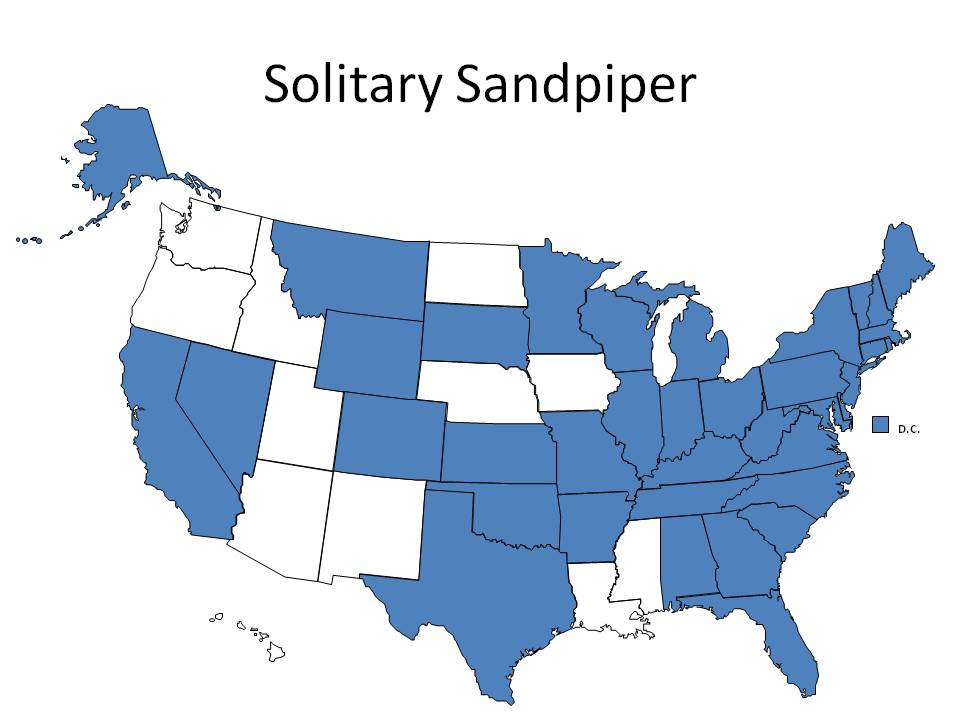
My statebird maps for Solitary Sandpiper and Ovenbird are inserted below.  Solitary is a rarity to look for in the southwest, and now CA is my second state (following NV) where I’ve seen it outside its typical range.  Though I still need it as a more regular migrant in 5 central states.  By comparison, Ovenbird isn’t necessarily known as much of a western vagrant, and CA is my first state for this species as a rarity.  And I need that one too in a number of states in its more normal range.


Saturday, March 2, 2013

2 North Carolina Statebirds, February 2013

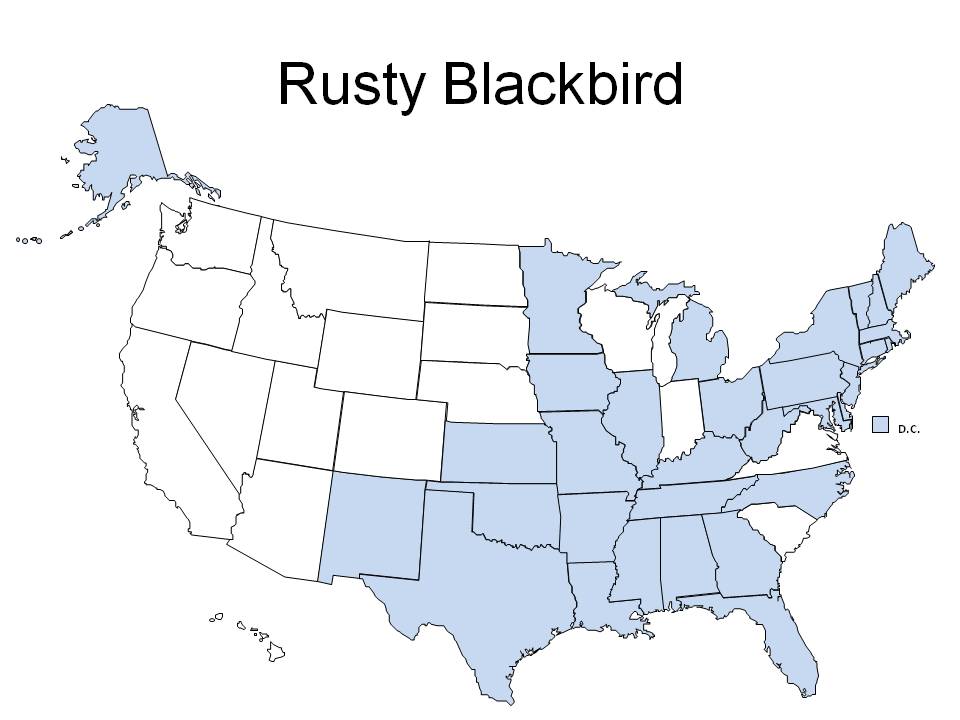
With a quick trip to central North Carolina I had only a little time for some local statebirding.  My NC list is pretty good at 249, so there aren’t a lot of easy gaps to fill.  But with a little research on e-Bird and the Carolinas listserve I identified 2 possible targets seen nearby recently – Rusty Blackbird including a recurring flock of 200 birds in a Durham office park of all places, and Mute Swan with a flock of 5 breeding in a lake in the Raleigh suburbs. 

Rusty Blackbird has been a bit of nemesis bird for me in NC, which is a pretty common wintering bird there.  I had a likely sighting of Rustys in a swamp 20 years ago but only got a brief view of the flock so decided to be safe and not check them off.  Little did I know that despite a number of winter trips to NC since that time I still would need them for my state list.  So it’s probably one of the more common birds I haven’t seen in NC. 

Mute Swan is a different story.  I remember seeing them on each trip to Chincoteague on the VA coast years ago.  But there are no Mute Swan reports on e-Bird there yet in 2013.  However there are small numbers of Mutes reported on e-Bird from the VA tidewater in 2013.  In NC there are some 2012 sightings on e-bird in the central part of the state and on the coast, but none in 2013.  Are they in decline in the region?  But just before my trip there was a report of 5, including immature birds, from a lake near Raleigh.  Needless to say it will be important to try to determine if they are wild birds.  In any case, certainly worthwhile to check them out.

My first birding stop was the large office park where the Rusty Blackbirds were reported.  When I got there I realized why the Rustys were hanging out there – the park was full of wet wooded swamps – perfect habitat for Rustys.  I drove around the park once without seeing any blackbirds.  But on my second lap I saw a distant flock of birds perched in some tree tops.  The entire group was Rustys – maybe 200 of them.  That was remarkably easy, especially given my lack of success in the past.  But in my state bird map below, it looks like I still need to have some similar success in SC and VA to get better coverage of this species in its wintering range.


A short drive later I was at Lochmere Lake where the Mute Swans had been reported.  The lake is a long, skinny manmade lake, more than a mile long and less than 1,000 feet wide, surrounded by suburban houses.  When I arrived at the dam I quickly found 2 adult Mute Swans, and 3 white farm ducks a short distance away.  Although the swans were not pinioned, they still could be dependent on homeowners for feeding.  But I then looked farther up the lake, and in addition to a number of Ruddy Ducks, I found an immature Swan at least ½ mile up the lake.  If all these birds were dependent on a feeder close to where the farm ducks were, why would a bird be a ½ mile away?  And the young bird was either born at this lake, or was part of a family group that bred elsewhere and flew into this protected lake.  The recent report at this sighting was of 5 birds, 2-3 being immatures.  I could only see the lower portion of the lake, so maybe the others were even farther from the dam that day, and even farther from those farm ducks.  Sure seems feasible to be wild birds, so I decided to count them.  I’ve now seen Mute Swans throughout the northeast and mid-Atlantic states, along with a number of Midwest states.  


That gives me 251 in North Carolina – my 17th state with at least 250.  And as is often the case with statebirding, I spent more time researching the statebirding potential than I spent in actually birding in the area. 

Monday, February 18, 2013

LeConte’s Sparrow, Concord, MA, February 2013

I was away on a business trip when the first post came out on the listserve that a LeConte’s Sparrow was found feeding on a cleared shoulder of a small suburban road in Concord.  A few years back I had tried for a LeConte’s in MA found at Great Meadows NWR (also in Concord amazingly).  I think I heard that bird calling from the cattails where it had been reported, but could never get a visual on it.  So I was very interested in trying to see this newly reported bird and fill that gap in my MA statelist.  It was reported to be very tame, and easily found by everyone that posted.  The problem was I wouldn’t be home for 3 more days – would the bird hang around that long?  And if it did stick around, and if my late afternoon flight back home was on time, I would be able to get to the bird’s location en route back from the airport with about an hour of sunlight to spare.  And then there’s the third “if” - if the bird was cooperative then I should be able to see it that afternoon.

The bird truly did stick around, and was reported the morning of the day I came back home.  And my flight was actually early, so everything was falling into place.  I arrived at the spot and saw 6 birders up ahead standing along the roadside – with binoculars and monster lenses apparently trained on the bird.  Amazingly they were practically looking down at their feet.  I walked up and realized the bird was no more than 5 feet away from me, crawling mouse-like under grasses on the road shoulder.  After a few seconds there was movement in the grasses, and I got amazing views of the head and back of the bird.  What a gorgeous little bird!  All things considered it turned out to be one my easiest New England statebirds in some time.  There was no need to stress about it afterall. 

MA is my second New England state for LeConte’s having seen one in Maine in 2010.  I also found and photographed one in Wyoming some years ago – one of only a handful of sightings for that state.  And I’ve also seen LeConte’s in 5 central states in its normal winter and breeding ranges.


Saturday, February 9, 2013

Northern Lapwing, Little Compton, Rhode Island, February 2013

As a next chapter to the amazing Lapwing story this winter following Superstorm Sandy, two Lapwings were reported in Little Compton, RI in early February.  Unfortunately they were reported by a worker at a farm within a very large complex of fields on private land with next to no access.  Birders were limited to viewing only a portion of these fields from the shoulder of SR-77.  Apparently the birds were principally being seen about a quarter mile from SR-77, in a portion of the fields which cannot be seen from the road.  So the lucky birders that saw these birds were those that happened to be along the public road during the rare times when the birds ventured into fields close to the road.  A couple days after they were first seen, my good birding buddy, Denny Abbott, and I decided to head down to Little Compton in hopes of being two of those lucky birders.  And just in case our luck wasn’t too good, we were prepared to spend the whole day there. 

We arrived at 9:30 with no Lapwings in site.  Worse than that, we were disappointed when we realized what little acreage was actually visible from the road.  Undaunted, we donned all our layers of winter clothes and were ready to wait them out.  At one point we had a flyby of 3 Killdeer - we got all excited because there had been a report that the Lapwings were with Killdeer.  But still no Lapwings.  A number of birders came and went during the day, including a couple that had seen 1 or 2 quite close to the road in previous days.  They were luckier than us.  But a couple others mentioned that the birds were not seen the previous day at all.  Ugh.  We finally called it quits at 4 PM and retreated to the car to warm up and head home.  That meant 2 consecutive days with no sightings – had they moved on?

The next day there was a report of a sighting from late in the day, so they were still around afterall.  So Denny and I decided to give it another try the following day, but only if there was a positive report.  And sure enough, around noon the next day, a report was posted of one Lapwing near the road.  So Denny and I instantly hit the road and were back at the spot by about 3 PM – but no Lapwings.  While we were there we talked to some local birders that came by and pieced together a timeline that showed that there were no sightings since at least 12:30.  Another disappointment.  Undeterred we continued our vigil.  We were about to leave at 4:20 when amazingly we were able to get one sighting of a Lapwing quite far from the road.  Perseverance, and a lot of luck, really paid off. 

That was my third New England state for Lapwing, and the second one (after MA) this winter.


And now for a little speculation on the Lapwings this winter.  Many feel that these birds were blown off-course from their normal Europe-to-Africa migration by the huge wind field of Superstorm Sandy.  Since Sandy’s passage, Lapwings have been reported in the US in ME, MA (initially 5 and still 2 remain on Nantucket), RI (2), NY (2), NJ (3), MD, VA, and GA, and in Canada in NS and NL.  Plus who knows how many more are around that haven’t been spotted yet by birders.  It seems a bit odd that these RI birds would have first showed up in the area in February.  With the hundreds and hundreds of acres of pasture in Little Compton alone, they could have easily been somewhere in the town since last Fall but not reported till now.  And the next question is whether Lapwings might actually end up breeding somewhere in the US or Canada this year.  I found the following information on the timing of their breeding season from http://www.arkive.org/lapwing/vanellus-vanellus -  During February, males begin to perform display flights over breeding territories in which they climb steeply upwards before tumbling down close to the ground. Between March and early July, three or four well-camouflaged eggs are laid in a scrape on the ground.  Maybe we should start watching for them to start their display flights soon.  Time will tell.

Monday, February 4, 2013

6 New Colorado Statebirds, January 2013

A particularly heavy travel schedule for work of late had become quite trying and tedious, with no time for birding during those trips.  So as my third trip to Denver in 4 weeks came up, I decided to try to see if I could squeeze in at least a little time to fill some gaps in my CO statelist.  With 266 birds on my CO list I don’t need too many regular birds, but I was hopeful that at least a few less common birds might be staked out in the greater Denver area.  The CO listserve is a good one, including an updated statewide RBA every couple days with sightings separated by county.  So as long as you know which counties are in your area, a little research on the listserve can be a big help in planning a statebirding trip to CO. 

So I opened up the CO listserve and quickly saw that there were a number of potential statebirds being seen in and around Denver, and many had been present for some time.  Now the question was whether I could have time to try for them.  Based on my initial work plans it looked like I might have an entire morning free, along with a couple early morning hours on a second day.  So I set up my plans to pursue 6 potential stakeout statebirds.  During my free morning I would start at dawn in Fort Collins at a spot with both Redpolls (including a first state record for Hoary), then head south to Lower Hoffman Lake for Trumpeter Swans, then farther south to Valmont Reservoir for Tundra Swans.  Then in my free early morning I would start at dawn at a Red Rocks Park feeder for a Golden-crowned Sparrow and then a quick stop at a marsh at the Wheatridge Greenbelt park for a Swamp Sparrow.  All in all a very doable schedule.

When I arrived in Denver one of the first things that happened was my work schedule changed, and now my free morning was going to be consumed by meetings.  Ugh!  Hate it when work gets in the way of birding.  So now I needed to rethink my schedule.  That would mean there would be no chance to get up to Fort Collins for both redpolls, but there was a feeder in Wheatridge with a small flock of Common Redpolls that I could squeeze into a lunch break instead.  And maybe I could get to the lakes with the Swans either at the end of a work day, or at dawn before work started.  So maybe I could still squeeze in attempts for 5 targets.

As the first day’s work neared an end, it looked like we might be done at 4:30, and sunset was 5:10 so a 30-minute drive to try for the Trumpeters could be feasible, though with little time to spare for searching for the birds.  As I left the office the light snow that was falling that afternoon was just ending, so I hit the highway and quickly got to Lower Hoffman Lake.  But it was surrounded by a suburban subdivision, so it took me a few minutes to find access.  When I finally got access to the lake, all I could see was ice.  Had to be some open water somewhere.  Eventually I found a different access point and saw some open water.  Sure enough there was a Trumpeter Swan in with quite a number of dabbling and diving ducks.  And as the light waned, large flocks of geese flew into the lake to roost on the ice.  This included several Cackling Geese – one was calling as it flew in with the Canadas.  This was my 12th state for Trumpeter Swan – aided by the big reintroduction program and their subsequent expanded breeding success.


 The next day my work meetings started at 8 AM, but with sunrise about 7, I figured I could get to Valmont Reservoir before work to try for the Tundra Swans.  I had been there back in 2007 to take in the spectacular gull show that occurs in winter evenings as gulls descend into an overnight roost on the open water of this power plant reservoir.  I arrived at 7 (even though an overnight snow made the drive challenging) but couldn’t find an access point on the north side of the lake.  But then I remembered that in 2007 we accessed the lake from the east, so I headed there and was able to drive toward the edge of the lake.  As soon as I parked I noticed a flock of at least 500 gulls circling low directly overhead.  I started scanning through the flock and quickly found a small white-winged gull – either a first year Thayer’s or an Iceland.  I watched it for at least 60 seconds – it had a thin all dark bill, never saw any darker coloration to the primaries or secondaries, and its tail was only slightly darker at the tip than at the base.  So although I never saw the bird from above, I concluded it was an Iceland Gull.  This or another Iceland was seen at Valmont the next day.  CO is now my third Midwest or West state for Icelands, in addition to seeing them in 11 states in the northeast,.  And that was my 10th gull species for CO – not bad for a state in the Rockies.


Next my attention turned to the Tundra Swans.  From the car I could see only a small portion of the reservoir, but no large white birds (just 3 large dark birds which were immature Bald Eagles).  So I started to walk over toward the lake and soon found quite a bit of open water and a flock of Canada Geese.  And then with a slightly different angle I found the flock of 12 Tundra Swans at the edge of the ice.  After a quick walk back to the car I was able to drive to work with and got to my meeting with just a couple minutes to spare.  Although my statebird map for Tundra Swan is a bit spotty, it’s pretty well filled in for the eastern and western migration and wintering populations. 


The next target was the Redpoll flock coming to a feeder in Wheatridge.  I only had a small window of time over lunch before having to go back to work, so I needed the redpolls to be pretty cooperative.  After a quick MacDonald’s stop I arrived at the house, but there were no birds present.  But luckily only 10 minutes later a mixed flock of finches flew into trees next door – Goldfinches, House Finches, and a couple Redpolls.  Soon the flock dropped into the feeding station and was joined by 30 or more other finches.  There were about 8 Common Redpolls in the flock, including one where the red pigment was replaced by orange.  This bird was also quite pale, but had a light tan rump, and a couple dark undertail coverts.  It was most likely just a Common Redpoll with some pigment issues.  Although CO was my 13th state for this species, my statebird map is pretty spotty except in the Northeast.


The next morning I had 2 free daylight hours of birding time before heading to the airport.  So I left the hotel before dawn to head to the beautiful Red Rocks Park, and specifically the Trading Post where a Golden-crowned Sparrow had been visiting a feeding station for most of the winter.  It was 20 degrees and quite breezy when I arrived (I was definitely underdressed for that windchill) but there were many birds at the feeders.  Most were juncos, and I counted 6 different races – Pink-sided, Oregon, Gray-headed, White-winged, Slate-colored, and Cassiar.  It was quite a show.  After about 15 minutes the Golden-crowned showed up (a nice adult bird), though it was only in view for about a minute before running back into the adjacent brush.  I waited for another 45 minutes but it not reappear, so I guess I was lucky.  By the way the “White-winged” Juncos were only my second in the west.  I mention “in the west” because I had a junco at my feeder in Massachusetts a couple years ago that had white wingbars but I guess it was more likely an aberrant Slate-colored than a White-wing.  That was my 5th state for Golden-crowned Sparrow, and my first as a rarity away from its normal range. 


The last stop was the Wheatridge Greenbelt which is a linear suburban park along a river that flows through the Denver suburbs.  There was a post from about 10 days earlier about a Swamp Sparrow in a cattail marsh, with very specific directions to the location.  So although the post was a little old, I thought I’d give it a try in hopes that this was a wintering bird.  I got to the park at about 8:30, and although the temperature was up to 25 degrees the wind had increased, so the wind chill was likely even lower.  A short walk later I was at the cattail marsh where the sparrow had been spotted – everything was completely frozen and the wind was howling.  But a Song Sparrow was chipping in the marsh so I had some hope.  Swamp Sparrows can be very tape-responsive, and I had planned to bring along my MP-3 play and speakers.  Unfortunately I forgot to pack them (doh!), so the night before I went to the Xeno Canto website and had picked out one recording of call notes and one of songs that I could play from my iPhone.  I started to play the call note recording and almost instantly had the bird respond.  The bird eventually appeared and gave me brief views before it went back to its hiding places in the frozen cattails.  Luckily that only took a couple minutes because I was really getting cold.  I’ve now picked up Swamp Sparrow in a number of western states as a rarity –maybe it’s easier to find as a rarity than other species.  On the way back to the car I found a Snipe along the edge of the open water along the river – didn’t expect that one in January in Denver. 


So that gave me 6 new statebirds, putting my CO state list at 272.  Certainly was fun to be able to see so many of my target birds - plus finding a rarity - even though my birding time was so limited.