Showing posts with label Rusty Blackbird. Show all posts

Wednesday, December 4, 2019

6 South Carolina Statebirds in November 2019


November was another great month of birding in South Carolina, focused not only on finding new birds for my SC list, but also on learning about hotspots within the “Upstate” (the higher elevation counties in western SC).  Along the way I teamed up with fellow Hendersonville birder Dave Minnich, who in turn introduced me to several Greenville County birders including Michael Robertson, Gary Harbour, and David Palmer.  And given my success with so many relatively easy birds, I prepared this monthly summary rather than individual blog posts for each trip – that will likely come in December.

11/4 – Tall Pines WMA

Dave Minnich and I had visited Tall Pines WMA in October and got a great introduction to the area with Michael’s, Gary’s, and David’s help.  When we came back on November 4th, Dave, Michael, and I first headed to several fields that looked like they could have good sparrow habitat.  We had a few sparrows here and there, but not the good numbers, and good species, we hoped for.  When we reached the third field we headed to the far side that was flooded and found some nice weedy habitat.  And within just a few more steps we flushed a small sparrow which flew a short distance to a brushy perch.  It sat in the open for just a couple seconds which was just barely long enough for Michael and me to ID it as a rare inland Lincoln’s Sparrow, new for my SC list.  Unfortunately, Dave didn’t get on the bird in time. 

My statebird map for Lincoln’s Sparrow is inserted below – solid shaded states are those where I’ve seen this species; cross-hatched states are those where it is regular but I haven’t yet seen it.  Now that I’m living in the southeast maybe I can fill in some of those gaps for this species.


As we walked from the field we entered a brushy area along a stream and began to hear the chattering calls of a Winter Wren – target #2.  This one was more cooperative, sitting in the open for us all to see.  I just need this species in one more state in the southeast as a wintering bird, though several more as a breeder in the Midwest.


Next we headed to a nice mixed hardwood/pine woodland.  In our previous trip to Tall Pines we took this same trail and didn’t see much.  This time we all thought that the woodlands could be a good spot to find my next target – Brown Creeper.  As we slowly walked the trail, we admired the trees and plants in the undergrowth, but once again didn’t see many birds.  But then we heard a single high-pitched call from high in the woodlands, which we all thought was likely to be a Creeper.  It continued to call and we eventually got looks at this shy bird.  We later had 2 others in this same stretch of woods.  Nice when a prediction comes true.  Six more states to go to fill in my statebird map for this widespread species.


11/9 – Anderson County - Townville Area

This was an organized trip run by the Greenville County Bird Club to visit several hotspots in the Townville area in Anderson County.  The key targets were Vesper and White-crowned Sparrows, along with Snow Goose as a recently reported rarity.  I met Michael near Greenville and carpooled to the starting point of the walk.  There we met up with about a dozen other birders, and we started with some nice woodland birding at Beaverdam Creek WMA.  Key highlight here was a late Yellowthroat.  Then we were off to the farm fields at Dobbins Farm.  A pair of Snow Geese had been reported on a small farm pond at this site for several days, as recently as the day before our trip.  But despite our best efforts we found no white geese.  We even tried several other ponds nearby without success.  Our best find here was a distant flock of 7 small peeps that were just too far to identify.  Michael mentioned that this spot was also well-known for wintering Brewer’s Blackbirds – something to keep in mind for a future trip.

Next Michael and I decided to leave the main group and head directly to Prater Farm where he has had the best luck with our target sparrows.  We made our way to Tom Martin Rd. and stopped at a brushy edge that had been good for the sparrows in the past.  Just as we got out of the car we flushed a sparrow from the roadside which flew up to a cedar tree.  Hmm… - that’s very typical of Vespers which will fly up to a higher perch after being flushed.  We changed our angle a bit and got a view of the sparrow in the tree – it was indeed a Vesper.  Then we noticed more activity in the tree, and spotted no less than 4 more Vespers.  It was an amazing flock of 5 Vesper Sparrows – I don’t remember seeing anything more than individuals away from their breeding grounds.


After celebrating our experience with the Vespers we started walking a bit further down the road and flushed another sparrow – it was a young White-crowned!  We found five other White-crowns here, including at lead one singing adult.  I just need this species in GA and DC to complete my statebird map.


At this same spot we also had a large flock of 100 Pipits in an adjacent field, a Eurasian Collared-Dove, and a perched Loggerhead Shrike.  A nice stop, and a nice way to end the morning’s trip.  I’ll definitely have to come back here in the winter to look for Brewer’s Blackbirds.  And since this area is close to the GA/SC stateline, maybe a future trip could include some time working on my GA list as well.

11/19 – Northern Greenville County Lakes

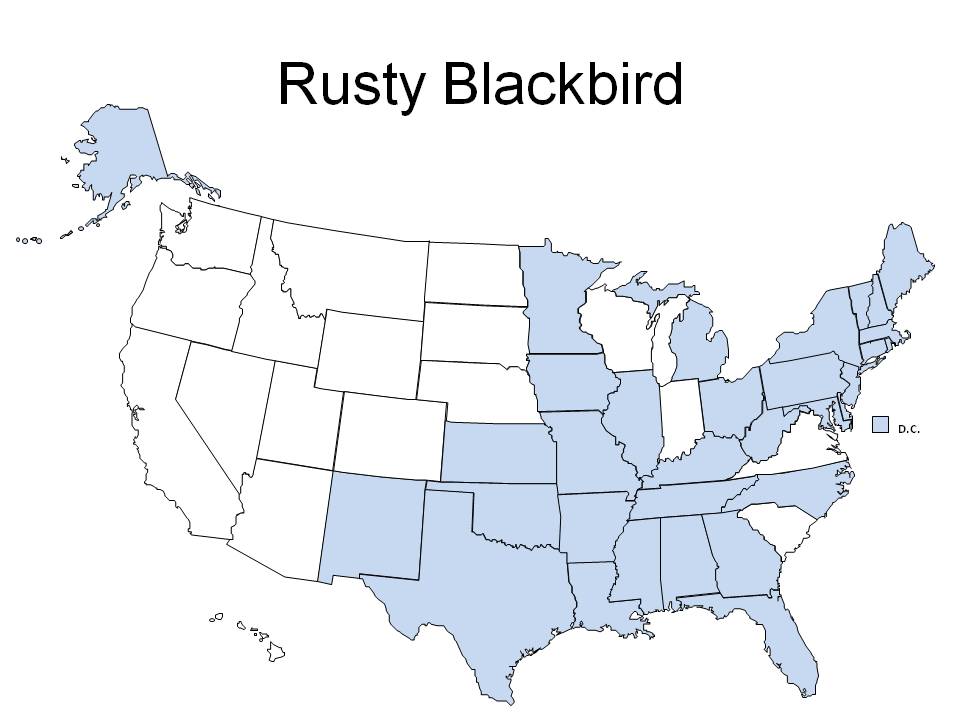
The goal of this trip was to check out a number of the lakes in northern Greenville County that can have some nice waterfowl during winter.  We had no key waterfowl targets – it was just a scouting effort.  But then oh by the way, Michael suggested we might get lucky with Rusty Blackbirds at Lake Cunningham.  He’s had them there off and on this time of year.  As I pulled in to Lake Cunningham David and Michael were already at the lake doing a bit of birding.  And within just a couple minutes a few blackbirds flew into a nearby tree.  After a quick view we realized we had our first Rusty Blackbirds.  Within the next few minutes more Rusty’s flew in – I counted 160 birds in total.  But just as quickly as they arrived, virtually the entire flock had flown away.  A nice start of the day!  I just need this species in 5 midwest states as a migrant or wintering bird.  Though it’s nice to have seen this species as a rarity in CA as well.


We made stops at 6 other ponds and lakes that morning, finding a few waterfowl here and there, the best being 5 Horned Grebes at Lake Robinson.  We also made a quick stop at Jordan Pond where Common Goldeneyes have wintered the last couple years – something to keep in mind for a future trip.  And my last stop was at the Stamey Valley Road lake where I had a flyover flock of 20 Rusty Blackbirds.  A nice way to end the morning.

I ended November with 6 new statebirds for my SC list which now stands at a nice round number of 250.  That’s 18 new SC species since I moved to the area just over 2 months ago.  Although there have been a couple rarities, most have been pretty regular species.  And with a dwindling list of relatively easy target birds, I’m sure I won’t be able to keep up this pace for too much longer.

Friday, January 8, 2016

5 “State" Birds in Washington, D.C. and 2 More in VA, December 2015


On most of my recent trips to Baltimore to visit relatives I’ve done at least a little birding in Washington, DC, VA, and/or WV to try to fill gaps in those “state” lists.  Although I had exceeded the old ABA reportable threshold in all 3 some years back, my key goal was to be at least 15 over the threshold in each location.  I reached the “reportable plus 15” goal in WV in 2014, but I was still short by 2 in DC and 3 in VA.  So that meant I needed to focus my Baltimore-area birding on DC and VA on future trips.

With an upcoming trip to Baltimore in December 2015, I set up eBird Needs Alerts for both DC and VA to see what might be around.  I was surprised to see that recent reports included no less than 7 possible “state” birds in DC and another 5 possible state birds in northern VA.  And many had been seen multiple days so they might well be chaseable.  I also sent a note to local DC birder Paul Pisano and he was most helpful giving me some micro-directions on each of the DC targets.  But as the trip neared, the reports on all but 3 species stopped coming in, and even a few negative reports were posted.  I was now less optimistic, but still hoped for 2 new birds each in DC and VA.  Armed with the latest information I set up an itinerary starting with birding in 5 locations in DC, followed by birding at 3 locations in northern VA, which would give me a chance at all 12 recently, or at least somewhat recently, reported target birds.

I started my trip at the Kenilworth Aquatic Gardens in the northeast corner of DC, arriving there about 20 minutes before dawn.  The prime targets here were an American Bittern, Purple Finches, and Ravens.  Although all had been reported regularly a week earlier, there were negative reports for all 3 species in the last 5 days.  In fact, given the negative reports I even wondered if I should make a stop here at all.  But ever the optimist, I began to walk slowly along the main trail in the pre-dawn light making my way toward some ponds that had been the favorite spot for the Bittern.  I was only part way down the trail toward the ponds when I stopped to check out some gulls flying overhead.  Just then a bird flushed from a small area of cattails not a few feet away – it was the Bittern.  I probably would have walked right by it had I not stopped for the gulls.  A nice rarity for DC (a “write-in” in eBird) and my first new DC bird.  This has been an elusive species for me across the country, even though it is regular throughout most regions (see my statebird map below).


I continued out to the boardwalk listening intently for calling Ravens or Finches but to no avail.  I then headed back toward a spot where an unconfirmed Orange-crowned Warbler had been reported the previous day.  There was a nice flock of White-throats and Juncos there, but no warbler, though a singing (!) Hermit Thrush was nice.  And then I heard the faint “tick” calls of Purple Finch overhead, and looking up I saw 2 birds passing by (#2).  Not a rarity but still a tough bird in DC, filling in the last gap in the northeast portion of my statebird map.


I headed out of Kenilworth very happy to have seen 2 of my 3 targets, which frankly were 2 more than I expected.

Next stop was the Rock Creek Golf Course where a Red-headed Woodpecker had been reported for 2 consecutive days a week ago, though there were no updates in the last 7 days.  Luckily a specific location was mentioned, and I was able to quickly find the dead tree where the bird had been seen.  But the best I could do was to find a Pileated in the distance.  I walked a bit farther down the fairway and heard a Red-belly and a Flicker  Then in the distance I heard several familiar Red-headed call notes that the BirdTunes app calls “rattle calls” (#3).  DC was the last gap in the eastern part of my statebird map for this species.


The next target bird was a Mute Swan that had been reliably seen around Theodore Roosevelt Island in the Potomac River.  It had most recently been seen on the east side of the island, viewable from Rock Creek Parkway, and Paul Pisano’s suggestion was to drive slowly down the Parkway and look toward the island as I drove past the Kennedy Center.  Sounded simple enough, as long as I could look for the bird safely in DC traffic (when was the last time anyone drove slowly down any parkway in DC?).  As I neared the island I hoped for a place to pull over, or that there would be a red light to stop traffic - but it wasn’t to be.  Luckily as I got to the Kennedy Center I was able to slow down a bit, looked to the right, and there was the Swan swimming close to the island (#4).  DC was the last northeast “state” where I needed this species.


Then I was on to Hain’s Point where a recent report included 7 Lesser Black-backed Gulls mixed in Ring-billed Gull flocks.  I drove around the perimeter of the park and saw very few gulls at all.  The best I could do was to find a late Laughing Gull in a small mixed gull flock.  So lacking the critical mass of gulls, I headed out of the park rather than searching any further.

My last DC stop was the LBJ Memorial Grove, which is on an island on the western edge of the Potomac River, just barely in DC.  For about 10 days an Orange-crowned Warbler had been seen here with a mixed Chickadee/Kinglet flock.  Amazingly an American Redstart had also been seen in this or a nearby flock.  The Orange-crowned was reported to be rather easy to find in brush immediately north of the parking lot, while the Redstart was only seen infrequently in the same general area.  Within a minute of getting out of my car I heard some Chickadee calls and quickly found a mixed flock of Chickadees and Kinglets in the brush just north of the parking lot.  Fully expecting to find the Orange-crowned with them, I looked through the flock multiple times, presumably seeing each bird in the flock several times, but the target bird was nowhere in sight.  The flock moved on to the east, but was soon replaced in the brush by another mixed flock.  This group included the typically harder to find Redstart which gave excellent views.  Although the Redstart is a rarer bird in winter than the Orange-crowned, I have seen Redstart in DC in the warmer seasons, and needed the Orange-crowned for my DC list.  So I decided to try to re-find the first Chickadee/Kinglet flock to see if the target bird had joined them.  I eventually re-found the flock in some pines to the east, and after a little searching found the Orange-crowned Warbler mixed in (#5).  How did I miss it when I first looked through that flock?  My statebird map for this species is very spotty in the east where it is uncommon or rare, though not surprisingly I’ve seen it in most of its regular western states.


I left DC with 5 new birds – much better than the 2 that I expected.  And 4 of these (Bittern, Red-headed Woodpecker, Swan, and Orange-crowned), along with the Redstart, were “write-ins” on eBird.  It was a nice start for the day, and now it was on to VA.

The first VA stop was at the Belle Haven area along the Potomac River in Fairfax County, where there had been 2 recent reports of Lesser Black-backed Gulls, and one of a cooperative Merlin.  When I arrived at midday the tide was high but falling and I could only find about 50 gulls, and nothing unusual.  Over the next 45 minutes more gulls flew in, but they were just the regular suspects.  And there was no Merlin in sight.  I considered staying longer in hopes that more gulls might arrive as the tide continued to drop, and maybe even the Merlin might appear.  But with 2 other stops to go, I decided to head out.  Interestingly, I made a stop here at Belle Haven on my last trip to northern VA in January 2015, and searched for but missed these same 2 species on that trip as well.

Next on my itinerary was Huntley Meadows Park where multiple Rusty Blackbirds had been reported most every day over the last couple weeks.  I had birded this park a couple times before, and knew that there were lots of wet swampy woodlands that would be ideal for Rusty Blackbirds.  But since no specific locations for the Rusty’s were mentioned in the eBird posts, I was concerned about how long it might take me to find them – if I found them at all.  As I arrived I went to the nature center thinking that I might find a park worker who might be able to give me some suggestions on the Rusty’s.  But before I could ask the worker behind the desk I noticed another birder and asked him about the birds.  It turned out that he had just completed leading a birdwalk at the park, and had had several Rusty’s that morning.  He took me to the spot where he had seen Rusty’s mixed in with Red-wings perched in some low trees, but we only found 1 Red-wing.  I decided to wait at this spot hoping the birds might return.  Over the next 15 minutes small groups of Red-wings flew in, and finally a lone female Rusty Blackbird joined them (VA statebird #1).  That fills a big gap in my statebird map, though I still need this species in 3 other states where they are regular.


My planned final stop was to be at turf farms in Fauquier County, about a 90-minute ride to the southwest.  There had been a recent post from Grassdale Road in the middle of the turf farms with 26 American Pipits and 5 Vesper Sparrows – 2 of my target birds.  But I had had reservations about heading to this spot from the beginning – the sightings were listed in just one post, there were no details on the birds, and it was a long ride away.  And now with my misses as Belle Haven, I wondered if I should head back there to see if my luck might improve instead of heading to the turf farms.  But the turf farm post was only 3 days old.  Plus I had birded a nearby spot at the turf farms last winter and had had good luck there with Horned Larks and Lapland Longspurs.  So I decided to stick with my original plans and headed to the turf farms.

The first thing I did when I arrived was to slowly drive the mile-long road to get the lay of the land, with car windows open to listen for Pipits, and also watching for sparrows that might flush from grasses along the roadside.  But I heard just 1 Horned Lark and found no sparrows at all.  On my way back I stopped several times to listen even more intently, but only heard one sparrow which turned out to be a Song.  I was now close to the beginning of the road sitting in my car wondering what to do next.  Then I heard a couple call notes that sounded Pipit-like coming from quite close to the car.  I got out and scanned the grass and found an otherwise silent flock of 14 Pipits foraging in the grass near the road (#2).  If that bird hadn’t called I likely would have missed them altogether.  I now only need American Pipit in 6 more mainland states.


With a few more minutes before I had to head back, I took the short drive to the spot I birded last winter with long-shot hopes I might run into Vesper Sparrows there.  And although I found a flock of at least 20 Savannah Sparrows, none had white outer tail feathers.  So Vesper Sparrow would have to wait for future VA trip.

I ended up with about 65 species for the day, including 5 additions for my DC list and 2 for my VA list.  My DC total is now 183, 18 over the old 2011 ABA threshold of 165 – of course exceeding my somewhat arbitrary “reportable plus 15” goal.  But a more up-to-date threshold could be calculated if one could find the total DC list.  With some research on the web I found out that the total DC list as of 4/19/15 was 334.  Dividing that number by 2 as the ABA used to do to calculate the thresholds, that would equate to a new threshold of 167.  In other words, 4 more species have been added to the DC list since 2011.  I would imagine my 183 will be safely over newly calculated DC thresholds for many years to come. 

My VA list is now 246, which is 14 over the 2011 ABA threshold of 232.  As of December 2015, the total VA list had increased to 471 resulting in a new threshold of 235.5.  So the VA list would have to increase by 22 before I would no longer reach the “reportable” threshold.  And although that sounds like a big number, the VA list increased by 7 from 2011 to 2015.  At that rate the threshold would pass my total in about 15 years.  Seems like even 15 over the old threshold might not be enough in VA.

Sunday, December 15, 2013

Nutmeg Mannikin – Lifebird – and 6 other California Statebirds, December 2013


A couple months ago I was scanning through ABA’s website and found an article describing that the ABA had just voted to add Nutmeg Mannikin as a countable bird in the ABA area.  Actually, more specifically, the population in southern CA is countable, even though there are populations in a number of other locations in the Lower 48.  A couple years ago I had found a small flock of Mannikins in the Los Angeles area at the edge of a riparian area, and last year I saw one in Houston in a manicured lawn in a park.  But those were not countable per ABA’s rules.  So I had to find them again in southern CA in order to add them to my list.  With regular trips to Los Angeles that shouldn’t be too hard.  So as my next CA trip neared, I contacted some local birding friends for advice.  It turns out that although they are all over southern CA, they are generally seen in small numbers and not necessarily very reliable in any one spot.  But a couple key locations were suggested, and I was ready to give it a try.  Plus southern CA can be a great spot for wintering rarities, many of which stick around for quite a while.  Then again, the last time I looked for wintering rarities in southern CA (3/13) I only found 2 of my 8 targets.  Hopefully my luck would be better this time.

The first birding I did was to go after a Dusky-Capped Flycatcher as a CA statebird.  One had reappeared for the 6th consecutive winter in La Mirada Creek Park very close to where my meetings were.  I had tried for this species twice last winter in another LA-area park without success, so maybe I’d have better luck this time.  It was a very cold morning by LA standards that day (only 40 degrees), and I doubted that the flycatcher, nor its insect food, would be very active early in the morning.  But I was only available in the early morning, so I arrived at 6:30 (20 minutes before sunrise), and began my vigil.  I found a few birds here and there, most notably a blooming tree that was being visited by dozens of Allen’s Hummingbirds, and a Sooty Fox Sparrow, but no sign of the target bird.  By 8:00 it was warming a bit, and some of the bird’s favorite trees were now in the sun, so I hoped that it might become more active.  And sure enough, I heard one call – an unmistakable loud “wheeeer”.  I quickly went to the area where I heard the call, but never saw or heard the bird again.  But one call was good enough.  CA is my second state for Dusky-capped (see my statebird map below).


 A White-throated Sparrow had been seen in the park recently as well, but I never got a good location for this one and didn’t find it.  Mannikins had actually been reported at the park as well, but I wasn’t too worried about missing this one since I had better spots for them. 

My key opportunity to try for Mannikins was late in the day at two different parks suggested by local birders – Ken Malloy Harbor Regional Park as the best location and Madrona Marsh as a secondary spot.  Their preferred habitat at these locations was the reed beds, and I was told they are often heard before being seen.  Harbor Park had a good-sized lake nearly surrounded by reeds, so lots of potential Mannikin habitat.  As a bonus, Harbor Park had a couple other rarities to try for as well – Rusty Blackbird and American Redstart.  Microdirections had been posted for both, so I had a realistic shot at 3 targets at this spot.  And since both the Blackbird and Redstart were being seen along the southwestern edge of the lake, I could focus on this part of the park for all 3. 

I began to walk around the edge of the lake listening for Mannikins at each area with reeds, but with no luck.  Eventually I got to the area where the Redstart was being seen, and although I had some Audubon’s Warblers there, there was no Redstart.  Then I got to the dam, one area where the Blackbird had been seen, but no luck on this one too.  I began to wonder if this was going to be yet another CA trip with limited success.  Next I walked below the dam where the Blackbird had also been seen and there it was – feeding out in the open in a small wet area.  I’ve seen Rusty Blackbird throughout much of its normal range in the east, and now in CA as my second western state (after NM) where it is a rarity.


There were many more reed beds to check for the Mannikins, so I headed back up the western side of the lake to bird these other areas.  En route I passed by the Redstart spot again so of course I tried for this one too.  There was a fair amount of activity in the area, again mostly Audubon’s Warblers.  And then I got a glimpse of a bird flitting very actively in the willows – just like Redstarts do at home.  It took a while to get a good view, but it turned out to be the target bird.  CA is my first western state for this otherwise eastern warbler.


My luck was definitely looking up, but I still needed my key target.  I continued to bird the reeds with no luck, only finding an occasional Yellowthroat and some Song Sparrows.  But then I got to another bed and quickly heard some faint high-pitched chirping.  Just a couple seconds later an immature Chestnut Mannikin came up out of the reeds and perched near the top of one just a few feet away.  And within a couple seconds 3 other immatures came up as well.  The group of 4 birds only stayed there for 5-10 seconds before taking off and flying away high overhead, disappearing in the distance.  Although it was a brief observation, I got to hear and see them in their preferred habitat – pretty satisfying all things considered.  That was lifebird #739 and #717 for me in the Lower 48.  And 3 for 3 targets in the park in just an hour of birding.

I needed to get on the road to drive to central CA for my next meeting, but had targeted another stakeout rarity that was right on my way – a Yellow-bellied Sapsucker at Veterans Memorial Park in Sylmar.  Again excellent microdirections had been posted (near hole #7 on a frisbee golf course).  So if traffic wasn’t too bad I could make it there just a little before sunset and give it a try. 

Despite some backups I successfully got to the park about 30 minutes before sunset.  And just after I arrived I ran into some frisbee players and they gave me directions to hole #7.  The area was heavily wooded, and most every tree had fresh sapsucker holes - so I was optimistic.  Just a minute later I heard some tapping, and it was a sapsucker, but the wrong species – the resident Red-breasted.  Over the next 20 minutes I heard and saw a nice mix of woodpeckers– 2 Flickers, 2 Nuttall’s, and an Acorn – but not the target.  Then I heard some tapping nearby, and chased it down, but unfortunately it turned out to be yet another Nuttall’s.  But just after it flew out of the tree, I heard a little more tapping, and there was the Yellow-bellied Sapsucker just a few feet from where the Nuttall’s had been.  My statebird map for Yellow-bellied is quite similar to my maps for the Rusty Blackbird and the Redstart - another common eastern species that is a regular wintering rarity in southern CA.


Later in the week I needed to drive to the San Francisco area for more meetings.  My route took me very close to Pixley National Wildlife Refuge, where Sandhill Cranes are a regular wintering species.  Sandhills are probably the most common species I still needed for my CA list, so I planned a short detour to try for them.  A recent e-bird report listed only 50 Cranes there, and it’s a pretty large refuge, so I wasn’t sure what my chances might be.  Plus the refuge is in a vast area of open farming fields, so lots of potential Crane habitat.  As I got to within a couple miles of the refuge I saw 4 large birds flying low over a field nearby.  I caught up to them, jumped out of the car, and they were indeed Sandhill Cranes.  And then I started to hear others, and noticed a large flock in the field a short distance away.  I estimated 550 birds - that was easy.  My statebird map for Sandhill Crane is quite spotty for this species although it is regular nationwide.


Having seen my target, I was tempted to leave right away.  But there were birds all around me, especially Savannah Sparrows, so I decided to stay for a few minutes.  I counted 50 Savannahs in view at once with an estimated 110 in the immediate area along the road.  Then 2 Long-billed Curlews flew overhead.  I started to scan the field where the Curlews flew from to see if there were others and noticed some Plovers in the distance walking in the field.  Although my first thought was Pacific Golden, I realized the location was all wrong for them.  And even though I just had binocs and they were quite distant, I was able to identify them as Mountain Plovers.  I counted 25 birds as I watched them feed in the field.  A few minutes later they flew directly overhead calling and giving great views of the white wing linings, eventually disappearing into a neighboring field.  I haven’t seen Mountain Plovers too many times (CA is only my 6th state), and each time I see this declining species it’s a pretty special event.


This turned out to be a very successful trip despite very limited birding time.  I found 6 of my 7 targets (including the Mannikin as a Lifer), plus the Plover as a bonus bird.  And now I have 364 total in CA, including 13 new CA species this year. 

Saturday, March 2, 2013

2 North Carolina Statebirds, February 2013

With a quick trip to central North Carolina I had only a little time for some local statebirding.  My NC list is pretty good at 249, so there aren’t a lot of easy gaps to fill.  But with a little research on e-Bird and the Carolinas listserve I identified 2 possible targets seen nearby recently – Rusty Blackbird including a recurring flock of 200 birds in a Durham office park of all places, and Mute Swan with a flock of 5 breeding in a lake in the Raleigh suburbs. 

Rusty Blackbird has been a bit of nemesis bird for me in NC, which is a pretty common wintering bird there.  I had a likely sighting of Rustys in a swamp 20 years ago but only got a brief view of the flock so decided to be safe and not check them off.  Little did I know that despite a number of winter trips to NC since that time I still would need them for my state list.  So it’s probably one of the more common birds I haven’t seen in NC. 

Mute Swan is a different story.  I remember seeing them on each trip to Chincoteague on the VA coast years ago.  But there are no Mute Swan reports on e-Bird there yet in 2013.  However there are small numbers of Mutes reported on e-Bird from the VA tidewater in 2013.  In NC there are some 2012 sightings on e-bird in the central part of the state and on the coast, but none in 2013.  Are they in decline in the region?  But just before my trip there was a report of 5, including immature birds, from a lake near Raleigh.  Needless to say it will be important to try to determine if they are wild birds.  In any case, certainly worthwhile to check them out.

My first birding stop was the large office park where the Rusty Blackbirds were reported.  When I got there I realized why the Rustys were hanging out there – the park was full of wet wooded swamps – perfect habitat for Rustys.  I drove around the park once without seeing any blackbirds.  But on my second lap I saw a distant flock of birds perched in some tree tops.  The entire group was Rustys – maybe 200 of them.  That was remarkably easy, especially given my lack of success in the past.  But in my state bird map below, it looks like I still need to have some similar success in SC and VA to get better coverage of this species in its wintering range.


A short drive later I was at Lochmere Lake where the Mute Swans had been reported.  The lake is a long, skinny manmade lake, more than a mile long and less than 1,000 feet wide, surrounded by suburban houses.  When I arrived at the dam I quickly found 2 adult Mute Swans, and 3 white farm ducks a short distance away.  Although the swans were not pinioned, they still could be dependent on homeowners for feeding.  But I then looked farther up the lake, and in addition to a number of Ruddy Ducks, I found an immature Swan at least ½ mile up the lake.  If all these birds were dependent on a feeder close to where the farm ducks were, why would a bird be a ½ mile away?  And the young bird was either born at this lake, or was part of a family group that bred elsewhere and flew into this protected lake.  The recent report at this sighting was of 5 birds, 2-3 being immatures.  I could only see the lower portion of the lake, so maybe the others were even farther from the dam that day, and even farther from those farm ducks.  Sure seems feasible to be wild birds, so I decided to count them.  I’ve now seen Mute Swans throughout the northeast and mid-Atlantic states, along with a number of Midwest states.  


That gives me 251 in North Carolina – my 17th state with at least 250.  And as is often the case with statebirding, I spent more time researching the statebirding potential than I spent in actually birding in the area.