Saturday, April 2, 2016

Painted Bunting, Pittsfield, VT, March 2016


It wasn’t too long ago that the state listserves were THE place to share information on your bird sightings –for common birds and rarities alike.  But with more and more people using eBird, many sightings these days are only posted on eBird and never make it to the listserves.  As a result, I’ve set up an eBird Needs Alert for each New England state to supplement information appearing on the listserves.  But the eBird reports can often introduce another challenge – details on locations and tips to find a rarity are not requested by eBird and are often not included the way they are generally contained in posts on the listserves.  Plus there are many eBird users who are less experienced birders, potentially introducing identification problems especially for rarities.

Both of these challenges were evident in mid-March when an eBird Needs Alert from Vermont appeared in my inbox with a report of a Painted Bunting.  The location was simply posted as Pittsfield, VT.  It included a short summary of the sighting, including that it was a male, and that it was seen at their feeder in the morning and refound in a thicket that afternoon.  Although it would be difficult to misidentify a male Painted Bunting, because it is so rare in VT (only 3 previous records I believe), it would still be nice to confirm the sighting.  Plus of course the location would need to be nailed down if you were to chase after it.  And speaking of chasing – the town was about a 2 ½ hour drive from home, so it was within my typical range for chasing (unlike many other VT rarities that are 3+ hours away in the Champlain Valley).  So this was definitely a bird I wanted to try to see.

The next day a second eBird post came across with another sighting of the bird.  So the bird was still around, but the location on this second post was still quite vague.  Luckily a couple VT birders went out that afternoon and confirmed the sighting, plus posted a few details on the location on the listserve.  And with a call to local birder Ted Murin, I was able to get the details on the locations where it was being seen.  I called Denny Abbott who also needed this bird in VT (you know it’s a rarity when Denny needs it!), and we made plans to chase after it the next morning.

As we made our way to VT there were a couple positive posts on the listserve that the bird was seen at the same feeders where it was first spotted.  Then about 30 minutes before we arrived another listserve post came across stating that it was re-found a short distance away with very specific directions.  So we were very optimistic that we would find the bird.  However when we arrived, there were no birders in sight.  Had everyone seen the bird and already left?  But then I looked to the northeast and there were about a dozen birders 200 yards away with scopes and binoculars all pointed in the same direction.  Within a couple minutes Denny and I had walked over to the birders, and they told us the bird was in a small hedgerow in the distance.  I scanned the brush and didn’t see the bird.  Then they clarified that the bird was actually on the ground beneath the brush, and I quickly found the Bunting.  Although it was distant, I got this passable phonescoped photo of the bird.
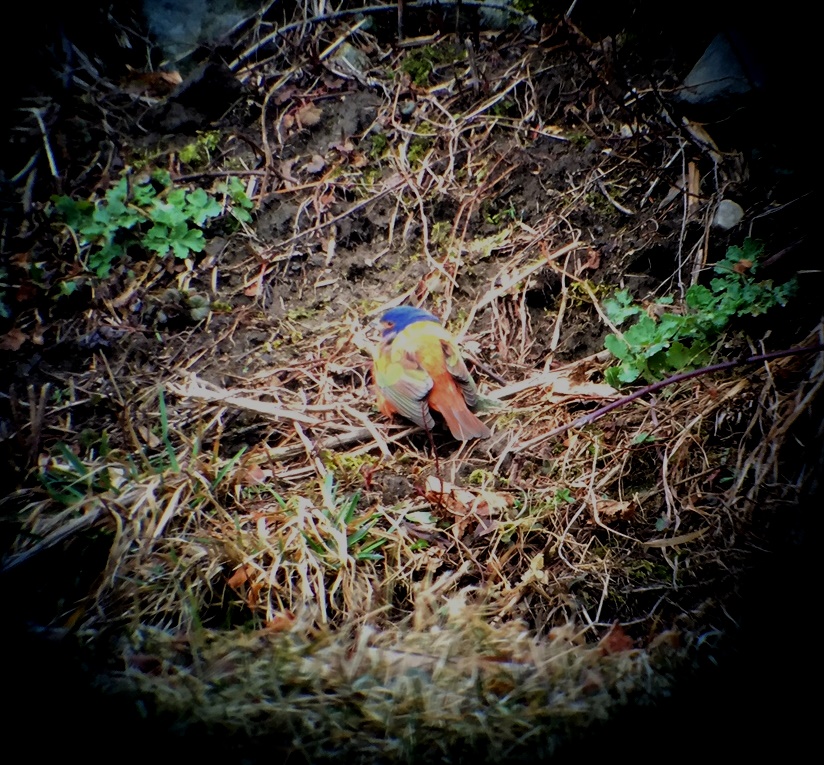

We watched the bird for the next 5 minutes, and during most of that time it stayed motionless on the ground.  Eventually it flew a short distance and perched on a low stone wall before it dropped out of sight.  I don’t believe it was seen again later that day so we would have missed it if we had arrived just a few minutes later.  Boy were we lucky to have arrived when we did.  Plus the bird sure didn’t seem very healthy so I wondered if it would be re-found, although it was still seen in the area for the next 2 days.

Painted Bunting is #273 for me in VT which is my fourth New England state for this species which is prone to vagrancy.  I’ve also seen this species in MD as a rarity and in many of the states within its regular range across the south.


Saturday, March 26, 2016

Redwing – Life Bird and First State Record – Hollis, NH, March 2016


I had just gotten home from church Sunday morning and happened to check my e-mail – a Redwing was just spotted by Chris McPherson in Hollis, NH.  Not a Red-winged Blackbird mind you, but an actual Redwing!  And there were photos too.  That would be a North American lifer for me.  And the location was just 15 minutes from home in fields that are part of my Hollis Christmas Count territory.  Needless to say, I wanted to see this bird.  I had a bunch of family commitments that afternoon, but could squeeze in about an hour to try for the bird, so I dropped everything and headed to Hollis.

When I arrived at the Hollis High School Chris McPherson was there with a couple other birders.  No one had seen the Redwing since Chris found it a couple hours earlier.  He described that the Redwing was with a very large flock of Robins, at times feeding in the grass in the outfield of the high school baseball field, and at times perched in low brush and trees at the field edges.  I’m quite familiar with this spot having covered it on Christmas Counts for a number of years.  It is a very birdy location, with lots of sumac berries for frugivores to eat, and brush for birds to forage in.  Within a few minutes more birders began to arrive, and we fanned out to look for our target bird.

I started walking north and quickly heard Robin call notes, found a few Bluebirds, and then saw a couple Robins, but certainly not the large flock that Chris described.  I headed up to the ball fields behind the middle school and began to notice a few Robins feeding on worms in the field.  I got a bit closer and soon counted 100 Robins in the field, and another 15 feeding nearby on sumac berries.  Was this the critical mass that would attract the Redwing?  Despite my optimism it was not to be.  And my hour was now up so I needed to head out.  By that time the bird had not been refound despite lots of birders looking.

Reports later that afternoon were few and far between and all negative - typically negative news doesn’t travel very quickly.  So I figured that the bird was not spotted after the original sighting.  But that night there was a post that the bird was seen again briefly by just a couple birders at 3 and again at 6:30 as it likely headed to roost.  The bird was still around!  I decided to be there at dawn the next day and take the day off from work if need be to chase after this amazing rarity.

When I arrived at 7 AM the next morning there were already 15 birders there.  I was parked alongside the high school baseball field and there were no Robins in site, so I decided to head to the north where I had the Robin flock the day before.  Up ahead I could see a couple birders standing at the edge of the middle school fields.  All of a sudden I noticed them point their scopes down toward the field.  Did they have the Redwing?  I quickly got up to the birders just as they said the Redwing flew from the field – ugh - I missed it by seconds.  But then someone spotted the bird perched in a low tree nearby.  And there it was – the Redwing was sitting in a sumac just a short distance away.  Success!  I headed back to my car to get my scope and noticed several birders nearby but looking in the wrong direction.  I flagged them down and luckily was able to get them on the bird.

By the time I was back with my scope the bird had moved to some nearby trees, and then later flew down into the high school ball field to search for worms with a flock of Robins.  I got these phonescoped pictures of this most cooperative bird. 


By now there were at least 30 birders there getting great looks at this bird.  With the pressure off we all starting introducing ourselves and I met a pair of birders from Pennsylvania who left their home at 1 AM that morning to chase after this bird.  With so few sightings the day before that was quite a bit of optimism on their part.  By comparison, I can’t remember the last time I needed such a short drive to get a life bird.  The Redwing stayed in view almost the whole hour I was there, which is remarkable given how difficult it was to find the previous day.  And I was able to get to work on time without taking a vacation day.

One other reflection on the Redwing and other rare Turdus species – almost exactly 3 years earlier I saw a stakeout Fieldfare as a life bird in Concord, MA.  As with the Redwing it was in a large flock of Robins.  Definitely the right time of year to look through those Robin flocks in New England.

Not only was Redwing the second new bird in one month for my NH state list, but it was also the second new bird that month for the overall NH state list.  That gives me 360 for my NH statelist, and 434 in New England.  It was also ABA lifebird #748 and #725 for the Lower 48.

Monday, March 21, 2016

Yellow-billed Loon, Provincetown, MA – First MA State Record, March 2016


“Race Point – Point, Apparent YELLOW-BILLED LOON” – that was the subject of a post from Steve Arena on the MA listserve on 2/27.  Needless to say that certainly got my attention.  Steve also posted photographs that convincingly showed that the bird was indeed a 1st year Yellow-billed Loon.  In subsequent days others refound the bird and confirmed this amazing sighting - a first record for MA. 

Ordinarily I would drop everything to chase after an extreme rarity like this, but Provincetown is a 3-hour drive from home, and beyond the distance I normally drive for a chase.  But as the bird continued to be seen on a daily basis, and apparently quite reliably, I started to think about whether I should give it a try.  Finally I decided to go for it, and started to research the particulars on this bird.  It was being seen about 1.5-2 miles southwest of the Race Point parking lot, requiring an hour walk one way in loose sand.  But I’m in good shape and was up for the challenge.  I set my alarm for 5 AM and was ready to go.

The next morning I was wide awake at 3:45 AM so decided to get out of bed and head out early.  I was at the Race Point parking lot at 7:45 and started the trek down the beach.  I wasn’t too worried about the walk down the beach since I expected I would spend most of my time walking on wet, hard-packed sand.  But even the wet sand was loose, making walking very slow and laborious.  Plus I was walking into a pretty stiff breeze.  As a result I was happy to notice that there were many birds along the beach and offshore giving me excuses to make frequent stops to catch my breath.  One of the first birds I stopped for was a Thick-billed Murre swimming just a few feet offshore.  And at each stop a scan of the ocean would reveal 1 or more flocks of large alcids flying by.  As I continued my walk I began to take notice of the steady stream of mostly single gulls flying along the beach in the same direction I was walking.  Almost half were white-wings – and virtually all were adult or 3rd year.  I conservatively estimated 25 Iceland Gulls, along with 2 adult Glaucous Gulls, plus one adult gull with very dark wingtips that I would have loved to have identified as a Thayer’s, but never pulled the trigger.

But back to the target bird…  The Yellow-billed Loon was apparently most often seen offshore in an area close to a radio tower.  As I neared the tower I saw 4 other birders arriving using an inland route, and all set up there scopes.  Then I noticed one birder pointing out to the ocean, and hoped that that meant he had spotted the bird.  A couple minutes later I got to the birders and they had indeed spotted the Yellow-billed offshore.  Although the seas were quite rough, I quickly picked out the Yellow-billed in with a number of Red-throated Loons.  Then one birder said he had a Pacific Loon – and I soon found it in the same scope field with the Yellow-billed.  Amazing! 

Over the next hour we continued to watch the Yellow-billed Loon as it loosely associated with about 35 Red-throated’s, 10 Common’s, and likely 2 different Pacific’s.  During that time we spotted 4 species of alcids on the water with them – Dovekie, Razorbill, Common Murre, and Thick-billed Murre.  Along with flyby flocks of large alcids offshore, and the continued parade of white-winged gulls, it was quite a spectacle. 

I tried taking phone-scoped photos of the Yellow-billed Loon, but the rough seas and distance to the bird made it very difficult.  I managed these miserable shots which only barely document the sighting.


On the way back I continued to spot alcids offshore and white-winged gulls closer to the beach.  At one point I spotted a flock of 15 gulls sitting on the beach – 3 were white-wings.  I took photos of this one bird that had a heavy bill and body larger than an Iceland suggesting immature Glaucous, but the bill was all dark and it was still smaller than a Herring suggesting Iceland.  An Iceland x Glaucous hybrid perhaps?


 And here it is next to a 3rd year Iceland for comparison -


Finally as I neared the parking lot I ran into a few small flocks of Horned Larks feeding in the wrack.  One flock included a Lapland Longspur – a nice conclusion to the trip.  And even though I was completely exhausted when I finally got back to the car, it was certainly all worth it.  Not only did I get a MA statebird, but it was only my second MA sighting of Pacific Loon and Dovekie.  What a tremendous experience – I have to get to Race Point more often!

Yellow-billed Loon was #409 for my MA list, and the 433rd species I’ve recorded anywhere in New England.  I’ve also seen this species in WA, AK, and BC.

Sunday, March 20, 2016

Tufted Duck, Salem, NH – First NH State Record, March 2016


It was the last day of a business trip and I was on my way back to the San Francisco airport when I received a text that a Tufted Duck was spotted in Salem, NH.  One might not get too excited about this report since this Eurasian rarity has recently been reported multiple times annually somewhere in New England.  But this was the long-awaited first record of Tufted Duck in NH - despite several recent sightings in northeastern MA tantalizingly close to the NH line.  Needless to say I wanted to see that bird to add it to my NH list!

But I was 3,000 miles away.  I was heading home that day but wouldn’t get in early enough to try for it that evening.  So I would have to hope that the bird would stay around until the next morning.  Another complication was that it was found on Captain Pond which is right on the NH/MA border.  That was just a mile to the northwest of Crystal Lake in Haverhill, MA, and about 6 miles northwest of Kenoza Lake in Haverhill where a Tufted Duck was found in January.  In fact, this could well be the same bird making stops in both states.  So I not only needed to cross my fingers that the bird would stay in the area, but also that it would not make a short flight to a nearby lake in MA.  Would this turn out to be another possible New England tick that I would miss because I was out of town? 

I arrived at Captain Pond just after dawn the next morning and there were already 3 birders on site.  The news was that the bird was still there, but recently swam out of sight into a cove around the corner.  The pressure was off, but I still needed the bird to cooperate.  A couple minutes later several flocks of Mallards flew from that general area.  And then while I was scanning through the Mallards a birder spotted a group of 4 divers flying from the cove.  The divers landed on the lake right in front of us – they were 3 female Scaup and the male Tufted Duck.  I guess I didn’t need to stress out over having to wait a day to see this bird after all.  The birds gave us some nice views as they swam by, and I was able to get this phonescoped photo of this very handsome bird.


Tufted Duck was #359 for my NH list, and the 240th species (and perhaps the rarest species) I’ve seen in every New England state.  I’ve also seen this rarity in the Lower 48 in MD, CA, and OR, as well as in AK.