Showing posts with label New Hampshire. Show all posts

Monday, May 6, 2019

Trumpeter Swan (But is it Countable?), April 2019, Candia NH


I was working outside in the garden early on Sunday morning 4/14 when I received a text from NH birder Steve Mirick that the Trumpeter Swan was continuing in Candia.  Trumpeter Swan?  What Trumpeter Swan?  I hadn’t seen any posts about what might be the first modern-day record of Trumpeter Swan in NH.  I came inside to check e-mails, and with some research noticed that the bird was first spotted the day before but initially reported as a Tundra Swan.  I don’t need Tundra for my NH list so it didn’t pop up in an eBird Needs Alert.  And with less people using the listserves, it wasn’t until the text the next day that the news got out in a big way.

Now I needed to free up some time to chase after the Swan.  Often Trumpeters will stick around for a while, so I wasn’t too worried that I couldn’t leave right away to chase after it.  Instead I planned to give it a try right after church.  I did a bit more research and found that the bird was being seen in the wetlands of the Abe Emerson Marsh Wildlife Sanctuary, and then downloaded a map of the trails at the site.  That was just a 45-minute drive away – less than half the distance of most of my normal New England chases.  I coordinated with NH birder David Donsker and it sounded like we would both arrive at about the same time.  More eyes the better.

By the time I left church there were a couple more posts, including photos of the bird swimming close by the photographer.  And while in route I called another NH birder David Deifik to make sure he knew about the bird.  He had just seen the Swan but it wasn’t in view at the time.  So I was optimistic though it might take a bit of searching.

I arrived at about 1 PM just as yet another NH birder Davis Finch got to the site (after all it could be a first recent NH record – everyone was descending on the site!).  Davis said he saw the bird as he passed by the marsh on Route 101; it was same story from David Donsker who had just arrived.  But stopping on the highway is likely to be frowned upon by local police, so we all started our searches from the trails in the sanctuary.  After about 20 minutes of increasingly anxious searching Davis and I finally spotted the Swan at the far southern end of the wetlands.  We were on the northeastern water’s edge about 1,000 ft away, and the bird was at least partially obscured, so the sighting wasn’t the best.  But we were able to get occasional views of the head/bill shape to ensure the ID and eliminate Tundra Swan.

Now the question was whether this bird could be countable in NH.  There is apparently one historical NH record of Trumpeter Swan, based on an account in "History of New Hampshire" by Jeremy Belknap written in 1792.  As a result, this species is on the NH state list based solely on the summary contained in that 200-year-old book.  But since then, Trumpeters had been extirpated from virtually all of their former range, and in fact hunted to near extinction.  That was until very successful re-introduction programs were begun in the 1980s in several Midwest states and Ontario.  This species is now successfully breeding in many locations throughout this region, including birds breeding as close as the Finger Lakes region of NY. 

Not surprisingly Trumpeters are showing up in increasing frequency in New England, and recent sightings have been deemed to be countable from viable re-introduced populations by the rare bird committees of VT, CT, RI, and MA.  At least one set of photos of the Candia bird showed that it was not banded, and had no wingtags, so the NH bird is not likely to be an escapee, and most likely from these re-introduced populations.  It will be up to the NH Rare Bird Committee to decide if this bird is indeed countable, but it would sure seem that based on the recent countable records elsewhere in New England, that the Committee members will decide to count this record as well.

If accepted by the NHRBC it would be number 370 for my NH list.  In my statebird map below, the 18 dark shaded states are those where I’ve seen Trumpeter Swan, including several midwestern states associated with the re-introduction program.  The cross-hatched states are those where this species is regular though I haven’t caught up with it yet.  I’ve also seen it in 2 Canadian provinces – BC and ON.  And with the increasing eastern populations Trumpeters will undoubtedly become regular in additional eastern states and provinces in the near future.


Wednesday, December 26, 2018

Third Time’s the Charm for American White Pelican, New Castle, NH, December 2018


American White Pelican is a rare vagrant in New England, as it is throughout virtually all of the eastern US.  And in New England, only rarely do birds stick around long.  Often they are seen as one or more high flying birds passing by on the coast.  Needless to say those birds aren’t chaseable unless you’re already on the coast and are lucky enough to be able to catch up with them as they head out of town.  As a result, in New England I’ve only seen White Pelican in MA and RI, and both birds were ones that had luckily stuck around for a couple days allowing for successful searches.

Then there was this interesting set of events in December 2018 -

It was Sunday afternoon, December 9, and at about 2 PM I received a text from Steve Mirick’s NH rare bird alert that an American White Pelican was reported heading south from Wells, ME.  Very appropriately Steve suggested it was worth keeping an eye out for the bird in NH.  Later in the day an eBird Maine Needs Alert came across with a White Pelican in York County.  The checklist was apparently from a full day of birding with the listed location being “York County”, and with no details on the location or time of the Pelican sighting.  Though there was a photo of the bird sitting in dry Spartina grasses in a coastal marsh somewhere.  Undoubtedly that was the bird reported in Wells which was last seen heading south.  Certainly not chaseable, right?

Then late in the afternoon Monday came yet another eBird Maine Needs Alert with a Pelican sighting.  At first I just assumed it was a second sighting from Sunday, but when I opened the e-mail I realized it was actually a Monday sighting once again from Wells.  The bird was seen swimming in the Webhannet River – apparently the bird was still around.  The post came across too late to give it a try that day, but it was certainly worth a try on Tuesday.  Especially since I didn’t go after chaseable White Pelicans (3 of them!) seen in Wells in May earlier this year. 

Tuesday morning I teamed up with Davis Finch and Mike Beck to search for the Pelican in Wells, ME.  But despite 3 hours scouring the waters and marshes of the Webhannet River we were unsuccessful.  Though it certainly was great to catch up with Davis and Mike!  Oh well – “a day late and a dollar short” as they say.  Tuesday evening while posting our sightings on eBird I noticed a post on the NH listserve that a White Pelican was photographed from Odiorne Point State Park that day.  The post was on a Facebook site and was not posted until dinner time that day.  Apparently our target bird was in NH while we were looking for it in ME - ugh.  And like Monday’s post of the bird in ME, it came across too late to chase that day in NH.  So once again it was time to plan for a chase the next morning.

Wednesday morning at 7 I met David Donsker at Odiorne in Rye, NH to look for our target bird.  But once again, I came up empty.  We searched the area around the Odiorne boat ramp where it was seen on Tuesday, as well as the Odiorne coast all the way to Frost Point, the New Castle coastline across the river from Odiorne, and as much of the remaining Newcastle coastline as we could access.  Once again I missed it by a day. 

Tallies from my 2 unsuccessful chases on consecutive days in 2 states – 7 hours of driving, 5 hours of birding, 0 White Pelicans. 

Two days later, Friday, I was in RI starting my day successfully adding Evening Grosbeak to my RI list as part of some inland birding in the morning.  That afternoon while doing a rather unremarkable seawatch from Point Judith, RI I got a text from Steve Mirick that the White Pelican had been re-found in New Castle, NH.  Even if I left that second I wouldn’t be able to make it to New Castle before dark.  My original plan was to spend the night in RI and participate in a Christmas Count the next morning.  But earlier in the day I had decided to pass on the CBC since I had come down with a pretty miserable cold.  Though my cold wasn’t bad enough to prevent me from chasing after a potential state bird!  Once again I planned an early morning trip to try for the Pelican – once again time back on the NH coast.

The bird had been seen on Friday from the “green bridge” – a narrow 2-lane metal bridge on Route 1B that takes you onto the island that makes up the majority of the town of New Castle.  It was also seen in the marina just east and south of that bridge.  But there was no place to pull over while on the bridge.  And the marina was private property requiring permission to access.  And did I mention that there are almost no public parking spots in the area?  Needless to say this could be a challenge.

At 7:10 Saturday morning, 12/15, while I was still in route to New Castle, I got a text from Steve that the Pelican was still there, seen from just west of the metal bridge.  Twenty minutes later I turned onto Route 1B, and luckily at that time of the day there was almost no traffic.  As I neared the green bridge there were no cars in sight behind me, so I was able to come to a full stop on the bridge.  I quickly looked to the right (south) where all of Friday’s sightings had been, but there was no bird.  Then I took a bit longer scan of the water and shorelines below but still no bird.  Then I made a quick look at the bit of the marina that is visible from the bridge, but again came up empty.  I was starting to worry.  Then I looked to the left, and peering between the bridge railings, I could see a large white bird swimming in the estuary to the north.  A quick binoc view confirmed I had the White Pelican!

I pulled ahead and parked in an “almost-legal” parking space, and there was the Pelican right in front of me.  Here’s a shot of the bird with no magnification.


And here’s a phonescoped photo of this most cooperative bird. 


Third time was the charm!

In subsequent days the bird was routinely being seen near the green bridge, and on the southern New Castle coast line opposite Odiorne.  Both of these areas were places David and I checked on Wednesday.  We also checked the edges of the marina as well, though couldn’t see into the center of the marina where even a large white bird could easily hide behind a boat and out of sight.  I wouldn’t be surprised if the Pelican was there all along, though I doubt that David and I overlooked it.  Instead I bet it was hanging out at the marina out of view when we were searching for it earlier in the week.  In any case, good thing that it stuck around for many to see it.

American White Pelican was #369 for me in NH, and my 36th state for this species which is prone to vagrancy across the US (see my statebird map below).


And now for a post-script –

At 3:30 in the afternoon of the 24th a (the?) White Pelican was spotted in Falmouth, ME – 50 miles (as the Pelican flies) northeast of New Castle.  The last eBird post of this bird in New Castle was at 11 AM on the 24th.  Was this the same bird, flying 50 miles to the northeast that day to return to the ME coast?  Or have there been 2 birds all along – one preferring the NH coast and a second bird that never left the southern ME coast?  The Pelican was not found in NH on the 25th, but one was seen in Portland, ME that morning, though just for a couple hours before flying out of sight.  So it’s looking more likely that it is indeed just one bird and not two.  Is it too late to ask for a chaseable Pelican in ME for Christmas?  Stay tuned…

Sunday, August 19, 2018

Best 2 Days of Birding Ever, August 2018


It all started with reports of a Little Egret in Westerly, RI – that’s only the 2nd record for the state based on eBird data, so it would be a great one to chase after.  And although the Egret was reported for a few consecutive days, it was only being seen between 5:30AM and 6 AM before flying off to points unknown with a flock of Snowy’s and Greats.  That was way too early for me to try for given my 2+ hour drive time.  But then the bird was found to be feeding during the day in marshes and perched in trees in the Winnapaug Pond area along Atlantic Avenue in Westerly.  So now it was very much chaseable.
And as I was putting my plans together to try for the Egret, a post came across the CT listserve from Tom Robben that he was able to see the continuing Bridled Tern on Great Gull Island in NY from a Lighthouse Cruise out of New London, CT.  This was presumably the same Bridled Tern that spent much of last summer on Falkner Island in CT.  Many birders got to see this reliable bird – that is the bird was reliable for almost everyone except for me.  I tried twice for the Tern without success.  And since this would be a life bird, I was still very interested in trying to see it this summer, even if it was in NY instead of CT.  Though Tom stressed that even if you were lucky enough to see the bird while on the Lighthouse Cruise it would still be very distant. 
So I started to revise my plans to start early morning in Westerly to try for the Egret, then head to New London to take the Lighthouse Cruise to try for the Tern.  While researching times for the cruise I noticed several e-mails regarding identification of a Hawk seen in Maine.  It took a while to unravel the story, but it was eventually ID’d as an amazing Great Black Hawk, native to Central and South America.  And despite some initial questions as to the location of the bird, it was verified to be in Biddeford, ME.  The bird was first seen two days earlier, but not re-found the next day.  What an exciting second ABA record!  But apparently no longer around.
And as they say on the infomercials – “But wait there’s more…”  I had just finished figuring out the Black Hawk story when an eBird NH Needs Alert came across with a Neotropic Cormorant seen in Gorham, NH 6 days earlier, complete with photos!  That would be a first record for NH and likely for all of New England.  But that was 6 days ago and a good 3 hours north of me.  So although there were now reports of 2 truly amazing birds north of me, both were now a bit dated, so I went back to continue my planning efforts to head south into RI and CT. 
Then minutes later came a report that the Great Black Hawk was re-found in Biddeford.  That certainly changed the equation.  And as I was piecing that together an e-mail arrived reporting that the Cormorant was still at the same location in Gorham.  I was having trouble keeping up…  Although the Little Egret and Bridled Tern were rare, they were not nearly as rare as the Great Black Hawk and Neotropic Cormorant.  So I changed my plans, and decided to start the day in Biddeford, then head north to Gorham.  The Egret and Tern could wait till the next day.
The Great Black Hawk was first reported two days earlier, though not surprisingly the observer needed help to identify this immature bird.  It was spotted in a small neighborhood along Maddox Pond Road just off the coast.  When the Hawk was re-found it was on nearby Lily Pond Avenue, with agitated Robins giving away its location.  So when I arrived at 7:30 that morning I headed right to Lily Pond Road and found at least 30 birders already milling about looking for our target bird.  No sightings yet.  But just a couple minutes later I could hear some Robins squawking a short distance to the south.  Could they have the Hawk?  I pointed out the calls to other birders, and many of us headed in that direction to check it out.  But before I could find the Robins here was another birder heading towards us to spread the word that he had the Black Hawk up ahead.  A minute later I came upon the squawking Robins, and there was the Great Black Hawk.  An amazing bird with such long legs and large bill.  It put on a great show, thanks to those marauding Robins.  Here are a couple phonescoped photos of the bird.


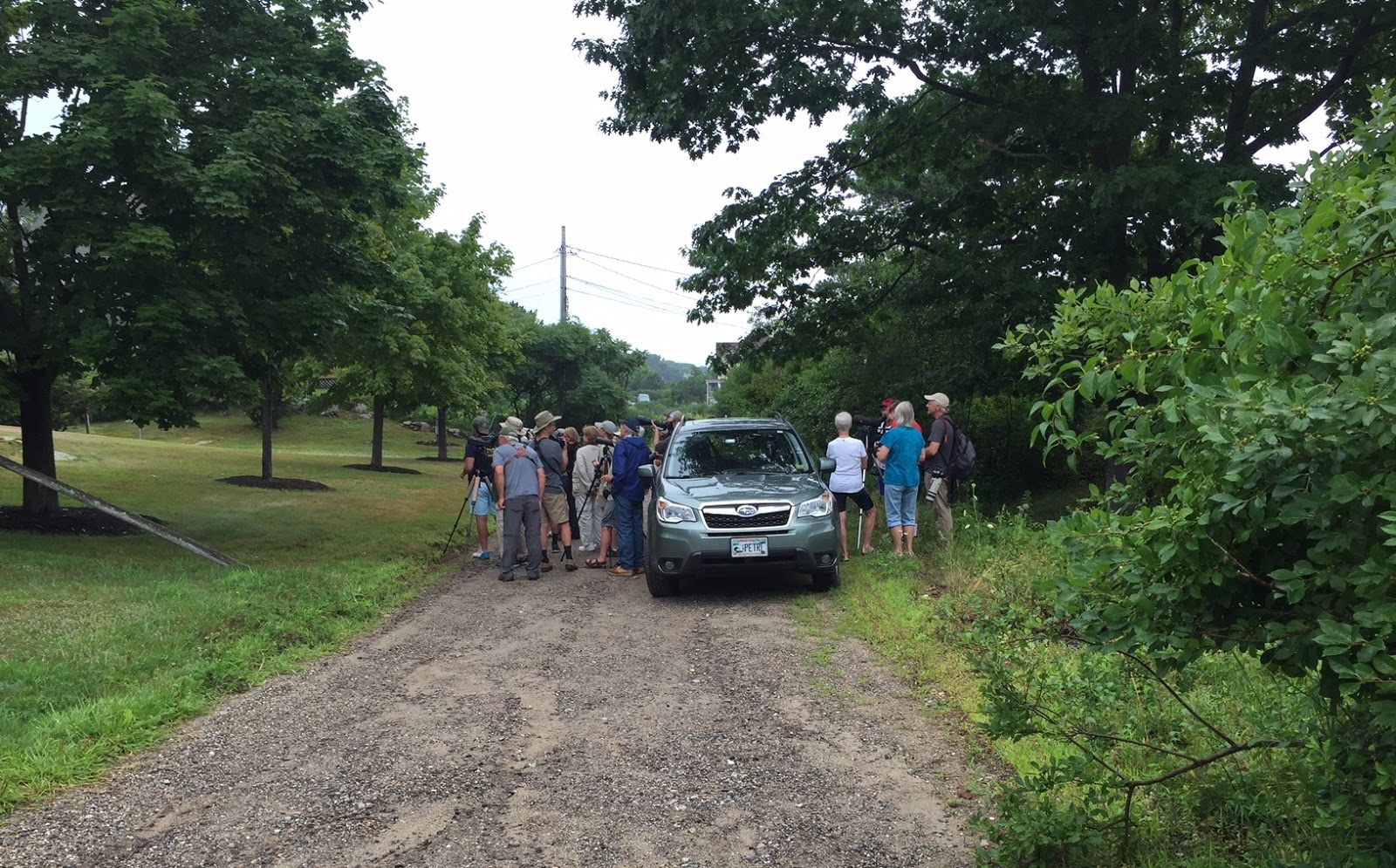
And a shot of the many happy birders who were there.


I spent about a half hour with the bird taking in all the great views, before it flew off a short distance back into the woods out of sight.  During this time I ran into Davis Finch, a long-time birding friend from NH.  I told him of my plans to try for the Neotropic Cormorant next, and he quickly accepted my offer to come along and make the trek up to Gorham.  After a short review of the maps, we planned our 2 ½ hour route, and at 8 AM our 2-car convoy started out through the country side.  About half way to Gorham I received a text with even more amazing news – a Wood Stork had just been spotted in southern NH at Pickering Ponds in Rochester!  There was only 1 previous hypothetical record for this species in NH, so it would be great to go after that bird too.  But we still needed to drive another hour north to try for the Cormorant.  And then it would take another 2-hour drive south before we could get to Rochester.  I shared the news with Davis when we arrived in Gorham, and we both crossed our fingers that the Stork would remain until we could get to Rochester.
But first we needed to focus on the Cormorant.  The eBird report included photos showing the bird perched on a line of orange buoys just upstream of a hydroelectric dam on the Androscoggin River.  Although directions in the first eBird report were cryptic at best, the new posts included good details, and after a short walk Davis and I approached the river where the Cormorant had been roosting.  As we crested the dike there was NH birder Steve Mirick already looking at our target bird.  I got these distant phonescoped photos of the Cormorant.


Interestingly the last Neotropic Cormorant I saw was earlier this year at Lake Mead near Las Vegas – also a rarity though certainly not as rare as this NH bird.  The NV Cormorant liked to perch on a floating “jetty” similar to our Gorham bird.  NH was my 8th state for this species which is increasingly prone to wandering from its regular range.


Although I was tempted to walk closer and get better views, both Davis and I were anxious to get back on the road to try for the Stork.  So by 10:30 our little convoy was heading south to Rochester, happily receiving updates that the Stork was still there.
Two hours later we pulled into the parking lot at Pickering Ponds, and within a couple minutes we walked up the dike to get a view of the impoundments.  There was a small group of birders up ahead, and they had the bird in their scopes.  Here’s a phonescoped picture of this most cooperative bird.


That was my second Wood Stork in New England – the first being in Barnstable, MA in November 1994.  And NH is now my 11th state overall for this species.


What an outstanding day!  I sure was glad I changed my priorities to head north to chase after these 3 extreme rarities.  And glad I went after the Hawk first because it was last seen at about 2 PM that day.
When I got home that afternoon I reviewed my e-mails and the Little Egret was seen again in Westerly, RI that day.  So that one was still in play.  And then I noticed an e-mail from a boat captain out of CT (Captain Ian Devlin) offering to take birders to Great Gull Island to try for the Bridled Tern.  That approach would certainly give me a much better chance of seeing the Tern compared to a “drive by” while on a Lighthouse Cruise.  I quickly replied back to him saying I would like to try for the Tern the next afternoon.  I also reached out to a CT birder Maggie Peretto who unfortunately was along with me on those same 2 unsuccessful attempts for the bird last summer, hoping that she might want to share the ride with me.  I got a quick reply from Maggie that she was interested, and she too sent an e-mail to Ian saying she wanted to go the next day.  But as the day progressed neither Maggie nor I had received a reply from Ian.  So despite the lack of responses, I planned to head out early the next morning to try for the Little Egret, then hopefully hear back from Ian to take his boat to try for the Bridled Tern.  But just in case I didn’t connect with Ian, I researched the times of the Lighthouse Cruise, as well as the regular New London to Orient Point ferries as fall back options. 
I was out of the house bright and early for the second consecutive day and arrived at Winnapaug Pond at about 8.  I was pretty familiar with this spot having seen 2 RI rarities there in the past – Ruff and White Ibis.  As I pulled up I could see another birder already there scoping the marshes.  Although he hadn’t found the Little Egret yet, he had found a flock of Snowy and Great Egrets about a quarter mile to the north feeding at the edge of the river channel.  This could well be the flock that the Little was associating with, so we spent the next few minutes trying to find out target.  But given the distance and all the tall vegetation we were unsuccessful picking out the Little Egret among those other white waders.
And then a couple of the Egrets left the flock and began flying toward us.  Then seconds later a few more took off.  I put a couple of these in my scope and initially thought in the distance that both were Greats based on size.  Then I realized one of them had a dark bill.  Now as they got closer I could see the dark-billed bird was a little smaller than the Great, and it had dark lores – I had the Little Egret!  The other birder spotted it in flight as well.  Interestingly, since the bird was flying nearly directly at us, neither of us saw the long head plume of the Little Egret.  Just goes to show you often need to focus on multiple field marks to make an ID.  I followed the target all the way to a nearby grove of trees, where it landed on the back side unfortunately out of view.  I waited another hour for the bird to drop down into the marsh to feed.  But it never came out into the open, nor were we able to re-spot it in the trees.  With the heat and humidity on the rise, I called it quits at 9:30, happy to have had at least a limited view of the Egret.  Good thing it wasn’t a lifer – I’ve also seen this species in ME, NH, and MA – otherwise I would have wanted better views.
Now I turned my attention to trying to get out to see the Bridled Tern.  I still hadn’t heard from Ian, so I gave him another call, but could only leave him another message.  It wasn’t looking like I would hear back from him, so I called the ferry company to see if they still had spaces open on the lighthouse cruise later that day.  Unfortunately the lighthouse cruise was canceled for the day.  This was bringing back awful memories of my futile attempts to try to get a boat out to see the bird last summer when it was in CT.  Although birders were heading out daily and seeing the Tern it took me a week to find a boat and captain to take me, and by then the bird was gone.  I probably spent more time trying to find a boat than my time actually on the water looking for the Tern.  Very frustrating…  But rather than head home, since I was already on the coast, I decided to just take a regular round-trip ferry ride out of New London to bird the Sound hoping for pelagics from the ferry.  Of course I would have next to no chance for the Bridled Tern – that would have to wait till another day. 
The next ferry with good viewing didn’t depart until 1 PM, so I had lots of time to kill.  I drove to New London, and parked in my regular garage, arriving at 10:30.  I relaxed in my car for a while, then headed into town and found a quaint sandwich shop for lunch.  It was now about Noon and just as I was about to head to the ferry to buy my ticket my phone rang – it was Captain Ian.  He could take me out at 2:30 that afternoon departing from Waterford a short distance to the west.  Next I tried to reach Maggie to see if she could go along with me.  Not only would it be great for her to have an opportunity to see the bird, but she could share the cost of the boat - $150 for 2 hours regardless of how many birders were on-board.  Unfortunately I didn’t have her phone number so could just send her an e-mail.
Now I had more time to kill, though first I had to find an ATM to get extra cash in case I was the only birder on board.  Within a few minutes I was at the boat ramp parking lot waiting for my trip to Great Gull Island.  Eventually I was able to connect with Maggie, but unfortunately she was unable to go along.  I was on my own, both with respect to paying for the boat as well as searching for the Bridled Tern.
Ian ended up being delayed in traffic, so we didn’t leave the dock until 3:45.  Luckily the water was quite calm because Ian’s boat seemed a bit small to head all the way across the Sound.  But after just a few rougher spots on our 20-minute ride, we neared Great Gull Island.  I had done quite a bit of research on the Tern, and thanks to info in blogs managed by Tom Robben (trips33.blogspot.com) and Joe DiCostanzo (inwoodbirder.blogspot.com), I knew that the Tern preferred to roost on rocks at the northeast corner of the island.  We headed right to that spot and I quickly started to scan the rocks.  There were quite a number of Common Terns scattered about, but no Bridled.  Then I did another scan, and then another scan – still no target bird.  I expanded my scans further to the east and west but still no Bridled.  This was bringing back most unpleasant memories from last summer. 
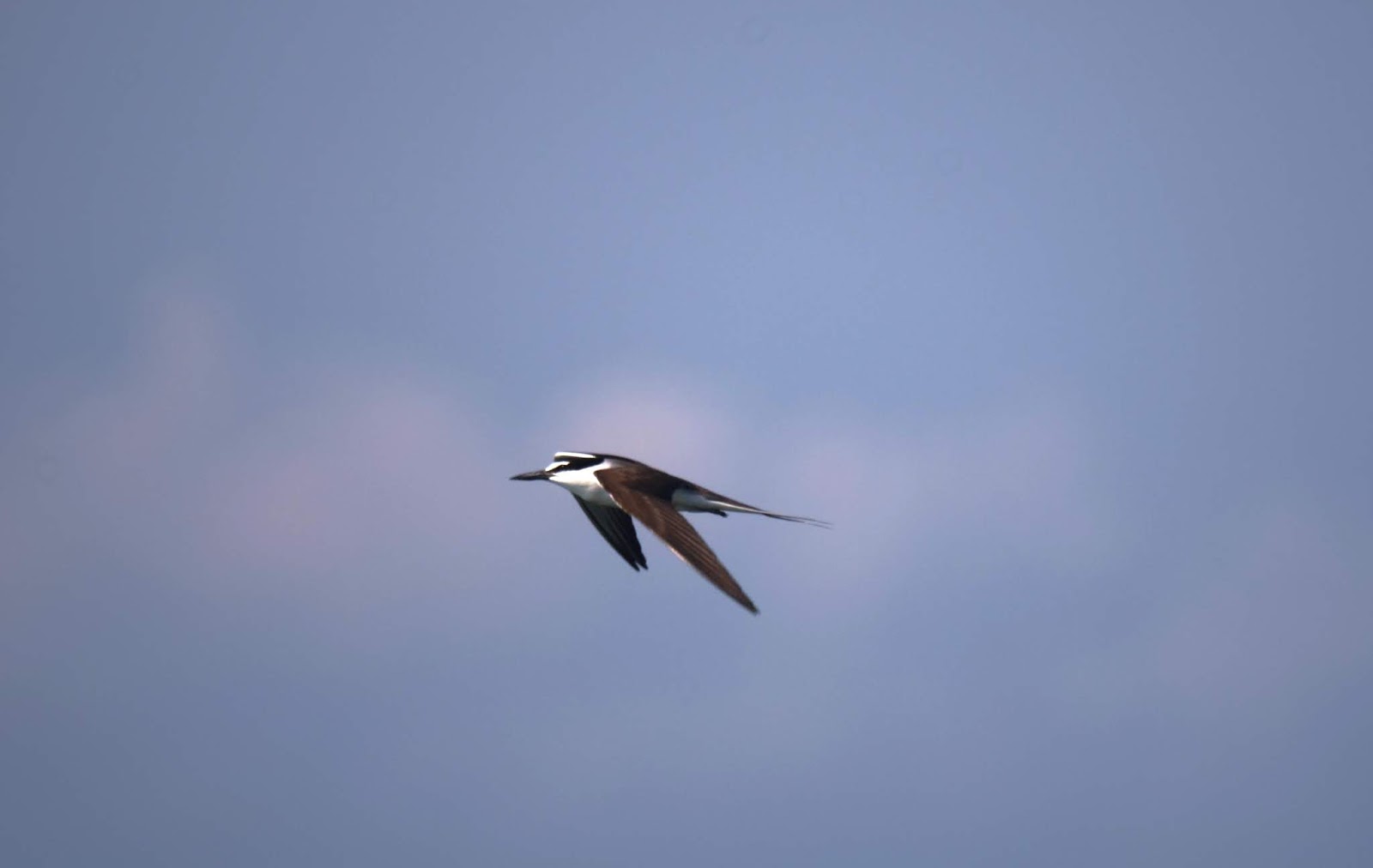
We had been at the island for maybe 5 minutes when seemingly all the Terns took off out over the water.  Ian spotted a Peregrine buzzing over the island and all the Terns were in chase.  I looked east into a boiling flock of maybe 500 or 1,000 Common and Roseate Terns low over the water and almost instantly picked out a darker-backed bird – I had the Bridled Tern!!!  We continued to follow the bird for a couple minutes as it flew around the boat, and I was able to get these pretty nice photos.


And later I got this shot of the Peregrine flying away, still mobbed by the Terns. 


At one point I watched the Bridled Tern land on the island, but it took off seconds later heading back out over the water.  We stayed at the island for the next 45 minutes but we never re-spotted the bird over the water nor perched, despite expanding our scans to nearby parts of the island.  The bird was obviously not perching in its favorite location.  Thank goodness for that Peregrine!  Otherwise I doubt we would have seen the Bridled Tern.


Before we headed back I spotted a Parasitic Jaeger harassing a Common Tern – in NY waters though.  I still need Parasitic for CT, which is the case for all the Shearwaters as well.  I had hoped that we might get lucky with other pelagics while motoring through the CT portion of the Sound on Ian’s boat, but it was too rough to scan while traveling along.  Though I certainly wasn’t going to be disappointed – after almost seeing a Bridled Tern while on a pelagic out of MA, having to pass on getting a boat to see one in ME, and 2 failed attempts last summer in CT, I finally had my life Bridled Tern!
What an ending to an outstanding 2 days of birding, not only seeing all 5 of my targets, but all 5 were also extreme rarities -

Day 1 –
    Great Black Hawk – life bird, first ME 2nd ABA record, bringing my ME list to 342
    Neotropic Cormorant – first New England record, NH bird #366
    Wood Stork – first confirmed NH record, NH bird #367
Day 2 –
    Little Egret – perhaps 2nd RI record, RI bird #330
    Bridled Tern – life bird, NY bird #284
My life lists now stand at 756 in the ABA Continental region (not including Hawaii), and 736 in the Lower 48.
In all my 51 years of birding, those were most definitely my best 2 consecutive days of birding ever!

Friday, September 15, 2017

MacGillivray’s Warbler, Odiorne Point State Park, First NH Record, September 2017

“Probably MacGillivray’s Warbler at Odiorne along east side of Boy Scout Trail” – that was the text that came across on Steve Mirick’s rare bird text chain.  Then a few minutes later I received this text – “DEFINITELY a MacGillivray’s Warbler”.  A first NH state record!  It was early Labor Day morning and I wanted to run right out of the house to give it a try.  But I had all day commitments at home and couldn’t break free. 

But what about tomorrow?  If it stuck around I could head out pre-dawn, and maybe even get back home before anyone was awake.  But that would be a big if.  Sometimes fall migrants stick around for a few days, but often they are one-day wonders.  The bird continued to be seen off and on into the early afternoon so that was good news.  And with southerly winds predicted overnight, perhaps the bird wouldn’t want to continue to migrate south.  That is if this western rarity even wanted to migrate south at all.  So I planned for an early trip to Odiorne Point State Park the next morning, optimistically hoping for the bird to continue at least into that next day.  Not surprisingly the MacGillivray’s had spent much of its time skulking in low vegetation, especially patches of goldenrod, right along the trail.  And most importantly, it was often quite vocal, giving series of sharp chip notes reminiscent of a Cardinal.  So I had a good idea where to look and what to listen for.

I arrived at Odiorne at about 7 AM and quickly headed to the beginning of the Boy Scout Trail as it’s called just off the southern tip of the parking lot.  As I arrived at the first patch of goldenrod I could see 3 other birds up ahead – they hadn’t had the bird but had just arrived.  It was a pretty chilly morning and likely this insect-eater’s food wouldn’t be active yet, so perhaps the target bird wouldn’t be moving around yet either.

I started to head back to the car to get a light jacket, and just as I neared the beginning of the trail I heard several sharp chip notes coming from the brush.  I stopped in my tracks, and listened intently – there it was again.  I got another birder on these chip notes, which soon became louder.  We both peered into the vegetation where they were coming from, but saw no movement.  Then it was silent.  I turned to the other birder and remarked that I thought that was the MacGillivray’s.  The birder I was with happened to have heard and seen the bird yesterday, and she agreed that those call notes sounded like what she had heard yesterday. 

So the bird was still around, but now I wanted a visual.  Unfortunately I had no other activity from the thicket for quite some time – no visuals or other chip notes.  It was now 8 AM and there were at least a dozen birders there with me searching for the bird.  But no one had any sightings.  Then I heard the sharp chip notes again, and got another birder on the calls.  We listened as the MacGillivray’s gave a series of 12-15 call notes from low in the goldenrod thicket.  Then it was quiet again.  The calls were coming from just 15 feet away but we saw no movement at all.  Very frustrating…  I stayed until about 8:45 when I had to head home, confident in the fact that I had heard the bird, but disappointed that I didn’t have a visual.

Later in the day there was one brief visual sighting of the MacGillivray’s from this area, and another sighting the next day as well.  And then amazingly the bird was re-sighted about a week later elsewhere in the park, a good half mile away!  Maybe it will stick around well into the fall.

MacGillivray’s Warbler was #364 for my NH list, joining MA as my only New England state for this rare western vagrant.  I’ve also seen this species throughout much of its regular western range in the US and Canada, though I still need it in AZ and MT as a regular breeder.  Not to mention I found one years ago as a rare spring migrant in ND.  (see my state and province maps below)


Thursday, August 31, 2017

Common Shelduck (of Unknown Provenance), Rye, NH - August 2017

An interesting report of an immature Common Shelduck came across my eBird NH Needs Alert.  Of course I needed Shelduck for my NH list – not only are there no accepted records in NH, there are no records accepted by the ABA.  Not surprisingly, my initial thought was this bird was an escapee from a local waterfowl breeder.  Slowly additional details came to light – first of all the bird was unbanded and not pinioned.  And then came a report that a local breeder was contacted and he had not lost any Shelducks.  Eventually photos showed the bird had both hind toes.  And there were reports that wild Shelducks in Europe are indeed migrating this time of year.  With this information, several birders were starting to think that it could be a wild bird.  So although I was still very skeptical, not wanting to take any chances, I decided to head out to try to find it.

I pulled up to the pools just south of Odiorne Point State Park where the Shelduck had been hanging out for the last week, and instantly spotted a large, pale duck at the edge of the southernmost pool.  With a quick binocular view it was obvious that it was the immature Common Shelduck.  I headed over to the pool and watched the bird for the next hour as it fed in the shallows with a slow side-to-side sweeping motion.  As I continued to study this very attractive bird, I couldn’t help but think I would have had no idea what species it was if I had discovered it.  Although lighting was harsh, I got these passable phonescoped photos of the bird. 


This isn’t my first encounter with Shelducks in the ABA.  Back in the 70’s there were breeding populations of both Common and Ruddy Shelducks in DE at Bombay Hook NWR, and I saw them on several trips to the region.  Needless to say everyone thought those local populations were from escaped birds and not wild countable birds.

Now some thoughts on whether the NH bird might be a wild migrant from an expanding population in Iceland, or an escaped feral bird -

First of all, one can only prove with 100% certainty that a bird is wild if it has been banded as a wild bird likely in its native land.  Though you can prove that a bird is an escapee in multiple ways such as if the bird is pinioned, missing hind toes, or banded by a breeder.  This bird is unbanded, unpinioned, and has its hind toes.  So without any feature to conclusively determine the provenance of the NH bird, one has to use a "weight of evidence" approach - is there more evidence that the bird is wild than it is an escapee? 

I’ve read a report that native Common Shelducks in Europe are indeed migrating at this time of year.  But it’s unclear if juveniles are migrating now, or just adults, or both.  Plus, how far are they migrating this early in the season?  For instance we might call a mid-summer Yellow Warbler at Odiorne a "migrant", but it may just be a post-breeding wanderer from a nesting location a mile away.  By comparison, the Stilt Sandpiper seen recently in the same pools the Shelduck is frequenting is certainly a long-range migrant - its closest breeding area in Manitoba is 1,300 miles away, and its breeding area in Nunavut is 2,300 miles (as the sandpiper flies). 

Could the Iceland Shelducks be "migrating" from their nest sites but still staying in country, going to a post-breeding feeding area still in Iceland?  For instance there is an eBird report of 120 birds at the Andakill mudflats in Iceland on 6/27/17 – perhaps a post-breeding dispersal site?  Or could they be migrating a greater distance, say to somewhere in the UK?  That would be about 1,200 straight-line miles to the southern end of England.  Or maybe they've already arrived in southern Spain, one of their typical wintering grounds - the straight-line distance is 2,000 miles.  They typically winter no farther south than coastal Morocco and Algeria - 2,200 miles away on a straight line. 

By comparison, the minimum straight-line distance from Iceland to the NH coast is something like 2,400 miles.  In other words - for this to be a truly wild migrant in NH, the distance the bird would have traveled would be roughly the same distance that a bird could have migrated from the species' farthest northwest breeding area (Iceland) to its farthest southwest wintering area (coastal Africa) - all before mid-August.  That is assuming that birds breeding in Iceland would winter all the way south to Africa in the first place (instead of birds breeding closer to Africa being the source of the individuals wintering in Africa). 

Muddying the waters - not all Shelducks leave Iceland for the winter - note an eBird report of 160 birds on 1/29/17 in Grunnafjordur, Iceland.  And Shelducks are breeding in Spain and Portugal - they are reported every month of the year in eBird.  So could birds breeding in Spain and Portugal be the source of those wintering in Africa, rather than birds from farther north?

Then there is the issue of when Shelducks normally appear on their wintering grounds in northern Africa.  Using eBird data, the first scattered reports are in October, and they don't seem to arrive in any real numbers until December.  Note that there are 4 reports of 26 to 46 birds in central Algeria in summer last year and since May of this year - likely a local feral flock I would imagine rather than migrants.

One point to note though is that there aren’t nearly as many users of eBird in Europe and Africa as there are in the States.  So one has to use a grain of salt when evaluating data from those regions. 

In summary - for the NH bird to have migrated from the closest breeding area in Iceland in August, it would have had to migrate a distance roughly equal to the distance the species might take from its farthest northwest breeding area (Iceland) to its farthest southwest wintering area (coastal Africa), and it would have had to do this migration at least a couple months before the first birds normally appear in coastal Africa.  Not to mention all of this migration would be along a route not typically taken by wild birds.

Can more eBird research shed additional light on the bird?  I'm sure it can, but with my limited effort it seems that the possibility that this is a true wild migrant is remote.  I wouldn't say 0%, but certainly a low probability.  But as I said initially - one cannot be 100% sure on this unbanded/unpinioned bird, so probabilities are the best we can work with.

Now for local sources of Shelducks - I’ve heard that a local waterfowl breeder has not lost any Shelducks.  But I found a couple websites that sell Shelducks - anyone could go online and purchase a pair for just $135.  So it would be easy enough for anyone to buy one – you wouldn’t just have to be a breeder to own Shelducks.  And if a breeder somewhere nearby in say MA or ME lost a bird, it sure could have wandered easily enough to the NH coast.  This is obviously the time of year when post-breeding dabbling ducks wander and congregate in favorite feeding locations.  In summary – it’s plausible that the NH bird is a local escapee - though again I can't say 100%.  But it is certainly a higher probability than the wild migrant option.

And a further complication – an adult Common Shelduck was discovered in far northeastern NY at about the same time the NH bird was discovered.  Were both of these two birds blown off-track from Iceland by the same forces?  Or were both birds escapees from the same breeder?  Or maybe the two sightings were just a coincidence?  Seems like this last option is the least likely, but who is to say.

In conclusion, given the weight of evidence as I know it now, I could not accept the NH Common Shelduck as a wild vagrant.

Now show me a bird in suitable habitat in December and I could change my mind.  Oh wait a minute - that's exactly what happened in MA in 2009 and even that record was rejected.  Though it’s notable that there was a group of 3 adult Shelducks seen in New Brunswick this past winter that local birders are thinking could be wild birds.  And apparently at least one older record from the east coast of Newfoundland (on 4/2/14 per eBird) has been accepted by the province’s committee.  So perhaps if this is the beginning of a future pattern of accepted wild Shelducks, the NH and MA rare bird committees could come back and re-evaluate the recent New England records. 

Thursday, July 20, 2017

Brown Pelican, Hampton, NH, June 2017

A post came across the Maine listserve that a Brown Pelican was spotted off Prout’s Neck in southern ME.  There were also a couple Pelicans being seen on the northern MA coast – that’s quite a movement of birds into New England!  Ordinarily I would want to chase after the ME bird (I already have Pelican in MA), but I was away on a week-long business trip and wouldn’t be able to go for it.  That is unless it stayed in the area until I returned.  And when the posts for the ME Pelican (as well as the MA birds) continued through the week, I started to get more optimistic that perhaps I had a chance for it.  I flew home Friday and that evening checked the ME listserve again – the Pelican was still being reported, though access to its preferred perches was a bit limited.  So early Saturday I put together a plan to head out to try for the bird the next morning, and I sent an e-mail to my NH birding colleague David Donsker to see if he wanted to come along.

Less than an hour later I received this text from Steve Mirick along the NH coast - “Brown Pelican flying south past Concord Point.  NOW!!”  And just a minute later I received this update – “Pelican LANDED ON CONCORD POINT!!”.  That would be a great bird to try for in NH, but realistically the chances were pretty slim that it would stay put for the next 90 minutes that it would take me to drive there.  So I lamented how I would miss another possible NH statebird, and went back to my chores.  Though of course I was still planning to head to ME the next morning to try for the Pelican there.

Then just a few minutes later I got a call from David Donsker – he was at Concord Point looking at the NH bird.  He said the Pelican was sleeping on rocks well above the high tide line, so perhaps it would stay.  That was enough to push me over the edge, and 5 minutes later I was out the door to begin my drive to the upper NH coast. 

My drives to chase after a rarity are nearly always quite stressful.  I always want to drive faster than I ought to, and can’t ever understand why a slow driver would be in front of me.  And then I always hope there will be positive updates as I make my drive making me feel more at ease.  One of those updates came from David about half way along my trip – the bird was still there.  But then as I was just 15 minutes away, he called again - but this time I could tell from the tone of his first few words that it wasn’t going to be a good update.  He reported that the bird had just taken off and left Concord Point, flying south.  My heart sank.  If only I had left right when I received the first texts I would have made it in time. 

What to do?  I was half-tempted to just turn around and head home.  But I was so close, why not try to re-find the bird?  I knew it was a long shot, but worth the try.  My first stop was at Eel Pond, a couple miles south of Concord Point.  I quickly scanned the beach, any rocks in view, the ocean, the pond, but found nothing.  Then I went a bit farther south and made another stop, but still nothing.  I realized that my access to the coastline was pretty limited, and there were many possible resting places that a Pelican might favor that were simply out of view.  Re-finding the Pelican was definitely going to be a needle in a haystack proposition; that is if the bird was even still in NH at all. 

Then I continued my trek to the south and arrived at the beach at North Hampton State Park.  I parked at the north end and scanned first north up the coast, then east out to sea, but found nothing.  Then I looked to the south and far in the distance I could see a couple Cormorants perched close to shore.  And next to them was another taller bird, or at least I thought it was a bird, that seemed about right for a Pelican.  I quickly pulled the scope from my car, and even though I later realized that the birds were 1.1 miles away, I could tell that I had indeed re-found the immature Brown Pelican!  I called Steve so he could get the word out.  He suggested that maybe the bird would be close to Bicentennial Park, so I made that my next stop.

A couple minutes later I pulled into the parking lot at Bicentennial Park in Hampton.  The lot was marked for residents with town stickers only, but I didn’t care.  I quickly set up the scope and looked north toward a rocky outcrop near Plaice Cove and there was the Pelican swimming first with some Cormorants, and then later with some Eiders.  Good thing the bird was standing when I first spotted it from the State Park as I doubt I would have been able to pick out a swimming bird at that distance.  And speaking of distance, I had re-found the bird 6 miles south of Concord Point, and 30 minutes after the Pelican had started its trek south.  I got these miserable phonescoped photos of the bird as it bobbed in the swells.


Later I was able to get a couple other birders on the target bird.  And while comparing notes a parking enforcement officer showed up and suggested we leave since we didn’t have the required resident stickers.  Not wanting to risk getting a parking ticket, we all headed out very happy to have seen the bird.

Soon after we left there was a report from another birder who watched the Pelican fly from Plaice Cove heading further south.  And later yet there were reports of the bird at Hampton Harbor and then near Seabrook Beach.  The bird was definitely making its way south.

On my drive home I wondered whether the NH bird was yet another Pelican in this mini-invasion, or perhaps one of the MA birds, or the worst option – that it was the bird that had been in ME for the last week.  Later that day there was one negative report from ME, and no positive reports at all.  So I decided not to head to ME the next day to try for that one.  And good thing I didn’t – a later post concluded that the NH bird was actually the one that had been at Prout’s Neck in ME the previous week.  Unfortunately there were no more reports of the Pelican returning to ME.  Oh well – I missed the chance to add Brown Pelican to my ME list, but got it in NH.

Brown Pelican was #363 for my NH statelist (after removing Thayer’s Gull which was just lumped with Iceland Gull).  And NH was my 3rd New England state for Brown Pelican – in addition to MA and RI.  Plus I’ve seen it throughout its regular range on the Atlantic, Gulf, and Pacific coasts, not to mention AZ.