Wednesday, November 21, 2012

Northern Lapwing, Bridgewater, MA, November 2012

Shortly after Superstorm Sandy came through, a small number of Northern Lapwings were found in the northeast, especially in MA.  These included 1 on Cape Cod and 2 on Nantucket discovered the day after the storm, and 1 seen briefly in southern Maine a couple days later.  Although the Cape Cod and Maine birds were just one-day wonders, the 2 on Nantucket are still being seen weeks later.  I sure wished I could go after the Nantucket birds, though getting to Nantucket is not a trivial endeavor consisting of a 2-hour drive to Hyannis and then an hour boat ride.  And then you still have to get transportation while on the island.  So I decided that I wouldn’t chase the Nantucket birds, despite the nearly daily posts of how reliable they are.

Then came posts on the MA listserve that 2 different Lapwings were discovered on the same day very close to each other in southeastern MA (on the mainland!) in farm fields in Bridgewater and Middleboro.  However, these posts came across the day I left for a 5-day business trip – the same business trip described in my previous post on the RI Mountain Bluebird.  So there were two mega-rarities being seen in New England that I couldn’t chase because of work.  Would the mainland Lapwings stick around till I got back like the Nantucket birds, or would they move on like the Cape Cod and Maine birds?  Both birds continued to be seen through the first 3 days of the trip.  But on day 4, there were no posts at all – negative or positive.  It’s not often that birders post negative news, so it seemed like no news was bad news.  Prompted by a request I put out on the listserve, there were two responses that no one saw the birds on day 4.  And there was negative news on day 5 as well, so the birds had likely moved on, or at least moved to other undiscovered locations.  And there had been no news on the Nantucket birds for several days.  But in this latter case, no news was just no news.  I called birders on the island and the birds were still being seen, and offers were made to pick me up on the island to get me to the lapwing spot if I came out.  That was all I needed – I made arrangements to head to Nantucket in 2 days.

The day before heading to Nantucket was my day to chase after the RI Mountain Bluebird.  After finding it in the morning, I headed over to Allen’s Pond in Dartmouth, MA to try for MA Cave Swallows.  I arrived there about noon and planned to spend a couple hours on the beach hoping for a flyby, before having to leave to get home for family commitments.  Shortly after I arrived a swallow approached me from the west – as it flew over my head I got clear views of a Tree Swallow.  Not a Cave, but any swallow in mid November is a good bird.  A couple minutes later I happened to check e-mails on my phone and someone had just posted that the Bridgewater Lapwing had just been refound!!  Instantly I started to run back to the car – or as best as you can run with a scope, binocs and camera, and wearing wellies.  But did I have enough time to get to Bridgewater, look for the bird, and still make it home on time?  On my way back to the car I plotted directions to the spot, and directions back home – I had about 90 minutes to look for the bird.  So the chase was on!

I arrived at the Bridgewater spot at 1:10 – about 50 minutes after leaving Allen’s Pond and 75 minutes after the bird was re-spotted.  There were 2 cars on the side of the road and 3 people a short distance out in the field with scopes.  A minute later I was with the birders who said they thought it was still out there behind a small rise, but hadn’t seen the bird for a couple minutes.  With a bit of repositioning there was the bird – feeding in a wet field with Ring-billed Gulls.  I snapped off a couple phone-scoped pictures of the distant bird, including one next to a Ring-bill for size comparisons.  It was great to watch it feed somewhat plover-like, including seeing the orange undertail coverts.


About 20 minutes later there was some kind of comotion off to the left and the Lapwing and most of the Ring-bills took off to the north.  I had great views of the bird in flight, seeing the black wing linings on the broad wings, and deep wingbeats that reminded me somewhat of a Green Heron or Short-eared Owl in flight.  Amazing views!  The bird dropped into the next field to the north over a tree line out of view.

That saved me the trip out to Nantucket!  Since seeng the Bridgewater bird it has once again become reliable, and the Nantucket birds continue as well.  Plus another Lapwing has been discovered in Virginia.

That was my second ever Northern Lapwing in the ABA - the first was in CT in November 2010. 


Tuesday, November 20, 2012

Mountain Bluebird, Fort Getty, Jamestown, RI, November 2012

Just before leaving on a business trip a flurry of posts came across the RI listserve about a Mountain Bluebird seen at Fort Getty in Jamestown – just a couple miles from where the Wood Sandpiper had been seen earlier in the fall.  It had apparently been first discovered a couple weeks earlier, so I hoped that it would stick around till when I got back in town.  Each day while I was gone there were posts that the bird was being seen reliably at the small Fort Getty park (there were no negative posts as all), so I was cautiously optimistic that it would still be around when I returned.

I headed to southern RI my first day back, arriving at Fort Getty early in the morning.  A quick look around the park did not yield the bluebird, though I did find a late Blackpoll Warbler.  I ran into another birder who had been there a while who also had not seen the bird, though she found the Blackpoll too.  My optimism was waning – would I be the first birder to miss the bluebird?.  I spent the next 45 minutes walking around the little park but with no luck.  A flyover flock of siskins with at least one redpoll was a minor consolation.  I started to wonder if the bluebird had relocated to one of the pastures near the entrance of Fort Getty Road.  I mentioned my theory to the other birder, and she said she would check it out on her way out of the park.  Sure enough, two minutes later, the other birder called me to report she found the bird in the eastern-most pasture on Fort Getty Road.  Two minutes later I was at the field getting good scope views of the Mountain Bluebird.

A couple minutes later we saw the bird fly off to the west.  So I went back to the campground (after a quick stop along Fort Getty Rd to see the Cattle Egret that had been feeding in the pasture) and instantly found the bluebird fly-catching from low posts at its more traditional location. 


RI was my third New England state for this casual vagrant to the east.  And of course I've seen it in most of the states in its normal range out west.

Monday, November 12, 2012

Allen’s Hummingbird, Great Barrington, MA, November 2012

For a few weeks a Selasphorus hummingbird had been coming to a feeder in Great Barrington in western MA.  Although it was originally thought to be a Rufous, a bander was called in to band it and be sure of the ID.  After reviewing the measurements it turned out to be a hatch-year male Allen’s Hummingbird.  There sure aren’t many records of Allen’s in MA.  The last one was one on the Cape a couple years ago which I missed by a day due to some poor planning on my part.  So I was happy to have a second chance to try for this very rare bird in MA.

While en route I got a call from the homeowner who said the bird was seen that morning, coming in every 20 minutes or so.  So I was cautiously optimistic when I arrived at 9:20.  At about 9:50 I saw it fly in to perch on a nearby shrub, then it fed briefly at the feeder, before flying off as it was chased away by a chickadee.  About 10 minutes later it flew back in, drank for quite a while, then perched in view in a nearby shrub for several minutes.  This was a strikingly colorful Selasphorus, including a few colorful feathers in the gorget.  Wish I could have gotten a picture.

That was my 421st species in New England.  The only other place I’ve seen Allen’s Hummingbird is southern CA.  Though I have also seen it on Santa Cruz Island which might well be a different species. 


Post Sandy Birding #3 – White Pelican in CT, November 2012

One of the more unexpected fallouts of Hurricane Sandy were a significant number of White Pelicans reported in New England – one in ME, 3 in NH, 2 in MA, and several sightings of at least 1 in CT.  I’ve only had White Pelican in MA, so all those other sightings are pretty exciting.  But most are of flybys or are otherwise not readily chaseable.  But one seemed to be quite reliable at Rocky Neck State Park in CT.  So I called my NH birding buddy Denny Abbott early in the morning and told him of the pelican sighting - he needed it for CT too.  So we hatched a plan that if the bird was seen again that morning we would make the trek south.  And sure enough the bird was reported early in the morning on the listserve, so within a few minutes Denny, Davis Finch, and I were heading south. 

With excellent directions from some local birders we went right to the correct spot in the park and instantly saw the bird.  It was sleeping in the marsh, apparently in the same spot it had been for a couple days.  Was it sick or injured due to the storm?  I’ve inserted below a couple less than exciting phone-scoped photos. 


I’ve seen White Pelican in most central and western states where it’s pretty easy to find (but what’s up with OR?), and I’ve seen it in a number of eastern states where it’s a regular wanderer. 

Post-Sandy Birding #2 – Western Kingbird, Yellow-throated Warbler, Cave Swallows – Rhode Island, November 2012

This is the second year in a row when a close brush by a hurricane has brought some good birds to New England.  Most of the best birds were seen along the CT and RI coastlines and the MA islands, including a Magnificent Frigatebird seen on the coast at the RI/MA stateline for 2 consecutive days.  That would be a key target for most New England birders – including my NH friends Denny Abbott and Davis Finch.  A Brown Pelican had also been seen there.  So we planned to meet at a park-and-ride pre-dawn and get to the RI coast by first light.

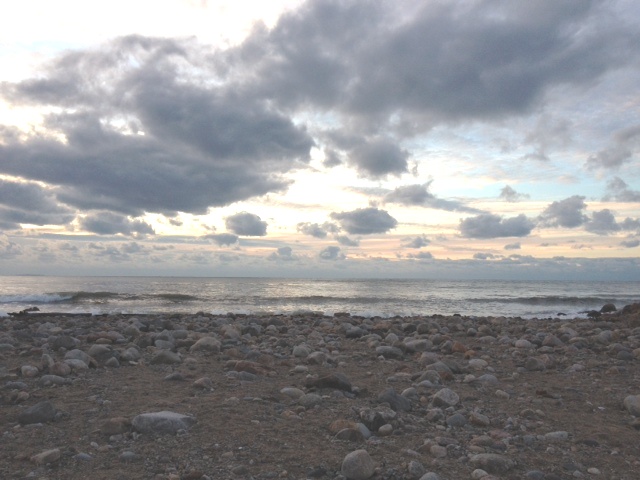
We arrived a bit before 7 AM to a spectacular sunrise, and started our vigil to await the Frigatebird.  Note all the rocks in the foreground which were pushed ashore by the hurricane. 


After a couple hours with no Frigatebird we took a walk to the east to Quicksand Pond, a large freshwater lake just barely west of the MA/RI stateline.  Soon after we arrived I picked out 1 and then 3 more distant swallows which I was able to identify as Caves.  Good birds in any New England state, though I already had them in RI.  But I need them in MA – and these birds were just a few hundred yards west of the state line and heading east.  I continued to follow them to the eastern edge of the lake when they gained a bit of altitude and I unfortunately lost sight of them.  I continued to scan the lake but they were gone so they must have gone into MA airspace.  But I never saw them in MA so can’t add them to my list.  One that got away…

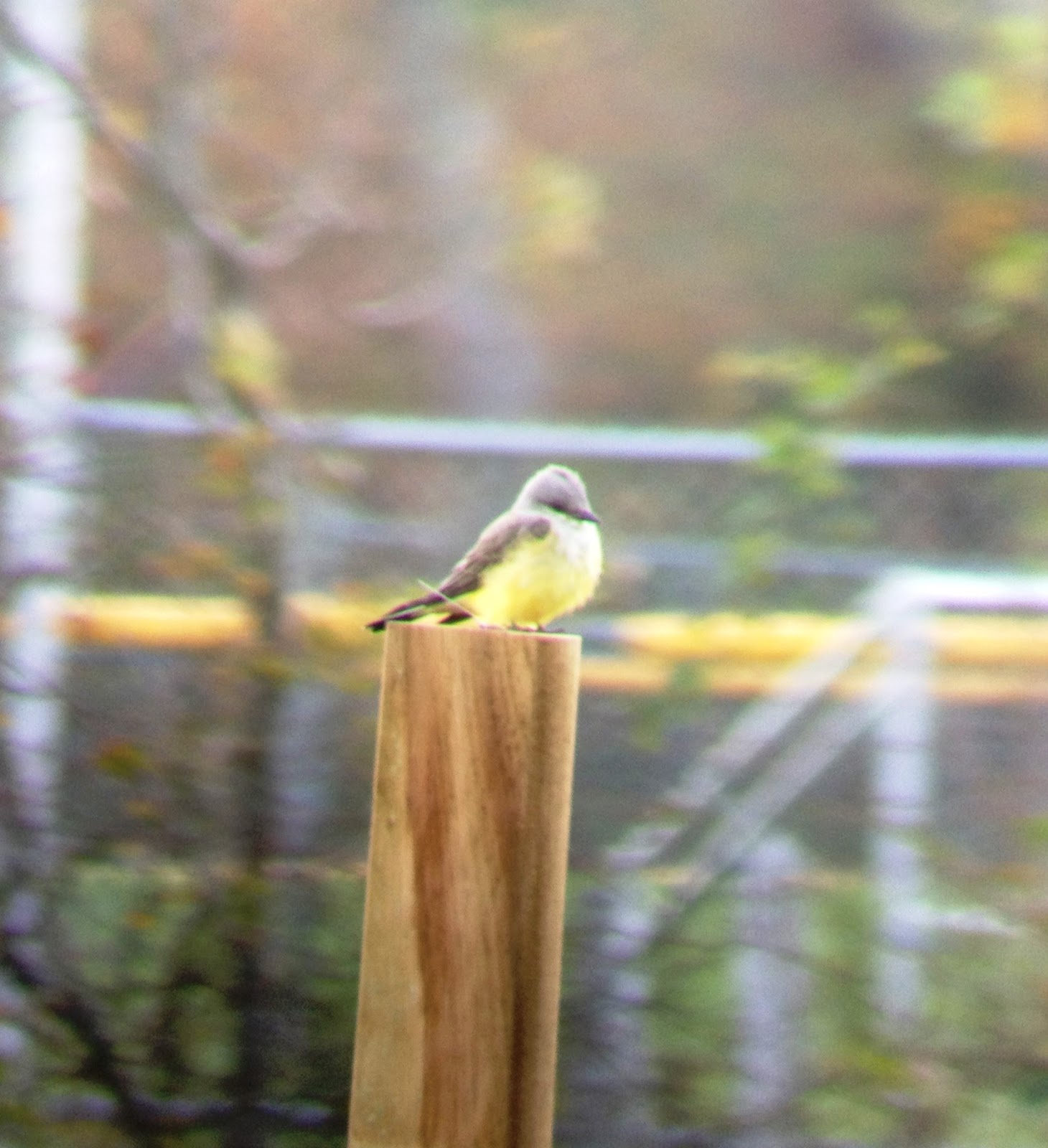
There was nothing else of interest on the coast, but there seemed to be a lot of birds moving well out to sea.  So we thought we might head to a south facing peninsula like Point Judith to check out the seabird migration.  Just after we left I got a call from local RI birder Jan St. Jean that she had just found a Western Kingbird just a short distance away in Tiverton.  A couple minutes later we caught up to Jan and she had the kingbird perched on a post along the road.  It was a most cooperative bird providing great phone-scoping opportunities.  A statebird for me and for Davis, but not for Denny.


RI is my third New England state with Western Kingbird (though I’ve also chased after it unsuccessfully in CT and ME).  I now have it in most every western state in its regular range (though OR is an obvious gap), and now 5 eastern states as a vagrant.  And Western Kingbird was #300 for me in RI!
We were just about to get back on the road when Jan got a call of a Cave Swallow at the south end of Scarborough Beach State Park in Narragansett.  A short ride later we were at the park but had no swallow.  We decided to leave the park and head to Point Judith.  But just as we did, Jan called again and said she had found a Cave Swallow at the north end of the park.  So we turned around and within a couple minutes we got great looks at a Cave Swallow right overhead, along with a Tree and 3 Barn Swallows.  A statebird for Davis, but not for Denny or me.

It was now early afternoon and we were starting to run short on time.  We discussed the options, but Denny didn’t care which choice we made because, as he put it, “There are no statebirds for me to go for.”  To which Davis reminded Denny that he shouldn’t be so negative.  Instead of heading south to Point Judith we headed north to Barrington to try for a Ruff that had been reliable for a number of days, but had not been reported since the hurricane. 

About 20 minutes after we left Scarborough Jan called yet again – there was a Yellow-throated Warbler at Scarborough within a few feet of where we had the swallows!  That would be a RI statebird for all of us!  So we turned around made our way back to Scarborough yet again.  As we arrived we could see Jan in the distance so I called her to get the micro-directions.  As she was directing us to a small group of pines here comes a small bird flying out of those trees to another couple pines – it was the Yellow-throated Warbler!  We got great views but only for a minute or so before it flew off toward another set of pines in the distance.  If we had been more than a few seconds later the bird might have flown off to that other part of the park and we might have missed it.  I’m sure Denny was happy to eat his words about not being able to get a new statebird.

That was my fifth New England state for Yellow-throated Warbler – but only my second away from a winter feeder.  I’ve now seen this species through most of its range though it would be nice to fill the gaps in NY and IN.
 

Thursday, November 8, 2012

Rufous Hummingbird, Biddeford, ME, and Post-Sandy Birding #1 – October 2012

While away on a business trip some posts started coming in about a Selasphorus hummingbird at a feeder in Biddeford, ME.  And a couple posts were suggesting it might not be the expected Rufous – some leaning toward Broad-tailed.  I have no Selasphorus hummers of any kind in Maine, so obviously worth a try for the bird.  But would it stay until I returned from my trip? 

And then there’s the issue of whether it would survive through Hurricane Sandy.  The hurricane battered the Maine coast with lots of wind and rain though certainly nothing like down on the NY, NJ and CT coasts.  The night of the storm I contacted the local homeowners with the hummingbird and they said they did not see it that day.  Was the wind just too strong for this little bird?  So thinking the bird might be gone, I decided to bird along the coast elsewhere the day after the storm looking for wind-blown birds. 

While driving north to head to the coast the morning after the storm I got a call from the homeowners – the hummer was back!  Needless to say I changed my course, and an hour later was at their front yard looking at the feeder.  After about a 20-minute wait I heard a sharp chip note and soon thereafter the hummingbird arrived to feed.  I had good long views of the bird from the back, and although I never saw the tail spread, I never saw any orange at all in the tail feathers.  Hmm…  Regardless of my possible ID, the bird was banded a couple days later and was confirmed as a Rufous Hummingbird.

After leaving the feeding station I began my search for storm-tossed birds.  Two stops in Biddeford yielded a couple large flocks of gulls but nothing of interest.  Then during an hour-long seawatch at the Cliff House in Ogunquit I saw mostly the normal fall seabird migrants, though a Laughing Gull was very late and perhaps blown north by the storm.  I also had the briefest view of a storm-petrel just before it disappeared behind a large swell never to be seen again.  Next stop was Cape Neddick where the first bird I saw was a very late bedraggled male Black-throated Blue Warbler – was this a storm bird?  With nothing else of interest in the thickets, and the road to Nubble Light closed due to the storm, I began to head home.  But one last check of the listserves mentioned a Leach’s Storm-Petrel at inland Lake Massabesic in NH.  With one more change in course I was at the lake with several other birders watching this poor confused bird bobbing around on the lake waters.  Not a NH statebird, but a great inland sighting none the less.

My statebird map for Rufous Hummingbird is inserted below.  I have now seen Rufous in each New England state (my 215th species in each of these 6 states), as well as five other eastern and Gulf Coast states as a winter vagrant.

Monday, October 29, 2012

35 Statebirds in Carlsbad, New Mexico – October 2012

With a business trip to Texas I was able to add a couple days to work on my New Mexico statelist.  I last birded in NM in 1995 (before Eurasian Collared Doves invaded), and my statelist was just 162.  To minimize travel time I targeted southeast NM within a short drive of Carlsbad.  Then with the help of e-bird I came up with a long list of potential targets that included a number of eastern birds that barely get to NM, desert residents, some late lingering migrants, and hopefully a few early winterers.  So with excellent help from some local birding experts, and review of the NM birdfinding guide, I mapped out a 2-day itinerary to maximize my statebirding potential.  Not surprisingly for this semi-arid location, many of the best spots would be oases and other riparian locations.  Here are the highlights of my trip, with new statebirds in bold -

Day 1
·        Just S of Loving – 2 Harris’ Hawks on a telephone pole
·        Loving – Eurasian Collared Dove (of course I had them everywhere during the trip).  NM was my 35th state for ECD (see map below)
·        Pond on 285 just N of Loving – 2 Dunlin, 1 Long-billed Dowitchers, 8 Least Sandpipers, along with 2 Wilson’s Phalaropes
·        Fields N of Loving – several flyover Sandhill Cranes.  3 Inca Doves at a house N of town.  I now have Inca Dove in all its regular southwestern states.  Fields were loaded with White-crowned Sparrows but not much else of interest.  In fact White-crowns were very common everywhere - at one location I found a flock of 200 birds.

·         6-Mile Dam – an excellent spot not mentioned in the birdfinding guide.  Statebirds were – 4 Virginia Rails calling, 1 Sora calling, numerous Marsh Wrens, 2 Swamp Sparrows, 3 Pied-billed Grebes, and a couple flyover Brewer’s Blackbirds.  Below the dam there was one calling Black-tailed Gnatcatcher plus 2 Eastern Phoebes (including one fighting with a Black Phoebe – not too many places in the country where that could happen!).  That pushes my E Phoebe sightings a bit to the SW now covering all the normal range of this common bird.
 
      ·        Private yard – 1 Blue Jay, along with 2 late Rufous Hummingbirds.
·        Avalon Reservoir – perhaps 2,000 waterfowl including Lesser Scaup, Canvasback, Redhead, 1 Clark’s Grebe, Eared Grebe, and 1 California Gull with a flock of Ring-bills, plus a flyover Merlin.  A flock of 500 cowbirds and Brewer’s Blackbirds was notable on the wires.  My Lesser Scaup sighting fills the next to last gap in my statebird map – I need to work on my paltry MT list!

·        Back to 6-mile Dam – thanks to a tip from a local birder I had a Barn Owl fly out of the dam structure illuminated by the light of the nearly full moon!  My Barn Owl states are really spotty – tough to get this one without local knowledge of a stakeout.

Day 2
·        Rattlesnake Springs – this desert oasis is described as one of the best birding locations in the state.  Unfortunately it was very slow the day I was there.  I started pre-dawn (29 degrees – brrr!) and the first 3 birds I had were a flyover Snipe, a calling Great Horned Owl, and a flock of Turkeys.  Migrants were limited to a number of Hermit Thrushes and some Yellow-rumps.  Only other statebirds were 2 White-throated Sparrows and 2 Brown Thrashers which are key winter targets for this site.  Likely the best highlight was a prolonged look at a Bobcat.
·        Carlsbad Caverns entrance road – I was hoping for quail or thrashers, but with no luck.  I did have 2 Brewer’s Sparrows, 1 Rufous-crowned Sparrow, and 1 Black-throated Sparrow.  Also had very close views of 4 Bighorn Sheep – including a family with young crossing the road right in front of me.
·        Brantley State Park– first stop was along the Pecos River below the dam – nothing of interest here except for a pair of flyover Greater Yellowlegs
·        Brantley SP Campground Access Road – This was an unplanned stop, but I decided to check out the campground in hopes of finding a feeder full of thrashers and quail at one of the camp sites.  Alas, there were no feeders.  But a cooperative Black-throated Sparrow was a nice consolation.  Then on a whim I went down to the boat ramp to see what might be around and had some good birds - 1 Western Sandpiper, 1 Baird’s Sandpiper, 1 Semipalmated Plover, about 15 Least Sandpiper, 4 Avocets, and 2 Greater Yellowlegs, all walking among a flock of pipits.  On the other side of the lake 1 Franklin’s Gull was mixed in with the Ring-bills.  My Western Sandpiper map shows pretty good coverage in the west and southeast, though spotty coverage in the Midwest.  For Franklin’s Gull, by comparison, my sightings are throughout the central part of the country with some vagrants in the east.

·        Brantley SP Cheapskate Point – several flocks of waterfowl included 4 Bufflehead.  Also had 8 more Leasts and 1 Greater Yellowlegs
·        Avalon Reservoir – wanted to give the waterfowl one more pass-through thinking that maybe I missed something the day before.  Although I didn’t pick out anything new in the rafts of ducks, I did find 2 Horned Grebes by themselves diving along the far shoreline.  Plus a Merlin passed over the reservoir – was this the same one I saw the day before?

I ended up with 109 species, including 35 new statebirds, putting my state list up to 197.  That’s still a long way from the ABA reportable threshold of 264, but getting closer.