Showing posts with label Cape May Warbler. Show all posts

Monday, October 27, 2025

Impromptu Trip to Atlanta Yields 7 Georgia Statebirds, October 2-4, 2025

One of the organizations I volunteer for was planning a meeting on the southern South Carolina coast in October 2025.  Of course, I would take advantage of the trip to include some birding in route and while on the coast.  I scanned my Needs Alerts for SC but came up empty.  But since I’d be close to Georgia maybe there might be some coastal birds or fall migrants to pursue just over the state line.  There were a couple records of migrant passerines I needed, but they looked iffy at best.  Instead, there were far more possibilities in northern GA.  I started to wonder if I could swing by the greater Atlanta area on the way home from the SC coast.  But that would make for a very long time on the road.

As I had more or less given up on the possibility of seeing any new statebirds on this trip, my SC meeting got canceled.  Hmm…  I had already blocked out several days to be away from home in early October.  And the statebird potential was pretty good in northern GA. Why not just head directly to the greater Atlanta area and forget about SC altogether?  Atlanta was closer than the SC coast anyway.  My impromptu trip to Atlanta was a go!

With a bit of research, I came up with 3 key targets, or groups of targets, for my trip.  The first was a group of long-staying Limpkins in Clayton County a bit south of Atlanta - I felt pretty good at my chances for this one.  My next targets were migrant passerines.  Numerous species popped up on my Needs Alerts, though none were seen regularly at any specific location, nor in good numbers.  Lastly, I targeted several shorebird species that were reported at a sod farm north of Atlanta.  Though the last report of these birds was a full week before my trip.  Overall, I felt like it would be a successful trip if I saw the Limpkin, 1 new migrant passerine, and 1 new shorebird species.  That would be a rather long trip for just 3 new state birds, but since I had the time available, why not. 

October 2 – Limpkin Search

Ever since the big Limpkin irruption year in 2023 I’ve noticed large numbers of Limpkins reported at the Clayton County Water Authority Lake Blalock hotspot.  These birds have apparently colonized this spot and are likely breeding.  That was the good news.  The bad news is that the birds have been around so long that few of the recent checklists included details for finding the birds.  Plus, the hotspot title included the phrase “limited access”, so I wasn’t even sure if I’d be able to access the spot.  Luckily, I found a couple birders who had recently seen the Limpkins that had eBird profiles with e-mail addresses.  I was able to get the scoop from them on how to buy a daily pass to the site, and that the birds were most often seen at the western end of the lake. 

Armed with those details, finding my target birds was actually quite easy.  I got my daily pass, drove a short distance to the parking lot at the western end of the lake, took a short walk to the water’s edge, and started scanning the shoreline of a nearby island.  Within a few seconds I found a Limpkin foraging along the shore (GA statebird #1).  And with a bit of scanning found 3 more feeding nearby.


My statebird map for Limpkin is inserted below.  I’ve only seen this species in its regular range in light-blue-shaded FL.  The 5 dark blue states (SC, NC, TN, TX, and now GA) are those where I’ve seen it as a rarity.  To think that before the 2023 irruption I had only seen Limpkin in FL. 

October 3 – Passerine and Shorebird Searches

My Needs Alerts for migrant passerines included multiple species, and multiple locations for most.  But no specific sites seemed to stand out as the most likely ones for my targets.  So I reached out to several GA birders to see where they would suggest.  One birder commented that migrants were better in both riparian and wet/weedy open habitats.  And all included one site in their suggestions – the Cochran Shoals Unit of the Chattahoochee River NRA.  My GA birding friend Bob Johnson gave me great details regarding how to bird that site, including birding an area along the river where nearby boardwalks go through wet scrubby areas.  That satisfied both the riparian and open habitat recommended conditions.  It seemed like Cochran Shoals might well be a prime spot so I chose that location as my starting point for the morning of the 3rd.  Now I just needed the birds to cooperate. 

I arrived in the Cochran Shoals parking lot just before sunrise and was surprised how many joggers and cyclists there were.  But the trail along the river was wide enough that hopefully we all could keep out of everyone’s way.  Here’s a shot of the river just as the sun was beginning to rise.

I got to the boardwalk area that Bob had recommended and was just about to walk into the wetlands when I noticed some movement in the trees right along the river.  It turned out that there were quite a number birds flitting around in the treetops.

I stayed there for an hour or more and had 9 warbler species in the trees, dominated by Redstarts, Black-and-whites, Magnolias, and Parulas.  Then I spotted a bird fly in with fine streaking below.  And with a closer look it turned out to be a Cape May, which was soon joined by a second one (GA statebird #2).

I then made my way to the boardwalk and found several Hooded Warblers, and a surprise Sedge Wren right along the boardwalk.  A bit later I heard sharp chip notes coming from the wet understory and eventually got great looks at a Northern Waterthrush (GA statebird #3).  GA is now my 34th state where I’ve seen this species.  The cross-hatched states are those where I’ve yet to see Northern Waterthrush in its regular range – 11 more to go.

I came back out to the main trail along the river and noticed a couple birders walking toward me.  They were local birders Rick Sellers and Pierre Howard who bird that site frequently.  They told me about a couple other areas to bird along the river, and we birded together for the rest of the morning.  We came up with a couple other good birds including a second Sedge Wren, and a few more warblers here and there.  They also took me to an area called the Vireo Trail that had some nice brushy understory.  Living up to its name we got Yellow-throated and Red-eyed Vireos here.  And most importantly I spotted an Empidonax flycatcher that was bright yellow below with a yellow throat - an adult Yellow-bellied Flycatcher (GA statebird #4).  Interestingly, the local eBird reviewers don’t accept silent Yellow-bellies without photos, though they are accepted here in western NC. 

We finished the morning with 55 species featuring 12 warblers, 3 vireos, and 4 Catharus thrushes and Wood Thrush.  It was great birding with Rick and Pierre.  In fact, birding was so good that morning that we decided to meet up there again the next morning. 

Next, I was onto the Etowah Indian Mounds Sod Farm north of Atlanta to try from some shorebirds.  Exactly a week earlier there was a checklist from this hotspot that included 4 of my targets - Golden-Plover, Buff-breasted, Baird’s and Pectoral.  But there had been no reports, positive or negative, from that site since.  I connected with a local birder familiar with the site who said that a week ago there had been heavy rains that flooded parts of the fields attracting those shorebirds.  But the sod had since dried up and local birders knew that meant the shorebirds were long gone.  I was tempted to pass on the site as a result, but I had the time and directions so I decided to give it a try.

There are 2 main viewing points onto the sod farm – one for the southern half and another for the northern half.  I first pulled into the southern pulloff and my eyes went right toward a small wet area in the distance – maybe I was going to be in luck after all.  But despite several scans I could only find Killdeer walking around the muddy area and neighboring sod.  I then started scanning the dry areas and found good numbers of Killdeer, but nothing else.  But then while scanning a more distant part of the farm to the southeast I spotted a more upright plover walking across the sod.  I increased the magnification on my scope to get a better look – tall upright plover with broad white eyeline and dark cap.  I had an American Golden-Plover (GA statebird #5).  Here are 2 distant phonescoped shots of the bird. 


Then with some additional scanning of adjacent areas I picked up 6 more Golden-Plovers.  Not bad for a bird that hadn’t been spotted for a week.

As they say on the TV commercials: “But wait there’s more…”  While scanning the Plovers another time to make sure I had an accurate count I noticed a pair of browner shorebirds a bit smaller than the Plovers.  They were Pectoral Sandpipers (GA statebird #6) – undoubtedly one of the most common species that I still needed in GA.  I’ve now seen Pectorals in all but 3 states in the continental US.

I was pretty confident that I had seen all the shorebirds present in the southern half of the farm, so I drove down the road a bit to the pulloff overlooking the northern areas.  This time I found a larger flooded area, and it was full of peeps.  I counted 62 Leasts and 5 Semis, along with 3 more Pectorals, a Solitary, 4 Snipe, and a Greater Yellowlegs.  I looked hard for Baird’s or something better, but to no avail.  Then in a more distant pond I spotted a pale bird that was very active – running along the banks, and swimming in the pond.  I thought it could be a Wilson’s Phalarope but couldn’t quite eliminate a more likely Lesser Yellowlegs.  Here are 2 miserable distant shots of the bird.


I ended the day with 5 new statebirds, and now 6 for the trip.  And I still had one more morning of birding ahead of me.

October 4 – Another Passerine Search

Given our success at Cochran Shoals on the 3rd, Rick, Pierre and I decided to head back there for a morning of birding on the 4th.  I once again arrived at dawn and headed to the boardwalk area where we had so many birds the day before.  But soon it was obvious that we wouldn’t have the same kind of morning, with fewer birds passing through the area.  I decided to return to the main trail to get a different view of the area.  And just after I arrived, I spotted a Cuckoo flying by – it had limited rufous in the primaries so I was hopeful that I had a Black-billed.  Luckily it landed in the open in the understory.  Lower perches are more typical for Black-billed so the evidence was mounting.  It started to preen, and as it preened its tail I got a good look at the underside which was mostly dark with limited white.  And then finally I got to see the all-black bill.  I had a Black-billed Cuckoo (GA statebird #7).  I still need this elusive species in a lot of states especially in the central part of the country.

Later we found at least 2 Yellow-billed Cuckoos, both perching higher in the trees which is typical for this species.  We finished the morning with 11 warbler species, 4 vireos, and 50 species total.  Not bad for a slow morning.  As lunchtime neared, I decided to call it quits and start the drive home.  I wished Rick and Pierre well, and hoped that we could bird again together either in north GA, or back home in western NC. 

I ended the trip with 83 species including 7 additional statebirds, obviously much better than the 3 I had hoped for.  That brings my GA state list to 279.  It would be nice to try to get to 300 someday, but there aren't too many easy birds left.

Sunday, October 2, 2022

Four Fall Migrants in Southwest Virginia, September 18-19, 2022

Soon after I moved to western North Carolina I put together a list of potential targets I needed for my Virginia state list that might be feasible in the southwestern corner of the state.  Although that is the closest portion of VA to my home, it is still at least a 2 hour drive just to reach the NC/VA stateline, and of course longer to get to any VA birding hotspots in the area.- As a result, I hadn’t yet made any efforts to bird in the area. 

But then as Fall 2022 approached I opened up my target list to see what migrants might be feasible as new VA statebirds.  There were actually a few pretty common migrants I needed, like Cape May, Tennessee, and Magnolia Warblers, and quite a number of rarer ones as well.  So I started to research potential VA birding locations as close to home as possible.  And given the distance, I figured it would be best to make it a 2-day, 1-night, trip.

While doing research for the trip I noticed that many of the eBird reports from the area came from local birder Allen Boynton.  So after I had pinned down what appeared to be the key hotspots I should bird I reached out to Allen to ask for some advice for birding those sites.  In his response Allen offered to bird with me if schedules meshed.  I never turn down an opportunity to explore a new area with a local expert, so I quickly accepted his offer.  And soon afterwards we had pinned down the dates for the trip – September 18 and 19.

We set the dates more than a week before the trip, long before there were any predictions for the size of the migration on those days.  So I just crossed my fingers that those dates would be good for migrants.  Unfortunately, it turned out that we picked some of the worst dates for migration in the entire month.  Although there were exceptionally high numbers of migrants earlier that week, the nights before my 2 planned birding days were among the worst that week.  Here is the reported number of birds crossing Grayson County the week of my trip, per BirdCast (dashboard.birdcast.info):

Night of –           Sept. 13 – 1,653,000

                             Sept. 14 – 1,548,000

                             Sept. 15 –   781,000

                             Sept. 16 –   334,000

                             Sept. 17 –    91,000 (night before Day 1)

                            Sept. 18 –   390,000 (night before Day 2)

                             Sept. 19 -  951,000

And ironically, migration picked up the night I left.  Go figure…  Despite the slow migration I still hoped for maybe 4 new statebirds on this trip.

My research also showed that a number of my targets were local but reliable breeders in the area as well.  That would of course need to wait till next summer, but a secondary objective of my September trip would be to get acquainted with some of these locations for a future summer trip.

Day 1 - September 18

I was out the door at about 5:45 on the 18th, and met up with Allen at 8:30.  First we headed to Homestead Road in Grayson County – one of Allen’s favorite spots.  We started at the eastern end of the road, which was quite birdy, with several warblers including Ovenbirds, Hooded, and Black-throated Blue.  There were also a number of Swainson’s Thrushes, and I was lucky enough to pick out one Gray-cheeked mixed in.  A bit later as we scanned a small feeding group in a treetop Allen spotted a Tennessee Warbler, which I quickly got on (new statebird #1).  My statebird map for Tennessee Warbler is inserted below.  The blue-shaded states are those where I’ve seen this species; the cross-hatched states are those in its regular range where I’ve yet to see it.  Now that I can color in VA I have just two states along the western edge of its range where I still need Tennessee.


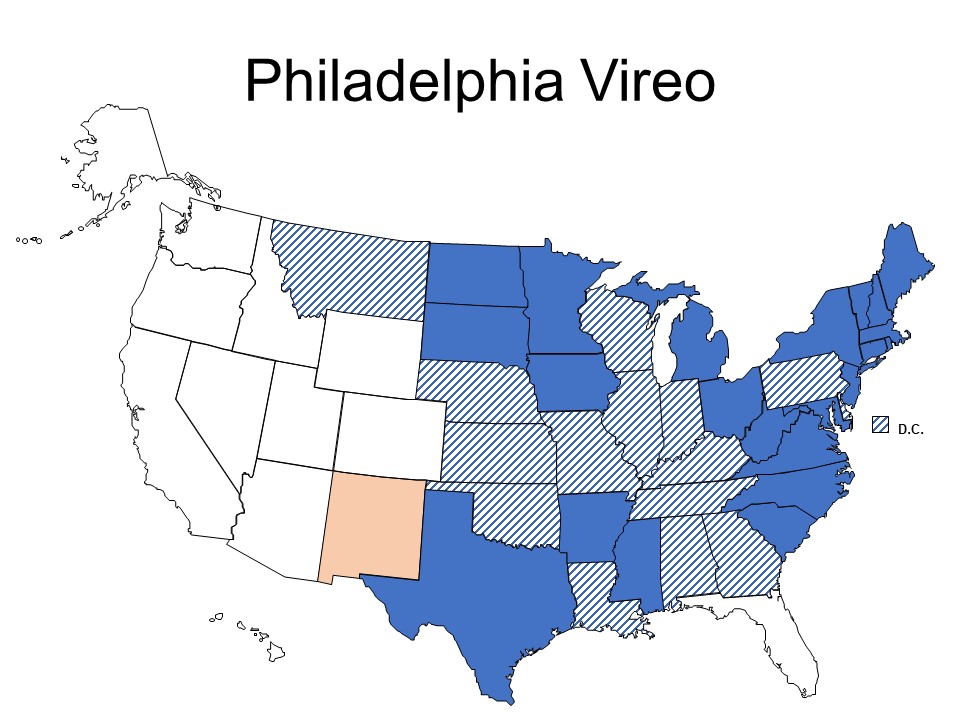
We continued to bird the site picking up more Thrushes and Rose-breasted Grosbeaks, and several Hummingbirds.  Then Allen spotted a Philadelphia Vireo high up in a tree.  Luckily the tree was pretty bare so I was able to get on the Vireo before it took off (statebird #2).  Thanks Allen!  Although the Philly Vireo range is quite similar to that of the Tennessee Warbler, my statebird maps are very different – I still need this less common species in many states in its regular range.  Though I have seen it in NM as a rarity (brown-shaded state).

We made several more stops on Homestead Road, including visiting quite a number of very nice habitats, but found no more migrants.  Definitely a place to come back to on a future trip – either for nesters or on a better migration day.

Next we were onto the Elk Garden Trailhead area.  This site features a grassy bald that has nesting Vesper Sparrows, which are occasionally reported into fall.  Just after we reached the parking lot we noticed a small group of juvenile sparrows foraging in the gravel.  Although I had Vesper on the mind, they were just juvenile Juncos.  We walked up the hill through the grasses, eventually connecting with the Appalachian Trail, looking for Vespers but just found Fields and Songs.  And we had a few migrants in the low trees at the edges of the bald, including Palm, Black-throated Blue, and Yellow-rumped Warblers, and a couple early Ruby-crowned Kinglets, but no key targets.  It was nice to see the site though and be able to know where to look for Vesper Sparrows on a future summer trip.

Then it was on to Whitetop Mountain which is a great spot for a number of my breeding targets like Least Flycatcher, Magnolia and Blackburnian Warblers, Vesper Sparrow, and Saw-whet Owl.  Though on this trip our principal targets were additional migrants.  Our first stop was a pullout just 0.7 miles up the mountain on Mud Creek Lane which Allen recommended as the best spot for Saw-whets.  But it was quite slow – in fact I don’t think we had a single bird.  Then we drove slowly up the rocky road through the grassy habitat hoping for Vespers to no avail.  A walk through the conifers near the top of the mountain was slow but yielded both Kinglets and a Sapsucker.  Another spot to file away for a summer visit.  Here’s a shot of the grasslands and conifers near the peak of Whitetop Mountain. 


And the beautiful scenery in the distance.


We visited three other spots later that afternoon hoping to run into foraging groups of migrants, but just found 3 Redstarts.  We ended the day with just 9 warbler species, and we had to work hard for almost every one of them.

Although I was planning to end the day with some nocturnal birding to try for Saw-whet Owls, I was pretty tired and decided to just try for them during the breeding season when they would likely be more vocal.

Day 2 – September 19

I woke up early on the 19th and went right to my phone to see the BirdCast report for the night before – migration numbers were better but still not the best.  The plan for this day was to meet Allen at Grayson Highlands State Park at sunrise to once again try for some migrants.  And as I planned my route I realized that on my way to the park I would go right by Whitetop Mountain where Saw-whets were possible.  It was early enough that I would have perhaps 30 minutes to try for them and still get to the park by sunrise.  It was a long-shot, but why not.

I reached Allen’s recommended Saw-whet spot on Mud Creek Lane at 6 and got out of the car.  Clear skies, calm winds, and no traffic suggested conditions would be perfect for owling.  I played some tape and listened, but heard no replies.  About 10 minutes into my stop I spotted a large bird fly into a tree nearby.  With my binoculars I could see a silhouette of a large owl, most likely a Barred, which continued to perch overhead for my entire stop.  My only other birds at this stop were 3 calling Swainson’s Thrushes – at least a few migrants were moving. 

Next it was onto Grayson Highlands State Park, where I met Allen at 7 AM.  Our first destination was the Visitor Center, but the gate to the Visitor Center roadway was closed.  Undeterred, we walked the last mile up the road to reach the empty gravel parking lots.  Since we were the first ones there that morning, we hoped to find Ruffed Grouse gritting in the lots, but not this time. 

Now we waited for the rising sun to illuminate the foliage to warm up the migrants, and their insect food, on that chilly morning.  We were at the hill just below the Visitor Center when the vegetation came into the sun.  And right on cue we started to see some activity.  It turned out to be a nice wave of warblers especially featuring Tennessee’s and Black-throated Green’s.  Soon after that wave moved down the road another wave appeared in its place.  Again, more of the same, along with a couple Redstarts and Yellow-rumps.  At one point Allen spotted a Cape May though I didn’t get on it until it was flying down the road – too late for a positive ID.  Luckily a third wave appeared a bit later, and this time I found another Cape May mixed in (statebird #3).  And just a minute later I spotted a Magnolia Warbler in that same wave (statebird #4).  My statebird map for Magnolia has many more shaded states than the one for Cape May – a comment on the fact that Maggie is generally quite a bit more common than Cape May.


And a bit later a fourth wave came by as well, like the others passing along this sunlit edge.  In less than an hour we ended up with 10 warbler species, and at least 200 individuals, predominantly Tennessee’s and Black-throated Green’s.  Unfortunately, at least half passed by without stopping long enough for IDs.  Here’s a picture of the edge where we had most of our warblers.


By 9 AM the warbler activity had ended, so we headed back down to the cars.  Along the way we were serenaded by both Kinglets, Brown Creepers, and Red-breasted Nuthatches as we passed through some great mixed spruce/fir forest.  And we couldn’t resist at least a brief stop at an overlook with this amazing scenery.

Our next stop was the Massie Gap area which is the best spot for nesting Alder Flycatchers locally.  They were long gone by September, but Allen showed me the wet area where they breed.  Yet another spot to remember on my summer trip to the area.  On the way back we ran into a few more warblers, notably another Cape May and another Magnolia. 

It was now early afternoon, and with a long drive home ahead of me, I decided to call it a day.  I ended up with 61 species for the 2-day trip, including 14 warbler species.  Very respectable numbers given the limited migration that occurred while I was in town.  And most importantly I added 4 new statebirds.  That brings my VA statelist up to 271. 

I can’t thank Allen enough for all of his help.  Not only for his tips on this trip but also for his advice to help me look for my summer target birds.  Hopefully I can get back to the area next summer and keep filling gaps in my VA statelist.

Tuesday, October 19, 2021

Two Statebirds at Rankin Bottoms, TN, September 19, 2021

Douglas Lake is a TVA reservoir on the French Broad River in eastern TN.  Falling water levels in summer and fall can expose mudflats at the upstream portion of the lake called Rankin Bottoms, making it a well-known shorebird hotspot.  But that only occurs when water levels are just right – too high and there’s no mud; too low and there’s way too much mud and the best habitat is too far away for IDs.  I’m pretty sure I birded there many years ago, in fact decades ago, during my travels in eastern TN.  But my memory of the site is fuzzy at best.

Early in the summer 2021 shorebird season water levels at Rankin Bottoms were too high and shorebirds were limited.  Interestingly, this was principally caused by flooding rains near where I live in the western NC mountains near the headwaters of the French Broad.  But then by September water levels must have dropped because on 9/15 I got an eBird TN Needs Alerts featuring Buff-breasted Sandpipers at Rankin Bottoms.  Birders were finding a dozen or more species of shorebirds there, including Wilson’s Phalarope, Golden-Plovers, and Sanderlings.  Not to mention White Pelican, Laughing Gulls, and Caspian, Black, and Forster’s Terns.  Although all of these are inland rarities, only the Buff-breasted would be new for my TN state list.  You see years ago I had many business trips to Memphis, TN and I frequently birded at Ensley Bottoms with local birding legend Jeff Wilson.  That spot is the sewage treatment facility for the city of Memphis and I accumulated a large list of shorebirds and waterbirds there over the years.  But never a Buff-breasted Sandpiper. 

Then on the 16th 2 Avocets were reported at Rankin Bottoms – another potential TN statebird for me.  That was enough to push me into planning a trip to eastern TN.  I reached out to my birding buddy Bill Hooker to see if he might want to come along.  It turns out that Bill had been to Rankin Bottoms earlier in the season and as a result knew the site quite well.  And since shorebirding wasn’t too fruitful on his earlier trip, he was game for going along with me for another try.

As our planned trip on the 19th neared, the Needs Alerts gave us some good news and some bad news.  First the bad news – the Avocets were one-day-wonders.  Then the good news – the Buffies continued with as many as 3 reported.  And more good news – a number of passerine migrants were also being seen there, including several Cape May Warblers which was another possible statebird.  It turns out that a long peninsula sticking into the reservoir is nicely vegetated in brush and trees and can be quite a migrant magnet.  Now with 2 statebird targets I was all set for another trip into eastern TN.

We were on the road shortly after 6 and soon had our first good bird of the day – a Barred Owl flew over the highway as we were heading north from Asheville.  A new bird for my Buncombe County list.  Was that an omen for what was to come?

A couple hours later we were pulling into Rankin Bottoms and got our first look at the mudflats – there were many, many acres of possible shorebird habitat.  Were the birds going to be too far to identify?  We stopped at the first overlook where the road crosses the railroad tracks, the spot where most of the shorebirds were reported, and did a quick binocular scan.  There were scattered small shorebirds in the distance, some several hundred yards out.  This was going to be difficult.  Then I noticed some closer birds – it was a small group of Sanderlings.  Now it was time for scanning of the more distant sections of the mudflats.  Eventually I was picking up the continuing Wilson’s Phalarope and 2 Golden-Plovers far in the distance.  But despite lots of effort I had no luck with my key target – the Buff-breasted Sandpipers.

With each of our scans we picked up additional shorebirds well in the distance, but many were too far to confirm the IDs.  And complicating the issue was that we were looking off to the east into the morning sun.  I worried that even if a Buff-breasted was still around it might be too far away.  As examples of what we were dealing with, Bill took numerous highly magnified pictures of birds on the flats, and here are his best pictures of a Golden-Plover and the Phalarope.


We talked about moving on to other overlooks to see if we could find the Buffies elsewhere but decided to continue to scan from the railroad track spot a bit longer since that’s where they had been reported.  And I’m glad we did, because with another scan of the distant flats I picked up a mid-sized shorebird that was walking in a more upright manner.  I focused on this bird and eventually could see that it had a brown chest and scaly back – I had a Buff-breasted Sandpiper!  That sure was difficult.

My statebird map for this species is inserted below – states where I’ve seen it in its regular range are in blue, cross-hatched states are those where I still need it in its normal range, and the numerous eastern brown states are where I’ve seen it as a rarity.  I put TN in the Buff-breasted’s regular range as the western edge of the state is within its normal migration route.  Though it’s certainly a rarity this far east in the state.

Now that we finally had our key target we moved on to the north a bit to check out the flats from other overlooks.  We eventually added a few more shorebird species, giving us 12 species for the morning, including finding a rare Knot (but still not a new statebird for me). 

Later we found a spit that had a small flock of Ring-billed Gulls, and with a closer look found 2 immature Laughing Gulls mixed in.  We were also able to find the continuing Black Tern, and discovered a nice breeding plumage Common Tern.  Here are 2 more of Bill’s photos – a shot of the spit in the distance and a close-up of the Black Tern.


Next we turned our attention to the landbird migrants.  We started walking north along the peninsula through the brushy woods and soon ran into a few Yellow Warblers and Redstarts.  A bit farther along I got a brief glimpse of a warbler showing considerable yellow below with streaking.  Eventually I got good looks at the target Cape May Warbler.  Nice to be able to color in TN in my statebird map, though I still need it as a regular migrant in quite a number of eastern and central states

We eventually saw a second Cape May, and ended up with 7 warbler species in total.  Not bad for a hotspot known for its shorebirds.

As we walked back to the car we checked out the mudflats one more time and realized the total number of shorebirds had diminished significantly.  Looks like we got to Rankin Bottoms just in time.

With the addition of the Buff-breasted Sandpiper and Cape May Warbler that brings my TN statelist to 246.  Nice to be able to continue to add a few statebirds in this neighboring state.

Saturday, December 16, 2017

Townsend’s Warbler, Trustom Pond, RI, November 2017


Townsend’s Warbler is a very rare vagrant in New England, with birds typically being spotted in late fall or winter.  My first ever New England Townsend’s was a bird I found at Odiorne Point State Park in NH over Thanksgiving weekend in 1993 – the first year I moved to New England.  Unfortunately that bird was a 1-day wonder which no one else saw.  At the other end of the spectrum sometimes Townsend’s will appear at feeding stations, spending much of the winter returning to the same location, which was the case for the one I saw in Cambridge, MA in 2007. 

So when a Townsend’s Warbler was reported at Trustom Pond NWR in RI, only the third record for the state, I really wanted to chase after it.  But as with most of these chases I had to be able to clear my calendar and hope that this non-feeder bird would stick around until I was free.  Luckily this one was reported for the next couple days, hanging out in the same location at Trustom Pond, and seen by a bunch of birders (though some needed several hours to find the bird).  Despite numerous posts, directions were at best confusing, especially since I wasn’t too familiar with the nooks and crannies of the refuge.  Several reports mentioned the bird was seen along the Red Maple Trail near the old windmill and near a bench that was dedicated to local birder Phil Budlong.  Other reports just said near the windmill.  I thought that meant there was a stretch of trail between the windmill and bench to look for the bird.  So my plan was to start walking the Red Maple Trail and look for the bench and windmill, and hopefully look for other birders too.

When I arrived at the refuge early in the morning I was happy to see a dozen cars in the parking lot - undoubtedly these were birders already searching for the same target bird.  My plan was coming together - I could get close to the bird’s location along Red Maple Trail and then look for the birders to tell me the correct spot.  “Bird the birders” as I say.  Perfect…  I started down the Red Maple Trail and quickly found the bench dedicated to Phil Budlong.  But there were no birders to be seen.  My first thought was that I wasn’t in the correct spot and all those birders were somewhere else looking at the target bird.  So I decided to check my e-mail for updates and sure enough there was a new post that the bird was seen in the original spot about 20 minutes earlier “near the windmill”.  But I couldn’t find any windmill.  Again that made me think that I was in the wrong location.

I was about to head farther down the trail to look for windmill and the birders, but quickly realized there was a major flock of passerines there.  What should I do – hope I was in the right spot and search through the birds (perhaps including the Townsends’), or should I keep searching for the birders (and the windmill) instead?  Although I also heard some distant chip notes that made me think I might have been hearing the Townsend’s, I decided to keep looking for the birders.  Just when I started farther down the trail I spotted a greenish-yellow bird fly by and got excellent looks at an Orange-crowned Warbler!  A great bird for RI and only my second for the state, but it wasn’t my target bird.  So I kept walking a bit farther and didn’t see anyone.  At this point I decided to head back to the original spot to search through the flock I briefly saw earlier.

I got back to initial location just a couple minutes later but by now most of the birds were gone - ugh.  So I concentrated on the area where I heard the potential Townsend’s chip notes and heard the calls again.  And then I heard them again, this time closer nearby.  A few seconds later I spotted a bird high in a deciduous tree – it was the Townsend’s!  I bet the bird was in the area as soon as I got to the spot.  Luckily it stayed put while I tried to figure everything out.  And while looking at the Townsend’s I noticed the windmill – no more than 30 ft from the bench tucked back into the woods hidden from the trail.  Like I always say – chasing down my target birds often requires a lot of detective work.

So there I was looking at Townsend’s at its key location (within a few feet of both the bench and the windmill), and there were at least a dozen birders in the park searching for it, but I was the only one there.  So much for “bird the birders”!  A minute later 3 other birders arrived and I got them on the bird.  But by the time others arrived the bird had flown off.

I stayed in the park another hour and had the bird one other time, though unfortunately again not all the birders had looks at it.

Townsend’s Warbler was #327 for me in RI.  I’ve now seen this species throughout most of its regular range in the western US and Canada, as well as in 3 New England states as rarities (see my state and province maps below).


Since I was able to find my target bird so quickly I decided to make a quick stop at nearby hotspot Mud Pond, which often has a nice group of ducks and shorebirds, and then do a brief sea watch as well.  But first I had to take a work call, and I had just enough time to drive to Mud Pond to take the call from there inside my car.  As I started on the call another birder drove up and set up his scope about 50 ft away to check out the ducks on the pond.  A minute later I noticed a bright yellow bird fly over the road in front of me and land in a bush on the other side about 10 ft behind the birder.  I put my binocs on it and it was a Yellow Warbler.  Unfortunately the other birder never even knew it was there.  I was told that that may have been the latest record for Yellow Warbler in the state.

Then just a few minutes later, while still on my call, I spotted a small bird drop in from a bush next to the road to drink from a small pool right in front of my car.  It was a Cape May Warbler, not 25 ft away from me.  An amazing pair of birds seen through my windshield while on a conference call.  Not bad…

After the call was over I headed over to Mud Pond and found a nice flock of Pintails, and a group of Dunlin foraging on the edge.  And a short stop at the beach yielded a nice Gannet show not too far offshore.  But I was actually more interested in looking for other late passerines, so I turned around and started walking north up Moonstone Beach Road to see what else I might find. 

I began a slow walk up the road, not finding too much.  But just then I noticed a large flycatcher fly over the road.  It was only a quick view and I never got the bird in my binocs.  But the “jizz” of the bird was that of a Myiarchus flycatcher.  The view was too short to eliminate a Phoebe, but I would bet it was an Ash-throated Flycatcher.  If I had still been in my car on my call I probably would have had a better view of it through the windshield as it flew by.  Go figure.  Who needs to beat the bush to go birding…  I spent the next 15 minutes in the area hoping to refind the bird, but with no luck.  At least I don’t need that one for my RI list. 

Along with numerous Yellow-rumps, I ended the morning with 5 species of warblers.  Not to mention the mystery flycatcher.  The Trustom Pond area can be good for fall migrants, though I’m not sure if I’ve ever had as many as 5 warbler species there in a single day before, even during the peak of migration.