Showing posts with label Philadelphia Vireo. Show all posts

Sunday, October 2, 2022

Four Fall Migrants in Southwest Virginia, September 18-19, 2022

Soon after I moved to western North Carolina I put together a list of potential targets I needed for my Virginia state list that might be feasible in the southwestern corner of the state.  Although that is the closest portion of VA to my home, it is still at least a 2 hour drive just to reach the NC/VA stateline, and of course longer to get to any VA birding hotspots in the area.- As a result, I hadn’t yet made any efforts to bird in the area. 

But then as Fall 2022 approached I opened up my target list to see what migrants might be feasible as new VA statebirds.  There were actually a few pretty common migrants I needed, like Cape May, Tennessee, and Magnolia Warblers, and quite a number of rarer ones as well.  So I started to research potential VA birding locations as close to home as possible.  And given the distance, I figured it would be best to make it a 2-day, 1-night, trip.

While doing research for the trip I noticed that many of the eBird reports from the area came from local birder Allen Boynton.  So after I had pinned down what appeared to be the key hotspots I should bird I reached out to Allen to ask for some advice for birding those sites.  In his response Allen offered to bird with me if schedules meshed.  I never turn down an opportunity to explore a new area with a local expert, so I quickly accepted his offer.  And soon afterwards we had pinned down the dates for the trip – September 18 and 19.

We set the dates more than a week before the trip, long before there were any predictions for the size of the migration on those days.  So I just crossed my fingers that those dates would be good for migrants.  Unfortunately, it turned out that we picked some of the worst dates for migration in the entire month.  Although there were exceptionally high numbers of migrants earlier that week, the nights before my 2 planned birding days were among the worst that week.  Here is the reported number of birds crossing Grayson County the week of my trip, per BirdCast (dashboard.birdcast.info):

Night of –           Sept. 13 – 1,653,000

                             Sept. 14 – 1,548,000

                             Sept. 15 –   781,000

                             Sept. 16 –   334,000

                             Sept. 17 –    91,000 (night before Day 1)

                            Sept. 18 –   390,000 (night before Day 2)

                             Sept. 19 -  951,000

And ironically, migration picked up the night I left.  Go figure…  Despite the slow migration I still hoped for maybe 4 new statebirds on this trip.

My research also showed that a number of my targets were local but reliable breeders in the area as well.  That would of course need to wait till next summer, but a secondary objective of my September trip would be to get acquainted with some of these locations for a future summer trip.

Day 1 - September 18

I was out the door at about 5:45 on the 18th, and met up with Allen at 8:30.  First we headed to Homestead Road in Grayson County – one of Allen’s favorite spots.  We started at the eastern end of the road, which was quite birdy, with several warblers including Ovenbirds, Hooded, and Black-throated Blue.  There were also a number of Swainson’s Thrushes, and I was lucky enough to pick out one Gray-cheeked mixed in.  A bit later as we scanned a small feeding group in a treetop Allen spotted a Tennessee Warbler, which I quickly got on (new statebird #1).  My statebird map for Tennessee Warbler is inserted below.  The blue-shaded states are those where I’ve seen this species; the cross-hatched states are those in its regular range where I’ve yet to see it.  Now that I can color in VA I have just two states along the western edge of its range where I still need Tennessee.


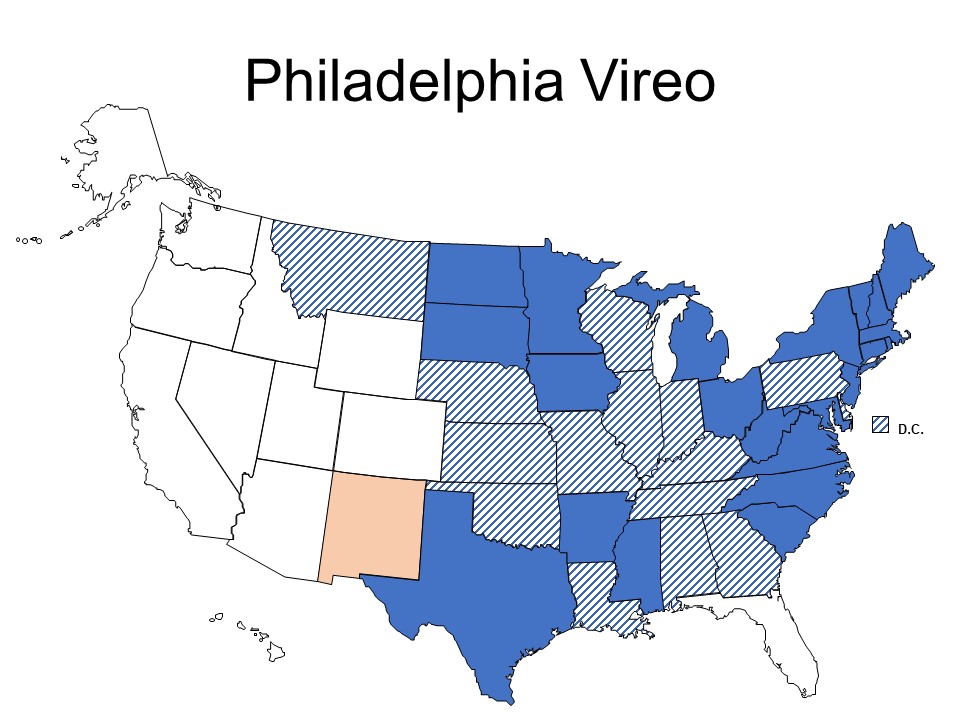
We continued to bird the site picking up more Thrushes and Rose-breasted Grosbeaks, and several Hummingbirds.  Then Allen spotted a Philadelphia Vireo high up in a tree.  Luckily the tree was pretty bare so I was able to get on the Vireo before it took off (statebird #2).  Thanks Allen!  Although the Philly Vireo range is quite similar to that of the Tennessee Warbler, my statebird maps are very different – I still need this less common species in many states in its regular range.  Though I have seen it in NM as a rarity (brown-shaded state).

We made several more stops on Homestead Road, including visiting quite a number of very nice habitats, but found no more migrants.  Definitely a place to come back to on a future trip – either for nesters or on a better migration day.

Next we were onto the Elk Garden Trailhead area.  This site features a grassy bald that has nesting Vesper Sparrows, which are occasionally reported into fall.  Just after we reached the parking lot we noticed a small group of juvenile sparrows foraging in the gravel.  Although I had Vesper on the mind, they were just juvenile Juncos.  We walked up the hill through the grasses, eventually connecting with the Appalachian Trail, looking for Vespers but just found Fields and Songs.  And we had a few migrants in the low trees at the edges of the bald, including Palm, Black-throated Blue, and Yellow-rumped Warblers, and a couple early Ruby-crowned Kinglets, but no key targets.  It was nice to see the site though and be able to know where to look for Vesper Sparrows on a future summer trip.

Then it was on to Whitetop Mountain which is a great spot for a number of my breeding targets like Least Flycatcher, Magnolia and Blackburnian Warblers, Vesper Sparrow, and Saw-whet Owl.  Though on this trip our principal targets were additional migrants.  Our first stop was a pullout just 0.7 miles up the mountain on Mud Creek Lane which Allen recommended as the best spot for Saw-whets.  But it was quite slow – in fact I don’t think we had a single bird.  Then we drove slowly up the rocky road through the grassy habitat hoping for Vespers to no avail.  A walk through the conifers near the top of the mountain was slow but yielded both Kinglets and a Sapsucker.  Another spot to file away for a summer visit.  Here’s a shot of the grasslands and conifers near the peak of Whitetop Mountain. 


And the beautiful scenery in the distance.


We visited three other spots later that afternoon hoping to run into foraging groups of migrants, but just found 3 Redstarts.  We ended the day with just 9 warbler species, and we had to work hard for almost every one of them.

Although I was planning to end the day with some nocturnal birding to try for Saw-whet Owls, I was pretty tired and decided to just try for them during the breeding season when they would likely be more vocal.

Day 2 – September 19

I woke up early on the 19th and went right to my phone to see the BirdCast report for the night before – migration numbers were better but still not the best.  The plan for this day was to meet Allen at Grayson Highlands State Park at sunrise to once again try for some migrants.  And as I planned my route I realized that on my way to the park I would go right by Whitetop Mountain where Saw-whets were possible.  It was early enough that I would have perhaps 30 minutes to try for them and still get to the park by sunrise.  It was a long-shot, but why not.

I reached Allen’s recommended Saw-whet spot on Mud Creek Lane at 6 and got out of the car.  Clear skies, calm winds, and no traffic suggested conditions would be perfect for owling.  I played some tape and listened, but heard no replies.  About 10 minutes into my stop I spotted a large bird fly into a tree nearby.  With my binoculars I could see a silhouette of a large owl, most likely a Barred, which continued to perch overhead for my entire stop.  My only other birds at this stop were 3 calling Swainson’s Thrushes – at least a few migrants were moving. 

Next it was onto Grayson Highlands State Park, where I met Allen at 7 AM.  Our first destination was the Visitor Center, but the gate to the Visitor Center roadway was closed.  Undeterred, we walked the last mile up the road to reach the empty gravel parking lots.  Since we were the first ones there that morning, we hoped to find Ruffed Grouse gritting in the lots, but not this time. 

Now we waited for the rising sun to illuminate the foliage to warm up the migrants, and their insect food, on that chilly morning.  We were at the hill just below the Visitor Center when the vegetation came into the sun.  And right on cue we started to see some activity.  It turned out to be a nice wave of warblers especially featuring Tennessee’s and Black-throated Green’s.  Soon after that wave moved down the road another wave appeared in its place.  Again, more of the same, along with a couple Redstarts and Yellow-rumps.  At one point Allen spotted a Cape May though I didn’t get on it until it was flying down the road – too late for a positive ID.  Luckily a third wave appeared a bit later, and this time I found another Cape May mixed in (statebird #3).  And just a minute later I spotted a Magnolia Warbler in that same wave (statebird #4).  My statebird map for Magnolia has many more shaded states than the one for Cape May – a comment on the fact that Maggie is generally quite a bit more common than Cape May.


And a bit later a fourth wave came by as well, like the others passing along this sunlit edge.  In less than an hour we ended up with 10 warbler species, and at least 200 individuals, predominantly Tennessee’s and Black-throated Green’s.  Unfortunately, at least half passed by without stopping long enough for IDs.  Here’s a picture of the edge where we had most of our warblers.


By 9 AM the warbler activity had ended, so we headed back down to the cars.  Along the way we were serenaded by both Kinglets, Brown Creepers, and Red-breasted Nuthatches as we passed through some great mixed spruce/fir forest.  And we couldn’t resist at least a brief stop at an overlook with this amazing scenery.

Our next stop was the Massie Gap area which is the best spot for nesting Alder Flycatchers locally.  They were long gone by September, but Allen showed me the wet area where they breed.  Yet another spot to remember on my summer trip to the area.  On the way back we ran into a few more warblers, notably another Cape May and another Magnolia. 

It was now early afternoon, and with a long drive home ahead of me, I decided to call it a day.  I ended up with 61 species for the 2-day trip, including 14 warbler species.  Very respectable numbers given the limited migration that occurred while I was in town.  And most importantly I added 4 new statebirds.  That brings my VA statelist up to 271. 

I can’t thank Allen enough for all of his help.  Not only for his tips on this trip but also for his advice to help me look for my summer target birds.  Hopefully I can get back to the area next summer and keep filling gaps in my VA statelist.

Wednesday, October 28, 2020

Three Rare South Carolina Migrants, September 2020

I had a most successful start to September in SC with 5 relatively common statebirds, or “low hanging fruit”, as summarized in my previous blog post.  But as the month progressed my luck shifted to some of the rarer species.

The first came late in the day during the Greenville County Fall Migration Count on September 19.  I had already started the day with 2 new SC statebirds by sunrise - several Gray-cheeked Thrushes (my target for the day) and a cooperative Canada Warbler.  My last stop of the day was at Hayes Farm mostly along Sally Gilreath Rd. in Travelers Rest.  This area has some great field habitat, interspersed with a few isolated areas of woodlands and lone oak trees.  I’ve birded there a few times and really enjoy birding the diverse habitats.  And when birding this spot during the Spring Migration Count I was surprised to see several passerine migrants in the woods, even in the isolated oak trees.  So I was hopeful that I might find some migrants during this count as well, though I wasn’t terribly optimistic I would once again find migrants in this limited habitat.

Birding started quite well with a most cooperative late Grasshopper Sparrow – likely a holdover from the breeding season.  And the first area of woodlands included some good numbers of Indigo Buntings and Blue Grosbeaks, but they too were likely local breeders.  I then turned onto Hayes Road, and soon found a flock of birds on the ground along the road – mostly Chipping Sparrows and a Palm Warbler.  They often perched up on the fence along the road, joined by a small group of Bluebirds.  As I scanned through the perched birds I spotted a small flycatcher mixed in.  I first expected it would be a Phoebe, but quickly realized it was way too small.  And with a closer look I could see it was an Empidonax.  Luckily it stayed on the wires, making short forays for insects and returning.  That allowed me to check off all the necessary fieldmarks to ID a silent fall Empid – grayish green back, creamy white below, short primary projection, buffy wing bars, small but distinct eye-ring.  And the kicker - a slumped posture that gave it a short-necked appearance, a field mark that I find diagnostic for fall Leasts.  I indeed had a Least Flycatcher, rare for SC.  Not bad for one of the few true migrants at this spot.

I’ve seen Least Flycatcher in most of the states in its regular range (the blue-shaded states in my statebird map below).  I still need it in four southeast states and 2 in the northwest portion of its regular range (cross-hatched states).  I’ve also seen this species as a rarity in AZ and AK (tan states).


But what’s with the gap in the southeast states?  Even though the Sibley range maps indicate that Least is a regular migrant in SC and elsewhere in the southeast, it is decidedly more common as a migrant through the central flyway than in the southeast.  This is shown quite well in the eBird map below for the August-October fall migration period for Least Flycatcher. 


My next trip to the SC Upstate was on September 26 with a trip to the Cottonwood Trail in Spartanburg.  This site is an oasis of woodlands, brush, and marshlands in a relatively urban setting.  This mix of habitats had attracted a good number and diversity of migrants so far this fall.  A couple days before my trip two Philadelphia Vireos had been seen near the area of the footbridge over the stream that runs through the site.  Though surely they wouldn’t still be around.  I planned to bird there with my SC birding friend Gary Harbour, and another birding friend Michael Robertson was part of another group at the park.  Lots of eyes to look for those migrants, though to ensure social distancing our two groups went off in separate directions - my group to the wetlands and the other group to the bridge. 

We had only been birding a short time when we got a text that the other group had a Philadelphia Vireo at the bridge.  Wow – did one of the birds from earlier in the week stick around?  But by the time we got over there the bird was gone.  There were a few migrant warblers in the trees above the bridge so we decided to stay there in hopes that the Vireo might return.  No more than a couple minutes later we spotted some movement in a brushy edge nearby.  And with a quick view we had the Philadelphia Vireo.  It stayed in the area for the next couple minutes giving good views for most of the birders there.  Regardless of whether this was a bird lingering from days early, it certainly turned out to be preferred habitat for this species. 

The range map for Philadelphia Vireo is similar to that for the Least Flycatcher.  Though it’s even less likely in the southeast, and not expected in the northwest.  And generally less common than the Least Fly throughout its range.  As a result, I still need it in quite a number of states.  On a more positive note, finding one in NM as a rarity during a spring migration fallout was pretty special.


Gary and I stayed in the general area slowly checking off a number of migrants, mostly warblers with a few others mixed in.  We birded the woodlands for a while, then switched our attention to the adjacent brushy area at a power line cut.  It was here that I spotted an Empid perched in a 10-foot tall shrub.  Oh no, not another silent Fall Empid to deal with.  But this one turned out to be relatively easy – this one was quite yellow below from the throat to the vent.  And with a yellow eye-ring, prominent wing bars, moderate primary projection, and greenish mantle we had a Yellow-bellied Flycatcher.  As yellow as it was below it was likely a bird of the year which had just molted before leaving the breeding grounds (unlike adults that don’t molt until after migration resulting in worn or faded yellow below when seen in migration).  Gary got on the bird as well, but before the other group was able to study it the Flycatcher flew into the woodland understory (its preferred habitat in migration) and was not seen again.  Two SC statebirds in the same day, and both rarities per eBird!

The range maps for all 3 of my new SC species are quite similar – migrants primarily through the central flyway, less often seen as a migrant in the southeast, and breeding along the northern tier of US states and southeastern and south-central Canada.  My statebird map for Yellow-bellied Flycatcher is a bit better than the one for the Vireo, but not much. 


With a total of 8 new SC statebirds in September that gives me 276 in SC.  Although it was nice ot finally check off those low hanging fruit, it’s always more fun to find those rarities.

Wednesday, November 6, 2019

10 North Carolina Statebirds in October 2019


October was a great birding month for me in my new home in the mountains of western North Carolina.  I birded several days a week at nearby hotspots, and most every day just in my own yard.  I added 10 new species to my NC list in October, about half being rarities needing details in eBird.  Short summaries of each of my additions are provided below.

10/1 – Nashville Warbler, Philadelphia Vireo – Yard

My yard continues to be an excellent birding spot, with many migrants passing through the yard virtually every day.  The month started off with a bang with additions of both Nashville Warbler and a Philadelphia Vireo, the latter considered to be rare per eBird.  I had 1 or 2 Philadelphia’s in the yard each day for the next 3 days.  My statebird map for Nashville Warbler is inserted below – I’ve seen it in the shaded states, and still need it in the cross-hatched states where it is a regular species.


10/6 – Northern Waterthrush – Jackson Park

My first birding trip in the area was a birdwalk run by the local Elisha Mitchell Audubon Society (EMAS) at the Beaver Lake sanctuary.  A couple of the folks in my group spotted a Northern Waterthrush but I missed it.  Hence it was a bit of a nemesis bird for a couple months until I finally caught up with one on my first trip to Jackson Park.  It turned out to be the first of several I had in the month.

10/9 – Peregrine Falcon, Dickcissel – Warren Wilson College

A Dickcissel spotted in a sunflower field at Warren Wilson College provided my first opportunity to chase after a local rarity.  Luckily I had attended an EMAS field trip to this spot so I knew where the field was and how to bird the site.  I arrived early the next morning and met up with a couple other birders also searching for the target bird.  There were many Indigo Buntings, and a couple Blue Grosbeaks, but no Dickcissel.  Most of the birds would be seen either flying out of the field to the adjacent trees, or flying back into the sunflower field.  But in most cases the birds would frustratingly instantly disappear into the vegetation; only occasionally would a few individuals sit out into the open for even a quick view. 

After an hour of searching I thought about leaving the sunflower field and birding elsewhere, but decided to focus on my real target – the Dickcissel.  I continued to try to ID the birds coming and going from the field from various vantage points, and at one point spotted a Peregrine Falcon overhead – a nice consolation prize, but still not the target.  Then at the 2-hour point I again thought about calling it quits.  But then I realized that the Buntings that were flying into the field were changing their MO and were actually sitting in the open for a while – maybe the Dickcissel might do the same I thought.  And sure enough, just a couple minutes later the 2 other birders and I all spotted the Dickcissel perched atop a sunflower.  Then again it might not have been “the” Dickcissel – this bird seemed to be paler below than the one photographed the day before.  A second bird perhaps?  In any case, my strategy to focus on my target rarity, rather than to divert my attention to more general birding, proved to be the right one.  As shown in my statebird map below I’ve seen Dickcissel in most of its regular range generally in the central portions of the country, and have found it as a rarity in a number of eastern states.


10/10 – Connecticut Warbler – Jackson Park

Local birder Dave Minnich and I were planning a birding trip for the 10th, and decided to try Jackson Park based on a couple reports of a Connecticut Warbler there.  The bird had been reported near the southern end of the Warbler Trail, so that’s where we started our trip.  But it was pretty slow in that area, and we continued our walk along the trail all the way to its northern end.  Shortly after we turned around and started our walk south back down the trail we heard a set of odd chip notes.  And just then I spotted a Connecticut Warbler just off the trail.  This was perhaps a half mile from the earlier sighting so likely a different bird.  The bird was seen again later that day by several other birders, and in fact continued to be seen for over a week – though as is often the case with these skulkers, it was not seen by everyone.

10/12 – Warbling Vireo – Yard

During one of my nearly daily stints birding in my yard I spotted a Vireo that instantly caught my eye – brownish back, faint eyeline, white throat, and only a bit of yellowish wash on the flanks.  Earlier in the month I spent a lot of time watching Philadelphia Vireos to make sure they weren’t Warbling Vireos.  And today’s bird was definitely a Warbling and not a Philadelphia, or Red-eyed for that matter.  This species is not only rare for NC, but it was also quite late for one, so it was a nice find.  I just need to see this wide-ranging species in a couple more southeastern states. 


10/18 - Lincoln’s Sparrow – Warren Wilson College

My targets on this trip to Warren Wilson were fall sparrows.  Earlier in the month a Nelson’s had been reported from a wet ditch in the middle of the fields (why didn’t I chase it?), plus it was time for Lincoln’s to be arriving.  So a sparrow search was on!  I headed to the ditch as soon as I got to the site and soon had a number of Songs, Swamps and Savannahs.  Then in the distance a Lincoln’s popped out and gave nice views.  Later I had several other Lincoln’s there – I guessed at least 3.  I also had another at the nearby gardens, and 2 at the sunflower field.  Interesting that this species is considered to be a rarity in eBird.

10/24 – American Bittern, Vesper Sparrow – Hooper Lane

A Vesper Sparrow was reported at the sod farms at Hooper Lane, though without a specific location.  There are numerous weedy ditches throughout the site so I planned to work the ditches and hope I ran into the Vesper, or maybe I should say a Vesper.  But shortly after I arrived at the farm I heard a Greater Yellowlegs in the distance.  I located it in a wet area in the distance, and decided to get closer to it to grab a photo, and look for other shorebirds.  I snapped this passable photo holding my phone up to my binocs. 


A bit later I spotted a pair of shorebirds overhead which turned out to be a White-rumped Sandpiper and an American Golden-Plover – both eBird rarities.  But neither was new for my NC statelist.  Unfortunately, by the time I went back to looking for my target Vesper Sparrow I had run out of time.  Though the shorebirds were certainly a nice consolation.

So I was back a couple days later to give it another try.  This time I started at the southernmost ditch and started heading west, flushing sparrows along the way.  But it was just the regulars – lots of Savannahs, a few Songs, and a couple Swamps – so my interest started to wane.  I was just about to give up when I flushed an American Bittern from the ditch – this addition wasn’t even on my radar screen.  I still need this reasonably common species in quite a number of states across the country.


Later in that same ditch I spotted a sparrow in the distance with a white eye-ring.  I initially thought I had a Vesper, but realized it was too small.  Then it turned to face me and it had a buffy chest with no striping – a Grasshopper Sparrow.  Nice!  But still no Vesper.

Next it was on to another ditch, with more Savannahs and Songs.  Then I spotted another Grasshopper Sparrow – only my second and third I’ve ever found in fall migration.  And the hits kept coming – I turned to look at the pool where the Yellowlegs had been a couple days earlier and spotted 4 shorebirds.  I needed to get closer to identify them as Pectoral Sandpipers – my 6th shorebird species there that week.

I was out of time and started to head back to the car along the ditch I birded earlier.  I wasn’t watching the sparrows too closely since I had seen them all on my first pass.  But just then I spotted a larger sparrow fly into the ditch from the nearby field.  And after just a couple seconds it popped into the open and was a Vesper Sparrow.  Although it took me a while to finally get my target, I’m not complaining since I found so many other goodies along the way.


I ended the month with a NC statelist of 270 – I’ve added 19 new birds to my list since moving here just over 2 months ago.  I continue to be amazed at how many good birding spots there are within 45 minutes of my house.  And speaking of my house, my yard list as of 10/31 stands at an amazing 92 species.  This includes 22 species of warblers and 6 vireo species as the fall migration through my yard was outstanding.  What a tremendous start to my time here in the Carolinas!

Sunday, July 22, 2018

First Trip to Newfoundland – June/July 2018 - 141 Species – Part 1 of 3


Each year I take an extended birding trip in Spring or Summer to work on my state or province lists.  This year I planned my first ever trip to Newfoundland, with a short side-trip to the French islands of St. Pierre et Miquelon.  As with all my trips, I spent many hours to plan for the best itinerary to maximize my species total.  Unfortunately there aren’t any recent birding guides to Newfoundland, though a somewhat dated “A Bird-Finding Guide to Canada” by J.C. Finlay had a chapter on birding in the province which was helpful at least in a general way.  And then of course there were lots of eBird data to pore over, plus a Newfoundland listserve to watch.  But by far the best information came when I reached out to local birders Alvan Buckley and Jared Clarke.  They provided a lot of general information, as well as tips to bird a number of my key sites.  Many thanks Alvan and Jared!
As I was putting my plans together I made two key observations that were somewhat surprising -
  • Many of the birds that are regular here in New England, and even some that breed north of New England, don't typically make it as far north as Newfoundland.  For instance my common yard birds like Chipping Sparrow, White-breasted Nuthatch, Scarlet Tanager, Eastern Pewee, and Red-eyed Vireo, are not seen at all, or just as rarities, in the province.  And even birds I think of as northern species like Bay-breasted and Blackburnian Warblers are rarities in Newfoundland. 
  • There are few species in general in the area.  A "Big Day", or even just a full day of birding in New England, will often far exceed 100 species.  By comparison, breaking 100 in Newfoundland in a day is quite unlikely.   
The next key observation was that I could need to cover a large area to maximize my Newfoundland list.  If I was going to see those “southern” rarities I would need to head to the southwestern corner of Newfoundland.  And the best part of Newfoundland for seabirds was the Avalon Peninsula which is the easternmost portion of the province.  That meant two of the most important areas to bird were a good 10-hour drive apart.  When I realized the amount of driving I would have to do, I added an extra day to my itinerary.
Armed with all this information, and after several months of preparations, I planned an 8-day itinerary in Newfoundland.  And despite all this birding, I expected perhaps just 96 species in Newfoundland.
Then there is St. Pierre et Miquelon.  The good news is that the schedule for the ferry from Fortune would allow me 2 ½ days on the islands, including a short side trip to the island of Langlade.  The bad news is that there is precious little information about birding there, few eBird posts (none recently), and I was unable to connect with any birders there even to just suggest the best locations to bird while on the island.  Undaunted, I guessed I might get 50 species there, just wandering around St. Pierre on my own looking for nice habitat.  I have to admit I wasn’t exactly expecting the best birding there, but it would likely be my only ever opportunity to get any “ticks” in this tiny ABA jurisdiction.
So I was finally ready for my 11-day trip to Newfoundland and St. Pierre!
This is the first of 3 parts summarizing my trip.  See my next 2 blog posts for the rest of my trip.
Day 1 - June 21 – Fly to St. John’s – Drive to Central Newfoundland
I didn’t arrive into the St. John’s airport until 4 PM local time, so that didn’t give me any real time for birding.  Instead the plan was to head west as far as Bishop’s Falls as I made my way to bird Gros Morne National Park the next day.
Before my trip I started to guess what my first bird might be for Newfoundland.  (In New Brunswick it was most fittingly a Canada Goose!).  Here given the coastal and suburban setting of the airport I guessed it might be a Ring-billed Gull.  Actually it turned out to be a Herring Gull – pretty close.  I had 8 species in route – including a flyover Bald Eagle – a species I didn’t see again until a week later.  It was dusk as I arrived at my hotel room, and I poked my head outside just long enough to hear Junco, Wilson’s Warbler, and Snipe just to wet my appetite.  A rainbow over my hotel was a nice site as well.

Day 2 - June 22 Partly Cloudy, low in the mid 40’s, high in the upper 60’s
My original plan was to make an early morning stop at Corduroy Brook Nature Trails in Grand Falls-Windsor, with Summer 2017 eBird posts including Ovenbirds and Red-eyed Vireos which could difficult to find elsewhere during my trip.  But there had been no recent eBird reports from this site so I wondered if this spot could be the best for an early morning walk.  And then just before my trip an eBird post came along from nearby at Jumper’s Brook Resource Road in Bishop’s Fall with Philadelphia and Red-eyed Vireos, so I decided to change my plans to hit this location instead.  And it turned out to be a good choice.  I slowly traveled up this road, making numerous stops along with way in nice varied woodland habitat.   Key highlights among the 30 species I had here in 2 hours and 15 minutes were 2 Philly Vireos, a Red-eyed Vireo, and an Ovenbird – all the key targets I was hoping for at Corduroy and then some.  Plus I heard a Ruffed Grouse – I do a lot of birding by ear and can hear the higher pitched calls really well.  However, the low tones of a Ruffed Grouse are really difficult for me to hear, so I was glad to get this one out of the way.  Also of note were 4 Tennessee Warblers which turned out to be my only ones for the trip.
I also realized that with the smaller number of species in the area, it would be easy to keep an exact count of all species seen/heard – I did that for all my stops in Newfoundland, entering eBird lists of exact counts of the birds I saw or heard.  At Jumper’s Brook this included 15 Yellow-bellied Flycatchers!  And among the 11 warblers I had here, I had 12 Yellows, 10 Black-and-whites, 10 Northern Waterthrushes, 8 Redstarts, 8 Mournings, and 8 BT Greens – most of which were flagged as high totals in eBird.
Next I was off to Gros Morne National Park, but in route to Gros Morne I made a short stop at the Deer Lake sewage impoundments.  Multiple eBird reports from this spot included Shovelers as a rarity, plus quite a diversity of other ducks.  Even though I was standing outside the perimeter fence to the impoundments, I quickly found 3 Shovelers, and regular Ring-necks, Blacks, and Wigeon, plus one Pintail, but missed several others recently reported like Mallard and Green-winged Teal.  Since it only took a few minutes to bird the impoundments, I decided to walk the trail down below the impoundments to see what might be in the marsh below.  Along the way I passed 2 small swampy areas, one of which contained 3 Wood Ducks as a rarity.  Down at the marsh I spotted an American Bittern, and my first Swamp Sparrow singing from the vegetation.  All in all a very nice (and efficient!) stop.
Since it was now midday, my plan was to make multiple stops along the coast in Gros Morne to look for seabirds, and then end the day with a walk through landbird habitat.  Along the way, I took these nice scenery shots at an overlook.


My first stop was Green Point, which had a nice collection of terns - 4 Caspians, and 40 Commons.  I thought Caspians would be tough on the trip, but I ended up seeing them in multiple locations over the next several days.
The next stop was the small community of Sally’s Cove where a flock of gulls included my only Iceland Gull of the trip, and in fact my only rare gull of the trip.  The next quick stop was at Broom Point where I had my first Common Eiders, including a crèche of 11 young with 3 hens.  Surprisingly I only had Eiders at a few locations throughout my trip; they are a common summer nester along much of the New England rocky coast.  I also had my first Arctic Tern of the trip here.  Then I was off to the town of St. Paul’s, but first a quick stop at the marsh just outside town yielded my first of only a few Canada Geese that I would have on the trip– again a bit of a surprise.  My next stop was in town to scan the inlet, and was surprised to find a breeding plumage Razorbill.  In St. Paul’s Bay I spotted a group of 8 Goldeneyes in the distance – only ones of the trip.  And in town there was a flock of 7 Common Grackles, which eBird called a rarity.
It was now late afternoon and time to turn back to landbirding, specifically on the Western Brook Trail.  The first part of this trail went through nice boggy wetlands with numerous Yellowthroats, Swamp and Savannah Sparrows, and Yellow Warblers.  Then I reached patches of woodlands, featuring my only Cape May Warbler of the trip.  And later I found an Olive-sided Flycatcher which was an eBird rarity – surprising that this species was a write-in since I had 7 of them at 5 locations on the trip.  Same goes with Winter Wren – nice singing bird, but a write-in in most places though I had 7 of them during my trek.  Plus I had my first Boreal Chickadee – I love this species.  White-throated Sparrow was most common species with 12, followed by 11 Yellow Warblers.  And a final note of interest - in the woodlands I tried to attract woodpeckers by tapping sticks together as I walked.  Although I never attracted any woodpeckers, I did attract Black-and-white Warblers several times.  I guess a tapping woodpecker could signal a potential source of food for a Black-and-white which similarly gleans insects from tree bark.
Here a couple nice scenery shots from the end of the Western Brook trail.


My last stop of the day was in Rocky Harbour where bird feeders in town were well-known for attracting some nice birds, including difficult-to-find Mourning Doves.  As I pulled up to the area there was a MoDo perched right above me on the wires.  I decided to get out to give it a closer look and quickly heard a bird giving a 3-part buzzy trill – each trill was the same length and same pitch.  A Clay-colored Sparrow, right?  I never saw the bird, but went with my gut of CCSP.  But later in the trip I heard a Junco giving a very similar song with 3 evenly spaces buzzy trills very similar to a CCSP.  Plus I heard 2 other Juncos giving a single long trill that was quite buzzy.  In all my years of birding I don’t think I’ve ever heard Juncos with buzzy trills, not to mention the 3-trill song.  In any case, I ended up calling the Rocky Harbour bird a much more likely Junco instead of a CCSP.
I ended the day with 77 species, and a province list of 78, walking 9.1 miles and 21,700 steps (per my FitBit).  A productive yet tiring day.
Day 3 - June 23 AM overcast lows in the low 40’s, PM partly cloudy highs in the mid 70’s
My dawn hike this day was on the James Callaghan Trail leading up to Gros Morne Mountain.  Before I could even start the walk I heard a Philly Vireo calling from the trees surrounding the parking lot.  And as I watched this bird, I spotted 5 Common Mergansers down in the river below.  That was a good start.  The trail had great habitat for Spruce Grouse, and I was the first person on the trail that day, so I was hopeful that I would happen on one.  I spent a lot of time peering into the spruces both on the ground and in the trees for my target grouse, all the while tallying the singing passerines along the way.  Eventually I would end up with one Spruce Grouse well up the trail on my return trip down the mountain.  Another highlight was 3 Pine Grosbeaks – 1 seen and 2 heard singing; this is another of my favorite boreal birds that I don’t see very often.  The species with the most individuals in my 3 hour hike was the ever-present Yellow-bellied Flycatcher at 13; Northern Waterthrush at 7 was the most common warbler.  Here is a picture of the trail, including the very nice spruce habitat, and the valley below way in the distance. 

My next hike was on the Baker’s Brook Falls trail, which thankfully was on more-level ground.  This trail had highly varied habitats including spruce bogs and drier spruce woodlands.  The key addition on this 2 ½ hour hike was a rare singing Nashville Warbler – the only one for the trip.  Other highlights were a family of 6 Gray Jays which were most inquisitive.  And I had 2 more Olive-sided Fly’s and 2 more Winter Wrens (still eBird write-ins).  The “winner” for the most common birds here were 20 Yellow-bellied Flycatchers, 14 White-throated Sparrows, and 11 Black-and-white Warblers.
My original plan was to stay in Gros Morne longer doing more landbirding, but the forecast for the next day was for heavy rain.  So I decided to head out of Gros Morne in the early afternoon to squeeze in a stop at a key landbird spot planned for the next day, the Starlite Trail.  On the way I made another stop at the Deer Lake sewage impoundments.  Interestingly most of yesterday’s ducks were gone – for instance only 2 Ring-necks were there when there were 24 the day before.  But I did add Rock Pigeon to my province list – one of the few times you can get excited about seeing a Rock Pigeon!
Along the way to Starlite I passed a small swampy wetlands and a pair of Rusty Blackbirds flew out – my only ones of the trip.  A lucky observation!
The southwest portion of the island is well-known for “southern” species not often seen in other parts of the province.  Many of these are overshoot migrants, often seen in early June but as I found out, not too likely to stick around.  Others are regular nesters, but only reliably found in this portion of the province.  For instance as I tracked sightings in the weeks leading up to my trip there were reports of quite a number of southern landbird species like Ruby-throated Hummingbird, Least Flycatcher, Eastern Kingbird, Pewee, Catbird, Veery, Parula, Nashville, Bay-breasted and Blackburnian Warblers, Chipping Sparrow, and Bobolink.  And wetlands birds included Great Blue Heron, Pied-billed Grebe, Soras.
Many of these species are seen in an area called the Codroy Valley, with many potential hotspots to visit.  One of the most important is the Starlite Trail where key targets are Least Flycatcher and Veery – this could be their only reliable breeding location in Newfoundland.  Plus this is one of the best spots for Ovenbird.  I arrived at 4:45 PM and was hoping that birdsong would pick up in late afternoon.  But it was still the warmest part of the day – and the black flies were horrendous.  As I made my way up the side of the mountain there were lots of Swainson’s Thrushes singing, so I was hopeful Veery’s would be cooperative as well.  I also heard 2 singing Ovenbirds.  But there was only 1 Yellow-bellied Fly – would that mean the Leasts would be quiet as well?
I was in a very nice mature birch forest habitat which was reported to be the right habitat for the Veery’s, so I made a stop at an overlook to listen.  Within in a few seconds I heard a portion of a song in the distance that could have been a Veery but I didn’t focus on it soon enough.  So I listened intently in the direction of the first song and then heard a full song of a Veery.  Success!  Here’s a picture of the valley below from the “Veery overlook” - that's my car in the parking lot far below.

Now I needed to find the Least Flycatchers.  The recent sightings seemed to suggest they could be farther up the mountain but still in birches, so I continued to climb the trail listening for my target bird.  A short distance farther up the mountain I began to hear chipping that sounded like a Least, though still no song.  I climbed a bit further and heard some more chipping coming from multiple birds.  I played a bit of tape and one responded in song.  Though despite hearing 4 calling birds I could get no visuals.  Although I wanted to stay to see the birds, the black flies were eating me alive, so I decided to head down to the car, happy to have gotten both of my targets.
My hotel was in Port aux Basques a short distance away, and I began the drive west down the Trans Canada Highway.  I had only driven a few miles when I was shocked to see a Cuckoo fly low across the road, flying into the brush next at the edge of the road right in front of me.  Though I saw the bird while I was driving and of course without using binoculars, I could clearly see the Cuckoo’s long-tailed shape and size, and only the slightest hint of any reddish hue in the wings making it a really rare Black-billed Cuckoo.  I wasn’t aware that there had actually been a couple other BB Cuckoo sightings in the general area in the prior couple days, all likely overshooting birds of this late migrant species.
I ended the day with 88 species in Newfoundland.  And although I had just 49 species for the day, many were rarities as far as eBird was concerned - of the 40 Newfoundland rarities listed in eBird that day I had 19 of them.  And with 26,200 Steps, and 10.9 miles walked including 2 treks up and down mountain trails, I was happy to reach my hotel and call it a day.
Day 4 - June 24 – Periods of moderate to heavy rain, strong winds, highs in the low 50s
The forecast was for heavy rain starting mid-morning, which just gave me enough time to bird a couple landbirding spots in the early morning.  My first stop at dawn was Red Rocks Rd. where many southern species were reported earlier in the month as overshooting migrants.  But as it turns out, most of those “southern” vagrants were long gone by the time I got to the area.  I walked the length of the road and back in a little over 2 hours finding lots of birds but adding only 2 to my province list.  The best was an Eastern Pewee which I first heard in song, then got a brief visual along the road, then heard it sing again back in the woods.  I actually might have had a second bird at the far end of the road – I only heard it sing once.  I also added 2 Red Crossbills mixed in with a flock of Siskins.  Other highlights were 4 singing Winter Wrens and a Red-eyed Vireo.  The most abundant bird was Siskin with 42 birds (including a flyover flock of 30).  The most common warblers were Yellow at 12 and Waterthrush at 8.
It wasn’t raining yet when I got back to my car so I still had time to do some more landbirding.  I rearranged my schedule to head to Cheeseman Provincial Park where several “overshoot” landbirds had been reported earlier in the month.  Plus a Wood Thrush had been reported singing there the previous 2 days.  Not to mention there were nesting Piping Plovers on the beach so lots to look forward to.
I arrived at the entrance to pay my park fee, and just as I opened my car window I heard a Northern Parula singing – nice!  I ended up with 2 in the park.  I then headed right to the spot where the Wood Thrush had been singing for the last 2 days, but despite several stops there I was not able to re-find it.  I had single Red-breasted Nuthatches in 2 spots – surprisingly my only Red Nuts for the trip.  61 Siskins again were the most abundant bird (due to a flyover flock of 50), with 5 Blackpolls and 5 Yellow-rumps as the most common warblers.
Then I was off to the coast to try for the Piping Plovers – 9 had been reported a couple days earlier so I was feeling pretty good about my chances.  I arrived at the coast at the middle of the beach – do I walk east or west to try for the plovers?  I decided to walk east but didn’t see any Plovers.  So I turned around and walked west and finally spotted 2 adult Piping Plovers ahead of me as I neared the far end of the beach.  Not wanting to bother these endangered species, I didn’t go any further to try to get a count.  It wasn’t raining yet, though it was very windy, so I decided to do a seawatch to see what wind-blown birds might be passing by.  I got to a spot in the dunes protected from the wind a bit, and added a flyby Red-breasted Merganser, and 3 distant Sooty Shearwaters.  A distant flock of 30 Common Eiders was nice too. 
But now it started to rain, so I headed back to my car and then off to Cape Ray to do another seawatch.  Along the way I made a few quick stops in the town of Cape Ray seeing birds that I mostly only found around the towns like Rock Pigeon, Blue Jay, Starling, and Grackle.  Plus in a small wetlands at the edge of town I found 3 rare Red-winged Blackbirds.
Then it was on to Cape Ray for a seawatch.  It was very windy and rainy, so I needed to bird from the car trying to look downwind as best as possible.  There was not much flying by, but I had my first of many Guillemots, and then spotted an adult Jaeger flying by quite closely.  I quickly got the bird in the scope and watched it for at least 30 seconds – it seemed thin-bodied enough to be a Parasitic, and tail shape seemed right as well.
I had planned to spend additional time landbirding in the area but it was raining heavily, so I decided to call it quits early and head north a short distance to the Codroy Valley.  I thought I might take a quick look at a number of my possible stops I had planned for the next day to get a feel for how I might bird there tomorrow.  But along the way the rain slowed to a drizzle, and since tomorrow’s forecast was for more heavy rain, I thought it would be worthwhile to try to hit at least a couple of tomorrow’s spots yet today if it wasn’t raining too hard.
First I headed to Loch Lomond where I could bird from the road and hopefully not get too wet.  I parked at the east end of the lake and quickly spotted another 3 Wood Ducks – I thought these were supposed to be rarities.  A family of Wigeons and another two families of Black Ducks were also swimming through the vegetation.  With no more waterfowl to look at, I turned my attention to the swallows flying low over the lake.  Interestingly almost all were Bank Swallows, and then I spotted a single Barn Swallow – 2 nice additions to my list.  A singing Red-winged Blackbird was an expected bird in this location.
Then I drove to nearby Shoal Pond where so many rarities had been spotted recently including Pied-billed Grebe, Coot, and Sora, plus a number of waterfowl.  This location would likely require a pretty long walk around the perimeter, so I wasn’t planning to bird there in the rain.  But as I got closer the rain got lighter, and was just a light drizzle when I arrived.  So I got my rain suit on, and decided to head to the lake yet this afternoon.
But then as I started walking east along the southern edge of the pond the fog rolled in and I couldn’t see 50 feet.  Plus the wind was a good 15-20 mph, and now with heavy drizzle it meant I was getting pelted with tiny rain droplets.  Not very conducive for looking for birds on the lake.  The best I could do was listen to a distant calling Bittern.  I kept heading east and finally the fog started to lift.  The first bird I saw on the lake was a rare Shoveler, followed by a family of Wigeon.  Now the fog had pretty much lifted, and I could scan most of the lake.  I looked back to the southwest corner and briefly saw a bird on the water, which then disappeared beneath the surface.  My initial thought was it could be a Grebe, and a few seconds later it reappeared – it was indeed a Pied-billed Grebe, last reported at the lake more than 2 weeks earlier.  A bit later I heard it call, and it was answered by a second bird calling toward the east side of the lake.  Nice!  Not a minute later I spotted another bird out on the water and with the scope verified I had the Coot, also last reported a couple weeks ago. 
I was now at the southeast corner of the lake with a nice cattail marsh in front of me.  I started to hear a staccato “kek kek kek” that initially I was unfamiliar with.  Then I realized it was like a slow version of the “grunt” of a Virginia Rail, and without the call tailing off at the end.  I went to my iBird Pro app and softly played through the various calls – what I was hearing was a perfect match for call #7 “Calls Between a Pair”.  The bird continued to call off and on while I was in ear-shot of it over the next 10-15 minutes.
I was now walking north up the eastern side of the pond, and still hadn’t heard Sora, which was getting to be concerning since this was the Shoal Pond rarity that was the most often reported so far this year.  Up ahead I could see a nice marsh in the northeast corner of the lake which seemed like great habitat for a Sora.  And sure enough as I neared this spot a Sora called, followed soon thereafter by another one nearby, and then a third bird called a bit farther south.  I guess I shouldn’t have been worried.  As I was giving myself a high five, I heard a “bink” of a Bobolink.  A few seconds later I spotted a male Bobolink, followed by at least 2 other males and a female.  All were in the somewhat drier portion of the marsh– don’t think I’ve ever seen Bobolinks in a marsh outside of fall migration.  And I can’t forget the Red-winged Blackbirds out in the marsh – expected at this site though still a rarity for the province.
I had seen or heard just about everything I could reasonably expect at Shoal Pond (and then some), so I headed back to my car.  Along the way the Virginia Rail kept calling, and my first Harrier passed by.  A nice ending of the day – my 80th species that day, and my 107th species in the province.  My FitBit said I had logged 26,100 Steps and 10.9 miles – another long but successful day.

Saturday, May 9, 2015

One TX and 3 CA Statebirds Using eBird’s Needs Alerts, April-May 2015


This post is much more about taking advantage of birding research tools than actually using birding skills to see new statebirds. 

I travel to San Francisco and Houston often, and have developed pretty good state lists in both states – 372 in CA and 419 in TX.  As a result, in the last few years I haven’t spent much time working on my statelists when I travel to these locations.  If I do actually do any birding on those trips, it is typically to chase after any rarities that may happen to be in the area when I’m in town.  And to isee if there are any rarities to chase after locally I’ve been using eBird’s Rarity Alerts for a given state.  I filter through the latest rarity sightings to eliminate the ones I already have for that state, and then focus on any remaining birds near where I’m traveling too.  This has helped me add a number of new statebirds over the years, including most recently a Painted Redstart in TX.

But recently I figured out how to use eBird’s Needs Alerts.  Prior to my most recent April trip to Houston I entered my entire TX statelist info the eBird database, and then set up daily Needs Alerts for the state.  The Needs Alerts then summarizes the sightings of any species not on my TX statelist – rare and common birds alike.  The only drawback to this report is it includes my needed birds throughout the state.  So to avoid this problem I set up a Needs Alert just for the local Harris County, thinking this would provide a listing of any bird I need for TX that has been reported in Harris County.  Unfortunately, it gave me the list of birds seen in Harris County that I had not reported in my eBird submittals just from Harris County.  That turned out to be a very lengthy list.

So since the Harris County Needs Alert wasn’t too helpful, I went back to the TX state-wide Needs Alert, and then keyed in on sightings in Harris County.  And lo and behold, there were a number of reasonably common TX birds that were being seen near Houston that I still needed for my TX.  It was migration season and there were a number of regular passerines passing though that I still needed – though I didn’t even realize these were gaps in my TX list.

It seemed like Houston Audubon’s Edith L. Moore Nature Sanctuary was the location where the highest number of my needed birds were being seen, including Hooded, Golden-winged, Swainson’s, and Worm-eating Warblers.  (Notably none of those would have shown up on the TX Rarities Alert.)  The park was just a few miles away from my Houston meetings, and it was small enough to bird pretty extensively before work in an early morning visit.  The problem was none of my needed migrants were still around the morning I was there.  In fact, there were few migrants at all. 

While I was at Moore Sanctuary I ran into another birder who suggested also trying Bear Creek Park for migrants.  This park is also not far from work, so I decided to head there after work that day.  Although I still had few migrants, I found a pair of Philadelphia Vireos – #420 for my TX list.  That was only my 17th state for this species, which can be a difficult bird to find in migration (see my statebird map below).


Other interesting birds in the park were a kettle of 16 Mississippi Kites, a Painted Bunting, and several singing Kentucky Warblers.  Though the mosquitoes greatly outnumbered the birds there.

Since using the eBird Needs Alert worked pretty well for my Houston trip, I decided to give it a try for my next San Francisco trip in May.  Again I entered my full statelist into eBird, and requested daily Needs Alerts.  Recent sightings of a couple reliable local breeding birds popped up – Poorwill and Grasshopper Sparrow.  As with my Houston trip, I didn’t even realize these two species were gaps in my CA statelist.  The best spot for Poorwill seemed to be Mount Diablo State Park.  However, I did a quick Google search and found that the State Park didn’t open until 8 AM, so that wouldn’t work for a pre-dawn Poorwill search.  With a bit more eBird research I found that nearby rural Riggs Canyon Preserve had a couple Poorwill sightings at this time last year, so that seemed like a good alternative though of course the posts were a year old.  As for Grasshopper Sparrow, they were apparently breeding at Las Trampas Regional Wilderness area, just a short distance from Riggs Canyon.  So I set up a plan to be at Riggs Canyon by 4:30 for the Poorwills, then over to Las Trampas by dawn (6 AM) for the Sparrows.  In theory I would have 2 new CA statebirds before work started at 8:30. 

I arrived at Riggs Canyon at 4:30 right on time, and parked at the end of the road.  I got out hoping to hear Poorwills right away, but with no luck.  I walked a short distance up the canyon but still no birds.  In my experience Poorwills are generally pretty tape responsive, so I decided to play a bit of tape.  I must have played no more than 5 calls when one replied from the foothill above me, and was still calling non-stop when I left a couple minutes later.  That was easy!  CA was my 12th state for Poorwill though I still need it for several of the states in its range. 


I then headed to Las Trampas and arrived at the park entrance at about 5:30 just as the first rays of light were coming over the hills to the east.  Unfortunately, the park didn’t open until 8 – just like Mount Diablo.  Argh…  But I could probably get back to Las Trampas after work the next day to try for the Sparrows, so I wasn’t too disappointed. 

The road up the canyon to the park had some excellent habitat – dry scrub, grassland, and riparian woodlands.  So with some time on my hands, I decided to bird along the entrance road for a little time before work.  There was quite a bit of song throughout, featuring species like California and Spotted Towhees and Scrub Jays.  Shortly after dawn I stopped along a thick riparian ravine and added gobbling Turkeys to my day list.  Then I heard a bird calling from the woods giving three low hoots.  The first 2 hoots were identical to typical Long-ear Owls with respect to pitch, cadence, etc.  But the third hoot was different – it was longer (lasting about 2-3 times the length of the first hoots), and lower pitched.  It sounded like - Hoot… (2 second break) ...Hoot….(2 second break)… Hooooo.  It then gave the same 3-hoot call a few seconds later.  This looked like a perfect spot for a nesting Long-ear, but the call wasn’t ideal.  But what else could it be?  The call notes were somewhat dove-like, and there were Band-tailed Pigeons in the area.  But with some research on the Xeno-canto website these calls weren’t like those of a Band-tailed Pigeon.  So I decided to count it as a Long-eared Owl.  CA is only my 8th state for this elusive bird.

 
I was back at Las Trampas after work the next day to try for the Grasshopper Sparrows.  One recent eBird post gave the location as “near the Cuesta Trail jct”.  With a park map I found the Cuesta Trail, and its beginning along the Rocky Ridge View Trail, so I figured that was the spot.  Although it was less than a mile hike from the parking area, it included about a 500 foot elevation increase to the spot, so it turned out to be a pretty strenuous hike.  As I neared the trail junction I stopped to listen, and instantly heard the song of a Grasshopper Sparrow.  There were at least 3 singing birds in the area.  I took this photo with the grassland habitat in the foreground and the excellent view from this high vantage point in the distance.


I’ve now seen this widespread species in 41 states across the country. 


So with the help of the eBird Needs Alerts that gave me 2 pretty easy statebirds in CA, plus it got me out birding to a spot that resulted in finding the Long-eared Owl.  Just before leaving the area I noticed another post on the CA Needs Alert with both an American Bittern and a Black Rail near my typical work location.  A likely spot to try on my next business trip to the Bay Area.