Showing posts with label Maryland. Show all posts

Friday, June 25, 2021

Mississippi Kite Bonanza, Delaware and Nearby Maryland, June 3-4, 2021

A late May and early June 2021 trip to the Mid-Atlantic and New England states gave me an opportunity to add a few species to my statelists in the region.  Although the primary focus was to visit relatives, there’s always time to squeeze in at least a little birding.  Since I used to live in the area my statelists there are pretty good, but there are usually at least a few targets to hope for – often there is a rarity or two that might be around when I’m in town, and occasionally a few remaining regular species that I haven’t yet run into. 

Our first stops were in PA where I added Trumpeter Swan to my list, and RI where I added Atlantic Puffin (see my earlier blog posts for summaries of these sightings).  Then it was on to visit relatives in northern Delaware.  As on my earlier stops, I pulled up an eBird Needs Alert and was surprised to see numerous reports of Mississippi Kites in DE.  As it turns out, this is the year for Brood X of the 17-Year Cicadas to hatch out, and there were numerous Kites that went north of their regular range, coming to the area to take advantage of this abundant food source.  There were pictures on-line of Kites capturing, and then eating, cicadas on the wing just like they do with dragonflies in their regular range. 

Here’s a picture of several cicadas hatching out on one part of one tree in just one morning.

And another picture of the ground below with all the shed skins of those that hatched out on previous days.

There was one DE spot in particular where up to a dozen MIKIs were spotted feeding – in Newark conveniently within 30 minutes of my brother’s house.  The spot was on Casho Mill Road over fields behind an elementary school.  This location was less than a mile from the MD stateline, and since I needed them for my MD list as well, I wondered if they were also being seen in MD.  Sure enough, there was a site just over2 miles away as the Kite flies in Elkton, MD where another feeding flock was being seen.  And not to be greedy, but this area was also less than a mile from the PA stateline – could there be a feeding flock just across the line in PA as well?  Unfortunately, eBird showed that there were only occasional Kite sightings at random locations in southeastern PA, none apparently chaseable.  I’d have to be content with 2 states out of 3.  My plan was first to pursue the DE birds and then try for the MD birds the next day.

A few hours after rolling into town on June 3 I mentioned the Mississippi Kites to my brother.  He was interested in seeing them as well, and was familiar with the elementary school where they were being seen.  So late in the afternoon we headed off to give them a try.  (We timed our trip to be late enough in the day so that everyone would be gone from the school – didn’t want anyone to question why people were walking around the school grounds with binoculars.)  Just after we arrived, we saw a birder out in the field pointing to the sky.  We looked up and there was an immature Mississippi Kite flying by.  A quick but good view, but we were hoping for more.  Not seeing any more birds overhead, we walked a bit farther and spotted some activity in the trees just beyond the fields.  We had one, then two, then more Kites perched in the trees.  We had at least 4 in view in each of 2 trees.  Here’s a distant picture of one of the subadult birds taken by holding my phone up to my binoculars.

We even saw a Crow catching cicadas on the wing doing its best Kite imitation.

Then on the morning of June 5th I was off to try to find Mississippi Kites in MD.  But along the way I made a few stops at White Clay Creek State Park nearby hoping for Yellow-throated Vireos.  That’s one of the few regular birds I still needed for my DE list, and there were a number of YTVI reports from various parts of the park this spring.  So even though I was optimistic, I unfortunately came up short at this very birdy spot.  Maybe I would have had better luck hearing them without the roar of the cicadas. 

Next it was off to Hillwood Road in Elkton, MD where there were double-digit reports of Kites feeding over the fields in the area.  When I arrived, it was still pretty cool and overcast - not the best conditions to see Kites hawking overhead.  So I wasn’t too surprised that I didn’t see any Kites in the air.  After a few minutes I thought about my experience the day before in DE when I was able to find several birds perched in nearby trees.  So I started scanning the trees in the yards near the fields and eventually spotted some movement – sure enough it was a Kite flying among the trees.  With a bit more scanning I found several birds flying through or just above the canopy presumably catching cicadas just as they took off from the trees.  Most surprisingly, at one point I saw a pair copulating, and a third bird carrying a stick as if it were nest building.  It’s not likely that they will stay in the area and nest, but then again sometimes birds that overshoot their normal ranges will colonize those new areas.  I ended up with at least 5 birds visible at one time in the trees.  And got these passable photos through my binoculars of one bird nicely perched, and a pair in another tree. 


But my Mississippi Kite story wasn’t over.  The next day, soon after starting our long drive home to NC, we were passing through northeastern MD on I-95 and there was another Mississippi Kite catching cicadas over the highway.  Quite a nice exclamation point to the trip.

Mississippi Kite was #277 for my DE list and #332 for my MD list.  Those are the 6th and 7th states where I’ve seen this species as a rarity (the brown-shaded states in my statebird map below).  The blue states are those where I’ve seen it in its regular range; the cross-hatched states are the last 2 in its normal range where I’ve yet to see it.


Thursday, February 22, 2018

Five Statebirds in the Mid-Altantic – and “Reportable Plus 15” in Virginia, January 2018


A trip to visit relatives in MD in January gave me an opportunity to fill a few gaps in my Mid-Atlantic statelists, not to mention pursue a few rarities.  With the help of eBird Needs Alerts in MD, DC, and VA I found several targets in the area, though they were pretty spread out.  In DC potential statebirds were Turkeys and Lesser Black-Backed Gull both seen occasionally in Anacostia River Park.  Plus there were several sightings of Common Goldeneye and older reports of Tundra Swan in the Potomac seen from the Alexandria waterfront (the whole river is in DC).  The VA targets were more numerous, including a long-staying Clay-colored Sparrow at the Laurel Hill Equestrian Center, seemingly reliable Iceland and Glaucous Gulls at the Occoquan Regional Park and sites downriver, and a Rough-legged Hawk and Short-eared Owls at Dulles Airport.  And in MD there was one key target – an overwintering Harris’s Sparrow at Bladensburg Waterfront Park.

That gave me a lot to search for.  Luckily I had a full day and an early morning of another day to chase after my targets, and I’d likely need all of that time.  Of all those targets the most important ones were in VA since my state total was 14 over the old reportable threshold, putting me just 1 short of my somewhat arbitrary “Reportable Plus 15” goal.  So my plan was to make a couple quick stops in DC and then spend the rest of the first day in northern VA.  Then early the next morning I would try for the Harris’s in MD. 

Anacostia River Park is a nice urban park running more than 2 miles along the southeastern side of the river.  This stretch can have some nice waterfowl (I had Cackling Goose here before), and wintering gulls including Lessers and Iceland.  And then there is the potential for Turkeys – this is basically the only spot for them in DC, though they are often elusive.  (I’ve tried for them unsuccessfully quite a number of times.)  I arrived in the park at dawn and drove slowly along the road looking for Turkeys to the inland side and gulls on the river.  But I was coming up empty on both targets.  Finally I got to the southern end of the park and noticed a few gulls on the ice.  A quick binocular scan yielded one darker-backed bird in the distance.  With the scope I confirmed it as an adult Lesser Black-Backed, and I was able to get this distant phonescoped photo. 


DC was my 29th jurisdiction for this rare but increasing Larid (see my statebird map below), and it was #184 for my DC list.


I spent a few more minutes touring the park without finding any Turkeys (again!), so with the key VA targets still ahead of me, I quickly headed to Alexandria to try for the waterfowl.  My first stop was at the Washington Sailing Marina and it was absolutely loaded with ducks – I guessed 3,000 to 4,000 birds total.  But despite lots of scanning I couldn’t find a lone Goldeneye that had been seen there recently.  And a local birder I ran into there said the Tundra Swan hadn’t been seen for several days.  So rather than further stops for the Swan, it was on to VA.

My first stop was at the Laurel Hill Equestrian Center where a Clay-colored Sparrow had been seen daily for some time feeding with White-crowned Sparrows along the grassy edges of the parking lot.  Seemed like a slam dunk.  As I pulled into the lot I spotted a couple birders a short distance away and asked if they had seen the bird.  One birder mentioned she had spished it in earlier in some brambles, but it hadn’t been since recently.  Another birder said to find the White-crown flock and you would find the Clay-colored.  But there were no sparrows at all feeding at the edges of the parking lot.  And although I found a number of sparrows including a few White-crowns in the brambles throughout the area, I never found a pure flock of White-crowns.

After about an hour I spotted a mid-sized raptor fly into a tree almost directly overhead.  It was a Merlin that stayed for at least 10 minutes.  Needless to say it scattered the sparrows down below.  While I waited for it to fly away so the sparrows would come back out, I mentally reviewed by VA state list and I realized that I actually needed Merlin for VA – that was number 247 for VA – 15 over the old ABA reportable threshold!  I now have 40 states plus DC meeting my Reportable Plus 15 goal.  My Merlin statebird map is pretty spotty for a species which is reasonably common country-wide.


But now it was time to get back to the sparrow search.  I spent another hour scouring the area, finding more sparrows including more White-crowns, but no Clay-colored.  Since Occoquan Regional Park was only about 15 minutes away, I decided to head there to try for the white-winged gulls, and then come back to try for the Clay-colored again.  Both Iceland and Glaucous had been reported at the park several times recently on eBird, as well at sites farther down the river, so I figured both would be somewhat reliable.  As I pulled up to the park I could see a couple birders already there with their scopes trained on the river and the flock of about 150 gulls out there on the ice.  I hurried up to them only to find out that not only did they not have the target birds, but one birder had been there for a while without success.  And worse yet - he had looked for the gulls there several times without any luck.  I asked about the spots down river and the birders suggested they would be even longer shots.  Though one birder did give me a new tip for finding the Clay-colored.

The target gulls certainly weren’t in the park, so I decided to head downriver to try for the gulls there.  I found good numbers of gulls on the water and shorelines, but couldn’t tease out any of my targets.  I had struck out on the white-winged gulls.

So I made my way back to the Equestrian Center to try for the Clay-colored again.  I figured I could give it about an hour before having to make my way to the Dulles Airport to try for the Rough-leg and Short-ears there.  First I checked on the grass around the parking lot and again found no sparrows at all.  Then I headed to the spot suggested by the birder at the Occoquan Park.  It had lots of sparrows, but no Clay-colored.  After my allotted hour I gave up and chalked it up as yet another missed target.

I wasn’t being too successful in VA – things had to pick up at Dulles, right?  The key location for the recent Rough-legged Hawk and Short-eared Owl reports was a hotspot called “Dulles Airport- Snowy Owl Observation Point”.  After some research it looked like this spot was actually a parking garage, which I confirmed by asking a few birders I had met earlier in the day.  They also confirmed that security wouldn’t arrest a birder using a scope there to peer out over the runways.  (It’s never good to be arrested while birding.)  I think I had it figured out.

I needed to get there early enough to try for the Rough-leg but stay late enough for Short-ears to appear.  So I arrived at 3:45 to give me maybe an hour to look for the Rough-leg before dusk.  I started my scans of the areas around the runways, and soon spotted several Red-tails perched in trees around the perimeter of the airport, but no apparent Rough-legs.  Then in the distance I spotted 3 Harriers dive bombing what appeared to be a large dark raptor perched on a low post.  After some time I could eventually pick out some field marks on the perched bird and it appeared to be a Rough-leg.  But it wasn’t until I watched the hawk fly a short distance down to ground apparently to capture prey that I could confirm it was a Rough-leg.  Not bad for a bird more than a mile away!  VA was my 30th state for Rough-legged Hawk – I still need it in a number of states especially in the upper Midwest.


Harriers will often roost in the exact same areas as Short-ears.  In fact, Harriers head to these roosts in the evening at about the same time that Short-ears come out to start their “day” – a changing of the guard kind of thing.  So since there were 3 Harriers harassing the Rough-leg late in the day, I was hopeful that I might find Short-ears in the same area as dusk approached.  While I was waiting for it to get darker (dusk was still an hour away) a couple other birders arrived, and I got them on the distant Rough-leg.  And sure enough the Harriers were still harassing it.  And then as I was pointing out the raptors to one birder I noticed a different bird harassing the Rough-leg – it was a Short-eared Owl!  I was able to watch the owl on an off for the next 10 minutes as it flew around the area.  Nice to not have to wait for dusk.  My statebird map for this species is really spotty – I still need it in many different states across the country. 


That gave me 249 on my VA statelist – now 17 over the old ABA threshold.

The next day I planned to head down to Bladensburg Waterfront Park in MD to try for the Harris’s Sparrow that had been at the park for some time.  The bird was most often seen feeding in one stretch of one of the trails with other sparrows, eating seed that had been placed there by helpful local birders.  Although that all seemed easy enough, actually the bird wasn’t being seen on every trip there.  My guess was that if a group of birders was at the site they might end up scaring away the sparrows along with the Harris’s, keeping them from feeding out in the open.  So to maximize my chances I decided to get to the park as early as possible and be the first birder to the site.

Right on schedule I arrived at the park about 20 minutes before sunrise, and quickly took the 15 minute walk to the area where the sparrow was being seen.  I was the only person there – so far so good.  As I neared the bird’s preferred part of the trail I could see a number of sparrows up ahead feeding out in the open.  I stopped for a while optimistically searching through them but there was no Harris’s.  Then I happened to look farther down the trail and there was another flock of sparrows feeding there as well.  I got a few steps closer to that second area, though still keeping my distance, and scanned through that second group.  And within seconds the Harris’s popped out into the open and fed right out in the trail, providing distant but excellent looks at this continuing rarity.  Isn’t it nice when your plans come together so well.  That was #331 for my MD statelist.  MD was my 6th eastern state, along with 1 western state (WA) where I’ve seen Harris’s Sparrow as a vagrant, along with most of the central states where it is a common migrant and wintering species. 


A nice couple days of birding with 5 new statebirds, especially for states where I already had pretty good lists.

Sunday, December 24, 2017

Shiny Cowbird, Bethesda, MD – First State Record, December 2017


Having grown up in MD my state list is pretty good at 329.  And with relatives still in MD, visits with the family can sometimes provide opportunities to add to that list, though target birds pretty much have to be rarities at this point.  A few days before a December trip to Baltimore I set up a Maryland Needs Alert in eBird.  Several species popped up, though most were too far away to try for given my small windows of available time.  But then at the bottom of the list I noticed numerous posts of a Shiny Cowbird being seen in Bethesda, MD, just north of DC.  Reports went back at least 3 weeks so the bird appeared to be rather reliable.  And Bethesda wasn’t too far from the BWI Airport.  So with a species as rare as this one (a first record for MD), I made plans to make a quick stop to try for the Cowbird before heading to the airport on my last day in MD.

Now I needed to compile the micro-directions.  The Cowbird was being seen in a small suburban neighborhood, and many sightings were of the bird perched high in a tree.  In most cases the Shiny Cowbird was associating with groups of Brown-headed Cowbirds.  And perhaps most importantly, recent sightings mentioned that the target bird was re-growing all of its tail feathers, so its tail was now much shorter than normal.  Several specific locations were mentioned, though access appeared to be limited.  Several posts mentioned seeing the bird from the driveway of the birder who first spotted the bird at 9901 Parkwood.  And 4804 Edgefield was mentioned several times.  Plus a feeder in the front yard of 9918 Parkwood was mentioned once.  So my plan was to at least bird these 3 locations, keeping an eye out for Cowbirds in general.  And needless to say my goal was to not get arrested peering into suburban backyards with binoculars.

I arrived at the neighborhood midday and instantly spotted 3 birders up ahead on Parkwood.  They mentioned that the bird had been seen a few minutes earlier, but was not visible now.  They also suggested that going over to Edgefield was best at this point.  A minute later I parked on Edgefield and found another small group of birders in front of 4804 Edgefield.  They provided a similar story – they had the bird earlier but not at the moment.  As we all waited for the Shiny Cowbird to reappear, I began to see lots of activity around this house.  Several times small groups of Brown-headed Cowbirds would fly in above the house, and then drop down in the backyard.  There must be feeders in the back, but the yard was not visible from the road.  Now I started to understand why many of the sightings were of the bird high in trees – it must be flying in from elsewhere, perching momentarily above the feeders when birders spot it, then dropping out of sight to feed.

We continued to wait for at least 30 minutes, and had lots of activity but now Shiny Cowbird.  I decided to walk over to Parkwood to see if my luck was any better there, trading cellphone numbers with a birder remaining at Edgefield in case the bird was spotted.  When I got to 9901 Parkwood I noticed a feeder in the back yard with a few House Sparrows and 1 Brown-headed Cowbird, but little activity in general.  Then I walked to 9918 Parkwood and found the feeders in the front yard but there were no birds at all.  So I returned to 9901 Parkwood to wait a bit longer there.  A couple minutes later a flock of about 10 Cowbirds flew in to a tree a short distance away – could the Shiny be in this group?  I scanned the group but they all looked like Brown-headed’s.  One by one they dropped down out of view into a thick stand of bamboo apparently near the backyard of 4804 Edgefield.  With just a couple birds left from that flock still perched in the tree I noticed that one bird had a short tail – and it was all dark including its head – I had the Shiny Cowbird!  Just then it too dropped down into the bamboo.  I called the birder back at Edgefield and told him I just had the bird, and it likely just dropped into their general location.  He responded by saying that they got access to the backyard with all the feeders so they would be waiting for it.

I quickly ran over to 4804 Edgefield and found out that one of the birders talked to the homeowner, and she was fine with us sitting in her back yard to watch the feeders.  I joined 3 other birders behind the house and found multiple feeding stations full of seed.  Within a minute a flock of Cowbirds dropped in and one was the Shiny Cowbird.  The flock was very skittish, but the target bird kept returning, and each time the easiest way to pick it out among its Brown-headed cousins was to look for the Shiny’s shorter tail. 

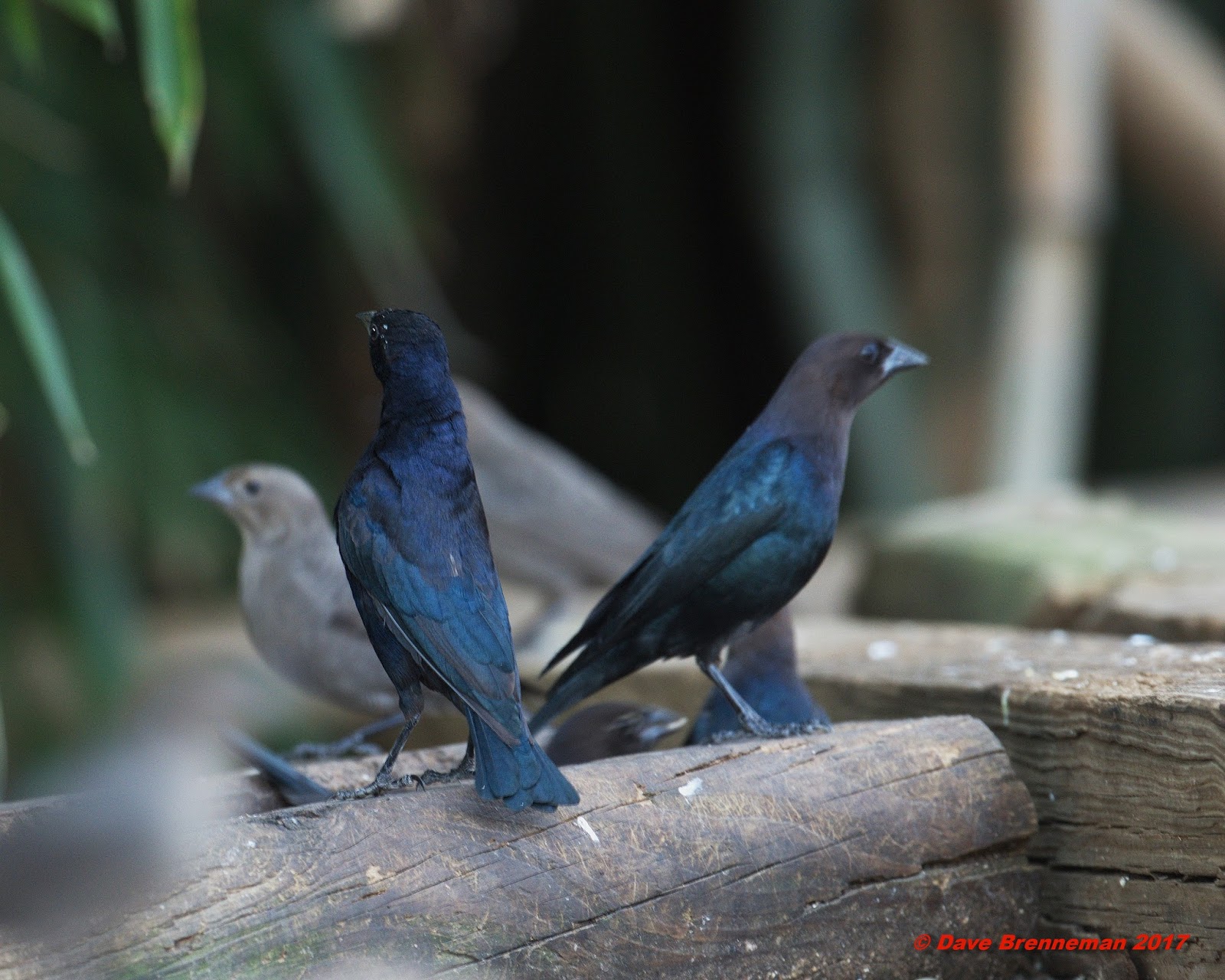
One of the birders I met there, Dave Brenneman, had a monster lens and he took numerous shots of the bird.  He shared this one with me, providing great comparisons with a male Brown-headed, not only showing the iridescent purple head of the Shiny Cowbird, but also its shorter tail. 


A couple minutes later I was back in my car and heading to the airport with plenty of time to spare.  On my way I reflected on what turned out to be a very satisfying chase – finding the target bird after about an hour’s search, and eventually getting great looks at an extreme rarity. 

That was my third sighting of Shiny Cowbird in the ABA area – I’ve also seen it in south FL and in LA where it is reported with increasing frequency these days.  All our local passerines need is yet another species of parasitic Cowbird to contend with.

Thursday, February 9, 2017

4 Maryland and 4 Delaware Statebirds (Aren’t eBird Needs Alerts Great?), January 2017


I grew up in Maryland and during that time really focused on my MD statelist.  As a result I developed a pretty good list while living there, standing at 321 when I moved out of the state almost 30 years ago.  At the time it was my single largest statelist, and MD was my first ABA reportable state.  Since then my focus has turned to exceeding ABA thresholds in all states, so since then I haven’t gone out of my way to try to add birds to my MD list.  Not surprisingly, I have only added 5 new birds to my MD list since I left, mostly with some opportunistic birding while visiting relatives in the area. 

But now I set a new goal to get to 15,000 total ticks.  To reach that threshold I can’t turn down any new reasonably feasible statebird, even in states with my largest lists.  So with an upcoming trip to MD in January I set up an eBird Needs Alert to see if any new birds might be around.  To my surprise many species popped up, including several species that were now regular in MD but weren’t even on my radar screen back in the 80’s – like Cackling Goose, Ross’s Goose, and Trumpeter Swan.  But more importantly the alert included a reliable rarity – Black-throated Gray Warbler.  This bird had been seen since late November in the small Tydings Memorial Park in Havre de Grace.  I only had a few hours available on one early morning to give it a try, but if I got there at dawn I could give it a couple hours before I had to head out.  Plus there was a reliable Trumpeter Swan a short distance away at Perryville Community Park.  So ever the optimist, if I could get the Warbler quickly, I could even try for the Swan as well.

I arrived at Tydings Memorial Park a bit before dawn to pea soup fog, and temps in the 30s.  Given the cool conditions I had expected this insect-eating bird to get active when its food started to get active, most likely in the first trees to be illuminated by the rising sun.  Apparently its favorite trees were a row of 4 cedars planted atop a hill in the park (recent directions put them at the east end of the park but it only took me a few seconds to find them at the west end of the park).  These would be the first ones to be in sunlight at dawn so my logic was coming together.  But that morning the rising sun was obscured by fog, and dawn arrived without any sunlit trees anywhere in the park. 

After a few minutes of searching with no luck I noticed another birder had arrived.  Hoping that he might have better directions I went over to him to compare notes.  To my surprise it was Jim Stasz, a birder I spent many hours birding with in the 70s and 80s.  In fact he was my key birding mentor from my younger formative days.  Amazing coincidence!  He too thought that the cedars would be the best spot to check at dawn.  But the fog was spoiling our plans.  Jim also mentioned that the bird was sometimes seen in the suburban neighborhood just to the north of the park, so that might be an alternate location to try.

In the next hour at least 8 other birders arrived, and we all fanned out throughout the park.  But to no avail.  Eventually the sun did come out, and a few birds made their way to the cedars, but no one spotted our target bird.

It was now time for me to head out having missed the Warbler, not to mention not even having a chance to try for the Swan.  I said goodbye to Jim and drove out of the park.  As I passed by on the road skirting the northern edge of Tydings Park, I noticed the birders all scurrying over to the neighborhood, crossing the road in front of me.  I pulled over and got the news – a birder had just found the Warbler one block to the north.  Seconds later I was with that birder standing at the base of the large spruce tree where he had heard the bird a couple minutes earlier.  Within a minute I heard the bird’s characteristic chip note, sounding much like a Yellow-rumped.  We all tracked the bird as it passed through the neighborhood, getting several brief looks at the bird as it continued to call from the treetops.  Eventually it flew over to the park, seemingly heading to its favorite row of cedars.  If I had left just a minute earlier I would have missed it!

MD was my fourth state where I’ve seen Black-throated Gray Warbler as a rarity – along with MA, GA, and ND, plus I’ve seen it throughout its normal range out west (see my statebird map below).  And it was number 327 for my MD list.


But that was just 1 new MD statebird, and the title of this blog said I added 4 in MD.  The other 3 came on my next trip “back home”.  Energized by the success of using a Needs Alert on my first trip, I set up another alert for my second trip.  Once again Cackling Geese, Ross’s Geese, and Trumpeter Swans dominated the report.  And all 3 were being seen close to my home base in Baltimore.  Most recently a Ross’s Goose and 2 Cackling Geese were being seen in a flock of Canadas 45 minutes northwest at Study Road Pond in Carroll County.  This flock also had an immature Snow Goose and a couple White-fronts – good birds for the area but not new for my MD list.  As with my first trip I had just a few hours free for birding, but these birds looked to be pretty reliable so it seemed to be worth a try.  Plus if I got these birds quickly I could try for a Trumpeter Swan just discovered in a small pond on the southwest outskirts of Baltimore. 

After a short ride into northern Carroll County I turned onto Study Road, and quickly spotted the pond ahead of me, along with a flock of geese on the grassy field above it.  And a second later I picked out a small white goose.  Within seconds I had the Ross’s Goose in my scope, and got this distant phonescoped photo of this most cooperative bird.  Needless to say a white goose in a flock of Canadas feeding in a grassy field really stands out.


MD was my 30th state for this expanding species.  And although I had seen Ross’s Goose in DE while I lived in the Mid-Atlantic, I don’t believe it was even on the MD statelist at the time.


Now I needed to search for the much less obvious Cackling Geese.  I quickly panned through the flock with my binocs and almost instantly picked out a group of 3 smaller geese feeding on the hill.  With the scope I could tell all 3 were much smaller than the Canadas, but they were facing away so I couldn’t see their bill and head shapes.  Eventually they turned and I could see all 3 had the stubbier bill, and more vertical forehead shape of a Cackling Goose.  But one was slightly larger – the rightmost bird of the trio in this photo.


And now in the middle in this photo.


Could the smaller birds be “Richardson’s” Cackling Geese and the larger one be a “Taverner’s” Cackling Goose?  Or maybe the larger bird is just the male of this potential family group, since males tend to be a little larger than females.  A bit later I found this other Goose that seemed small enough to be a Cackling, but its head/bill shape was more Canada like.  Not sure what to make of this one – maybe a small “Parvipes” Canada, or dare I say a hybrid?


Later I found the immature “Blue Phase” Snow Goose, but with a quick scan I couldn’t locate a White-front.  Although I thought about spending more time looking for that fifth goose species, since I got my target geese so quickly, I decided I should head out to make a very quick try for the Trumpeter Swan.  Luckily the Swan had been seen on a small pond, so it wouldn’t take long to either find it or realize the bird had moved on.  Maybe even easier than the Ross’s Goose.

Potentially a bigger issue with the Swan could be gaining access to the pond.  The bird was seen on the property of a gated retirement community, but one eBirder mentioned he just asked for permission at the gate and was given access.  So I wasn’t too worried when I drove up to the gate to ask as well.  However, the guard said she couldn’t let me on the property.  The pond was not visible from the road, so now what should I do?  I quickly pulled up the area on my map app in the satellite view, and could see the pond on the eastern edge of the retirement community property.  Maybe I could get a view of the pond from the back side of one of the businesses to the east.  I drove around to a couple spots and eventually found one that gave me a view to at least a portion of the pond.  And sure enough on my second stop there was the immature Trumpeter swimming down below.  Makes up for not being able to try for the Trumpeter on my first trip to MD.  I got this miserable shot of the bird by holding my phone up to my binocs.


MD is my second east coast state where I’ve counted the reintroduced Trumpeter Swans – luckily they have been accepted on the MD statelist. 


That gave me 4 new birds on my MD list in just 1 month, raising my total to 330.  After I entered all my sightings in eBird my MD Needs Alerts now only had a couple entries.  Though unfortunately none of the remaining birds were close enough to chase after, but I was very happy with adding 4 new birds in such limited birding time.

With so much success using a MD Needs Alert, I started to think about setting up Needs Alerts for nearby states.  Although my statelists in adjacent states were also pretty good, they weren’t as good as my MD list, so there would likely be several targets to pursue.  The problem was I didn’t have any more spare time while I was in Baltimore.  But I still had to drive back to MA at the end of the trip, so maybe there would be some statebirds I could pursue close to my planned route home with just some short side-trips.  I started with a Needs Alert in DE where my statelist stood at a very respectable 270.  My planned route would take me on I-95 through New Castle County in DE, and sure enough there were several potential targets in that northernmost DE county.  And with a bit of research I was able to find 4 reasonably likely targets to pursue close to my I-95 route – Ring-necked Duck and Common Merganser at the Newark Reservoir, Black-capped Chickadee at feeders at the Tri-State Bird Rescue, and Cackling Goose at Bellevue State Park.  Despite having to make stops at 3 different sites, my total additional drive time was just 45 minutes.  If I made short “tactical” birding stops at each location it would all be feasible - my plan was set.

After just an hour drive from Baltimore I neared the DE stateline and took the exit to head to the Newark Reservoir.  Several recent eBird reports had included small flocks of both Common Mergansers and Ring-necked Ducks there, including just 2 days before my visit.  (Not exactly sure why I still needed these quite common species in a state where I’ve done so much birding over the years…)  There were also a couple reports of Cackling Geese there a few weeks earlier, so another one to watch out for.  I needed a short walk uphill to gain access to the reservoir, but I hoped to be able to quickly check off both the Ring-neck and Merg once I got the reservoir in view.  As I headed up the path to the reservoir I saw a duck flying overhead – it was a male Common Merganser.  That was easy!  Now I just needed the Ring-necks to be as cooperative.  Unfortunately it wasn’t to be.  Although I had 9 Common Mergs on the water, I could not find any Ring-necked Ducks.  And there was only 1 Canada Goose – none of its smaller cousins were around. 

My statebird map for Common Merganser pretty closely matches it regular range, though I still need it in OH.  And as a postscript – if I had found a Ring-necked Duck I could have filled in DE in my statebird map as my last continental US state for that species.  (I’ve seen 26 species in every continental US state.)


Next I was off to nearby Tri-State Bird Rescue and Research, where a few eBird posts had reported a Black-capped Chickadee coming to their feeders.  The northern tip of DE is traditionally near the southern edge of the range of Black-caps, especially in winter when a few birds tend to move a bit south of their normal breeding ranges.  And many of these birds are reported from feeders, not surprisingly with several Carolinas, as was the case with the Tri-State feeders.  That brings up the challenge of identification of these 2 very similar species.  Luckily I’ve grown up near the edge of the Carolina/Black-capped ranges, so I’ve spent a lot of time with these 2 species.  To me, the biggest ID clue is the size difference, though interestingly that feature isn’t stressed in the field guides.  When I travel to MD and see a Carolina Chickadee, after spending years with Black-caps in New England, my first thought is how much smaller Carolinas are. 

With prior approval to bird at the Tri-State feeders, I arrived mid-morning and headed to a deck overlooking their feeding station.  I quickly found 4 Carolina Chickadees actively coming to the feeder to grab a sunflower seed.  They would then fly to a bush just a short distance away to open the seed.  They would chatter a bit, and then head back to the feeder to repeat their cycle.  Despite my best efforts, I couldn’t turn any of them into a Black-cap.  After 20 minutes I was starting to second-guess my efforts.  After all it had been more than a month since the last eBird report.  Then I spotted a different Chickadee fly in from the south.  I instantly thought that this bird was bigger.  And when it landed near the feeder I could see its whiter wings, rustier sides, and more ragged edge to the bib – a Black-capped Chickadee.  However my look was brief, as it stayed near the feeder for just 10 seconds, never actually stopped at the feeder, and then flew off to the north.  In other words it wasn’t even associating with the Carolinas that had taken up residence at the feeding station.  I’ve now seen Black-capped Chickadee in just about all its regular states, including down the spine of the Appalachians in VA, NC, and TN.


I was now quickly back on the road driving through some suburban streets headed off to my next stop.  As I neared a red light I could see a large flock of crows circling overhead.  I half-heartedly told myself to keep an eye open for Common Raven which had been occasionally reported from the general area.  As I sat at the light I noticed one more distant Corvid that seemed to be doing more soaring than flapping.  On a lark I picked up my binocs from the passenger seat, lowered my window, and focused my binocs on the bird in question – it had a wedge-shaped tail.  Amazingly, it was indeed a Raven!  I continued to watch it glide along the edge of the flock of Crows; that is until the light turned green.  Thank goodness for long red lights.  With the exception of NJ, I’ve seen this species in all its regular states and a few others as it continues to expand its range.


Next I was off to Bellevue State Park to try for Cackling Geese.  A flock of 5 had been reported there in early January, but that was now more than 2 weeks ago.  But I tried to remain optimistic.  Once I got to the park it was pretty easy to find the lake and adjoining fields where the mixed Canada and Cackling Goose flock had been reported.  And sure enough up ahead there was a small flock of about 200 geese grazing in the field.  A quick scan did not reveal any smaller geese.  So I got closer and with just a bit of searching found a flock of 5 smaller Cackling Geese feeding together.  Perhaps a family group?  Amazing that they have stayed in this park for so long.  I got this photo of the 5 Cackling Geese with 2 larger Canadas off to the side.

 
My Cackling Goose statebird map is less a reflection of the wintering range of this species than it is  indicative of the states in which I’ve birded in the proper season since Cackling Goose was split out as a separate species.


That gave me 4 new DE statebirds, bringing my list up to 274.  And along with my MD success, amazing to add 8 new birds to my already substantial Mid-Atlantic statelists despite making just 3 short birding trips.  As I continued my drive north up the NJ Turnpike I was half-tempted to pull over and set up a quick Needs Alert in NJ.  But that will have to wait for a future trip. 

I love Needs Alerts…