Showing posts with label Ross's Goose. Show all posts

Wednesday, February 8, 2023

All-Day Birding Trip in Georgia Yields a New Statebird in South Carolina, January 28, 2023

Wait, what?  How do you get a new bird in SC when you’re on an all-day trip to GA?  The answer is you still have to drive through SC in order to get to and from GA…

I signed up to attend a Greenville County (SC) Bird Club walk at Lake Hartwell on January 28, 2023.  Lake Hartwell is a large man-made lake along the SC/GA state line near the northern end of both states.  With the exception of an initial couple stops in SC, the remainder of the trip was to be spent on the GA side of the lake.  We hoped for rarer waterbirds such as a Red-throated or Pacific Loon, Red-necked Grebe (seen on the lake 10 days earlier), a Scoter, or maybe a Long-tailed Duck.  And since most of our stops were in wooded campgrounds and picnic grounds, I was hopeful for a Brown Creeper that I still needed for my GA list.

But the lake did not give us any rarities that day.  Even though I counted an even 50 Loons, all were Commons.  And although our 176 Horned Grebes was probably the most I’ve seen in a single day, we could not find any other Grebe species.  Landbirds were quite plentiful, but not my target Creeper.  I even added an extra stop on my own at the end of the day in woodlands at the dam just barely in GA, but still couldn’t get a Creeper.  Though a rare Blue-headed Vireo was a nice consolation prize. 

I was just about to call it quits for the day when, on a lark, I decided to check my eBird Needs Alert for SC just in case something had recently been reported nearby.  Amazingly, the first bird that popped up was a Ross’s Goose spotted earlier in the day in nearby Abbeville County.  And it was re-found within the last couple hours.  A quick Google Maps search showed that the bird was only 20 minutes off my route home, so it was definitely worth giving it a try.  The chase was on!

As I headed there, I re-reviewed the eBird reports.  The Ross’s was found on Paco Road at 8 that morning with these details: “First spotted associating with an agitated pair of CANG by the pond, later flew to top of pasture with them.”  Then at 2:30 the same birder noted that the bird was continuing in the pasture with Canadas.  The satellite view of Paco Road on Google Maps showed a small pond with an adjacent pasture along this short road.  It all looked promising.

As I neared Paco Road I started to see several farm ponds scattered throughout the fields.  I figured the Ross’s Goose could actually be frequenting any of these ponds in the area so I watched for any Canadas, or better yet white geese, as I passed by.  Then just before taking a right turn onto Paco Road I came to a pond on the left.  With a quick glimpse I saw something white in the field nearby. 

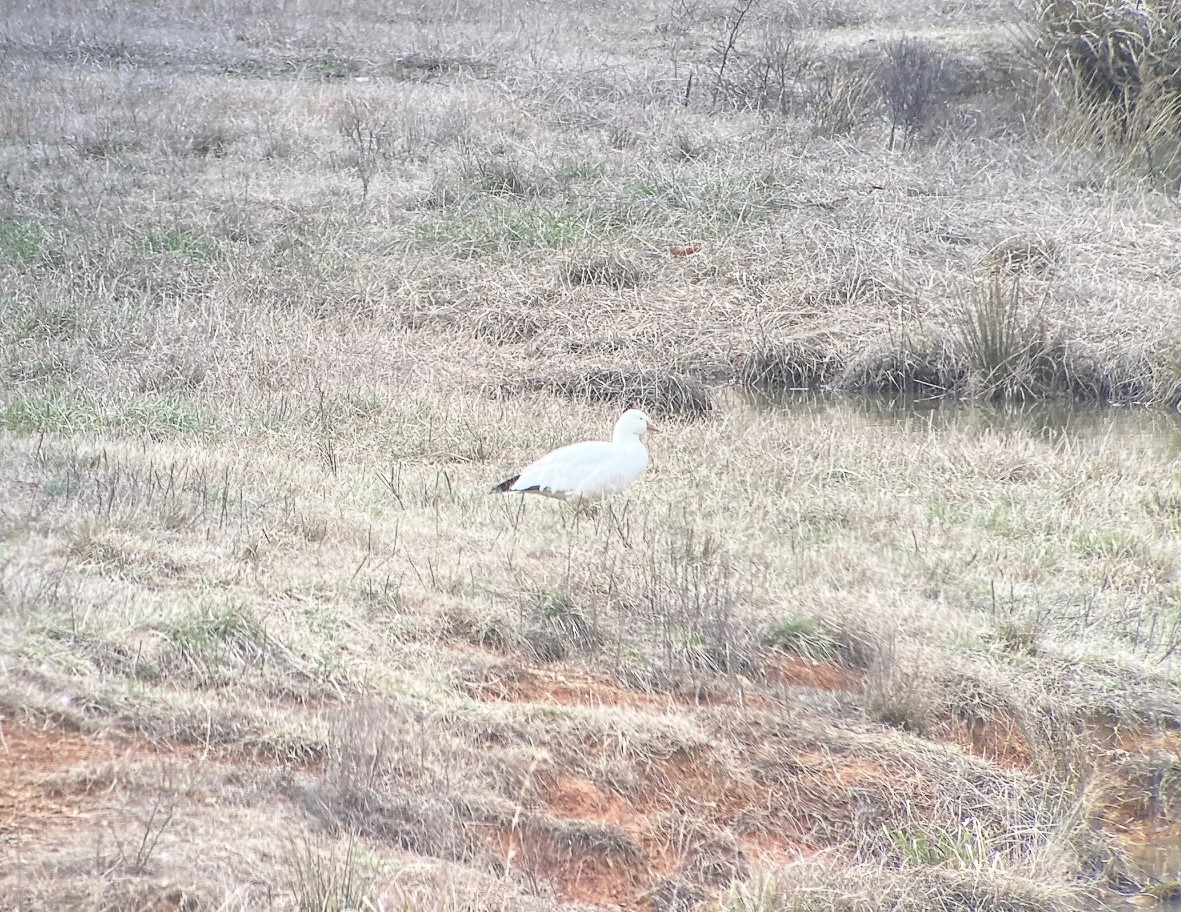
I pulled off on the shoulder and put it in my binoculars – it was indeed a small white goose in a flock of Canadas.  Then with a scope view I confirmed the ID as the diminutive Ross’s Goose.


Good thing I noticed it there instead of going right to the pond on Paco Rd.

Ross’s Goose had been somewhat of a nemesis bird for me in SC, having chased after several reported birds with no luck.  So it’s finally nice to add it to my list - #297 in SC.  Even though virtually all my birding time that day was in GA. 

And it was a great way to cap off the month of January 2023 in SC where I added 3 rare waterfowl to my state list – Common Merganser, Red-necked Grebe, and now Ross’s Goose.

My statebird map for Ross’s Goose is inserted below.  In its regular range the blue-shaded states are those where I’ve seen this species, and the cross-hatched states are those where I’ve yet to see it.  The numerous brown-shaded states are those where I’ve seen it as a rarity as this species is prone to vagrancy throughout much of the east.  


Saturday, January 8, 2022

Coastal VA and NC Trip Nets 11 New Statebirds, December 9-13, 2021, Part 2 of 2

I attended a Carolina Bird Club trip to the Outer Banks of NC in mid-December 2021.  And along with extensions into coastal VA, plus 2 travel days, I made it into a 5-day weekend.  It had been more than 20 years since I birded southeastern VA, and I had quite a number of possible new statebirds.  First, several target species like Lesser Black-backed Gull and White Ibis are more numerous there now.  Plus my VA statelist was only at 250 so there were a number of gaps in general I could fill.  On the downside, my last trip was before 9/11 when I was still able to bird on the islands of the Chesapeake Bay Bridge Tunnel (CBBT) – locations which are no longer accessible due to possible terrorist concerns.  As for NC, even though it had been nearly 3 decades (ouch) since I birded the Outer Banks, my potential targets in NC were pretty limited.  Most importantly I was banking on a couple long-staying rarities, Eurasian Wigeon and Hudsonian Godwit, which were rather reliable.  All told I hoped for 5 or 6 new statebirds in VA and 3 in NC.  And I was looking forward to reacquainting myself with some of the top hotspots on the NC and VA coasts.

This is my summary of the second half of the trip; see my prior post for the first half of the trip.

December 12 – 6 for 6 in Eastern VA

The CBC trip continued on the Outer Banks through the morning of the 12th, but it sounded like the plan was to cover some of the same area we birded on the 11th, plus some other spots that would likely not yield any new statebirds for me.  Plus I had 6 feasible targets in eastern VA, especially given that I missed the Heermann’s Gull and didn’t pursue the Red-cockaded Woodpeckers and Western Kingbird earlier in my trip.  Though the targets would have to be cooperative if I was to have enough time to try for all 6.  So I decided to change my plans and bird eastern VA instead of NC.  I hoped I wouldn’t regret my decision.

The first stop was to try for the continuing Western Kingbird in Virginia Beach at a hotspot called the Harris Teeter Retention Pond.  The bird was most often seen perching in trees surrounding a large field to the south of the shopping center.  Though the last report had the bird at an adjacent school.  Once I parked at the shopping center it only took me a few minutes to get to the back of the buildings and the small pond which looked nice for a migrant shorebird or two in season.  But shorebirds weren’t my target here.  I decided to target the trees around the field as I walked right by the school.  Though I did stop long enough to see a few White-crowns feeding along the trail.

I was now walking along the western edge of the field looking for any movement of larger birds in flight or perched in the trees.  I had a few Blue Jays and woodpeckers here and there but no insectivores.  It was a cold, gray, breezy morning so I started to worry that the insects weren’t moving yet -not the best conditions for a flycatcher.  As I neared the southwest corner of the field I spotted a larger bird fly into the bare deciduous trees.  And with a quick binocular view I had my target Western Kingbird (statebird #5).  I got these distant digibin shots of the bird.


 VA was my 5th eastern state to see Western Kingbird as a rarity. 

I had given myself 90 minutes at this first stop of the day, but only needed 30.  It’s great especially to have the first target to be so cooperative.  Now a whole hour ahead of schedule, I was well-positioned to be able to pursue all my targets for the day. 

Next I was off to the Princess Anne WMA, where White Ibis were being seen in two adjacent tracts – Beasley and Whitehurst.  They were reported a bit more frequently at Beasley, so that’s where I would start.  The WMA was only open for birding on Sundays since hunting was allowed every other day of the week.  Hence I targeted this spot on Sunday the 12th instead of the 10th on my first trip through the area. 

The Beasley Tract features numerous small impoundments flooded to attract waterfowl.  So my plan was to scan each one to look for my target White Ibis feeding in the shallow water.  After a short walk through pine woodlands I arrived at the impoundments that were on both sides of my trail.  Although some were obscured by vegetation, I hoped that I would quickly find my target.  But after searching the first half dozen impoundments I had no waders at all.  And the only waterfowl was a Pied-billed Grebe – had the hunters scared away all the birds?  But then I noticed a tight flock of larger birds overhead – I had 8 White Ibis flying to the north (statebird #6).  I searched the rest of the impoundments but still never found any foraging waders.  Though I had 2 more small flocks of White Ibis flying low to the north.  Wonder where they were coming from and going to?

It was nice to fill in VA in my statebird map as the northernmost Atlantic state where it is regular.  I’ve also seen White Ibis as a rarity in 7 northeast states and DC.

I had one more longer shot target at this spot – Blue-headed Vireo.  This is one of several quite common passerine migrants and nesters that I still need for my VA list.  There were occasional recent records of Blue-headed at the Beasley tract which is near the northernmost extent of its wintering range.  The parking lot was surrounded by nice pine habitat which should be quite good for roaming bands of wintering passerines.  So when I got back to the car I played some Screech-owl tape and quickly attracted a number of Yellow-rumps.  At one point I thought I heard a couple Blue-headed call notes but they were faint and didn’t continue so I couldn’t be sure.  A few minutes later I felt like I had found everything that was in the area so stopped the tape and was about to get in the car.  Just then I heard the characteristic scolding calls of a Blue-headed Vireo (statebird #7) – I guess I could have counted it based on those first call notes afterall.  I now just need this species in MS and DC in its regular range.

The next stop was at the Piney Grove Preserve in Sussex County for the resident Red-cockaded Woodpeckers.  I was actually lucky to have noticed one recent report for this species – otherwise I would have passed right by this area without knowing that this was a regular spot for these woodpeckers.  When I arrived in the area along Chinquapin Road it was obvious where to look for these endangered woodpeckers – there were extensive patches of tall longleaf pines actively managed to reduce the undergrowth. 

I drove slowly through the area stopping at several locations, listening intently for their characteristic calls, but with no luck.  I also looked for the nesting trees that have white rings painted on their trunks, but never found any.  I was starting to get a little worried.  Then finally on my next stop I heard a few woodpecker taps, then got a quick view of a medium-sized woodpecker.  A bit later I heard the calls and got good views of a Red-cockaded Woodpecker (statebird #8).  And as is typical of this species, it was one of 4 birds foraging together in the pines.  Here’s a digibin shot of one of the shier birds.

I also got nice views of a second Blue-headed Vireo here – rarer at this inland location than the one I had earlier closer to the coast.

With the woodpecker under my belt I was off for a second try at the Heermann’s Gull.  My luck with this very reliable bird had to be better than on my first stop – right?  As I pulled into the Hopewell Marina I saw a group of birders around the boat ramp which is the gull’s preferred roosting and feeding spot.  I quickly drove over to them hoping (indeed expecting) that they had my target bird.  But they had been unable to find the Heermann’s despite quite a bit of searching.  Had I struck out again?  Just then another birder walked over saying she just heard that it was perched under the bridge.  That was one of the spots I searched on my earlier try so I knew exactly where to look.

We all drove over to the bridge and sure enough there was a significant flock of gulls perched on the nearby wooden piers under the bridge.  But with a quick binocular scan none of us picked out the gull.  It should be obvious given its unique charcoal gray plumage, so now we wondered about the accuracy of that third-hand report.  I set up my scope to do a more detailed scan, even though I was pretty sure binocular views were good enough.  And then I spotted the Heermann’s – it was sleeping in the shadows of the bridge and it was nearly the same color of the wood (statebird #9). 

VA is now the 4th state where I’ve seen this species as a rarity on the Atlantic or Gulf Coasts.  Wonder what’s causing the vagrancy of this Pacific Ocean gull.

I was thinking of staying to wait for the bird to wake up and give better views, but I had one more target to chase after – Ross’s Goose.  A pair of these diminutive geese were reported in a large flock of Snow Geese two days earlier at Turkey Island Road in nearby Henrico County.  Photos showed the geese foraging in harvested corn fields so it seemed like it could be relatively easy to find them.  That is if the flock was still around.  Afterall there had been no reports in the last 2 days. 

After a quick 20-minute drive I arrived at Turkey Island Road, driving through very nice ag lands with cornfields on both sides of the road.  Excellent wintering goose habitat.  The only problem was I couldn’t find any geese of any species.  I got to the end of the road and turned around for another try.  Then I noticed a car parked on the side of the road ahead of me.  Not too surprisingly, they were birders also looking for the Ross’s.  [On a side note they had recently moved from NH and new of me from my New England days – small world.]  They had just come from a nearby small lake, likely finding the right flock of Snow Geese but not finding the Ross’s.  I was glad I ran into these birders because I didn’t know about the lake.  And always up for a challenge, I was willing to try to find the Ross’s in with the Snows. 

After a short drive and a walk through the fields I came upon the lake with all the geese.  It was located behind a hill and out of view from Turkey Island Road – I would have never found the lake on my own.  The lake was full of geese – I estimated 750 Canadas and 500 Snows – but all quite far away.

Surprisingly most of the Snows were blue-phase birds.  And most of the few white-phase Snows were noticeably small than the “Blues”.  So the good news was that there weren’t many white geese to look through.  The bad news was that the Ross’s wouldn’t be too much smaller than the white Snows.  I started to scan the flock slowly but couldn’t come up with the Ross’s.  But then I noticed a group of 4 white geese together with what appeared to be small bills.  It took a while to get clear views but I finally could see the short stubby bills, steep forehead, and rounded head of Ross’s Geese (statebird #10).  Here’s a very distant phonescoped pic of the birds in the background.

I texted both the NH birders and the ones with me at the Hopewell Marina to tell them that I had found the Ross’s.  A few minutes later they all got to see the birds.  Interestingly the best way to find them in the flock was to look for 4 white geese swimming together.

VA is now my 32nd state for this expanding species.  It wasn't too long ago that Ross's Goose was quite a rarity anywhere across the country.

What a day – I found all 6 of my target birds.  A nice improvement from the beginning of my trip.  Though as an aside, it turns out that the CBC group re-found the Hudsonian Godwit on the Outer Banks that day.  I guess I can’t be everywhere.

December 13 – Another Slow Travel Day

The 13th was my day for the long ride back home from the coast.  And along the way I would make another try for the Say’s Phoebe in Guilford County, NC.  But first on the VA part of my drive I kept an eye open for Turkeys – a bird I still needed for my statelist.  But the best I could do was to spot a dead bird on the side of the highway.  Alas, not countable unless it was still breathing.

I rolled into the Guilford County Farm mid-morning and started my slow walk through the area.  As before I slowly walked around the complex checking out every conceivable Phoebe perch.  After 90 minutes I was not very optimistic.  And then I got a text from the Blue Ridge Audubon group saying that there was a Varied Thrush coming to a feeder in Hickory.  A quick look at GoogleMaps showed that Hickory was right on my home.  The text included the fact that the homeowner was willing to have visitors, his address, and where to stand to look for the Thrush.  Hmm…  Would the Thrush be more likely than the Phoebe?  After searching for the Say’s Phoebe now for 4 hours over 2 trips, I decided to throw in the towel and give the Varied Thrush a try. 

Just after getting back on the road I called my birding friend Bill Hooker and alerted him to the Thrush report.  Bill was very interested, though I mentioned the only thing missing from the report was whether there were certain times of the day when the Thrush was being seen.  Bill decided to try for it as well, and his ETA was actually a few minutes earlier than mine.  An hour later I was just a few minutes away from the feeding station when Bill called.  He was on-site and talked to the homeowner – the Thrush was only being seen once a day pretty early in the morning.  Ugh…  We gave it about an hour, seeing a good number of birds at the feeding station.  But given its history, not surprisingly we had no Varied Thrush. 

That was a tough way to end the trip – missing both of my last targets.  But it was still a most successful weekend, with 10 additions to my VA list, bringing my statelist up to 260.  And my NC list is now at 312 with the addition of 1 new bird.  Certainly better than the 8 or 9 new statebirds I hoped for for the entire weekend.  Plus I reacquainted myself with many of the key hotspots in the upper portion of the Outer Banks and coastal VA. 

Can’t wait to go back!

Monday, February 15, 2021

More Rarities at Dobbins Farm – But Not the Expected One, Anderson County, SC, February 10, 2021

Ross’s Goose is one of my favorite birds, dating back to my numerous work trips to the Memphis area in the late 90s and 2000’s.  During the colder months I would enjoy seeing large flocks of white geese either migrating through or wintering in the area.  The vast majority were Snows, but with close examination I would spot occasional Ross’s Geese mixed in.  In flight, a Ross’s would often be at the head of the line.  It was fun to play “Where’s Waldo” looking for those diminutive geese among their larger cousins.  Over the years I would end up adding Ross’s to my lists in 31 states and 1 Canadian province as this species rapidly increased in numbers. 

When I moved to the Carolinas I needed Ross’s Goose for my statelists in both NC and SC, as well as Snow Goose in South Carolina.  I was able to see Ross’s in NC within just a few months of moving to the region in 12/19.  And finally got Snow Goose in SC about a year later in 11/20 at Dobbins Farm in Anderson County.  And although there were several more Ross’s records in the mountains of NC, there were no nearby records of Ross’s in SC.

That is until late January 2021 when Ross’s and Snows appeared at not 1 but 2 farm ponds in Anderson County.  Remarkably the sites were just 11 miles apart “as the goose flies”.  Unfortunately, I had commitments at home that prevented me from getting out at that time.  But the reports continued at both spots for a couple weeks, until I was finally able to make a run to the area on February 10.  The last report from the first site, Clemson University Simpson Research Station, was on the 7th – 2 Ross’s were seen with 5 Snows.  And from the other site, Dobbins Farm where I’ve seen several rarities since moving to the area, the last report was on the 8th with 1 each Ross’s and Snow.  There were no reports positive or negative from the 9th.  But I was still quite optimistic that the birds that had been around at the Clemson site for 13 days, and at Dobbins Farm for 11 days, would still be around when I was finally able to look for them.

My plan for the 10th was to first head to the Clemson site since it was closer, then bird the Dobbins Farm area.  I got out of the house early on the 10th and arrived at the Clemson site at about 9 AM.  The Ross’s and Snow Geese were sometimes seen with Canadas on the farm pond there, and sometimes seen foraging in fields nearby.  As I pulled up to the pond I hoped (dare I say expected) to see some white dots on the water which would be my target birds – but I didn’t see a single goose.  I got out and with a quick binocular view couldn’t find any waterfowl at all.  They must be feeding in the fields I surmised.  There was suitable grazing habitat all around me, so I did a 360-degree search but still found no geese.  I drove east a short distance and looked from that different vantage point but again found no geese.  At least I still had Dobbins Farm to search for my target.

Twenty minutes later I arrived at Dobbins Farm again hoping to see those white dots on the ponds in the distance.  First I arrived at the upper pond – no geese at all.  Then I pulled down to the lower pond – no geese again.  I checked both ponds more closely, but there’s next to no way a white goose could hide on these relatively small farm ponds.  To say that I was upset would be an understatement – saying a number of things to myself that I can’t put in print here on my blog.  I had gotten there just a day or 2 too late.

I was tempted to just get back in the car and drive home, but decided to do at least a little birding at Dobbins before heading back.  One of my other targets at that farm has been Brewer’s Blackbirds that are occasionally reported from the site.  In fact a male/female pair were spotted there a few days earlier.  The cows were feeding in their troughs along the road so I though perhaps a blackbird might be there feeding on some spilled grain.  I quickly searched the area but came up empty.  Then I heard a couple blackbird call notes in the distance.  The recent report mentioned the Brewer’s were “Seen in top of trees behind lower pond”, so I looked into those trees in the distance and sure enough there was a blackbird perched near the top.  Too far to ID with binoculars, so I quickly got out my scope.  The bird was very glossy, with a yellow eye, and short tail – I had myself a male Brewer’s Blackbird!  Here’s a picture of those trees in the background behind the lower pond.


And a phonescoped view of the bird, though admittedly too distant to confirm the ID in this less-than-ideal photo.


 While studying the Brewer’s I realized that there was a nearby meadowlark singing an odd song.  I focused on the call and realized it was the singing Western Meadowlark, a bird I first heard here back in November and was now being occasionally heard and seen yet again among all the Eastern Meadowlarks.  Who knows how long it had been singing and I hadn’t noticed it while concentrating on the blackbird.  Then I turned back to the blackbird and realized there was a second one in the trees – another male Brewer’s.  Nice consolation prizes – a new SC statebird in the Brewer’s, and an even rarer Western Meadowlark.

Here’s my statebird map for Brewer’s Blackbird – the blue-shaded states are those where I’ve seen this species in its regular range.  The cross-hatched states are those in its regular range where I’ve yet to see this species.  The 4 tan states are those where I’ve seen it as a rarity.


I drove back to the upper pond hoping against hope that I might still find those white geese.  At the northeastern end of the pond I spotted a few Canada Geese at the edge of the pond.  While scanning through them I noticed a pair of geese flying overhead.  They circled and pitched in right in front of me – it was a pair of Greater White-fronted Geese.  I got these passable phonescoped photos of the pair.


White-fronts are actually rarer in the region than Ross’s.  Over the last 6 years in the SC Upstate there have been 15 reports of Ross’s while just 11 reports of White-fronts.

I’ve now seen White-fronted Goose throughout most of the states in its regular range, along with most east coast states where it’s a rarity.  Most of those northeast sightings are of birds from the Greenland flavirostris race, while sightings from the western Carolinas are most likely from the inland frontalis race.


That gave me 2 additions to my SC state list, bringing my total to 284.  Not to mention my second observation of the Western Meadowlark – only the second SC state record.  So even though I missed my target (and expected) Ross’s Goose, I’ll gladly take this great set of consolation prizes.  I’ll just have to get the Ross’s Goose in the future – maybe on a future trip to Dobbins Farm.

Tuesday, December 24, 2019

Ross’s Goose, Hendersonville, NC December 4, 2019

It was midday on the 4th when I got a call from local Hendersonville birder Wayne Forsythe – he had just found a Ross’s Goose in a pond with Canadas.  And it was right in Hendersonville!  Wayne is well-known for his knowledge of the local birding sites.  In November he found the Short-eared Owl at Hooper Lane, and he had now found the Ross’s.  It was only a 20-minute drive away, and I was free, so within just a couple minutes I was out the door and hoping that my target Ross’s Goose would stick around on the pond and not leave to feed in nearby fields. 

Wayne had spotted the bird on a small pond at a site called Camp Pinewood just northeast of downtown.  When I arrived I found the site blocked off by a gate, but the pond was still visible looking through the gate.   And with a quick scan I found the Ross’s swimming among about 100 Canadas.  A small white goose really sticks out among the Canadas.  Though there were about a half dozen Mute Swan decoys on the lake that caused a bit of confusion.  Here are a couple phonescoped shots of this diminutive goose.


That was statebird number 274 for my NC list.  Great to be connected with Wayne and so many other excellent birders in the area.

Numbers of both white geese have increased dramatically in the last couple decades.  For instance, in the 1983 First Edition of the National Geographic guide, Ross’s was shown as a wintering bird in just 5 states – LA, TX, NM, CA, and OR.  While the 2008 Fifth Edition shows a wintering range of more than a dozen states including much of the Mid-South and a couple east coast states.  A couple decades ago my work travels used to take me to Memphis, TN, and I took advantage of those trips to add birding time in five states in the Mid-South – TN, KY, MO, AR, and MS.  Ross’s was just starting to expand its range there at the time, and I was able to find Ross’s in each of these states.  

I really fell in love with this little goose during these Memphis trips, and have continued to enjoy looking for it across the country where today it is either regular or a sought-after rarity in virtually every state.  My statebird map for Ross’s Goose is inserted below – solid shaded states are those where I’ve seen this species; cross-hatched states are those where it is regular but I haven’t seen it yet.  I’m especially happy with my results in New England, having seen Ross’s in all 6 where it is still exceptionally rare though increasing.


Thursday, February 9, 2017

4 Maryland and 4 Delaware Statebirds (Aren’t eBird Needs Alerts Great?), January 2017


I grew up in Maryland and during that time really focused on my MD statelist.  As a result I developed a pretty good list while living there, standing at 321 when I moved out of the state almost 30 years ago.  At the time it was my single largest statelist, and MD was my first ABA reportable state.  Since then my focus has turned to exceeding ABA thresholds in all states, so since then I haven’t gone out of my way to try to add birds to my MD list.  Not surprisingly, I have only added 5 new birds to my MD list since I left, mostly with some opportunistic birding while visiting relatives in the area. 

But now I set a new goal to get to 15,000 total ticks.  To reach that threshold I can’t turn down any new reasonably feasible statebird, even in states with my largest lists.  So with an upcoming trip to MD in January I set up an eBird Needs Alert to see if any new birds might be around.  To my surprise many species popped up, including several species that were now regular in MD but weren’t even on my radar screen back in the 80’s – like Cackling Goose, Ross’s Goose, and Trumpeter Swan.  But more importantly the alert included a reliable rarity – Black-throated Gray Warbler.  This bird had been seen since late November in the small Tydings Memorial Park in Havre de Grace.  I only had a few hours available on one early morning to give it a try, but if I got there at dawn I could give it a couple hours before I had to head out.  Plus there was a reliable Trumpeter Swan a short distance away at Perryville Community Park.  So ever the optimist, if I could get the Warbler quickly, I could even try for the Swan as well.

I arrived at Tydings Memorial Park a bit before dawn to pea soup fog, and temps in the 30s.  Given the cool conditions I had expected this insect-eating bird to get active when its food started to get active, most likely in the first trees to be illuminated by the rising sun.  Apparently its favorite trees were a row of 4 cedars planted atop a hill in the park (recent directions put them at the east end of the park but it only took me a few seconds to find them at the west end of the park).  These would be the first ones to be in sunlight at dawn so my logic was coming together.  But that morning the rising sun was obscured by fog, and dawn arrived without any sunlit trees anywhere in the park. 

After a few minutes of searching with no luck I noticed another birder had arrived.  Hoping that he might have better directions I went over to him to compare notes.  To my surprise it was Jim Stasz, a birder I spent many hours birding with in the 70s and 80s.  In fact he was my key birding mentor from my younger formative days.  Amazing coincidence!  He too thought that the cedars would be the best spot to check at dawn.  But the fog was spoiling our plans.  Jim also mentioned that the bird was sometimes seen in the suburban neighborhood just to the north of the park, so that might be an alternate location to try.

In the next hour at least 8 other birders arrived, and we all fanned out throughout the park.  But to no avail.  Eventually the sun did come out, and a few birds made their way to the cedars, but no one spotted our target bird.

It was now time for me to head out having missed the Warbler, not to mention not even having a chance to try for the Swan.  I said goodbye to Jim and drove out of the park.  As I passed by on the road skirting the northern edge of Tydings Park, I noticed the birders all scurrying over to the neighborhood, crossing the road in front of me.  I pulled over and got the news – a birder had just found the Warbler one block to the north.  Seconds later I was with that birder standing at the base of the large spruce tree where he had heard the bird a couple minutes earlier.  Within a minute I heard the bird’s characteristic chip note, sounding much like a Yellow-rumped.  We all tracked the bird as it passed through the neighborhood, getting several brief looks at the bird as it continued to call from the treetops.  Eventually it flew over to the park, seemingly heading to its favorite row of cedars.  If I had left just a minute earlier I would have missed it!

MD was my fourth state where I’ve seen Black-throated Gray Warbler as a rarity – along with MA, GA, and ND, plus I’ve seen it throughout its normal range out west (see my statebird map below).  And it was number 327 for my MD list.


But that was just 1 new MD statebird, and the title of this blog said I added 4 in MD.  The other 3 came on my next trip “back home”.  Energized by the success of using a Needs Alert on my first trip, I set up another alert for my second trip.  Once again Cackling Geese, Ross’s Geese, and Trumpeter Swans dominated the report.  And all 3 were being seen close to my home base in Baltimore.  Most recently a Ross’s Goose and 2 Cackling Geese were being seen in a flock of Canadas 45 minutes northwest at Study Road Pond in Carroll County.  This flock also had an immature Snow Goose and a couple White-fronts – good birds for the area but not new for my MD list.  As with my first trip I had just a few hours free for birding, but these birds looked to be pretty reliable so it seemed to be worth a try.  Plus if I got these birds quickly I could try for a Trumpeter Swan just discovered in a small pond on the southwest outskirts of Baltimore. 

After a short ride into northern Carroll County I turned onto Study Road, and quickly spotted the pond ahead of me, along with a flock of geese on the grassy field above it.  And a second later I picked out a small white goose.  Within seconds I had the Ross’s Goose in my scope, and got this distant phonescoped photo of this most cooperative bird.  Needless to say a white goose in a flock of Canadas feeding in a grassy field really stands out.


MD was my 30th state for this expanding species.  And although I had seen Ross’s Goose in DE while I lived in the Mid-Atlantic, I don’t believe it was even on the MD statelist at the time.


Now I needed to search for the much less obvious Cackling Geese.  I quickly panned through the flock with my binocs and almost instantly picked out a group of 3 smaller geese feeding on the hill.  With the scope I could tell all 3 were much smaller than the Canadas, but they were facing away so I couldn’t see their bill and head shapes.  Eventually they turned and I could see all 3 had the stubbier bill, and more vertical forehead shape of a Cackling Goose.  But one was slightly larger – the rightmost bird of the trio in this photo.


And now in the middle in this photo.


Could the smaller birds be “Richardson’s” Cackling Geese and the larger one be a “Taverner’s” Cackling Goose?  Or maybe the larger bird is just the male of this potential family group, since males tend to be a little larger than females.  A bit later I found this other Goose that seemed small enough to be a Cackling, but its head/bill shape was more Canada like.  Not sure what to make of this one – maybe a small “Parvipes” Canada, or dare I say a hybrid?


Later I found the immature “Blue Phase” Snow Goose, but with a quick scan I couldn’t locate a White-front.  Although I thought about spending more time looking for that fifth goose species, since I got my target geese so quickly, I decided I should head out to make a very quick try for the Trumpeter Swan.  Luckily the Swan had been seen on a small pond, so it wouldn’t take long to either find it or realize the bird had moved on.  Maybe even easier than the Ross’s Goose.

Potentially a bigger issue with the Swan could be gaining access to the pond.  The bird was seen on the property of a gated retirement community, but one eBirder mentioned he just asked for permission at the gate and was given access.  So I wasn’t too worried when I drove up to the gate to ask as well.  However, the guard said she couldn’t let me on the property.  The pond was not visible from the road, so now what should I do?  I quickly pulled up the area on my map app in the satellite view, and could see the pond on the eastern edge of the retirement community property.  Maybe I could get a view of the pond from the back side of one of the businesses to the east.  I drove around to a couple spots and eventually found one that gave me a view to at least a portion of the pond.  And sure enough on my second stop there was the immature Trumpeter swimming down below.  Makes up for not being able to try for the Trumpeter on my first trip to MD.  I got this miserable shot of the bird by holding my phone up to my binocs.


MD is my second east coast state where I’ve counted the reintroduced Trumpeter Swans – luckily they have been accepted on the MD statelist. 


That gave me 4 new birds on my MD list in just 1 month, raising my total to 330.  After I entered all my sightings in eBird my MD Needs Alerts now only had a couple entries.  Though unfortunately none of the remaining birds were close enough to chase after, but I was very happy with adding 4 new birds in such limited birding time.

With so much success using a MD Needs Alert, I started to think about setting up Needs Alerts for nearby states.  Although my statelists in adjacent states were also pretty good, they weren’t as good as my MD list, so there would likely be several targets to pursue.  The problem was I didn’t have any more spare time while I was in Baltimore.  But I still had to drive back to MA at the end of the trip, so maybe there would be some statebirds I could pursue close to my planned route home with just some short side-trips.  I started with a Needs Alert in DE where my statelist stood at a very respectable 270.  My planned route would take me on I-95 through New Castle County in DE, and sure enough there were several potential targets in that northernmost DE county.  And with a bit of research I was able to find 4 reasonably likely targets to pursue close to my I-95 route – Ring-necked Duck and Common Merganser at the Newark Reservoir, Black-capped Chickadee at feeders at the Tri-State Bird Rescue, and Cackling Goose at Bellevue State Park.  Despite having to make stops at 3 different sites, my total additional drive time was just 45 minutes.  If I made short “tactical” birding stops at each location it would all be feasible - my plan was set.

After just an hour drive from Baltimore I neared the DE stateline and took the exit to head to the Newark Reservoir.  Several recent eBird reports had included small flocks of both Common Mergansers and Ring-necked Ducks there, including just 2 days before my visit.  (Not exactly sure why I still needed these quite common species in a state where I’ve done so much birding over the years…)  There were also a couple reports of Cackling Geese there a few weeks earlier, so another one to watch out for.  I needed a short walk uphill to gain access to the reservoir, but I hoped to be able to quickly check off both the Ring-neck and Merg once I got the reservoir in view.  As I headed up the path to the reservoir I saw a duck flying overhead – it was a male Common Merganser.  That was easy!  Now I just needed the Ring-necks to be as cooperative.  Unfortunately it wasn’t to be.  Although I had 9 Common Mergs on the water, I could not find any Ring-necked Ducks.  And there was only 1 Canada Goose – none of its smaller cousins were around. 

My statebird map for Common Merganser pretty closely matches it regular range, though I still need it in OH.  And as a postscript – if I had found a Ring-necked Duck I could have filled in DE in my statebird map as my last continental US state for that species.  (I’ve seen 26 species in every continental US state.)


Next I was off to nearby Tri-State Bird Rescue and Research, where a few eBird posts had reported a Black-capped Chickadee coming to their feeders.  The northern tip of DE is traditionally near the southern edge of the range of Black-caps, especially in winter when a few birds tend to move a bit south of their normal breeding ranges.  And many of these birds are reported from feeders, not surprisingly with several Carolinas, as was the case with the Tri-State feeders.  That brings up the challenge of identification of these 2 very similar species.  Luckily I’ve grown up near the edge of the Carolina/Black-capped ranges, so I’ve spent a lot of time with these 2 species.  To me, the biggest ID clue is the size difference, though interestingly that feature isn’t stressed in the field guides.  When I travel to MD and see a Carolina Chickadee, after spending years with Black-caps in New England, my first thought is how much smaller Carolinas are. 

With prior approval to bird at the Tri-State feeders, I arrived mid-morning and headed to a deck overlooking their feeding station.  I quickly found 4 Carolina Chickadees actively coming to the feeder to grab a sunflower seed.  They would then fly to a bush just a short distance away to open the seed.  They would chatter a bit, and then head back to the feeder to repeat their cycle.  Despite my best efforts, I couldn’t turn any of them into a Black-cap.  After 20 minutes I was starting to second-guess my efforts.  After all it had been more than a month since the last eBird report.  Then I spotted a different Chickadee fly in from the south.  I instantly thought that this bird was bigger.  And when it landed near the feeder I could see its whiter wings, rustier sides, and more ragged edge to the bib – a Black-capped Chickadee.  However my look was brief, as it stayed near the feeder for just 10 seconds, never actually stopped at the feeder, and then flew off to the north.  In other words it wasn’t even associating with the Carolinas that had taken up residence at the feeding station.  I’ve now seen Black-capped Chickadee in just about all its regular states, including down the spine of the Appalachians in VA, NC, and TN.


I was now quickly back on the road driving through some suburban streets headed off to my next stop.  As I neared a red light I could see a large flock of crows circling overhead.  I half-heartedly told myself to keep an eye open for Common Raven which had been occasionally reported from the general area.  As I sat at the light I noticed one more distant Corvid that seemed to be doing more soaring than flapping.  On a lark I picked up my binocs from the passenger seat, lowered my window, and focused my binocs on the bird in question – it had a wedge-shaped tail.  Amazingly, it was indeed a Raven!  I continued to watch it glide along the edge of the flock of Crows; that is until the light turned green.  Thank goodness for long red lights.  With the exception of NJ, I’ve seen this species in all its regular states and a few others as it continues to expand its range.


Next I was off to Bellevue State Park to try for Cackling Geese.  A flock of 5 had been reported there in early January, but that was now more than 2 weeks ago.  But I tried to remain optimistic.  Once I got to the park it was pretty easy to find the lake and adjoining fields where the mixed Canada and Cackling Goose flock had been reported.  And sure enough up ahead there was a small flock of about 200 geese grazing in the field.  A quick scan did not reveal any smaller geese.  So I got closer and with just a bit of searching found a flock of 5 smaller Cackling Geese feeding together.  Perhaps a family group?  Amazing that they have stayed in this park for so long.  I got this photo of the 5 Cackling Geese with 2 larger Canadas off to the side.

 
My Cackling Goose statebird map is less a reflection of the wintering range of this species than it is  indicative of the states in which I’ve birded in the proper season since Cackling Goose was split out as a separate species.


That gave me 4 new DE statebirds, bringing my list up to 274.  And along with my MD success, amazing to add 8 new birds to my already substantial Mid-Atlantic statelists despite making just 3 short birding trips.  As I continued my drive north up the NJ Turnpike I was half-tempted to pull over and set up a quick Needs Alert in NJ.  But that will have to wait for a future trip. 

I love Needs Alerts…