Showing posts with label Virginia. Show all posts

Wednesday, January 21, 2026

Mid-Atlantic Christmas Vacation Yields 2 Statebirds, December 22, 29, 2025

A trip to the Mid-Atlantic states for the Christmas holidays presented the opportunity to chase after a few new statebirds nearby.  Since I grew up in the area, I have good state lists in all the states in the region.  But there are almost always at least a few possible new statebirds not too far away. 

Now it was time for some research.  We were based in Baltimore, so that meant no less than 5 states plus the District of Columbia would be no more than an hour away.  I pulled up my Needs Alerts for MD, PA, DE, VA, WV, and DC and came up with several reasonable possibilities –

PA – A Rufous Hummingbird was reliably visiting a feeder in Landenberg just across the state line

DC- Several waterfowl including Ross’s and Snow Geese, Goldeneye, and Long-tailed Duck had been seen recently, along with Harrier and Iceland Gull.  Though none were necessarily very reliable.  Plus, there was a Snowy Owl report.  

VA – Trumpeter Swans are reliable in Fauquier County right along our route back to NC.  That one could wait till our trip home.

My first opportunity to break away was the afternoon of the 22nd which was just enough time for what would hopefully be a short visit to Landenberg, PA in Chester County to look for the Rufous Hummingbird.  Luckily multiple eBird reports included all the necessary details – the feeder was in the back yard at the end of the driveway, the bird visited the feeder frequently (every 10-15 minutes), and it was not necessary to get prior permission from the homeowner. 

I arrived just after 2 PM, and walked to the end of the driveway.  The hummingbird feeder was right in front of me, along with a couple seed feeders.  The yard was quite birdy with a number of sparrows and chickadees on and below the seed feeders.  But of course, I concentrated on the hummer feeder as I waited for my target bird.  After an increasingly tense 15-minute wait the Rufous finally flew into the top of a small tree near the feeder.  And a few seconds later it landed on the feeder for a long drink providing great views.  It was #244 for my PA list. 

My statebird map for Rufous Hummingbird is inserted below.  The light blue shaded states are those where I’ve seen this species in its regular range.  The cross-hatched states are the states where I’ve yet to see it in its regular range.  And the 8 dark blue shaded states are those where I’ve seen Rufous Hummingbird as a rarity, now including PA. 

The summary of my DC trip on the 23rd is a short one since I didn’t find any of my targets.  That was despite sorting through at least 1,500 Canada Geese on the Langston Golf Course unsuccessfully looking for white geese.  And checking all the waters around Hain’s Point for unusual waterfowl, Harriers, and gulls.  That might be the first time I've had an extended birding trip and not found any of my multiple targets. 

I also kept my eyes open for Snowy Owls as I birded in the area.  Numerous birders reported a Snowy Owl the next day on the grounds of Washington National Airport.  Interestingly, the location listed on many of the reports was Hain’s Point in DC where the birders were standing, even though all the airport property is in VA.  My rule is that the location needs to be where the bird is, not where the birder is.  (I didn’t need Snowy Owl on my VA list since I’ve seen one in VA – in fact at Washington National - a few years ago.)

I may have missed my target birds in DC, but still had some nice scenery.


My last targets were Trumpeter Swans in Fauquier County in northern VA.  This species is always on my VA needs alerts, especially in this county.  So this area must be a regular hotspot for them.  I chose Sky Meadows State Park as our spot to try for them since they seemed to be quite reliable there recently, and it was only a few minutes off our route home on the 29th.  (Afterall, it’s always important to find my target birds quickly when I was with my NBS - non-birding spouse.)  As we pulled into the State Park entrance we looked to the right at small Turner Pond and instantly spotted a pair of Trumpeter Swans feeding in the middle.  That was easy!  Here’s a picture of Turner Pond with the Swans toward the back left. 

Trumpeter Swan was #277 for my VA list.  And VA was the 22nd state where I’ve seen this species, which is being re-introduced into much of its former breeding range.


Tuesday, October 25, 2022

Brown Booby in Southwestern Virginia, October 5, 2022

On my last trip to the VA coast in February 2022 one of my long-shot targets was Brown Booby.  There had been a few sightings of one or more Brown Booby leading up to my trip, but sightings were scattered on the coast and none were reliable.  Little did I know that my best chance for this vagrant in VA would come in the mountains in the southwestern corner of the state. 

On September 23 I checked my eBird VA Needs Alert and along with reports of several shorebirds and passerines I needed was a report of a Brown Booby.  I just assumed it was on the coast, but was shocked to see it was in Smyth County – one of the VA counties in the southwestern portion of the state where I birded a week earlier in search of migrant passerines.  Certainly notable, but since it was nearly a 3-hour drive away, I didn’t think too much of it. 

But as the days passed the reports continued on a daily basis.  And looking ahead, we were planning a vacation to visit family in the Mid-Atlantic states starting October 5.  Our route would take us up I-81 within 15 minutes of the reservoir where the Booby was residing.  Certainly worth a short side trip, but would the bird stay around that long?

It was still being reported daily as our trip neared.  So I started compiling information on the sightings to prepare for my search.  The bird was being seen at a large lake at Hungry Mother State Park.  Several sightings were from the dam, and most others were near the beach often loosely associating with a flock of Canada Geese.  But it seemed like the bird might well be frequenting all parts of the lake so it might take some searching, and luck, to find it.  I also reached out to Allen Boynton, the birder I birded with in the area just a couple weeks earlier.  Although he had already seen the bird, he agreed to meet me there to try to get some better photographs.  Our plan was set.

We pulled into the parking area for the dam at the state park at about 11:30 and Allen was there waiting for us.  We quickly walked to the top of the earthen dam and started our scan of that portion of the reservoir.  Unfortunately, despite lots of scans, the bird was nowhere in sight.  The beach area wasn’t visible from the dam, so Allen suggested that I go up to the beach and he would stay at the dam looking for it there. 

A few minutes later we pulled into the beach parking lot and were greeted with this nice scenic shot.

Then almost instantly I spotted the Brown Booby in flight just off the beach.  I texted Allen about the sighting, and then went back to looking for the Booby.  After a while I re-found it flying over the reservoir, and even watched it plunge dive for food.  Much like its Gannet cousins on the coast.  Very neat!  Eventually it flew to a low perch across from the beach where it sat for the rest of my stay.  I got this heavily cropped phonescoped photo of the Booby perched just a foot off the water on the opposite side.

With a long trip still ahead of us, my wife and I stayed with the bird just a few more minutes, then bid farewell to Allen and got back on the road.  Nothing better than a cooperative super-rarity fitting so nicely into the family plans.

Brown Booby was #272 for my VA state list, and the 6th state where I’ve seen this species.  My statebird map is inserted below – I’ve seen it in FL which is the only state where it is regularly seen from shore (shaded in blue).  Plus I’ve now seen it as a rarity (the brown-shaded states) in 5 others.  As my map shows, Brown Booby’s are certainly prone to vagrancy.


Saturday, February 26, 2022

7 VA Statebirds in the Second Half of a NC/VA Coastal Trip Including Bullock’s Oriole and Other Nice Rarities, February 16-17, 2022

The Carolina Bird Club (CBC) had originally scheduled its January 2022 meeting for the NC Outer Banks.  But the Omicron Covid variant had other ideas.  Unfortunately, Covid numbers started to peak just before the meeting, and the CBC not surprisingly cancelled the meeting.  I was really looking forward to the guided field trips, not only to bird the coast, but to also learn about how to bird the area in general.  But if the Covid numbers dropped quickly, maybe I could squeeze in a trip to the coast on my own, perhaps in late February. 

And just as I had hoped, the numbers did indeed improve into February.  So I started to plan a 4-day trip to the upper NC coast and southeastern VA.  Given the long travel times to get to the coast that would give me 2 full days of birding at the coast but just a couple hours on the travel days.  It turned out that I was free February 14 to 17, which lined up nicely with some dry but chilly weather.  This was starting to come together.

Then came the research into possible statebirds.  There were a few rarities being seen in both states, along with a number of regular species I still needed for my state lists.  After quite a bit of research, and with nearly last-minute updates to chase newly reported rarities, I came up with the following tentative itinerary –

·       2/14 – travel to the NC coast at Wrightsville Beach for stakeout Mountain Bluebird and Long-tailed Ducks, then late afternoon birding at the Alligator NWR for an elusive Ash-throated Flycatcher, along with Golden Eagle and Rough-legged Hawk that were occasionally reported

·       2/15 – birding on the OBX starting with a seawatch at Cape Point, then time searching for a recently reported Snowy Owl near the Oregon Inlet campground, then another seawatch at Jennette’s Pier

·       2/16 – an action-packed day in southeastern VA with stops for a number of stakeouts (Bullock’s Oriole, Brewer’s Blackbird, Iceland Gull, and Common Eider) along with a seawatch at Ruddee Inlet, searches for Vesper Sparrows in Northampton County, and ending the day for Woodcocks at the Eastern Shore of VA NWR

·       2/17 – a seawatch at dawn at Little Island Park before starting the drive home

And with that itinerary I hoped for perhaps 4 or 5 new statebirds in each state.

This blog post summarizes the VA portion of my trip.  The NC portion was summarized in the previous post.

February 16 – Stakeouts and Hotspots in Southeastern VA

The plan for the day was to make stops at 4 locations for stakeout rarities, plus general birding at 4 other locations.  All these spots were pretty close to each other, meaning driving time wasn’t too extensive.  So, with a little luck, I would have enough time to search for all my targets.   

The first stop was for a long-staying Bullock’s Oriole at a feeder in Chesapeake.  The immature male bird had been coming to a backyard feeding station, along with an immature Baltimore Oriole.  With a bit of research I found the contact information for the homeowner, Deb Shelton, and reached out to her for permission to look for her bird.  She was most gracious, and invited me into her backyard to look for the Orioles.  She said that they were very active at the feeders early in the morning, and since this was the rarest of my targets, I decided to make that my first stop of the day. 

I arrived just before 7:30 and met Deb outside her house.  She described how both Orioles often fed together, showed me their favorite perch tree, mentioned that they often came in first for a peanut, etc.  She really knew her birds.  Armed with lots of great information, I made my way to the back deck to start my vigil.  But it didn’t take long.  Within 5 minutes I spotted an Oriole fly in from the left – it was the Baltimore.  And then right on cue the Bullock’s Oriole flew in a few seconds later (statebird #1).  It perched in the backyard for a minute or two, then flew to the feeders to grab a peanut – just as Deb said he would.  I got this picture with my cellphone and no magnification.

A poor excuse for a photo I’m afraid, especially compared to this exceptional photo taken by Deb Shelton.

I can’t thank Deb enough for her hospitality and of course for setting up such a nice feeding station that attracted those Orioles!

My statebird map for Bullock’s Oriole is inserted below.  The states where I’ve seen this species in its regular range are shaded in blue.  And now NC is the 7th state where I’ve seen Bullock’s Oriole as a rarity (shaded in tan). 


I hated to “bird and run”, but I had lots of other targets to try for.  I bade farewell to Deb, and then headed off to my next stakeout for Brewer’s Blackbird in Virginia Beach.  The eBird hotspot I was heading to was called “Breeze Farms (Brewer’s Blackbird Spot)”.  With a name like that how could I go wrong?  The hotspot was a small farm with various types of farm animals in small pens.  This was classic Brewer’s habitat, and as a result this had become a regular spot for them from December to March since 2016. 

Along the way I passed by lots of ag fields which I scanned for my VA nemesis bird – Wild Turkey.  That was by far the most common bird I still needed for my VA state list.  But rarely are Turkeys in stakeout locations.  Instead, you typically just run into them.  And I kept my eyes peeled for them as I drove by every field, though luck never seemed to be on my side.

Now back to the Brewer’s - many of the recent sightings mentioned them being perched in trees, and as I pulled up I noticed one tall deciduous tree in the middle of the farm.  That must be the one.  There was a small flock of Starlings up there, but I didn’t notice any Blackbirds.  But then the Starlings flew off leaving one lone Blackbird behind.  It was either a female Cowbird or Brewer’s, but it flew off before I could get conclusive scope views.  This wasn’t looking good…  But then I noticed a small flock of birds near the ground in one of the pens.  The flock rose above the fencing and I could see it was a mixed Blackbird-Starling flock.  Most of the birds settled back in the pen out of view but 3 birds landed on the top railing.  With the scope I could pick out 2 male and 1 female Brewer’s Blackbirds (statebird #2).  I watched a bit longer and the entire flock flew up again – this time I could make out about 10 blackbirds though couldn’t be sure of the IDs before the entire group settled back in the pen out of sight.  I likely had 10 Brewer’s but could only be sure of 3.

VA is now the 4th state after NC, SC, and GA where I’ve seen Brewer’s Blackbirds since moving to the region.  And I still need it in a few other states where it’s regular (the cross-hatched states in my statebird map below).  Although I have VA coded as a state out of their regular range based on range maps in the field guides, they sure seem to be regular at least at this one spot in VA.

Next I was on to Ruddee Inlet where an Iceland Gull has been seen irregularly with the local Ring-bills.  Along the way I once again kept my eyes open for Turkeys – and once again came up empty.  When I arrived at Rudee Inlet there was a small flock of Ring-bills in the parking lot, but no Iceland.  I had brought a loaf of bread along with me as gull bait, and was able to double the size of the flock with a few offerings, but still no Iceland.  I checked a couple nearby gull flocks close to the inlet and up the beach but still couldn’t find my target.

So now my focus shifted to doing a seawatch from the inlet.  The water was quite smooth and visibility was great, so I was hopeful I might pick out something good.  But alas, there was very little activity – just a few Gannets, Cormorants, and Red-throated Loons.  But then a bit later I spotted an alcid flying low to the water.  It was pretty far out but I could tell I had a Razorbill.  And a bit later another Razorbill flew by much closer (statebird #4).  As I always say – it’s quality not quantity.  Razorbill is typically the most common alcid on the East Coast, and I’ve now seen it in 8 of 11 coastal states from NC northward.

Happy with my seawatch results I went back to searching for the Iceland Gull but again just found Ring-bills.  It turns out the Iceland was last seen the day before on the 15th.

The next stop was only a short distance away at Lynnhaven Inlet where a female Common Eider had spent most of the winter.  I got some good intelligence about where to look and where to bird from, and the inlet was reasonably small, so I was cautiously optimistic.  But after a lot of searching I came up empty.  I even tried an additional vantage spot with no luck.  That was 2 misses in a row.  At least I was on schedule for the rest of my stops.

My remaining 3 stops were in Northampton County across the Chesapeake Bay Bridge Tunnel (CBBT).  You’re no longer allowed to stop on the islands of the CBBT, which can be pretty good birding.  So I just kept my eyes open as I crossed the mouth of the Chesapeake just in case something nice was flying by.  My first target when I got back onto land was Vesper Sparrow.  There had been 2 reports of as many as 45 Vespers in a couple fields along Arlington Road.  Though there were no details, and the reports were now 2-3 weeks old, so I was less optimistic about this one.  I pulled into the first spot and found an excellent set of fields with short-cut sparse vegetation - perfect for Vespers.  I parked on the shoulder and started walking along the edge of the field hoping to run into some sparrows.  But after a 20-minute walk I had just 1 Song.  As I headed back to the car a car pulled up and asked what I was doing.  He nicely said it was private land and suggested that I head out. 

With that experience I just birded from the road at the second spot, and found a couple Horned Larks, but still no sparrows.  Then I drove some nearby roads with good sparrow habitat though struck out there too.  And of course, I kept my eyes open for Turkeys though with similar results.

It was now late in the afternoon and I hoped I could reverse my latest streak and end my day on a high note.  My last target was American Woodcock at the Eastern Shore of VA NWR.  There was one recent Woodcock report from the refuge, with 13 birds displaying at dusk.  And although that report was now nearly 3 weeks old, I expected that they were nesting in the area and would still be active during my visit.  I arrived at the refuge at about 4:30 and did a little birding around the wetlands and woods while waiting for dusk. 

A general rule of thumb is that Woodcocks begin to call 20 minutes after sunset.  Sunset that day was 5:45 so I likely had to wait till just after 6 for some sightings.  As sunset neared I positioned myself along the south side of Hallett Circle in what looked like nice Woodcock habitat. 

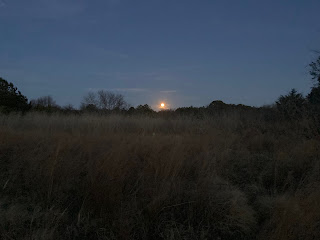
A nice flight of Robins and Blackbirds heading to roost and a distant calling Clapper Rail kept me occupied while waiting for my target birds to wake up.  Then at 6:06, 21 minutes after sunset, I heard the twittering flight call of a Woodcock in the distance (statebird #4).  The rule of thumb is accurate once again.  As I drove out I passed through more good habitat along Fitchett’s Road and heard 2 birds “peenting”, and saw 3 others in the waning light.  As I left the refuge I got this shot of the moon rising over one of the Woodcock’s fields.

VA was my 29th eastern state with Woodcocks, but I still need them in a number of states mostly near the western edge of their range.


That gave me 4 of 7 targets on the day – not great, but I’ll take it.

February 17 – Seawatch and Drive Home

My only planned stop of the day was an extended seawatch at Little Island Park.  The key attraction here was a long fishing pier from which numerous reports had been posted on eBird.  Unlike some other fishing piers that open later in the morning (like Jennette’s Pier in Nags Head, NC that opens at 9), the pier at Little Island is not gated so you can access the pier at dawn.  It’s often the case that seabird movement is best in the early morning, and that was typically the situation at Little Island with best numbers often from seawatches starting at sunrise.  So my plan was to start at sunrise and stay at least a couple hours before making the long drive home.

I arrived at 6:45 to this spectacular sunrise.

And after pausing to take in the view, bird activity quickly started to pickup around me.  Soon the sky was full of Gannets flying south.  Many were right overhead and some were calling – I’ve never heard Gannets call except at a breeding colony in Newfoundland.  And although there were some diving birds, most were just heading south.  The flight continued until 7:05, and over those 20 minutes I estimated 10 birds were passing by every second for an astounding total of 12,000 Gannets!  Here’s a typical picture of that amazing flight.

The rest of the time during my seawatch there were hundreds if not thousands in view, but they seemed to be milling about rather than heading south.

But Gannets weren’t the only birds heading south.  There was a steady stream of other species heading south, dominated by Red-throated Loons, Red-breasted Mergansers, Cormorants, and Black Scoters.  At one point I spotted a pair of birds flying together – the lead bird was obviously a Red-throated Loon.  But the second bird was about a third smaller, and although roughly the same shape it had a more arched body, a faster fluttering wingbeat, and white patches in the secondaries – I had a Red-necked Grebe (statebird #5).  I was able to watch this pair for 10-15 seconds as they passed by to the south.  VA was the 5th state where I’ve seen this species as a rarity south of its normal wintering range.

Then there was the alcid show.  Although most of the seabirds were flying southbound, I started to notice singles or pairs of birds heading north.  These northbound birds invariably turned out to be Razorbills, some flying quite close to shore.  And then while watching one Razorbill heading north, a much smaller alcid passed through my scope field heading south.  I had a Dovekie, looking like a football with no extended head and neck, and a whirr of wings (statebird #6).  Soon thereafter a second Dovekie passed by – luckily these birds were rather close providing good extended scope views.  I had 2 other likely Dovekies that flew by farther out.  Although the range maps show Dovekie wintering as far south as North Carolina, they aren’t often seen from shore.

After about 2 hours the activity had slowed and I still needed to make the long drive home.  So I decided to call it quits with these very rough estimates –

Black Scoter – 100

Red-breasted Merganser – 135

Red-necked Grebe - 1

Dovekie – 2

Razorbill – 31 (exact count)

Red-throated Loon – 175

Gannet – 12,000

Double-crested Cormorant – 110

Truly a spectacular seawatch!

But the trip wasn’t over quite yet.  My route home included a couple hours of driving time through agricultural fields in southeastern VA – more Turkey habitat.  But I wasn’t too hopeful given my track record.  And as I neared the NC line I had pretty much given up.  But this time the “birding gods” were looking out for me.  Just 20 minutes before crossing back into NC, while driving on US 58 in Brodnax, I spotted a group of 8 Turkeys in an adjacent field.  And 10 minutes later I spotted another small flock (statebird #7).  Until then my daily VA Needs Alerts would include a dozen or more Turkey sightings scattered across the state – probably the most common species I still needed in VA.  Thankfully my Needs Alerts will no longer be dominated by Turkey sightings.  I only need Turkey in 6 more states plus DC.

A perfect ending to an excellent trip!  With 7 new birds that brings my VA list to 267.  The link to the eBird Trip report for this VA portion of my coastal trip is inserted below –

https://ebird.org/tripreport/39066

Can’t wait to go back to the VA coast again, likely next winter.  Or earlier if there are some nice rarities to chase.

Tuesday, March 16, 2021

Exciting Second Trip to Tennessee in a Week – Not to Mention a Short Side Trip into Virginia, February 20, 2021

On February 17th I made my first birding trip to eastern TN since moving to western NC, breaking the ice so to speak.  That was a most successful trip to an area northwest of home, netting three new birds for my TN list.  While doing research for that trip I found several other targets I needed near the northeast corner of TN in an area north of home, but that would have been too much ground to cover for one day.  So while driving back from my most successful initial TN trip I was already starting to plan my next TN trip, this one to northeast TN.

There were 3 key targets being seen north of me near I-26.  The first 2 were seen at South Holston Lake, specifically from the boat launch along Route 421.  First there was a White-winged Scoter reported along with a Long-tailed Duck (since I got a Long-tailed on my previous TN trip that one was no longer a target).  Then there was a Red-throated Loon seen along with several Common Loons.  The Scoter was reported multiple times, though the Loon was only reported once.  So I was hopeful for the Scoter but realistic that my chances were low on the Red-throated.  Though I’m always up for a long-distance Loon search – it’s almost like my beloved seawatches.  The third target was perhaps even a longer-shot – a pair of Common Mergansers reported just once on the Watauga River in Johnson City, and that was nearly a week earlier.  But that spot would only require a short side-trip on my route home, so certainly worth a try.

And then there’s another twist – the South Holston Lake boat ramp is less than 10 minutes from the TN/VA state line.  My VA statelist was a respectable 249, but I still had many gaps.  I set up an eBird Needs Alert for VA and found only one recently reported target near the state line – Wild Turkey, and they’re almost never reliable.  With a bit more research I found very few hotspots nearby, and few recent checklists submitted in the area.  With no reliable targets to chase after my thoughts turned to doing a bit of speculative birding in the area.  One of my possible VA statebirds was the Pine Siskin.  This has been a great winter for Siskins, with many moving through earlier in the season.  So ordinarily I would think that this would be the year for me to add that species to my VA list.  But lately the reports from southwestern VA had been pretty limited, with none being reliable.  (Actually, the closest recent Siskin report was from the Holston Lake boat ramp in TN – but I didn’t need Siskin for my TN list.)  Maybe I could get lucky and just run into a flock.  One of the closest hotspots was Washington County Park on South Holston Lake.  It had a nice wooded area which looked like it could be birdy.  So I decided to make a short side-trip to the park and hope to get lucky birding the woodlands and brushy edges.

The night before my trip I checked eBird one last time for updates.  Unfortunately, there was a report from the boat ramp with no Scoter or Oldsquaw, and still no Red-throated Loon.  And no new Common Merganser sightings.  Had they all moved on?  I was realistically thinking that I might not get any new statebirds on this trip.  But even if that were the case, it would give me a chance to visit a new area. 

The morning of the 20th was a cold one – 24 degrees when I left the house.  And when I crested the mountains near the TN/NC line the temp had dropped to 18 degrees.  The clouds near the top looked a bit ominous, and were spitting a few snow flurries, but I wasn’t too concerned about road conditions.  Shortly after I crossed into TN I spotted an immature Bald Eagle flying overhead – not new for my list but perhaps an omen of good things to come.

I arrived at the Holston Lake boat launch area around 8:45 and started to get my bearings.  First there were long views like this one out on the lake in several directions where searches for Loons might be fruitful.


But the photos of the Scoter and Long-tailed Duck looked to be in more protected waters and from a closer distance.  The area between the boat ramp and the marina toward the west was quite protected, so I started my search there.  Unfortunately, the only waterfowl there were 2 Canada Geese.  I started to wonder if it might be worthwhile to try to access the marina and look for the ducks among the boat slips.  There was also a somewhat protected area to the southeast, but that area came up empty for waterfowl.  The only birds were a small flock of Ring-billed Gulls with a couple Bonaparte’s mixed in. 

Then I turned my focus to a search for Loons farther out on the lake.  It was rather breezy, which put a bit of a chop on the reservoir.  My first scan came up empty.  Then on the next scan I found a Loon which was obviously a Common.  And then on a later scan I found 2 others together but again they were just Commons – though they were a considerable distance out making the IDs challenging. 

I was coming up empty on both of my targets, but I didn’t feel good that I had found the right spot for the Scoter.  I started to wonder if there was another cove with protected waters nearby that I hadn’t found yet.  I walked a short distance north toward the main road, and looking off to the northeast found a small protected cove.  Could this be the right spot? 


 As I set up my scope a Red-breasted Nuthatch called from the pines overhead.  One of the checklists with the Scoter also had a Red Nut – maybe I was finally in the right spot.  On the first scan I saw only a Bufflehead.  Then with binocs I spotted a dark duck on the water a short distance away.  I put it in my scope and I had the female White-winged Scoter.  And with another scan I spotted the Long-tailed Duck.  A bit later all 3 divers where swimming together providing this phonescoped moment.


It’s amazing how looking in the right spot can increase your chances of finding your target birds.  While I was there a local birder arrived also looking for the Scoter and Long-tailed and I was able to point her toward this protected cove.  Looks like I wasn’t the only one who didn’t know where to look.  I made sure when completing my eBird checklist for this spot to add some specific directions to this cove.

My statebird map for White-winged Scoter is inserted below.  The blue-shaded states are those where I’ve seen this species in its regular range – principally on the Pacific coast, northern Atlantic coast, and along the Great Lakes.  The cross-hatched states are those where it is regular but I haven’t yet seen it.  And now TN was the 7th state where I’ve seen this species as an inland or southern rarity. 


So with one target under my belt I returned to my original spot to spend more time looking for Loons.  My first couple scans came up empty – no Loons at all, just a flyby Bufflehead.  But the water was pretty rough, and there was a bit of heat shimmer so distant viewing wasn’t exactly easy.  Then I picked up one Common Loon in the distance, and a short distance away spotted a second Loon, both diving frequently.  My initial take on this second bird was that it was noticeably smaller than the Common.  Did I have the Red-throated?  The overall appearance seemed to be that it was a browner bird, a bit lighter than the nearby Common.  Then I focused on the head - the bill was smaller than the Common and the head was more rounded.  I did not notice that its head and bill were more upturned typical of a Red-throated, but given the considerable distance (likely over a half mile) and its limited time above water, I felt like that wasn’t a deal breaker.  After 30 minutes of studying this bird I concluded I had found the Red-throated Loon.  Unfortunately, it was way too far away for photos. 

In my statebird map below I’ve seen Red-throated Loon in all its regular coastal states, but still need it in several states in the Great Lakes region.  And TN was my second state (after VT) where I’ve seen it as a rarity. 


Now it was off to VA and my speculative search for Pine Siskins.  Just a couple minutes after crossing the stateline I arrived at the gate to Washington County Park, only to find out that it was closed.  Mind you, it was not just a pole across the road to keep cars out but you could still walk in.  No, it was a gate in a chain-link fence blocking all access to the park.  That was disappointing.  At least there was also a boat ramp down to South Holston Lake that I could explore.  I set up my scope and only found a couple Ring-billed Gulls flying about.  There was a little passerine activity along the shoreline but not much else.  I was just about to call it quits on the VA part of my trip when I noticed a medium-sized red passerine fly past me along the shoreline.  I put my binoculars on it and was shocked to realize it was a male Red Crossbill!  I followed it to a grove of pine trees a short distance away and realized there was a whole flock of Crossbills up there.  I guessed perhaps 8 or 10 birds flitting about, complete with their “kip kip” call notes.  Just then the whole flock dropped down to the water’s edge to drink – I counted 14 Crossbills, more than half red adult males.  I snapped this phonescoped photo unfortunately a second after most of the flock took of – at least 2 birds remained for the shot.


Red Crossbill was #250 for my VA list – my 24th state with at least 250 species.  And VA was my third state where I’ve added this species to my state list since moving to the area (along with NC and SC).  I’m still hoping to see Crossbills in TN most likely in the highest mountains along the Blue Ridge, where they are typically much more common than in VA.


A bit later I had a calling Brown-headed Nuthatch in those same pines.  And a Palm Warbler foraging on the lawn below.  A very nice stop.  On my way back to TN I drove some of the back roads still hoping to find a Siskin flock but to no avail.  Though I’m certainly not disappointed - I’ll take Red Crossbill over Pine Siskin any time!  Maybe I can get back to the area in early spring and get Siskins as they are heading back north.  

My next planned stops on my way south were a couple areas along South Holston Lake hoping to find other waterfowl or gulls.  A couple stops along the river below the dam yielded an amazing 152 Bufflehead, along with 20 Wigeon.  It was a fast-flowing river that looked good for Common Mergansers, but not today.  And a stop at the dam overlook offered this nice scenic view, though I didn’t have a single bird on the water.


Next I was off to the Johnson City area to try for the Common Mergansers.  The birds had been seen on the Watauga River, which meanders through the area for quite a number of miles.  The eBird report mentioned “Seen multiple times flying up/downstream.  Landed in water in front of us”.  There was only limited access to the river, providing a view of only one small portion of river habitat likely suitable for Mergansers.  And along with the fact that the sighting was now 6 days old, this would be a long-shot to say the least. 

I arrived at the pinned eBird location to find a small park and fishing pier with a nice view of the river.  Certainly seemed suitable for Mergansers.  But the problem was I saw no waterfowl at all.  I scanned upstream and down, and waited at least 10 minutes, but still no waterfowl.  Then on one scan I noticed a Great Blue Heron standing on a grassy bank a short distance downstream.  On closer look I thought I could see the dark head of a duck, likely a Mallard, sitting in the grass nearby.  I put them in the scope – it wasn’t a Mallard, it was a male Common Merganser! 


I was able to drive down closer to the roosting Merganser now barely visible over a small rise, and realized a female was by his side.


Later when I looked back at my photo of the Heron in the distance I realized you could see the reddish head of the female Merganser right behind the legs of the Great Blue.  Not sure I would have spotted my targets if the Great Blue hadn’t been perched there.  And if the birds had been resting along the shoreline just a short distance farther downstream they would have been around the bend and out of view.  Certainly an element of luck involved with birding.

I’ve seen Common Merganser throughout most of its range, though I still need it in 3 northern states, as well as 5 southeastern states where this species might be better called the “Not So Common Merganser”.


That brings my TN list up to 243 – a nice addition of 6 birds over 2 trips in the same week.  An excellent way to start my birding in eastern TN.  I’ve come up with a list of another 34 possible targets along the eastern edge of TN to hope for in the future.  Plus, another 32 additional targets in southwestern VA.  Can’t wait for more trips to explore these new regions.

Thursday, February 22, 2018

Five Statebirds in the Mid-Altantic – and “Reportable Plus 15” in Virginia, January 2018


A trip to visit relatives in MD in January gave me an opportunity to fill a few gaps in my Mid-Atlantic statelists, not to mention pursue a few rarities.  With the help of eBird Needs Alerts in MD, DC, and VA I found several targets in the area, though they were pretty spread out.  In DC potential statebirds were Turkeys and Lesser Black-Backed Gull both seen occasionally in Anacostia River Park.  Plus there were several sightings of Common Goldeneye and older reports of Tundra Swan in the Potomac seen from the Alexandria waterfront (the whole river is in DC).  The VA targets were more numerous, including a long-staying Clay-colored Sparrow at the Laurel Hill Equestrian Center, seemingly reliable Iceland and Glaucous Gulls at the Occoquan Regional Park and sites downriver, and a Rough-legged Hawk and Short-eared Owls at Dulles Airport.  And in MD there was one key target – an overwintering Harris’s Sparrow at Bladensburg Waterfront Park.

That gave me a lot to search for.  Luckily I had a full day and an early morning of another day to chase after my targets, and I’d likely need all of that time.  Of all those targets the most important ones were in VA since my state total was 14 over the old reportable threshold, putting me just 1 short of my somewhat arbitrary “Reportable Plus 15” goal.  So my plan was to make a couple quick stops in DC and then spend the rest of the first day in northern VA.  Then early the next morning I would try for the Harris’s in MD. 

Anacostia River Park is a nice urban park running more than 2 miles along the southeastern side of the river.  This stretch can have some nice waterfowl (I had Cackling Goose here before), and wintering gulls including Lessers and Iceland.  And then there is the potential for Turkeys – this is basically the only spot for them in DC, though they are often elusive.  (I’ve tried for them unsuccessfully quite a number of times.)  I arrived in the park at dawn and drove slowly along the road looking for Turkeys to the inland side and gulls on the river.  But I was coming up empty on both targets.  Finally I got to the southern end of the park and noticed a few gulls on the ice.  A quick binocular scan yielded one darker-backed bird in the distance.  With the scope I confirmed it as an adult Lesser Black-Backed, and I was able to get this distant phonescoped photo. 


DC was my 29th jurisdiction for this rare but increasing Larid (see my statebird map below), and it was #184 for my DC list.


I spent a few more minutes touring the park without finding any Turkeys (again!), so with the key VA targets still ahead of me, I quickly headed to Alexandria to try for the waterfowl.  My first stop was at the Washington Sailing Marina and it was absolutely loaded with ducks – I guessed 3,000 to 4,000 birds total.  But despite lots of scanning I couldn’t find a lone Goldeneye that had been seen there recently.  And a local birder I ran into there said the Tundra Swan hadn’t been seen for several days.  So rather than further stops for the Swan, it was on to VA.

My first stop was at the Laurel Hill Equestrian Center where a Clay-colored Sparrow had been seen daily for some time feeding with White-crowned Sparrows along the grassy edges of the parking lot.  Seemed like a slam dunk.  As I pulled into the lot I spotted a couple birders a short distance away and asked if they had seen the bird.  One birder mentioned she had spished it in earlier in some brambles, but it hadn’t been since recently.  Another birder said to find the White-crown flock and you would find the Clay-colored.  But there were no sparrows at all feeding at the edges of the parking lot.  And although I found a number of sparrows including a few White-crowns in the brambles throughout the area, I never found a pure flock of White-crowns.

After about an hour I spotted a mid-sized raptor fly into a tree almost directly overhead.  It was a Merlin that stayed for at least 10 minutes.  Needless to say it scattered the sparrows down below.  While I waited for it to fly away so the sparrows would come back out, I mentally reviewed by VA state list and I realized that I actually needed Merlin for VA – that was number 247 for VA – 15 over the old ABA reportable threshold!  I now have 40 states plus DC meeting my Reportable Plus 15 goal.  My Merlin statebird map is pretty spotty for a species which is reasonably common country-wide.


But now it was time to get back to the sparrow search.  I spent another hour scouring the area, finding more sparrows including more White-crowns, but no Clay-colored.  Since Occoquan Regional Park was only about 15 minutes away, I decided to head there to try for the white-winged gulls, and then come back to try for the Clay-colored again.  Both Iceland and Glaucous had been reported at the park several times recently on eBird, as well at sites farther down the river, so I figured both would be somewhat reliable.  As I pulled up to the park I could see a couple birders already there with their scopes trained on the river and the flock of about 150 gulls out there on the ice.  I hurried up to them only to find out that not only did they not have the target birds, but one birder had been there for a while without success.  And worse yet - he had looked for the gulls there several times without any luck.  I asked about the spots down river and the birders suggested they would be even longer shots.  Though one birder did give me a new tip for finding the Clay-colored.

The target gulls certainly weren’t in the park, so I decided to head downriver to try for the gulls there.  I found good numbers of gulls on the water and shorelines, but couldn’t tease out any of my targets.  I had struck out on the white-winged gulls.

So I made my way back to the Equestrian Center to try for the Clay-colored again.  I figured I could give it about an hour before having to make my way to the Dulles Airport to try for the Rough-leg and Short-ears there.  First I checked on the grass around the parking lot and again found no sparrows at all.  Then I headed to the spot suggested by the birder at the Occoquan Park.  It had lots of sparrows, but no Clay-colored.  After my allotted hour I gave up and chalked it up as yet another missed target.

I wasn’t being too successful in VA – things had to pick up at Dulles, right?  The key location for the recent Rough-legged Hawk and Short-eared Owl reports was a hotspot called “Dulles Airport- Snowy Owl Observation Point”.  After some research it looked like this spot was actually a parking garage, which I confirmed by asking a few birders I had met earlier in the day.  They also confirmed that security wouldn’t arrest a birder using a scope there to peer out over the runways.  (It’s never good to be arrested while birding.)  I think I had it figured out.

I needed to get there early enough to try for the Rough-leg but stay late enough for Short-ears to appear.  So I arrived at 3:45 to give me maybe an hour to look for the Rough-leg before dusk.  I started my scans of the areas around the runways, and soon spotted several Red-tails perched in trees around the perimeter of the airport, but no apparent Rough-legs.  Then in the distance I spotted 3 Harriers dive bombing what appeared to be a large dark raptor perched on a low post.  After some time I could eventually pick out some field marks on the perched bird and it appeared to be a Rough-leg.  But it wasn’t until I watched the hawk fly a short distance down to ground apparently to capture prey that I could confirm it was a Rough-leg.  Not bad for a bird more than a mile away!  VA was my 30th state for Rough-legged Hawk – I still need it in a number of states especially in the upper Midwest.


Harriers will often roost in the exact same areas as Short-ears.  In fact, Harriers head to these roosts in the evening at about the same time that Short-ears come out to start their “day” – a changing of the guard kind of thing.  So since there were 3 Harriers harassing the Rough-leg late in the day, I was hopeful that I might find Short-ears in the same area as dusk approached.  While I was waiting for it to get darker (dusk was still an hour away) a couple other birders arrived, and I got them on the distant Rough-leg.  And sure enough the Harriers were still harassing it.  And then as I was pointing out the raptors to one birder I noticed a different bird harassing the Rough-leg – it was a Short-eared Owl!  I was able to watch the owl on an off for the next 10 minutes as it flew around the area.  Nice to not have to wait for dusk.  My statebird map for this species is really spotty – I still need it in many different states across the country. 


That gave me 249 on my VA statelist – now 17 over the old ABA threshold.

The next day I planned to head down to Bladensburg Waterfront Park in MD to try for the Harris’s Sparrow that had been at the park for some time.  The bird was most often seen feeding in one stretch of one of the trails with other sparrows, eating seed that had been placed there by helpful local birders.  Although that all seemed easy enough, actually the bird wasn’t being seen on every trip there.  My guess was that if a group of birders was at the site they might end up scaring away the sparrows along with the Harris’s, keeping them from feeding out in the open.  So to maximize my chances I decided to get to the park as early as possible and be the first birder to the site.

Right on schedule I arrived at the park about 20 minutes before sunrise, and quickly took the 15 minute walk to the area where the sparrow was being seen.  I was the only person there – so far so good.  As I neared the bird’s preferred part of the trail I could see a number of sparrows up ahead feeding out in the open.  I stopped for a while optimistically searching through them but there was no Harris’s.  Then I happened to look farther down the trail and there was another flock of sparrows feeding there as well.  I got a few steps closer to that second area, though still keeping my distance, and scanned through that second group.  And within seconds the Harris’s popped out into the open and fed right out in the trail, providing distant but excellent looks at this continuing rarity.  Isn’t it nice when your plans come together so well.  That was #331 for my MD statelist.  MD was my 6th eastern state, along with 1 western state (WA) where I’ve seen Harris’s Sparrow as a vagrant, along with most of the central states where it is a common migrant and wintering species. 


A nice couple days of birding with 5 new statebirds, especially for states where I already had pretty good lists.