Showing posts with label Maine. Show all posts

Wednesday, December 26, 2018

Third Time’s the Charm for American White Pelican, New Castle, NH, December 2018


American White Pelican is a rare vagrant in New England, as it is throughout virtually all of the eastern US.  And in New England, only rarely do birds stick around long.  Often they are seen as one or more high flying birds passing by on the coast.  Needless to say those birds aren’t chaseable unless you’re already on the coast and are lucky enough to be able to catch up with them as they head out of town.  As a result, in New England I’ve only seen White Pelican in MA and RI, and both birds were ones that had luckily stuck around for a couple days allowing for successful searches.

Then there was this interesting set of events in December 2018 -

It was Sunday afternoon, December 9, and at about 2 PM I received a text from Steve Mirick’s NH rare bird alert that an American White Pelican was reported heading south from Wells, ME.  Very appropriately Steve suggested it was worth keeping an eye out for the bird in NH.  Later in the day an eBird Maine Needs Alert came across with a White Pelican in York County.  The checklist was apparently from a full day of birding with the listed location being “York County”, and with no details on the location or time of the Pelican sighting.  Though there was a photo of the bird sitting in dry Spartina grasses in a coastal marsh somewhere.  Undoubtedly that was the bird reported in Wells which was last seen heading south.  Certainly not chaseable, right?

Then late in the afternoon Monday came yet another eBird Maine Needs Alert with a Pelican sighting.  At first I just assumed it was a second sighting from Sunday, but when I opened the e-mail I realized it was actually a Monday sighting once again from Wells.  The bird was seen swimming in the Webhannet River – apparently the bird was still around.  The post came across too late to give it a try that day, but it was certainly worth a try on Tuesday.  Especially since I didn’t go after chaseable White Pelicans (3 of them!) seen in Wells in May earlier this year. 

Tuesday morning I teamed up with Davis Finch and Mike Beck to search for the Pelican in Wells, ME.  But despite 3 hours scouring the waters and marshes of the Webhannet River we were unsuccessful.  Though it certainly was great to catch up with Davis and Mike!  Oh well – “a day late and a dollar short” as they say.  Tuesday evening while posting our sightings on eBird I noticed a post on the NH listserve that a White Pelican was photographed from Odiorne Point State Park that day.  The post was on a Facebook site and was not posted until dinner time that day.  Apparently our target bird was in NH while we were looking for it in ME - ugh.  And like Monday’s post of the bird in ME, it came across too late to chase that day in NH.  So once again it was time to plan for a chase the next morning.

Wednesday morning at 7 I met David Donsker at Odiorne in Rye, NH to look for our target bird.  But once again, I came up empty.  We searched the area around the Odiorne boat ramp where it was seen on Tuesday, as well as the Odiorne coast all the way to Frost Point, the New Castle coastline across the river from Odiorne, and as much of the remaining Newcastle coastline as we could access.  Once again I missed it by a day. 

Tallies from my 2 unsuccessful chases on consecutive days in 2 states – 7 hours of driving, 5 hours of birding, 0 White Pelicans. 

Two days later, Friday, I was in RI starting my day successfully adding Evening Grosbeak to my RI list as part of some inland birding in the morning.  That afternoon while doing a rather unremarkable seawatch from Point Judith, RI I got a text from Steve Mirick that the White Pelican had been re-found in New Castle, NH.  Even if I left that second I wouldn’t be able to make it to New Castle before dark.  My original plan was to spend the night in RI and participate in a Christmas Count the next morning.  But earlier in the day I had decided to pass on the CBC since I had come down with a pretty miserable cold.  Though my cold wasn’t bad enough to prevent me from chasing after a potential state bird!  Once again I planned an early morning trip to try for the Pelican – once again time back on the NH coast.

The bird had been seen on Friday from the “green bridge” – a narrow 2-lane metal bridge on Route 1B that takes you onto the island that makes up the majority of the town of New Castle.  It was also seen in the marina just east and south of that bridge.  But there was no place to pull over while on the bridge.  And the marina was private property requiring permission to access.  And did I mention that there are almost no public parking spots in the area?  Needless to say this could be a challenge.

At 7:10 Saturday morning, 12/15, while I was still in route to New Castle, I got a text from Steve that the Pelican was still there, seen from just west of the metal bridge.  Twenty minutes later I turned onto Route 1B, and luckily at that time of the day there was almost no traffic.  As I neared the green bridge there were no cars in sight behind me, so I was able to come to a full stop on the bridge.  I quickly looked to the right (south) where all of Friday’s sightings had been, but there was no bird.  Then I took a bit longer scan of the water and shorelines below but still no bird.  Then I made a quick look at the bit of the marina that is visible from the bridge, but again came up empty.  I was starting to worry.  Then I looked to the left, and peering between the bridge railings, I could see a large white bird swimming in the estuary to the north.  A quick binoc view confirmed I had the White Pelican!

I pulled ahead and parked in an “almost-legal” parking space, and there was the Pelican right in front of me.  Here’s a shot of the bird with no magnification.


And here’s a phonescoped photo of this most cooperative bird. 


Third time was the charm!

In subsequent days the bird was routinely being seen near the green bridge, and on the southern New Castle coast line opposite Odiorne.  Both of these areas were places David and I checked on Wednesday.  We also checked the edges of the marina as well, though couldn’t see into the center of the marina where even a large white bird could easily hide behind a boat and out of sight.  I wouldn’t be surprised if the Pelican was there all along, though I doubt that David and I overlooked it.  Instead I bet it was hanging out at the marina out of view when we were searching for it earlier in the week.  In any case, good thing that it stuck around for many to see it.

American White Pelican was #369 for me in NH, and my 36th state for this species which is prone to vagrancy across the US (see my statebird map below).


And now for a post-script –

At 3:30 in the afternoon of the 24th a (the?) White Pelican was spotted in Falmouth, ME – 50 miles (as the Pelican flies) northeast of New Castle.  The last eBird post of this bird in New Castle was at 11 AM on the 24th.  Was this the same bird, flying 50 miles to the northeast that day to return to the ME coast?  Or have there been 2 birds all along – one preferring the NH coast and a second bird that never left the southern ME coast?  The Pelican was not found in NH on the 25th, but one was seen in Portland, ME that morning, though just for a couple hours before flying out of sight.  So it’s looking more likely that it is indeed just one bird and not two.  Is it too late to ask for a chaseable Pelican in ME for Christmas?  Stay tuned…

Saturday, October 20, 2018

Prothonotary Warbler, Kennebunkport, ME, October 2018


Each year I make an early fall trip to southeast VT looking for sparrows and late warblers.  So as early October rolled around I made my plans for my annual VT adventure to Brattleboro and Vernon, with a multi-stop, day-long itinerary. 

But wait – the title of this post talks about Kennebunkport, ME, not VT.  How did that happen?

Literally minutes before heading out the door I remembered that not one but two Prothonotary Warblers had been spotted in the last 2 days on the southern coast of ME.  One report was just the previous afternoon in Kennebunkport.  There have been quite a number of Prothonotary’s in ME both in spring and fall the last few years, but I hadn’t had a chance to chase after any of them.  So rather than a completely speculative trip to VT, why not change my plans to chase after a recently spotted rarity just a bit farther away?  I turned my computer back on, and did a bit of research on yesterday’s Prothonotary in Kennebunkport.  And just in case that bird didn’t cooperate, I also took notes on the one seen 2 days earlier just up the coast in Scarborough.  I changed my route on the Map App to drive northeast to Kennebunkport instead of northwest to Brattleboro, and I was out the door.

After a 2-hour drive I arrived at Fishers Lane in Kennebunkport.  The location of yesterday’s sighting was pretty specific, with the observer mentioning that the bird was in brush at the end of the road near the brown canoe.  There were 3 other cars parked at the end of the road when I got there, so I was hopeful that other birders already had the bird.  After a short walk I spotted the brown canoe and then a birder nearby.  I had the right spot, now I needed the bird to cooperate. 

I approached the birder and he said he was one of the observers of the Prothonotary yesterday, and he was standing at the location of yesterday’s sighting.  He also mentioned that other birders had the target bird an hour earlier in the brush a short distance down the beach.  So I walked in that direction and soon found 3 other birders also looking for the bird.  It seemed that the bird was moving around in a reasonably small patch of brush near the beach and an adjacent freshwater wetlands.  Now to start my search.

There were at least 5 birders in this small area anxiously searching for this bright yellow bird.  Over the next hour there were numerous Yellow-rumps passing through, and I spotted a Blackpoll as well, but no Prothonotary.  Then while scanning the backside of the marsh in the distance I caught a briefest of glimpses of yellow.  I told the 2 birders I was standing next to that I may have the bird.  Then a couple seconds later the Prothonotary popped up in the open 2 feet off the ground.  By the time I said I had the bird, it dropped back in the brush again out of sight.  Unfortunately I was never able to get the other birders on it. 

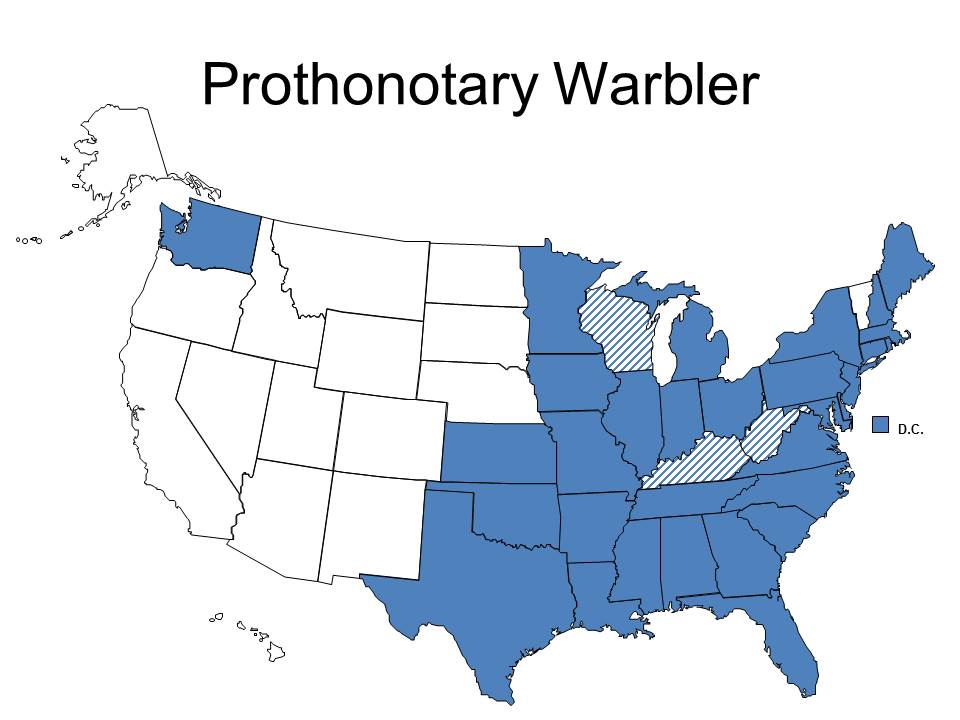
It’s nice to finally check off Prothonotary Warbler for my ME list - #343 for that state.  That was the 32nd state where I’ve seen this species (the dark blue shaded states in my statebird map below).  The cross-hatched states are those in its regular range where I still need it for my statelists – I’m only missing it in 3 states where it is a non-rarity.  Plus Prothonotary can be seen as a rarity in a few other states, including ME and elsewhere in northern New England.  Though few would expect it in WA, where I found one a couple years ago as an extreme rarity.


I had set aside the whole day to find the Prothonotary, or the one found the day before.  So now that I found my target so quickly, I needed to decide what to do with the rest of the day.  First I tried to get a better view of the Prothonotary, but I spent the next 30 minutes at the Fishers Lane spot without re-finding it.  During this time I continued to notice quite a large number of Yellow-rumps in the area, and wondered if this was going to be a good fallout day.  So with some advice from other birders there, I decided to head up the coast, and first headed to Timber Point to try my luck with migrants there.  The fallout of Yellow-rumps continued at this spot as well.  I did my best to make an exact count which was 176 in the 90 minutes I was there.  I tried not to double-count any birds, but it was impossible to tell for sure since they were always coming and going, often with 5-10 in view anywhere there were shrubs and edges.  I also picked up a late Redstart, and two cooperative Swainson's Thrushes.

Then it was off to Biddeford Pool and the South Point thickets.  I had 20 more Yellow-rumps here plus a most cooperative Gray-cheeked Thrush.  Or more accurately I should say it was a Gray-cheeked/ Bicknell’s since apparently the latest ID advice is that you can’t safely separate these two species if they are not singing or in the hand.

My last stop was at the Nubble Thickets in Ogunquit where I’ve had great migrants in the past.  However, I didn't have a single warbler there!  And the only migrants were one White-throat and one Junco.  Go figure.  The highlight here was a small duck out on the ocean in a large flock of Common Eiders which turned out to be a Green-winged Teal.  A nice find at the end of a nice day of birding.

I’d like to think that I made the right decision to search for the Prothonotary in ME instead of heading to VT.  Then again, I guess I’ll never know what I might have found if I had kept with my original plans and traveled to VT instead.

Sunday, August 19, 2018

Best 2 Days of Birding Ever, August 2018


It all started with reports of a Little Egret in Westerly, RI – that’s only the 2nd record for the state based on eBird data, so it would be a great one to chase after.  And although the Egret was reported for a few consecutive days, it was only being seen between 5:30AM and 6 AM before flying off to points unknown with a flock of Snowy’s and Greats.  That was way too early for me to try for given my 2+ hour drive time.  But then the bird was found to be feeding during the day in marshes and perched in trees in the Winnapaug Pond area along Atlantic Avenue in Westerly.  So now it was very much chaseable.
And as I was putting my plans together to try for the Egret, a post came across the CT listserve from Tom Robben that he was able to see the continuing Bridled Tern on Great Gull Island in NY from a Lighthouse Cruise out of New London, CT.  This was presumably the same Bridled Tern that spent much of last summer on Falkner Island in CT.  Many birders got to see this reliable bird – that is the bird was reliable for almost everyone except for me.  I tried twice for the Tern without success.  And since this would be a life bird, I was still very interested in trying to see it this summer, even if it was in NY instead of CT.  Though Tom stressed that even if you were lucky enough to see the bird while on the Lighthouse Cruise it would still be very distant. 
So I started to revise my plans to start early morning in Westerly to try for the Egret, then head to New London to take the Lighthouse Cruise to try for the Tern.  While researching times for the cruise I noticed several e-mails regarding identification of a Hawk seen in Maine.  It took a while to unravel the story, but it was eventually ID’d as an amazing Great Black Hawk, native to Central and South America.  And despite some initial questions as to the location of the bird, it was verified to be in Biddeford, ME.  The bird was first seen two days earlier, but not re-found the next day.  What an exciting second ABA record!  But apparently no longer around.
And as they say on the infomercials – “But wait there’s more…”  I had just finished figuring out the Black Hawk story when an eBird NH Needs Alert came across with a Neotropic Cormorant seen in Gorham, NH 6 days earlier, complete with photos!  That would be a first record for NH and likely for all of New England.  But that was 6 days ago and a good 3 hours north of me.  So although there were now reports of 2 truly amazing birds north of me, both were now a bit dated, so I went back to continue my planning efforts to head south into RI and CT. 
Then minutes later came a report that the Great Black Hawk was re-found in Biddeford.  That certainly changed the equation.  And as I was piecing that together an e-mail arrived reporting that the Cormorant was still at the same location in Gorham.  I was having trouble keeping up…  Although the Little Egret and Bridled Tern were rare, they were not nearly as rare as the Great Black Hawk and Neotropic Cormorant.  So I changed my plans, and decided to start the day in Biddeford, then head north to Gorham.  The Egret and Tern could wait till the next day.
The Great Black Hawk was first reported two days earlier, though not surprisingly the observer needed help to identify this immature bird.  It was spotted in a small neighborhood along Maddox Pond Road just off the coast.  When the Hawk was re-found it was on nearby Lily Pond Avenue, with agitated Robins giving away its location.  So when I arrived at 7:30 that morning I headed right to Lily Pond Road and found at least 30 birders already milling about looking for our target bird.  No sightings yet.  But just a couple minutes later I could hear some Robins squawking a short distance to the south.  Could they have the Hawk?  I pointed out the calls to other birders, and many of us headed in that direction to check it out.  But before I could find the Robins here was another birder heading towards us to spread the word that he had the Black Hawk up ahead.  A minute later I came upon the squawking Robins, and there was the Great Black Hawk.  An amazing bird with such long legs and large bill.  It put on a great show, thanks to those marauding Robins.  Here are a couple phonescoped photos of the bird.


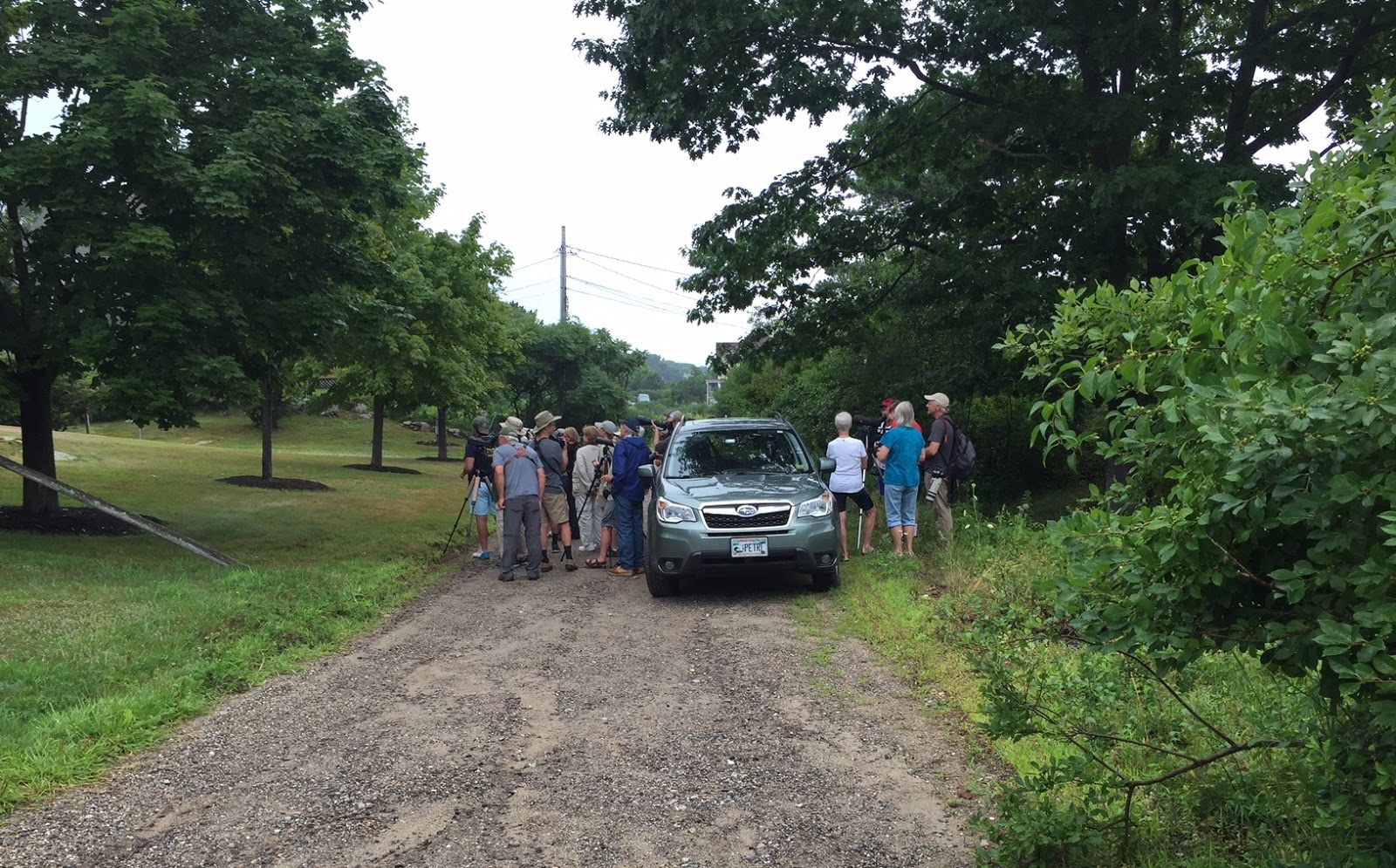
And a shot of the many happy birders who were there.


I spent about a half hour with the bird taking in all the great views, before it flew off a short distance back into the woods out of sight.  During this time I ran into Davis Finch, a long-time birding friend from NH.  I told him of my plans to try for the Neotropic Cormorant next, and he quickly accepted my offer to come along and make the trek up to Gorham.  After a short review of the maps, we planned our 2 ½ hour route, and at 8 AM our 2-car convoy started out through the country side.  About half way to Gorham I received a text with even more amazing news – a Wood Stork had just been spotted in southern NH at Pickering Ponds in Rochester!  There was only 1 previous hypothetical record for this species in NH, so it would be great to go after that bird too.  But we still needed to drive another hour north to try for the Cormorant.  And then it would take another 2-hour drive south before we could get to Rochester.  I shared the news with Davis when we arrived in Gorham, and we both crossed our fingers that the Stork would remain until we could get to Rochester.
But first we needed to focus on the Cormorant.  The eBird report included photos showing the bird perched on a line of orange buoys just upstream of a hydroelectric dam on the Androscoggin River.  Although directions in the first eBird report were cryptic at best, the new posts included good details, and after a short walk Davis and I approached the river where the Cormorant had been roosting.  As we crested the dike there was NH birder Steve Mirick already looking at our target bird.  I got these distant phonescoped photos of the Cormorant.


Interestingly the last Neotropic Cormorant I saw was earlier this year at Lake Mead near Las Vegas – also a rarity though certainly not as rare as this NH bird.  The NV Cormorant liked to perch on a floating “jetty” similar to our Gorham bird.  NH was my 8th state for this species which is increasingly prone to wandering from its regular range.


Although I was tempted to walk closer and get better views, both Davis and I were anxious to get back on the road to try for the Stork.  So by 10:30 our little convoy was heading south to Rochester, happily receiving updates that the Stork was still there.
Two hours later we pulled into the parking lot at Pickering Ponds, and within a couple minutes we walked up the dike to get a view of the impoundments.  There was a small group of birders up ahead, and they had the bird in their scopes.  Here’s a phonescoped picture of this most cooperative bird.


That was my second Wood Stork in New England – the first being in Barnstable, MA in November 1994.  And NH is now my 11th state overall for this species.


What an outstanding day!  I sure was glad I changed my priorities to head north to chase after these 3 extreme rarities.  And glad I went after the Hawk first because it was last seen at about 2 PM that day.
When I got home that afternoon I reviewed my e-mails and the Little Egret was seen again in Westerly, RI that day.  So that one was still in play.  And then I noticed an e-mail from a boat captain out of CT (Captain Ian Devlin) offering to take birders to Great Gull Island to try for the Bridled Tern.  That approach would certainly give me a much better chance of seeing the Tern compared to a “drive by” while on a Lighthouse Cruise.  I quickly replied back to him saying I would like to try for the Tern the next afternoon.  I also reached out to a CT birder Maggie Peretto who unfortunately was along with me on those same 2 unsuccessful attempts for the bird last summer, hoping that she might want to share the ride with me.  I got a quick reply from Maggie that she was interested, and she too sent an e-mail to Ian saying she wanted to go the next day.  But as the day progressed neither Maggie nor I had received a reply from Ian.  So despite the lack of responses, I planned to head out early the next morning to try for the Little Egret, then hopefully hear back from Ian to take his boat to try for the Bridled Tern.  But just in case I didn’t connect with Ian, I researched the times of the Lighthouse Cruise, as well as the regular New London to Orient Point ferries as fall back options. 
I was out of the house bright and early for the second consecutive day and arrived at Winnapaug Pond at about 8.  I was pretty familiar with this spot having seen 2 RI rarities there in the past – Ruff and White Ibis.  As I pulled up I could see another birder already there scoping the marshes.  Although he hadn’t found the Little Egret yet, he had found a flock of Snowy and Great Egrets about a quarter mile to the north feeding at the edge of the river channel.  This could well be the flock that the Little was associating with, so we spent the next few minutes trying to find out target.  But given the distance and all the tall vegetation we were unsuccessful picking out the Little Egret among those other white waders.
And then a couple of the Egrets left the flock and began flying toward us.  Then seconds later a few more took off.  I put a couple of these in my scope and initially thought in the distance that both were Greats based on size.  Then I realized one of them had a dark bill.  Now as they got closer I could see the dark-billed bird was a little smaller than the Great, and it had dark lores – I had the Little Egret!  The other birder spotted it in flight as well.  Interestingly, since the bird was flying nearly directly at us, neither of us saw the long head plume of the Little Egret.  Just goes to show you often need to focus on multiple field marks to make an ID.  I followed the target all the way to a nearby grove of trees, where it landed on the back side unfortunately out of view.  I waited another hour for the bird to drop down into the marsh to feed.  But it never came out into the open, nor were we able to re-spot it in the trees.  With the heat and humidity on the rise, I called it quits at 9:30, happy to have had at least a limited view of the Egret.  Good thing it wasn’t a lifer – I’ve also seen this species in ME, NH, and MA – otherwise I would have wanted better views.
Now I turned my attention to trying to get out to see the Bridled Tern.  I still hadn’t heard from Ian, so I gave him another call, but could only leave him another message.  It wasn’t looking like I would hear back from him, so I called the ferry company to see if they still had spaces open on the lighthouse cruise later that day.  Unfortunately the lighthouse cruise was canceled for the day.  This was bringing back awful memories of my futile attempts to try to get a boat out to see the bird last summer when it was in CT.  Although birders were heading out daily and seeing the Tern it took me a week to find a boat and captain to take me, and by then the bird was gone.  I probably spent more time trying to find a boat than my time actually on the water looking for the Tern.  Very frustrating…  But rather than head home, since I was already on the coast, I decided to just take a regular round-trip ferry ride out of New London to bird the Sound hoping for pelagics from the ferry.  Of course I would have next to no chance for the Bridled Tern – that would have to wait till another day. 
The next ferry with good viewing didn’t depart until 1 PM, so I had lots of time to kill.  I drove to New London, and parked in my regular garage, arriving at 10:30.  I relaxed in my car for a while, then headed into town and found a quaint sandwich shop for lunch.  It was now about Noon and just as I was about to head to the ferry to buy my ticket my phone rang – it was Captain Ian.  He could take me out at 2:30 that afternoon departing from Waterford a short distance to the west.  Next I tried to reach Maggie to see if she could go along with me.  Not only would it be great for her to have an opportunity to see the bird, but she could share the cost of the boat - $150 for 2 hours regardless of how many birders were on-board.  Unfortunately I didn’t have her phone number so could just send her an e-mail.
Now I had more time to kill, though first I had to find an ATM to get extra cash in case I was the only birder on board.  Within a few minutes I was at the boat ramp parking lot waiting for my trip to Great Gull Island.  Eventually I was able to connect with Maggie, but unfortunately she was unable to go along.  I was on my own, both with respect to paying for the boat as well as searching for the Bridled Tern.
Ian ended up being delayed in traffic, so we didn’t leave the dock until 3:45.  Luckily the water was quite calm because Ian’s boat seemed a bit small to head all the way across the Sound.  But after just a few rougher spots on our 20-minute ride, we neared Great Gull Island.  I had done quite a bit of research on the Tern, and thanks to info in blogs managed by Tom Robben (trips33.blogspot.com) and Joe DiCostanzo (inwoodbirder.blogspot.com), I knew that the Tern preferred to roost on rocks at the northeast corner of the island.  We headed right to that spot and I quickly started to scan the rocks.  There were quite a number of Common Terns scattered about, but no Bridled.  Then I did another scan, and then another scan – still no target bird.  I expanded my scans further to the east and west but still no Bridled.  This was bringing back most unpleasant memories from last summer. 
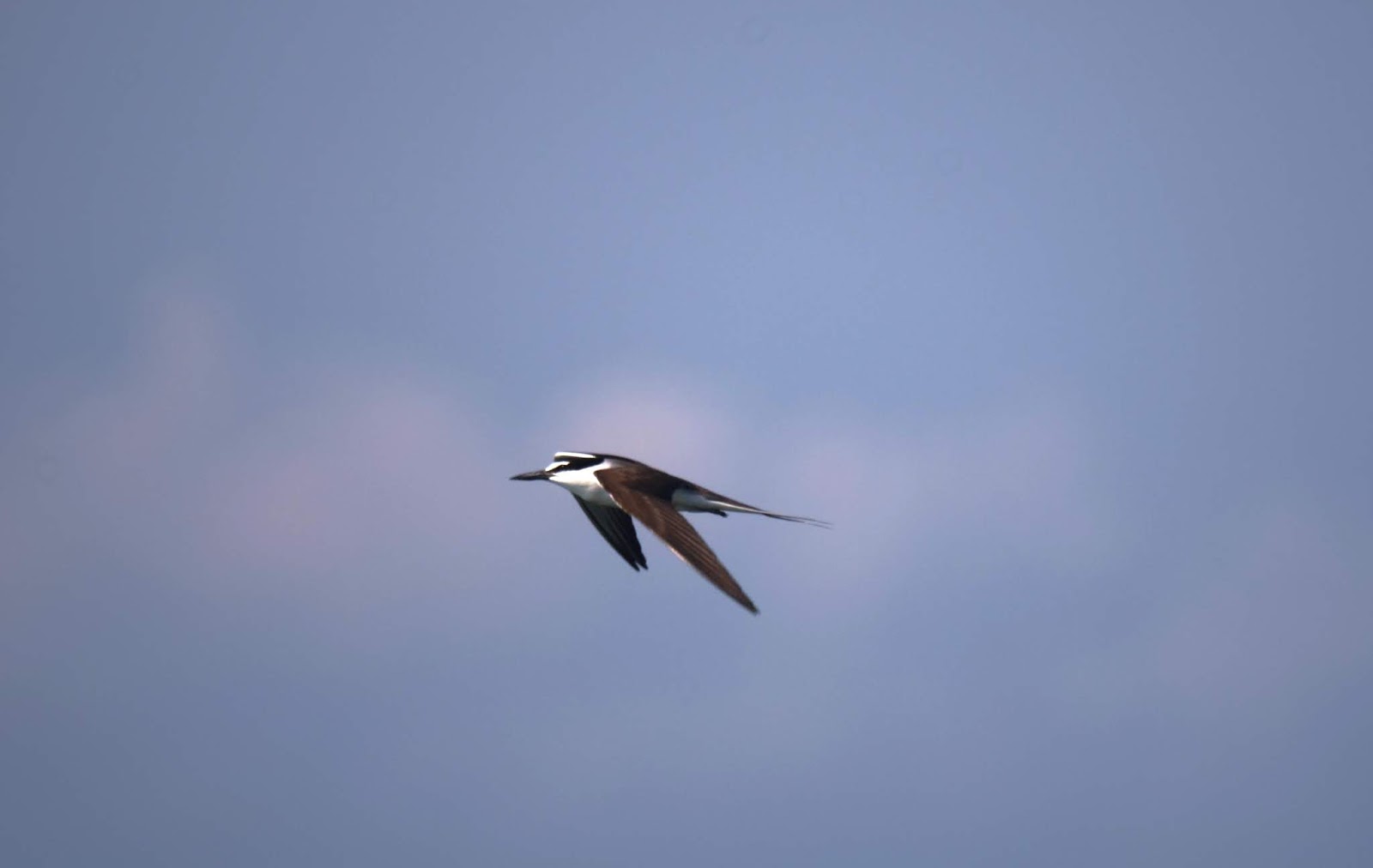
We had been at the island for maybe 5 minutes when seemingly all the Terns took off out over the water.  Ian spotted a Peregrine buzzing over the island and all the Terns were in chase.  I looked east into a boiling flock of maybe 500 or 1,000 Common and Roseate Terns low over the water and almost instantly picked out a darker-backed bird – I had the Bridled Tern!!!  We continued to follow the bird for a couple minutes as it flew around the boat, and I was able to get these pretty nice photos.


And later I got this shot of the Peregrine flying away, still mobbed by the Terns. 


At one point I watched the Bridled Tern land on the island, but it took off seconds later heading back out over the water.  We stayed at the island for the next 45 minutes but we never re-spotted the bird over the water nor perched, despite expanding our scans to nearby parts of the island.  The bird was obviously not perching in its favorite location.  Thank goodness for that Peregrine!  Otherwise I doubt we would have seen the Bridled Tern.


Before we headed back I spotted a Parasitic Jaeger harassing a Common Tern – in NY waters though.  I still need Parasitic for CT, which is the case for all the Shearwaters as well.  I had hoped that we might get lucky with other pelagics while motoring through the CT portion of the Sound on Ian’s boat, but it was too rough to scan while traveling along.  Though I certainly wasn’t going to be disappointed – after almost seeing a Bridled Tern while on a pelagic out of MA, having to pass on getting a boat to see one in ME, and 2 failed attempts last summer in CT, I finally had my life Bridled Tern!
What an ending to an outstanding 2 days of birding, not only seeing all 5 of my targets, but all 5 were also extreme rarities -

Day 1 –
    Great Black Hawk – life bird, first ME 2nd ABA record, bringing my ME list to 342
    Neotropic Cormorant – first New England record, NH bird #366
    Wood Stork – first confirmed NH record, NH bird #367
Day 2 –
    Little Egret – perhaps 2nd RI record, RI bird #330
    Bridled Tern – life bird, NY bird #284
My life lists now stand at 756 in the ABA Continental region (not including Hawaii), and 736 in the Lower 48.
In all my 51 years of birding, those were most definitely my best 2 consecutive days of birding ever!

Saturday, October 7, 2017

Fork-tailed Flycatcher, Gilsland Farm, Falmouth, ME, 9/17

While taking a break from chores around the house I opened my e-mails to see what might be around.  Needless to say my attention was instantly drawn to one that had just been posted with this subject line – “FORK-TAILED FLYCATCHER, Gilsland Farm, Falmouth”.  I’ve seen this South American vagrant in New England in MA, NH, and CT, but still needed it in ME, so of course I wanted to run right out and chase after it.  However as is often the case, I had commitments that day and could not go twitching.  And worse yet, I couldn’t go out the next day either.  Would the bird still be around on Day 3?  Vagrant Fork-tails will often stick around for a while, so I tried to be optimistic that I might still have the chance to see it in a couple days.

The e-mails and eBird Alerts continued throughout Day 1, and then luckily continued through most of Day 2 as well.  The bird was being reasonably reliable, though it was more difficult to find when a cooler fog bank engulfed the farm.  Under those conditions the flycatcher’s food was likely less active, so the bird was not surprisingly less visible feeding from lower perches.  All sightings were around the North Meadow, and since I’ve birded Gilsland Farm before, I had a general idea of the habitat and trails in this area.  With a bit of research I compiled a pretty good list of areas where the bird had been seen over those 2 days – basically any perch around the perimeter or in the middle of North Meadow.  It would be a large area to cover, but I was hopeful that there would be lots of eyes looking for it when I finally had a chance to give it a try. 

I left the house pre-dawn on Day 3 to make the 2-hour drive to Falmouth.  Just after dawn I saw a post that the Fork-tail was refound that morning, but the weather was once again cool and foggy at Gilsland Farm, so the bird was not being very cooperative.  But at least it was still around!

I arrived at 8 AM and quickly noticed 3 birders out in the middle of North Meadow.  I made my way down to them and one of the birders was the person who had spotted the target bird earlier that morning.  Unfortunately it had not been seen for at least an hour.  Soon thereafter I came upon a birding tour group who had decided to stop at a spot with a nice overlook of virtually the entire North Meadow in hopes of spotting the bird on an exposed perch.  And then minutes later the leader of that group got a phone call from another birder on site saying he had refound the bird.  After a few anxious seconds of searching, I spotted the Fork-tailed Flycatcher in the distance hunkered down in an apple tree.  The pressure was off, but I wanted to get much better views of this most attractive adult bird and its long tail feathers.

After a short walk I made my way down much closer to the apple tree where the Flycatcher had been spotted earlier.  The bird was still there, but mostly obscured by foliage.  Eventually I got some better views of the bird, and was able to get this passable phonescoped shot of it in the fog.


A couple minutes later it flew down to some shrubs in front of me and began to eat berries, providing this “Kodak moment”.


Satisfied with these great looks, I began my short walk out of the park, only to realize that the bird had flown into trees right in front of me.  So of course I had to stop to get a few more phonescoped shots of this amazing bird.  Unfortunately the thick fog limited picture quality quite a bit (not that phonescoped pictures are ever very good quality).


I headed back to my car very satisfied with my great views of this spectacular Fork-tailed Flycatcher, which was #341 for my ME list.  

Wednesday, August 9, 2017

Caspian Tern, Hills Beach, Biddeford, Maine, July 2017

In recent years Biddeford has been a key spot for sightings of both Caspian and Royal Terns in ME.  And more specifically, perhaps the Hills Beach section of Biddeford has been THE spot in ME for these large terns in late summer and early fall.  Back in July 2014 I made two trips to Hills Beach to try for both Royal and Caspian Terns (along with Skimmers – though I didn’t need that one for ME) that had been spotted there following the passage of Hurricane Arthur.  After dipping on my targets on the first trip, I was successful in finding 2 Royal Terns on my second visit there, though I missed the Caspian Tern and Skimmers.  At the time I reflected that if I could only find 1 of my targets it was nice that I found the rarer Royal Tern.  After all, Caspians are seen there every year.  Plus after two trips to Hills Beach I finally figured out how to successfully bird this spot.

But despite their regular occurrence, 3 years later I still needed Caspian Tern for my ME list.  In fact, Caspian was perhaps the most common bird I still needed for ME (along with others like Connecticut Warbler and Western Kingbird).  Of course Caspian Tern is still a rarity in the state since ME sightings are likely to be of a limited number of birds migrating along the coast to and from small breeding colonies far to the northeast in Newfoundland and nearby Quebec.  Although there are also larger inland colonies in Ontario and upstate NY, plus the sole New England colony on Lake Champlain, it’s unlikely that those birds make their way far to the east on the ME coast during migration.

Right on cue as we entered mid July 2017, the first Caspian Tern report was posted from Hills Beach.  Although it was reported on just one day, it sure got my attention.  And when another was spotted in downeast ME a week later, that was enough of a catalyst to make me start planning my next attempt for Caspian Tern at Hills Beach.  I contacted Mike Beck, a birder and former co-worker who retired to ME, and we planned to meet at Hills Beach the next morning.  Although we wouldn’t be chasing after a specific reported bird (it had been over a week since the last one was reported at Hills Beach), the timing was right for us to try to find the next one.

We arrived at 8 AM and parked along the shoulder of Hills Beach Road opposite Bufflehead’s restaurant in the only area where you can legally park and gain access to the beach.  And with a short walk we were overlooking the sandflats at full low tide.  There were a bunch of Common Terns perched on the flats and flying about, but no large terns were to be seen.  We continued to scan the area, picking out a number of feeding Bonaparte’s Gulls and several small flocks of Dowitchers, but the diversity was pretty limited.

Then at about 8:30 I spotted a larger bird flying out over the water in the distance which was flying like a larger tern.  Could it be a Caspian?  I continued to watch this bird for a couple minutes, and became convinced it was a tern, and it had a heavier more gull-like flight of a Caspian instead of the more buoyant flight of the thinner-winged Royal Tern.  But it was too far away and I couldn’t be 100% sure. 

I returned to scanning over the flats, and not five minutes later I heard a single call of a Caspian Tern coming from somewhere close nearby.  I would have sworn I was about to see it right away flying out over the flats somewhere.  But alas, I never did spot it despite much anxious scanning.  I was sure it was the call of a Caspian, but why did I only hear it once?  And why did we not see the bird afterwards?

Mike and I then walked out on the sandflats to get closer views, and especially to be able to see the area to the east.  We began to find more shorebirds, including quite a number Semi Plovers and Semi Sands.  We also spotted a rare pair of Oystercatchers flying across the flats – only my third for ME.  But we couldn’t come up with any large terns.

A short while later we saw another birder on the flats and were able to compare notes.  He said he too had a larger tern flying out over the water at about 8:30.  Sounds like he saw the same bird I had seen. So that made me feel better about my ID of that sighting, but certainly not the best of sightings.

Since we didn’t see the target bird perched on the flats at lower tide, my strategy was to stay at least until the tide had risen to about mid-tide when there would be only limited amounts of flats still exposed.  In theory, that would concentrate the foraging birds, and hopefully force the Caspian to perch in just a few remaining exposed areas.  But even at mid-tide I couldn’t re-find the Caspian.

As I left the area I recalled in past years that birders have mentioned that they’ve had the large terns flying directly overhead, going back and forth between Biddeford Pool and Hills Beach.  So I wonder if the bird I heard calling was actually over my head and on its way to Biddeford Pool.  Its next calls (if any) would then be behind me so I didn’t hear them.

In any case, certainly not satisfying observations, but good enough to count for my ME list.  As a post-script – the next 2 days a single Caspian Tern was spotted perched on the flats at Hills Beach – potentially the same bird I had, though mine certainly wasn’t nearly as cooperative.

Caspian Tern was the 340th species for my ME statelist, and the 246th species I’ve seen in all 6 New England states.  Given that Caspian Tern has a range that spans much of the continent, it’s not too surprising that ME was the 41st state where I’ve seen this species, not to mention 3 Canadian provinces (see my statebird map and province bird maps below).


Thursday, May 5, 2016

Western Grebe, Brunswick, ME, April 2016


I was watching my e-mail the morning that a post came across the listserve that a Western Grebe had just been found at Simpson’s Point Landing in Brunswick, ME.  That would be “just” a 2 ½ hour drive for me, so I was definitely tempted to chase after it.  But my success rate chasing new statebirds in ME north of Portland is really low.  In fact that success rate gets worse as my driving distance increases – even though my success rate for birds in Portland and south is quite high.  So mostly due to my past successes, or lack thereof, I decided to pass on this one.

Interestingly, this was the 3rd Western Grebe to be spotted in New England in the past week.  One had been hanging out on the NH coast for several days (I saw that one though it was not a new statebird), and another was a 1-day wonder on the CT coast a week earlier.  I unfortunately decided not to chase after that one even though I need Western Grebe for my CT list. 

As the day progressed I kept seeing posts of birders seeing the Grebe.  And with each successive post I kicked myself a little harder for not going after it.  Finally I decided to give it a try the next day, but only if someone posted that the bird was refound.  I wanted to make sure it would stick around like the NH bird instead of just being seen the one day like the CT bird.  A good strategy I thought to maximize my chances of seeing the bird if I went after it.  I posted a request to the listserve for updates the next morning, and my Maine friend Rob Speirs replied saying he was going there first thing in the morning and would post his results.  That was the good news.  The bad news was that he tried for it the first day with no luck.  Then my NH friend Bob Crowley responded saying he missed the Grebe on the first day as well.  Suddenly the bird wasn’t looking like quite the slam dunk as one would have thought just based on the positive listserve posts.  But I decided to stick with my strategy after all.

The next morning I got up early and was completely prepared to run out the door as soon as I got positive word from Rob.  And then at 7:30 Rob posted that the bird was still there.  No more than 5 minutes after his post I on the road, committing to the 5-hour round trip drive to chase after a new bird for my ME list.

I arrived at Simpson’s Point Landing at about 10 and there were 8 other birders already there.  But as I drove up I noticed that everyone was looking in different directions – not a good sign.  Sure enough, no one had seen the Grebe since Rob’s initial sighting earlier that morning.  Maine birder Louis Bevier was there and I compared notes with him – lots of birds were present including a remarkable flock of Black Scoters that numbered well into the thousands (some were even singing!), but no Western Grebe.  While I was there I met Josh Fecteau, and shared with him my less-than-stellar success rate for birds north of Portland.  I just had to laugh about it.  Over time the other birders gave up, and finally Josh and I threw in the towel at 1 PM after 3 hours of scanning the bay. 

On the way home I stopped to look at a small flock of Bohemian Waxwings that I had spotted in route, which were only my second for ME.  And although I got these passable phonescoped pictures of these most cooperative birds, it was a small consolation for yet another central ME miss.


As luck would have it the Western Grebe was spotted every day for the next 4 days.  Now the weekend was nearing and I would again have time to try for the bird.  Should I try for it yet again?  I decided to make the trek again on Saturday if it was seen Friday afternoon.  And this time I would head out even earlier, since the bird appeared to be a bit more reliable in the early morning.  There was a positive post from Friday afternoon from Noah Gibb who mentioned the bird was “wicked faahh out”.  So I was on for the Saturday drive the next morning.

As I neared Brunswick skies were overcast with a few showers and light winds.  Cloudy conditions and light winds would be ideal for looking for the Grebe, especially if it was far in the distance.  So my optimism was increasing when I arrived at Simpson’s Point Landing at 8 and saw that the water was nearly flat calm.  Josh was there again with another birder and I was hopeful that they could point the bird out to me.  Alas, they reported that they had not spotted the bird yet.  Not again!  Josh and I joked that he shouldn’t be there any day that I was trying for the target bird to avoid my bad aura. 

I started to scan the nearby water and came up empty, though again there were many birds in the bay.  Then I started to think that maybe I should start looking farther in the distance.  Not only did Noah mention that it was far out the day before, but I imagined that the other birders had spent a lot of time scanning all the closer waters already that morning.  And given the excellent viewing conditions, we could truly check out the waters much farther out than we could the first day I was there.  So I put my scope on 50X and started to look as far out as possible.

After some negative scanning I spotted a sleeping bird way out that was likely a Common Loon, but I couldn’t be sure it wasn’t a sleeping Western Grebe.  I know the 2 species aren’t that similar, but the distance was so great I couldn’t be sure.  So I mentioned this bird to the others, and decided to just keep it in my scope hoping it would wake up.  Then a couple minutes later another bird popped up out of the water right in my scope field – good sized but smaller than the sleeping bird, generally black and white, and with a long neck.  It was the Western Grebe!!!  I got the other 2 birders on the target bird and there were high fives all around.

Over the next 30 minutes the Grebe swam toward us, but was still extremely far away.  I got this miserable phone-scoped photo of the bird with the already distant Black Scoters in the foreground –


That evening with the help of Google Maps and tried to decide exactly how far out the bird might have been.  The best I can tell when we first spotted the bird it was 6,500 ft or 1¼ miles away.  But remember the bird swam toward us for the next 30 minutes so it got closer over time – though “closer” is all relative.  In the photo I took above the bird was still 5,000 feet away – nearly a full mile.  Pretty amazing.  If the Grebe had been in this same general area the first day I was there we never would have seen it given the glare off the water in sunny skies and more normal light chop of the water.

Western Grebe was #339 for me in ME, and maybe this will start a trend of an improved success rate chasing birds farther north in ME.  This was my the 4th New England state for Western Grebe; I’ve also seen this species in WI and MD as a rarity, plus of course many states out west (see my statebird map below).