Showing posts with label Wood Stork. Show all posts

Thursday, January 30, 2020

NC Route Back from the Carolina Bird Club Winter Meeting, January 2020

The winter meeting of the Carolina Bird Club (CBC) was scheduled for the upper SC coast, based in Litchfield Beach, on January 17-18, 2020.  I’ve always loved coastal birding, and really miss not being able to bird the coast regularly now that I’ve moved to the mountains of NC.  So it was a no-brainer to sign up to attend the winter meeting.  I had many potential new statebirds to hope for during the CBC event, 5 of which had been reported recently.  Plus of course I’d have the opportunity to bird while heading to the coast, and on my way back home, especially if I came back using a route through NC.  With a lot of research, I developed an itinerary giving me the opportunity for 4 recently reported targets in SC on my way to the coast, and 9 potential birds in NC on my way back.  Of course I wouldn’t find everything, so I realistically hoped for perhaps 5 new birds for my SC list, and 5 others for my NC list over the long weekend.

And regardless of the number of new birds I might add to my lists, I was really looking forward to an extended birding trip on the coast.

My birding plan heading back from the CBC meeting was to focus on NC targets – with a first full day on the coast and the next day at inland sites.  So I developed an extensive NC itinerary to either chase after recently reported rarities, or to head to good birding locations with the potential for other targets. 

But all that was pending any rarities that might be spotted at the CBC or nearby in SC that could be chaseable.  It turned out that earlier in the week news got out that a Bullock’s Oriole was being seen at a feeder in Pineville, SC.  Not wanting to pass up on a chance at the extremely rare Bullock’s, I decided to try for the Oriole in SC as my first stop before embarking on the NC part of the trip.  Even though it would mean a fair amount of backtracking, and I wouldn’t get to NC till late morning.  So I revised my itinerary to spend only half of the day on the 19th on the NC coast along with a few hours in the morning of the 20th, followed by only a partial day birding inland on the 20th.  It was unfortunate that the weather on the 20th was supposed to be quite a bit colder and windier, which would likely hamper my birding efforts especially on the coast.

Luckily I did find the Bullock’s Oriole in SC – hopefully the impact of the reduced time available to bird NC later that day would not be too significant. 

This blog post covers the NC portion of the trip on my trip back from the meeting; the previous post summarized the SC portion.

January 19, 2020 – Coastal NC

My first NC target was Wood Stork which is found in very low numbers in winter along or near the southern NC coast.  One or 2 had been reported recently from several spots in that region, initially sporadically from several nearby locations in Sunset Beach.  Plus there were occasional White Pelican sightings from the area.  Then more recently Storks were apparently more reliable from 2 locations in and around Wilmington.  But I would pass by Sunset Beach on my way to Wilmington, so I decided to stop at Sunset Beach first.  I made multiple stops around the Oyster Bay golf course, and the Twin Lakes, but with no luck.  Given that I had less time to bird NC, I was hoping to find a Stork on this first stop, but now I still had to give it a try at least at one of the Wilmington spots. 

Next I was off to Holden Beach where 4 of my targets had been reported recently – Clay-colored Sparrow, Sedge Wren, and Iceland Gull and Parasitic Jaeger from seawatches.  Though I was realistic that none of these were particularly likely.  The downside for the CCSP was that it was only reported once, 23 days earlier.  On the positive side location details were excellent, and my past experience with wintering CCSP rarities is that they will often stick around for quite a while.  The Wren location was sketchy, though there seemed to be a lot of suitable habitat on the island.  And of course you can never guarantee any species on a seawatch. 

Undaunted, my first stop was where the Clay-colored Sparrow had been reported. The eBird post from 12/27 not only included a specific location, but also that the bird was in a flock of Song Sparrows.  I quickly found the location mentioned in the checklist and started to spish – almost immediately Song Sparrows started to pop up.  But after a few minutes of searching, and more than a dozen Songs coming in to investigate, I couldn’t find the Clay-colored.  The bird certainly must have moved on I thought, so I gave up and walked a short distance away to check out a Spartina marsh to try for Sedge Wrens, but again with no luck.  As I headed back to the car, I decided to give the Sparrow one more try.  And with just a couple more sphishes a smaller sparrow popped up – it was the Clay-colored! (NC statebird #1)  Yet another datapoint where a wintering CCSP sticks around for some time.  As shown in my statebird map below, NC is the 8th eastern state, not to mention CA, where I’ve now seen this wide-ranging wanderer as a wintering vagrant.  (Cross-hatched states are those where this species is regular but I have not yet seen it.)


Next I was off to Heron Landing Marsh which was a site of a recent Sedge Wren report.  This marsh looked like an excellent spot for the Wren, and I listened intently for this normally vocal bird, without luck.  Then I decided to take a walk out into the marsh to try more distant portions.  After a few minutes I flushed a small bird that disappeared into a stunted bush at the edge of the marsh.  I finally got a glimpse and noted orange on the head – it was one of the “sharp-tailed” sparrows.  Now I needed much better looks to get an ID.  Finally it moved a bit more in the open and I saw a bright orange chest with somewhat diffuse streaking – it was a Nelson’s Sparrow of the inland race (NC statebird #2).  I spent some more time with this skulking bird to get better looks and started to realize there were actually 2 birds there.  Finally, the second bird gave me a look and it was also a Nelson’s, but this one had very blurry streaks on the orange chest making it an Atlantic race bird – one I’m especially familiar with on their breeding grounds in NH and ME.  Amazing to get one of each race sitting next to each other!  Most of my birding on the southern Atlantic coast was before the Nelson’s/Saltmarsh split, and as a result I don’t have records of whether I had wintering Nelson’s in those states.  So with my move to the region I’m hoping to be able to fill these gaps in my statebird map.  And of course I need them in all the Midwest states where they breed or are a regular migrant.


On my way back to the car I went by a small flock of shorebirds in the salt panne in the middle of the marsh.  Nothing out of the ordinary, but it did include three “Western” Willets.  Some day this might be a split from the “Eastern” Willet, so good to keep it in the bank.

My next planned stop was a fishing pier at Holden Beach to do a seawatch.  Unfortunately the pier was closed so I set up my scope to scan the ocean from the beach at the base of the pier.  But there was nothing on the water and very little flying by.  Rather than continue here, I decided to call it quits pretty quickly, giving me more time for hopefully more fruitful stops in the future.

Now I was on to Wilmington and two more stops where Wood Stork had been reported recently.  The first stop on my route was Greenfield Park and Gardens, though my odds seemed more promising at the farther stop at Reunion Road.  I decided to cross my fingers and hope to find my target at the closer location, saving a bit of time.  Though realistically I figured it could take me the rest of the day to find a Stork at either of these stops. 

Greenfield Park included a lake lined with mature bald cypress trees draped with Spanish moss – a very nice classic southern swamp.  The recent sightings noted that the local Stork would perch in those cypresses.  And the latest report mentioned the bird was on the north side of the lake, “roosting in a cypress tree a few hundred feet east of the viewing shelter with the short boardwalk to it, between the paddleboat dock and the long footbridge”.  That seemed pretty specific, assuming I could find all these landmarks.  When I arrived I was alarmed to see just how many trees there were –would this be a needle-in-a-haystack kind of search?  But I quickly found the paddleboat dock, and then headed east on the path along the shoreline.  Soon I found a wooden structure that could well be the viewing shelter mentioned in the post.  I walked out to the shelter on the short boardwalk and was just about to start looking out to the east when something caught my eye at the water’s edge just a few feet away – it was the Wood Stork! (NC statebird #3).  It stayed there for just about a minute before flying over to the other side of the lake, disappearing out of view behind the outer cypresses.  If I had gotten there just minutes later I would have missed it.  I only need Wood Stork in 1 more southeast state where it is regular.


And since it took me less than 5 minutes to find my target, I had time for at least one more stop yet that afternoon.  That could be especially worthwhile since my next target was a stakeout Black-headed Gull at Carolina Beach Lake.  On the positive side this bird had been reported every day for at least a couple weeks, and was in with a small flock of Ring-bills on a rather small pond.  On the negative side this bird was not always at the lake, with some birders needing to wait a considerable amount of time before the bird appeared.  Originally I planned to try for this bird the next morning on the 20th, but now with extra time on the 19th, I could give it a try both days if necessary.

As I pulled into the park I spotted 4 birders with binocs and cameras all pointed in one direction.  As I always say “bird the birders”, so I quickly went over to them and found out that the Black-headed Gull had just flown in, though it was on the back side of the roof of a gazebo and mostly obscured.  I changed my angle a bit and could see the bird’s head – just enough to see the tell-tale fieldmarks though I could only see 10% of the bird (NC statebird #4).  I took a quick walk to get to the other side of the structure, and quickly spotted it on the roof among Ring-bills, now looking away from me.  Unfortunately seconds later it took off and disappeared off to the north.  During the brief time I saw the immature Black-headed I was able to take this photo holding my phone up to the binocs – not exactly the best “Kodak Moment”.  


Luckily, I’ve seen many Black-headed Gulls over the years especially in the northeast, so I didn’t need great views to confirm the ID (see my statebird map below). 


And since I needed less than 5 minutes to find the Gull, I had at least some time to head to my next planned stops at Fort Fisher just a short distance down the peninsula to the south.  The first stop was the Basin Trail where a Sedge Wren had recently been reported calling from the marsh.  With the help of input from some local birders I figured out how to access the Basin Trail, but soon realized perhaps a half mile of the trail went through marsh habitat that could be suitable for a wintering Sedge Wren.  This one could be problematic, especially given my limited time. 

The first part of the trail went through nice coastal woodlands, but my target was in the marshes ahead so I didn’t stop.  As soon as I came out of the woods I trail began to skirt along the edge of what appeared to be a very nice stretch of marsh.  Sedge Wrens are very responsive to taped calls, and even poor vocal imitations.  So I stopped and made a few imitations of its characteristic “chat” call and almost instantly got a single response.  It was likely a Sedge Wren but I wasn’t going to ID it based on a single call.  Then I waited for a minute or so but heard no further calls.  I tried my imitation again and this time the bird responded with multiple call notes, confirming it as a Sedge Wren (NC statebird #5).  That was far easier than I expected it would be. 

After yet another very quick (and successful!) stop, I still had time for a bit more birding.  I made a quick drive to the southern end of the peninsula at the ferry stop, scanning the rocks and inlet for seabirds.  There were lots of birds but nothing out of the ordinary.

And then at 4:45 I pulled into a parking lot at Fort Fisher overlooking the ocean to do a seawatch.  Visibility was excellent, lighting was great, and there were only gentle swells on the ocean, so I was hopeful.  But on my first few scans I didn’t see much flying by, and only a couple gulls on the water.  And then I spotted a Loon quite a distance out swimming on the surface that caught my attention – its back was much darker than I’d expect for a Common.  My initial gut feel was that it might be a Pacific Loon, a bird I’ve seen a few times as a rarity off the New England coast (and of course on the Pacific coast).  But I needed a lot more details to confirm such a rarity.  I zoomed in and recorded these observations while I watched it over the next 30 minutes -
-  Although it was all alone and I couldn't make direct size comparisons, it didn't look large and heavy enough to be a Common
-  Back was very dark and one solid color - darker than a Common
-  Hindneck was very dark, with a sharp vertical edge separating the dark hindneck and the white foreneck.
-  I could not see a chinstrap - but it was likely too far out to be able to see one even if it were present
-  Bill seemed too small for a Common
-  Way too dark for a Red-throated, and held bill horizontal unlike typical Red-throated

I took a few phonescoped photos, and although the bird was really distant, these three seem to support the ID as a Pacific Loon (NC statebird #6).


Wow – what a way to end the day!  And since I was able to find my last 3 targets so quickly, I was able to bird all my planned coastal locations on the 19th, despite starting my day chasing after the Bullock’s Oriole in SC.  I would have preferred more time birding the coast, but now I could concentrate on my inland targets the next day.

January 20, 2020 – Inland NC

I had two key stakeout targets on my way back home on the 20th – Lark Sparrow and Western Tanager.  It would have been nice to try for a couple others, like relative longshots Iceland Gull and White Pelican, and Sandhill Crane which would require additional driving time.  But I needed to be sure to leave enough time to find the Sparrow and Tanager as key rarities, and of course still have time for the drive home.  Perhaps I could find these three others more locally somewhere in western NC.

The Lark Sparrow was discovered on the 11th at the Ezell Farm Community Park in Mint Hill, an eastern suburb of Charlotte.  It was seen again on the 12th but not reported for another week.  I had assumed this bird had moved on and had taken it off my target list until it was re-found on the 18th and again the 19th.  It was once again back on my itinerary.  The bird was most often found in and around the fenced community garden at the park, and sometimes in the fields surrounding the garden.  And just as important, it was often reported to be in a flock of Savannah Sparrows. 

I left my Wilmington hotel pre-dawn and arrived at the park around 10 AM.  It had turned noticeably colder and it was rather windy, so I thought it might be a challenge to get the sparrows to perch out in the open.  I could see the community garden a short distance ahead – a small half-acre patch of personal vegetable gardens surrounded by chain-link fencing.  And the garden was in the middle of 30 acres of grassy fields – all suitable habitat for Savannah Sparrows.  I headed right over to the garden, and made a slow loop around the perimeter but didn’t see a single bird.  Then I noticed some nice brushy sparrow habitat to the southeast and spent some time there.  But after a couple minutes I realized that although this area might be good for White-throats and Songs, it wasn’t right for Savannahs – they were more likely in the grassy fields – all 30 acres of them!

A couple reports from the 11th mentioned that the Lark Sparrow was in the grassy field “to the right of the entrance road”.  I guessed that this meant “right” of the road as you walked to the gardens instead of from the gardens.  [Note to anyone reading my post – please don’t give directions that include words like “left” and “right” that are often confusing – use of “east” and “west” are much more definitive.]  I started a slow walk of this field, and flushed 2 individual small sparrows that were likely Savannahs, but found no flock.

I was now walking in the general direction of the gardens and noticed a couple birds up on the telephone wires to the south.  After a few steps in that direction I spotted a small flock of sparrows fly from that area and land in trees to the west.  With a quick scan I realized these were all Chipping Sparrows.  It was a flock of sparrows, but the wrong species.  So I once again turned my attention to the area with the telephone wires and spotted several sparrows in the distance.  As I got closer I realized I had a flock of Savannahs just outside the fenced area – was it the right flock?  Within a couple minutes the entire flock flew to the ground inside the garden area.  As they flew away from me I spotted one larger sparrow with white outer tail patches – that must be the Lark Sparrow, but I wanted a better view.  I got to the other side of the gardens just as the entire flock flew up to perch in the fencing.  There were about a dozen Savannahs and the boldly-marked head of the Lark Sparrow (NC statebird #7).  Here is a shot taken by holding my phone up to my binocs, first uncropped then heavily cropped.


NC was my 8th east-coast state where I’ve seen Lark Sparrow as a rarity.


After taking a few minutes to enter my sightings on the eBird app, I was off to try for my next target – the Western Tanager.  This stakeout bird was coming to a feeder near the center of Charlotte just a few minutes away.  It appeared to be quite regular so I was cautiously optimistic.  When I arrived I found another birder there watching the feeders from her car.  She said I had just missed the bird after it fed at the feeders for several minutes.  Hmm – if I hadn’t stopped to do the eBird checklist at the Lark Sparrow spot I bet I would have gotten there in time.  Are we spending too much time focused on our smartphone eBird app instead of actually birding?  But that’s for another post…

I started my vigil watching the feeders from a short distance away.  The feeders were mounted on the back of a condo complex on a second floor balcony.  This was in a suburban location without much good habitat nearby, so there weren’t many birds in the area.  I waited for about 45 minutes seeing just a couple Chickadees and Cardinals at the feeders.  But then finally the target bird appeared on the feeders (NC statebird #8).  I got this shot of the very photogenic adult male Western Tanager by holding my phone up to my binocs.


It stayed either feeding, or just perched on the feeders out in the open, for the next 10 minutes.  I worried that this large bright yellow bird might be an easy target for a passing Accipter.  Otherwise it seemed to be very contented at the feeders in this rather marginal habitat.  Hopefully it makes it through the winter and returns to its normal breeding range in spring. 

My Western Tanager statebird map is similar to the one for the Lark Sparrow – I’ve seen this species in most of the central/western states in its regular range, plus a number of eastern states as a vagrant.


What an excellent way to end my winter trip to coastal NC and SC, and points between.  I added 8 new statebirds in NC, bringing my list to 285.  That's in addition to 9 statebirds in SC.  All in all, twice what I had hoped for.  And that included seeing several stakeout rarities and finding a couple others on my own. 

I understand the next CBC winter meeting will be in January 2021 in coastal NC.  Can’t wait!

Sunday, August 19, 2018

Best 2 Days of Birding Ever, August 2018


It all started with reports of a Little Egret in Westerly, RI – that’s only the 2nd record for the state based on eBird data, so it would be a great one to chase after.  And although the Egret was reported for a few consecutive days, it was only being seen between 5:30AM and 6 AM before flying off to points unknown with a flock of Snowy’s and Greats.  That was way too early for me to try for given my 2+ hour drive time.  But then the bird was found to be feeding during the day in marshes and perched in trees in the Winnapaug Pond area along Atlantic Avenue in Westerly.  So now it was very much chaseable.
And as I was putting my plans together to try for the Egret, a post came across the CT listserve from Tom Robben that he was able to see the continuing Bridled Tern on Great Gull Island in NY from a Lighthouse Cruise out of New London, CT.  This was presumably the same Bridled Tern that spent much of last summer on Falkner Island in CT.  Many birders got to see this reliable bird – that is the bird was reliable for almost everyone except for me.  I tried twice for the Tern without success.  And since this would be a life bird, I was still very interested in trying to see it this summer, even if it was in NY instead of CT.  Though Tom stressed that even if you were lucky enough to see the bird while on the Lighthouse Cruise it would still be very distant. 
So I started to revise my plans to start early morning in Westerly to try for the Egret, then head to New London to take the Lighthouse Cruise to try for the Tern.  While researching times for the cruise I noticed several e-mails regarding identification of a Hawk seen in Maine.  It took a while to unravel the story, but it was eventually ID’d as an amazing Great Black Hawk, native to Central and South America.  And despite some initial questions as to the location of the bird, it was verified to be in Biddeford, ME.  The bird was first seen two days earlier, but not re-found the next day.  What an exciting second ABA record!  But apparently no longer around.
And as they say on the infomercials – “But wait there’s more…”  I had just finished figuring out the Black Hawk story when an eBird NH Needs Alert came across with a Neotropic Cormorant seen in Gorham, NH 6 days earlier, complete with photos!  That would be a first record for NH and likely for all of New England.  But that was 6 days ago and a good 3 hours north of me.  So although there were now reports of 2 truly amazing birds north of me, both were now a bit dated, so I went back to continue my planning efforts to head south into RI and CT. 
Then minutes later came a report that the Great Black Hawk was re-found in Biddeford.  That certainly changed the equation.  And as I was piecing that together an e-mail arrived reporting that the Cormorant was still at the same location in Gorham.  I was having trouble keeping up…  Although the Little Egret and Bridled Tern were rare, they were not nearly as rare as the Great Black Hawk and Neotropic Cormorant.  So I changed my plans, and decided to start the day in Biddeford, then head north to Gorham.  The Egret and Tern could wait till the next day.
The Great Black Hawk was first reported two days earlier, though not surprisingly the observer needed help to identify this immature bird.  It was spotted in a small neighborhood along Maddox Pond Road just off the coast.  When the Hawk was re-found it was on nearby Lily Pond Avenue, with agitated Robins giving away its location.  So when I arrived at 7:30 that morning I headed right to Lily Pond Road and found at least 30 birders already milling about looking for our target bird.  No sightings yet.  But just a couple minutes later I could hear some Robins squawking a short distance to the south.  Could they have the Hawk?  I pointed out the calls to other birders, and many of us headed in that direction to check it out.  But before I could find the Robins here was another birder heading towards us to spread the word that he had the Black Hawk up ahead.  A minute later I came upon the squawking Robins, and there was the Great Black Hawk.  An amazing bird with such long legs and large bill.  It put on a great show, thanks to those marauding Robins.  Here are a couple phonescoped photos of the bird.


And a shot of the many happy birders who were there.


I spent about a half hour with the bird taking in all the great views, before it flew off a short distance back into the woods out of sight.  During this time I ran into Davis Finch, a long-time birding friend from NH.  I told him of my plans to try for the Neotropic Cormorant next, and he quickly accepted my offer to come along and make the trek up to Gorham.  After a short review of the maps, we planned our 2 ½ hour route, and at 8 AM our 2-car convoy started out through the country side.  About half way to Gorham I received a text with even more amazing news – a Wood Stork had just been spotted in southern NH at Pickering Ponds in Rochester!  There was only 1 previous hypothetical record for this species in NH, so it would be great to go after that bird too.  But we still needed to drive another hour north to try for the Cormorant.  And then it would take another 2-hour drive south before we could get to Rochester.  I shared the news with Davis when we arrived in Gorham, and we both crossed our fingers that the Stork would remain until we could get to Rochester.
But first we needed to focus on the Cormorant.  The eBird report included photos showing the bird perched on a line of orange buoys just upstream of a hydroelectric dam on the Androscoggin River.  Although directions in the first eBird report were cryptic at best, the new posts included good details, and after a short walk Davis and I approached the river where the Cormorant had been roosting.  As we crested the dike there was NH birder Steve Mirick already looking at our target bird.  I got these distant phonescoped photos of the Cormorant.


Interestingly the last Neotropic Cormorant I saw was earlier this year at Lake Mead near Las Vegas – also a rarity though certainly not as rare as this NH bird.  The NV Cormorant liked to perch on a floating “jetty” similar to our Gorham bird.  NH was my 8th state for this species which is increasingly prone to wandering from its regular range.


Although I was tempted to walk closer and get better views, both Davis and I were anxious to get back on the road to try for the Stork.  So by 10:30 our little convoy was heading south to Rochester, happily receiving updates that the Stork was still there.
Two hours later we pulled into the parking lot at Pickering Ponds, and within a couple minutes we walked up the dike to get a view of the impoundments.  There was a small group of birders up ahead, and they had the bird in their scopes.  Here’s a phonescoped picture of this most cooperative bird.


That was my second Wood Stork in New England – the first being in Barnstable, MA in November 1994.  And NH is now my 11th state overall for this species.


What an outstanding day!  I sure was glad I changed my priorities to head north to chase after these 3 extreme rarities.  And glad I went after the Hawk first because it was last seen at about 2 PM that day.
When I got home that afternoon I reviewed my e-mails and the Little Egret was seen again in Westerly, RI that day.  So that one was still in play.  And then I noticed an e-mail from a boat captain out of CT (Captain Ian Devlin) offering to take birders to Great Gull Island to try for the Bridled Tern.  That approach would certainly give me a much better chance of seeing the Tern compared to a “drive by” while on a Lighthouse Cruise.  I quickly replied back to him saying I would like to try for the Tern the next afternoon.  I also reached out to a CT birder Maggie Peretto who unfortunately was along with me on those same 2 unsuccessful attempts for the bird last summer, hoping that she might want to share the ride with me.  I got a quick reply from Maggie that she was interested, and she too sent an e-mail to Ian saying she wanted to go the next day.  But as the day progressed neither Maggie nor I had received a reply from Ian.  So despite the lack of responses, I planned to head out early the next morning to try for the Little Egret, then hopefully hear back from Ian to take his boat to try for the Bridled Tern.  But just in case I didn’t connect with Ian, I researched the times of the Lighthouse Cruise, as well as the regular New London to Orient Point ferries as fall back options. 
I was out of the house bright and early for the second consecutive day and arrived at Winnapaug Pond at about 8.  I was pretty familiar with this spot having seen 2 RI rarities there in the past – Ruff and White Ibis.  As I pulled up I could see another birder already there scoping the marshes.  Although he hadn’t found the Little Egret yet, he had found a flock of Snowy and Great Egrets about a quarter mile to the north feeding at the edge of the river channel.  This could well be the flock that the Little was associating with, so we spent the next few minutes trying to find out target.  But given the distance and all the tall vegetation we were unsuccessful picking out the Little Egret among those other white waders.
And then a couple of the Egrets left the flock and began flying toward us.  Then seconds later a few more took off.  I put a couple of these in my scope and initially thought in the distance that both were Greats based on size.  Then I realized one of them had a dark bill.  Now as they got closer I could see the dark-billed bird was a little smaller than the Great, and it had dark lores – I had the Little Egret!  The other birder spotted it in flight as well.  Interestingly, since the bird was flying nearly directly at us, neither of us saw the long head plume of the Little Egret.  Just goes to show you often need to focus on multiple field marks to make an ID.  I followed the target all the way to a nearby grove of trees, where it landed on the back side unfortunately out of view.  I waited another hour for the bird to drop down into the marsh to feed.  But it never came out into the open, nor were we able to re-spot it in the trees.  With the heat and humidity on the rise, I called it quits at 9:30, happy to have had at least a limited view of the Egret.  Good thing it wasn’t a lifer – I’ve also seen this species in ME, NH, and MA – otherwise I would have wanted better views.
Now I turned my attention to trying to get out to see the Bridled Tern.  I still hadn’t heard from Ian, so I gave him another call, but could only leave him another message.  It wasn’t looking like I would hear back from him, so I called the ferry company to see if they still had spaces open on the lighthouse cruise later that day.  Unfortunately the lighthouse cruise was canceled for the day.  This was bringing back awful memories of my futile attempts to try to get a boat out to see the bird last summer when it was in CT.  Although birders were heading out daily and seeing the Tern it took me a week to find a boat and captain to take me, and by then the bird was gone.  I probably spent more time trying to find a boat than my time actually on the water looking for the Tern.  Very frustrating…  But rather than head home, since I was already on the coast, I decided to just take a regular round-trip ferry ride out of New London to bird the Sound hoping for pelagics from the ferry.  Of course I would have next to no chance for the Bridled Tern – that would have to wait till another day. 
The next ferry with good viewing didn’t depart until 1 PM, so I had lots of time to kill.  I drove to New London, and parked in my regular garage, arriving at 10:30.  I relaxed in my car for a while, then headed into town and found a quaint sandwich shop for lunch.  It was now about Noon and just as I was about to head to the ferry to buy my ticket my phone rang – it was Captain Ian.  He could take me out at 2:30 that afternoon departing from Waterford a short distance to the west.  Next I tried to reach Maggie to see if she could go along with me.  Not only would it be great for her to have an opportunity to see the bird, but she could share the cost of the boat - $150 for 2 hours regardless of how many birders were on-board.  Unfortunately I didn’t have her phone number so could just send her an e-mail.
Now I had more time to kill, though first I had to find an ATM to get extra cash in case I was the only birder on board.  Within a few minutes I was at the boat ramp parking lot waiting for my trip to Great Gull Island.  Eventually I was able to connect with Maggie, but unfortunately she was unable to go along.  I was on my own, both with respect to paying for the boat as well as searching for the Bridled Tern.
Ian ended up being delayed in traffic, so we didn’t leave the dock until 3:45.  Luckily the water was quite calm because Ian’s boat seemed a bit small to head all the way across the Sound.  But after just a few rougher spots on our 20-minute ride, we neared Great Gull Island.  I had done quite a bit of research on the Tern, and thanks to info in blogs managed by Tom Robben (trips33.blogspot.com) and Joe DiCostanzo (inwoodbirder.blogspot.com), I knew that the Tern preferred to roost on rocks at the northeast corner of the island.  We headed right to that spot and I quickly started to scan the rocks.  There were quite a number of Common Terns scattered about, but no Bridled.  Then I did another scan, and then another scan – still no target bird.  I expanded my scans further to the east and west but still no Bridled.  This was bringing back most unpleasant memories from last summer. 
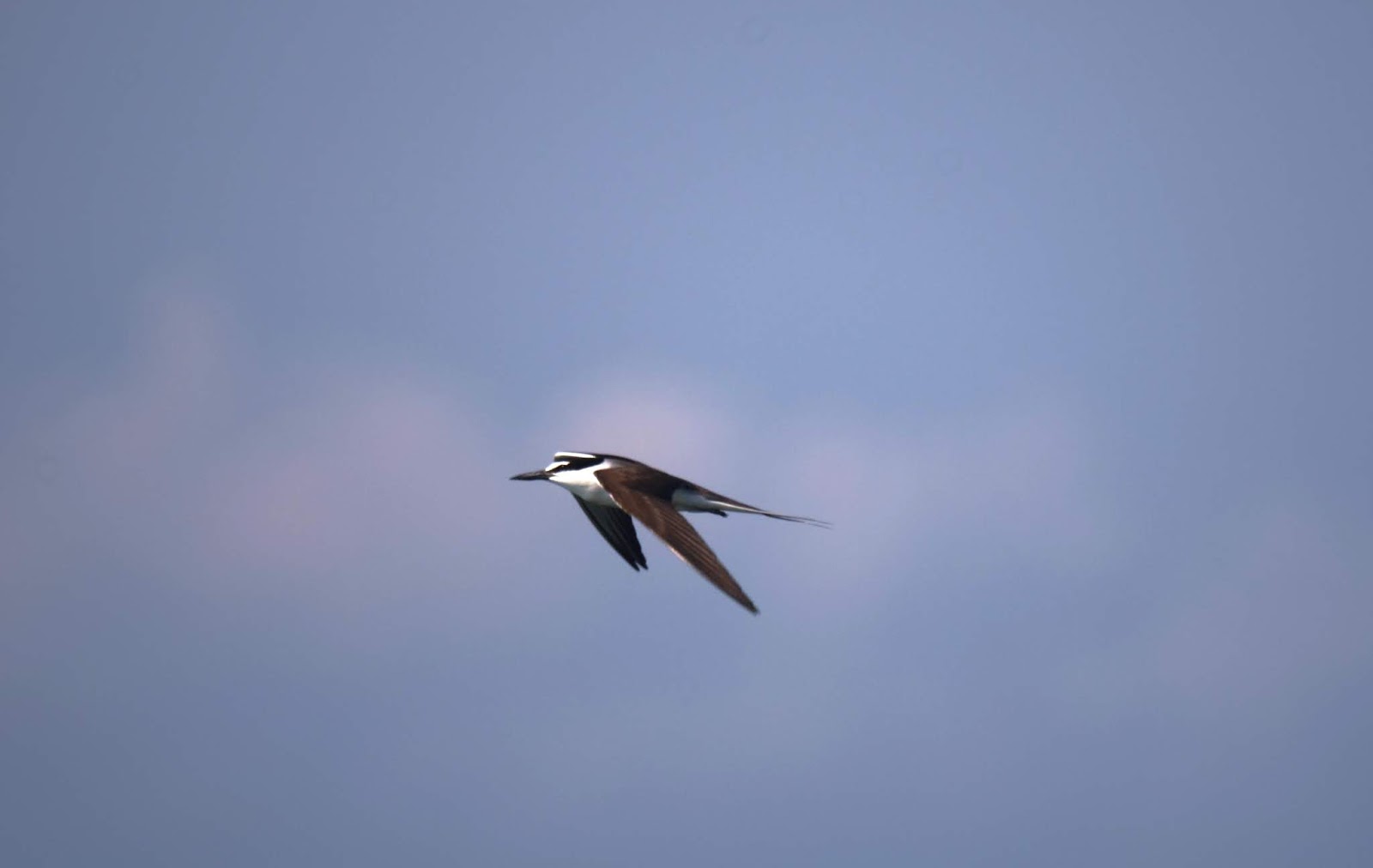
We had been at the island for maybe 5 minutes when seemingly all the Terns took off out over the water.  Ian spotted a Peregrine buzzing over the island and all the Terns were in chase.  I looked east into a boiling flock of maybe 500 or 1,000 Common and Roseate Terns low over the water and almost instantly picked out a darker-backed bird – I had the Bridled Tern!!!  We continued to follow the bird for a couple minutes as it flew around the boat, and I was able to get these pretty nice photos.


And later I got this shot of the Peregrine flying away, still mobbed by the Terns. 


At one point I watched the Bridled Tern land on the island, but it took off seconds later heading back out over the water.  We stayed at the island for the next 45 minutes but we never re-spotted the bird over the water nor perched, despite expanding our scans to nearby parts of the island.  The bird was obviously not perching in its favorite location.  Thank goodness for that Peregrine!  Otherwise I doubt we would have seen the Bridled Tern.


Before we headed back I spotted a Parasitic Jaeger harassing a Common Tern – in NY waters though.  I still need Parasitic for CT, which is the case for all the Shearwaters as well.  I had hoped that we might get lucky with other pelagics while motoring through the CT portion of the Sound on Ian’s boat, but it was too rough to scan while traveling along.  Though I certainly wasn’t going to be disappointed – after almost seeing a Bridled Tern while on a pelagic out of MA, having to pass on getting a boat to see one in ME, and 2 failed attempts last summer in CT, I finally had my life Bridled Tern!
What an ending to an outstanding 2 days of birding, not only seeing all 5 of my targets, but all 5 were also extreme rarities -

Day 1 –
    Great Black Hawk – life bird, first ME 2nd ABA record, bringing my ME list to 342
    Neotropic Cormorant – first New England record, NH bird #366
    Wood Stork – first confirmed NH record, NH bird #367
Day 2 –
    Little Egret – perhaps 2nd RI record, RI bird #330
    Bridled Tern – life bird, NY bird #284
My life lists now stand at 756 in the ABA Continental region (not including Hawaii), and 736 in the Lower 48.
In all my 51 years of birding, those were most definitely my best 2 consecutive days of birding ever!

Wednesday, September 20, 2017

Two Southeastern Rarities in Ocean County NJ, September 2017

I used to bird in NJ quite a bit while growing up in Maryland - when I moved away from the Mid-Atlantic region for good in 1993 I had a respectable 240 on my NJ statelist.  And then over the next several years I would have frequent business trips to the Garden State, allowing me to add a few birds here and there, increasing my list to 277 by 2009.  But then my work responsibilities changed and I had no more NJ trips for quite a while. 

Then in September 2017 an impromptu trip to Princeton came up.  These meetings were actually supposed to be in Houston, but the location was changed due to all the flooding caused by Hurricane Harvey.  I would likely have a free morning during the trip, plus I would be coming in the evening before, so I would have a little free birding time in the area.  As soon as my trip was confirmed my thoughts went to pursuit of the most common NJ bird that I still needed for my statelist – Barred Owl.  In fact, missing Barred Owl in NJ may well be the most glaring gap in any of my statelists.  Per my statebird map below, I’ve seen or heard Barred Owl throughout almost all of its eastern range, plus in WA and OR in its expanding western range.  But I still needed it in NJ!


I planned to arrive in northern NJ in the evening, and with some eBird research for likely Barred Owl locations, decided to try for it at dusk at the Great Swamp NWR.  I’ve birded Great Swamp in the past, even trying for Barred Owl there, but this time I hoped for a more successful visit.  After all, it is a quite common bird in the proper habitat.

As for my free morning, I first thought about trying for passerine migrants at spots near Princeton.  But my eBird Needs Alerts didn’t come up with too many realistic possibilities.  Then I noticed multiple records of Mississippi Kite at a “stakeout” hotspot in Ocean County.  I was hoping to stay closer to Princeton, but this location was only about an hour and 15 minutes away, and this likely represented the most reliable possible statebird for me.  That is assuming the Kites hadn’t migrated south yet.  And just before my trip a pair of Wood Storks were reported at a wetlands just 10 minutes from the Kite location.  Despite the longer drive time, I would still have plenty of time to try for both the Kite and Storks and still get back to Princeton before my meetings started.  That gave me 3 targets to pursue – my plan was set.

The day of my drive to NJ was hot and muggy, with the possibility of evening thunderstorms.  As I got close to the New York City area the skies were looking ominous, though the storms seemed to be mostly north of the city.  But then as I got into NJ storms were now just to the west – I crossed my fingers they would hold off until after dusk.  When I arrived at Great Swamp right around sunset the good news was it hadn’t started to rain yet; the bad news was it was extremely windy – miserable conditions to try to hear an Owl.  I got out of my car and with the noise of the wind blowing through the trees I didn’t even give owling a try.  And then it started to rain, so I just cut my losses and headed to my hotel, once again unable to fill the biggest gap in my NJ (or any) statelist.  Hopefully the next day would be more successful.

My first target that morning was a stakeout location in Waretown where Mississippi Kites had bred at least since 2015.  Up to 3 birds had been reported at this spot up through the day before my trip, so I was hopeful that I could find them quickly.  The problem was finding the correct location.  Not surprisingly these birds were “old news” by the end of their third breeding season there, and few eBird reports gave detailed locations for the birds.  I also read about a preferred roost tree, which photos showed to be a tall dead deciduous tree, but I couldn’t be sure of the location of the tree.  Plus the Kites were reported from literally dozens of different locations in the general vicinity.  So my plan was to head to the GPS coordinates of the eBird stakeout hotspot, and then keep my eyes open as I arrived in the area. 

Morning traffic was a bit tough that morning, but I eventually got to the general area and slowly drove through the suburban neighborhood that the Kites had called home – it looked a lot like the neighborhood where Kites have nested in NH for the last several years.  I got to the location of the hotspot (at the corner of Walker Lane and Elizabeth Avenue), and prepared to pull over to park.  Just then I looked up and saw a tall dead tree, and spotted a small raptor flying from the tree and heading down the road in front of me – it was the Mississippi Kite.  I had apparently pulled in right beneath its preferred roost tree and unfortunately flushed it from its roost.  That certainly wasn’t my plan. 

NJ was my 23rd state for Mississippi Kite.  Although I still need it AL and VA within its regular southeastern range, I’ve seen it in a number of states in the Midwest and Northeast as part of this species’ apparent attempt at range expansion.


Given my fleeting looks at the bird, I was hoping that it would soon come back to its roost tree.  So I stepped a short distance away to wait its return.  Unfortunately a couple minutes later several cars arrived dropping kids off to a school bus stop at that same intersection.  Finally, fifteen minutes later the bus arrived and the moms headed out of the area.  And now that it had quieted down, I was once again hopeful the Kite would return.  As I waited a pair of local birders arrived, but despite 3 pairs of eyes, we had no other sightings of the Kite in its tree or overhead. 

I was beginning to run short of time, and started to think that I should head out to try for the Wood Storks.  I mentioned the Storks to the other birders, and they were planning to look for them as well.  So with no additional Kite sightings, we decided to give the Storks a try, and we could then come back to try for the Kites again if there was time. 

I followed the local birders to the Bayshore Drive Impoundments section of Forsythe NWR.  We first went to an observation deck on the north side of the impoundments, and found quite a number of waders, but no Storks.  I then mentioned that one sighting the day before mentioned seeing the birds “from the north end of the public beach deck”, and if the eBird location was correct, that would be just a mile or so around the bend on the east side of the impoundments.  So we decided to try to find that spot.

As we got to the public beach we could see a long deck paralleling the beach that was 4 or 5 feet above the parking lot.  We walked up on the deck and looked toward the impoundments to the west, and although the extra elevation was helpful, we still only had limited line of sight into the wetlands.  But since the post mentioned the north end of the deck, we walked to the far north end and looked from there.  Sure enough we had a much better view of the impoundments, and we all simultaneously spotted a pair of large white waders in the far distance.  I got them in the scope and sure enough they were the Wood Storks.  Despite being roughly a half mile away, I got this barely passable phonescoped photo of one of the Storks with a much smaller Egret in the foreground.


NJ was my 10th state for Wood Stork, and my second as a rarity along with MA.


With that one checked off pretty quickly, I still had time to give the Kites one last try.  I headed back to the roost tree, and waited around for a few minutes, but with no luck.  It turns out that my sighting was the last one at this site on eBird for the year before.  Luckily that last bird decided to wait to begin its southbound migration until I was able to see it.    


Adding the Kite and Stork brings my NJ statelist up to 279.  And although I sure would have loved to finally get a Barred Owl in NJ, all things considered, I’d rather add the rarities to my list.  The Barred Owl will have to wait until another trip.