Showing posts with label Olive-sided Flycatcher. Show all posts

Tuesday, June 24, 2025

Filling Gaps in Minnesota and North Dakota State Lists While Heading to and from Manitoba, May-June 2025

When it came time to start planning my big spring 2025 birding trip the destination was quite obvious – it had to be Manitoba.  That was my last state or province that I hadn’t birded extensively, with an existing province list of just 61.  Needless to say, there were lots of potential new province birds waiting for me in MB.  And if I flew into Grand Forks, ND, I could also fill a few gaps in my MN and ND lists before or after the MB portion of the trip. 

My good birding friends Bill and Anita Hooker went with me on my trip to FL back in January 2025, so I reached out to them to see if they might be interested in also coming along with me to MB and the northern US Great Plains.  They like to keep county and state lists, and Anita likes to photograph what we find, and a lot of this area would be new territory for them.  So they agreed to come along but decided to drive to ND from home in NC so they could bird along the way.  They would pick me up at the Grand Forks airport and we could travel together from there in their car.  The trip was coming together…

I spent several months planning the trip, including searching for the best birding hotspots in MB to maximize our species total, and looking for specific one-off targets near Grand Forks in MN and ND.  I came up with a 13-day itinerary where I could add at least 140 species in MB to break 200 for the province, add perhaps only 4 in ND, and hopefully 2 in MN (though 0 was a possible outcome – there aren’t too many realistic targets for me in that part of MN).

This blog post summarizes the MN and ND legs of the trip. The MB portion of the trip is summarized in the next 3 posts.

5/28 – Fly to ND, Birding in Northwestern MN

The plan for the day was to fly to Grand Forks, ND, arriving about noon.  Then we would head east for an afternoon of birding in northwestern MN to add some species to my state list, and for Bill’s county lists.  Unfortunately, the spring eBird reports from the area contained few potential targets for me.  Things were looking bleak.  But finally, just two days before the trip, there were several local reports of migrant waterfowl and shorebirds that I needed for my list.  Plus a number of sightings of Gray Partridge – another one I still need for MN.  Primarily based on the reports from 5/26 I came up with an itinerary to visit 5 spots not too far east of Grand Forks.

I arrived at Grand Forks right on time and Bill and Anita were waiting for me at baggage claim.  After some rearranging of the luggage, we headed east to our first stop at the Thief River Falls WTP.  Recent reports from there included several targets – Horned and Western Grebes, Willet, Golden Plover, Red-necked Phalaropes, and Partridges.  But the reports were now 2 days old, so I hoped the targets would still be around.  Once we figured out how to view the ponds, we found many dabbling ducks, a few divers, and some Eared Grebes.  And we only found a few shorebirds, though a couple breeding plumage Sanderlings were nice. 

I was considering heading out to the next stop, but I felt like I just hadn’t looked through the waterfowl sufficiently.  So I did another scan and sure enough picked out a sleeping Western Grebe that eventually woke up and gave us good views (MN state bird #236).  In my statebird map below, the light blue-shaded states are those where I’ve seen Western Grebe in its regular range.  The 3 cross-hatched states are those where I still need the Grebe in its normal range.  And the dark blue-shaded states are those where I’ve seen Western Grebe as a vagrant.

And with some additional searching of another pond we found a small flock of Wilson’s Phalaropes spinning on the surface.  We continued to scan the flock and Bill eventually picked out a dark-chested bird in the distance that we determined to be a lone Red-necked Phalarope (MN #237).  The range map in the Sibley app considers this Phalarope to be a rarity in MN.  So MN is now the 6th state where I’ve seen Red-necked Phalarope as a rarity.

Our next stop was the NW Minnesota Pollinator Garden where several target migrant passerines had been reported, along with more Partridges.  We found the spot to be quite birdy, including both Orioles, many Clay-colored Sparrows eating dandelion seeds, and a “Traill’s” Flycatcher.  But we found none of my targets.

Then we were off to the Agassiz Valley impoundment.  The highlight of this site was a very large active Bald Eagle nest, complete with two adults and one nestling.  We had more of the regular waterfowl, and a few shorebirds along with a surprising 18 Marbled Godwits, but once again none of my targets.

On our way to the next stop we covered an area where there had been a number of reports of Partridges.  But again we came up empty.  I recalled the advice I received from one wise birder years ago – “you never see a Gray Partridge when you’re looking for it.”

Our last stop of the afternoon was at the Warren Sewage Lagoons where Horned Grebe and more Partridges had been reported.  We found a nice flock of Wilson’s Phalaropes and Stilt Sandpipers, but once again no targets.

We ended the day with 81 species in MN – not bad for just an afternoon.  Plus I added 2 to my MN list bringing my state total to 237.

5/29 – Eastern ND, and Drive to MB

The game plan for the day was to start with a bit of birding in eastern ND, then make the 4+ hour drive to southwestern MB.  Our key ND birding spot for the morning was Sertoma Park and the adjacent coulee in downtown Grand Forks.  This site is well-known as a hotspot for spring migrants – a wooded oasis surrounded by the prairie.  We started birding there just after sunrise hoping for some migrants, but the chilly and overcast weather wasn’t very cooperative.  Not surprisingly we saw few birds in the first 15 minutes or so as we tried to figure out the best way to bird the site.  Then I noticed a large flycatcher perched on the top of a snag.  The lighting was miserable, but we could determine that it was an Olive-sided Flycatcher (ND state bird #231).  

It didn’t stay perched there for long, quickly dropping out of sight.  Though we saw this bird again several times elsewhere in the park.  Here’s a distant shot of the bird characteristically perched atop a dead snag.

With few passerines moving about, our focus shifted to Green Heron, which is quite a common nester in the park.  The good news is that there are lots of wetlands and rivers there where a Green Heron could forage.  The bad news is that that meant there were lots of places for them to hide.  We started looking around the wetlands in the park with no luck, and then started walking along the trail adjacent to the coulee.  After a short walk Bill spotted one of our targets perched on a low snag.  And it was soon joined by a second Heron (ND #232).  Their favorite perch is in the background of this shot.

As we continued down the trail we started picking up a few migrant passerines, mostly Redstarts and Swainson’s Thrushes.  At least there was now some activity.  We returned to the park and found a paved loop trail through some nice vegetation.  And then located a small dirt trail that took us into the thicket.  Soon we started picking up a few migrants like Philadelphia Vireo, Alder Flycatcher (several of which were singing), and Tennessee Warbler.  Then a female Magnolia Warbler popped into view (ND #233).  And a bit later a male Canada Warbler passed through the woods (ND #234), singing a couple of times.  I still need this species in a number of south-central states as a migrant.

Later we found a nice male Mourning Warbler – not new for my ND state list but always a beautiful bird to see.  And it was our 12th warbler species for the park.

By then we had birded all the trails in the park at least once, and decided to start heading northwest toward MB.  But first we made a pitstop at the Larimore Rest Area just west of Grand Forks.  A small island of trees at the rest area included a singing warbler that we eventually heard close enough to identify as Northern Parula (ND #235).  ND was the last state where I needed Parula in its regular range. 

We of course continued to bird as we headed west across the northern tier of ND counties.  Mostly we picked up field birds that could be identified at highway speeds.  But the highlight was at one point where Route 2 passed close to a lake near Leeds, ND.  As we checked out the lake a Caspian Tern conveniently flew right alongside the car (ND #236).  

We ended the ND portion of the day with 86 species including 13 warbler species.  And with 6 additions, my state list was at 236.

5/29-6/9 – 12 Days in MB

See my next 3 blog posts for the Canadian portion of the trip.

6/10 – “Surgical” Stops For MN and ND Targets

Our plan was to choose a border crossing that would take us from MB heading into northwest MN.  I had only 1 realistic target in MN – Nelson’s Sparrow.  Although there had been no reports of this species at all in 2025 in northwest MN, they were reported at one spot in the area last year – at the Karlstad CR-9 Marshes on June 10th – interestingly a year to the day before our 2025 visit.  My only concern was whether the marsh would be too dry for the sparrows this year given that many areas of MB just a short distance to the north were going through a severe drought.  But it would only be an additional 30 minutes of driving time, so I thought we’d give it a try. 

Soon after we crossed the border Anita spotted some large birds in the adjacent field.  They turned out to be a pair of Sandhill Cranes with a colt perhaps half the size of Mom and Dad.  A nice way to start our time back in MN.

We arrived at the Karlstad marshes at 9 AM and instantly were serenaded by multiple Sedge Wrens – that was a good sign.  And there were numerous winnowing Snipe overhead.  We could see standing water in the cattail-lined ditches along the road so we were hopeful that water levels could support our target Nelson’s.  We listened intently, hearing numerous Sedge Wrens and a few Swamp and Savannah Sparrows, plus a pair of Marbled Godwits.  Finally, I picked up a Nelson’s Sparrow singing in the distance.  We played some recordings and got a second one to answer as well (MN #238).

We got back in the car and started our 30-minute drive west toward ND.  Just a few miles before we reached the state line Anita spotted a large raptor overhead.  It was flying with its wings held in a dihedral – could it be a Swainson’s?  We pulled over and the dark trailing edge to pale wings quickly nailed it as a Swainson’s Hawk (MN #239).  I now just need this species in 2 more states in its regular range.

Initially Swainson’s had been a MN target based on several reports of this species in northwest MN in 2024.  But there had not been any reports in the region at all this year, so I had dropped it off my target list.  Not surprisingly it was listed as “Unreported” in eBird.

That was a most successful brief visit to MN – finding 2 species that had not been reported nearby at all in 2025.

After getting our fill of the Swainson’s Hawk, we continued on to ND, where our first target was Gray Partridge.  That would be a US lifer for Bill and Anita.  We had a lead from local birder Sandy Aubol on a site where she had seen them recently.  We scoured the roadside edges but came up empty.  Though we briefly got excited by a distant “bump” in the road which turned out to be just a Mallard.  Then we headed to an eBird hotspot, Prairie Chicken WMA, where Partridges were reported a week earlier.  But again to no avail.  A US sighting just wasn’t meant to be for us on this trip.  Though we did have Partridges several times in MB.

Our last stop of the day was at the Turtle River State Park where three of my targets had been reported recently – Trumpeter Swan, Scarlet Tanager, and Indigo Bunting.  I got excellent advice on locations for all 3 once again from Sandy Aubol and from fellow local birder Judy Johnson, so I was cautiously optimistic.  Especially for the Swans which were nesting in an oxbow lake right at the park entrance. 

We pulled into the park entrance and had excellent views of the lake next to us.  But there were no large white swimming birds in site.  Despite lots of many different angles and views of the lake we couldn’t find the Swans.  We would just have to try again on the way out.

Then we headed to the CCC parking lot where both birders reported our passerine targets.  We crossed a small footbridge at the west end of the lot and soon heard a distant singing  Scarlet Tanager (ND #237).  I just need this species in one more state in its regular range.

We doubled back to another trail and soon had 2 singing Indigo Buntings a bit surprisingly in this opening in the woods under a thick canopy (ND #238).

Many thanks to Sandy and Judy for their advice!

As we headed out of the park we of course needed to try for the Swans one more time.  But still no luck.  Wonder if they were tucked back into the cattails out of view on or near a nest.

We finished the US part of our trip with 113 species in ND, 8 of which were new for my state list – much better than the 4 I hoped for.  That brought my ND state list to 238.  Plus we observed 95 species in MN, including 4 additions to my state list, surpassing the 2 I expected.  My MN list now stands at 239.

(See my next 3 blog posts for a summary of the MB portion of the trip.)


Tuesday, May 26, 2020

Olive-sided Flycatcher – Yardbird!, May 14, 2020

Last Fall during the excellent migration season in my yard I had a larger flycatcher that perched for a while at the top of a dead snag.  It was dark above and vested below.  Olive-sided, right?  The only problem was it didn’t seem large enough to be able to eliminate the resident Pewees or maybe a migrant Phoebe.  Though arguably, if it was a Pewee it would have been a Western Pewee with that vested look.  In retrospect, I’m not really sure why I didn’t conclude it was an Olive-sided.

Then on May 13th I pursued an Olive-sided Flycatcher reported at the Biltmore Estate in Asheville.  I missed it by less than a minute, but then stayed for another 3 hours unsuccessfully waiting for it to return.  Then again maybe it did return.  Halfway through my vigil I spotted a large dark flycatcher flying across the river, leaving the Biltmore side roughly even with the island where the Olive-sided had been seen previously.  I followed it in my binocs as it continued across the river and land in a tree on the far side.  Even though I could see it perched, given that it was roughly 500 feet away I couldn’t be sure of the ID.  It could well have been the Olive-sided, but I couldn’t eliminate Phoebe, even though no one had reported one in the immediate area.

So the next morning when I started my daily “Big Sit” in my back yard I couldn’t help but think I could have already seen Olive-sided Flycatcher in NC - not once, but twice.  I settled in and quickly ticked off the local breeders that were here daily, like Baltimore Oriole, Hooded Warbler, Wood Thrush, Scarlet Tanager, and Eastern Pewee.  And there was still a smattering of late migrant warblers like Redstart, Blackpoll, and Chestnut-sided, plus a Swainson’s Thrush.  A typical morning on the back deck…

And then I heard a call coming from the top of the canopy that I didn’t instantly recognize – two clear plaintive notes, the first higher in pitch than the second.  Then it hit me –it was the last 2 notes of the Olive-sided’s “quick three beers” song.  I listened intently for it to sing again – but to no avail.  I searched the bare snag where last Fall’s bird had perched, and all the other possible tall perches I could see, but again no luck. 

Now I started second-guessing myself.  I’m very familiar with the song of the Olive-sided, which is quite diagnostic.  But just maybe it was the second half of a Pewee’s song – the one that drops in pitch.  But I could hear my resident (likely breeding) Pewee singing at the time far east of the house a hundred yards away.  Plus when would you hear a Pewee just give one snippet of one song?  Not to mention that call is quite different from the “three beers” notes.  And what about the fact that I didn’t hear the Olive-sided’s first “quick” note?  I’ve heard other Olive-sided’s singing where the first note was very difficult or impossible to hear because the bird was farther away, or there was too much other bird song in the area.  Then again, maybe I just didn’t notice it that day in my back yard. 

My gut/initial ID is almost always correct, and I couldn’t come up with other likely options.  So at the end of the day I decided to go with my initial ID and conclude it was a less-than-cooperative Olive-sided Flycatcher.  I just wish it had called again.  Or better yet – sat in the open for me to see my first Olive-sided for the state.  Then again, perhaps I had already seen Olive-sided twice before in western NC…

Olive-sided Flycatcher was #295 for my NC statelist.  In my statebird map below the blue-shaded states are those where I’ve seen this species; cross-hatched states are the ones where it is regular but I haven’t caught up with it yet.  This species is generally rare in the east, and especially in the southeast where its migration routes just barely cut across the northern part of the region.  As a result, I still need it in quite a number of eastern states.


The Olive-sided was an amazing 125th species for the yard list.  This has been a spectacular Spring in the yard with many additions to my yard list including-
4/5 - Black Vulture - since then seen most sunny days; Rough-winged Swallow
4/6 - Great Blue Heron - flyover
4/8 - Common Loon – flyover in breeding plumage; Prairie Warbler
4/14 - Worm-eating Warbler, Palm Warbler, Red-shouldered Hawk  
4/16 - Orange-crowned Warbler
4/20 - Fish Crow
4/21 – Mallard, Purple Martin
4/24 - Orchard Oriole, Red-headed Woodpecker
4/27 - Summer Tanager
5/1 - Cerulean Warbler
5/2 - Veery
5/3 - Barn Swallow
5/4 - Kentucky Warbler
5/6 - Short-billed Dowitcher, Lesser Yellowlegs
5/13- Yellow Warbler

A few of these really stand out -

Red-headed Woodpecker – I’ve had one in my yard 3 times now, often enough to make me think they could be nesting nearby.  On one of my walks up the mountain I played some tape and got one to instantly respond.  Since then I’ve heard a bird calling from above the yard numerous times.  And a couple of those times there were 2 calling birds.  I need to head up there one day this summer to try to locate a nesting tree.

Summer Tanager – Back in my New England days Summer Tanager was a rarity I searched for often in early spring as an overshooting migrant.  So when I heard its 2-note “chick it” call in the yard, it brought back fond memories of a successful northeast Tanager search.  And the bird was a young 2-toned red/yellow bird which was often the case for the New England birds as well. 

Shorebird Flock – I have a tree in my yard that budded out this spring, but then those buds never opened.  Early that morning I was searching through the canopy of that tree with my binoculars in hopes that I could find at least some of the buds opening up just when a flock of large shorebirds flew into my binocular field.  I was able to get an extended view of the flock as I followed them across the sky in the distance and concluded I had about 10 Lesser Yellowlegs and 1 Dowitcher, which was most likely a Short-billed.  I doubt I would have ever seen these birds if I hadn’t been inspecting the tree buds.  Boy was I lucky.  Unfortunately the tree wasn’t as lucky – I’m pretty sure it has died. 

Yellow Warbler – that was my 29th warbler species for the yard list in less than a year, with 26 species this Spring and 22 species last Fall.  There aren’t too many more possibilities, with perhaps Wilson’s, Connecticut, Mourning, and Swainson’s being the most likely.  My yard is pretty dry, so it’s not likely I’ll ever get other more remote possibilities from wetter habitats like Northern and Louisiana Waterthrush, or Prothonotary.  But then again, who knows.

Like I said, it’s been a spectacular Spring in the yard.

Wednesday, May 20, 2020

Missed My Two Target Birds But Still Got a Statebird, Biltmore Estate, NC, May 13, 2020

The local Blue Ridge Birders text group had been abuzz reporting on good numbers of migrants at the Biltmore Estate, highlighted by a report from Aaron Steed of 85 species in just 4 hours.  Interestingly, this came at a time when migration had slowed in my yard.  Then early on the May 13th came a report of an Olive-sided Flycatcher there, with very specific information on the location.  Since things were slow in my yard, and most importantly since I had an annual pass for the Biltmore, I decided to give it a try.  Though first I had to make a reservation to access the grounds, and luckily there were openings for the very next hour.  And just before I hit the road I got directions to the Black-billed Cuckoo spotted there the previous day.  Both birds had been spotted close to the Lagoon, so with a bit of luck I could possibly come up with 2 possible statebird targets in the same general area.

I arrived at the Lagoon within an hour of the sighting of the Olive-sided, and joined several other birders already on site.  And we soon found the exposed perches where the bird had been spotted on an island in the river.  But unfortunately there was no Flycatcher, as least not right now.  There were plenty of potential perches and habitat in the area, so after a couple minutes we decided to split up and cover more area up and down the river.  I decided to head down river toward yesterday’s Cuckoo location – maybe I could run into both birds.  How lucky would that be?

Just a few minutes later I got a text that the Olive-sided had returned to its original perches on the island.  Although I instantly started to run back to the Olive-sided, it took a lot longer than I had expected – I had covered at lot of territory.  I finally made it back to the island, but unfortunately the bird had just left a few seconds earlier.  Alas, the Cuckoo search took me too far away from the Olive-sided spot and cost me the Flycatcher.  As Maxwell Smart used to say – “Missed it by that much.”  (And by the way, I never even made it to the location where the Cuckoo was seen the previous day.)  Ugh…

The good news was the bird was still around, and it certainly had preferred perches.  So I decided to just stay at the island to wait for the bird to return.  About an hour later I received a text that a Wilson’s Warbler had just been spotted near the other end of the Lagoon, within just a couple hundred yards from where I waited for the Flycatcher to return.  I needed the Warbler for my statelist as well, and started to wonder if I should give up on the Flycatcher to try for the Warbler.  There had been no sightings of the Flycatcher in an hour, and the Warbler had just been spotted.  But I decided to stick with the Flycatcher search as it was the rarer of the two.

My vigil was now going on 2 hours still with no sightings.  And just then I spotted a large dark flycatcher flying across the river, leaving the Biltmore side roughly even with the island.  I followed it in my binocs as it continued across the river and land in a tree on the far side.  It was pretty far away – roughly 500 feet – and I couldn’t be sure of the ID.  It was large and darker above, and it could well have been the Olive-sided.  Though I couldn’t eliminate Phoebe.  Then again no one had spotted a Phoebe in the area.  And I would think that if a Phoebe had been nearby I would have heard it calling before its flight across the river.  A maybe – but not definitive.

At 2 PM I finally threw in the towel on the Olive-sided after a 3-hour wait.  I had not only missed the 2 previously reported targets (1 by less than a minute), but also hadn’t chased after the Wilson’s Warbler.  On a whim I decided to head back to the area where the Warbler was reported, even though it had been 2 hours since I had received the text.  On the way I ran into Bob Butler who said he just had a female Wilson’s at the original location.  With renewed optimism I went to the spot where Bob had his bird but could only find Redstarts.  Once again dejected, but undeterred, I walked a bit further along the river’s edge in nice brushy wet habitat and spotted a glimpse of yellow.  A second later I had a male Wilson’s Warbler in my binocs! 

Wilson’s Warbler was #294 for my NC statelist.  In my statebird map below, the blue-shaded states are those where I’ve seen this species; cross-hatched states are those where it is regular though I’ve yet to see it.  I still need this species in a number of eastern states, as it is much more common in the west.


I briefly thought about returning to the favored perches of the Olive-sided, but decided I had given that one enough of a try.  I may have missed my initial key targets, but at least I was still able to find one new unexpected statebird.  It was a bittersweet trip, though I can only imagine how I would have felt if I hadn’t been able to re-find the Wilson’s Warbler.

Saturday, September 22, 2012

White Ibis and 2 Other “State” Birds in Washington, DC, September 2012


First some general information on birding in DC - Yes Washington, D.C. is considered by the ABA to be a reportable geography, just like the 50 United States.  And birding in DC can be extremely challenging.  First it is a tiny area – many counties are bigger than the District.  Secondly, the areas of good habitat are few and far between given its very urban nature.  And some of the better sites are in some pretty seedy locations.  As a result, the ABA reporting threshold for DC is lower than for any of the 49 mainland states.  After many days of birding in the District I’m very proud to say that I’m reportable in DC.  Because of the birding challenges in DC I’m more excited about my DC list than of any of my lists for the 50 states. 

Now on to the new “state” birds - While in the area visiting relatives, I decided to take an early morning to try to add to my DC list.  Ordinarily September would be a good month to try for some migrant passerines, but there were strong southerly winds, and weather was warm and very warm.  So not conducive for migrants.  Instead I decided to try for some DC shorebirds.  The best (only?) shorebird habitat is along the Anacostia River during low tide.  Although no shorebirds had been reported recently, I decided to give it a try, starting at dawn at the Kenilworth Aquatic Gardens.  Located on the Anacostia, it also has the only nice wetlands that I’ve found in the District.  Dawn coincided with the low tide that day, so I arrived at first light and made my way to the river’s edge.  It was not yet dawn when I arrived to find lots of mud, but no birds.  In the dim light I noticed something big sitting on a dead snag in the marsh – it was an immature White Ibis!  Even some of the common waders can be tough in DC – let alone a rarity like a White Ibis.  It gave great views even in the dim light.  A little distance ahead I got to another area of mudflats but still no shorebirds.  A small cattail marsh was nearby, so I decided to play some Sora tape – one called back almost instantly!  I had had Virginia Rail in the Kenilworth marshes years ago, and now had my first DC Sora.  On my way back into the park I passed by where I had the Ibis and it was feeding on the mud close nearby.  I was able to get this sketchy photo holding my phone up to my binocs.  I guess it’s not too bad given the technology I was using. 


Back in the park I focused on trying to find migrant passerines but found almost none.  Until I noticed a flycatcher on a distant high snag – an Olive-sided Flycatcher.  “State” bird #3.  So in 3 hours in the park I found just 1 shorebird (a Spotted Sand) – miserable results for my intended objective.  But I got 3 really good new state birds which was more than I had hoped for.

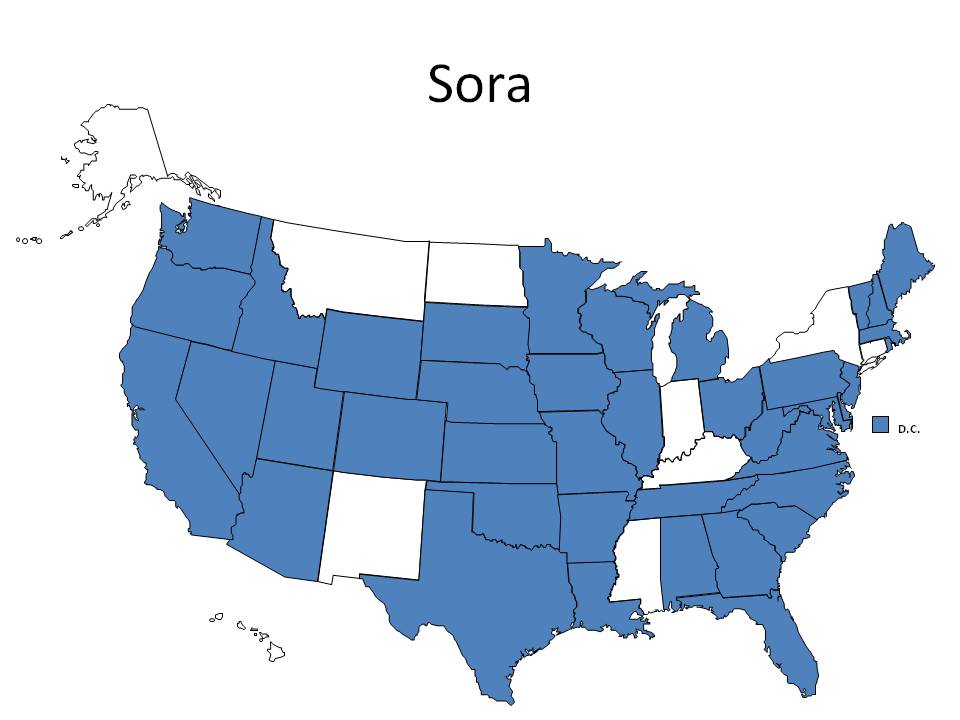
That gives me 175 for my DC list – now safely 10 over the threshold.  I’ve inserted 2 of my state bird maps below – the first is for White Ibis where I’ve seen it in all the states in its regular range and now as a vagrant in 4 states in the Mid-Atlantic and 2 in the Northeast.  By comparison the Sora map shows that I’ve seen it in many states across the US, though I’ve got some big misses here and there.