Showing posts with label White Ibis. Show all posts

Saturday, January 8, 2022

Coastal VA and NC Trip Nets 11 New Statebirds, December 9-13, 2021, Part 2 of 2

I attended a Carolina Bird Club trip to the Outer Banks of NC in mid-December 2021.  And along with extensions into coastal VA, plus 2 travel days, I made it into a 5-day weekend.  It had been more than 20 years since I birded southeastern VA, and I had quite a number of possible new statebirds.  First, several target species like Lesser Black-backed Gull and White Ibis are more numerous there now.  Plus my VA statelist was only at 250 so there were a number of gaps in general I could fill.  On the downside, my last trip was before 9/11 when I was still able to bird on the islands of the Chesapeake Bay Bridge Tunnel (CBBT) – locations which are no longer accessible due to possible terrorist concerns.  As for NC, even though it had been nearly 3 decades (ouch) since I birded the Outer Banks, my potential targets in NC were pretty limited.  Most importantly I was banking on a couple long-staying rarities, Eurasian Wigeon and Hudsonian Godwit, which were rather reliable.  All told I hoped for 5 or 6 new statebirds in VA and 3 in NC.  And I was looking forward to reacquainting myself with some of the top hotspots on the NC and VA coasts.

This is my summary of the second half of the trip; see my prior post for the first half of the trip.

December 12 – 6 for 6 in Eastern VA

The CBC trip continued on the Outer Banks through the morning of the 12th, but it sounded like the plan was to cover some of the same area we birded on the 11th, plus some other spots that would likely not yield any new statebirds for me.  Plus I had 6 feasible targets in eastern VA, especially given that I missed the Heermann’s Gull and didn’t pursue the Red-cockaded Woodpeckers and Western Kingbird earlier in my trip.  Though the targets would have to be cooperative if I was to have enough time to try for all 6.  So I decided to change my plans and bird eastern VA instead of NC.  I hoped I wouldn’t regret my decision.

The first stop was to try for the continuing Western Kingbird in Virginia Beach at a hotspot called the Harris Teeter Retention Pond.  The bird was most often seen perching in trees surrounding a large field to the south of the shopping center.  Though the last report had the bird at an adjacent school.  Once I parked at the shopping center it only took me a few minutes to get to the back of the buildings and the small pond which looked nice for a migrant shorebird or two in season.  But shorebirds weren’t my target here.  I decided to target the trees around the field as I walked right by the school.  Though I did stop long enough to see a few White-crowns feeding along the trail.

I was now walking along the western edge of the field looking for any movement of larger birds in flight or perched in the trees.  I had a few Blue Jays and woodpeckers here and there but no insectivores.  It was a cold, gray, breezy morning so I started to worry that the insects weren’t moving yet -not the best conditions for a flycatcher.  As I neared the southwest corner of the field I spotted a larger bird fly into the bare deciduous trees.  And with a quick binocular view I had my target Western Kingbird (statebird #5).  I got these distant digibin shots of the bird.


 VA was my 5th eastern state to see Western Kingbird as a rarity. 

I had given myself 90 minutes at this first stop of the day, but only needed 30.  It’s great especially to have the first target to be so cooperative.  Now a whole hour ahead of schedule, I was well-positioned to be able to pursue all my targets for the day. 

Next I was off to the Princess Anne WMA, where White Ibis were being seen in two adjacent tracts – Beasley and Whitehurst.  They were reported a bit more frequently at Beasley, so that’s where I would start.  The WMA was only open for birding on Sundays since hunting was allowed every other day of the week.  Hence I targeted this spot on Sunday the 12th instead of the 10th on my first trip through the area. 

The Beasley Tract features numerous small impoundments flooded to attract waterfowl.  So my plan was to scan each one to look for my target White Ibis feeding in the shallow water.  After a short walk through pine woodlands I arrived at the impoundments that were on both sides of my trail.  Although some were obscured by vegetation, I hoped that I would quickly find my target.  But after searching the first half dozen impoundments I had no waders at all.  And the only waterfowl was a Pied-billed Grebe – had the hunters scared away all the birds?  But then I noticed a tight flock of larger birds overhead – I had 8 White Ibis flying to the north (statebird #6).  I searched the rest of the impoundments but still never found any foraging waders.  Though I had 2 more small flocks of White Ibis flying low to the north.  Wonder where they were coming from and going to?

It was nice to fill in VA in my statebird map as the northernmost Atlantic state where it is regular.  I’ve also seen White Ibis as a rarity in 7 northeast states and DC.

I had one more longer shot target at this spot – Blue-headed Vireo.  This is one of several quite common passerine migrants and nesters that I still need for my VA list.  There were occasional recent records of Blue-headed at the Beasley tract which is near the northernmost extent of its wintering range.  The parking lot was surrounded by nice pine habitat which should be quite good for roaming bands of wintering passerines.  So when I got back to the car I played some Screech-owl tape and quickly attracted a number of Yellow-rumps.  At one point I thought I heard a couple Blue-headed call notes but they were faint and didn’t continue so I couldn’t be sure.  A few minutes later I felt like I had found everything that was in the area so stopped the tape and was about to get in the car.  Just then I heard the characteristic scolding calls of a Blue-headed Vireo (statebird #7) – I guess I could have counted it based on those first call notes afterall.  I now just need this species in MS and DC in its regular range.

The next stop was at the Piney Grove Preserve in Sussex County for the resident Red-cockaded Woodpeckers.  I was actually lucky to have noticed one recent report for this species – otherwise I would have passed right by this area without knowing that this was a regular spot for these woodpeckers.  When I arrived in the area along Chinquapin Road it was obvious where to look for these endangered woodpeckers – there were extensive patches of tall longleaf pines actively managed to reduce the undergrowth. 

I drove slowly through the area stopping at several locations, listening intently for their characteristic calls, but with no luck.  I also looked for the nesting trees that have white rings painted on their trunks, but never found any.  I was starting to get a little worried.  Then finally on my next stop I heard a few woodpecker taps, then got a quick view of a medium-sized woodpecker.  A bit later I heard the calls and got good views of a Red-cockaded Woodpecker (statebird #8).  And as is typical of this species, it was one of 4 birds foraging together in the pines.  Here’s a digibin shot of one of the shier birds.

I also got nice views of a second Blue-headed Vireo here – rarer at this inland location than the one I had earlier closer to the coast.

With the woodpecker under my belt I was off for a second try at the Heermann’s Gull.  My luck with this very reliable bird had to be better than on my first stop – right?  As I pulled into the Hopewell Marina I saw a group of birders around the boat ramp which is the gull’s preferred roosting and feeding spot.  I quickly drove over to them hoping (indeed expecting) that they had my target bird.  But they had been unable to find the Heermann’s despite quite a bit of searching.  Had I struck out again?  Just then another birder walked over saying she just heard that it was perched under the bridge.  That was one of the spots I searched on my earlier try so I knew exactly where to look.

We all drove over to the bridge and sure enough there was a significant flock of gulls perched on the nearby wooden piers under the bridge.  But with a quick binocular scan none of us picked out the gull.  It should be obvious given its unique charcoal gray plumage, so now we wondered about the accuracy of that third-hand report.  I set up my scope to do a more detailed scan, even though I was pretty sure binocular views were good enough.  And then I spotted the Heermann’s – it was sleeping in the shadows of the bridge and it was nearly the same color of the wood (statebird #9). 

VA is now the 4th state where I’ve seen this species as a rarity on the Atlantic or Gulf Coasts.  Wonder what’s causing the vagrancy of this Pacific Ocean gull.

I was thinking of staying to wait for the bird to wake up and give better views, but I had one more target to chase after – Ross’s Goose.  A pair of these diminutive geese were reported in a large flock of Snow Geese two days earlier at Turkey Island Road in nearby Henrico County.  Photos showed the geese foraging in harvested corn fields so it seemed like it could be relatively easy to find them.  That is if the flock was still around.  Afterall there had been no reports in the last 2 days. 

After a quick 20-minute drive I arrived at Turkey Island Road, driving through very nice ag lands with cornfields on both sides of the road.  Excellent wintering goose habitat.  The only problem was I couldn’t find any geese of any species.  I got to the end of the road and turned around for another try.  Then I noticed a car parked on the side of the road ahead of me.  Not too surprisingly, they were birders also looking for the Ross’s.  [On a side note they had recently moved from NH and new of me from my New England days – small world.]  They had just come from a nearby small lake, likely finding the right flock of Snow Geese but not finding the Ross’s.  I was glad I ran into these birders because I didn’t know about the lake.  And always up for a challenge, I was willing to try to find the Ross’s in with the Snows. 

After a short drive and a walk through the fields I came upon the lake with all the geese.  It was located behind a hill and out of view from Turkey Island Road – I would have never found the lake on my own.  The lake was full of geese – I estimated 750 Canadas and 500 Snows – but all quite far away.

Surprisingly most of the Snows were blue-phase birds.  And most of the few white-phase Snows were noticeably small than the “Blues”.  So the good news was that there weren’t many white geese to look through.  The bad news was that the Ross’s wouldn’t be too much smaller than the white Snows.  I started to scan the flock slowly but couldn’t come up with the Ross’s.  But then I noticed a group of 4 white geese together with what appeared to be small bills.  It took a while to get clear views but I finally could see the short stubby bills, steep forehead, and rounded head of Ross’s Geese (statebird #10).  Here’s a very distant phonescoped pic of the birds in the background.

I texted both the NH birders and the ones with me at the Hopewell Marina to tell them that I had found the Ross’s.  A few minutes later they all got to see the birds.  Interestingly the best way to find them in the flock was to look for 4 white geese swimming together.

VA is now my 32nd state for this expanding species.  It wasn't too long ago that Ross's Goose was quite a rarity anywhere across the country.

What a day – I found all 6 of my target birds.  A nice improvement from the beginning of my trip.  Though as an aside, it turns out that the CBC group re-found the Hudsonian Godwit on the Outer Banks that day.  I guess I can’t be everywhere.

December 13 – Another Slow Travel Day

The 13th was my day for the long ride back home from the coast.  And along the way I would make another try for the Say’s Phoebe in Guilford County, NC.  But first on the VA part of my drive I kept an eye open for Turkeys – a bird I still needed for my statelist.  But the best I could do was to spot a dead bird on the side of the highway.  Alas, not countable unless it was still breathing.

I rolled into the Guilford County Farm mid-morning and started my slow walk through the area.  As before I slowly walked around the complex checking out every conceivable Phoebe perch.  After 90 minutes I was not very optimistic.  And then I got a text from the Blue Ridge Audubon group saying that there was a Varied Thrush coming to a feeder in Hickory.  A quick look at GoogleMaps showed that Hickory was right on my home.  The text included the fact that the homeowner was willing to have visitors, his address, and where to stand to look for the Thrush.  Hmm…  Would the Thrush be more likely than the Phoebe?  After searching for the Say’s Phoebe now for 4 hours over 2 trips, I decided to throw in the towel and give the Varied Thrush a try. 

Just after getting back on the road I called my birding friend Bill Hooker and alerted him to the Thrush report.  Bill was very interested, though I mentioned the only thing missing from the report was whether there were certain times of the day when the Thrush was being seen.  Bill decided to try for it as well, and his ETA was actually a few minutes earlier than mine.  An hour later I was just a few minutes away from the feeding station when Bill called.  He was on-site and talked to the homeowner – the Thrush was only being seen once a day pretty early in the morning.  Ugh…  We gave it about an hour, seeing a good number of birds at the feeding station.  But given its history, not surprisingly we had no Varied Thrush. 

That was a tough way to end the trip – missing both of my last targets.  But it was still a most successful weekend, with 10 additions to my VA list, bringing my statelist up to 260.  And my NC list is now at 312 with the addition of 1 new bird.  Certainly better than the 8 or 9 new statebirds I hoped for for the entire weekend.  Plus I reacquainted myself with many of the key hotspots in the upper portion of the Outer Banks and coastal VA. 

Can’t wait to go back!

Friday, August 15, 2014

White Ibis, Old Lyme, CT, August 2014


Denny Abbott and I had tried unsuccessfully for a White Ibis in Stratford, CT a couple years ago.  Although every miss is disappointing, that one was particularly frustrating as we were within 100 yards of the bird and didn’t know it.  We were looking at a pond on the south side of a warehouse near the coast while the bird was actually being seen in a pond we didn’t even know existed on the north side of that building.  It made for a pretty depressing ride home after that trip.  So when news of an immature bird in Old Lyme was posted to the listserve, I was itching to go.  And with another White Ibis I saw in NH a few days earlier, that gave us 2 in New England at the same time.

The listserve posts were not too detailed, and in fact the first two mentioned it was in Hawk’s Nest Marsh but did not give a road name.  But with a fair amount of additional research I eventually figured out that the bird was seen in the morning and evening in the marsh along West End Drive, especially associating with Snowy Egrets.  And one post mentioned that the bird was first spotted two days earlier.  That same birder posted his sighting on e-bird and mentioned the earlier sighting was from Otter Rock Road.  I looked at the tide tables and realized that there were morning and evening high tides at the time, so maybe the bird was most likely at West End Drive at high tides.  Or maybe that was just coincidence as there were no posts (positive or negative) from the middle of the day during lower tides.  Given our recent experience with the White Ibis in NH, I wondered if this bird too might disappear in channels at lower tides, and therefore would be easiest to spot at higher tides.  Going on that theory, I called Denny and we planned to head to West End Drive during the afternoon/evening the next day during the high tide.

We arrived at West End Drive mid-afternoon with a low but rising tide.  We quickly realized that the marsh near West End Drive was actually mostly salt pannes, likely not affected by the tides.  There was considerable Spartina marsh farther out, complete with a number of channels lined by brush.  So now my theory was starting to come together – perhaps the bird was seen along West End Drive in the salt pannes at high tide when there was no other habitat for it to feed in elsewhere in the marsh.  And at lower tides it would prefer to feed in the channels, likely out of view – just like the NH bird we saw a few days earlier.

We scanned the marsh and pannes and saw no waders at all.  Several active Osprey nests were nice to watch, as were a couple Saltmarsh Sparrows, but there were no waders.  At one point a flock of 14 dark ibises flew overhead – but no White Ibis was in the flock.  After about 45 minutes of scanning, and with a tide that was still pretty low, I suggested to Denny that we drive up to Otter Rock Road to see if the bird might be in the marsh there.  We could always come back to West End Drive later as the tide got higher.

Otter Rock Road runs along the western edge of the upper reaches of Hawk’s Nest Marsh, with houses on one side and the marsh at the edge of the road on the other side.  Although there was a lot of brush along the edge, we found a couple places to look out into the marsh, which was mostly Spartina with some large pools.  One Great Egret was standing exposed in the marsh, but we saw nothing else.  Then I noticed the head of a Snowy Egret appear at the top of a deep channel, then disappear, then appear once more.  If an all-white Egret could hide in the channel, then a mostly brown immature Ibis could certainly go unnoticed there.  Our level of optimism was definitely increasing.  I walked a short distance away to check out another vantage point and when I returned Denny mentioned he had just gotten a brief glimpse of a dark wader with some white plumage.  And just a few seconds later, the White Ibis popped into view.  For the next 15 minutes the bird continued to feed in the marsh, at times disappearing into the channels, then briefly coming back into view.  And all the time it was very closely associating with the Snowy Egret.  I was able to take several pretty nice phone-scoped photos.


Good thing I did all that detective work researching the places where the bird had been seen.  And it looked like my theory for how the tide might affect its movements might have been pretty accurate.

That was number 311 for me in CT, and my fourth New England state with White Ibis.


Sandwich Tern in MA, White Ibis in NH, and Royal Tern in ME – all in one July 2014 Afternoon


Hurricane Arthur passed by the New England coastline and made landfall in the Canadian Maritimes in early July.  In the days immediately following landfall numerous reports of southern terns were posted in the Maritimes.  And a few days later came reports of Royal and Caspian Terns and Skimmers from the ME coast – birds likely making their way back down the coast.  Most of these reports came from the Hills Beach section of Biddeford.  So I headed to Hills Beach, and despite spending an entire morning there, had no luck with any of the rarities.  As the reports from Hills Beach continued to come in over subsequent days I realized that most sightings were in the evening on rising tides.  I guess I was at the right place but the wrong time of day. 

So it was time to head back to Hills Beach to try again.  High tide on my planned next trip to Hills Beach was at 9 PM, so a rising tide would be at dinner time or later, meaning heading out about mid-afternoon.  But those plans changed when a report of a Sandwich Tern at Plum Island in MA came in around lunch time.  (Actually it was also seen the day before but I missed that report – ugh.)  I alerted Denny Abbott who needed Sandwich Tern for his MA list as well, and he headed right there.  Minutes later I was en route to Plum Island as well, hoping to try for that Tern first and then head to ME.  Denny called me from Plum Island saying that he had the Sandwich Tern, and it was sleeping on the beach in a flock of gulls so no need to rush.  So the pressure was off a bit – I should be able to drop into Plum Island, get the Sandwich Tern quickly, and have plenty of time to head up to Maine.  And then just before I arrived at Plum Island I got a call from Steve Mirick that a White Ibis was just reported on the NH coast.  Wow – another one to try for, through as long as the Sandwich Tern and Ibis cooperated, there still should be enough time.

When I arrived at Lot 1 at Plum Island I noticed a couple birders heading to their cars.  As I passed them en route to the beach I jokingly said something like “Don’t tell me the bird just left”, fully expecting that they would reply that it was still asleep on the beach.  Instead one birder replied that it had just flown away!  My heart sank.  I headed to the beach and the 3 other birders that were still there said that I missed it by less than 5 minutes.  The flock of gulls was still there, but there no terns at all.  They mentioned that it had flown to the south, but were otherwise not very helpful in giving any other details.  Not the friendliest of interactions I’m afraid.

Now what do I do?  Do I cut my losses here and head right up to NH (and then to ME) for the other targets?  Or should I stay here and try for the Sandwich Tern, increasing my chances for this bird but limiting my time and chances of getting the NH and ME targets?  I could see a number of small terns flying over the surf in the distance to the south which was the general area where the Sandwich was last seen.  So I optimistically hoped it could still be around feeding with the others, and decided to stay at Plum Island at least for a while.  I spent the next 10 minutes scanning through the terns but only found Commons and Leasts.  Another birder arrived and we both continued the scans.  Still with no luck searching to the south, I decided to look through the flock of sleeping gulls on the beach thinking that maybe the target bird would return to its roosting spot.  Just then I noticed a tern fly over the flock – it was the Sandwich!  I got the other birder on it, and we watched it make a couple passes before it dropped out of sight and presumably landed on the beach.  That was my first Sandwich Tern for anywhere in New England – my 426th species – and MA statebird number 403.  MA is only my 10th state for this southeastern species.


The other birder decided to walk to a different vantage point to try to see it perched on the beach.  But I had other target birds to try for, so after a brisk walk back to the car, I was headed off Plum Island to try for the White Ibis in NH. 

En route to NH I called Steve Mirick back to get an update on the Ibis.  Steve had refound it at Awcomin Marsh in Rye, NH, and with Steve’s excellent directions I mapped out a route to the spot.  After going through some challenging mid-afternoon coastal traffic, I finally arrived at the marsh and found at least another half dozen birder’s cars there.  Unfortunately the bird was no longer in sight – earlier it was perched on a tree at the marsh edge but has since disappeared from sight.  Maybe if I had gotten the Sandwich Tern quicker I could have been at the Ibis spot sooner and could have gotten that bird before it disappeared.  No one said it would be easy.

By now there were at least a dozen birders at the marsh observation deck all scanning the marsh and surrounding trees.  The tide was falling now, and there were a number of channels in the marsh that the bird could disappear into.  So Steve Mirick and Ben Griffith offered to go walking out in the marsh to try to flush it from a channel somewhere.  I and the others continued to scan the marsh in hopes that Steve or Ben might flush the bird.  After a few minutes with no success our hopes dwindled.  But just then I spotted the Ibis perched on a tree at the edge of the marsh – it had indeed been feeding down in a channel making it not visible from our vantage point.  Many thanks to Steve and Ben for volunteering to walk through the marsh to re-find it.  I got some pretty miserable phone-scoped photos of the bird looking almost directly into the sun.


White Ibis was number 353 for me in NH.  And I’ve now seen White Ibis in 6 Mid-Atlantic and Northeast states plus DC as a rarity, plus most the states in its typical southeastern range. 


I was now 2 for 2 pursuing my targets, with still plenty of time to get up to Biddeford, ME to try for the tern targets there.  After a relatively short 1-hour drive I was in Biddeford and arrived along Hills Beach by late afternoon.  Tide was quite low but rising, so I was hopeful conditions would be right to see the terns.  I parked toward the end of Hills Beach near Sky Harbor Drive where I had been earlier in the week, and started to scan.  There were a number of Common Terns and many gulls on the extensive sand flats, but no bigger terns.  Then I noticed a birder way out on the flats to the west closer to Basket Island, so I decided to head down that way and see if he was having any success – “bird the birders” as I call it.

I parked in the only area where you can legally park and gain access to the beach (opposite Bufflehead’s restaurant), and walked down to the sandflats.  I met up with the birder who told me he had a flyby Skimmer earlier, but no large terns.  There were many small terns on the flats, mostly concentrated in a few larger flocks.  So I set up my scope and started to scan through a flock of terns on one spit and almost instantly found a Royal Tern, and then another, almost side by side.  Until that day no one had seen 2 Royal Terns together during this recent tern “invasion”.  By now another birder arrived and we all got good but distant looks.  The other birders wanted to get some photos, so they headed out to get closer; I decided to keep my feet dry, so I continued to watch from a distance.  I got a couple distant phone-scoped photos that I had to crop extensively to see the Royals.


The other birders must have gotten excellent shots as the terns were not very wary.

 
I spent the rest of the evening there and continued to see both Royal Terns off and on, but there were no other sightings of Skimmers (at least I already had that one for my ME list).  And there were no sightings of Caspian Terns that day or beyond.  I guess if I could only get one tern it was better to get the Royals which were the rarer target.  That gave me 333 in ME and it was my fourth New England state as a rarity.


That capped off an amazing afternoon with 3 New England statebirds in 3 states – all seen in just a 2-hour span.  Only twice before have I been able to get new statebirds in 3 states in one day.  And that gave me 8 New England statebirds in July – an excellent month.  All three species are southeastern birds – in fact my statebird maps are quite similar for each of them.  The terns were likely blown north by Hurricane Arthur though you wouldn’t think the Ibis was affected by the storm.  And as a final thought, one could almost guarantee that I would see the Royal Terns after finding the Sandwich Tern because, as they say, “one good tern deserves another.”

Saturday, September 22, 2012

White Ibis and 2 Other “State” Birds in Washington, DC, September 2012


First some general information on birding in DC - Yes Washington, D.C. is considered by the ABA to be a reportable geography, just like the 50 United States.  And birding in DC can be extremely challenging.  First it is a tiny area – many counties are bigger than the District.  Secondly, the areas of good habitat are few and far between given its very urban nature.  And some of the better sites are in some pretty seedy locations.  As a result, the ABA reporting threshold for DC is lower than for any of the 49 mainland states.  After many days of birding in the District I’m very proud to say that I’m reportable in DC.  Because of the birding challenges in DC I’m more excited about my DC list than of any of my lists for the 50 states. 

Now on to the new “state” birds - While in the area visiting relatives, I decided to take an early morning to try to add to my DC list.  Ordinarily September would be a good month to try for some migrant passerines, but there were strong southerly winds, and weather was warm and very warm.  So not conducive for migrants.  Instead I decided to try for some DC shorebirds.  The best (only?) shorebird habitat is along the Anacostia River during low tide.  Although no shorebirds had been reported recently, I decided to give it a try, starting at dawn at the Kenilworth Aquatic Gardens.  Located on the Anacostia, it also has the only nice wetlands that I’ve found in the District.  Dawn coincided with the low tide that day, so I arrived at first light and made my way to the river’s edge.  It was not yet dawn when I arrived to find lots of mud, but no birds.  In the dim light I noticed something big sitting on a dead snag in the marsh – it was an immature White Ibis!  Even some of the common waders can be tough in DC – let alone a rarity like a White Ibis.  It gave great views even in the dim light.  A little distance ahead I got to another area of mudflats but still no shorebirds.  A small cattail marsh was nearby, so I decided to play some Sora tape – one called back almost instantly!  I had had Virginia Rail in the Kenilworth marshes years ago, and now had my first DC Sora.  On my way back into the park I passed by where I had the Ibis and it was feeding on the mud close nearby.  I was able to get this sketchy photo holding my phone up to my binocs.  I guess it’s not too bad given the technology I was using. 


Back in the park I focused on trying to find migrant passerines but found almost none.  Until I noticed a flycatcher on a distant high snag – an Olive-sided Flycatcher.  “State” bird #3.  So in 3 hours in the park I found just 1 shorebird (a Spotted Sand) – miserable results for my intended objective.  But I got 3 really good new state birds which was more than I had hoped for.

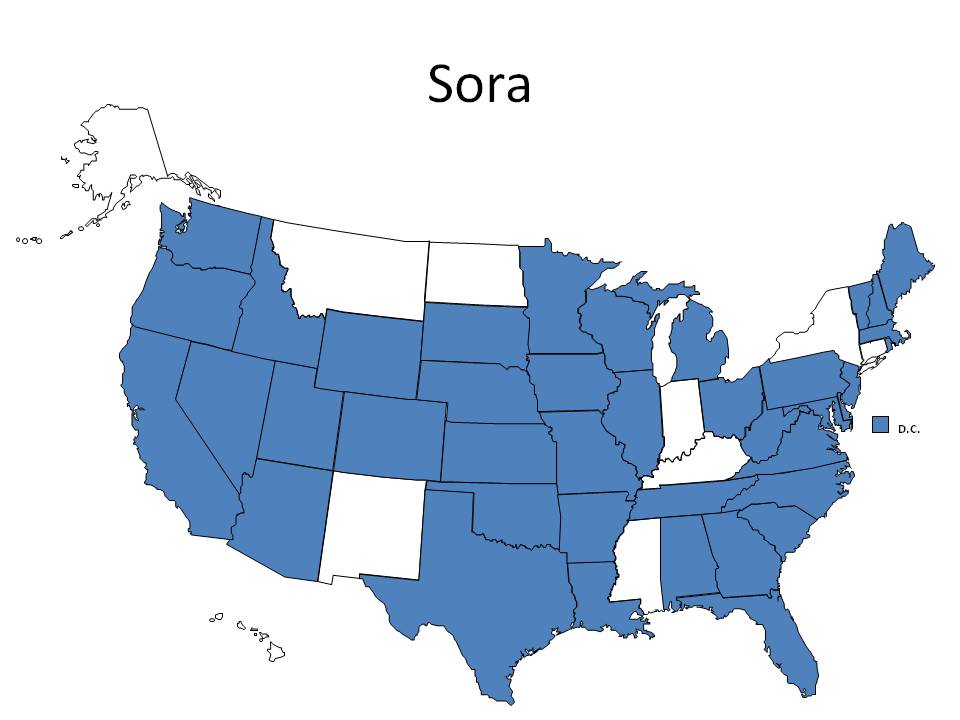
That gives me 175 for my DC list – now safely 10 over the threshold.  I’ve inserted 2 of my state bird maps below – the first is for White Ibis where I’ve seen it in all the states in its regular range and now as a vagrant in 4 states in the Mid-Atlantic and 2 in the Northeast.  By comparison the Sora map shows that I’ve seen it in many states across the US, though I’ve got some big misses here and there.


Saturday, August 18, 2012

Eurasian Collared-Doves in PA and MD, and White Ibis in PA, August 2012

A trip to visit relatives in PA and MD has to include at least a little birding time, right?  Of course it does for a "total ticker".  Though since I grew up in the area I've got pretty good lists for all the mid-atlantic states (and especially MD), and there's not much in the way of likely state birds.  I started off spending a little time checking the listserves and didn't see much to chase.  Then on to e-bird where I started to research Eurasian Collared-Doves - I need them for every mid-atlantic state except DE.  There has been a colony of ECDs in the little town of Shady Grove, PA for some time, and recent e-bird reports included up to 4 birds.  Plus there were a number of recent e-bird sightings of 1-2 birds just to the south across the stateline into MD.  Two possible statebirds within a 90 minute drive of the relatives - certainly critical mass and worth the try. 

I got up early on my first available morning only to find that it was raining heavily in the general vicinity of the doves.  So I decided to make that trip the next day.  But I had free time on my hands that morning before anyone else was awake.  What to do...  I checked the PA listserve and read that an immature White Ibis had been found the previous day just an hour away with pretty good local directions.  After a few minutes of looking at the map, I was off to the Susquehanna River a bit northeast of York to try for the ibis. 

The bird had been found in a small stream channel a short distance from the Susquehanna.  When I arrived I found some excellent riparian habitat along a small dirt road, and realized that the stream channel was at least a mile and half long.  And some of it was obscured by trees.  This could be a challenge.  I slowly drove along the channel 2 times checking at each opening in the trees, but with no luck.  A calling Screech Owl was a nice find though.  I decided to give it one last try, and as I reached the mouth of the channel I noticed a small wader on the rocks - it was the White Ibis.  Wonder where it was on my first 2 passes?  PA is now my 13th state for White Ibis (see the map below) - 8 southeast states in its normal range, along with 3 in the mid-atlantic and 2 in the northeast as a vagrant.


And the next day I was off for an early morning try for the ECDs.  After a pleasant drive through the beautiful PA countryside I neared the small town of Shady Grove, en route to Kline's Grocery in the middle of town which has been the center of dove activity.  One of the first birds I noticed on the eastern edge of town was a chunky dove on the wires - a most cooperative Eurasian Collared-Dove.  I drove a 1/2 mile to Kline's Grocery and had another 4 ECDs within just a couple minutes.  A nice colony of doves!

Next was a quick drive across the MD line to the small crossroads of Reidtown where ECDs had been reported this year.  Just 5 miles "as the dove flies" from Shady Grove, perhaps this is the beginnings of a satellite colony.  Soon after I arrived I found many Mourning Doves on the wires but no ECDs.  Then I noticed a dove in flight and got a brief view of a chunky square-tailed bird flying away.  A couple minutes later I saw the same bird in flight, and again at the same angle, as it flew off to the northwest out of sight.  I had wished for better views, but the bird didn't return in the next 2 hours.  So that would have to do to add Eurasian Collared-Dove to my MD list. 

Those are my 33rd and 34th states for ECD, with most being in the southeast and out west.  (I haven't birded in NM and MT since ECDs arrived there.)  And now I have them in MD, PA, DE, and VT in the northeast.  Just as it did in Europe, this species expands its range to the northwest before colonizing to the northeast.  And for statelists - that gives me 326 in MD and 238 in PA.