Showing posts with label Prothonotary Warbler. Show all posts

Saturday, September 7, 2024

Kentucky Trip Nets 11 State Birds, Plus one in Indiana – August 20-23, 2024

My Kentucky list has been stuck at 204 since my last trip to the state in 2006.  So now that I’m living in the southeast I’ve been looking for an excuse to get back to KY to fill some gaps in my state list.  Then in late summer of 2023 I began to notice lots of good birds being reported at the Falls of the Ohio - a wetlands area in the Ohio River near Cincinnati.  At one point there were 8 species there that would have been new for my KY list.  I had my excuse to go birding in KY!   And although birding at the Falls could be my prime reason to return to KY, I could always try for other new state birds en route or nearby.  Plus while I’m in the area I could cross over into Ohio and bird the southwest part of that state as well.  Unfortunately, I didn’t get my plans together early enough to make the trip in 2023, but there was always next year.

As Summer 2024 progressed I started to plan my KY and OH trip in earnest.  First of all, I scheduled my trip for the third week of August which historically was the week with the greatest number of targets for me at the Falls of the Ohio (based on eBird bar charts).  Then I reached out to former KY birder Teresa Noel, whom I met this past year.  She gave me lots of advice for my targets, and also connected me with local KY birder Dave Svetich.  Dave was helpful as well, and in turn put me in touch with another local birder, Katey Buster, who gave me more tips.

With the help of all those local experts and lots of hours on eBird, I found 16 potential KY state birds in the region.  That included my nemesis bird for KY – House Wren.  (How could I have more than 200 species in KY and not have House Wren on my list?)  That was the good news.  The bad news was that, as the trip neared, only 2 realistic targets were being seen at the Falls of the Ohio – Peregrine Falcon and Neotropic Cormorant.  And they weren’t even being seen every day.  So even though birding at the Falls was the trigger for my trip, it looked like my potential targets there would be limited.  Plus, since most of my regional targets were local breeders, I worried that they may be difficult to find so late in the summer.  If I had known how slow it would be at the Falls I could have just made this year’s trip early in the summer for KY breeders.  And then come back another year in late summer to bird the Falls.  But when I was starting to plan the trip earlier in the summer I couldn’t have predicted how good (or not) birding at the Falls might be in late August. 

Things were looking so bleak the last couple days before the trip that I almost canceled.  But then I remembered hockey great Wayne Gretzky’s quote – “you miss 100% of the shots you don’t take.”  In a twisted bit of logic I applied that quote to my trip saying that I certainly won’t get any new KY birds if I don’t go at all.  So I decided to go, and at the very least learn about the birding hotspots so I could come back and be successful on a future trip. 

It was pretty much the same story in southwestern OH.  My eBird research revealed 7 reasonable targets, 4 of which were late breeders, while the others were either waders or shorebirds.  But in order to pursue several of them I’d have to drive all the way north almost to Columbus, which was farther than my original plans. 

Despite the timing of the trip for the breeders, and the lack of rarities at the Falls, I still hoped for perhaps 9 new KY state birds.  Plus 3 new birds in OH.  Though perhaps I was being too optimistic.

This blog post summarizes the KY portion of my August 2024 trip, plus a little bit of Indiana.  My next post summarizes the OH part of the trip.

Day 1 – August 20

My plan for the first day of the trip was to leave late-morning to begin a 5-hour drive to the Red River Gorge area of central KY to look for Swainson’s Warbler.  My departure was delayed a bit to pursue a Western Kingbird in my home county in NC.  Luckily that was a successful search and made the delay worthwhile.  (See my previous post for the Western Kingbird summary.) 

While driving along through southeastern KY I spotted a large Corvid right over the road in front of me.  My first thought was that it could be big enough for a Raven, which would be quite a rarity for KY in general, and especially this far west.  As I got closer, I could see the large beak and wedge-shaped tail – it was indeed a Raven (KY state bird #1).  Then I spotted a second Raven flying along with the first one.  Luckily there was no traffic on this rural road, and I was able to pull over to watch this pair continue to fly along before disappearing behind a tree line.  I opened an eBird checklist and found that I was in Owsley County.  And this was the first Raven eBird record for that county.  That wasn’t a bird I had on my radar screen at all.  What a great start to the trip!

My state bird map for Common Raven is inserted below.  The blue-shaded states are those where I’ve seen this species in its regular range.  The cross-hatched state (NJ) is the last state in its regular range where I still need it.  The purple-shaded states are those where I’ve seen this species as a rarity - KY is now the 4th state along with KS, DE, and RI.

My first planned birding stop of the day was at the Red River Gorge area for Swainson’s Warblers.  Although the most recent report in the area was in mid-July, I often hear singing Swainson’s singing into September back home in NC.  Plus I had heard a pair of birds just the week before back home responding to tape.  So I was hopeful I would be able to find them during my KY trip.  There were quite a number of sites in the area with Swainson’s reports in eBird earlier in the year, and I chose one key area, along Nada Tunnel Road, as my birding site for the evening.  When I got to the area I was greeted by these multi-story rock formations which were just spectacular.

But unfortunately, that was the only highlight.  Despite being in seemingly good Swainson’s habitat I couldn’t scare one up.  I made numerous stops covering several miles of the road, listening and playing some tape.  Several times I heard a series of sharp chip notes but they were always Hooded Warblers.  But I wasn’t too disappointed because I had planned stops in another part of Red River Gorge the next morning just in case I missed Swainson’s that evening.  Though I was still a bit concerned that it might be too late in the year for my target at least locally.

After dinner my last stop was a try for Whip-poor-wills at Koomer Ridge Campground.  Similar to the local Swainson’s story, the most recent local report for this species was in mid-July.  But there had been several reports of Whips at this campground this summer, so I was cautiously optimistic.  But I struck out yet again – despite stops at numerous spots around the campground, and playing some tape, there were no calling Whip-poor-wills.  Now I was really getting worried about the timing of my trip so late in the breeding season.  Hopefully tomorrow would be a better day.

Day 2 – August 21

I started the day at dawn back in Red River Gorge for yet another try for Swainson’s Warbler.  This time I birded the Rock Bridge Trail, starting my hike down the trail at dawn.  The first part of the trail was in nice mature deciduous woodlands but not quite Swainson’s habitat.  And once again I picked up several more calling Hooded Warblers along the way.  Then as I neared the junction with the Swift Camp Creek Trail I got into an area with steep slopes and a thick understory of rhododendron – perfect for Swainson’s.  Here’s a picture of the valley below me.


I turned onto the Swift Camp Creek Trail and continued my slow walk.  Just a couple hundred yards down the trail I heard a series of sharp chip notes that I instantly knew were coming from a Swainson’s and not the higher metallic notes of the common Hooded Warblers.  I even checked with Merlin and it agreed.  (KY state bird #2)  Maybe summer wasn’t quite over just yet after all.  Since I’ve moved to the southeast I’ve now picked-up Swainson’s Warbler in 4 states - NC, SC, TN, and now KY.  Still a few more to go though.

On my way back to the car I was serenaded by a Red-breasted Nuthatch, which turned out to be a rarity needing details in eBird.  This species is not normally a summering bird in that area.

Next I was on to the Haley Downs Road hotspot which is known in central KY for its grassland birds.  Within just a couple minutes of parking I walked towards a fallow grassy field and almost instantly had small groups of Bobolinks flying overhead (KY state bird #3).  That was easy! 

Now I focused on my 2 sparrow targets – Grasshopper and Henslow’s.  Grasshoppers were still singing now back home so I was hopeful on that one.  Henslow’s are normally reported at this hotspot most summers, but hadn’t been reported at Haley Downs this year so I wasn’t too optimistic about that one.  I listened and played tape at a number of grassy fields with no luck for either species.  Then I heard a soft call coming from a small patch of uncut taller grass that at first I didn’t recognize.  I focused my attention on the area where the call had come from and heard it again.  Was it the song of a Henslow’s?  I listened intently and heard it give 2 more of its insect-like songs – I indeed had a singing Henslow’s (KY state bird #4).  Maybe it was a pair having a late brood after a failed earlier nesting nearby.  But I had no luck with what should have been the more likely Grasshopper Sparrows.

While trying one more time for Grasshoppers I noticed a large pale bird perched in a distant tree.  A quick binocular view revealed that it was a Eurasian Collared-Dove.  It wasn’t new for my KY list, but it was a rarity for the area.  It stuck around for several days for Katey Buster and several other local birders to see.

And speaking of rarities, as I was leaving Haley Downs a Loggerhead Shrike flew over the road.  I didn’t realize it at the time but that was another rarity, with less than 20 county records, and luckily it too was re-found by another birder.  Though I would have traded both rarities for a Grasshopper Sparrow…

The next target as I continued my drive to the west toward Lexington was a Mute Swan reported from a private pond on Berea Rd in Fayette County.  The pond was a short distance off the road so access was a bit iffy, but once I figured out how to get a view of the pond the Mute Swan was quite obvious with binoculars (KY state bird #5).  The swan is circled in this cellphone picture without magnification.

The Pfeiffer Fish Hatchery northwest of Lexington was my next stop, where a Baird’s Sandpiper was found a few days earlier.  But since my drive took me through areas of grassy pastures I made several stops along the way hoping to run into Grasshopper Sparrows.  I was once again unsuccessful on all those stops.  But across the road from the field at one of those stops in Franklin County was a brushy area that looked good for Wrens.  I played a bit of House Wren calls and songs and almost instantly one responded, and then popped into the open (KY state bird #6).  Finally – House Wren in KY!  KY was the last state in the Lower 48 for me to see House Wren.  That is the 59th species that I’ve seen in all the Lower 48 states (plus DC).

Pfeiffer Fish Hatchery was full of Great Egrets and Great Blues, but the only shorebirds I could find were Killdeer.  And this long-staying Mute Swan was photogenic.

My next stop was another long shot – Peregrine Falcon in downtown Lexington.  The good news was that eBird reports gave the location of a nest box on the Central Bank building downtown.  The bad news was that there had been no sightings since June.  But I had some time, so why not give it a go.  I parked in a downtown parking lot with good views of the skyline.  I quickly found the nest box which was empty, and scanned the edges of the nearby buildings.  I only found a few Rock Pigeons which seemed to be totally at ease.  Oh well, it was worth the try.

After dinner I headed to Lexington Green Pond in the Lexington suburbs where 2 Mute Swans had been reported sporadically.  As I pulled up I saw the pair of Swans along with about 50 Mallards all being fed by shoppers.  Since the Swans are countable, they must be tame but not feral.  Interesting that Mute Swans around home in western NC that appear to be very wild are always considered to be escapees. 

The last target of the day was Common Nighthawk.  There were numerous recent Nighthawk reports throughout the central and western parts of the state as they were migrating through the region.  But there didn’t seem to be any particular spot where they might be seen reliably on any given evening.  So I decided to just find a large shopping center parking lot nearby that would provide me a full view of the sky.  And if I don’t see one passing by overhead maybe I’ll find one after dark eating the insects attracted to the parking lot lights.  I picked out a large parking lot for a grocery store a short distance from my Lexington hotel as a good candidate.  I parked in a quiet part of the lot about an hour before sunset and started my vigil.  After about 30 minutes of counting Crows, Starlings, and House Sparrows I spotted a candidate in the distance.  And with a binocular view I picked out not 1 but 2 Nighthawks flying by (KY state bird # 7).  A nice way to end the day.  I just need this species in 1 more state.

Day 3 – August 22

The first stop of the day was at the Talon Winery south of Lexington.  No, I wasn’t going there to attend a wine tasting event.  Instead, I was there to look for grassland species that regularly breed around the winery grounds.  Specifically, I was hoping to see Henslow’s Sparrows reported as recently as the previous afternoon, and to hope for Grasshopper Sparrows that bred there this year but hadn’t been seen for a couple weeks. 

When I arrived, I went right to the area of the uncut field where both sparrows were reported.  But I couldn’t find the field.  I rechecked with Katey Buster and I had the right spot.  It turns out the field had just been cut – literally in the last 18 hours since the eBird report the previous afternoon.  I could not find a single sparrow in the area, though there were at least 20 Meadowlarks walking through the now short vegetation, perhaps lamenting that they had lost their nests.  If only they had delayed cutting the field by a day.  Luckily, I had a Henslow’s the day before at my other stop, but Grasshopper Sparrow would have to go down as one I missed because my trip was so late in the summer.

Next I was off to Henderson County in western KY just across the river from Evansville, IN.  It was a long drive but I had 3 key targets there not easily found elsewhere in the state.  The first was a flock of Black-bellied Whistling-Ducks that were being seen for some time at the Industrial Park Pond hotspot.  Some reports made it look like you would just drive up to the pond and they’d be right in front of you.  Then again there were other reports where the BBWDs were not found at all.  I was one of the luckier birders, because the instant I pulled up to the pond I could see a flock of brown ducks on the far bank – with a quick binocular view I confirmed I had 7 BBWDs (KY statebird #8).  I was just giving myself a high five when I noticed 2 sleeping BBWDs practically right in front of me.  Here are digi-bin pictures of both the distant flock and the pair right next to my car.


My next target was Bell’s Vireo, which is a regular nester in the area.  There had been several reports in the area recently, but the one that sounded most promising was at the Diamond Island Boat Ramp hotspot where 2 had been reported less than a week earlier.  When I arrived at the boat ramp I found a large brushy area near the water that seemed like the right habitat.  I played some tape at several stops before I caught a glimpse of a candidate low in the vegetation.  Eventually it popped out and gave good looks – it was indeed a Bell’s Vireo (KY state bird #9).  Little did I now that listening to recordings of its song would prove to be helpful the next day in the OH portion of my trip.  I just need this species in 4 more states in its regular range.

My last stop in the county was at the Horseshoe Road Slough where a Baird’s Sandpiper had been spotted recently, along with a Buff-breasted the week before, and always with a nice mix of other shorebirds and waders.  It took me a while, but I finally found the slough tucked into a sea of soybean plants.  I found lots of waders but the only shorebirds I found were 1 Killdeer and 2 Spotted’s.  Little did I know that a Red-necked Phalarope was found at a nearby slough that same day.  If only I had checked my KY Needs Alert before leaving the area…

My original plans included a nighttime stop to try for Chuck-will’s-widows and Whip-poor-wills south of Louisville.  But given all the driving I did that day, the lack of recent goatsucker reports, and my lack of success with Whips earlier in the trip, I decided to pass on these nocturnal birds.

Day 4 – August 23

I started Day 4 of the trip at Turkey Run Park in the Louisville suburbs in hopes of finding a Prothonotary Warbler.  This was another late summer breeder which initially I wasn’t too optimistic about, but it had been reported several times recently from the park so maybe I’d be successful after all.  My first stop was near the entrance where 1 had been reported earlier in the week.  I found some good riparian habitat along Turkey Run, but a calling Screech Owl and a perched adult Bald Eagle were the only notable birds.  Next, I headed to Squire Boone Bottoms where there had not only been a recent report, but also reports of a likely nesting pair earlier in the summer.  A mile and a half loop trail took me down through the bottoms area which had some excellent riparian habitat along the river.  It looked like a great spot for Prothonotary’s!  I slowly walked along the river playing some tape hoping for a response.  The area was quite birdy, but I couldn’t find my target.  But then finally I heard a Prothonotary sing, undoubtedly in response to my tape (KY state bird #10).  Just 2 more states to go in this species’ regular range.

The next stop was in a small residential neighborhood in Louisville to look for Yellow-Crowned Night Herons.  There had been several reports of 1 or maybe 2 nests in this area in the spring and early summer but I figured surely those birds would fledge and move on before my late August trip.  So this species wasn’t one of my initial targets.  But then there were a couple reports in early August from the same spot.  And again, a nest with juveniles was reported.  It must be a second brood – I didn’t know that YCNH’s have multiple broods.  With a bit of help from my KY contacts I found out that the nest was in a tree in front of the house at 3542 Ramona Ave.  As I pulled onto Ramona Ave. I saw very large deciduous trees planted in the front yards of each house.  I got to 3542 and stepped out of the car.  With a quick scan I found a dense area of twigs and sticks that must have been the nest.  And with a closer binocular view I could pick out at least 3 juveniles at the nest (KY state bird #11).    

That was 2 for 2 for the morning so far.  But now it was on to the Falls of the Ohio where my opportunities were likely to be pretty limited.  In the previous couple weeks there had been just 2 possible targets being seen there – a Peregrine reported on maybe a third of the checklists, and a long-staying Neotropic Cormorant.  But the Cormorant had not been seen for 2 days so maybe it had moved on.  Like I said, it was looking pretty bleak.

When I arrived at the hotspot I was truly taken aback by the scenery and the enormity of the site.  Here’s a scenery shot of the lower falls and fossil beds, taken from the observation deck at the Falls of the Ohio Foundation on the Indiana bank of the Ohio River.


And here’s a shot of the upper falls with a distant railroad trestle which was apparently the Peregrine’s favorite perch.

One of the first birds I saw when I got there was the long-staying American White Pelican, which unfortunately was not a new state bird for me in KY.  The bird was in flight over the Falls, and since basically the entire river and the Falls are in KY, the Pelican was squarely in KY airspace.  But as the bird circled it slowly drifted northward, and eventually it slipped out of sight into Indiana – a bonus Indiana state bird for me!  That was unexpected.  As shown in my White Pelican state bird map I’ve now seen this species as a rarity in 10 Midwest and northeast states.

Now it was time to get to work on my KY targets.  The Neotropic Cormorant liked to perch with Double-crested’s on a distant concrete wall nearly a half mile away.  But thanks to a 50X scope I could see the cormorant flock quite well.  Despite lots of searching, unfortunately I couldn’t pick out the diminutive southern cousin among the 85 Double-crested’s.  Here’s a shot of a portion of the flock.

Next I focused on the railroad trestle for the Peregrine.  But again I came up empty.  At one point a train went across the trestle and I hoped it might flush the raptor but to no avail.

Back to the Falls I was able to find Little Blue Herons and a Snowy Egret, both somewhat unusual for the site, but not new for my KY list.  Ironically, I need both of those species for my IN list, but these waders were definitely inside KY, albeit within a quarter mile of the state line.  I also scoured the wetlands and fossil beds for rarer shorebirds but just came up with 13 Killdeer.  A pair of Caspian Terns and a Black-crowned Night Heron were nice as well.  After about 2 and a half hours of scanning (and hoping) I decided to give up on the Falls of the Ohio and the KY leg of my trip, and head into OH. 

Ironically the key trigger for my trip, a visit to the Falls of the Ohio, didn’t yield any new KY state birds.  But if it hadn’t been for that hotspot, I wouldn’t have made the trip to KY at all, and wouldn’t have added 11 new birds to my KY state list.  That’s still a nice tally compared to my expectation of adding 9 new birds.  That brings my new KY total to 215.  And now I have good locations for Grasshopper Sparrow, Chuck-will’s widow, and Whip-poor-will should I come back on a future summer trip.  Plus I can’t forget the 1 new bird in IN which brings that state list to 233. 

And now a bit of a postscript regarding the significance of my 215 total in KY –

Early in my birding career I set a goal to see at least half of the birds on the official state lists of each state in the Lower 48 and DC.  The genesis of this goal comes from the American Birding Association (ABA).  Back in the day, the ABA would publish your state and Canadian province totals but only if you had observed at least half of the total ever recorded in that state/province.  So my goal was to be able to report my totals in each of the Lower 48 states and DC.  The ABA last published birders’ totals in this way in 2011.  Later they went to a digital format where all your totals would be published without any threshold.  And of course, eBird has taken that approach as well.  But my goal remained – to be able to meet the ABA reportable threshold in each state.  And in 2023, with a birding trip to Oregon, I reached my lifelong goal of being reportable in each of the Lower 48 states plus DC. 

As of 2011 the ABA reporting threshold for KY was 194, meaning the total state list was twice that total or 388.  I had 204 on my KY list at the time so I was safe at 10 over the threshold.  Or was I?  You see as new birds are added to a state list, the threshold increases as well.  As of January 2023 (the most recent update on the internet), the official KY statelist had increased to 396 (www.birdky.org/kbrc.php).  That means the threshold has increased to 198.  My new KY total of 215 is 17 over that new threshold – that should hold me for a while.

Saturday, October 20, 2018

Prothonotary Warbler, Kennebunkport, ME, October 2018


Each year I make an early fall trip to southeast VT looking for sparrows and late warblers.  So as early October rolled around I made my plans for my annual VT adventure to Brattleboro and Vernon, with a multi-stop, day-long itinerary. 

But wait – the title of this post talks about Kennebunkport, ME, not VT.  How did that happen?

Literally minutes before heading out the door I remembered that not one but two Prothonotary Warblers had been spotted in the last 2 days on the southern coast of ME.  One report was just the previous afternoon in Kennebunkport.  There have been quite a number of Prothonotary’s in ME both in spring and fall the last few years, but I hadn’t had a chance to chase after any of them.  So rather than a completely speculative trip to VT, why not change my plans to chase after a recently spotted rarity just a bit farther away?  I turned my computer back on, and did a bit of research on yesterday’s Prothonotary in Kennebunkport.  And just in case that bird didn’t cooperate, I also took notes on the one seen 2 days earlier just up the coast in Scarborough.  I changed my route on the Map App to drive northeast to Kennebunkport instead of northwest to Brattleboro, and I was out the door.

After a 2-hour drive I arrived at Fishers Lane in Kennebunkport.  The location of yesterday’s sighting was pretty specific, with the observer mentioning that the bird was in brush at the end of the road near the brown canoe.  There were 3 other cars parked at the end of the road when I got there, so I was hopeful that other birders already had the bird.  After a short walk I spotted the brown canoe and then a birder nearby.  I had the right spot, now I needed the bird to cooperate. 

I approached the birder and he said he was one of the observers of the Prothonotary yesterday, and he was standing at the location of yesterday’s sighting.  He also mentioned that other birders had the target bird an hour earlier in the brush a short distance down the beach.  So I walked in that direction and soon found 3 other birders also looking for the bird.  It seemed that the bird was moving around in a reasonably small patch of brush near the beach and an adjacent freshwater wetlands.  Now to start my search.

There were at least 5 birders in this small area anxiously searching for this bright yellow bird.  Over the next hour there were numerous Yellow-rumps passing through, and I spotted a Blackpoll as well, but no Prothonotary.  Then while scanning the backside of the marsh in the distance I caught a briefest of glimpses of yellow.  I told the 2 birders I was standing next to that I may have the bird.  Then a couple seconds later the Prothonotary popped up in the open 2 feet off the ground.  By the time I said I had the bird, it dropped back in the brush again out of sight.  Unfortunately I was never able to get the other birders on it. 

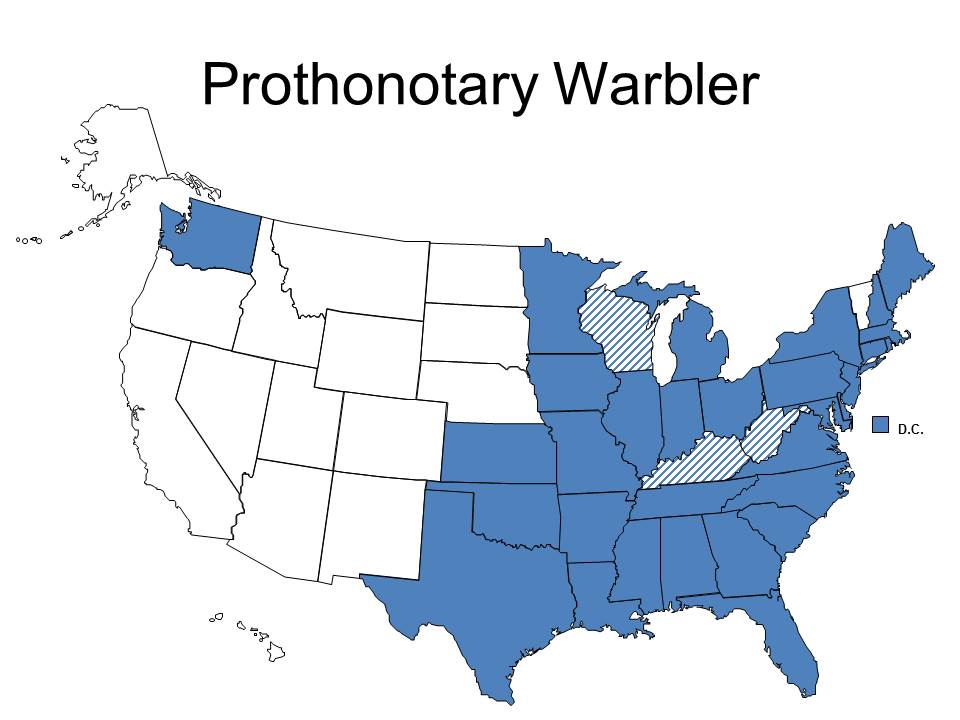
It’s nice to finally check off Prothonotary Warbler for my ME list - #343 for that state.  That was the 32nd state where I’ve seen this species (the dark blue shaded states in my statebird map below).  The cross-hatched states are those in its regular range where I still need it for my statelists – I’m only missing it in 3 states where it is a non-rarity.  Plus Prothonotary can be seen as a rarity in a few other states, including ME and elsewhere in northern New England.  Though few would expect it in WA, where I found one a couple years ago as an extreme rarity.


I had set aside the whole day to find the Prothonotary, or the one found the day before.  So now that I found my target so quickly, I needed to decide what to do with the rest of the day.  First I tried to get a better view of the Prothonotary, but I spent the next 30 minutes at the Fishers Lane spot without re-finding it.  During this time I continued to notice quite a large number of Yellow-rumps in the area, and wondered if this was going to be a good fallout day.  So with some advice from other birders there, I decided to head up the coast, and first headed to Timber Point to try my luck with migrants there.  The fallout of Yellow-rumps continued at this spot as well.  I did my best to make an exact count which was 176 in the 90 minutes I was there.  I tried not to double-count any birds, but it was impossible to tell for sure since they were always coming and going, often with 5-10 in view anywhere there were shrubs and edges.  I also picked up a late Redstart, and two cooperative Swainson's Thrushes.

Then it was off to Biddeford Pool and the South Point thickets.  I had 20 more Yellow-rumps here plus a most cooperative Gray-cheeked Thrush.  Or more accurately I should say it was a Gray-cheeked/ Bicknell’s since apparently the latest ID advice is that you can’t safely separate these two species if they are not singing or in the hand.

My last stop was at the Nubble Thickets in Ogunquit where I’ve had great migrants in the past.  However, I didn't have a single warbler there!  And the only migrants were one White-throat and one Junco.  Go figure.  The highlight here was a small duck out on the ocean in a large flock of Common Eiders which turned out to be a Green-winged Teal.  A nice find at the end of a nice day of birding.

I’d like to think that I made the right decision to search for the Prothonotary in ME instead of heading to VT.  Then again, I guess I’ll never know what I might have found if I had kept with my original plans and traveled to VT instead.

Saturday, December 10, 2016

Prothonotary Warbler, North Hampton, NH, November 2016


Earlier in the month I had an excellent birding trip to WA where I saw many rarities including finding a Prothonotary Warbler – only the 4th for the state.  And amazingly a few days later came a report of a Prothonotary on the NH coast, with photos of the bird foraging in boulders right on the coast in North Hampton.  Although the species is not nearly as rare in NH as it is in WA, there are still only a handful of records for NH – there are only 8 accepted NH records since 1950 (according to The Birds of New Hampshire by Keith and Fox) and no prior reports in eBird.  Not surprisingly it’s one I needed for my NH list.  But the bird was not re-found the next couple of days so it appeared to be just a one-day wonder. 

Later that week I sent a note off to a couple of the folks I had birded with in WA to tell them of yet another very late Prothonotary, this one closer to home.  I was just hitting the send button when a text came across that the NH bird was re-found in almost the exact same spot it was seen 4 days earlier!  I wanted to run right out the door, but had commitments through early afternoon and wouldn't be able to make it there until mid-afternoon at the earliest.  But I wasn’t too worried.  After all it had stuck around for 4 days, so I was cautiously optimistic that it would remain until that afternoon.

I continued to check my phone as the morning progressed, and several positive updates came through.  But by noon the updates stopped.  I guess most everyone who wanted to see the bird must have already seen it.  So by the time I was finally able to head to the NH coast it had been a couple hours since the last report.  I tried to remain positive…

When I arrived at North Hampton State Beach I met up with local birder David Donsker.  He told me that apparently no one had seen the bird for a while, but it looked like a couple birders a few hundred yards up ahead might be acting like they had just re-found it.  I ran maybe a quarter mile north up the walkway and as I got to the birders they said they just had the bird down in the rocks.  Another minute later I got the first glimpse of the bird as if foraged for insects way down in the boulders.  The bird would disappear for a few minutes and then reappear near the surface a few rocks farther away – apparently the same thing it had been doing all day long.

After getting great looks at the Prothonotary as it hopped among the boulders we watched the bird fly out to the seaweed-covered rocks by the water line.  It was now near low tide, so it was pretty far out.  But even at that distance the bright orangey bird was very easy to pick out among the dark rocks.  At that point we left the spot and headed back to the cars.  Little did we know that we would be among the last birders to see the warbler, as it was not re-found after it headed out toward the water.  Boy was I lucky – a few minutes later and I would have missed it.

Prothonotary Warbler was number 362 for my NH list.  I’ve now seen this species in CT, MA, RI, and NH in New England, along with most of the states in its regular range in the southeast and central US, and of course in WA as a vagrant.  Interesting that in 2002 I had a singing Prothonotary Warbler in good breeding habitat in my hometown of Pepperell, MA just 3 miles from NH.  It took all these years until I finally got one north of the NH state line.


And a few thoughts on vagrancy in Prothonotary Warblers –

Interesting that both the WA and NH birds were seen at about the same time, as was one posted on eBird in northern CA.  This early- to mid-November timeframe is generally a couple months after birds have left their breeding grounds.  Throughout their regular breeding range there are only a handful of sightings in October – and most of these are in early October.  But there are actually a fair number of late October, November, and even December records scattered across the country.  Similarly, the three prior WA records were all from the fall, though averaging a bit earlier with one each in August, September, and October.  So it seems October/November could be a time to look for Prothonotary Warbler as an extreme rarity. 

It is also of note that the pattern for vagrancy in Prothonotary’s in New England and eastern Canada is a bit different.  Although there are a few fall records in the northeast in late fall, the bird is more likely to be found as a vagrant in Spring, likely as an overshoot of its regular southeast breeding grounds.  Plus Prothonotary’s are found occasionally as a breeder in the southern part of New England.  There was even a male Prothonotary that sang as if on territory this year in southern VT.

And one other thought on the 2016 sightings – the WA, NH, and CA birds are all at roughly the same latitude, though obviously on opposite coasts.  Additionally, the normal range for Prothonotary Warbler in the central US is roughly equidistant between the locations of the WA/CA sightings and the NH sighting.  Could these November, 2016 vagrants have been from the same population - with the NH bird taking about the same amount of time to get to its northeast location as the WA/CA birds needed to travel northwest to the Pacific coast?  Wonder where they might have been in the last couple months after leaving their breeding grounds.

Friday, November 18, 2016

18 Statebirds in Washington, “Reportable Plus 15”, November 2016 – Part 1 of 2


I was really excited when a business trip to Seattle was scheduled in November 2016 giving me another opportunity to bird in the Pacific Northwest.  My WA statelist was 251 which was 3 over the old ABA reportable threshold, defined as half of the state total.  But with a little on-line research, I found that the WA statelist now stands at 511 – a whopping 15 higher than the total when the ABA threshold was calculated back in 2011.  And dividing 511 by 2, the present threshold would be 255.5.  WA is a great example of why I’ve revised my goal to be at least 15 over the old ABA threshold in each state, or “Reportable Plus 15” as I call it.  In fact, maybe Reportable Plus 15 may not be enough to keep me over threshold for long in WA.  In any case, I wanted to add at least 12 to my WA statelist to get to 15 over the ABA threshold.

Now comes the planning.  Although I had a pretty good WA list already, I expected I would have realistic possibilities for new statebirds in most any part of the state.  I was thinking of adding at least a couple vacation days to my trip which would allow me to get to most any portion of WA except for the far eastern end.  But now I needed to decide if I should I go east into central WA for inland targets, stay in the Cascades for mountain targets, or head to the coast especially for waterbirds and the like?  I compiled a list of targets for all these areas, and came up with pretty significant lists of possibilities in each region.  Then I set up a Needs Alert in eBird and found that not only were most of my targets being seen, but several pretty extreme rarities were being seen in Neah Bay, which is at the northwest tip of the Olympic peninsula.  The reliable Neah Bay rarities included Rose-breasted Grosbeak, Dickcissel, Ruff, numerous Palm Warblers, and as many as 6 Tropical Kingbirds.  With some more research I found that Neah Bay is quite notorious for vagrants in October and early November.  So even if these rarities weren’t still around in 3 weeks when I got to WA, others might take their place.  Plus there were several more regular targets being seen in the area as well, especially on seawatches.  The downside was that Neah Bay was at least a 4-hour drive from Seattle, trading a lot of potential birding time for driving time. 

Next I turned my sights to the closer Cascades.  My interest was piqued by a post on the listserve about some seemingly reliable Three-toed and Black-backed Woodpeckers northeast of Cle Elum.  And several other mountain targets were being reported near Mount Ranier.  But calls to the local forestry service and Mount Ranier National Park indicated that the roads would at least be very muddy if not snow-covered.  Not the best for a small rental sedan. 

Then I researched the drier central part of the state, and again came up with some possible targets.  But these were more spreadout, and many seemed to be less reliable.

The last key factor was that I had planned to take a summer trip one year to eastern OR to work on my statelist there.  On that trip I had also planned to add a day or two in eastern WA to fill gaps in my WA list.  My targets on that eastern WA trip included several of my central WA targets of this November trip, as well as many of my targets in the Cascades.  And of course few if any of my coastal targets would be possible in eastern WA. 

I had made up my mind – I would head to the coast on this trip, focusing not only on all those rarities in Neah Bay, but also potential targets elsewhere on the coast, and others in route to and from the coast not likely to be seen on a future eastern WA summer trip.  As the trip neared, unfortunately the Grosbeak, Dickcissel, and Ruff were no longer being reported in Neah Bay.  But just as I expected, new rarities were being found there, like Orchard Oriole, Clay-colored Sparrow, Gnatcatcher, and a state-first Field Sparrow.  But then most of these were not being reported in the last couple days before my trip.  Unphased, I tried to remain optimistic that a coastal itinerary including Neah Bay would be my best choice.

With a couple tweaks just a day before my trip started, my planned itinerary was to start on the afternoon of Day 1 pursuing two stakeout shorebirds in the Seattle area, then bird the last couple hours of the afternoon at Hurricane Ridge in the Olympic National Park.  On Day 2 I would spend the entire day in Neah Bay trying to chase after all those landbird rarities and to do an extended seawatch.  Birding Day 3 would start in southwest WA in Westport for a stakeout Bar-tailed Godwit and nearby Snowy Plover, and then near Ridgefield NWR for Red-shouldered Hawk and Sandhill Crane.  Finally, I had a late morning flight out of Seattle on Day 4, which would give me a couple early morning hours near Seattle to fill any last remaining gaps in my list. 

With that itinerary I estimated that I might be able to add 8 birds to my WA list.  Though it would be great to add 12 to reach my Reportable Plus 15 goal.

This post summarizes my Day 1 and Day 2 sightings.  The next post will summarize my birding on Days 3 and 4.

Day 1 – Morning – Surfbird Chase in Seattle

My first target bird was Surfbird reported on the waterfront only 15 minutes from my meetings in downtown Seattle.  These birds had been reported in October at Alki Beach and two nearby locations in West Seattle, though not in the last couple weeks.  Although my meetings started at 8, which was roughly sunrise, I figured I could see these birds at first light, and still have enough time to make it back for the meetings.  I specifically targeted the Don Armeni Boat Ramp where 36 Surfbirds along with 35 Black Turnstones had been reported 2 weeks ago - this was a very specific location and seemed to have the critical number of “rockpipers” to suggest they would still be there 2 weeks later when my trip began.  I arrived at the park at about 7 AM, and although it was still dark, I counted on being able to see the birds at the boat ramp under the lights of the park.  But to no avail.  I also walked the entire rocky waterfront along the park and didn’t see a single shorebird.  Could the birds instead be at either of the other nearby locations where they had been reported recently?  Unfortunately I didn’t have time to check these other spots, and I reluctantly left at 7:30 having missed my first target.  As I drove back into downtown (in some pretty ugly traffic), I wasn’t too disappointed since I optimistically assumed I would be able to find them in the early morning the day I was to fly out on Day 4.

Day 1 – Afternoon – Seattle and Hurricane Ridge

My meetings were done right on schedule at Noon, meaning I had time to both make a quick stop for a stakeout Red Knot nearby, and still have time to spend a couple hours birding Hurricane Ridge.  The Knot had been reported seemingly reliably for some time in Yukon Harbor, though with no specific location given.  Each time it was seen with Killdeer, and most recently with some Dunlin.  So although I was optimistic that the bird would be in the harbor that day, I worried a bit about how long it might take for me to find the bird.  After all I was on a tight schedule, made even tighter when my map app sent me on a very inefficient route that cost me 15 to 20 minutes of extra travel time.  But the good news was that the tide was pretty high so the mudflats would be limited, hopefully concentrating the shorebirds.

When I finally neared the harbor I noticed a small creek entering the harbor to the south with a bit of a beach, so I targeted this spot as my first stop.  But a quick scan revealed just a couple gulls.  I then scanned the rocky shoreline to the north and noticed another larger creek coming into the harbor, with a nice exposed delta.  I thought this spot looked like a great location for Killdeer to forage, maybe to include a wayward Knot.  A couple minutes later I pulled up to that beach and instantly noticed a larger pale bird standing on the mud right next to the road.  Seconds later I got great binocular views of the Red Knot (new WA statebird #1), along with 5 Killdeer.  A nice “write-in” in eBird.  As shown in my statebird map below, WA was my 18th coastal state where I’ve seen Red Knot, along with sightings as a rare migrant in 3 inland states.


Next I was off to Hurricane Ridge in Olympic National Park with the principal target being Sooty Grouse.  This area also had occasional reports of a few of my targets from the Cascades, the most likely being Clark’s Nutcracker.  So although I would have just 2 hours of daylight, I was hopeful I would turn up something there.  And then when I paid the surprising $25 fee to drive up Hurricane Ridge, I sure hoped I would be successful in my searches.

The weather near the bottom was quite nice – mid 50s, partly cloudy, and light breezes.  But the forecast was for late day showers, and as I climbed the ridge I could see really dark clouds in the distance.  When I got to the top the skies were threatening, and I could see it was snowing in the distance.  Temps had dropped into the low 40s.  And most importantly – it was really windy.  Winds were so strong I literally could not walk into the wind.  Now I know why it is called Hurricane Ridge!  Luckily I found a few trails that were on the lee side of the ridge and started my searches.  Unfortunately I found few birds at all – just some Golden-crowned Kinglets, a couple Varied Thrushes, and a few “Oregon” Juncos.  At one point I looked down in the valley still on the lee side of the ridge and spotted a migrant Bald Eagle passing by below me.  A nice and somewhat surprising find.  Then on the next scan I spotted a large brown Falcon.  My first thought was that it was a Prairie Falcon, but that would be a rarity this far west.  So I watched it intently trying to turn it into something else.  It was too small (and too brown) to be a somewhat more likely Gyrfalcon.  And it lacked the strong moustache stripe of the Peregrine.  Unfortunately since the bird was flying below me I did not have the opportunity to see the tell-tale dark armpit of a Prairie.  I watched the bird pass by for about 30 seconds before it flew out of sight behind another ridge.  And despite my efforts to try to turn it into a more likely species, I concluded it was a Prairie Falcon (#2), rare for this part of the state and one of my targets but only if I had made the trip into central WA.  That fills a gap in my statebird map, though I still need this species in several western states in its regular range.


Day 2 – Neah Bay

The forecast for Neah Bay was for rain in the morning and showers in the afternoon – that would certainly make for challenging birding conditions, but it was WA in November afterall.  I left my hotel in Port Angeles at about 5 AM, and started the 90-minute trek to Neah Bay in some heavy rain and fog.  And along with the very dark and twisting road it made for quite the white-knuckle drive.  My plan was to arrive in Neah Bay pre-dawn to try for a Pygmy Owl that had been reported about a week earlier.  Luckily by the time I rolled into the area the rain had stopped, and with no wind I had good conditions to listen for the Owl.  But despite several stops I couldn’t scare one up.  I quit owling about 30 minutes before sunrise and decided to make a quick tour of this small town to get a better handle on all the different locations where the rarities had been reported.  It was nice to finally see the town after staring at the GoogleMaps images for so long.

I decided to start my daylight birding at the far eastern edge of town on a road called Ba’adah Village Loop Road.  The previous weekend a Clay-colored Sparrow had been seen there several times in the brushy edges of a big excavation.  So armed with these excellent directions, I made this my first stop arriving about 15 minutes before sunrise.  I walked up to the excavation and spotted a couple sparrows feeding in the dirt, but they were just Golden-crowns.  I followed them over to the base of a small blackberry thicket but didn’t see any other sparrows.  Then I noticed a bright orangey-yellow spot in the brush.  I put my binoculars on it and got a partial view of a bright yellow bird – could it be a Prothonotary Warbler?  Then it popped into the open not 20 feet from me – it was indeed a gorgeous male Prothonotary!  (#3)  I knew that was quite a rarity, so while I watched the bird I called a WA birder who had given me advice to alert him.  It turns out that this was only the 4th record for WA.  He spread the word, putting it on the listserve and calling a few other birders who were in the area.  My statebird map shows pretty good coverage of this species in its regular range in the southeast and south-central states, and now WA as an extreme rarity.


After about 30 seconds I lost the warbler in the tangles even though it was a pretty small area.  I noticed a bird fly out of the brush to the west, so I headed in that direction and found more good brushy habitat, but didn’t re-find the warbler.  I headed back to the original spot and spotted a larger paler yellow bird fly overhead.  Even though it was a quick view I knew it was an Oriole.  I watched it land in a tree on the other side of the excavation and spotted the Orchard Oriole (#4) – not nearly as rare as the Prothonotary but still a great rarity.  WA was my second west coast state for this species as a rarity.

 
At one point the bird landed very low in a bush where I got this shot with my phone.  Needless to say not even a record shot, but indicative of how cooperative the bird was.


And although 2 Orchard Orioles had been reported in Neah Bay a week ago, they were from an area more than a half mile away, and there were no reports since then.  So I felt like I had found a new bird. 

I spent some more time around the excavation which was now quite birdy, finding a number of Golden-crowned Sparrows and Juncos, and seeing the Oriole a couple more times.  I then headed east around the loop road, especially focused on the brushy areas hoping for more rarities.  Plus a tropical Kingbird had been seen in the area so I watched the open perches.  I ran into a number of smaller passerines like Chestnut-backed Chickadees, Bushtits, Pacific Wrens, and both Kinglets, but no more rarities. 

Soon I was back near the excavation and again the area was hopping – loads of sparrows, a couple Spotted Towhees, and some Sooty Fox Sparrows.  Then I spotted the Oriole again – or should I say another Oriole?  This one looked brighter yellow below than the first one.  And then I spotted another flash of yellow as a bird flew by me landing on top of the same bush where the Oriole was perched - a Tropical Kingbird (#5).  WA was my 6th state for this species – 4 of which as a rarity.


So in a little more than an hour I had found one extreme rarity (the Prothonotary), found 1 (or maybe 2) other rarities (the Orioles), and re-found another rarity (the Kingbird).  Amazing!

I then walked a short distance to the north where more brush lined a rock wall at the water’s edge.  There were a number of birds calling in the brush and I picked out a Yellowthroat (another eBird write-in) along with several sparrows.  I walked to the top of the rocks, and spotted a couple warblers flitting about.  Hoping to pick put a Palm Warbler, I tracked them down and spotted one Audubon’s and one Myrtle Warbler.  As I put one in my binoculars I noticed a couple birds soaring low over the water in the background – they were Fulmars (#6).  WA was only my 6th state for Fulmar.


I changed my focus to the water and it was alive with Fulmars.  I wasn’t planning to do a seawatch here, instead planning to look from the jetty later in the day.  But since there were so many birds in view, I decided to give it a try.  After heading back to get my scope and umbrella (it was raining again), I was back looking out over the ocean.  A quick scan revealed dozens if not a hundred Fulmars soaring back and forth.  And there were several flocks of alcids, mostly likely Common Murres, flying west in the distance.  Then I started to focus on the Fulmars to see if I could pick out anything else.  I was especially hoping for Pink-footed Shearwaters which had been reported several times recently.  I was able to pick out a few Sooty Shearwaters mixed in which seemed to fly a little more buoyantly than the Fulmars.  And a couple of times I picked out light phase Fulmars which really stood out against the dark sea and dark sky. 

And then I spotted a small pale bird fluttering low over the water.  It was a Fork-tailed Storm-Petrel (#7), a rarity reported only a couple of times from Neah Bay recently.  I’ve only seen this species once before – on my first trip to Alaska in 1987.  I hate to think that was nearly 30 years ago!  It took me a while to realize it, but that meant that the Storm-Petrel was new for my Lower 48 list - #726.

It was really raining now, but at least the wind was at my back so I wasn’t looking into the rain.  I continued scanning through the many Fulmars and spotted a bird which was generally dark but with a pale body.  This one had potential…  It was paler brown above than the Fulmars, and did indeed have a pale body, and lighter underwings, and again had the more buoyant shearwater flight.  It was a Pink-footed Shearwater – another eBird rarity (#8).  I’ve only seen this species once before – while on a pelagic trip off CA.

And then not a minute later I noticed 3 small pale shorebirds flying low over the water – Red Phalaropes (#9).  Another species reported from only a few recent Neah Bay seawatches.  WA was my 12th state for this species – a nice mix of coastal states, a few inland states where it was a rarity, plus a breeder in AK.


That gave me 4 targets from the seawatch, all within just 30 minutes.  And although all 4 had been seen during recent Neah Bay seawatches, only the Fulmar was regular.  Although I really wanted to continue the seawatch, I thought it was best to keep with my original plan of landbirding in the morning and doing a more extensive seawatch in the afternoon from the jetty.  After all, by far the greatest numbers of seabirds had been reported from the jetty. 

It was now about 10:00, and I decided to head toward the waterfront east of the Warmhouse restaurant where several rarities had been reported the last couple weeks.  I had just started birding this area, not seeing much of anything in the way of passerines, and trying unsuccessfully to find a Surfbird in with a flock of Black Turnstones.  Just then 3 cars of birders pulled up, and one birder asked if I was the one who had seen the Prothonotary.  I gave them directions to the spot, and also asked if they had found any rarities yet that morning.  They had started at Hobuck Beach but had struck out on the flock (!) of Palm Warblers that had been reported there seemingly reliably – one less spot for me to head to I guess.  Seconds later they were off to try for the Prothonotary.  Although I had already birded that area, I thought it would be worthwhile to join them, not so much to re-find the Prothonotary, but instead in hopes that all those eyes would find more rarities.

Minutes later we were back at Ba’adah Village Loop Road fanning out to look for the Warbler.  Despite lots of eyes no one found the Warbler.  Though the Orchard Oriole appeared at least a couple of times once again giving good looks.  We were now birding the brush along the rocks along the shore and one birder mentioned he had a flock of Surfbirds down below at the waterline.  A few seconds later after clamoring up the rocks I was looking at a flock of 8 Surfbirds down below (#10) – not a rarity but still not regular at Neah Bay (there had only been 1 sighting of this species there this Fall).  That meant I wouldn’t have to try for Surfbirds near Seattle the morning I was to fly out – giving me flexibility to search for other targets that might be around.  I’ve now seen Surfbird in each west coast state, along with ME as an amazing rarity a few years back.


Not having found any new rarities in the area, I wished the birders the best in their Warbler chase, and decided to head into town to bird some of the other spots where rarities had been reported.  First I headed to the vicinity of the Butler Motel where Swamp Sparrows had been reported, but with no luck.  Then I walked the streets of “downtown” Neah Bay looking for good brushy habitat where rarities might hide out.  In one vacant lot I found a large flock of Zonotrichia sparrows - principally Golden-crowns with a few White-crowns, but no Harris’s that had been reported in the area.  Though I did find 1 if not 2 Tropical Kingbirds.  After striking out at a couple more stops I headed down to the marshes of the Wa’atch River Valley in another search for recently reported Swamp Sparrows.  Although the habitat looked great, I couldn’t get any to respond to taped calls (they are normally very tape responsive).

It was now lunchtime, and I had been invited to the 70th birthday party for Nancy Butler, the owner of the Butler Motel.  Ordinarily I would have passed on the invitation and continued birding, but I felt like it would be nice to be part of Nancy’s celebration.  After all, it was the Rose-breasted Grosbeak and Dickcissel coming to her feeders that initiated my interest in coming out to bird Neah Bay in the first place.  While we were waiting for the party to begin, a couple of the birders who were with me looking for the Prothonotary arrived with smiles on their faces.  They had re-found the warbler, getting some great pictures.  I guess that meant the heat was off for the WA rare bird committee to accept my visual-only account of this rarity.  Here is a phone shot of the camera display of the picture taken by Brad Waggoner.


Nancy wanted to share her birthday celebration with her birds, and had made a cake out of suet cakes for them.  This is a shot of her taking out the cake, with her famous feeders nearby.


After a quick stop at the party, and a tasty sandwich which was much better than the lunch of power bars I had planned otherwise, I was off to the jetty for my long-awaited seawatch.  Almost every seawatch from the jetty in the last couple weeks had reported high numbers of Fulmars, with occasional Pink-footed Shearwaters, Red Phalaropes and a couple Fork-tailed Storm-Petrels and Buller’s Shearwaters.  Of course I had already seen all but the Buller’s in the morning at my impromptu seawatch.  So I had just the Buller’s Shearwater as a possible long-shot target.  It would be a lifer!  And of course I could always find something else.

When I got in place on top of the rocks a quick scan revealed a number of Fulmars passing by, though not as many as during my morning seawatch.  I settled in and started my scans, spotting a couple Pink-footed Shearwaters including one that was pretty close in giving much better views than the one I had in the morning.  And I starting picking out a number of single Red Phalaropes, some of which landed to feed in the floating seaweed, close enough for me to try unsuccessfully to turn them into Red-necked Phalaropes.  An occasional Kittiwake passed by as well – not a rarity but at least unusual for the location.  Over the next 90 minutes I estimated I easily watched 20-30 Fulmars each minute – several were light phase which some day may be a different species.  Since many may have been flying back and forth, I made a conservative estimate of only 5 new birds per minute, or 450 Fulmars.  I also tallied 2 Pink-footed, 12 Red Phalaropes, and 6 Kittiwakes.  I also had a few Murres and several single Marbled Murrelets.  But no Buller’s Shearwaters, though I tried to make each light-phased Fulmar into one.  Overall numbers on a per minute basis were lower than what I had seen in the morning – in hindsight I should have stayed at the morning seawatch longer.  I took this representative phone-scoped shot of a Fulmar passing by in the distance.


Just as I was leaving the jetty a couple birders were arriving to start their seawatch.  I compared notes with them – they had not seen the Prothonotary despite a pretty extensive search.  I asked if they had had any Palm Warblers, the last of the recently reported rarities that I had not yet found, and in fact they had.  They had found one in a mixed flock in town, along with the Harris’s Sparrow.  I got the location from them and was on my way.

Ten minutes later I had parked the car and was walking along the town streets looking for the foraging flock.  Within a couple blocks of their reported location I started to hear some chip notes of Yellow-rumps and soon located the flock.  I counted at least 5 Yellow-rumps of both races, mostly in a tree with bunches of white flowers that were attracting a number of insects.  There were also a large number of Golden-crowns and few White-crowns in the shrubs and on the ground.  This had to be the correct flock, but where was the Palm Warbler?  Just then another warbler popped into the open – with the tell-tale wagging tail it was the target Palm Warbler of the western race (#11).  WA joins CA as my second state where I’ve seen this species as a rarity.


And not a minute later I noticed a flash of yellow in the flowering tree.  It was another Orchard Oriole; very likely a different bird than the one I had in the morning a mile and a half away on the east side of town.  While I was getting good views of the Oriole I heard some commotion from the sparrows, and many of them flew up into the tree next to me.  With a quick glimpse I thought one looked different, and sure enough it was the continuing Harris’s Sparrow.  I didn’t need that one for my WA statelist, but it was nice to re-find the stakeout rarity.  What a great flock of birds!  But it wasn’t over – as I walked back to my car I spotted 2 different Tropical Kingbirds.

Next I headed to the Neah Bay harbor to try to find a Clark’s Grebe that had been reported a couple times recently.  I found at least 200 Western’s, but couldn’t find one of their paler cousins.  And behind me I spotted yet another Tropical Kingbird, getting this phone-scoped photo.


Another stop on the waterfront yielded a nice diverse group of divers, and then I found a flock of Wigeon that included this male Eurasian Wigeon.


It was now pretty late in the day, and I decided to head down the Wa’atch Valley as my last stop to see what I might find.  Although not a rarity, it was fun to watch a flock of about 200 Cackling Geese, with 9 Snow Geese at the edge of the flock.  Plus a Rough-legged Hawk perched on a telephone wire was a nice addition to the day list.  But again I came up empty trying to attract Swamp Sparrows.

I spent the last few minutes of the day watching the feeders right outside my room at the Butler Motel.  Steller’s Jays and Golden-crowned Sparrows dominated the seed feeders, and an Anna’s Hummingbird posed very cooperatively at the hummingbird feeder.  I got this passable photo holding my phone up to my binocs (the 511th species I've photographed).


What a great way to end an amazing day.  I ended up with 83 species, 9 of which were new for my WA statelist.  And 8 were eBird rarities requiring details.  Of course the highlight was finding the Prothonotary Warbler.  What a day!

I now had 11 new birds for my WA statelist, already way over my expected 8 new birds with more than a full day of birding yet ahead of me.  Plus I only needed 1 more to get to Reportable Plus 15.  It was turning out to be a great trip.