When it came time to start planning my big spring 2025 birding trip the destination was quite obvious – it had to be Manitoba. That was my last state or province that I hadn’t birded extensively. To paraphrase the Star Trek intro – Manitoba, the final frontier. ((Then again I haven’t yet birded Canada’s more distant and less accessible territories – Nunavut, Northwest, and Yukon.)
With an existing province list of just 61, there were lots
of potential new province birds waiting for me in MB. And if I flew into Grand Forks, ND, I could also
fill a few gaps in my MN and ND lists before or after the MB portion of the
trip.
I reached out to my good birding friends Bill and Anita
Hooker who went with me on my trip to FL back in January 2025, and they agreed
to come along on this trip as well. It
was all coming together.
One last big picture decision to make was whether to include
a trip to Churchill in our MB itinerary.
I’ve heard so much about Churchill over the decades, starting back in
the late 1900’s when Ross’s Gulls nested there.
I know Ross’s haven’t been seen there in a while, but birding continues
to be great. So we talked ourselves into
making the extra round-trip flights from Winnipeg to Churchill, though it made
for a pricey add-on to the trip.
I spent several months planning the trip, including
searching for the best birding hotspots in MB to maximize our species total,
and looking for specific one-off targets near Grand Forks in MN and ND. I came up with a 13-day itinerary where I
could add at least 140 species in MB to break 200 for the province, add perhaps
only 4 in ND, and hopefully 2 in MN.
This blog post summarizes the Churchill portion of the trip,
covering June 6 to 9.
6/6 – Churchill
The day had finally come for our trip to Churchill! I had heard so much about Churchill over the
years (in fact, decades), and had read “A Birder’s Guide to Churchill”
cover-to-cover at least 3 times trying to prepare for and plan this leg of our
trip. The field guide was now 21 years
old, so I knew it was a bit dated. For
instance, Ross’s Gulls were still being seen when the book was written (Ross’s
was last reported in 2016). And one of
my hoped-for targets, Smith’s Longspur in its brilliant breeding plumage, was still
a regular nester when the guide was published (only 3 reports in all of
2024). But I still hoped it would be a
valuable resource.
Our flight to Churchill left Winnipeg right on time at 10:30.
A tour group of 11 birders was also on
that flight, and Bill happened to be sitting next to one of the birding guides. Bill made some introductions and I was able
to ask the bird guide a number of questions and get his advice on several of
our targets. For instance, he told me
the best spots for Spruce Grouse and where the Smith’s Longspurs formerly
nested. In general, he said the field guide was still reasonably accurate, so I
hoped my research would be on track.
Our flight landed just a few minutes late at 1:15 PM. While waiting for our bags at the airport it
was tough not to see this sign regarding the risks of polar bears. They normally aren’t seen in Churchill until
July, but we were duly warned.

This was forecasted to be the best weather day of our 4 days in Churchill (spitting a bit of rain, temps in low 50s, windchill in the upper 40s) so we wanted take advantage of the “good” weather. We picked up our rental car without a hitch – a 10-year old Nissan SUV with over 150,000 miles on it. The Check Engine and Low Tire Pressure lights were on but the owner of the rental car company assured us not to worry about them. And, oh by the way, the tailgate didn’t latch. After a quick stop for staples at the grocery store, we were out birding by 2:45.
I decided to start by heading out the peninsula towards Cape
Merry. Our first stop was the Granary
Ponds where we quickly added Greater Scaup and singing White-crowned and Fox Sparrows. (MB #205-207)
Then we made it to Cape Merry where we started a seawatch at
the mouth of the Churchill River where it empties into Hudson Bay. Our best viewing spot was a former fort
structure with walls that were almost too tall to look out over. Check out the ominous skies on this “best”
weather day.

The seawatch started slow but the birding soon picked up. We quickly got the easy ones out of the way - Common Eider, Arctic Tern, and Pacific Loon. Later I spotted a flock of Scoters sleeping at the river mouth that turned out to be mostly White-winged with a few Surf mixed in. And while watching them a flock of Black Scoters flew by in the background. A bit later a lone Long-tailed Duck flew by, and 2 Red-throated Loons were feeding in the river. Later a Parasitic Jaeger flew in harassing a Tern that had apparently just caught a fish. After about an hour we figured we had checked off all the regulars, and we headed back to the car. We could certainly come back there for seawatches later in the trip – perhaps the bad weather might blow something in. Along the walk back to the car an American Pipit flew into the grasses right in front of us, giving me 10 new province birds in just an hour. (MB #208-217)
Next, we headed to Goose Creek Road to get in some birding there
while the weather was still good. Our
first stop was the spruce forest along Kennedy Park Road, and here we picked up
a Lesser Yellowlegs calling from the top of a spruce tree (MB #218). I had hoped to see 3 different species
seemingly out of place perched on spruce trees (Yellowlegs, Godwits, and
Bonaparte’s), but interestingly this was the only one on our trip. A bit later I heard a distant singing finch “identified”
by Merlin as a Pine Grosbeak. With a bit
of tape one flew right in (MB #219). We
had no luck with Spruce Grouse though. Here’s
a shot of the nice boreal forest habitat.

We returned to Goose Creek Road and soon came to several ponds with shorebirds and waterfowl quite close to the road. We were treated to a great show of Hudsonian Godwits counting at least 7, most being in high breeding plumage (MB #220). There were also a dozen Short-billed Dowitchers, undoubtedly of the hendersoni race, in their brilliant orange breeding plumage (MB #221). It’s so rare that I get to see these species in their breeding plumage.


We also had numerous Lesser Yellowlegs, Red-necked Phalaropes, and a few Stilt Sandpipers on the flats. Plus, we spotted a Wilson’s Phalarope which is rare this far north.
Our next stop was a feeding station we heard about at the
Goose Creek Cottage area, adding numerous Redpolls (MB #222), along with
multiple Pine Grosbeaks. Plus there were
lots of sparrows - at least 1 Harris’s
Sparrow (MB #223 and new for my Canada list), Fox, White-crowned,
White-throated, and Junco. It may not be
much of a feeding station, but the birds (and snowshoe hares!) sure enjoyed it.

On a later stop Anita and Bill picked up a distant singing Blackpoll Warbler which I just couldn’t hear. We’ll hopefully get another one of them later.
We quit birding at 7 PM with only 50 species for the day. But that tally included 19 new Manitoba species
bringing my total to 223. Not bad for just
5 hours birding. I was now nearing my next
milestone: my single highest province list is 224 in BC. Surely that milestone will be reached the
next day.
6/7 – Churchill
The 7th was rainy, cold and windy – just what the meteorologists
had predicted. It rained off and on all
day. And temperatures started in the
balmy mid-40s dropping to 34 degrees by the afternoon. The 10-20 mile per hour winds gave us a 25-degree
windchill. Not exactly the best for
birding. But we endured anyway…
We started our day back at Goose Creek/Hydro Road to bird
the southern portion we didn’t get to the previous day. But first we went back to the Goose Creek
Cottage area for a quick stop at the feeders again. There was nothing new (though we did stop for
more views of the Pine Grosbeaks), so we drove to the end of the road hoping
for a recently reported Spruce Grouse.
Despite a walk around a closed gate and some walking through more
excellent boreal forest, we struck out on the Grouse. Though I finally heard and saw a singing
Blackpoll Warbler that I missed the day before (MB #224). Notably we had few other boreal species despite
this very nice habitat.

We continued farther down Hydro Road checking out more wetlands hoping for recently reported Black Ducks. We finally picked out 4 Blacks with Mallards and other waterfowl in a shallow lake (MB #225). And nearby at the Hydro Road Tower we had several singing Northern Waterthrushes.
We reached the end of the road at the pump station and I got
out of the car to check out what birds may be on the river. But the combination of wind and rain made me scurry
back to the warmth of our car. We turned
around to come back toward town, and soon afterwards while driving through an
area of spruce woodlands I spotted a large bird ahead in the road. We stopped and got distant views of what we
thought was going to be a female Spruce Grouse.
We were able to slowly pull up even with it for spectacular views.

Later we heard from the eBird reviewer that it was actually a Sharp-tailed Grouse. As we were studying this bird we did consider Sharp-tailed as a possibility. (We don’t have a lot of experience with these species, especially at distances of less than 10 ft.) Though we noted that Sharp-tailed just shouldn’t be in Churchill - the Sibley range maps showed it was not in the area, it’s not mentioned at all in the Birder’s Guide, and eBird considered it unreported and needing details. Plus, Sharp-tailed has only been reported in eBird in the area 2 other times this year, and 3 times in 2024. That’s a lot fewer sightings than Spruce Grouse. So I guess a silver lining to correcting the ID to Sharp-tailed is that we actually found a much rarer bird than the Spruce Grouse. Of course, we saw dozens of Sharp-tailed’s in southern parts of the province a week earlier so it wasn’t a new province bird.
Our next area to explore was on to the east along Launch
Rd. But the weather was now so cold we
mostly birded from the car. The next
addition was at the Below-the-Observatory Tundra. I scanned the wet tundra below from the lee
of the car and spotted 2 Tundra Swans, 1 was on a nest (MB #227 and new for my
Canada list). Later we would find 3 more
in flight. Here’s a shot of the wet tundra
below.

A stop at both the old and new landfills revealed not a single gull of any species. That’s certainly a huge change from the way it used to be. Quoting the 20-year-old Birder’s Guide: “The gulls at this dump surely support the claim that after the Niagara River, the Churchill area is probably the best place in North America to see a variety of gulls.” Though we did see this very authentic mural painted on the side of the former trash incinerator.

On a later stop while driving through the dry tundra on the Golf Balls Road we spotted a flyby American Golden-Plover in the distance (MB #228). Here’s a typical view of the drier tundra in the area.

The last birds of the day were 4 Snow Geese right outside town, and 2 Brown-headed Cowbirds that are rare for the area. There were actually quite a number of Cowbird sightings while we were in Churchill. That doesn’t bode well for species that are subject to parasitism. In fact, I wonder if Cowbirds might be successful in parasitizing ground-nesting small shorebirds (like Leasts and Semis).
We ended with 62 species for the day – not bad for such
difficult weather conditions. And I added
4 birds to my Manitoba list, bringing the total to 228 – by far my best list
for any Canadian province both with respect to the percentage of the total
species ever seen in that province, and the absolute number of species.
6/8 – Churchill
We looked forward to spending much of the day of the 8th in
the boreal habitats along Twin Lakes Road and at Twin Lakes. But then there was the weather. We thought it was bad on the 7th – it was
even worse on the 8th. It rained most of
the day, with temperatures in the low 30’s (the car thermometer said -1 degrees
Celsius as times), with strong NE winds giving wind chills in the lower 20s at
best. As a result, most of our birding
was from the car, with at most short walks into good habitat. Though our lack of walks likely didn’t cause
us to miss too many birds, as there were few (if any) birds at nearly all our
stops.
Despite the challenging conditions, we were able to eke out some
good birds. Probably our favorite was Willow
Ptarmigan (MB #229 – and new for my Canada list). Our first was right along the side of the
road on Twin Lakes Road and we had 3 others at later stops including this
handsome male.

A couple times I got out for short walks and found a number of Orange-crowned Warblers. All were foraging low to the ground which was likely the best location for the insects they searched for in these temperatures. And speaking of insectivores, at one point we spotted a rare Eastern Kingbird hovering along the road. That was one confused bird.
We were now in the heart of Spruce Grouse habitat, with
thick stands of spruces and large patches of reindeer moss as a ground cover.

We drove every mile of road we could in and around the Twin Lakes area, but couldn’t find one of these prime targets. In fact, our only boreal species for the area was one calling Canada Jay. Pretty slim pickings…
At one point we were driving along a two-track road through
the woods and Anita and I both spotted a large raptor fly up from the road
ahead of us. It appeared to be uniformly
gray. Could it have been a Great Gray
Owl? We got out to look for it but
couldn’t locate any raptors or any birds at all for that matter. And we couldn’t drive any further because of
the snow drift across the road. Here’s a
selfie of our intrepid group all bundled up against the elements.

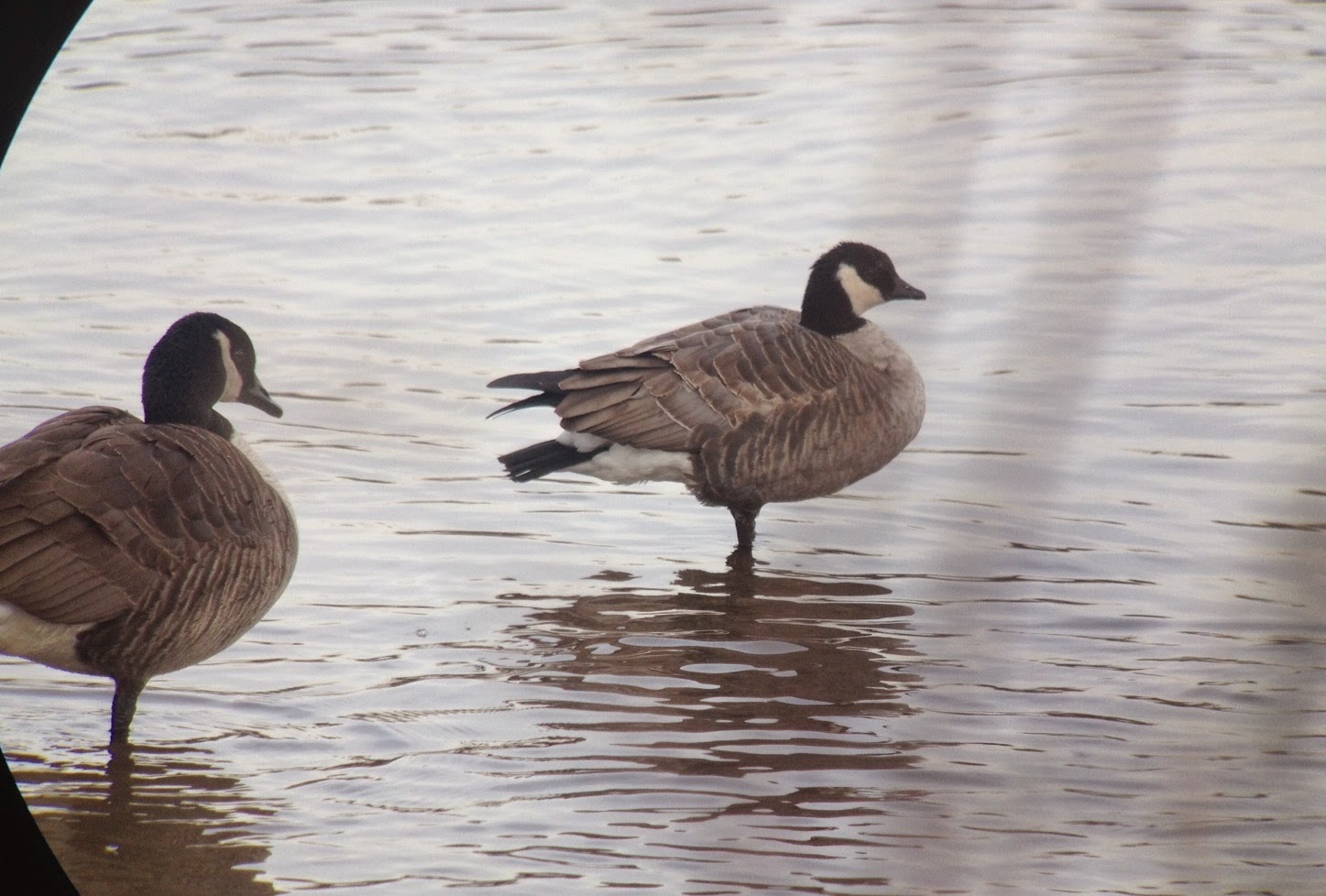
Next we were onto Ramsay Trail, though it took a bit of searching to find it as it was not mentioned in the Birder’s Guide. Soon after starting on the trail a Solitary Sandpiper called nearby (MB #230). And no more than a couple minutes later I heard what I thought was a singing American Tree Sparrow. I played tape and it flew right in (MB #231). We had 2 others in this area as well. We also spent some time with a flock of geese that Merlin thought included a Cackling Goose, but that was just optimism on Merlin’s part.

Later in the afternoon I went out on my own along Cape Merry, but the rain and wind had picked up making it difficult to do a seawatch. Though I was able to briefly spot several Beluga Whales feeding in the river.
A last stop of the afternoon was at “The Flats”. I covered only a portion of this area in the
wind and rain and had a nice mix of shorebirds including a flock of Turnstones
and a Dunlin. I’ll have to go back there
tomorrow when the weather was predicted to be better.
I ended the day with 3 new province birds, bringing my MB
total to 231. Not bad given the weather
conditions.
6/9 – Last Day in Churchill
We woke up on the 9th to much better weather conditions – it
had finally stopped raining and the wind wasn’t howling. Of course, this was the day we were set to
leave and we could only bird till about Noon.
Go figure… Though it was still
just in the low 30s.
While standing in the hotel parking lot as we were set to
head out to begin our day, I noticed a small bird in a group of stunted spruce trees
at the edge of the parking lot across the road.
Initially I expected it would be a White-crowned Sparrow which was
common in the town. But when I got it in
my binocs I realized it was a rare female Bay-breasted Warbler (MB #232). Later it flew to small trees at the edge of
our parking lot and we got great views. That
was a nice start to the day.
Our first stop was at the Flats – a portion of which I
birded the previous day. We drove to the
end and found our only Sanderlings of Churchill, plus a flock of 12 White-rumps,
a Dunlin and a Turnstone. The tide was
pretty high at the time – maybe it would have been better at a lower tide.
We decided to bird Goose Creek/Hydro Road again to see what
new birds might have migrated in. Our
first stop was along Kennedy Road for yet another try for Spruce Grouse. Again, we came up empty though we heard that
one was seen there the previous day.
Then we were on to Goose Creek Cottage road. A quick stop at the feeders gave us views of
5 Pine Grosbeaks. While watching the
feeders I heard a blackbird calling nearby.
I looked up and saw a Common Grackle fly into a tree above the feeders –
another rarity for Churchill.
We drove to the end of the road where again our key target
was Spruce Grouse. As we got out of the
car we heard a Catbird singing from the brush – apparently a continuing rarity heard
there recently. Though we didn’t hear it
when we were there the previous day. A
walk into the woods there gave us a couple Fox Sparrows, a singing Pine
Grosbeak, and our only Boreal Chickadee at Churchill.
Back on Hydro Road heading south we spotted the same
Sharp-tailed Grouse we saw the previous day.
Continuing south we went by the wetlands that contained good numbers of
shorebirds on previous trips, but numbers were way down today. Though we did have one spot with 2
Black-bellied and 1 American Golden-Plover in nice breeding plumage. And an adjacent pond had 2 Sandhill Cranes.
As we continued south I spotted a blackbird flying over the
road. I got an extended view of the bird
which turned out to be a Rusty Blackbird - the last new province bird for the
trip (MB #233).
Our last stop in Churchill was on a bluff along the
Churchill River to try to see Belugas. This
was the same spot I saw distant Belugas the previous day so we were
hopeful. On our way along the edge of
Hudson Bay we got this view of ice that had been blown on-shore by the strong
northeast winds the last couple days.

After a bit of a wait at the bluff we got excellent views of several Belugas when they surfaced. What a great way to end the Churchill portion of the trip, and for MB in general.
I added 2 birds to my MB list that day, bringing my total to
233.
And now a postscript on our trip to Churchill –
I was actually a bit disappointed with our trip to
Churchill. For decades I had heard so
many stories about the great birding there, but I’m afraid it just didn’t quite
live up to the hype. Numbers of
waterfowl seemed to be about as expected, but numbers of virtually all other
species were much lower than I had anticipated.
We saw most of our expected species, but most were in low numbers. Except for good numbers of Pine Grosbeaks and
Redpolls, boreal passerines were virtually non-existent. And I was really hoping to see Yellowlegs,
Godwits, and Bonaparte’s perched on tree tops, but we saw just 1 calling Lesser
Yellowlegs perched at the top of a spruce.
Needless to say, the cold and wet weather didn’t help, but with all the
time we spent in good habitat I still expected more birds. Were we too early in the year for nesting
species? For instance, tamarack trees and
many shrubs were not yet leafed out. Maybe
a July trip might have been more fruitful.
Now for some final thoughts on the Churchill rarities. We found 7 rarities needing ID details in
eBird – that’s a huge number in just 3 full days of birding. All were species that are common in southern
portions of MB, so were likely spring migrants that overshot their normal
ranges. Then again, with global warming,
were these southern MB birds heading north to expand their breeding ranges? And continuing that logic, maybe some individuals
of the regular Churchill species were missing from Churchill because they are
now nesting farther north as well.
MB Trip by the Numbers
172 – New MB ticks
233 - MB Province list total, my largest province list both
by absolute number of species and the percentage of species ever reported in
that province
231 - Number of species seen in MB on this trip (only Palm
Warbler and Golden-crowned Kinglet were seen on previous MB trips but not on
this trip)
387 – Canada list, adding 4 species on this trip (Black-backed
Woodpecker, Harris’s Sparrow, Tundra Swan, Willow Ptarmigan)
20 - Number of waterfowl species seen in MB
26 - Number of shorebird species
20 - Number of sparrow species
22 - Number of warbler species
92 - Number of species seen in Churchill
7 - Number of “southern” rarities seen in Churchill (Wilson’s
Phalarope, Sharp-tailed Grouse, Eastern Kingbird, Brown-headed Cowbird, Bay-breasted
Warbler, Gray Catbird, Common Grackle)
My eBird Trip Report for all our stops in MB can be found here: ebird.org/tripreport/ 388769
And the Trip Report for the Churchill portion of the trip
can be found here: ebird.org/tripreport/384450