Showing posts with label White-crowned Sparrow. Show all posts

Tuesday, January 31, 2023

8 Georgia Statebirds Following a Trip to the Florida Panhandle, January 7-8, 2023

Late in December 2022 I noticed a post from a local birder where he mentioned he had just seen a White Wagtail in FL.  That would be a lifebird, one I missed back in 2016 practically in my backyard in NH because I was out of town.  Although I’ve had the eBird ABA Rarities alert turned on for years, I haven’t been checking it lately since I’m not doing much traveling during Covid.  So a Wagtail in FL wasn’t exactly on my radar.  But with some quick eBird searches I found out that the White Wagtail was being seen nearly daily in Tallahassee.  That seemed pretty far away, but with a drive time of “only” 7 1/2 hours, it was actually about the same amount of time it takes to drive to the NC Outer Banks.  The hunt was on!

In theory I could drive down to Tallahassee in one day, hopefully see the bird, and drive back the next day.  But why not add a couple days to the trip and look for some statebirds in the FL panhandle and in southern and central GA on the drive back.  So I started planning for a 4-day trip to try for the Wagtail as a lifebird and a number of statebirds in both states.

I first focused on potential statebirds in FL within a couple hours of Tallahassee.  All told I found a possible 14 targets in FL (including the Wagtail), which was a surprisingly high number given that my FL list was already at 320.  I realistically hoped to find perhaps 8 of them.

Then it was time to research targets in GA.  My statelist was only 258, so there would be lots of possible statebirds.  My route to and from Tallahassee would go through much of GA, way too much to bird effectively on this short trip.  Plus all my GA stops would have to be just on the way back home since I wanted to make a beeline for Tallahassee on the first day of the trip in search of my key target, the Wagtail.  So I needed to focus on potential targets that might be closer to my direct route home, thus minimizing drive times for side-trips.  That meant I wouldn’t be able to get to the coast, which was unfortunate since there were a number of my targets there.  And north of Atlanta would be out of bounds as well.  Despite all those constraints, I was still able to map out a route back taking me through the center of the state then heading northeast to Augusta that would give me 12 possible statebird targets.  I figured if I could find 6 of them that would make for a successful GA portion of the trip.

This post covers the GA portion of my trip, on Days 3 and 4 of the trek.  The previous blog post summarized the FL half of the trip.

Day 3 - January 7

The first stop of the day was the last one in FL – agricultural fields in the panhandle close to where AL, GA, and FL come together.  Luckily it didn’t take long to find my target Horned Lark there since I had a full day of GA birding (and driving!) planned.  In fact, I probably had more stops planned than I could bird successfully.  So soon after seeing the Larks I was back on the road heading northeast through southern GA. 

My first GA stop was an eBird hotspot called Standard Elevator Rd. in Sumter County.  The key target here was Say’s Phoebe that had been reported there twice in late December, though the most recent report was now 10 days old.  And complicating the issue was that no details on the location of the bird were provided.  This was a 3-mile-long road, and the hotspot was apparently the entire road.  Certainly lots of territory a single flycatcher could hide in.  The only clues were that the one checklist included photos of the bird on the ground on a dirt road, on a telephone wire, and on a telephone pole.  Recent reports from the hotspot also included a Pectoral Sandpiper, though ID details were limited on this species that would typically be in South America this time of year.  Plus there were occasional reports of 3 of my other targets, Sandhill Crane, and White-crowned and Vesper Sparrows, which were also seen at a number of other sites in this part of the state.  Lots of opportunity, though with limited time and directions, I wasn’t too overly optimistic.

As I pulled into the eastern end of the road I noticed a small roadside farm pond with mudflats.  I broke out the scope and picked up 15 Least Sandpipers, both Yellowlegs, and a Snipe, but no Pectoral.  That is assuming that this was the pond where the Pectoral had been spotted in the first place. 

Then I turned my attention to my key target, the Say’s Phoebe.  My first strategy was to try to find the area where the photos had been taken.  But the road was paved instead of dirt, and it was lined with 3 miles of telephone wires and poles.  This would be next to impossible.  I drove along a short distance and briefly got excited when I found a couple Phoebes but they turned out to be Eastern.  I had basically given up on the Phoebe and turned my attention to my Sparrow targets.  There was some nice brush along the roadside and I played some White-crowned tape to see if I could get lucky.  Amazingly an immature White-crowned almost instantly popped up – it was the first sparrow I saw along the road (GA statebird #1). 

My statebird map for White-crowned Sparrow is inserted below.  The blue-shaded states are those where I’ve seen this species in its regular range, which is basically the entire US.  The one cross-hatched location, Washington, D.C., is the last jurisdiction where I have not yet seen this species.

A short distance farther ahead I left the brushy area behind and came upon a dirt agricultural field.  I noticed some movement at the muddy edge and it was a Vesper Sparrow.  And then I realized there were actually 3 Vesper Sparrows foraging together (GA statebird #2).  Remarkably the first 4 sparrows that I saw along the road were a White-crowned and 3 Vespers.  Can’t ask for anything better than that.  Well I guess unless I saw the Say’s Phoebe too. 

Like White-crowned, Vesper is seen across the Lower 48 states, though I still need this one in 5 states plus DC.  (There aren’t too many good sparrow spots in DC I guess.)

I drove along a bit farther down the road and spotted a Phoebe flying nearby.  I quickly got out but it was just another Eastern.  But before I could return to the car I heard the bugling of a Sandhill Crane.  I looked up and there was a flock of 8 birds flying low overhead (GA statebird #3).  In my statebird map for this species that tan-shaded states are those eastern states where I’ve seen this species as a rarity.

The 2 Sparrows and the Crane had been reported at a number of my planned stops, so seeing them all so quickly meant I could spend less time looking for them on upcoming stops.  Plus 1 upcoming stop solely for Cranes could be eliminated altogether.  This gave me more time for my other targets.

And speaking of other targets, my thoughts came back to the Say’s Phoebe.  The place where I had parked was close to where farmer’s equipment had driven from the fields to the paved road, covering the road with large amounts of dirt.  Could this be what I thought was a dirt road in one of the pictures?  Then I started thinking about Say’s Phoebe’s preferred microhabitat – they especially like to forage and perch around farm buildings.  I could see a group of farm buildings up ahead near the western end of Standard Elevator Rd. – maybe I could re-find the bird after all.  I spent some time wandering around the buildings, seeing a number of perched birds like Mourning Doves and a Mockingbird, but not my target.

Then I remembered there were old farm buildings at the other end of the road as well.  I drove back there and just as I was getting out of the car noticed a telephone pole covered in poison ivy vines.  That reminded me that in the photo showing the Phoebe perched on a telephone pole the pole was also covered in vines.  Had I found the correct spot? 

Just when I started walking around the area near the pole a small flycatcher flew by and perched most cooperatively in a low tree – I had my Say’s Phoebe. 

GA was my 3rd eastern state finding this species as a rarity.

It’s most satisfying when my research and detective work lead to a successful chase!  And with 4 targets at my first stop I couldn’t have asked for a better start to my day.

Next I was off to the Dooly County Road Farm Pond hotspot where 2 Canvasbacks had been reported intermittently.  When I pulled up and did my first scan I didn’t see a single duck.  That wasn’t looking good.  But part of the pond was obscured by a small hill so I adjusted my viewing angle and noticed a group of 5 Hooded Mergansers actively diving.  And then 4 Cormorants swam into view.  But still no Canvasbacks though I picked out 2 rare continuing Long-billed Dowitchers.  I was now convinced that I could see the entire pond, and the Canvasbacks just weren’t there no matter how hard I tried.  But I had another spot for Canvasback on the next day so I wasn’t throwing in the towel on this species just yet. 

My next target was a Ross’s Goose reported twice in a small runoff retention pond in a suburban subdivision in Warner Robins.  Photos and a GoogleEarth view of this spot suggested the habitat was marginal, so I wasn’t too optimistic on this one.  But it was just a few miles off my route so worth the try.  When I arrived I realized that the pond was inside a gated community.  I tried driving around the outside of the community but fencing blocked my views.  I was tempted to just give up, but decided to try to talk my way into the neighborhood.  Luckily there was someone manning the gate, and they let me in to survey the waterfowl at the pond.  Just as I pulled in I spotted a couple Canadas - this was looking good.  But when I got a better view of the pond a small flock of Canadas were the only geese there.  In hindsight, with limited time available and more spots to bird yet that day, it would have been better to skip this spot altogether.

After a quick break to gas up, I was back on the road heading north to the Piedmont NWR to look for Red-cockaded Woodpeckers.  This one had not been on my radar screen until the night before when a report came through on my Needs Alert.  Then with some additional historical research I found out that Red-cockaded was actually regular on the refuge, presumably with active management for this endangered species.  If it hadn’t been for the previous day’s report I would have driven right past this spot.  But “shoe-horning” this additional spot in an otherwise already full schedule meant I had maybe just 90 minutes of birding time there.

After arriving at the refuge I went right to the location of yesterday’s report at the Wildlife Drive hoping the birds were still in the vicinity.  Foraging birds are often quite vocal, so I listened and watched intently.  I walked and drove along that section of the road, finding excellent managed habitat for Red-cockaded, but didn’t find my target bird.  Though I did see several marked trees the Red-cockaded was using for feeding or nesting.

I then went to nearby Cut-through Road where they had also been reported recently.  As before, I walked along the road through excellent habitat.  Several times I heard tapping but it turned out to be Red-bellies and Sapsuckers.  Then I heard more tapping and finally heard the characteristic “seep” calls of a Red-cockaded Woodpecker in the distance (GA statebird #5).  I briefly tried to track it down but realized the bird was pretty far away and my time was limited.  Not the most satisfying observation I’m afraid. 

After I got home, I realized that I could also have searched for Bachman’s Sparrow in this same habitat.  Although they are easier to find in spring and summer while singing on territory, they are still present in the winter months.  If I go back for the sparrow hopefully I’ll get some nice views of Red-cockaded Woodpeckers as well.

My last stop of the day was the Augusta regional airport where there had been recent sightings of both LeConte’s and Henslow’s Sparrows.  But those birds would have to wait till the next morning.  Today I wasn’t arriving at the airport until sunset when my targets would be Woodcock and Short-eared Owl.  Both species were only reported there once, and it was more than 2 weeks ago, but I was hopeful that the Woodcocks were local breeders and would be calling each evening.  I was a bit less optimistic for the Owl, but still worth the try.

I arrived at the end of General Perry Smith Parkway at the edge of the airport property at 5:34, one minute before sunset.  Skies were clear and there was no wind - excellent conditions to see or hear both species.  From my vantage point I could see most of the airport property as I hoped to see a Short-ear either sitting on a low perch, or flying low over the ground.  My initial scans came up empty, though a flyover late Bald Eagle was interesting.  As it got darker, I scanned even more intently but couldn’t come up with an Owl.  There’s a rule of thumb that Woodcocks start calling 20 minutes after sunset, so at 5:55 I crossed my fingers that the “timberdoodles” would soon start their courtship.  But at 6:00 there were still no calling Woodcocks and it was almost too dark to see a Short-ear even if it was there.  My hopes were waning.  Then finally at 6:02 I heard the first of 2 Woodcocks calling a short distance away (GA statebird #6).  It’s nice to shade in GA in my statebird map, but I still need this species in a number of states especially in the western portion of its range.

At 6:10 it was now too dark to try to see a Short-eared Owl, so I gave up on my nocturnal search and called it a day. 

Day 4 - January 8

At sunrise on the 8th I was back at the airport to try for the LeConte’s and Henslow’s Sparrows.  Both species had been found in a very small grassy area with some standing water and clumps of broomsedge a short distance from the spot where I had the Woodcocks the prior evening.  Although I had excellent directions to the wet area where the sparrows were found, I wasn’t too overly optimistic since the LeConte’s was last seen nearly 2 weeks ago, and the Henslow’s was last seen 5 days earlier.  I spent a fair amount of time trudging through the area but only found Songs and Fields.  I spotted similar habitat across the road at a retention pond and gave that a try too but only found Songs and Savannahs there.  It looks like I was too late for these little skulking targets.

My next stop was the Brickyard Ponds hotspot a short distance away where Canvasback was quite reliable and Black Duck was seen occasionally.  And there was even a recent report of Neotropic Cormorant there.  I traded e-mails with local birders who shared advice how to bird this spot, and they suggested that Canvasback was most likely to be seen in the Garden Pond.  After paying the small entrance fee at the bait shop I began the drive into the large complex of lakes of various sizes and shapes.  The first couple lakes had few waterfowl, but quite a number of Double-crested Cormorants.  I checked each one but couldn’t come up with the smaller Neotropic.  There were also multiple Anhingas nicely perched around the perimeter of each of the lakes. 

Then I reached the Garden Pond and it was absolutely covered in waterbirds.  Closest to the road were large numbers of Coots, perhaps 400 of them.  Then I looked farther out on the lake and the water was covered in diving ducks – certainly critical mass to find a Canvasback.  The flock was dominated by at least 500 Ring-necked Ducks.  Some of the closest Ring-necks flew off when I drove up; I just hoped the Canvasbacks weren’t with them.  Now it was time for a closer look to see what other species might be mixed in.  With a more methodical scan I was able to pick out 15 Redheads, 10 Buffleheads, and 15 Ruddy Ducks in with the Ring-necks.  I was starting to get worried until I finally found a pair of female Canvasbacks swimming far in the distance among the other ducks (GA statebird #7).  I just need Canvasback in 1 more state in the continental US.

With the Canvasback behind me, it was time to get back to looking for Black Duck and Neotropic Cormorant.  I birded the remaining lakes but unfortunately couldn’t come up with either of those long-shot targets.  Although I only got 1 of my targets, the Brickyard Ponds hotspot sure looked like a great birding site. 

My last stop of the trip was Lake Olmstead on the northern side of Augusta where a pair of Long-tailed Ducks were first spotted 2 weeks ago and were being seen almost daily.  It’s a small lake so I was cautiously optimistic.  The reports often mentioned that they were being seen off the boat ramp, though they were diving frequently.  I pulled into the parking lot at the boat ramp and instantly noticed movement out on the lake – it was the pair of Long-tailed Ducks!  (GA statebird #8)  That was easy.  They were indeed diving frequently, but I was able to get this passable phone-scoped photo.

Long-tailed duck 2 pic

Two days earlier I also added Long-tailed Duck to my FL list – nice to get this rarity back-to-back in these 2 southeastern states.

What a great way to end the trip!  My 8 new GA statebirds were 2 more than I hoped for, and it brings my statelist to 265.  And along with 10 new statebirds in FL (including a Lifer!), it was a great start to the 2023 birding year.

Wednesday, December 4, 2019

6 South Carolina Statebirds in November 2019


November was another great month of birding in South Carolina, focused not only on finding new birds for my SC list, but also on learning about hotspots within the “Upstate” (the higher elevation counties in western SC).  Along the way I teamed up with fellow Hendersonville birder Dave Minnich, who in turn introduced me to several Greenville County birders including Michael Robertson, Gary Harbour, and David Palmer.  And given my success with so many relatively easy birds, I prepared this monthly summary rather than individual blog posts for each trip – that will likely come in December.

11/4 – Tall Pines WMA

Dave Minnich and I had visited Tall Pines WMA in October and got a great introduction to the area with Michael’s, Gary’s, and David’s help.  When we came back on November 4th, Dave, Michael, and I first headed to several fields that looked like they could have good sparrow habitat.  We had a few sparrows here and there, but not the good numbers, and good species, we hoped for.  When we reached the third field we headed to the far side that was flooded and found some nice weedy habitat.  And within just a few more steps we flushed a small sparrow which flew a short distance to a brushy perch.  It sat in the open for just a couple seconds which was just barely long enough for Michael and me to ID it as a rare inland Lincoln’s Sparrow, new for my SC list.  Unfortunately, Dave didn’t get on the bird in time. 

My statebird map for Lincoln’s Sparrow is inserted below – solid shaded states are those where I’ve seen this species; cross-hatched states are those where it is regular but I haven’t yet seen it.  Now that I’m living in the southeast maybe I can fill in some of those gaps for this species.


As we walked from the field we entered a brushy area along a stream and began to hear the chattering calls of a Winter Wren – target #2.  This one was more cooperative, sitting in the open for us all to see.  I just need this species in one more state in the southeast as a wintering bird, though several more as a breeder in the Midwest.


Next we headed to a nice mixed hardwood/pine woodland.  In our previous trip to Tall Pines we took this same trail and didn’t see much.  This time we all thought that the woodlands could be a good spot to find my next target – Brown Creeper.  As we slowly walked the trail, we admired the trees and plants in the undergrowth, but once again didn’t see many birds.  But then we heard a single high-pitched call from high in the woodlands, which we all thought was likely to be a Creeper.  It continued to call and we eventually got looks at this shy bird.  We later had 2 others in this same stretch of woods.  Nice when a prediction comes true.  Six more states to go to fill in my statebird map for this widespread species.


11/9 – Anderson County - Townville Area

This was an organized trip run by the Greenville County Bird Club to visit several hotspots in the Townville area in Anderson County.  The key targets were Vesper and White-crowned Sparrows, along with Snow Goose as a recently reported rarity.  I met Michael near Greenville and carpooled to the starting point of the walk.  There we met up with about a dozen other birders, and we started with some nice woodland birding at Beaverdam Creek WMA.  Key highlight here was a late Yellowthroat.  Then we were off to the farm fields at Dobbins Farm.  A pair of Snow Geese had been reported on a small farm pond at this site for several days, as recently as the day before our trip.  But despite our best efforts we found no white geese.  We even tried several other ponds nearby without success.  Our best find here was a distant flock of 7 small peeps that were just too far to identify.  Michael mentioned that this spot was also well-known for wintering Brewer’s Blackbirds – something to keep in mind for a future trip.

Next Michael and I decided to leave the main group and head directly to Prater Farm where he has had the best luck with our target sparrows.  We made our way to Tom Martin Rd. and stopped at a brushy edge that had been good for the sparrows in the past.  Just as we got out of the car we flushed a sparrow from the roadside which flew up to a cedar tree.  Hmm… - that’s very typical of Vespers which will fly up to a higher perch after being flushed.  We changed our angle a bit and got a view of the sparrow in the tree – it was indeed a Vesper.  Then we noticed more activity in the tree, and spotted no less than 4 more Vespers.  It was an amazing flock of 5 Vesper Sparrows – I don’t remember seeing anything more than individuals away from their breeding grounds.


After celebrating our experience with the Vespers we started walking a bit further down the road and flushed another sparrow – it was a young White-crowned!  We found five other White-crowns here, including at lead one singing adult.  I just need this species in GA and DC to complete my statebird map.


At this same spot we also had a large flock of 100 Pipits in an adjacent field, a Eurasian Collared-Dove, and a perched Loggerhead Shrike.  A nice stop, and a nice way to end the morning’s trip.  I’ll definitely have to come back here in the winter to look for Brewer’s Blackbirds.  And since this area is close to the GA/SC stateline, maybe a future trip could include some time working on my GA list as well.

11/19 – Northern Greenville County Lakes

The goal of this trip was to check out a number of the lakes in northern Greenville County that can have some nice waterfowl during winter.  We had no key waterfowl targets – it was just a scouting effort.  But then oh by the way, Michael suggested we might get lucky with Rusty Blackbirds at Lake Cunningham.  He’s had them there off and on this time of year.  As I pulled in to Lake Cunningham David and Michael were already at the lake doing a bit of birding.  And within just a couple minutes a few blackbirds flew into a nearby tree.  After a quick view we realized we had our first Rusty Blackbirds.  Within the next few minutes more Rusty’s flew in – I counted 160 birds in total.  But just as quickly as they arrived, virtually the entire flock had flown away.  A nice start of the day!  I just need this species in 5 midwest states as a migrant or wintering bird.  Though it’s nice to have seen this species as a rarity in CA as well.


We made stops at 6 other ponds and lakes that morning, finding a few waterfowl here and there, the best being 5 Horned Grebes at Lake Robinson.  We also made a quick stop at Jordan Pond where Common Goldeneyes have wintered the last couple years – something to keep in mind for a future trip.  And my last stop was at the Stamey Valley Road lake where I had a flyover flock of 20 Rusty Blackbirds.  A nice way to end the morning.

I ended November with 6 new statebirds for my SC list which now stands at a nice round number of 250.  That’s 18 new SC species since I moved to the area just over 2 months ago.  Although there have been a couple rarities, most have been pretty regular species.  And with a dwindling list of relatively easy target birds, I’m sure I won’t be able to keep up this pace for too much longer.

Sunday, April 28, 2019

Nine Winter Province Birds, Southern Quebec, March 2019


Over the years I’ve birded Quebec a number of times, always in the southern portion of the province crossing the border from northern NH, VT, or NY.  And most typically my trips have been in the warmer months of June through September.  I’ve avoided mid-winter birding there given how cold and snowy it can be in winter in this inland Canadian province.  But to have a good Quebec list you can’t completely avoid birding in those cold winter months.  As a compromise I birded southern Quebec in November 2015 picking up a number of winter species including Tree Sparrow, Common Redpoll, Rough-legged Hawk, and multiple species of waterfowl. 

But that still left numerous gaps in my province list consisting of species that are almost only seen in those cold mid-winter months.  Plus, since I’ve never birded anywhere in Canada in mid-winter, several of these would be new for my entire Canada list.  Not to mention my Quebec list was at 198 – sure would be nice to exceed 200.  So now with lots of spare time on my hands, I decided to plan a mid-March trip to Quebec.  That is assuming I could find a 3-day window of time with no precipitation and temps that aren’t too cold.  Luckily the long-term forecasts predicted some promising weather March 12 to 14, so the stars were starting to align. 

Now it was time to start my planning efforts.  I came up with a realistic list of nearly 20 targets, including some pretty exciting winter birds like Bohemian Waxwing, Pine Grosbeak, Snowy Owl, and Hoary Redpoll.  Plus a few other rarer species that are out of season (White-crowned Sparrow), or rare for the area (Gray Partridge and Black-backed Woodpecker).  I typically hope to find maybe half of my targets on these types of trips, and on this one I expected to be able to add perhaps 8 or 9 species to my Quebec list.  I then reached out to my good birding friend David Donsker and he agreed to join me on this cross-border adventure.  He had not birded in Quebec before, so everything would be a new species for him. 

March 12 – Day 1

David and I headed out just after lunch on the 12th, and given the 4+ hour ride to the border, we would only have a couple hours of daylight to bird on Day 1.  To maximize our birding time the plan was to bird the agricultural fields just across the border from VT, with multiple targets seen throughout the area – Snow Bunting, Snowy Owl, Wild Turkey, and Lapland Longspur.  But perhaps our key target was the rare Gray Partridge recently seen in small numbers frequenting a small area of fields and homesteads. 

As we neared the border we twice spotted flocks of Turkeys feeding in fields in northern VT, so we hoped that would bode well for at least this one target once we got into Quebec.  Luckily our wait to get through customs was minimal, so we crossed the border just after 5.  And within just a couple minutes we spotted a large flock of Snow Buntings along the roadside – Province bird #1 and new for my Canada list as well – a great start. 

Next we reached Route 35 where a number of Snowy Owls had been reported recently.  Our plan was to drive along as slowly as possible on this busy road keeping our eyes open for a Snowy Owl along the way.  The fields were snow covered, so finding a white bird on a white background at 50 mph (or 80 km/hr) created a nearly impossible scenario for us, and we struck out at this first location.  But this was just the first of many locations where Snowy’s had been reported recently, so we weren’t too worried. 

We then headed toward the area where the Partridges had been reported, and as we drove along a small back road named Rang du Grand Bois, David yelled – “Turkeys!”.  It took a couple minutes to find a safe spot to turnaround, but soon we were back at the spot and there was a flock of 6 Turkeys feeding in the ag field nearby – province bird #2.  That meant we wouldn’t have to make stops at a couple other spots where Turkeys had been reported, freeing us up to spend more time looking for our other targets.

As we neared the Partridge location we came upon a small group of Horned Larks on the shoulder of Rang des Soixante.  Just as we started to scan them they all took off out over the snow covered field.  Luckily I had rolled down my window to try for a better view because I was able to hear the telltale rattle call of at least 1 Lapland Longspur mixed in with the higher pitched calls from the Larks (province bird #3).  Unfortunately we never saw the bird, and David was unable to hear it since he was on the other side of the car.  We waited a while, and a nice group of 20 Snow Buntings soon landed along the same exposed road shoulder, but the Longspur and Larks never returned. 

A couple more miles down the road we reached the area where the Gray Partridges had been seen –a small flock had been spotted numerous times along a diamond of roadsides, fields, and homesteads.  Though despite 3 slow tours around the diamond, we couldn’t come up with them.  The reports were now about a week old, so maybe they had moved on.  A consolation was finding a nice mixed flock of Buntings and Larks along a roadside with some extended (though distant) views of a Longspur mixed in. 

It was now getting dark and we called it quits, making our way to the highway to head to our hotel.  But then while driving along Route 10, up ahead we both spotted a bump on a light pole on the highway.  It was far enough away that we weren’t sure if it was even a bird.  As we got closer, we could tell it was a perched raptor, and as we passed almost directly below it, we could see that it was a Snowy Owl.  Here’s a picture of the roadway just after we confirmed the Snowy.


What a way to end the day – 4th new province bird, and new for my Canada list. 

March 13 – Day 2

Our first stop of the day was at Centre Ecologique Fernand-Seguin where there had been multiple reports of Hoary Redpolls, and two overwintering adult White-crowned Sparrows.  Although one can be skeptical of the quality of Hoary ID’s, there were photos included in several of the eBird reports that looked good.  Both the Redpolls and Sparrows were coming to feeders at the park – but there were apparently multiple feeders with limited details on the locations of each.  Looks like we would have to do a bit of research when we get to the park.

Luckily when we arrived one of the first things we spotted was a park map.  But the trails were a bit confusing, and we weren’t quite sure which feeder to head to.  As we stood there scratching our heads, a worker from the park office (which wasn’t even open yet), walked over to us to offer help.  She told us which feeders both of our targets frequented, and how to get to these feeders.  We couldn’t have asked for better local directions!

Our first destination was the Swallow Feeder preferred by the Redpolls.  After a short walk through the woods we could see a clearing up ahead, with a pole-mounted feeder.  There were birds swirling about – a large flock of Redpolls.  And the first bird we both put in our binocs was one perched on the feeder – it was a Hoary Redpoll (province bird #5, and new for Canada).  We watched as the Redpolls flew all around us, sometimes flying mere feet from us.  They were feeding on the ground, in the shrubs, and on the feeder.  And there were multiple birds singing – I’ve never heard singing Redpolls outside of birds on their breeding grounds in Alaska.  Over the next 15-20 minutes we estimated that we had at least 3 Hoary’s in with the flock of at least 50 Commons.  Could have been even more.  

Redpoll feeder

Although we hated to leave the Redpoll show, it was on to search for the White-crowned Sparrows which were being seen at the Chickadee Feeder.  After a short walk we came to this next feeder, where a photographer was already waiting.  We watched Chickadees come and go, and a few Redpolls as well, but no sparrows.  After a few minutes David noticed a bird skulking nearby which was a nice adult White-crowned Sparrow (province bird #6).  Often wintering White-crowns in New England will be immatures so it was a bit surprising that this one was an adult.  An excellent start to the day!

Next we were off to Technoparc Montreal and the adjacent Dorval Golf Course where there had been many reports of roosting owls – Short-eared, Great Horned, Long-eared, and Saw-whet, plus occasional Northern Shrike reports.  The details were a bit sketchy, but I was finally able to figure out that most all of the owl sightings were at the golf course, even though most were entered into eBird at the Technoparc hotspot.  Unfortunately when we arrived at the golf course we found out that it had recently been closed to the public since walking through the now melting snow cover could result in damage to the turf.  And we never found any places to bird at the Technoparc.  Frustrating…

The next stop was the eBird hotspot called Campus Macdonald where numerous Bohemian Waxwings had been recently reported.  Unfortunately here too the spot(s) where the Waxwings were being seen couldn’t have been the location of the hotspot, which was in the middle of ag fields for a university.  Instead we poked around one set of university buildings adjacent to the fields thinking this could be the spot, but never found any fruiting trees.  Then we noticed signs for another part of the university campus a short distance away, so we though we’d give that a try.  That part of the campus was very congested with cars and pedestrian students, complicated by roads narrowed by large snow and ice piles.  After driving around for a while we finally found a small group of fruiting crabapple trees that looked to be likely candidates, but there were no frugivores in sight.  After a great start we had come up completely empty on our next two locations. 

Hoping for better luck, we headed to Barrage (dam in French) du Grand-Moulin, which was a small backwater on the Riviere des Mille Iles where several Glaucous and occasional Iceland Gulls had been reported.  Interestingly, in this part of Quebec the most common wintering gull is typically the Great Black-backed, followed by Glaucous, then Herring, Iceland, and lastly Ring-billed.  To get to the viewing spot we had to navigate around large snow and ice piles, and then take a short walk in waist-deep snow.  Finally we got to the overlook, only to find less than 10 gulls on the water – just GBBG and Herring.  Was this going to be yet another strikeout?  Then we noticed a small group of gulls fly in to bathe on the river.  Then another small flock.  As more small groups came in we soon had critical mass and the first adult Glaucous Gull flew in (province bird #7).  More birds kept pitching in, and eventually we found 3 adult and 1 1st/2nd year Glaucous.  And just before we were going to leave, David spotted an adult Iceland (province bird #8).

Although the birds were distant I took these phonescoped shots of one of the adult Glaucous Gulls, perched near the left edge of the ice partially obscured.  After I got home and looked more closely at the photos I noticed an adult gull in the water a short distance to the left of the Glaucous, which appears smaller than a Herring, and a bit darker backed.  If only we had noticed it when we were there we could have focused our attention on this bird to try to turn it into a California.


Now that we were back in the “win column” we hoped our success would continue at the intersection of Rue d’Ivry et Avenue JJ Joubert in a rather urban portion of Laval Island to try for Pine Grosbeaks.  There had been daily reports of a flock here at a church through 3/9, but there had been no reports (positive or negative) since then.  Unfortunately there were no birds of any type when we arrived at the church – at least it was a small site and it only took us a few minutes to realize we were too late for our target. 

So we quickly headed to our last stop of the day - Cimetieres Mt-Royal and Notre-Dame-des-Neiges in Montreal where both Bohemian Waxwings and Pine Grosbeaks had been occasionally reported.  I birded this site a few years ago and remembered that the cemeteries are full of fruit trees, so we hoped to finally be successful finding these targets on our 3rd try.  After getting some directions at the office, we started a slow ride through the cemetery.  Roughly a half hour into our search we spotted a small group of 11 Robins roosting in a deciduous tree.  And then with a more detailed look we spotted 3 Bohemian Waxwings in the flock (province bird #9, and also new for Canada).  There was also a Cedar Waxwing mixed in, which is rarer than Bohemians in this area in winter.  Elsewhere in the cemetery we found another flock of 7 Robins, but no more Waxwings, and no Grosbeaks.  Interestingly, an eBirder reported a Pine Grosbeak there that day, but no Robins or Waxwings.

Day 3 – March 14

The key stop of the day was at the Bois Bon Air woodlands in the northeast part of Laval Island to search for a Black-backed Woodpecker that had been in these woods for over a month.  Reports mentioned seeing the bird on the Deer Trail and near the marsh, but with no maps available on-line and no further instructions, David and I worried that we might not find the proper locations.  So the first thing we did when we arrived in the area was to ask for directions at a skimobile shop nearby.  They gave us a few suggestions to access the woods, though no further details on the Deer Trail or the marsh.  A few minutes later we were walking toward the suggested access point, and up ahead we saw that 2 birders had just arrived.  In somewhat broken English they said they knew where the bird was and would take us there.  Suddenly we were much more positive about our chances.  Despite this new-found optimism, and 3 hours walking through the deep snow, we never found our target bird.  We saw lots of trees that had been de-barked by the Black-back, but it wasn’t to be.  Here’s a shot typical of the woodlands we searched.


As we were leaving 2 other birders were just arriving; it turns out that they found the Woodpecker a couple hours later.  Go figure.

Little did we know that our luck would get no better the rest of the day.  Plus since we spent more time than planned at the Woodpecker spot, we had less time to bird other locations.  We made a stop at the Aeroport de St-Hubert to try for a recently reported Northern Shrike with no luck, though did find a nice Snowy Owl.  And one last stop at feeders that had daily reports of Pine Siskins mixed in with a Redpoll flock yielded just 2 Repolls.  Interestingly the best bird of the day was one of our last birds - an early Turkey Vulture that was a flyover as we neared the border.  It was also the only eBird rarity of the trip.

We ended the trip with 44 species - a respectable total for a late-winter trip to these inland locations.  And although we missed a number of our targets, I was very happy to add 9 to my Quebec list, which was roughly what I expected before the trip started.  My province list now stands at 207 which is 90% of the old ABA reportable threshold.  That makes Quebec my best Canadian province list based on percentage of total birds on the province list.  Plus 4 of these species were new for my overall Canada list, bringing my total to 379.  By comparison, my Lower 48 US list of 737 is nearly twice that total.  Needless to say there are a lot of species in south FL or TX that I’ll never see in Canada.

Wednesday, January 7, 2015

8 Statebirds in DC and VA, January 2015


With an upcoming trip to visit relatives in the Mid-Atlantic states, I started to plan a day of statebirding to fill gaps in the local statelists.  My initial plan was to spend a day in VA since my VA statelist was just 7 over the old ABA threshold.  Though as I started to review my list and come up with possible VA targets, I realized that few (if any) of my target birds were really very likely.  So initially I thought that getting maybe 3 new VA statebirds would make for a successful trip.  But then as the trip neared, a number of rarities were being reported in the area that weren’t even on my target list – Clay-colored Sparrow, Cackling and White-fronted Geese, Lapland Longspur, and Snowy Owl.  And by combing through the eBird and listserve reports, there were no less than 6 other possible statebirds reported in northern VA the week before my trip.  Now maybe 6 or 7 new statebirds would be an appropriate goal to set. 

Complicating the situation was that there were recent eBird reports of a couple birds I needed for the DC list as well.  But before I get to the possible DC targets, a little background on the challenges of birding DC is in order.  First of all, the District is a very small area – no bigger than many counties.  And then of course it is very urbanized, with limited good habitat.  So although my DC list was a very small 175, it was actually 10 over the old ABA threshold, and the 8th highest DC list reported on the ABA website.  As a result I’m probably prouder of my DC list than of any of my lists for the other states.  Now back to the trip at hand - since I would pass through DC in route to northern VA, it would be easy enough to make a couple quick side trips to try for some DC targets to start the day.  So I decided to squeeze in a couple brief stops in DC and then spend the rest of the day in VA.  It would be a full itinerary, but I outlined a plan with 3 DC targets (though only 1 was reported in the last week), and at least 11 VA targets.

As I got ready to leave the house that morning, I checked eBird one last time to see if there were any updates.  Nothing of note was reported in VA, but no less than 4 new targets were reported in DC from the previous day – Tree Sparrow, Meadowlark, Cackling Goose, and Orange-crowned Warbler.  Unfortunately, only the Goose was at a spot that was included in my original itinerary.  Maybe I could get to these other locations if the birds were really cooperative.  Then again, if I added these stops early in the day in DC I could end up running out of time at the end of the day in VA.  Since these newly reported birds would be tough to pass up, I decided to play it by ear and try all these additional locations, adjusting my timing as the day progressed.

I arrived at Kenilworth Park in DC a few minutes before sunrise.  This is the only location in DC with large grassy fields, and is the spot where I’ve gotten my only Grasshopper Sparrow, Blue Grosbeak, and Pipits for DC.  The previous day a pair of Tree Sparrows were reported there, with pretty specific micro-directions provided.  A Meadowlark was also found there the day before (this is THE spot for Meadowlarks in DC), though the location was not provided.  As I neared the entrance I saw a police car with its lights flashing blocking the gate – what did that mean?  At the very least I couldn’t drive in through the main entrance.  I drove along the side of the park and was lucky enough to find a spot where I could walk in, which amazingly happened to be close to the Tree Sparrow location.  After a short walk I was in a brushy area that sounded like where the sparrows were seen the day before.  And as I arrived I could hear some sparrow chips from a short distance away.  After a couple minutes of spishing some sparrows came into view, including obscured views of 2 American Tree Sparrows.  That was easy!  I’ve now seen Tree Sparrow throughout the northeast except for DE, and still need it in its wintering range in several western states (see my statebird map below).


I spent another 15 minutes in the park trying for the Meadowlark, but without success.  Though that wasn’t too surprising since I did not have specific location to search.

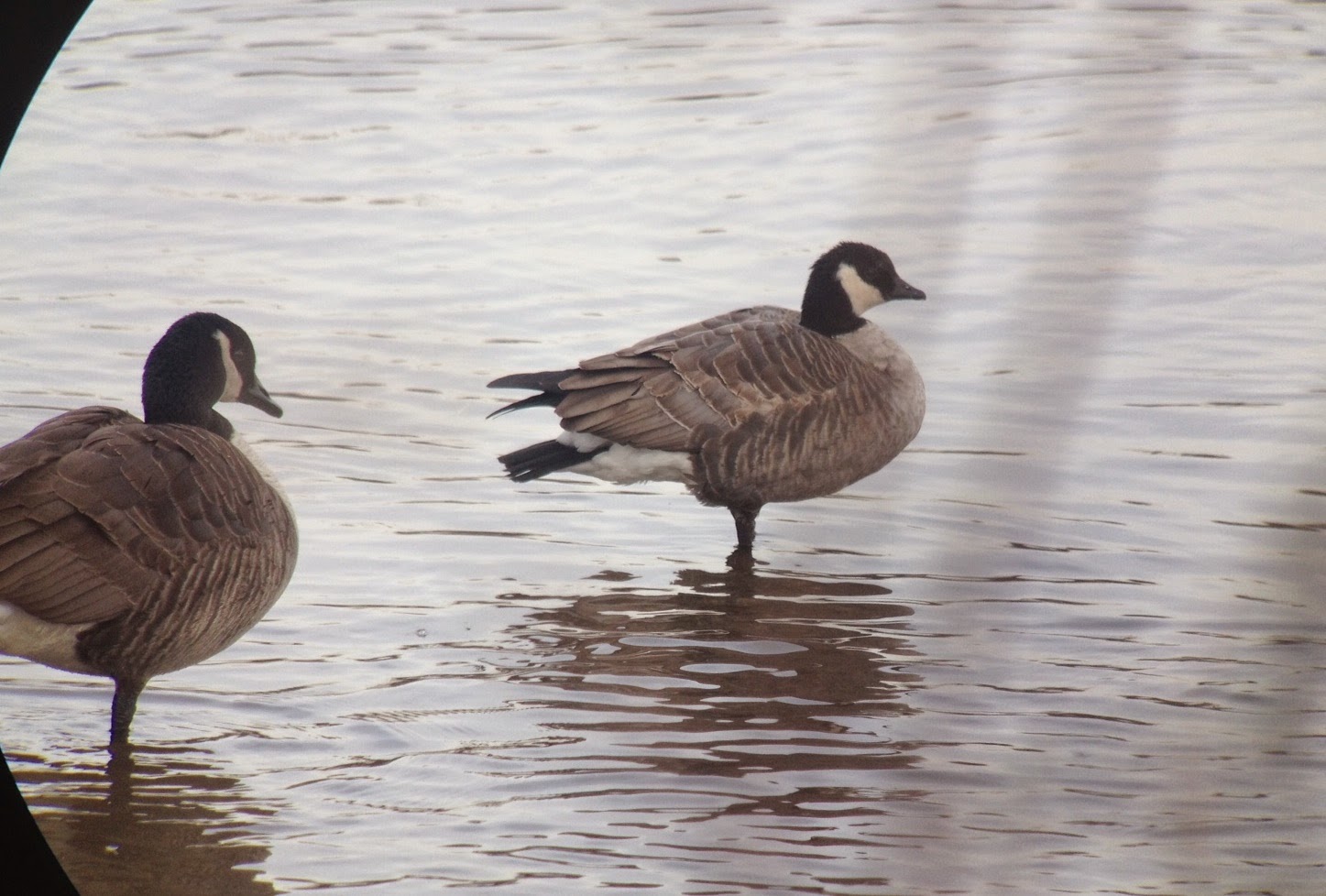
The next stop was the Anacostia Park where a Cackling Goose was reported the day before.  After just a minute I found 2 small flocks of Canadas in the water.  And within only a minute of searching I found the Cackling Goose in the first flock.  I got these two phonescoped photos of the bird, providing good comparisons with the Canadas.


This park can also be good for rare gulls and Turkeys, but brief looks came up empty.  So it was quickly on to the FDR Memorial where the Orange-crowned Warbler was seen the previous day.  Along the way I started to wonder if I had time to try for this bird, especially since directions were not too detailed.  And then along the way I made a wrong turn and found myself on a bridge heading across the Potomac out of DC.  So I decided to pass on the Warbler and instead headed to two locations in DC where Common Mergansers had been reported.  The first was the Georgetown Reservoir which you can bird in seconds right from your car.  I was really hopeful I would find the Merganser reported there the previous day since that would save me a lot of time, but unfortunately there were no Mergansers.  So the next stop was on the Potomac at Fletcher’s Boathouse (which I eventually got to despite driving the wrong way on a one-way street – oops).  Although this location was just a couple minutes away, it could mean some significant walking to look up and down river for the target birds.  But luckily I quickly found one male Common Merg sitting on rocks at the first river overlook.  My statebird map pretty well matches the normal range for this species except for OH and the Dakotas.


That gave me 3 of 4 likely target birds for DC (though I didn’t try for the Warbler), increasing my list to 178 for the District.  And 2 of the 3 new birds were rarities needing details on eBird. 

I was now 15 minutes ahead of schedule and headed to my first stop in VA.  The first VA targets were White-fronted and Cackling Geese and Lesser Black-backed Gull seen from several locations along the Potomac waterfront in northern Fairfax County.  I was able to pick out the White-fronted quite quickly, even though it was backlit and sleeping at the time (I picked it out based on the horizontal white stripes where the sides and wing coverts come together).  The bird later flew to the Hunting Creek bridge area and gave excellent views.


I’ve seen this species in quite a number of eastern states where it is rare but regular – in fact my coverage for this species in the east is better than in its regular range in the central and western states.


I spent the next hour or so pouring through the Canada Geese looking for the minima Cackling that had been seen just a couple days earlier.  Although I never found that bird, I found at least 20 noticeably smaller geese – most were likely parvipes Canada Geese that had necks and bills that were smaller than the Canadas but with similar proportions to the larger Canadas.  But I also found at least two other smaller geese that had shorter bills and necks that with smaller proportions than for the larger Canadas.  I believe these would be taverner’s Cackling Geese.  And another of the smaller geese had a significant white band at the base of the black collar.  Not clear if that one was a parvipes or a taverner’s.

Several times I took breaks from staring at the Geese to look through the numerous gulls present along the river but to no avail.  But I had several other spots to try for the rarer gulls later in the day.  So 2 getting out of 3 targets here wasn’t bad.

I was now about 15 minutes behind schedule, and off to Woodbridge where the Clay-colored Sparrow had been reported.  Some posts from this spot had White-crowned Sparrows, and one had a Lincoln’s Sparrow and a Merlin – all targets for me.  I arrived at the CCSP spot and the first bird I saw was a Cooper’s Hawk perched low nearby.  Not surprisingly there was no activity there.  So I started working a short distance away and ran into many sparrows but no CCSP, nor any other targets.  I even tried across the road, finding more sparrows, but again no targets.  I had just about given up, and lamented that I had missed all my targets, when a White-crowned Sparrow popped into the open – at least I got 1 new statebird here.  That fills one of the last gaps in my statebird map – I only need it in 3 more states and DC.


Later in the day a birder posted to the listserve that he saw the CCSP about 30 minutes before I arrived – probably before the Cooper’s appeared.  And he saw a Lesser Black-backed Gull a bit farther down the road as well.   

The next stop was at nearby Neabsco Creek to try for recently reported Lesser Black-backed and Iceland Gulls.  There were quite a number of gulls there, but nothing of interest. 

Then on to the Prince William Landfill for one more chance for the rarer gulls.  But I couldn’t talk myself into the active part of the landfill, and could only view the active fill area from a distance.  A quick scan did not reveal any targets.  Then a loud sound from the landfill made all the gulls fly off and away from the landfill complex.  Rather than waiting for them to return, I decided to head out and conserve some time for my last 2 stops of the day.  But that meant I dipped on all the rarer gulls for the day.

The next hot spot was the turf farms near Remington where for some time numerous Lapland Longspurs had been feeding with Horned Larks.  And in the last couple days, another of my targets, American Pipit, was reported there too.  Even including a report from that morning.  When I arrived I popped out of the car and instantly heard a flock of Larks overhead including at least 1 Longspur.  Over the next 20 minutes there were frequent flocks of Larks calling overhead, and most had 1 or more Longspurs.  And at one point a flock of 4 Longspurs flew overhead.  I later found a flock of 60 Larks and 3 Longspurs feeding in one field.  So I estimated I had at least 12 Longspurs during my hour at the turf farms.  I still need this species in a number of states in its winter range.


I kept on hoping that I would hear Pipits overhead given all the Lark and Longspur activity, but to no avail. 

My final stop of the day was just outside Reagan National Airport where a very white Snowy Owl had been seen 12 consecutive evenings.  Most every day the bird would first appear on a perch within the airport complex, with the only viewing point being a very distant Gravelly Point.  The Owl typically first appears around sunset each night, which allowed me more time to hit the other spots.  I arrived at Gravelly Point just before sunset and quickly joined a group of about 50 birders and on-lookers looking toward the airport.  The Snowy Owl was already in sight, sitting on a distant windsock at the airport.  I took this phonescoped photo of the bird in the distance –


And then heavily cropped -


VA was only my 11th state for this widespread bird.  Similar to my statebird map for the Lapland Longspur, I'm missing a lot of states in its wintering range.  I guess I don’t bird much in northern states in the winter.


That gave me 5 new VA statebirds, for a total of 244, or 12 over the old ABA threshold.  And although I missed a few of my VA targets (including 3 seen by others that day), I got 4 of the 5 rarities that had been seen recently.  Those are the most important ones to find – the others can come later.

And for the day, I added 1 new statebirds in each of 8 stops – only missing statebirds on 3 other stops.  A very good start to the 2015 birding year.