Saturday, April 25, 2015

Aplomado Falcon (Lifebird) and Painted Redstart, TX, April, 2015


In 2014 the ABA published several revisions to their listing rules, including one related to re-introduced native species.  In the past those species needed to be part of a viable self-sustaining population in order to be “countable”.  But according to the new rule, you can count these species if they are just breeding in the wild.  That means that species like the Aplomado Falcon in south TX was now countable on your ABA list.  However, the Falcon is still not countable on your TX list since the TX Bird Records Committee (TBRC) still requires that species to meet the viable population threshold. 

I’ve never seen an Aplomado Falcon in the ABA area (though I’ve seen them in Brazil).  Back in January 2011 I made a half-hearted attempt to find them outside Laguna Atascosa NWR.  But, instead of spending much time looking for the Falcons, I focused my searches on a countable lifer, Rufous-backed Thrush, and the “Mangrove” Warbler which would be a lifer if it is ever split from the Yellow Warbler.  I found both the Thrush and Warbler, but was unsuccessful on the Falcon.

But now that the Falcons are countable, it was time to dedicate some time to go after them.  As I’ve done several times in the past, I needed to add a vacation day to one of my regular business trips to Houston, and make the trek to southern TX.  So with an upcoming trip in April, I started my planning and research.  Most of the recent e-Bird sightings were concentrated in 3 areas – in and around Laguna Atascosa NWR, around SR 100 just south of the refuge, and on Old Port Isabel Road a bit farther to the south.  I traded e-mails with some refuge staff and heard about a pair nesting around SR 100, but the nest site was really distant.  I also contacted a birder who had seen the Falcons the previous week and they suggested another nesting pair near the southern end of Old Port Isabel Road.  So armed with micro-directions for both sites, and the general distribution of recent sightings, I was pretty optimistic about my chances of seeing the bird.  Especially since I had basically a full day available between late afternoon on the first day of my visit and most of the day on the second day, I thought I would eventually run into a bird somewhere in the area.

I arrived at the McAllen airport mid-afternoon (I got an earlier flight than expected), and an hour later I was at the nest site on Old Port Isabel Road.  The directions were perfect, and I could see the nesting box a couple hundred yards to the west.

Nest box in the distance just to the left of a stand of yuccas
The nest box was like a large cage with bars that would prevent Great Horned Owls from getting to the nest.  And using my scope at 50 power I thought could see a bump on the floor of the cage, but couldn’t even tell if it was a bird, let alone a Falcon.

"Bump" in the center of the cage is likely the Falcon on its nest
I continued to stare at the nest box for the next hour, and twice thought I saw the bump move.  And then I noticed it stand up and turn – although the view was brief and very distant I thought I could see the head pattern of an Aplomado Falcon.  So now I was pretty sure it was my target bird, but still wanted a better view.  In the meantime a singing Cassin’s Sparrow was nice, as were these Gull-billed Terns that loafed nearby.

 
At one point I turned my attention to some call notes behind me.  When I turned back around there was a second Aplomado Falcon sitting on the nest structure.  Within seconds the bird that had been on the nest walked out of the nest structure and flew off.  The second bird then walked into the nest structure and settled down on the nest.  All of this occurred within just a couple minutes – nice views, but very brief.  Then a couple minutes later what was presumably the first bird appeared on top of one of the yuccas near the nest structure, and sat there for the next 30 minutes until I left.  Although it was windy which caused a lot of vibration of the scope, I was still able to get this phonescoped photo.


The Aplomado Falcon was ABA lifer #745, and Lower 48 lifer #723.  And it was my 9th lifer I’ve seen in TX as a result of a vacation day added to a Houston business trip in the last 6 years. 

Since I was able to see the Falcon on Day 1, and in fact pretty early on Day 1, I now had time to chase after some possible TX statebirds both the evening of Day 1 and also on Day 2.  I need a number of regular migrant passerines for my TX list, so I made a quick drive to the coast to hit several migrant hotspots on South Padre Island.  I didn’t have too much time, but ran into a nice mixed flock with one each of Yellow-throated, Tennessee, and Prothonotary Warblers, along with a Lincoln’s Sparrow and 2 Indigo Buntings.  No new statebirds, but this mixed migrant flock made me think that spending more time there on Day 2 would be worthwhile. 

But on Day 2 I first needed to chase after my key TX statebird target - a Painted Redstart that was spending its second consecutive winter at a rest stop south of Falfurrias.  I’ve seen Painted Redstart in its normal range in Arizona, but it is quite a rarity for TX.  I arrived at the rest stop just after dawn, and went to the area south of the rest rooms where the bird was most often reported.  The rest stop was a large, heavily forested area, and there were quite a number of singing migrants in the woods, so I worried about how I might find this bird.  But within 2 minutes of my arrival, I noticed some movement low in the trees and there was the Redstart – what a gorgeous bird – TX statebird #420.  Good thing I saw it when I did because I spent the next hour in the area and didn’t see it again. 

There were a number of Yellow-rumps – both “Myrtle” and “Audubon’s”, and an Orange-crowned at the rest stop, but that was it for migrant warblers.  And likely local nesting Kiskadees, Couch’s Kingbirds, Hooded Orioles, Black-crested Titmice, and Green Jays were nice.  But the highlight beyond the Redstart was a pair of Barn Owls that came out of a tree cavity.  In this photo (taken with just my iPhone), can you see the head of a Barn Owl in the cavity directly over the blue trash barrel?


I then headed back to South Padre Island to once again try for some migrant passerines.  But the migrants were few and far between.  In several hours of birding at the hotspots on the island and the rest stop I had just 11 migrant warblers of 6 species.  And I dipped on possible statebirds American and Least Bitterns that had been reported in the marshes at Convention Center.

But I got my 2 key targets – Aplomado Falcon and Painted Redstart.  A most successful trip!

Friday, April 17, 2015

Eurasian Wigeon, Putney Great Meadows, VT, April 2015


Just before lunchtime came a report of a Eurasian Wigeon spotted in Putney, VT, feeding in a flooded field at the Putney Great Meadows.  Back in Spring 2014 I had decided not to chase a VT Eurasian Wigeon spotted in northwestern VT because it was a 3 ½ hour drive for me.  But this bird was in southeast VT, and although I didn’t know where Great Meadows was exactly, I knew this would be less than a 2 hour drive away.  As I rushed to head out the door I e-mailed the person who reported it and hoped she would get back to me with directions before I got to the area.  (It was there the day before as well, though the news didn’t get out.)  Luckily the local VT birder sent great micro-directions while I was en route – park on River Road opposite Ompawmet Road at the railroad tunnel.  Then climb up the bank to the railroad tracks for a nice view of Great Meadows to the east.

When I first arrived at River Road and got my first distant glimpse of Great Meadows I didn’t see any standing water in the field.  Did I have the right location?  But as I got to Ompawmet Road I saw the railroad tracks and tunnel, and new I was in the right spot.  I could see another birder with a scope up on the tracks, so I quickly got out of my car and climbed up the very steep bank to join him.  He had the target bird in his scope, and I got a quick view – a nice male Eurasian Wigeon! 

As I set up my scope to get better looks, I noticed that there was another birder/photographer out in the field quite close to the birds.  And I could hear the Canada Geese starting to “talk” as if they were upset at his presence.  I quickly got on the Wigeon, and got this passable phonescoped picture of this charming bird –


Good thing I got this shot when I did, because not 30 seconds later the photographer walking in the field flushed the entire flock of dabblers including the Eurasian Wigeon.  This was less than 2 minutes after I arrived – if I had delayed my trip by even a few minutes I would have been most disappointed.  Plus there were many Green-winged Teal in the flock, and I was really hoping to be able to check for Eurasian Teal, but never had the chance to.  The Wigeon and the other dabblers never returned while I was there.  And the photographer flushed most of the other birds in the field as well, so I didn’t have the opportunity to look for other rarities.  Those photographers….

It turns out that there was another Eurasian Wigeon in Vernon, VT that day, and one each in central MA and central CT.  That was 4 in the Connecticut River Valley on the same day.  And a couple Eurasian Teal were seen in VT the day before as well.  That’s a nice haul of European migrant waterfowl for inland New England!

VT was my last New England state for Eurasian Wigeon – the 234th species I’ve seen in each of those 6 states.  I now have seen this species in 13 states overall – not bad for a Eurasian bird (see my statebird map below).


This brings my VT total up to 268, and 1,998 in New England.  Just 2 more to go to 2,000.

Tuesday, March 31, 2015

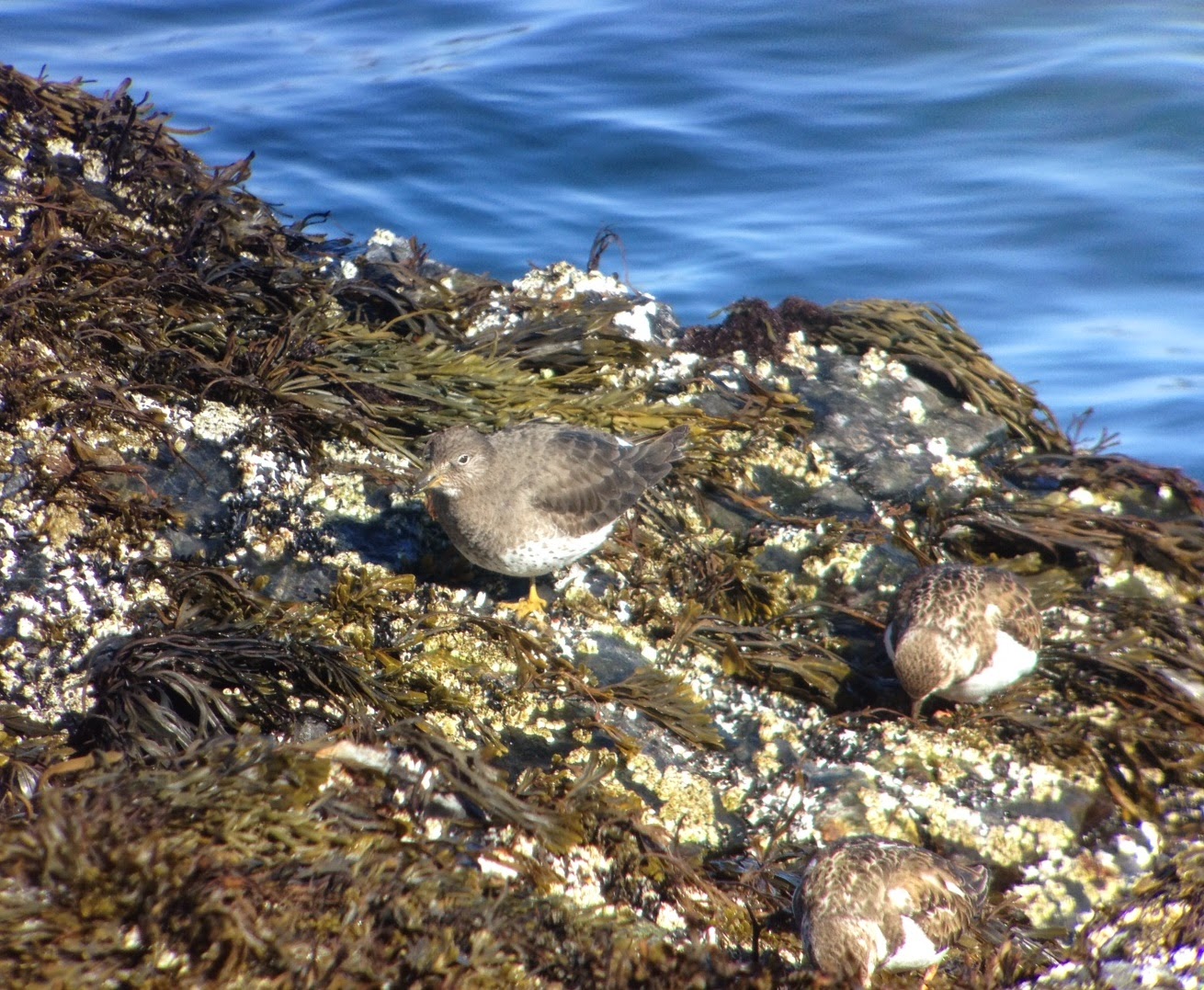
Surfbird, Biddeford Pool, ME, March 2015


Yes a Surfbird in ME!  Not only was this the first record for ME, but a first record for New England and maybe only the second ever record on the Atlantic coast.  What’s a Surfbird doing in ME?

The first post came through late Saturday afternoon – a 3 PM sighting from the rocks on Eastern Point sanctuary in Biddeford Pool.  Not surprisingly the observer was a bit skeptical of the ID, even though he got good views of the bird and photos.  A search at dusk that evening was negative, which certainly was more than a bit disappointing.  But since this bird’s preferred feeding areas were likely affected by the tides, the Surfbird may have just been feeding on rocks at a different portion of the peninsula during the search at dusk. 

I really wanted the bird to still be around.  And I really wanted to see this bird!  The challenge was I had family commitments in Worcester for most of the day on Sunday.  But if the bird was seen again on Sunday, and if I could break away by mid-afternoon, I could still get to Biddeford Pool by about the same time and tide it was seen on Saturday afternoon. 

Sunday morning I packed my gear in the car, and crossed my fingers.  During the family event I kept watching my e-mail, and sure enough the bird was re-found in the early morning.  Now I needed to be able to break free in time.  Luckily I was free by 1:45, and was quickly on the road.  On the way I got a call from Denny Abbott who had seen the bird around lunch time, and he gave me micro-directions to the spot where it was roosting with some Turnstones.  I arrived at 3:45 (yes I drove faster than I should have), hopeful that the bird was still around since there had been no posts since mid-morning.  Several birders were leaving as I got out of my car and they confirmed the bird was still being seen at Denny’s spot, and other birders were still on it.  The stars were aligning…

After a vigorous 5-minute walk I could see a couple birders up ahead with scopes.  With heart still pounding, I caught up with them and they pointed out which rock the Surfbird was on.  But it had been out of view for a while (it hadn’t flown away, had it?).  They suggested going to a different vantage point to get another angle on the spot – another birder was there with his scope trained down on the rock in question, so I was hopeful.  Two minutes later I was standing with that birder.  I could see several Turnstones but nothing else.  Then a larger, plump, gray bird walked into view – it was the Surfbird – acting as if it were on tidal rocks on an Oregon coastline.  I got several phonescoped photos of the bird, including these two shots –


Surfbird was #336 for my ME list and #1,997 for total ticks in New England.  This one sure wasn’t on my list of expected New England birds.  ME was my fourth state for Surfbird (see my statebird map below) – surprisingly I still need it for my WA list.


Saturday, March 21, 2015

Dovekie, Pacific Loon and Lots of Guillemots, Off Block Island, RI, March, 2015


In December 2014 I took a pelagic trip in RI waters with great hopes of filling some key gaps in my statelist, especially Dovekie and Fulmar.  There were no Fulmars seen on the trip, so we all struck out on that one.  The Dovekie story, however, was a little different – several were seen on the trip, and virtually every birder saw at least one.  That is, except for me.  It seems I was always looking in the wrong direction when one was seen, or didn’t get the news early enough to get on them.  So that was a very frustrating miss.  Though an adult Thayer’s Gull on that trip was a very nice consolation.

That was my only ever winter pelagic, and likely my last.  Even though the weather was relatively warm and calm for that time of year, the trip was still extremely cold and I was very uncomfortable during most of the trip.  Other birders have also seen some good winter pelagics off RI from cod fishing boats, but I don’t think those trips would be any better than the pelagic.  So it looks like if I’m going to get Dovekie, Fulmar, and other winter pelagic species for my RI list I’ll need to either be really lucky to see them from shore, or from the ferry to/from Block Island.  And then if I take the ferry to the Island, maybe I could spend some time looking for pelagics while doing a seawatch from Block Island itself. 

And speaking of seeing pelagics from the mainland - earlier this winter a chaseable Thick-billed Murre, another RI statebird target, was seen from land in Newport.  But I didn’t get the news early enough, and then wasn’t available to go after it.  Like I said, I would need to be really lucky to see a new pelagic species from the mainland.

So the rest of the winter I kept thinking about getting out to Block Island to at least try for Dovekie, which in reality isn’t that rare in RI.  Much of this winter has been really cold, so not very good weather for a trip to the Island.  But finally in March with some seasonable weather forecasted, I put aside a day for the trip.  The ferry to the island leaves Point Judith at 10, arriving at 11, and the return trip doesn’t leave the Island until 2:30.  So in addition to the time on the ferry, I would have about 3 hours for a seawatch from land. 

Despite my best laid plans, I almost didn’t make it to the ferry in time.  What is normally a 2-hour drive on the weekend, or at least outside of rush hour, took me nearly 3 hours due to icy roads and lots of backups.  I almost turned around a couple times, but ended up making it to the ferry with minutes to spare.  I’m sure glad I didn’t turn around.

As the boat was leaving the dock I realized that the air was virtually still.  And then as we exited the harbor I could see the ocean was as smooth as glass, and visibility was excellent with no heat shimmer – the only challenge was the vibration of the boat engines.  As a result, when we got to open water I was able to identify waterfowl on the water at a considerable distance.  Though I imagined that the lack of even a light breeze would limit my chances for Fulmar and other birds that might take advantage of the wind to move through the area.

But despite the excellent viewing conditions, the first few minutes of the trip were pretty slow, with just a few Common Loons and Scoters here and there.  And then I noticed a group of 5 Loons swimming on the surface – 3 Commons, a Red-throated, and then another with a gleaming white hindneck.  When it would turn its head so that the hindneck was pointing toward the sun it was as if a beacon went off!  It was the size of the Red-throated, held its head horizontally, and had a short broad bill.  It was a nearly full breeding plumaged Pacific Loon – only my second one for RI.  Quite a start.

As we crossed the sound I continued to pick out small groups of Scoters, and a few Loons, but little else.  Then up ahead I noticed a large flock of waterfowl on the water some distance ahead of us – it was a flock of Scoters stretching at least a quarter mile to either side of our upcoming path.  As we neared the group they started to fly away, most waiting until we were right on top of them.  Almost all were White-winged Scoters (I estimated 3,000), with just a few Surf Scoters mixed in.  Later on I found a flock of mostly Black Scoters, (about 800), with about 200 Long-tailed Ducks mixed in.  Interesting that the White-wings and Blacks were staying in separate flocks.

Now we were nearing Block Island and I was getting disappointed that I had not seen any alcids.  Then as we approached the harbor I noticed a small dark alcid flying along the boat.  My thoughts quickly jumped to Dovekie, but instead it was a breeding plumaged Black Guillemot.  That was only my second Guillemot for RI, which is actually quite rare in the state.  A nice bird but not one of my targets.

A few minutes after landing I took a quick pre-arranged taxi ride to the southeast part of the island for my first ever Block Island seawatch.  I had been told that the Southeast Lighthouse and adjacent Mohegan Bluffs can be good locations, so I had the taxi drop me at the lighthouse to start.  Unfortunately this site is quite high off the water, and the shoreline is rather distant.  I wasn’t even going to try from this spot, but decided to set up the scope and give it a quick scan just in case there might be something good below me.  Only when I started to scan the open ocean did I realize how amazing the viewing conditions were – I was able to identify birds on the water well over a mile out.  And although there were very few birds in flight, there were quite a number of birds on the water – many flocks of Scoters, a number of Loons, and small groups of Red-necked and Horned Grebes were the key species.  Then I noticed a small dark bird way out – another breeding plumaged Guillemot.  Soon I had another and then a flock of 3 more.  Glad I stopped.  But given the distance to the water I didn’t stay here long, and headed to Mohegan Bluffs to see if I could get closer to the water.

I had been told that the key attraction for the Mohegan Bluffs site is that you can take steps down the bluffs to be close to the water level.  And although it would mean climbing down, and then back up, 116 steps in all (I counted), it was worth it.  I set up my scope at a landing at the bottom of the steps that gave me a little elevation above the water, and a wide view of the coastline.  


In addition to the ever present Scoters, Grebes, and Loons, there was a flock of at least 100 Common Goldeneye and another 100+ Bufflehead feeding close to shore.  And again I started finding more Guillemots.  With each scan I picked out more birds – all were way out on the water, and most were in breeding plumage.  I counted 10 birds in total, including these three birds perhaps a mile out in this heavily cropped phonescoped photo.


Over the next half hour I had 2 pairs of Razorbills fly by quite closely, and 5 other large alcids farther out, but little else was flying.  So I had now spent at least 90 minutes on the seawatch, and was likely seeing the same birds over and over again.  Although I had had some great birds, I was beginning to prepare myself for the reality that I wouldn’t get any new RI statebirds today.  On my next scan, as I got to the same group of 3 Guillemots I had photographed earlier, I noticed another small alcid even farther out.  This one seemed to have a shorter neck than the Guillemots, and was black above and white below.  Could this be a Dovekie?  It was so far way that I was a bit doubtful that I could be sure, even though I watched it swim and dive for the next several minutes.  But then it stretched its wings and there were no white wing patches - it was indeed a Dovekie.  And a few minutes later another Dovekie flew through my scopefield, and I was able to watch it for quite a while as it headed east.

Dovekie was # 319 for me in RI, which was my fourth, and likely last, New England state for this species. (see my statebird map below).

 
The ride back on the ferry was rather uneventful, except for a flyby of two large alcids.  They were close enough that I’m pretty sure they had smaller heads and bills making them Murres, and one bird was in full breeding plumage.  But I couldn’t tell for sure which species they were.  Common is certainly more likely.

Looking back on it all, it was a tremendous day.  First of all, any day with a new statebird in New England is a great day.  Dovekie was #1,996 for me in New England - just 4 more to go to 2,000.  And although as predicted I had very few birds in flight, including no Fulmars and not even a Kittiwake, I had lots of other great birds - 16 Guillemots (an amazing RI total – maybe a state record?), and a breeding plumaged Pacific Loon.  Though I doubt I would have seen any of those good birds if it hadn’t been for absolutely ideal viewing conditions.  Over the years I’ve now seen 6 new RI statebirds from the Block Island ferry, and now one on a winter seawatch from the Island.  I’m sure there will be more Block Island seawatches in my future.  And as I always say – “I love a seawatch”.