Showing posts with label Black Tern. Show all posts

Tuesday, October 19, 2021

Two Statebirds at Rankin Bottoms, TN, September 19, 2021

Douglas Lake is a TVA reservoir on the French Broad River in eastern TN.  Falling water levels in summer and fall can expose mudflats at the upstream portion of the lake called Rankin Bottoms, making it a well-known shorebird hotspot.  But that only occurs when water levels are just right – too high and there’s no mud; too low and there’s way too much mud and the best habitat is too far away for IDs.  I’m pretty sure I birded there many years ago, in fact decades ago, during my travels in eastern TN.  But my memory of the site is fuzzy at best.

Early in the summer 2021 shorebird season water levels at Rankin Bottoms were too high and shorebirds were limited.  Interestingly, this was principally caused by flooding rains near where I live in the western NC mountains near the headwaters of the French Broad.  But then by September water levels must have dropped because on 9/15 I got an eBird TN Needs Alerts featuring Buff-breasted Sandpipers at Rankin Bottoms.  Birders were finding a dozen or more species of shorebirds there, including Wilson’s Phalarope, Golden-Plovers, and Sanderlings.  Not to mention White Pelican, Laughing Gulls, and Caspian, Black, and Forster’s Terns.  Although all of these are inland rarities, only the Buff-breasted would be new for my TN state list.  You see years ago I had many business trips to Memphis, TN and I frequently birded at Ensley Bottoms with local birding legend Jeff Wilson.  That spot is the sewage treatment facility for the city of Memphis and I accumulated a large list of shorebirds and waterbirds there over the years.  But never a Buff-breasted Sandpiper. 

Then on the 16th 2 Avocets were reported at Rankin Bottoms – another potential TN statebird for me.  That was enough to push me into planning a trip to eastern TN.  I reached out to my birding buddy Bill Hooker to see if he might want to come along.  It turns out that Bill had been to Rankin Bottoms earlier in the season and as a result knew the site quite well.  And since shorebirding wasn’t too fruitful on his earlier trip, he was game for going along with me for another try.

As our planned trip on the 19th neared, the Needs Alerts gave us some good news and some bad news.  First the bad news – the Avocets were one-day-wonders.  Then the good news – the Buffies continued with as many as 3 reported.  And more good news – a number of passerine migrants were also being seen there, including several Cape May Warblers which was another possible statebird.  It turns out that a long peninsula sticking into the reservoir is nicely vegetated in brush and trees and can be quite a migrant magnet.  Now with 2 statebird targets I was all set for another trip into eastern TN.

We were on the road shortly after 6 and soon had our first good bird of the day – a Barred Owl flew over the highway as we were heading north from Asheville.  A new bird for my Buncombe County list.  Was that an omen for what was to come?

A couple hours later we were pulling into Rankin Bottoms and got our first look at the mudflats – there were many, many acres of possible shorebird habitat.  Were the birds going to be too far to identify?  We stopped at the first overlook where the road crosses the railroad tracks, the spot where most of the shorebirds were reported, and did a quick binocular scan.  There were scattered small shorebirds in the distance, some several hundred yards out.  This was going to be difficult.  Then I noticed some closer birds – it was a small group of Sanderlings.  Now it was time for scanning of the more distant sections of the mudflats.  Eventually I was picking up the continuing Wilson’s Phalarope and 2 Golden-Plovers far in the distance.  But despite lots of effort I had no luck with my key target – the Buff-breasted Sandpipers.

With each of our scans we picked up additional shorebirds well in the distance, but many were too far to confirm the IDs.  And complicating the issue was that we were looking off to the east into the morning sun.  I worried that even if a Buff-breasted was still around it might be too far away.  As examples of what we were dealing with, Bill took numerous highly magnified pictures of birds on the flats, and here are his best pictures of a Golden-Plover and the Phalarope.


We talked about moving on to other overlooks to see if we could find the Buffies elsewhere but decided to continue to scan from the railroad track spot a bit longer since that’s where they had been reported.  And I’m glad we did, because with another scan of the distant flats I picked up a mid-sized shorebird that was walking in a more upright manner.  I focused on this bird and eventually could see that it had a brown chest and scaly back – I had a Buff-breasted Sandpiper!  That sure was difficult.

My statebird map for this species is inserted below – states where I’ve seen it in its regular range are in blue, cross-hatched states are those where I still need it in its normal range, and the numerous eastern brown states are where I’ve seen it as a rarity.  I put TN in the Buff-breasted’s regular range as the western edge of the state is within its normal migration route.  Though it’s certainly a rarity this far east in the state.

Now that we finally had our key target we moved on to the north a bit to check out the flats from other overlooks.  We eventually added a few more shorebird species, giving us 12 species for the morning, including finding a rare Knot (but still not a new statebird for me). 

Later we found a spit that had a small flock of Ring-billed Gulls, and with a closer look found 2 immature Laughing Gulls mixed in.  We were also able to find the continuing Black Tern, and discovered a nice breeding plumage Common Tern.  Here are 2 more of Bill’s photos – a shot of the spit in the distance and a close-up of the Black Tern.


Next we turned our attention to the landbird migrants.  We started walking north along the peninsula through the brushy woods and soon ran into a few Yellow Warblers and Redstarts.  A bit farther along I got a brief glimpse of a warbler showing considerable yellow below with streaking.  Eventually I got good looks at the target Cape May Warbler.  Nice to be able to color in TN in my statebird map, though I still need it as a regular migrant in quite a number of eastern and central states

We eventually saw a second Cape May, and ended up with 7 warbler species in total.  Not bad for a hotspot known for its shorebirds.

As we walked back to the car we checked out the mudflats one more time and realized the total number of shorebirds had diminished significantly.  Looks like we got to Rankin Bottoms just in time.

With the addition of the Buff-breasted Sandpiper and Cape May Warbler that brings my TN statelist to 246.  Nice to be able to continue to add a few statebirds in this neighboring state.

Monday, September 25, 2017

“Pelagic” Birding in VT (and NY) on Lake Champlain, September 2017

Pelagic – adjective; of, relating to, or living or occurring in the open sea.

That is the definition of the word “pelagic” in the Merriam-Webster dictionary.  There’s certainly no “open sea” in VT.  But one of the key birding attractions in VT in fall is to hope to see pelagic birds on Lake Champlain.  Although landlocked, Lake Champlain attracts quite a nice collection of typically “open sea” birds like Jaegers, Kittiwakes, Sabine’s Gulls, and even rarer species.  Many think the pelagic birds seen on Lake Champlain have passed down the St. Lawrence seaway and eventually make their way to the lake on their southbound migration routes.  Or perhaps these birds are just taking an overland route south and are at least momentarily attracted to pelagic-like, almost normal, habitat at this large body of water.  In any case, these are exciting rarities to try for especially in this landlocked state.

Passage of the pelagics is especially associated with certain weather conditions.  Typically they are seen following a frontal passage on northwest winds.  They are often spotted from shore, with a preferred location being the Charlotte Town Beach.  I have done a few lake-watches from this spot in the past but have not had any success, mostly because my trips haven’t coincided with the passage of the fronts. 

Plus in the last few years, Allan Strong has set up boat trips on Lake Champlain to look for pelagics.  The first of these trips occurred in October 2013 a day after a front, with remarkable success.  I added 3 statebirds to my VT list that day – Little Gull, Red Phalarope, and “Jaeger, sp.” (an unidentified bird at considerable distance).  Plus there was a tremendous passage of geese, ducks, loons, and grebes that day.  The next trip was in September 2015, when summer-like weather resulted in next to no migration and no pelagics.  That’s the nature of pelagic birding in general, and more specifically pelagic birding in VT.

The next boat trip was planned for early September of 2017, timed to be at the peak of Jaeger migration.  Luckily I would be able to squeeze it in between business trips, so I signed up to go.  My plan was to arrive in the area the evening before, get a hotel in Burlington, and be ready to go on the boat the next day.  And since the boat didn’t leave the dock until 9:30, I could spend a couple hours at the Charlotte Town Beach doing an early morning lake watch before heading to the boat.  Plus as the trip neared it appeared that I could arrive early enough to do a bit of land birding the evening before, with the key target being Orange-crowned Warbler which continues to elude me in VT. 

My plans were set – now I just needed to hope for the right weather conditions.  As the pelagic neared, the weather forecasts were looking promising.  The day before the trip would be showery, preceding the passage of a cold front overnight, followed by northwesterly breezes the day of the pelagic.  I would have preferred the winds to be a bit stronger after the front, but I would take it.

I arrived in northern VT the evening before the pelagic, with just enough time to bird the Whitney Creek area in Addison.  This spot has nice brushy undergrowth that has featured quite a number of Orange-crowned Warblers over the years.  Luckily the rain had stopped just before I arrived.  But despite lots of spishing and playing a bit of tape, there were few migrants of any type, and certainly no Orange-crown.  It was a long shot, but still worth the try since I don’t often get to this Orange-crown hot spot in northwestern VT.

The next morning I arrived at the Charlotte Town Beach on Lake Rd. just as it was getting light.  Skies were partly cloudy, and there were light breezes out of the northwest.  Visibility was quite good, though there was a bit of heat shimmer coming off the water.  All things considered, pretty nice viewing conditions.


I sat on a bench at the park and started my scans.  Unfortunately it was quite slow.  I spotted occasional flocks of Cormorants heading south, and the ever-resent Ring-billed Gulls milling about, but little else.  Three continuing Sanderlings on the beach were nice.  But certainly not my targets.  A little later my VT birding friend Hank Kaestner arrived to join in the scans, but we continued to come up empty.

But just then I spotted a medium-sized dark bird rise up off the water a short distance out.  It was flying much more tern-like than an immature Herring Gull – the only other option for an all dark Larid – it was a Jaeger!  But what species?  Both of us followed the bird for a couple minutes, and during most of this time the bird lazily flew around the lake, sometimes even rising quite high and soaring out over the water.  At one point it chased a Ring-bill and it was a bit smaller than the Gull.  All the while we could hardly see any white in the base of the primaries, and the bird was very sleek-bodied.  I was now starting to think that this could be a Long-tailed Jaeger.  After the bird flew north out of site, we started to compare notes.  In addition to my observations, Hank also commented that this bird was more gray than brown and rufous seen on Parastics and Pomarines.  We both agreed that this was indeed a Long-tailed Jaeger.  Not bad for the only pelagic bird I saw on the lakewatch.

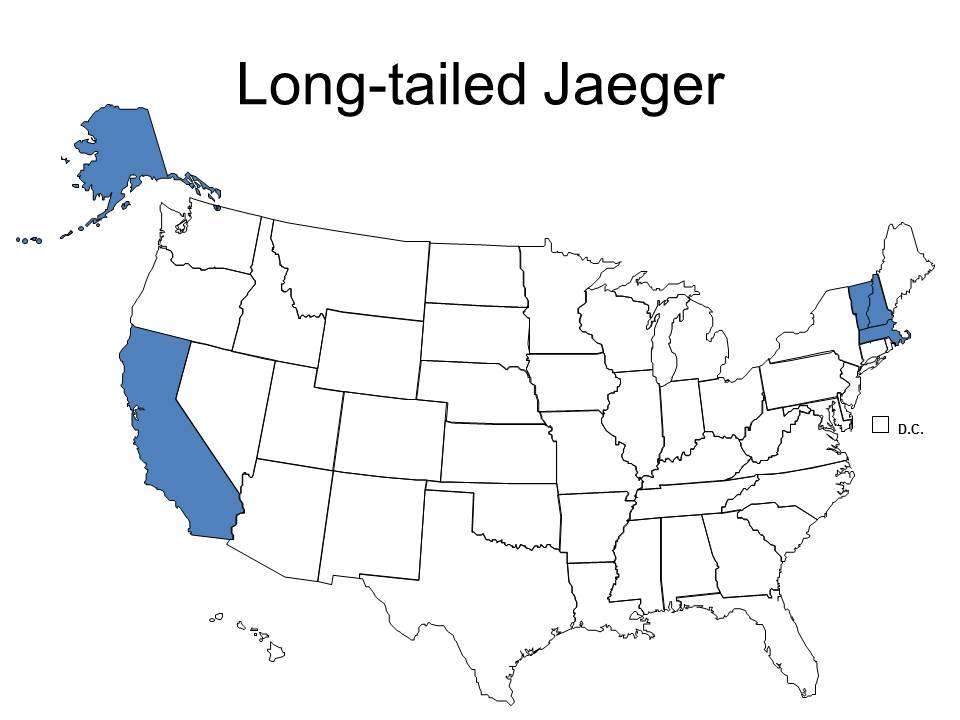
I’ve now seen Long-tailed Jaeger in only 5 states – in AK as a breeder; in CA, NH, and MA on pelagic trips, and now from shore in VT (see my statebird map below).  And although new for my VT list, it replaces my earlier “Jaeger, sp.” sighting, so no net addition on my list.


Then it was off to the boat trip, where I was joined by about 10 other birders all keenly hoping for more pelagic species.  The trip started pretty slowly, with a few migrant flocks of Cormorants and Canada Geese, but no other obvious migrants.  We passed by a few feeding flocks of gulls, in each case hoping to find a Jaeger in their midst, but to no avail.  Although there was a breeze out of the northwest, it must have been too light to usher in our pelagic targets.

A bit later the boat made its way toward the middle of Lake Champlain just a bit east of the VT/NY stateline.  We continued to come by a few feeding flocks of gulls, with some of those gulls coming over to the boat to feed on the chum Allan was throwing.  And then in one of the gull flocks I spotted a gull with large white triangular wing patches – Sabine’s Gull!!!  I soon got the rest of the boat on this immature bird, and we successfully chased it a bit farther west where we got close looks as it fed.  And then the bird became attracted to the chum and came over right next to the boat.  Birders with nice cameras and lenses got amazing photos of the Sabine’s – I got these miserable shots just holding up my cell phone.


We continued to watch the bird as it flew a bit farther west eventually getting into NY waters.  One of the rare times where one single bird has passed over a stateline giving me ticks in two different states - #280 for me in VT and #282 for NY.  I’ve seen Sabine’s Gull only twice before in the in East (in MA and NH), plus once in AK.  And my personal Sabine’s jackpot was seeing flocks of hundreds of birds while on my sole CA pelagic trip years ago.


Later on in the trip I spotted a distant immature Jaeger flying by to the west.  Although we tried to chase after it, we couldn’t refind the bird, which would unfortunately have to stay as another “Jaeger, Sp.” – and likely in NY waters.  Though while trying to refind the Jaeger we did come up with a late Black Tern, which would turn out to be the last bird of interest for the trip. 

Although we didn’t have many pelagics on the trip, the Sabine’s was quite amazing.  And of course the Long-tailed Jaeger from shore was special too.  The other Jaegers will have to wait till another time.

Friday, September 4, 2015

Black Tern, Stratford CT, August 2015


In New England Black Tern is easiest to find during summer at the marshes where it breeds in ME and northern VT.  However, it can be a pretty challenging bird to find elsewhere in New England.  Although a regular migrant in spring and fall mostly along the coasts, it comes through in pretty small numbers and in narrow windows of time.  And they don’t typically stick around so they aren’t very chaseable.  For instance I didn’t add Black Tern to my NH list until September 2011 when several passed by at sea while I was on a pelagic trip.   

The last New England state where I needed Black Tern was CT.  The story in CT was the same as the other coastal states – a regular migrant but typically not sticking around to chase.  And then there was the extra complication that even the closest coastal CT spot was a 2-hour drive away.  So I typically didn’t even give them a second thought when one was reported.  But then in early August quite a large flock of Sterna terns began congregating at the mouth of the Housatonic River between Milford Point and Stratford Point.  And for a couple days in a row a small number of Black Terns were seen in the flock.  Maybe these would finally be chaseable.  Or perhaps others would find their way to the flock attracted to the same conditions causing the Sterna terns to flock there.  So after receiving excellent advice and directions from Patrick Comins and Frank Mantlik who bird the area extensively, I was ready to give it a try. 

I arrived at Stratford Point at 8:30 the next morning at nearly full low tide.  Looking to the north there was a wide expanse of mudflats and literally thousands of Sterna terns – maybe 3,000 in total.  But they were very distant; many were more than ½ mile away (little more than specks using binoculars and still barely identifiable even using a scope).  Always up for a challenge, I started scanning through the flock hoping to pick out a smaller darker one that could be a Black Tern.  But after numerous scans I could only find Common Terns, with a number of shorebirds mixed in.  I was now getting pretty disappointed and decided to pan out over the Sound to see what I might find flying by a bit closer.  And almost as soon as I did I picked out a flock of 4 Black Terns flying quickly out of the mouth of the Housatonic to open waters, as if they were leaving the area.  Success! 

With such a large flock of terns, I was hoping for some other rarities as well.  After all, as they say – “one good tern deserves another”.  But despite another hour plus of scanning I saw nothing new except for a couple Roseates.  And twice I picked out a single Black Tern sitting in the flock on the sand bars.  Here is a very distant phonescoped photo of one of the Blacks.


Black Tern was #319 for me in CT, and the 237th species I have seen in each of the 6 New England states.  I’ve now seen this species in 42 states, only missing it in several Midwestern states and in the Pacific Northwest (see my statebird map below).