Showing posts with label Wilson's Phalarope. Show all posts

Tuesday, October 19, 2021

Two Statebirds at Rankin Bottoms, TN, September 19, 2021

Douglas Lake is a TVA reservoir on the French Broad River in eastern TN.  Falling water levels in summer and fall can expose mudflats at the upstream portion of the lake called Rankin Bottoms, making it a well-known shorebird hotspot.  But that only occurs when water levels are just right – too high and there’s no mud; too low and there’s way too much mud and the best habitat is too far away for IDs.  I’m pretty sure I birded there many years ago, in fact decades ago, during my travels in eastern TN.  But my memory of the site is fuzzy at best.

Early in the summer 2021 shorebird season water levels at Rankin Bottoms were too high and shorebirds were limited.  Interestingly, this was principally caused by flooding rains near where I live in the western NC mountains near the headwaters of the French Broad.  But then by September water levels must have dropped because on 9/15 I got an eBird TN Needs Alerts featuring Buff-breasted Sandpipers at Rankin Bottoms.  Birders were finding a dozen or more species of shorebirds there, including Wilson’s Phalarope, Golden-Plovers, and Sanderlings.  Not to mention White Pelican, Laughing Gulls, and Caspian, Black, and Forster’s Terns.  Although all of these are inland rarities, only the Buff-breasted would be new for my TN state list.  You see years ago I had many business trips to Memphis, TN and I frequently birded at Ensley Bottoms with local birding legend Jeff Wilson.  That spot is the sewage treatment facility for the city of Memphis and I accumulated a large list of shorebirds and waterbirds there over the years.  But never a Buff-breasted Sandpiper. 

Then on the 16th 2 Avocets were reported at Rankin Bottoms – another potential TN statebird for me.  That was enough to push me into planning a trip to eastern TN.  I reached out to my birding buddy Bill Hooker to see if he might want to come along.  It turns out that Bill had been to Rankin Bottoms earlier in the season and as a result knew the site quite well.  And since shorebirding wasn’t too fruitful on his earlier trip, he was game for going along with me for another try.

As our planned trip on the 19th neared, the Needs Alerts gave us some good news and some bad news.  First the bad news – the Avocets were one-day-wonders.  Then the good news – the Buffies continued with as many as 3 reported.  And more good news – a number of passerine migrants were also being seen there, including several Cape May Warblers which was another possible statebird.  It turns out that a long peninsula sticking into the reservoir is nicely vegetated in brush and trees and can be quite a migrant magnet.  Now with 2 statebird targets I was all set for another trip into eastern TN.

We were on the road shortly after 6 and soon had our first good bird of the day – a Barred Owl flew over the highway as we were heading north from Asheville.  A new bird for my Buncombe County list.  Was that an omen for what was to come?

A couple hours later we were pulling into Rankin Bottoms and got our first look at the mudflats – there were many, many acres of possible shorebird habitat.  Were the birds going to be too far to identify?  We stopped at the first overlook where the road crosses the railroad tracks, the spot where most of the shorebirds were reported, and did a quick binocular scan.  There were scattered small shorebirds in the distance, some several hundred yards out.  This was going to be difficult.  Then I noticed some closer birds – it was a small group of Sanderlings.  Now it was time for scanning of the more distant sections of the mudflats.  Eventually I was picking up the continuing Wilson’s Phalarope and 2 Golden-Plovers far in the distance.  But despite lots of effort I had no luck with my key target – the Buff-breasted Sandpipers.

With each of our scans we picked up additional shorebirds well in the distance, but many were too far to confirm the IDs.  And complicating the issue was that we were looking off to the east into the morning sun.  I worried that even if a Buff-breasted was still around it might be too far away.  As examples of what we were dealing with, Bill took numerous highly magnified pictures of birds on the flats, and here are his best pictures of a Golden-Plover and the Phalarope.


We talked about moving on to other overlooks to see if we could find the Buffies elsewhere but decided to continue to scan from the railroad track spot a bit longer since that’s where they had been reported.  And I’m glad we did, because with another scan of the distant flats I picked up a mid-sized shorebird that was walking in a more upright manner.  I focused on this bird and eventually could see that it had a brown chest and scaly back – I had a Buff-breasted Sandpiper!  That sure was difficult.

My statebird map for this species is inserted below – states where I’ve seen it in its regular range are in blue, cross-hatched states are those where I still need it in its normal range, and the numerous eastern brown states are where I’ve seen it as a rarity.  I put TN in the Buff-breasted’s regular range as the western edge of the state is within its normal migration route.  Though it’s certainly a rarity this far east in the state.

Now that we finally had our key target we moved on to the north a bit to check out the flats from other overlooks.  We eventually added a few more shorebird species, giving us 12 species for the morning, including finding a rare Knot (but still not a new statebird for me). 

Later we found a spit that had a small flock of Ring-billed Gulls, and with a closer look found 2 immature Laughing Gulls mixed in.  We were also able to find the continuing Black Tern, and discovered a nice breeding plumage Common Tern.  Here are 2 more of Bill’s photos – a shot of the spit in the distance and a close-up of the Black Tern.


Next we turned our attention to the landbird migrants.  We started walking north along the peninsula through the brushy woods and soon ran into a few Yellow Warblers and Redstarts.  A bit farther along I got a brief glimpse of a warbler showing considerable yellow below with streaking.  Eventually I got good looks at the target Cape May Warbler.  Nice to be able to color in TN in my statebird map, though I still need it as a regular migrant in quite a number of eastern and central states

We eventually saw a second Cape May, and ended up with 7 warbler species in total.  Not bad for a hotspot known for its shorebirds.

As we walked back to the car we checked out the mudflats one more time and realized the total number of shorebirds had diminished significantly.  Looks like we got to Rankin Bottoms just in time.

With the addition of the Buff-breasted Sandpiper and Cape May Warbler that brings my TN statelist to 246.  Nice to be able to continue to add a few statebirds in this neighboring state.

Sunday, May 17, 2020

Willow Flycatcher Chase Yields a Wilson’s Phalarope, Henderson County, NC, May 8, 2020

Willow Flycatcher was one of the many species on my NC “needs list” when I moved to the NC mountains.  Willows nest in limited numbers in western NC, and are occasional migrants through the area.  Three times last September I had a “Traill’s” Flycatcher pass through my yard.  Not surprisingly these birds were silent, hence my ID as “Traill’s”.  Back in the 90’s, while birding literally right at the NC/TN stateline in the Smokies, I had nesting Alder Flycatcher in NC, so seeing silent Traill’s Flycatchers wasn’t sufficient to add a bird to my NC statelist.  By comparison in SC, when I moved to the area I needed both Willow and Alder Flys.  In fall 2019 I had a couple silent Traill’s, so I was able to add Traill’s to my SC statelist.  Hopefully someday I will be able to hear singing Willows or Alders in SC so I can update that statelist to replace Traill’s with one or more specific IDs.

While birding around the area this past winter, several birders told me stories of recent Willow Fly nesting locations in nearby NC.  Several mentioned one specific ditch at the Sod Farm, but the vegetation had since been cut down.  And a couple mentioned a site at the Mills River park which apparently was still viable.  In addition, I found a local spot in Fletcher along Rockwell Drive with some excellent wetland habitat complete with a nice patch of willow trees – likely ideal for Willow Fly.  And I thought I heard one on a trip there at the end of April, but I couldn’t quite get it to cooperate enough to confirm it.  Then on May 6th local birder Kevin Burke reported that Willow Flycatcher was back at the Mills River park.  Probably no reason to rush right out there as they would likely be nesting, but I probably shouldn’t wait too long and go out there to look for them as soon as I had the opportunity.

That opportunity came the morning of the 8th which turned out to be a somewhat slow morning for migrants in my yard.  It had been tough to tear myself away from my excellent yard birds, but with nothing moving by mid-morning, it was time to take a short road trip to try for the Willow Flycatcher.  On my way to the Mills River park I realized I would pass right by a flooded field on Route 191 where Kevin had reported “a ton” of shorebirds 2 days earlier.  I imagined those individuals would be long gone, but who knows what I might find.  I wasn’t quite sure where the flooded field was, but I’d probably figure it out.  (I bet you were wondering how Wilson’s Phalarope would come into the picture…)

Just after I crossed over French Broad River on Route 191 I pulled over onto a wide shoulder on the east-bound side of the road.  There was a small pond in a low spot in a corn field in the distance which did indeed looked inviting.  It was pretty windy and quite chilly for early May, so I stayed seated behind the wheel and held my scope on my lap for a warmer look out to the pond.  The first birds I saw were a few Yellowlegs, and then I noticed a few small peeps.  Then I spotted a tall long-legged shorebird that was a bit smaller than the Yellowlegs with a gray back.  I increased the power on my scope and noticed shades of pink on the bird’s long neck – did I have a Wilson’s Phalarope?  I adjusted myself for better viewing, but then couldn’t refind the bird.  Did it fly?  Were my eyes playing tricks on me and it was just a Yellowlegs?  Then a minute later the bird re-appeared giving me long views – it was a breeding plumage male Wilson’s Phalarope.  Now the bird was running around in classic Phalarope fashion, both on the mud and in and out of the grasses.  Although the bird was not seen later that day, it returned for several birders to see it on the 9th and 10th. 

And good thing the weather was so cool and gloomy on the day I spotted the Phalarope – I went back and saw it again on the 9th on a sunny and warmer day and the heat shimmer made viewing challenging to say the least.  Not sure I would have first noticed the bird in the distance under those conditions.

I didn’t realize how rare Wilson’s Phalarope was in the area until checking eBird that night – there were only 6 prior western NC records in eBird.  And I also didn’t realize until later that I needed Wilson’s Phalarope for my NC statelist.  Years ago I had done a lot of shorebirding on the NC Outer Banks and had just assumed I had seen this species on one of those trips.  Instead it was #291 for my NC list, and a completely unexpected bonus bird. 

My statebird map for Wilson’s Phalarope is inserted below – solid blue-shaded states are those where I’ve seen this species; cross-hatched states are those where it is regular but I still haven’t caught up with it.  The numerous tan-colored states throughout the east are the ones where I’ve seen Wilson’s Phalarope as a rarity, though it is regular very locally in several of these.


With that excitement behind me, it was time to move on to the Mills River park to search for my original target – the more mundane Willow Flycatcher.  I had heard that the bird was in a thick grove of trees on the right just after you enter the park.  When I got out of the car I realized the weather conditions that helped me find the Phalarope weren’t exactly ideal for finding a flycatcher – their food isn’t very active on cold, raw days, so the flycatchers aren’t either.  I listened intently at the edge of the grove but didn’t hear or see the target bird.  I then took a short walk along a wet tree-lined ditch leading from the grove, but still no luck.

I returned to the grove resolved to the reality that I would just have to come back on a warmer day.  But just then I heard a single harsh “whit” call.  That was likely the Willow, but I needed confirmation.  I walked into the interior of the grove and heard several more “whit” call notes.  And then finally got good visuals of the little non-descript Empid with next to no eye-ring.  I could check off the Willow Flycatcher as #292 for my NC list.  As shown in my statebird map below I only need this species in 5 more states where it is regular, plus GA and SC where it would replace an unidentified “Traill’s” on those lists.


It was quite a day – certainly nice to get your target bird, and even better to find a totally unexpected rarity as well.

Wednesday, September 3, 2014

Marbled Godwit in RI, and Wilson’s Phalarope in CT, August 2014

With a free day coming up I started to review possible statebirding possibilities, and my thoughts quickly went to a very reliable Wilson’s Phalarope that had been seen for several days in Guilford, CT.  And with a little more digging I found a couple reports of a Marbled Godwit at Quicksand Pond in the southeastern corner of RI in Little Compton.  Though since the Godwit reports were a bit cryptic (for instance not saying where the bird was being seen at Quicksand Pond), and the most recent report was a couple days old, I was a bit worried about whether to give that one a try.  But since I had some time available, I decided to put a few miles on the car and try for both birds. 

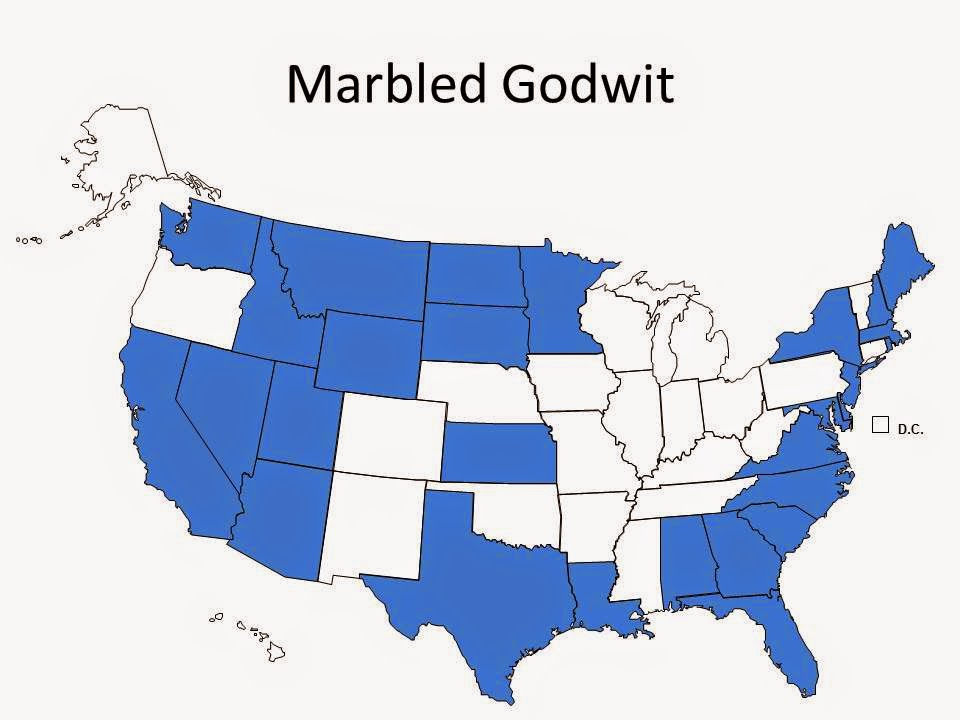
I arrived at the Little Compton beach just west of Quicksand Pond at about 7:30, early enough to not have to pay to park at the town beach.  Now the challenge was to try to locate the Godwit in this very large pond with considerable mudflats.  As I approached the southwest corner of the Pond I noticed several shorebirds along the edge.  I did a quick scan and found several Dowitchers and a few peeps, but nothing else of interest.  Then I looked to the east and found several more peeps, but still no large shorebirds.  I didn’t see any other mudflats in the immediate area, and started to worry about my chances.  Then farther off to the northeast I noticed a distant flock of maybe 200 gulls standing in shallow water.  I scoped through these birds and got brief glimpses of a smaller, darker bird walking among the gulls.  After a few seconds it came out into the open and it was the Marbled Godwit.  I ran into a couple local birders a couple minutes later and they said the Godwit had not been seen the day before.  I guess I got pretty lucky.  That was number 314 for me in RI, and my fourth New England state for this species (see my statebird map below).  I’ve now seen it in most coastal states in its migration and wintering range, many of the states in its inland breeding range, and a few inland states as a migrant.


I spent a little more time at Quicksand Pond looking for other shorebirds and found a number of peeps near the southeast corner close to the outlet of the pond.  I was about to leave the site when I looked up and noticed a Royal Tern fly right over my head coming in off the ocean.  I watched it fly around the northern stretch of the pond for a while but then lost it in the distance.  Not a new statebird for me, but a good bird for RI.

I headed back to the car and then drove west to Guilford, CT to try for the Wilson’s Phalarope.  This bird had been seen very reliably right along the road at the edge of Leete’s Island saltmarsh for several days, and was seen that morning, so I was quite optimistic.  When I arrived another birder was already there with a scope.  She said she had just arrived and hadn’t found the bird yet.  I wasn’t too disappointed (yet), and started to scan the flats.  There were numerous peeps and a few Yellowlegs, but no Phalarope.  I continued to scan, picked out a Baird’s and pointed it out to the other birder, but still couldn’t find the Phalarope.  Now I was beginning to worry since all the posts had mentioned how cooperative the bird had been right along the road.  I started to look farther out in the marsh and realized that there was quite a bit of habitat with good numbers of peeps.  Maybe it was just out of sight at this point.  I scanned some more and a medium-sized shorebird with a white rump flew through my scope field.  I watched it land and it was indeed the Wilson’s Phalarope.  I got this phonescoped photo of the bird as it fed.
 

That was number 312 for me in CT, which was my last New England state for Wilson’s Phalarope – my 227th species in each New England state.  And in my statebird map (below), I’ve seen this species throughout most of its normal range in the west and a number of eastern states as a rarity.


Saturday, June 28, 2014

Wilson’s Phalarope, Succotash Marsh, Rhode Island, June 2014

The first of 2 e-mails came across early in the morning that there was a male Wilson’s Phalarope “in the usual big pond” in Succotash Marsh in RI.  A few minutes later the second e-mail was posted that the bird was “in the grass to the left of the main pond”.  I had some time to break away to go chasing after it, but I first needed to figure out exactly where this spot was.  Last summer a local RI birder showed me a salt pan in Succotash Marsh west of Succotash Road where Wilson’s Phalaropes had been reasonably regular in spring.  (The irony that day was that we had just come from birding the Charlestown Breachway in an unsuccessful search for a staked out Wilson’s Phalarope.)  So I thought that had to be the right spot.  But maybe the big pond could be the big tidal pool on the east side of the road.  I decided to make a couple calls from the road as I headed south to confirm the location.  The first call was to Rachel Farrell who compiles and posts these sightings and she said that no further description of the site that had been given by the observers.  My next call was to Jan St. Jean who agreed that the spot was likely the salt pan described to me last year, but didn’t know for sure.  So I decided to make the salt pan my first stop.

After my 2-hour drive I arrived at the marsh and headed right to the salt pan.  It was a warm summer day with lots of beachgoers around, so I was happy to find a place to park.  The tide was excessively high, and even the normally non-tidal salt pan was flooded.  I wondered if that would impact the phalarope.  I saw a Willet walking along the edge of the pond, a Black Duck, and a Snowy Egret, but nothing else in and around the pond.  I decided to get a closer look and walked down the slope to the marsh, but again no target bird, though I couldn’t see the grasses to the south (likely “the left” reported in the e-mail assuming I was in the right spot).  So I climbed back up to the road to get a different vantage point.  For some reason I stopped to look with my binocs one more time from the road and I noticed a small bird swimming at the edge of the pond.  I put my scope on it and it was indeed the Wilson’s Phalarope.  I watched for the next 30 seconds as it swam into and out of the grasses, going out of view at times.  And then it was gone, presumably feeding farther back in the grasses at the north edge of the pond.  Good thing I learned about this spot last year. 

Wilson’s Phalarope was # 313 for me in RI – exactly 100 over the old ABA reportable threshold.  RI was my 33rd state for this species (see my statebird map below).  It was also my first New England statebird since March - hopefully that will break my dry spell.