Showing posts with label Brewer's Blackbird. Show all posts

Thursday, January 26, 2023

Life Bird and 10 State Birds, Florida Panhandle, January 5-7, 2023,

Late in December 2022 I noticed a post from a local birder where he mentioned he had just seen a White Wagtail in FL.  That would be a lifebird, one I missed back in 2016 practically in my backyard in NH because I was out of town.  Although I’ve had the eBird ABA Rarities alert turned on for years, I haven’t been checking it lately since I’m not doing much traveling during Covid.  So a Wagtail in FL wasn’t exactly on my radar.  But with some quick eBird searches I found out that the White Wagtail was being seen nearly daily in Tallahassee.  That seemed pretty far away, but with a drive time of “only” 7 1/2 hours, it was actually about the same amount of time it takes to drive to the NC Outer Banks.  The hunt was on!

It turns out the White Wagtail first arrived on November 24, and was being seen quite reliably at a couple runoff retention ponds in downtown Tallahassee.  It was feeding along muddy shorelines, and judging by the excellent photos posted on eBird, birders were able to get quite close to it.  In theory I could drive down to Tallahassee in one day, hopefully see the bird, and drive back the next day.  But why not add a couple days to the trip and look for some statebirds in the FL panhandle and in southern and central GA on the drive back.  So I started planning for a 4-day trip to try for the Wagtail as a lifebird and a number of statebirds in both states.

I first focused on potential statebirds in FL within a couple hours of Tallahassee.  I used to live in Gainesville, FL, and remember that the Tallahassee area was home to a number of wintering birds that are very difficult to find elsewhere in FL, including – White-breasted Nuthatch, Brown Creeper, Winter Wren, and Dark-eyed Junco.  And an agricultural area a short distance west of there was the only spot for Horned Larks in the state.  I only made it to the panhandle in winter once before but focused on water and marshbirds during that trip, so all of these local specialties were still targets.  And speaking of waterbirds, my eBird research revealed a number of other possible statebirds at nearby St. Marks NWR.  All told I had a possible 14 targets in FL (including the Wagtail), which was a surprisingly high number given that my FL list was already at 320.  I realistically hoped to find perhaps 8 of them.

Then it was time to research targets in GA.  My statelist was only 258, so there would be lots of possible statebirds.  My route to and from Tallahassee would go through much of GA, way too much to bird effectively on this short trip.  Plus all my GA stops would have to be just be on the way back home since I wanted to make a beeline for Tallahassee on the first day of the trip in search of my key target, the Wagtail.  So I needed to focus on potential targets that might be closer to my direct route home, thus minimizing drive times for side-trips.  That meant I wouldn’t be able to get to the coast, which was unfortunate since there were a number of my targets there.  And north of Atlanta would be out of bounds as well.  Despite all those constraints, I was still able to map out a route back taking me through the center of the state then heading northeast to Augusta that would give me 12 possible statebird targets.  I figured if I could find 6 of them that would make for a successful GA portion of the trip.

As I was making my final preparations for the trip I heard from my birding friend Bill Hooker that he and his wife Anita were planning to head to Tallahassee for the Wagtail the same day I was.  That would be great – whoever got there first could report their results to the other.  The trip was really coming together!

This post covers the FL portion of my trip.  The next blog post will cover the GA half of the trip.

Day 1 - January 5

I was out the door earlier than expected on the 5th and luckily made the trip around Atlanta through the morning rush with no backups.  My ETA in Tallahassee was around 2 PM.  That gave me lots of time to think about seeing my target Wagtail.  The bird was being reported from 2 runoff retention ponds – nearly daily at Lake Elberta, and occasionally at the nearby Mills Street Pond.  Unfortunately, there had been only 1 report of the bird on the 4th, at the Mills Street Pond.  And there were a couple posts where the Wagtail had not been seen that day.  And even worse, a Merlin was included on one checklist.  The Merlin might keep the Wagtail away from its regular feeding spots.  Or even worse, the Wagtail could become Merlin food.

So with the less than stellar reports from the 4th, I was very anxious to check reports from the morning of the 5th to see if the Wagtail was re-found.  The first report from Lake Elberta was posted about 8 AM - no Wagtail was seen.  Two others from Lake Elberta were posted soon thereafter and again no Wagtail was included.  Then there was a report from Mills Street Pond – no Wagtail there either.  Was I going to be a day too late for the Wagtail?  Then at 11 AM another Mills Street checklist was posted - I was almost too afraid to open it.  But I scrolled down to the end and there was the Wagtail complete with a picture.  The Wagtail was back!  I could breathe again!  I shared the news with Bill and Anita, and it turned out they would be arriving just a few minutes after me.  I pushed the accelerator down a bit harder as a I realized that I still had 3 hours to go before I got there.

After taking what seemed like forever to navigate through the traffic lights of downtown Tallahassee, I finally pulled up to the Mills Street Pond.  Pretty unremarkable actually.

Just up ahead there was a car parked on the side of the road with a camera sticking out of the driver’s window.  This was looking positive - “bird the birders” as I always say.  I pulled in front of the birder’s car and quickly scanned the small grassy mudflat while still sitting in my car.  In just a few seconds I picked out the White Wagtail walking along the mudflat, wagging its long tail as it went.  I called Bill and gave him the news, suggesting they stay in the car when they arrive.  A few minutes later they pulled in, and Anita got this great photo of our key target bird.


Unfortunately, my digi-binned photos were not nearly as good.  I tried to get out to get a phonescoped photo but the bird flushed to the southern end of the pond.  At least we got to hear the 2-note “pipit” call when it flew.

White Wagtail was #763 for my Continental ABA list, and #743 in the Lower 48.  It was the first new lifebird I had seen since 2018, though I’ve added at least one new lifebird each year since then due to ABA splits or decisions that certain introduced species were now countable. 

With our key target out of the way, we could focus on our other birding priorities for the trip – mine were new statebirds and Bill’s were county birds.  But Bill mentioned that since so many of my statebird targets were pretty rare in FL, he would come along with me and try for them as well.  Afterall, they would likely be new county birds for him as well.

And since we saw the Wagtail so quickly we had quite a bit of birding time left that day.  Our next stop was just a short 30-minute drive to the east at the Fred Myers Williams Fish Pond where a large flock of Brewer’s Blackbirds were reliably being seen.  A little surprising to have Brewer’s at a fish pond – normally they’re associated with cattle feed lots – but we’d give it a go.  As we pulled up to the hotspot location we saw a small herd of cows in the field immediately to the right, and sure enough there was a large flock of blackbirds with them.  

With a quick scan we realized that nearly all of them were Brewer’s – we estimated 300 (FL statebird #2) – with just a few cowbirds mixed in.  We never did see a pond.  My statebird map for Brewer’s Blackbird is inserted below.  The blue-shaded states are those where I’ve seen this species in its regular range.  The 3 cross-hatched states are the last ones in its normal range where I’ve yet to see it.  And the 5 brown-shaded states are those where I’ve seen Brewer’s as a rarity.  Since I moved to NC I’ve added Brewer’s Blackbird to 5 southeastern statelists – VA, NC, SC, GA, and now FL.


We had time for one more stop that afternoon, and decided to head to Faulk Drive Landing on Lake Jackson where a Clay-colored Sparrow had been reported earlier in the week.  Unfortunately, the only sparrows we had there were a couple Swamps in the marsh.  A consolation prize was a most cooperative Orange-crowned Warbler.  A nice way to end a most successful day.

Day 2 – January 6

Our first stop of the day was at Elinor Klapp-Phipps Park on the north side of Tallahassee.  There had been a number of recent reports of Dark-eyed Junco in the park with specific directions to one spot near Gate A.  It was also known as one of the better spots for White-breasted Nuthatch in FL (though with no recent reports), and occasional winter sightings of Brown Creeper including one in the past week.  A target-rich location.  We didn’t have specific locations for the Nuthatch and Creeper, so we’d just have to get lucky to run into them.

We arrived at Gate A a bit before sunrise and quickly heard a couple Great Horned Owls as our first birds of the day.  As we headed over to the trail where the Juncos had been reported we were surrounded by excellent hardwood and softwood woodlands.  We kept our ears open for our Nuthatch and Creeper targets and crossed our fingers.  While we waited for the morning sun to hit the Junco trail we played some Screech Owl calls nearby and were inundated by passerines with big numbers of Pine Warblers, Chickadees, and Titmice, a few Brown-headed Nuthatches, and goodies like Yellow-throated Warbler and Blue-headed Vireo.  But none of our targets stopped by. 

Then we walked over to the spot where the Juncos had been reported most often and I noticed some movement in the grass.  There was a group of 3 Juncos foraging on the ground at the edge of the trail (FL statebird #3).  FL was my 48th state for Dark-eyed Junco – I have to get back to ND to finish filling in my statebird map for this species.


We headed back to the car and kept our ears open for Nuthatches and Creepers but to no avail.  At least we added one of our targets.

Next we were on to Gardner Road Landing just to our north where Winter Wrens had been rather reliable, and quite vocal.  When we arrived we found quite a bit of very nice wet wooded habitat perfect for a Winter Wren.  We listened for their chattering calls but only heard Carolinas.  We then walked a short distance to the end of the road and noticed some movement low in the brush.  Then the small brown bird started to chatter and gave us brief views – it was our target Winter Wren (FL statebird #4). 

After a quick view of the wetlands at the end of the landing road, we headed off to Roden Cove Landing where there had been a report of 2 White-faced Ibis.  Unfortunately that was 10 days ago, so this one could well be a long shot.  We took a short walk to the edge of the wetlands and began to scan.  There were quite a number of birds there, dominated by at last 1,000 Coots.  And the marshy edges had good numbers of waders, including a small group of White Ibis, but no dark ones.  Then I spotted a flock of 6 dark Ibis in flight in the distance, unfortunately way too far to ID.  And they kept flying farther away and eventually disappeared.  That was frustrating. 

We went back to scanning the closer marsh and picked up another dark Ibis foraging alone.  This one was close enough for a potential ID, but we had left the scopes in the cars.  So Bill and I rushed back to get the scopes and Anita stayed with the bird.  When we returned the bird had moved a bit but was still close enough to try to see eye color.  The Ibis was actively feeding so it took a while to get good views of the face, but we could definitely see red eyes.  Plus the wings and mantle were greener than you’d normally see on a Glossy – we had our target White-faced Ibis (FL statebird #5).  FL was my 9th state seeing this species as a rarity.  White-faced sure is prone to vagrancy in the east.

A bit later we found another group of 7 dark Ibis nearby, though the difficult sun angle made it tough to see eye color.  Luckily one bird was close enough that we could see it had dark eyes and confirmed it as a Glossy.  We started to take a hike along the marsh edge to change the sun angle on the others but decided it would be best to spend that time looking for our other targets instead.

We headed back to the parking lot which was nearly surrounded by mature live oaks.  There had been a recent report of White-breasted Nuthatch at this hotspot, and these trees looked like an ideal spot for one.  We played some Screech Owl tape, getting a number of birds to respond, but not our target Nuthatch.  I hated to leave that one behind, but with no specific locations for the Nuthatch, and several targets waiting for us at the coast, we decided to pack up and headed south.

Our next stop was St. Marks NWR, a spot I had not visited since I lived in FL in the late 80’s.  I had 3 possible statebird targets there, the first being a long-staying American Golden-Plover that was reported to be most cooperative at the East River Pool.  Little did we know that our biggest problem finding this bird would be gaining access to the pool.  The 2-lane road was being repaved, and nearby parking lots were full of construction vehicles.

But Bill was able to talk one of the workers into allowing us to park briefly in one of the lots, giving us enough time to walk to the pool.  With the clock ticking we quickly made it to the metal pier and almost instantly picked out the American Golden-Plover (FL statebird #6).  Most cooperative indeed.

Although I lived in FL for a time, I was never able to see any of the “grasspipers” including Baird’s and Buff-breasted.  Interesting that I finally saw the Golden-Plover in FL in winter when they are normally supposed to be in southern South America.

The next target was a Long-tailed Duck that had been reported for awhile at the end of the Cedar Point Trail near the Lighthouse Pool.  But the sightings had been intermittent.  In fact, as we walked down the trail we met a couple groups of birders coming back from unsuccessful searches for the bird.  So I wasn’t very optimistic.  We got to the end of the trail and started scanning the offshore waters.  There were quite a number of Scaup and Bufflehead in the distance, but no sight of my target bird.  Then in one of my distant scans I noticed some ducks in the foreground.  I focused on the closer waters and there was the Long-tailed Duck (FL statebird #7).  It was diving frequently, along with a small group of Buffleheads.  Maybe it was overlooked by the other birders because they were focused on the more distant ducks, like I did initially.  I was able to get Bill and Anita on the bird, along with a number of other birders that passed by.  FL was my 4th state with Long-tailed Duck as a rarity.


Our next target was a long-staying American Flamingo that is often seen in the Lighthouse Pool.  I had seen Flamingo before in FL – a flock of 16 off of Snake Bight Trail at Everglades NP in 2008.  But I could never turn down an opportunity to see such a striking bird.  Unfortunately, the Flamingo was not on the flats at the pool, nor on the small offshore island it sometimes frequents.  Though the pool was full of waterfowl and shorebirds.


Our last stop at St. Marks was to bird the offshore waters near the lighthouse to look for a Surf Scoter that was first found there in late December.  Although it had been spotted numerous times since then, it was last reported 3 days ago.  There had also been occasional reports of Black Scoter from this spot.  I did several scans from the parking lot but came up empty.  We then walked west along the south shore, and I scanned at several more vantage points but to no avail.  With no other possible spots for Surf Scoter I hated to give up, but it was time to throw in the towel.  Even though we missed a couple targets, it was still fun to bird St. Marks again after so many years.

Our next target was Black Scoter which was quite often seen nearby at Alligator Point and Bald Point SP.  In fact, I had a 20-year-old FL birdfinding guide that said that Alligator Point was the best spot in the area for Black Scoter.  The local birder I ran into at the Wagtail spot mentioned that they are best seen near the “area of new pavement”.  As we arrived near the point this spot became obvious– there was a section of the coastal road that had apparently washed out in a recent storm and had just been replaced.  And sure enough large rafts of ducks were there just offshore - we estimated 500 birds.  With a quick binocular scan all I could find were Greater Scaup.  But with so many divers surely there were Scoters mixed in somewhere.  I scanned through the flocks more closely and picked out a few Redheads and even a Ring-necked Duck, but no Scoters. 

I could see another raft in the distance a bit farther west so I decided to change my vantage point and give them a look.  But a couple scans revealed just more Scaup.  Then I spotted a group of 4 larger, all dark ducks just offshore which only provided a quick but tantalizing view before they dove.  Did I have my target bird?  A few seconds later they all resurfaced - they were indeed Scoters but surprisingly they were female Surf Scoters instead of the expected Black Scoter (FL statebird #8).  I’ve now seen Surf Scoter in each of its expected coastal and Great Lake states except for PA, plus have seen it in 4 inland states as a rarity.

I then spotted another Scaup raft a bit farther to the west and again picked out 2 more Surf Scoters diving at the nearshore edge of the flock.  Anita was able to get this nice picture of this pair of birds.


It sure was great to find these 6 Surf Scoters, especially since they had not been reported here recently.  But we were still missing our target Black Scoter which was supposed to be the Scoter species for this spot.  There had been a Black Scoter report from nearby Bald Point SP the day before, so maybe we’d get lucky there.  It took us a while to find the park and an access point to scan the offshore waters, and it was now closing in on sunset.  But at least we were looking nearly due east with the setting sun to our backs, and the water was almost flat, giving us excellent visibility.  An initial scan revealed just a couple Scaup and little else.  So I started scanning farther out and picked out perhaps 200 Scaup and 10 Redheads far in the distance but they were way too far out to try to see if a Scoter might be mixed in.

Then I spotted a flock of perhaps 50 ducks far to the east roughly flying towards us.  As they got closer I could finally start to pick up some field marks – they were generally uniform brown indicating they were Redheads.  Then the flock turned so that they were flying perpendicular to our line of sight and I noticed one darker bird mixed in.  I was getting excited…  I kept staring at the flock and eventually could see the darker bird was all black, and on their closest approach I could see the yellow knob on the bill.  Finally, we had our Black Scoter, and an adult male at that (FL statebird #9).  My Black Scoter statebird map has a few less states shaded in than in my Surf Scoter map - Black Scoter is often the least common of the wintering scoters.

What an excellent way to end the day, finding 2 Scoter species and Long-tailed Duck on the Gulf Coast.  When the eBird checklists were all compiled (thanks to Bill for maintaining the checklists!) we came up with 109 species for the day – an outstanding total for a January day.

Day 3 - January 7

We had just one more planned stop together in the FL portion of our trip – a set of fields in Jackson County in the panhandle close to where AL, GA, and FL come together.  This area is well-known as the sole spot where Horned Larks are somewhat reliable in FL.  In fact, I remember this location when I lived in FL in the 80s but never made the trek there to give the Larks a try.  There were also a couple recent records of Lapland Longspur mixed in with the Larks and Pipits.  Another one to watch and listen for. 

We left the hotel pre-dawn so that we could arrive at the Concord Road Ag Fields hotspot by sunrise.  When we arrived I was bit surprised to see that the soil in the agricultural fields was nothing but sand.  Must be tough to grow a crop there.  But it sure was great habitat for those “prairie birds”.  And the roads were mostly just compacted sand, though hard enough to be passable.  Here’s a picture of one of the fields with the road in the foreground.


Our first birds of the morning were a pair of Great Horned Owls calling in the distance.  Then we picked out a Harrier sitting in the fields.  A nice start to the day…  But it was time to focus on our targets.  Eventually we started to hear Pipits calling overhead or out in the fields.  And with scope views I could see some Pipits flying far out in the fields.  Then we heard the characteristic calls of Horned Larks as a pair flew overhead.  And a couple minutes later a flock of 4 Larks flew over low enough that we could see their unique face pattern (FL statebird #10).  Horned Lark is 1 of only 26 species that I’ve seen in all 49 continental US states and Washington D.C. 


I then spent a little time scanning the fields hoping to find a Longspur.  But with the exception of that initial group of distant Pipits, I could find no other birds foraging in the fields.  I was tempted to spend more time scanning additional fields but had a full day of stops planned through GA as I headed back toward home.  So I decided to pass on further attempts for the Longspur to ensure I had enough time for my GA targets.  And with Bill and Anita now focused on birding other nearby counties in the FL panhandle, we wished each other good birding and went our separate ways for the rest of the trip.

I ended the FL portion of the trip with 10 new statebirds, including of course the White Wagtail as a life bird.  That’s much better than the 8 I had hoped for.  That brings my FL list up to a respectable 330. 

The GA portion of my trip is summarized in my next blog post. 

Saturday, February 26, 2022

7 VA Statebirds in the Second Half of a NC/VA Coastal Trip Including Bullock’s Oriole and Other Nice Rarities, February 16-17, 2022

The Carolina Bird Club (CBC) had originally scheduled its January 2022 meeting for the NC Outer Banks.  But the Omicron Covid variant had other ideas.  Unfortunately, Covid numbers started to peak just before the meeting, and the CBC not surprisingly cancelled the meeting.  I was really looking forward to the guided field trips, not only to bird the coast, but to also learn about how to bird the area in general.  But if the Covid numbers dropped quickly, maybe I could squeeze in a trip to the coast on my own, perhaps in late February. 

And just as I had hoped, the numbers did indeed improve into February.  So I started to plan a 4-day trip to the upper NC coast and southeastern VA.  Given the long travel times to get to the coast that would give me 2 full days of birding at the coast but just a couple hours on the travel days.  It turned out that I was free February 14 to 17, which lined up nicely with some dry but chilly weather.  This was starting to come together.

Then came the research into possible statebirds.  There were a few rarities being seen in both states, along with a number of regular species I still needed for my state lists.  After quite a bit of research, and with nearly last-minute updates to chase newly reported rarities, I came up with the following tentative itinerary –

·       2/14 – travel to the NC coast at Wrightsville Beach for stakeout Mountain Bluebird and Long-tailed Ducks, then late afternoon birding at the Alligator NWR for an elusive Ash-throated Flycatcher, along with Golden Eagle and Rough-legged Hawk that were occasionally reported

·       2/15 – birding on the OBX starting with a seawatch at Cape Point, then time searching for a recently reported Snowy Owl near the Oregon Inlet campground, then another seawatch at Jennette’s Pier

·       2/16 – an action-packed day in southeastern VA with stops for a number of stakeouts (Bullock’s Oriole, Brewer’s Blackbird, Iceland Gull, and Common Eider) along with a seawatch at Ruddee Inlet, searches for Vesper Sparrows in Northampton County, and ending the day for Woodcocks at the Eastern Shore of VA NWR

·       2/17 – a seawatch at dawn at Little Island Park before starting the drive home

And with that itinerary I hoped for perhaps 4 or 5 new statebirds in each state.

This blog post summarizes the VA portion of my trip.  The NC portion was summarized in the previous post.

February 16 – Stakeouts and Hotspots in Southeastern VA

The plan for the day was to make stops at 4 locations for stakeout rarities, plus general birding at 4 other locations.  All these spots were pretty close to each other, meaning driving time wasn’t too extensive.  So, with a little luck, I would have enough time to search for all my targets.   

The first stop was for a long-staying Bullock’s Oriole at a feeder in Chesapeake.  The immature male bird had been coming to a backyard feeding station, along with an immature Baltimore Oriole.  With a bit of research I found the contact information for the homeowner, Deb Shelton, and reached out to her for permission to look for her bird.  She was most gracious, and invited me into her backyard to look for the Orioles.  She said that they were very active at the feeders early in the morning, and since this was the rarest of my targets, I decided to make that my first stop of the day. 

I arrived just before 7:30 and met Deb outside her house.  She described how both Orioles often fed together, showed me their favorite perch tree, mentioned that they often came in first for a peanut, etc.  She really knew her birds.  Armed with lots of great information, I made my way to the back deck to start my vigil.  But it didn’t take long.  Within 5 minutes I spotted an Oriole fly in from the left – it was the Baltimore.  And then right on cue the Bullock’s Oriole flew in a few seconds later (statebird #1).  It perched in the backyard for a minute or two, then flew to the feeders to grab a peanut – just as Deb said he would.  I got this picture with my cellphone and no magnification.

A poor excuse for a photo I’m afraid, especially compared to this exceptional photo taken by Deb Shelton.

I can’t thank Deb enough for her hospitality and of course for setting up such a nice feeding station that attracted those Orioles!

My statebird map for Bullock’s Oriole is inserted below.  The states where I’ve seen this species in its regular range are shaded in blue.  And now NC is the 7th state where I’ve seen Bullock’s Oriole as a rarity (shaded in tan). 


I hated to “bird and run”, but I had lots of other targets to try for.  I bade farewell to Deb, and then headed off to my next stakeout for Brewer’s Blackbird in Virginia Beach.  The eBird hotspot I was heading to was called “Breeze Farms (Brewer’s Blackbird Spot)”.  With a name like that how could I go wrong?  The hotspot was a small farm with various types of farm animals in small pens.  This was classic Brewer’s habitat, and as a result this had become a regular spot for them from December to March since 2016. 

Along the way I passed by lots of ag fields which I scanned for my VA nemesis bird – Wild Turkey.  That was by far the most common bird I still needed for my VA state list.  But rarely are Turkeys in stakeout locations.  Instead, you typically just run into them.  And I kept my eyes peeled for them as I drove by every field, though luck never seemed to be on my side.

Now back to the Brewer’s - many of the recent sightings mentioned them being perched in trees, and as I pulled up I noticed one tall deciduous tree in the middle of the farm.  That must be the one.  There was a small flock of Starlings up there, but I didn’t notice any Blackbirds.  But then the Starlings flew off leaving one lone Blackbird behind.  It was either a female Cowbird or Brewer’s, but it flew off before I could get conclusive scope views.  This wasn’t looking good…  But then I noticed a small flock of birds near the ground in one of the pens.  The flock rose above the fencing and I could see it was a mixed Blackbird-Starling flock.  Most of the birds settled back in the pen out of view but 3 birds landed on the top railing.  With the scope I could pick out 2 male and 1 female Brewer’s Blackbirds (statebird #2).  I watched a bit longer and the entire flock flew up again – this time I could make out about 10 blackbirds though couldn’t be sure of the IDs before the entire group settled back in the pen out of sight.  I likely had 10 Brewer’s but could only be sure of 3.

VA is now the 4th state after NC, SC, and GA where I’ve seen Brewer’s Blackbirds since moving to the region.  And I still need it in a few other states where it’s regular (the cross-hatched states in my statebird map below).  Although I have VA coded as a state out of their regular range based on range maps in the field guides, they sure seem to be regular at least at this one spot in VA.

Next I was on to Ruddee Inlet where an Iceland Gull has been seen irregularly with the local Ring-bills.  Along the way I once again kept my eyes open for Turkeys – and once again came up empty.  When I arrived at Rudee Inlet there was a small flock of Ring-bills in the parking lot, but no Iceland.  I had brought a loaf of bread along with me as gull bait, and was able to double the size of the flock with a few offerings, but still no Iceland.  I checked a couple nearby gull flocks close to the inlet and up the beach but still couldn’t find my target.

So now my focus shifted to doing a seawatch from the inlet.  The water was quite smooth and visibility was great, so I was hopeful I might pick out something good.  But alas, there was very little activity – just a few Gannets, Cormorants, and Red-throated Loons.  But then a bit later I spotted an alcid flying low to the water.  It was pretty far out but I could tell I had a Razorbill.  And a bit later another Razorbill flew by much closer (statebird #4).  As I always say – it’s quality not quantity.  Razorbill is typically the most common alcid on the East Coast, and I’ve now seen it in 8 of 11 coastal states from NC northward.

Happy with my seawatch results I went back to searching for the Iceland Gull but again just found Ring-bills.  It turns out the Iceland was last seen the day before on the 15th.

The next stop was only a short distance away at Lynnhaven Inlet where a female Common Eider had spent most of the winter.  I got some good intelligence about where to look and where to bird from, and the inlet was reasonably small, so I was cautiously optimistic.  But after a lot of searching I came up empty.  I even tried an additional vantage spot with no luck.  That was 2 misses in a row.  At least I was on schedule for the rest of my stops.

My remaining 3 stops were in Northampton County across the Chesapeake Bay Bridge Tunnel (CBBT).  You’re no longer allowed to stop on the islands of the CBBT, which can be pretty good birding.  So I just kept my eyes open as I crossed the mouth of the Chesapeake just in case something nice was flying by.  My first target when I got back onto land was Vesper Sparrow.  There had been 2 reports of as many as 45 Vespers in a couple fields along Arlington Road.  Though there were no details, and the reports were now 2-3 weeks old, so I was less optimistic about this one.  I pulled into the first spot and found an excellent set of fields with short-cut sparse vegetation - perfect for Vespers.  I parked on the shoulder and started walking along the edge of the field hoping to run into some sparrows.  But after a 20-minute walk I had just 1 Song.  As I headed back to the car a car pulled up and asked what I was doing.  He nicely said it was private land and suggested that I head out. 

With that experience I just birded from the road at the second spot, and found a couple Horned Larks, but still no sparrows.  Then I drove some nearby roads with good sparrow habitat though struck out there too.  And of course, I kept my eyes open for Turkeys though with similar results.

It was now late in the afternoon and I hoped I could reverse my latest streak and end my day on a high note.  My last target was American Woodcock at the Eastern Shore of VA NWR.  There was one recent Woodcock report from the refuge, with 13 birds displaying at dusk.  And although that report was now nearly 3 weeks old, I expected that they were nesting in the area and would still be active during my visit.  I arrived at the refuge at about 4:30 and did a little birding around the wetlands and woods while waiting for dusk. 

A general rule of thumb is that Woodcocks begin to call 20 minutes after sunset.  Sunset that day was 5:45 so I likely had to wait till just after 6 for some sightings.  As sunset neared I positioned myself along the south side of Hallett Circle in what looked like nice Woodcock habitat. 

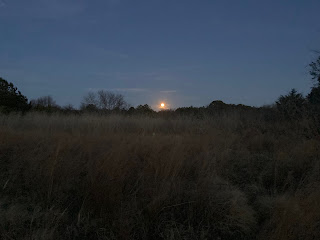
A nice flight of Robins and Blackbirds heading to roost and a distant calling Clapper Rail kept me occupied while waiting for my target birds to wake up.  Then at 6:06, 21 minutes after sunset, I heard the twittering flight call of a Woodcock in the distance (statebird #4).  The rule of thumb is accurate once again.  As I drove out I passed through more good habitat along Fitchett’s Road and heard 2 birds “peenting”, and saw 3 others in the waning light.  As I left the refuge I got this shot of the moon rising over one of the Woodcock’s fields.

VA was my 29th eastern state with Woodcocks, but I still need them in a number of states mostly near the western edge of their range.


That gave me 4 of 7 targets on the day – not great, but I’ll take it.

February 17 – Seawatch and Drive Home

My only planned stop of the day was an extended seawatch at Little Island Park.  The key attraction here was a long fishing pier from which numerous reports had been posted on eBird.  Unlike some other fishing piers that open later in the morning (like Jennette’s Pier in Nags Head, NC that opens at 9), the pier at Little Island is not gated so you can access the pier at dawn.  It’s often the case that seabird movement is best in the early morning, and that was typically the situation at Little Island with best numbers often from seawatches starting at sunrise.  So my plan was to start at sunrise and stay at least a couple hours before making the long drive home.

I arrived at 6:45 to this spectacular sunrise.

And after pausing to take in the view, bird activity quickly started to pickup around me.  Soon the sky was full of Gannets flying south.  Many were right overhead and some were calling – I’ve never heard Gannets call except at a breeding colony in Newfoundland.  And although there were some diving birds, most were just heading south.  The flight continued until 7:05, and over those 20 minutes I estimated 10 birds were passing by every second for an astounding total of 12,000 Gannets!  Here’s a typical picture of that amazing flight.

The rest of the time during my seawatch there were hundreds if not thousands in view, but they seemed to be milling about rather than heading south.

But Gannets weren’t the only birds heading south.  There was a steady stream of other species heading south, dominated by Red-throated Loons, Red-breasted Mergansers, Cormorants, and Black Scoters.  At one point I spotted a pair of birds flying together – the lead bird was obviously a Red-throated Loon.  But the second bird was about a third smaller, and although roughly the same shape it had a more arched body, a faster fluttering wingbeat, and white patches in the secondaries – I had a Red-necked Grebe (statebird #5).  I was able to watch this pair for 10-15 seconds as they passed by to the south.  VA was the 5th state where I’ve seen this species as a rarity south of its normal wintering range.

Then there was the alcid show.  Although most of the seabirds were flying southbound, I started to notice singles or pairs of birds heading north.  These northbound birds invariably turned out to be Razorbills, some flying quite close to shore.  And then while watching one Razorbill heading north, a much smaller alcid passed through my scope field heading south.  I had a Dovekie, looking like a football with no extended head and neck, and a whirr of wings (statebird #6).  Soon thereafter a second Dovekie passed by – luckily these birds were rather close providing good extended scope views.  I had 2 other likely Dovekies that flew by farther out.  Although the range maps show Dovekie wintering as far south as North Carolina, they aren’t often seen from shore.

After about 2 hours the activity had slowed and I still needed to make the long drive home.  So I decided to call it quits with these very rough estimates –

Black Scoter – 100

Red-breasted Merganser – 135

Red-necked Grebe - 1

Dovekie – 2

Razorbill – 31 (exact count)

Red-throated Loon – 175

Gannet – 12,000

Double-crested Cormorant – 110

Truly a spectacular seawatch!

But the trip wasn’t over quite yet.  My route home included a couple hours of driving time through agricultural fields in southeastern VA – more Turkey habitat.  But I wasn’t too hopeful given my track record.  And as I neared the NC line I had pretty much given up.  But this time the “birding gods” were looking out for me.  Just 20 minutes before crossing back into NC, while driving on US 58 in Brodnax, I spotted a group of 8 Turkeys in an adjacent field.  And 10 minutes later I spotted another small flock (statebird #7).  Until then my daily VA Needs Alerts would include a dozen or more Turkey sightings scattered across the state – probably the most common species I still needed in VA.  Thankfully my Needs Alerts will no longer be dominated by Turkey sightings.  I only need Turkey in 6 more states plus DC.

A perfect ending to an excellent trip!  With 7 new birds that brings my VA list to 267.  The link to the eBird Trip report for this VA portion of my coastal trip is inserted below –

https://ebird.org/tripreport/39066

Can’t wait to go back to the VA coast again, likely next winter.  Or earlier if there are some nice rarities to chase.

Tuesday, November 30, 2021

Hummingbird Trifecta, Plus an Unexpected Rarity, Athens, Georgia, November 28, 2021

One of the first things I do each morning is to turn on my computer and check my Needs Alerts for nearby states.  In the GA Needs Alert I look for records from counties in the northeast corner of the state which are closest to home.  But there are few birders in that part of GA so most days no records pop up.  That was once again the case on the morning of the 27th. 

But then I noticed that there were 3 rare hummingbird species being reported in Clarke County – Black-chinned, Calliope, and Rufous.  I had no idea where Clarke County was, but that would certainly be enough justification for a chase, if it was only close enough.  With a quick search I realized Clarke was the county surrounding Athens, GA – roughly a 2 1/2 hour drive.  That’s a bit farther than my normal 2-hour drive limit, but with 3 rarities in the area, it was certainly worth the try. 

Though the trip would only be worthwhile if I could find information on locations and procedures for seeing the birds.  I first researched the Calliope and found that the bird had actually spent most of last winter at that location as well, so it seemed that this bird might be quite reliable.  I first looked through recent eBird reports but found no details.  So I then looked at the reports from when it first appeared last year and found directions for viewing – text the homeowner in advance and she would unlock the backyard gate to let you in.  So I texted the homeowner and she almost instantly replied and invited me to see her bird the next morning.  But, she mentioned the Calliope was most reliable before 9 AM so she suggested I try for it before the other hummers.

Then it was on to the Black-chinned.  The bird first appeared on 11/10, but had only become a daily visitor starting on the 19th.  Reports came in throughout the day so it seemed pretty reliable.  And with just a bit of hunting I found an eBird post that provided the viewing protocol – no need to contact the owner in advance, and viewing was from the driveway with feeders in the front yard.  That sounded pretty easy.

But the Rufous was more challenging.  Only one eBird post included what was apparently the address, but none provided access details.  So I reached back out to the Calliope homeowner to see if she knew the details on the Rufous.  Luckily she did, and sent me the contact information of the Rufous homeowner, Vince Howard.  I texted Vince and he was very obliging, inviting me to his backyard the next morning.  The complication was that his bird was almost never seen past 8 AM. 

So with quite a bit of effort I had obtained the protocols for seeing each bird, and had gotten the needed permission.  Now I needed to figure out the order to try for them.  Although all 3 are rarities, the Calliope and Black-chinned are certainly much rarer, so those should be my highest priority.  And since the Calliope had been around the longest (both this winter and last), maybe the newcomer Black-chinned should be my first priority.  Now I needed to factor in the most reliable times to see each bird.  The Rufous was only reliably seen before 8, Calliope before 9, and Black-chinned all day.  With all those datapoints I decided to try for the Calliope first, then the Black-chinned, and the Rufous last.  I knew that would greatly reduce my chances for the Rufous, but I figured there could always be other Rufous Hummingbirds I could chase in GA in the future.

The last issue that crossed my mind was how long to wait for each hummer to appear.  With multiple target birds, you never know if waiting longer for an earlier target increases your odds for seeing that one, or just diminishes your odds for seeing later ones.  I decided to cross that bridge when I came to it.

With my strategy all set to try for the 3 rare hummingbirds, I then checked to see if there were other birds I might need that had been seen recently nearby.  With a bit of research it seemed my most likely nearby opportunities could be Vesper and White-crowned Sparrows.  Both species had been seen about 20 minutes to the west of Athens at the Robertson Bridge Road hotspot, though the sightings were about 2 weeks old.  But since I would be in the area, and likely done looking for hummingbirds in the morning (regardless of whether I was successful), it still seemed to be worth the try.  My plans were set!

I was out of the house the next morning at 5 AM – even earlier than I planned.  And with few cars on the road I made great time getting to Athens.  I pulled into the Calliope spot at 7:40, and quickly made my way to the back yard.  The first thing I spotted as I walked into the yard was a beautiful pineapple sage plant covered in red tubular flowers.  Not surprisingly this was reported to be a favorite of the Calliope.  I walked to the area under the deck, the recommended viewing spot, and started my vigil.  Not 2 minutes later I noticed movement and there was the little hummingbird perched in a bush next to the sage.  It was facing me giving great views of his beautiful gorget.  That was easy!

My statebird map for Calliope Hummingbird is inserted below.  The blue states are those where I’ve seen this species in its regular range; the cross-hatched states are those where I still need it.  And the 6 brown states are those where I’ve seen Calliope as a rarity.


 Although I wanted to stay longer, I had other hummingbirds to chase after.  So I only stayed for a couple more minutes before heading back to the car.  And just 10 minutes later, by 8:00, I was at the residence where the immature Black-chinned was being seen.  The protocol here was to stand on the driveway and watch the feeders in the front yard.  Plus the day before the hummer was spotted at the top of the crepe myrtle which apparently was one of its favorite perches.  When I arrived the homeowner was out filling his birdbath.  He said he had already seen it that morning, and said it was really only reliable from 8 to 9.  Good thing I got there early.  I settled in watching a few birds coming and going and then within 5 minutes spotted my target bird fly into the top of the crepe myrtle.  It sat there for at least a minute giving good views of its long and slightly decurved bill, and slightly curved folded wing.  Then if flew off to the north chipping along the way.  GA is now my second state (after CT) seeing Black-chinned as a rarity.

Two down and one to go, though I wasn’t terribly optimistic about the Rufous.  I arrived at 8:20 and was joined by Vince in his backyard to watch for his hummingbird.  He had seen and photographed the Rufous that morning before 8, but true to form had not seen it since then.  There were many birds at his feeding station including 2 nice Orange-crowned Warblers.  But there were no hummingbird visits at the feeder.  Then again at one point I thought I saw a hummingbird fly by - maybe that was just wishful thinking.  It was now 9:15 and I was starting to wonder how much longer I should wait.  And just then I looked back at the feeder and there was the Rufous feeding.  It drank for at least a minute, giving me views of its green back and closed tail.  Then it was off in a flash.  Although I would have liked to have seen its rufous flanks and gorget, I was happy to have just seen it so late in the morning.  Here is one of Vince’s pictures he took that morning through his window.

I’ve now seen Rufous Hummingbird in each southeast state but MS where it is now a regular wintering species.  Along with 7 northeast states where it is still considered a true rarity.

Three for three rare hummingbirds in one county all within 2 hours – a hummingbird trifecta.  And to think just a day earlier I didn’t even realize they were being seen there.  I obviously have to add Clarke County to the list of GA counties in which to search for new GA statebirds.

But my birding day wasn’t over yet.  It was only 9:30 when I left the Rufous location, so that gave me plenty of time to head to Robertson Bridge Road to look for some sparrows.  This hotspot was a narrow dirt road that winds through cattle pastures, with low shrubs along most of the roadsides.  It certainly looked good for sparrows.  I parked my car near the north end and started birding the road on foot.  I soon ran into a White-throat and several Songs, but sparrows were scarce.  Then I noticed a large blackbird flock in one pasture and with a quick view realized they were mostly Rusty’s.  I guessed at least 75 birds, along with 50 Starlings and few Red-wings.  They later perched in nearby trees along Barber Creek and then flew off. 

I then looked back into the pasture and spotted two blackbirds near some cattle.  With binocular views I could see they were all dark, and quite shiny.  Brewer’s perhaps?  I raced back to the car to get the scope, and then with scope views could see they were very iridescent and glossy despite the cloudy weather conditions, with medium length tails.  Brewer’s Blackbirds indeed!  I always think Brewer’s males look like miniature grackles – very glossy but lacking the long tail.  That was an unexpected surprise – not a huge rarity but still requiring details in eBird.  GA is my third southeast state (after NC and SC) where I’ve added this species since moving to the area.

What a great morning!  The hummingbird trifecta plus an unexpected rarity brings my GA statelist to 257.  Certainly made the 4:30 AM wake-up call worthwhile.

Monday, February 15, 2021

More Rarities at Dobbins Farm – But Not the Expected One, Anderson County, SC, February 10, 2021

Ross’s Goose is one of my favorite birds, dating back to my numerous work trips to the Memphis area in the late 90s and 2000’s.  During the colder months I would enjoy seeing large flocks of white geese either migrating through or wintering in the area.  The vast majority were Snows, but with close examination I would spot occasional Ross’s Geese mixed in.  In flight, a Ross’s would often be at the head of the line.  It was fun to play “Where’s Waldo” looking for those diminutive geese among their larger cousins.  Over the years I would end up adding Ross’s to my lists in 31 states and 1 Canadian province as this species rapidly increased in numbers. 

When I moved to the Carolinas I needed Ross’s Goose for my statelists in both NC and SC, as well as Snow Goose in South Carolina.  I was able to see Ross’s in NC within just a few months of moving to the region in 12/19.  And finally got Snow Goose in SC about a year later in 11/20 at Dobbins Farm in Anderson County.  And although there were several more Ross’s records in the mountains of NC, there were no nearby records of Ross’s in SC.

That is until late January 2021 when Ross’s and Snows appeared at not 1 but 2 farm ponds in Anderson County.  Remarkably the sites were just 11 miles apart “as the goose flies”.  Unfortunately, I had commitments at home that prevented me from getting out at that time.  But the reports continued at both spots for a couple weeks, until I was finally able to make a run to the area on February 10.  The last report from the first site, Clemson University Simpson Research Station, was on the 7th – 2 Ross’s were seen with 5 Snows.  And from the other site, Dobbins Farm where I’ve seen several rarities since moving to the area, the last report was on the 8th with 1 each Ross’s and Snow.  There were no reports positive or negative from the 9th.  But I was still quite optimistic that the birds that had been around at the Clemson site for 13 days, and at Dobbins Farm for 11 days, would still be around when I was finally able to look for them.

My plan for the 10th was to first head to the Clemson site since it was closer, then bird the Dobbins Farm area.  I got out of the house early on the 10th and arrived at the Clemson site at about 9 AM.  The Ross’s and Snow Geese were sometimes seen with Canadas on the farm pond there, and sometimes seen foraging in fields nearby.  As I pulled up to the pond I hoped (dare I say expected) to see some white dots on the water which would be my target birds – but I didn’t see a single goose.  I got out and with a quick binocular view couldn’t find any waterfowl at all.  They must be feeding in the fields I surmised.  There was suitable grazing habitat all around me, so I did a 360-degree search but still found no geese.  I drove east a short distance and looked from that different vantage point but again found no geese.  At least I still had Dobbins Farm to search for my target.

Twenty minutes later I arrived at Dobbins Farm again hoping to see those white dots on the ponds in the distance.  First I arrived at the upper pond – no geese at all.  Then I pulled down to the lower pond – no geese again.  I checked both ponds more closely, but there’s next to no way a white goose could hide on these relatively small farm ponds.  To say that I was upset would be an understatement – saying a number of things to myself that I can’t put in print here on my blog.  I had gotten there just a day or 2 too late.

I was tempted to just get back in the car and drive home, but decided to do at least a little birding at Dobbins before heading back.  One of my other targets at that farm has been Brewer’s Blackbirds that are occasionally reported from the site.  In fact a male/female pair were spotted there a few days earlier.  The cows were feeding in their troughs along the road so I though perhaps a blackbird might be there feeding on some spilled grain.  I quickly searched the area but came up empty.  Then I heard a couple blackbird call notes in the distance.  The recent report mentioned the Brewer’s were “Seen in top of trees behind lower pond”, so I looked into those trees in the distance and sure enough there was a blackbird perched near the top.  Too far to ID with binoculars, so I quickly got out my scope.  The bird was very glossy, with a yellow eye, and short tail – I had myself a male Brewer’s Blackbird!  Here’s a picture of those trees in the background behind the lower pond.


And a phonescoped view of the bird, though admittedly too distant to confirm the ID in this less-than-ideal photo.


 While studying the Brewer’s I realized that there was a nearby meadowlark singing an odd song.  I focused on the call and realized it was the singing Western Meadowlark, a bird I first heard here back in November and was now being occasionally heard and seen yet again among all the Eastern Meadowlarks.  Who knows how long it had been singing and I hadn’t noticed it while concentrating on the blackbird.  Then I turned back to the blackbird and realized there was a second one in the trees – another male Brewer’s.  Nice consolation prizes – a new SC statebird in the Brewer’s, and an even rarer Western Meadowlark.

Here’s my statebird map for Brewer’s Blackbird – the blue-shaded states are those where I’ve seen this species in its regular range.  The cross-hatched states are those in its regular range where I’ve yet to see this species.  The 4 tan states are those where I’ve seen it as a rarity.


I drove back to the upper pond hoping against hope that I might still find those white geese.  At the northeastern end of the pond I spotted a few Canada Geese at the edge of the pond.  While scanning through them I noticed a pair of geese flying overhead.  They circled and pitched in right in front of me – it was a pair of Greater White-fronted Geese.  I got these passable phonescoped photos of the pair.


White-fronts are actually rarer in the region than Ross’s.  Over the last 6 years in the SC Upstate there have been 15 reports of Ross’s while just 11 reports of White-fronts.

I’ve now seen White-fronted Goose throughout most of the states in its regular range, along with most east coast states where it’s a rarity.  Most of those northeast sightings are of birds from the Greenland flavirostris race, while sightings from the western Carolinas are most likely from the inland frontalis race.


That gave me 2 additions to my SC state list, bringing my total to 284.  Not to mention my second observation of the Western Meadowlark – only the second SC state record.  So even though I missed my target (and expected) Ross’s Goose, I’ll gladly take this great set of consolation prizes.  I’ll just have to get the Ross’s Goose in the future – maybe on a future trip to Dobbins Farm.