Showing posts with label Red-necked Grebe. Show all posts

Monday, March 13, 2023

Three Opportunistic Chases Nets Two Statebirds in Knoxville, TN, March 7-8, 2023

My wife and I scheduled a trip to Knoxville, TN in early March 2023 to take our dog to the University of Tennessee Veterinary School for some testing.  If we had spare time, that could present some statebird opportunities in a part of the state I don’t often get to.  Though at best my time would be limited, so the targets would likely need to be nearby.  I started to watch the eBird Needs Alerts during the week leading up to the trip but initially came up with no nearby targets.  But then the day before we left a report came in of a Tundra Swan in a small impoundment at a treatment plant a short distance east of Knoxville.  It was about 10 minutes off our route to and from Knoxville, so it was one to try for likely on the way home.  At least that gave me one to look forward to.  Assuming the Swan stuck around, that is.

We made the drive to Knoxville on the 6th, and that evening I re-checked my Needs Alert.  The Tundra Swan was still around, so that was good news.  And even better, two more of my “Needs” were reported that day no more than 15 minutes away – a Red-necked Grebe and a Black Scoter, both on Fort Loudoun Lake.  It sounded like I would have some free time in the middle of the day on the 7th, so it would be feasible to chase after both birds.  Suddenly I was up to 3 statebird possibilities. 

It turned out that I had about 2 hours of free time in the early afternoon of the 7th, which was perfect to bird nearby Loudoun Lake.  I first went to the boat ramp at Concord Park where the Red-necked Grebe had been spotted the previous day.  Comments from that sighting noted that the bird was with Pied-billed Grebes generally on the far southern part of the lake.  Unfortunately looking to the south meant looking into the sun that time of day, and my initial scans came up with just a couple Cormorants in the difficult lighting conditions.

Then I panned more to the southeast in somewhat better lighting and picked out a few Pied-billed Grebes in the distance.  Had I found the correct spot?  Sure enough a few seconds later I spotted the much larger Red-necked Grebe loosely associating with the Pied-bills.  The large yellow bill and longer neck were clinching field marks.  I tried some distant digiscoped photos but each time I got everything lined up the bird dove.  Here’s a picture of the reservoir with the Grebes about 2,000 ft out.

My statebird map for Red-necked Grebe is inserted below.  The blue-shaded states are those where I’ve seen this species in its regular range.  The 4 cross-hatched states are those in its normal range where I’ve yet to see it.  And the brown-shaded states are those where I’ve seen it as a rarity – several southeastern states as a wintering bird, and 2 central states as a rare breeder.


Luckily it only took a few minutes to get the Grebe, so I quickly headed to nearby Carl Cowen Park where the female Black Scoter had been reported the previous day.  The bird was swimming in a distant tight flock of 35 diving ducks, so I figured my best shot at finding the Scoter was to look for that flock of divers.  Unfortunately, once again I was looking to the south into the sun – ugh.  Amazingly I almost instantly found a flock of divers – did I have the flock?  But like the Grebes, they were nearly a half mile away.  I counted 47 birds, and watched the flock for at least 45 minutes.  Unfortunately, not only could I not pick out the Scoter, I couldn’t even be sure of the IDs of the other ducks (though I assumed they were Ring-necks, Scaup and/or Redheads).  I bet I had the Scoter in view, but the flock was just too far away and lighting was so bad that I couldn’t be sure.  That was frustrating.

After getting negative results on our dog’s tests (yay!), we headed home on the 8th.  Luckily my non-birding wife agreed to let me take the 10-minute side trip to try for the Tundra Swan.  The bird was being seen now 3 days in a row in an impoundment at a sewage treatment plant along Route 160 in Hamblen County.  The small impoundment was right next to the road, so I hoped we would need less than 5 minutes to find my target bird.  We pulled over on the road shoulder even with the pond and I did a quick binocular scan.  Even though that large white bird should have jumped out at me, I couldn’t find it.  Had it moved on since yesterday’s sighting?  There were some cattails and other vegetation on the pond, so maybe it was a bit obscured.  And sure enough, with a closer look I found the Tundra Swan on the near shore partially hidden by cattails.  Here’s a shot with no magnification of the impoundment, and with an arrow pointing toward the Swan.


TN is now my 8th state where I’ve seen Tundra Swan as a rarity.  Though I still need it in a number of states where it is a regular migrant.

That gave me two new TN statebirds in less than an hour of birding time.  That’s pretty efficient birding, and very opportunistic given my time and geographic constraints.  And with the addition of 2 birds my TN statelist is now at 255.

Wednesday, February 8, 2023

Red-necked Grebe, Lake Hartwell, South Carolina, January 19, 2023

On the evening of January 17 my birding friend Bill Hooker e-mailed me this photo of a bird he and Vicky Burke had seen earlier in the day at the Oconee Campground on Lake Hartwell in SC.  He was asking me to confirm the ID as a rare Red-necked Grebe. 

I responded right away - it was indeed a Red-necked Grebe.  A great find this far south, especially inland!

That was definitely one to chase after, but would it stick around?  As with any rarity, it was certainly possible that it was just passing through and had already moved on.  But in this case, even if it was still around, visibility and distance to the bird could make for a difficult identification.  Lake Hartwell is a very large man-made lake, and despite having many viewing points, there are still large portions not visible from a nearby public vantage point.  Given all those challenges, I decided to wait for other birders’ posts before committing to the 90-minute one-way drive.  

On the morning of the 18th there were negative reports from 2 different birders, so I figured the Grebe had moved on.  However, both birders commented that visibility wasn’t the best in the morning fog, so maybe there was still hope.  And sure enough, later that day came reports from those same birders that they had re-found the Grebe.  Although Bill and Vicky had the bird not too far out north of the Oconee Campground, sightings on the 18th were east of the campground, and likely farther away.  Although it sounded like the ID was challenging at that distance, I was willing to give it a try on the 19th.

The morning of the 19th was rainy, but forecasts showed the rain would stop midday.  Unfortunately, the winds would pick up soon thereafter with the passage of a cold front.  So it sounded like I had a small window of dry and calm weather where viewing would be best.  Now I just had to time it right.  It was still raining at the house when I left at noon, but the rain stopped about halfway there.  So far so good.  And when I arrived at the Oconee Campground there was just a light breeze and no fog.  Nearly perfect conditions.  Now I just needed the bird to cooperate.

I first checked the area off to the north where it was found on the 17th.  There were 3 Horned Grebes not too far off, but little else.  If only my target Red-necked Grebe was associating with them...  Then I walked to the eastern end of the campground peninsula and started to scan off to the east where it was seen on the 18th.  In the nearshore waters there was a flock of Canada Geese, some Cormorants, and a pair of Lesser Scaup in, but no Grebes of any variety.  Then I started scanning the water farther east and picked up a large flock of distant Bonaparte’s Gulls near the far shore.  If my target Grebe was that far away I doubt I would even spot it let alone be able to confirm the ID.  I was beginning to question the likelihood of a successful search.

I changed my angle a bit and did a quick binocular scan toward the east.  Amazingly I very quickly spotted a bird on the water about midway across the lake.  My first impression was that it was a brown Grebe, and certainly not the black-and-white look of a Horned Grebe.  And in the general area where the Red-necked was seen yesterday.  I wasn’t jumping to any conclusions just yet but I was getting hopeful.  I quickly put it in the scope, and although it was pretty far away, I could tell I had my target Red-necked Grebe – its neck was longer than Pied-billed or Horned, was brown-bodied, with a throat paler than the body, and in profile I could see a large yellow bill.  I’m glad I spotted it when I did because the wind was starting to pick up and the rougher waters were making the viewing more difficult.  

All things considered that was a very satisfying chase, and #296 for my SC statelist.  Made the drive home more tolerable.

My statebird map for Red-necked Grebe is inserted below.  The blue-shaded states are those where I’ve seen this species in its regular range.  The 4 cross-hatched states are those in its normal range where I’ve yet to see it.  The brown-shaded states are those where I’ve seen it as a rarity – several southern Atlantic states as a wintering bird, and 2 central states as a rare breeder.


Tuesday, July 26, 2022

Two Lifelong Goals Achieved on Western Montana / Idaho Panhandle Trip, July 6-16, 2022, Part 1 of 4

In 2014 a trip to the upper Midwest enabled me to get both my SD and ND statelists above 200.  Those were my 47th and 48th continental US states to exceed 200.  That left MT as my last of the continental 49 states with a list below that threshold.  Admittedly that is a somewhat arbitrary goal - it’s a lot easier to get to 200 in larger states like CA and TX with large statelists than in places like NH and RI with smaller lists.  But ever since 2014, I’ve wanted to get back to MT to get my last continental US statelist over 200. 

I started planning a western MT trip back in 2019, and had hoped to go in June of that year.  But that was the year my wife and I moved from MA to NC, and I was focused on selling the old house and buying the new one.  So I put the trip off to 2020.  But then Covid hit, so I delayed it to 2021.  And then with the pandemic continuing, I delayed the MT trip to 2022.  Then in February 2022, being fully vaccinated and boosted, I finally decided that it was safe enough to get back on the road and schedule the trip.  I reached out to my good birding friend David Donsker and he agreed to go along as well.  We made our plane reservations for July 6-16 to Missoula, and were all set.  That is except for lots of planning – hundreds of hours of planning.

I’ve birded in MT on 4 previous occasions, most recently a 4-day trip in May 2014, giving me a total of 175 species.  Each of these trips was in the eastern or central portion of the state dominated by various plains and grassland habitats.  So since I had never been to the mountains of western MT with a very different mix of bird species, I had significant statebird potential on my first trip there.  Certainly, it should be easy to add at least the 25 I needed to get to 200.

And since we’d be in the northwest corner of MT not far from ID, I decided to add a couple days in the ID panhandle.  I’ve birded ID 4 other times, but never made it into the far northern portion of the state.  In fact, my interest in birding the ID panhandle was spawned while on a birding trip in southern British Columbia.  At one point my route through BC took me within a few miles of the ID border, and I was seeing several species in BC that I needed in ID, like American Redstart and Red-eyed Vireo.  I was tempted to cross over the border on that trip, but instead decided to save this new part of ID for a future trip.

My tentative itinerary was to make a big loop, first birding a day each in MT near Missoula and Kalispell, then head west for about 2 days in the ID panhandle, then back east into MT for 4 days in Glacier National Park, followed by heading southeast for a day in the plains at Freezout Lake WMA and Benton Lake NWR, before heading back to Missoula.  That route would give me a whopping 84 targets in MT though I’d be happy if I found just 47.  That would put me 6 over the old ABA reportable threshold for MT of 216, and of course way over my goal of 200.  Plus I had another 26 targets in ID with a realistic goal of finding 12. 

If I met my expected totals I would add 59 new statebirds in MT and ID.  That would give me 14,989 Total Ticks – the sum of all my US state and Canadian province lists.  Just 11 short of my goal to reach the nice round number of 15,000.  But with a bit of luck (and good planning) 15,000 ticks might be within reach.  Sure would be nice to reach both lifelong milestones, all continental states over 200 and total ticks of 15,000, on the same trip.

With a bit of luck this could be a really exciting trip!

This blog post is the first of 4 parts summarizing our trip, covering our first 3 days in MT. 

Day 1 – 7/6 – Afternoon in Missoula

We landed at the Missoula airport in the early afternoon, and after getting the rental car went straight to birding.  Just before our trip I had reached out to local Missoula birder Jillian Leblow for advice and she was a wealth of knowledge.  Given that we both had a very early start to the day, we decided to focus on a few specialties in Missoula that wouldn’t require much hiking.  Our first target was Lewis’s Woodpecker in Council Grove State Park.  Jillian had told me that they were nesting right at the parking lot so we hoped this could be a pretty easy stop for them.  And they did not disappoint – after just a few minutes walking around we found several of these very colorful birds (MT statebird #1).  My statebird map for Lewis’s Woodpecker is inserted below.  The blue-shaded states are those where I’ve seen this species.  The cross-hatched states are those where I have yet to find it – just 3 more to go.

And shortly thereafter we heard twittering calls coming from the tall pines right in the middle of the parking lot and found a small flock of Pygmy Nuthatches (#2).  That was an easy and fruitful stop indeed!

Next we headed to Milltown State Park to try for White-throated Swifts recently reported there.  The locations of the sightings in recent eBird reports were a little confusing so I was a little unclear where the best spot might be to look for them.  But when we got close to the park it became obvious – there was one tall bluff along the river that looked perfect for Swift nesting sites.  So we parked on the road opposite the tall rock face and started scanning.  We had a few swallows and singing Warbling Vireos along the river, but no Swifts.  Then I heard their characteristic twittering calls behind me and there was a flock of 5 White-throated Swifts flying across the sky (#3).  And as icing on the cake we had another small group of Pygmy Nuthatches nearby.  I’ve now caught up with White-throated Swifts in all their regular states except OR.

Our last stop of the day was to be Greenough Park, a quaint town park from which many checklists were reported in eBird.  But 10 minutes into our walk a thunderstorm came through that made us scurry back to the car.  Still 3 new MT statebirds with just a little birding time was a good start to the trip.

Day 2 – 7/7 – Missoula and Ninepipe NWR

The plan for the day was to spend much of the morning birding with Jillian at Pattee Canyon southeast of Missoula.  But first we took advantage of the fact that our internal clocks were still on east coast time to get in some predawn owling time nearby.  I targeted three locations in the Lolo National Forest south of Missoula where owls had been reported recently.  Our first 2 stops had recent reports of Flammulated Owls, but despite calm and quiet conditions and a bright moon, none would reply to our calls.  Best we could do was to hear a single Common Nighthawk. 

Our last stop was on Larch Camp Road where there was a recent report of both Saw-whet and Pygmy Owls.  The sky was starting to brighten in the east so we focused on the nocturnal Saw-whet to start.  But once again there were no replies, at least initially.  And just when I started to think we would strikeout on the owls that morning, I started to hear a Saw-whet give a single toot in response to the tape (#4).  I’ve had Saw-whets give single toots like this in the past a couple times in response to callback.  Although MT was my 16th state for this species, I still need it in many more.

We took a short walk down the road where the calls seemed to be coming from and played some more tape.  This time we heard a harsh call as a reply.  It sounded like an owl, but it was tough to tell which one was giving this very atypical call.  Then it gave a perfect Western Screech-Owl song, followed by a second bird nearby (#5).  And with the brightening sky we watched both birds fly almost directly overhead across the road.  Then a 3rd bird started to call from the original spot.  Maybe a Screech-Owl family?  These were most unexpected birds, and apparently of interest to the local birders.  A nice start to the day.

A few minutes later we were at the trailhead to Pattee Canyon and met up with Jillian who agreed to show us around.  One of the key targets here was Pygmy Owl which had nested along one of the trails earlier in the season.  But the young had recently fledged so we weren’t too surprised not to find them at the nest hole that Jillian showed us.  Nor did any birds respond to call back.  But even though we missed our first target, the habitat looked great, initially primarily this open pine woodland with a grassy understory.

Jillian’s skills were tremendous, and she helped us out with all those bird songs that we weren’t familiar with.  Several had songs similar to their eastern counterparts, so it was fun to compare and contrast them.  For instance, MacGillivray’s Warbler’s song has lots of similarities to Mourning Warbler.  Both Western Tanager’s song and call were similar to those of Scarlet Tanager.  And Cassin’s Vireo was a buzzier version of Blue-headed.  We were also lucky enough to get 2 targets that eBird data suggested were more likely in Pattee Canyon than at any of our other planned stops – Williamson’s Sapsucker and Evening Grosbeak.  Plus we got a few of the less likely ones like Pileated Woodpecker, Cordilleran Flycatcher, and our only MT Nashville Warbler.  All told I added 14 new MT birds on this most productive walk, bringing my tally up to 19 new species.  Many thanks once again to Jillian for her help.  And there was even some nice scenery at the top of our hike too.

Our next planned stops were three waterfowl refuges north of Missoula- Ninepipe NWR, then Kicking Horse Reservoir, and then Pablo NWR.  I had a number of targets at these sites, including Horned and Red-necked Grebes, Trumpeter Swan, Sandhill Crane, Cinnamon Teal, Short-eared Owl, Black-necked Stilt, and White-faced Ibis.  All had recently been reported at several or all of these waterbodies and associated wetlands, but most all were seen only occasionally and in low numbers.  So the strategy was to bird all of them in hopes of running into each target at least once.  Plus the refuges east of the mountains we would visit at the end of the trip could yield these targets if we didn’t get them at these western sites.

As we drove down out of the canyon to start heading north the Low Tire Pressure light came on.  Often this is not a big deal, but we still checked the tires anyway.  It turned out the front left tire was very low, so we pumped it up and hoped it was already pretty low when we first got the car.  But a half hour later we checked it again and it had lost pressure in just that short amount of time.  So we aired it up again and decided to keep an eye on it.

As we neared Ninepipe NWR I mentioned to David that I wasn’t able to find much information on how to bird that site.  So we would just find whatever vantage points we could and bird from each of them.  Our first viewing spot was to be the main entrance road which entered the refuge from the east.  We pulled into what we thought was the entrance road only to find out it was a small turnaround with limited visibility of the water.  But I mentioned we may as well scope the water here just in case something good happens to be flying by.  And just as I stepped out of the car a Caspian Tern flew right by (#19).  That was lucky.  Although Caspians had recently been reported occasionally at nearly all the wetlands we would be visiting, that one turned out to be our only one of the trip.  I’ve now seen this species in all but 5 states where it is regular.  I’ve also seen it in CO and ME as a rarity (the tan-shaded states).

Farther up the road we got to the real main entrance road but it actually only gave us access to a small part of the refuge.  We set up the scope for some distant viewing and found a small group of Trumpeter Swans (#21), along with a large nesting colony of Ring-billed Gulls, and a number of diving and dabbling ducks.  My statebird map below reflects the Trumpeter Swan range map in the Sibley app, indicating that this species is a rarity in a number of states where I’ve seen it.  In reality, Trumpeter Swan is expanding its range quite a bit, so it is no longer a rarity in a several of these states.

And along with viewing from a few other vantage points we found 3 species of Grebes – Eared, Clark’s and Western, though no Horned.  And we finally found my only remaining dabbling duck target, Cinnamon Teal (#22), but nothing else of interest.  We drove along the western and southern edges of the refuge hoping to come upon a perched Short-eared Owl, but with no luck.

As we reached the end of the perimeter road we got out and checked the tire.  It was lower still – alas, it was time to take care of it.  After many calls pursuing multiple options we finally got the rental car company to send us to a tire repair shop that fixed it quite quickly.  Though unfortunately we lost most of the afternoon birding time dealing with the tire, eliminating our opportunity to bird Kicking Horse and Pablo Reservoir.  Hopefully we could still get our remaining wetlands targets at the refuges east of the mountains near the end of the trip.  Another casualty of our tire debacle - we wouldn’t have time to look for Merlins possibly nesting at Wayfarers SP along the way.  But it could have been worse - at least the car was fixed that day and it didn’t impact the next day’s birding too. 

Day 3 – 7/8 – Glacier NP and Kalispell Area

The original plan for Day 3 was to bird the greater Kalispell area.  But even though that was the most likely area for Gray Partridge and Turkey, sightings were few and far between, and none were apparently reliable.  There were however apparently reliable spots for Red-necked Grebe and Sandhill Crane, and an iffy site for Horned Grebe.  But all 3 could be birded quickly in the afternoon.  So instead of committing our good early morning time to birding Kalispell, we decided to head into Glacier National Park for our first visit to the western side of the park.  Then we would make those quick stops for the Grebes and Crane in the afternoon while on the way through Kalispell in route to ID.

By the way, if you're planning to bird Glacier NP be sure to purchase a copy of "Glacier is for the Birds" by David Benson.  It's an excellent resource and proved to be invaluable for my birding in the park.

We arrived at Glacier a few minutes before the 6 AM official opening time and surprisingly we were able to drive right in without showing our visitor passes to anyone.  As we drove to our first stop at the Fish Creek Campground and adjacent picnic area we heard the first of many Pacific Wrens singing a somewhat less musical song than its eastern Winter Wren counterpart (#23).  And when we reached the picnic area we had this tremendous sunrise view of McDonald Lake.

A short walk through the thick conifers on the way to the campground yielded a singing Brown Creeper (#24).  Then a quick walk around a couple of the campground loops gave us a few of the common regulars like Hammond’s Flycatcher, Cassin’s Vireo, “Audubon’s” Warbler, and Western Tanager.  When we reached the main campground road we came to a stream that had another singing Pacific Wren.  And while we strained our eyes to get a view of this skulking bird a Dipper flew by – our only one for the trip.  (We never did see the Wren – in fact never saw one on the entire trip though we heard many.)

Next we headed to the Inside North Fork Road which is a secluded unmaintained road which first passes through a thick conifer forest, and then comes to an extensive burn area with young trees and brush.  Before we had gone far down the road a deer came running right towards us.  And a few seconds later a black bear came ambling down the road as well.  Luckily we were in the car at the time – yes that's my dashboard in the foreground.  We rolled our windows up when it got 5 feet away and passed right by the car.

One of our key targets once we got into the burn area was the Dusky Flycatcher.  Their song is virtually identical to Hammond’s Flycatcher, and except for a shorter primary projection, has a very similar plumage.  The key differences are that Dusky prefers more open, brushy habitat, whereas Hammond’s prefers a thick conifer forest.  Dusky also sings from a lower perch while Hammond’s typically sings from a higher perch.  Here’s a typical shot of the burn area and the low trees and brush revegetating the area.

Soon after we reached the young forest in the burn area we started to hear the characteristic song of the Dusky and Hammond’s Flycatchers.  Although it sounded like the Hammond’s we heard earlier in the tall conifers, this one was singing from the brushy vegetation.  We played a bit of tape of the Dusky and a bird flew right in in response.  We had our Dusky Flycatcher – the 25th new MT statebird and #200 for my MT list.  I reached my first milestone of the trip - at least 200 species in all 49 continental states. 

I still need Dusky Flycatcher in a couple states where it’s regular, plus I’ve seen it as a rarity in migration in KS and OK.

Further up the road we got to an area where a stream bed paralleled the road, and we picked up a number of American Redstarts and Tennessee Warblers in the riparian vegetation – our only ones for the MT part of the trip.  A bit farther along the stream bed widened into a nice wetlands where we heard my fourth and final warbler target – Northern Waterthrush (#26).  I had been worried that my warbler targets might not still be singing this late in the year, but I guess I didn’t need to worry after all.  In fact, we had 8 warbler species singing just along this road, which is a nice tally for western birding.  At 10 AM we turned around and headed back toward Kalispell after a most successful morning in the park. 

As we headed back through the Kalispell area in route to ID we planned 3 quick stops for specific targets.  And along the way we’d keep our eyes peeled for Gray Partridge and Turkey.  The first stop was for a pair of Horned Grebes reported in a small pond on Monegan Road in Whitefish.  The birds had been reported there a few times, but not too recently.  I knew this one was iffy, but just maybe a pair was nesting at the pond.  It didn’t take us much time to survey the pond when we arrived – it truly was a small body of water.  But Mallards, a pair of Ruddy Ducks, and a nest of Coots was all we found there.  I knew it was a long shot.

Next, we were on to 2 spots in an area called West Valley to try for Sandhill Cranes.  Both places had reported Cranes in the double digits as recently as just 2 weeks earlier, whereas there were just occasional reports from other wetlands in the area and generally of just 1 or 2 birds.  So I was cautiously optimistic.  The first spot we went to was the West Valley Bird and Wildlife Viewing Area, which was on a hill giving us a nice view of a couple nearby lakes.  But the lakes were quite small and lacking cattails or similar vegetation for Cranes to forage or nest in.  We had some dabblers and Lesser Scaup, but little else.  The best bird was a singing Clay-colored Sparrow right next to the parking lot.  Unfortunately, it was a similar story at the nearby West Valley Ponds – limited habitat and just a few dabblers.  Where were the Cranes?  Migration was long over so the recent reports had to be of local nesting birds.  Maybe they truly were breeding in the area but only occasionally coming to the ponds to feed.  In any case, we were disappointed to strike out at what appeared to be the best Crane spot of our trip.

After a short drive we were on to our next site – Smith Lake Waterfowl Production Area.  Several recent reports from this site had multiple Red-necked Grebes, potentially of nesting birds.  This appeared to be the best spot for them in the region – our other planned stops only had occasional reports of single birds.  So although I was optimistic, this story sounded just like the one for the Sandhill Cranes at our last stops.  Smith Lake was a large wetlands and the only potential viewing spot I could find on-line was from a boat ramp on the southeast edge.  We headed right for the boat ramp, and one of the first birds I saw on the open water was an adult Red-necked Grebe (#27).  I ended up counting at least 13 birds, including a pair with 3 young.  I’ve now seen this species across most of its breeding and wintering ranges, along with IA and WY as a rare breeder, and several east coast states where it’s a rare wintering species.

And over the adjacent cattails there were at least 10 Black Terns flying about in their sharp breeding plumage.  Plus with singing Marsh Wrens of the western subspecies, it was quite a spot.  Here’s a view of the wetlands from just above the boat ramp.

Although that was our last stop in MT, the Grebes weren’t the last new bird in MT.  As we neared the MT/ID stateline in Troy, MT we had a Vaux’s Swift pass over the car (#28).  Luckily, we would get much better views of this species later in the trip after we were back in MT.  

The ID portion of our trip is summarized in the next blog post.
Saturday, February 26, 2022

7 VA Statebirds in the Second Half of a NC/VA Coastal Trip Including Bullock’s Oriole and Other Nice Rarities, February 16-17, 2022

The Carolina Bird Club (CBC) had originally scheduled its January 2022 meeting for the NC Outer Banks.  But the Omicron Covid variant had other ideas.  Unfortunately, Covid numbers started to peak just before the meeting, and the CBC not surprisingly cancelled the meeting.  I was really looking forward to the guided field trips, not only to bird the coast, but to also learn about how to bird the area in general.  But if the Covid numbers dropped quickly, maybe I could squeeze in a trip to the coast on my own, perhaps in late February. 

And just as I had hoped, the numbers did indeed improve into February.  So I started to plan a 4-day trip to the upper NC coast and southeastern VA.  Given the long travel times to get to the coast that would give me 2 full days of birding at the coast but just a couple hours on the travel days.  It turned out that I was free February 14 to 17, which lined up nicely with some dry but chilly weather.  This was starting to come together.

Then came the research into possible statebirds.  There were a few rarities being seen in both states, along with a number of regular species I still needed for my state lists.  After quite a bit of research, and with nearly last-minute updates to chase newly reported rarities, I came up with the following tentative itinerary –

·       2/14 – travel to the NC coast at Wrightsville Beach for stakeout Mountain Bluebird and Long-tailed Ducks, then late afternoon birding at the Alligator NWR for an elusive Ash-throated Flycatcher, along with Golden Eagle and Rough-legged Hawk that were occasionally reported

·       2/15 – birding on the OBX starting with a seawatch at Cape Point, then time searching for a recently reported Snowy Owl near the Oregon Inlet campground, then another seawatch at Jennette’s Pier

·       2/16 – an action-packed day in southeastern VA with stops for a number of stakeouts (Bullock’s Oriole, Brewer’s Blackbird, Iceland Gull, and Common Eider) along with a seawatch at Ruddee Inlet, searches for Vesper Sparrows in Northampton County, and ending the day for Woodcocks at the Eastern Shore of VA NWR

·       2/17 – a seawatch at dawn at Little Island Park before starting the drive home

And with that itinerary I hoped for perhaps 4 or 5 new statebirds in each state.

This blog post summarizes the VA portion of my trip.  The NC portion was summarized in the previous post.

February 16 – Stakeouts and Hotspots in Southeastern VA

The plan for the day was to make stops at 4 locations for stakeout rarities, plus general birding at 4 other locations.  All these spots were pretty close to each other, meaning driving time wasn’t too extensive.  So, with a little luck, I would have enough time to search for all my targets.   

The first stop was for a long-staying Bullock’s Oriole at a feeder in Chesapeake.  The immature male bird had been coming to a backyard feeding station, along with an immature Baltimore Oriole.  With a bit of research I found the contact information for the homeowner, Deb Shelton, and reached out to her for permission to look for her bird.  She was most gracious, and invited me into her backyard to look for the Orioles.  She said that they were very active at the feeders early in the morning, and since this was the rarest of my targets, I decided to make that my first stop of the day. 

I arrived just before 7:30 and met Deb outside her house.  She described how both Orioles often fed together, showed me their favorite perch tree, mentioned that they often came in first for a peanut, etc.  She really knew her birds.  Armed with lots of great information, I made my way to the back deck to start my vigil.  But it didn’t take long.  Within 5 minutes I spotted an Oriole fly in from the left – it was the Baltimore.  And then right on cue the Bullock’s Oriole flew in a few seconds later (statebird #1).  It perched in the backyard for a minute or two, then flew to the feeders to grab a peanut – just as Deb said he would.  I got this picture with my cellphone and no magnification.

A poor excuse for a photo I’m afraid, especially compared to this exceptional photo taken by Deb Shelton.

I can’t thank Deb enough for her hospitality and of course for setting up such a nice feeding station that attracted those Orioles!

My statebird map for Bullock’s Oriole is inserted below.  The states where I’ve seen this species in its regular range are shaded in blue.  And now NC is the 7th state where I’ve seen Bullock’s Oriole as a rarity (shaded in tan). 


I hated to “bird and run”, but I had lots of other targets to try for.  I bade farewell to Deb, and then headed off to my next stakeout for Brewer’s Blackbird in Virginia Beach.  The eBird hotspot I was heading to was called “Breeze Farms (Brewer’s Blackbird Spot)”.  With a name like that how could I go wrong?  The hotspot was a small farm with various types of farm animals in small pens.  This was classic Brewer’s habitat, and as a result this had become a regular spot for them from December to March since 2016. 

Along the way I passed by lots of ag fields which I scanned for my VA nemesis bird – Wild Turkey.  That was by far the most common bird I still needed for my VA state list.  But rarely are Turkeys in stakeout locations.  Instead, you typically just run into them.  And I kept my eyes peeled for them as I drove by every field, though luck never seemed to be on my side.

Now back to the Brewer’s - many of the recent sightings mentioned them being perched in trees, and as I pulled up I noticed one tall deciduous tree in the middle of the farm.  That must be the one.  There was a small flock of Starlings up there, but I didn’t notice any Blackbirds.  But then the Starlings flew off leaving one lone Blackbird behind.  It was either a female Cowbird or Brewer’s, but it flew off before I could get conclusive scope views.  This wasn’t looking good…  But then I noticed a small flock of birds near the ground in one of the pens.  The flock rose above the fencing and I could see it was a mixed Blackbird-Starling flock.  Most of the birds settled back in the pen out of view but 3 birds landed on the top railing.  With the scope I could pick out 2 male and 1 female Brewer’s Blackbirds (statebird #2).  I watched a bit longer and the entire flock flew up again – this time I could make out about 10 blackbirds though couldn’t be sure of the IDs before the entire group settled back in the pen out of sight.  I likely had 10 Brewer’s but could only be sure of 3.

VA is now the 4th state after NC, SC, and GA where I’ve seen Brewer’s Blackbirds since moving to the region.  And I still need it in a few other states where it’s regular (the cross-hatched states in my statebird map below).  Although I have VA coded as a state out of their regular range based on range maps in the field guides, they sure seem to be regular at least at this one spot in VA.

Next I was on to Ruddee Inlet where an Iceland Gull has been seen irregularly with the local Ring-bills.  Along the way I once again kept my eyes open for Turkeys – and once again came up empty.  When I arrived at Rudee Inlet there was a small flock of Ring-bills in the parking lot, but no Iceland.  I had brought a loaf of bread along with me as gull bait, and was able to double the size of the flock with a few offerings, but still no Iceland.  I checked a couple nearby gull flocks close to the inlet and up the beach but still couldn’t find my target.

So now my focus shifted to doing a seawatch from the inlet.  The water was quite smooth and visibility was great, so I was hopeful I might pick out something good.  But alas, there was very little activity – just a few Gannets, Cormorants, and Red-throated Loons.  But then a bit later I spotted an alcid flying low to the water.  It was pretty far out but I could tell I had a Razorbill.  And a bit later another Razorbill flew by much closer (statebird #4).  As I always say – it’s quality not quantity.  Razorbill is typically the most common alcid on the East Coast, and I’ve now seen it in 8 of 11 coastal states from NC northward.

Happy with my seawatch results I went back to searching for the Iceland Gull but again just found Ring-bills.  It turns out the Iceland was last seen the day before on the 15th.

The next stop was only a short distance away at Lynnhaven Inlet where a female Common Eider had spent most of the winter.  I got some good intelligence about where to look and where to bird from, and the inlet was reasonably small, so I was cautiously optimistic.  But after a lot of searching I came up empty.  I even tried an additional vantage spot with no luck.  That was 2 misses in a row.  At least I was on schedule for the rest of my stops.

My remaining 3 stops were in Northampton County across the Chesapeake Bay Bridge Tunnel (CBBT).  You’re no longer allowed to stop on the islands of the CBBT, which can be pretty good birding.  So I just kept my eyes open as I crossed the mouth of the Chesapeake just in case something nice was flying by.  My first target when I got back onto land was Vesper Sparrow.  There had been 2 reports of as many as 45 Vespers in a couple fields along Arlington Road.  Though there were no details, and the reports were now 2-3 weeks old, so I was less optimistic about this one.  I pulled into the first spot and found an excellent set of fields with short-cut sparse vegetation - perfect for Vespers.  I parked on the shoulder and started walking along the edge of the field hoping to run into some sparrows.  But after a 20-minute walk I had just 1 Song.  As I headed back to the car a car pulled up and asked what I was doing.  He nicely said it was private land and suggested that I head out. 

With that experience I just birded from the road at the second spot, and found a couple Horned Larks, but still no sparrows.  Then I drove some nearby roads with good sparrow habitat though struck out there too.  And of course, I kept my eyes open for Turkeys though with similar results.

It was now late in the afternoon and I hoped I could reverse my latest streak and end my day on a high note.  My last target was American Woodcock at the Eastern Shore of VA NWR.  There was one recent Woodcock report from the refuge, with 13 birds displaying at dusk.  And although that report was now nearly 3 weeks old, I expected that they were nesting in the area and would still be active during my visit.  I arrived at the refuge at about 4:30 and did a little birding around the wetlands and woods while waiting for dusk. 

A general rule of thumb is that Woodcocks begin to call 20 minutes after sunset.  Sunset that day was 5:45 so I likely had to wait till just after 6 for some sightings.  As sunset neared I positioned myself along the south side of Hallett Circle in what looked like nice Woodcock habitat. 

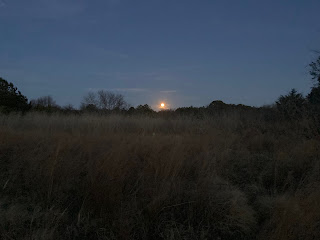
A nice flight of Robins and Blackbirds heading to roost and a distant calling Clapper Rail kept me occupied while waiting for my target birds to wake up.  Then at 6:06, 21 minutes after sunset, I heard the twittering flight call of a Woodcock in the distance (statebird #4).  The rule of thumb is accurate once again.  As I drove out I passed through more good habitat along Fitchett’s Road and heard 2 birds “peenting”, and saw 3 others in the waning light.  As I left the refuge I got this shot of the moon rising over one of the Woodcock’s fields.

VA was my 29th eastern state with Woodcocks, but I still need them in a number of states mostly near the western edge of their range.


That gave me 4 of 7 targets on the day – not great, but I’ll take it.

February 17 – Seawatch and Drive Home

My only planned stop of the day was an extended seawatch at Little Island Park.  The key attraction here was a long fishing pier from which numerous reports had been posted on eBird.  Unlike some other fishing piers that open later in the morning (like Jennette’s Pier in Nags Head, NC that opens at 9), the pier at Little Island is not gated so you can access the pier at dawn.  It’s often the case that seabird movement is best in the early morning, and that was typically the situation at Little Island with best numbers often from seawatches starting at sunrise.  So my plan was to start at sunrise and stay at least a couple hours before making the long drive home.

I arrived at 6:45 to this spectacular sunrise.

And after pausing to take in the view, bird activity quickly started to pickup around me.  Soon the sky was full of Gannets flying south.  Many were right overhead and some were calling – I’ve never heard Gannets call except at a breeding colony in Newfoundland.  And although there were some diving birds, most were just heading south.  The flight continued until 7:05, and over those 20 minutes I estimated 10 birds were passing by every second for an astounding total of 12,000 Gannets!  Here’s a typical picture of that amazing flight.

The rest of the time during my seawatch there were hundreds if not thousands in view, but they seemed to be milling about rather than heading south.

But Gannets weren’t the only birds heading south.  There was a steady stream of other species heading south, dominated by Red-throated Loons, Red-breasted Mergansers, Cormorants, and Black Scoters.  At one point I spotted a pair of birds flying together – the lead bird was obviously a Red-throated Loon.  But the second bird was about a third smaller, and although roughly the same shape it had a more arched body, a faster fluttering wingbeat, and white patches in the secondaries – I had a Red-necked Grebe (statebird #5).  I was able to watch this pair for 10-15 seconds as they passed by to the south.  VA was the 5th state where I’ve seen this species as a rarity south of its normal wintering range.

Then there was the alcid show.  Although most of the seabirds were flying southbound, I started to notice singles or pairs of birds heading north.  These northbound birds invariably turned out to be Razorbills, some flying quite close to shore.  And then while watching one Razorbill heading north, a much smaller alcid passed through my scope field heading south.  I had a Dovekie, looking like a football with no extended head and neck, and a whirr of wings (statebird #6).  Soon thereafter a second Dovekie passed by – luckily these birds were rather close providing good extended scope views.  I had 2 other likely Dovekies that flew by farther out.  Although the range maps show Dovekie wintering as far south as North Carolina, they aren’t often seen from shore.

After about 2 hours the activity had slowed and I still needed to make the long drive home.  So I decided to call it quits with these very rough estimates –

Black Scoter – 100

Red-breasted Merganser – 135

Red-necked Grebe - 1

Dovekie – 2

Razorbill – 31 (exact count)

Red-throated Loon – 175

Gannet – 12,000

Double-crested Cormorant – 110

Truly a spectacular seawatch!

But the trip wasn’t over quite yet.  My route home included a couple hours of driving time through agricultural fields in southeastern VA – more Turkey habitat.  But I wasn’t too hopeful given my track record.  And as I neared the NC line I had pretty much given up.  But this time the “birding gods” were looking out for me.  Just 20 minutes before crossing back into NC, while driving on US 58 in Brodnax, I spotted a group of 8 Turkeys in an adjacent field.  And 10 minutes later I spotted another small flock (statebird #7).  Until then my daily VA Needs Alerts would include a dozen or more Turkey sightings scattered across the state – probably the most common species I still needed in VA.  Thankfully my Needs Alerts will no longer be dominated by Turkey sightings.  I only need Turkey in 6 more states plus DC.

A perfect ending to an excellent trip!  With 7 new birds that brings my VA list to 267.  The link to the eBird Trip report for this VA portion of my coastal trip is inserted below –

https://ebird.org/tripreport/39066

Can’t wait to go back to the VA coast again, likely next winter.  Or earlier if there are some nice rarities to chase.

Saturday, September 3, 2016

Iowa Statebirding Trip, Part 1 of 2 – North-Central IA, July 2016


I don’t get to the upper Midwest very often, so when a business trip to Minneapolis came up in July I naturally started to think about statebirding possibilities.  My MN list was at 226, which was 8 over the old ABA reportable threshold of 218.  One of my original statebirding goals was to be over the ABA threshold in each state.  Those thresholds, last published by the ABA in 2011, were one half of the total list for each state.  And since the overall state lists slowly inch up as new species are added, the thresholds slowly rise as well.  As a result of this slow rise in the state thresholds, I revised my goal to be 15 over the old 2011 ABA threshold in each state – I call it “Reportable Plus 15”.  Although somewhat arbitrary, my hope is that by reaching that goal I would stay above the state threshold for many years to come. 

Now it was time to do some research.  I set up an eBird Needs Alert for MN which revealed that there were quite a number of possible new statebirds within a couple hours’ drive of Minneapolis.  But then I realized that a few of these potential targets southeast of Minneapolis were actually not too far from IA.  I’ve only birded in IA twice before, and with a statelist of just 178, my statebirding potential was of course even greater there than in MN.  Now I started to consider coming into Minneapolis a couple days early to be able to bird in IA as well as MN.  Like I said – I don’t get to this part of the country often so I may as well take advantage of these trips when I get them.

I did a quick search through the range maps in the field guides and made a long list of possible IA statebirds by season.  Not surprisingly I had gaps throughout my list that could potentially be filled on a summer trip.  However, July is frequently thought of as a slow month for birding - landbird targets can be tough to find since it is late in the season for breeders to still be singing, and it is early for most shorebirds that might be passing through.  Then again the optimist might find this as a great time – breeding birds are still around plus the early shorebirds are just arriving – a nice confluence of both breeding and migration seasons.  Ever the optimist, especially when it comes to statebirding, I was hopeful that I could find quite a number of new birds for my IA list, as well as for my MN list.

My first IA eBird research focused on the northern tier of IA counties to minimize driving time.  And one of the first sightings I keyed in on was of a Red-necked Grebe just south of the MN-IA line at Silver Lake WMA.  The range maps in the field guides show that species as a rarity in IA at any time of the year, and certainly not a breeder that far south, so I started to dig a little more.  That’s when I also found recent eBird reports of multiple Red-necked Grebes to the west at Trumbull Lake.  And when I opened those checklists I saw that Western Grebes were being seen there as well, along with Eared Grebes (though I already had that one on my IA list) – and all were breeding at the lake!  Then I noticed nearby reports of a great shorebird spot with a lot of diversity especially for this early in the year.  And another spot had several of my target grassland sparrows.  Then the icing on the cake was a report of a King Rail nearby.  All told that gave me 24 possible targets reported from this prairie pothole country in Clay, Palo Alto, and Dickinson Counties.  Although this was farther west than I was originally planning to travel, needless to say I now needed to include this area in the IA portion of my itinerary.  And my chances of finding these birds picked up significantly when I was able to contact a couple of the local birders in the area who offered to take me around to help me find my targets.

I also needed a number of landbirds for my IA list, and some were reasonably common breeders throughout the state, such as Ruby-throated Hummingbird, Wood Thrush, and Ovenbird.  Although these might be possible in the area where I hoped to find all those grebes and shorebirds, that area is more known for its prairie and farming than for its woodlands.  In addition I needed a few landbird breeders that are limited to the eastern part of the state, including a number of warbler species.  So I wondered if I could also do some woodland birding in the eastern edge of the state on this trip.  It would make for a long drive across IA, but it would put me nearly directly south of several of my southeastern MN targets, resulting in a nice loop through MN, IA, and back into MN.  Then again, it was late July and I continued to worry that my target breeders might prove too difficult to find.

The alternative to the eastern IA woodland sites was to head to southcentral IA including Hawkeye WMA where excellent numbers of shorebirds had been recently reported, including several rarities like Avocet, Piping Plover, and Marbled Godwit.  I could also do some landbirding in the area and potentially pick up some of my more southern landbird targets.  But on the day before my trip there was a post from the area that mentioned water levels were way up and shorebird numbers were much lower, with Avocets being the only rarity that remained.  I sure hated to pass up the opportunity for good shorebirds, but it seemed like my timing wasn’t the best, and decided on the eastern IA woodland stops instead.

After digesting all that research I came up with this itinerary making a large loop down to IA and back –
  • Day 1 – land in Minneapolis midday, bird in MN toward the southwest in the afternoon and evening
  • Day 2 – bird in north-central IA for prairie birds, drive to the eastern end of the state that evening
  • Day 3 – start in northeastern IA for woodland birds, then try for targets in southeastern MN on the way back toward Minneapolis
With that itinerary I expected to get 19 new species for my IA list.  Though I sure hoped to be able to stretch that total a bit to 22 to get my statelist to 200.

And then while on the plane to MSP I realized that my planned stops in eastern IA would put me just across the Mississippi River from WI.  I’m 14 over threshold in WI, so just 1 bird shy of that magical Reportable Plus 15 goal.  With some quick eBird research I found Wyalusing State Park right across the river from one of my IA stops had recent reports of no less than 8 possible WI statebirds.  Though with a very full itinerary, I didn’t think I would actually be able to squeeze in a stop at the park.  At the very least it was something to keep in the back of my mind as the trip unfolded…

This post details the northcentral IA portion of my trip.  The previous post detailed the MN part of the trip and my next post will summarize the eastern IA and WI portion of the trip.

Day 1 – Southern MN, and a Little Time in IA

I made multiple stops in MN adding 5 birds to my statelist as I worked my way south.  And although I didn’t leave my last MN stop until 7:30 PM, and still had an hour to go to get to my hotel in IA, my statebirding wasn’t over yet for the day.  One of the species I needed for my IA list was Common Nighthawk.  And since I was arriving so late into IA I was going to be passing through several towns at dusk when Nighthawk might be a possibility.  Sure enough the first larger IA town I came into was Estherville and I quickly spotted 3 Nighthawks flying through the downtown area (IA statebird #1).  Plus I had several a few minutes later in Emmetsburg.  I’ve now seen this species in 45 states (see my statebird map below).


With this bird disappearing as a nester back home in New England, sure nice to see this species is still a common breeder in this part of the country.  And a nice start to the IA portion of my trip.

Day 2 – Northwestern IA

My plan was to bird through mid-afternoon in Clay, Palo Alto, and Dickinson Counties where so many targets birds had been recently reported, including several that are rarities for IA.  Local birders Lee Schoenewe and Joe Jungers had offered to bird with me that day.  And since they knew the area so well, I was very optimistic about my chances for finding many of these birds. 

We met just after 7 at Lost Island Prairie Wetland Nature Center.  I say “just after” 7 because although I arrived before 7 I went to the wrong part of the park to wait for Lee and Joe.  As a result I wasn’t with them a short distance away when they had a calling Black-billed Cuckoo as they waited for me.  By the time I figured out the correct spot to meet, the Cuckoo has stopped calling.  Ugh.  But things would pick up I’m sure. 

Our first stop was at a small marsh in Dewey’s Pasture WMA on 350th Avenue north of Ruthven where Lee and Joe had found King Rail just a couple weeks before.  As we arrived we were greeted by a Black Tern flying low over the marsh (IA #2).  Although this species is seen across the country, I still need it in a few Midwest and northwest states.


Then we had several Virginia Rails quickly respond to a bit of tape (IA #3).  But the key target here was their larger cousin, so we positioned ourselves along the edge of the marsh and Lee played some King Rail calls.  While we waited the first of many Marsh Wrens came to the edge of the marsh (IA #4).  Joe got several shots of these most cooperative birds, including this bird right in front of us.


And while we were watching the Wrens a Clay-colored Sparrow called from the dry hillside to the north (IA #5).  But despite playing tape from several locations we couldn’t get the King Rail to reply. 

Next we were on to Trumbull Lake where breeding had been documented for 4 species of Grebes and Forster’s Terns this summer.  Apparently local authorities had recently done a lot of work to rejuvenate the wetlands, and the new conditions were most attractive to these and other more common nesters like my other targets the Common Gallinule and both Bitterns.  One minor challenge was that viewing was getting more challenging of late as the cattails rimming the lake had gotten taller, so we might need a bit of luck to help us see birds out on the water. 

As we drove along we passed through several wetlands, though we only made a couple brief stops so we could concentrate on Trumbull Lake up ahead.  But one stop was most fruitful – we flushed an American Bittern right next to the road (IA #6).  At our first lake stop on the east side of the lake we set up our scopes on a bit of a high spot to peer over the cattails.  I quickly picked up a rare Eared Grebe (an eBird rarity) and several Pied-billed Grebes along with several Ruddy Ducks.  Then Lee got me on a pair of Red-necked Grebes (IA #7).  IA is only my 4th state where I’ve seen this species as a breeding bird (along with ID, ND, and MN).


We couldn’t come up with any of our other targets here so we headed to another overlook a bit to the north.  Here we had a broader view of the lake, though again the tall cattails blocked our view of the near shore.  Lee picked out a couple Western Grebes mostly obscured by the vegetation.  I wasn’t tall enough to see them, though I heard them calling.  Luckily we all had views of this target a couple minutes later (IA #8).  I’ve now seen Western Grebe throughout most of its western range along with a few eastern and 1 Midwest state as a rarity.


Another target we searched for here was Forster’s Tern which nested at the lake and had been quite easy to see in Joe’s and Lee’s recent trips to Trumbull Lake.  We found numerous Black Terns dancing over the lake at these first stops, but no Forster’s.  Then Joe picked out a juvenile Forster’s flying among the Blacks in the distance.  Unfortunately I didn’t pick it out.  But we weren’t worried because our next stop was at the north end of the lake where they had been easiest to see in the past.  But again we came up empty – sure wish I had spent more effort to find Joe’s bird.  Though we did pick up a cooperative Willow Flycatcher (IA #9) driving to one of our overlooks.  And then our last stop on the lake was at a portion of the marsh where Common Gallinules were regular that summer.  We went to “the” spot for them, played some tape, and one called back right away (IA #10).  Another example where I wouldn’t have found one of my targets without the local birders’ help. 

One of our other targets that had been regular at Trumbull Lake earlier in the summer, but had eluded us so far, was Least Bittern.  We made stops at lots of great cattail habitat where they had been heard regularly that summer but couldn’t scare one up.  So we headed to Dan Green Slough, and specifically the boat ramp near the southern end of the lake.  This spot too had lots of cattails, but most importantly had numerous openings in the vegetation where we might spot a Bittern.  We played some tape, but to no avail.  Then just as we were leaving the boat ramp a Least Bittern took off from one of the edges just a short distance away (IA #11).  It must have been there the whole time.  Although I’m slowly filling in my statebird map for this species, I still have quite a number of gaps – especially in the southeast.


We left the wetland habitats very happy to have spotted all but 2 of our targets, though we were all surprised that we hadn’t found a cooperative Forster’s Tern.

Next we were on to a couple sheetwater pools northwest of Spencer.  These flooded fields had attracted some nice rarities recently, though there had been no recent reports from this spot.  Before we even got out of the car we could see quite a number of peeps moving about along with a few larger shorebirds.  With several scans we picked out good numbers of Pectoral and Semi Sands, and smaller numbers of Yellowlegs, but none of the rarer species jumped out at us.  But then slowly we started to pick out some of my targets.  First we spotted a Semipalmated Plover (IA #12).  Then we added a Short-billed Dowitcher to the list (IA #13).  And a nearly breeding plumage Stilt Sandpiper was nice, though not a new statebird for me. 

We then drove over to the other pool just a couple hundred yards away.  One of the first birds I spotted was a basic-plumaged Western Sandpiper (IA #14).  While we were scanning the birds here a couple different shorebird flocks dropped in both to this second pool as well as the first one.  So we headed back over to the first pool and added another half dozen Short-billed Dowitchers, a second Semi Plover, and several more Stilt Sands, but nothing new.  Although diversity was lower than a couple weeks earlier, we still were able to spot 12 shorebird species at the pools.

Our next stops were at some natural prairie and planted pasture fields nearby to try for Upland Sandpiper.  They had nested in these fields this year, and had been reasonably reliable earlier in the season.  But in late July I wasn’t too optimistic – even if they were still around they would likely not be calling, and grasses would be quite high by now.  So it could be a needle-in-a-haystack kind of proposition.  We slowly drove down the road passing along the edge of a very nice prairie habitat, but couldn’t spot an Uppie.  Then we got to the field planted in pasture grasses and saw that about half the field had just been cut.  I wondered if the cut grass might attract Uplands since their food might be easier to find.  Not to mention the birds would be easier to see in the short grass.  And sure enough, a short distance down the road there was an Upland Sandpiper standing in the field near the road (IA #15).  Joe got this great shot right from the car.


Then it was on to an adjacent natural field of prairie grasses where Henslow’s Sparrows had nested earlier in the year.  It was now late morning, and of course late summer – not the best timing to hear singing passerines, so again I wasn’t overly optimistic.  We pulled over and listened – I was pleasantly surprised to hear quite a bit of song – there were a number of Sedge Wrens and Grasshopper Sparrows along with a single Clay-colored Sparrow, and of course the ever-present Dickcissels.  But no Henslow’s.  We pulled up a bit farther and listened again but heard pretty much the same mix of birds.  Then I played some Henslow’s tape and we listened some more.  Again no luck.  Just as we were about to pull away I heard a single “tslick” of a Henslow’s Sparrow (IA #16).  I still have a long way to go to find this species in the states in its range throughout much of the eastern US.


Next Lee took us to a small sod farm just a couple miles away to check for early Buff-breasted Sandpipers.  There had been no reports from this spot so far this year so this location wasn’t on my radar screen.  But within seconds of pulling up Lee spotted 3 Buff-breasteds close to the road that joined 2 others farther back on the sod (IA #17). 

I still needed Vesper Sparrow for my list so Lee next took us to a dirt road that dead-ended at the Spencer Municipal Airport where he said he almost always has Vespers.  We drove slowly down to the end but only picked out a few Dickcissels.  We then turned around and headed back down the road and flushed a sparrow off the ground that had white outer tail feathers – a successful side-trip for a Vesper Sparrow (IA #18).

We then headed back to Lee’s house for a lunch break.  Plus Lee had hummingbirds coming to his feeder – another of my targets.  That’s one I had hoped for the next day in woodlands in the eastern part of the state.  But getting it today would take the pressure off having to randomly run into a bird tomorrow.  We had not been back at his house for more than 5 minutes when a Ruby-throated Hummingbird came in to drink at his feeder (IA #19).  Another of Lee’s stakeouts came through for us.  IA fills one of the last gaps in my statebird map for this species.


After a quick lunch we were off again, this time to Freda Haffner Kettlehole State Preserve near the MN border which has been a traditional spot for Blue Grosbeak.  Along the way I got a quick view of a Yellow-billed Cuckoo as it flew right in front of the car – not the best views but good enough for my 20th IA statebird on the trip.  As we approached the preserve we came upon a small flock of Lark Sparrows in the road as if to welcome us to this new habitat.  When we got out of the car we were serenaded by a nice mix of Grasshopper, Clay-colored, and Field Sparrows, and Dickcissels, but no Grosbeaks.  We had waited a couple minutes when we all spotted a chunky finch-like bird fly over the road and into a nearby brushy tree.  A bit later the bird popped into the open and it was a female Blue Grosbeak (IA #21).  And just a minute later we heard one singing – a male had flown in as well and was singing from the powerlines overhead.  I now have only a couple gaps in my statebird map to fill in for this species that stretches across the southern and central states.


That was the last of my target birds, and as we walked back to the car I quickly reviewed my notes and realized that my IA state list now stood at 199.  I shared that detail with Lee and Joe and none of us wanted to call it a day one short of 200.  Lee mentioned that we might still have a chance at finding Forster’s Tern if we added some stops around Spirit Lake.  So we started with a couple stops overlooking the lake from the west side but with no luck.  Then we made a stop on the north end of the lake right at the MN/IA line but only found some roosting gulls.  Now we were on the east side of Spirit Lake and Lee navigated us to one last spot where he had seen Forster’s in the past.  We got out of the car and scanned a distant shoreline and at first only spotted a flock of gulls.  Then I noticed what appeared to be a smaller roosting bird worthy of a scope view.  A few seconds later we confirmed an adult Forster’s Tern (IA #22).  With that target bird under my belt IA became my 48th state with at least 200 species (I’m under 200 only in MT and HI – and also Washington, DC).

That ended a remarkable day where we found all but 1 of my staked out target birds.  Needless to say I couldn’t have done it without the help of Lee Schoenewe and Joe Jungers.  Great birders who know the birds of their area like the backs of their hands.  As we parted ways I mentioned that I hoped to bird with them again someday, perhaps on a return trip in spring some year to work on passerine migrants in western IA.

My next post summarizes my statebirding stops in eastern IA, and a brief stop in WI.