Showing posts with label Purple Finch. Show all posts

Saturday, November 21, 2020

Northern Finch Invasion Yields Rare Evening Grosbeaks, Yard Bird, Hendersonville, NC, November 8, 2020

Each year a forecast of the potential for winter finch irruptions is published by the Finch Research Network.  Although these forecasts are especially focused on Ontario and adjacent states and Canadian provinces, often they can suggest movements in more southern states.  That was definitely the case with the “Winter Finch Forecast 2020-2021” which can be found here - https://finchnetwork.org/winter-finch-forecast-2020.  That forecast certainly caught many birders’ attending with this first sentence– “It looks to be a flight year for several species in the East.”  That would actually turn out to be quite an understatement, particularly for birders here in the Carolinas.  Here are key quotes from that report for several species forecasted to irrupt this winter –

Purple Finch - The worst kept secret, most Purple Finches will migrate south out of Eastern Canada this winter. 

Red Crossbill - Red Crossbills are currently fairly widespread in Central Ontario to southern Maritimes and northeastern states mainly feeding in areas of heavy white pine crop. Red Crossbills should shift southward some as the white pine crop is depleted. 

Redpolls - If the redpolls move on from the Swamp Birch crop, expect a moderate to good flight south out of the boreal forest. 

Pine Siskins - The smaller numbers remaining in the eastern boreal forest should move southward looking for food. 

Evening Grosbeak - Expect flights into southern Ontario, southern Quebec, Maritime Provinces, New York and New England States, with some finches going farther south into the United States. 

Red-breasted Nuthatch - With cone crops in the eastern boreal forest mostly poor, expect this species to continue to move southward. 

The first notable local examples of movements of “winter” finches came while we were actually still in summer – good numbers of Red Crossbills were found feeding on an abundant white pine crop at lower elevations in western NC.  Although not unprecedented, this certainly was outside their more expected spruce/fir forest locations along the highest ridges.  With these movements I was lucky enough to add Red Crossbill to my SC list on 6/30/20 with birds just across the NC stateline, and to my Henderson County NC list on 8/20.  Later I had a rare Red Crossbill farther to the east in Polk County on 11/7/20.  And good numbers of Red-breasted Nuthatches were evident in these same areas, resulting in another addition to my SC list on 9/6/20, as well as a first for my yard list on 9/14/20.  I have no pines near my yard making Red Nuthatches most unexpected.

The next big irrupter was Pine Siskin.  My first Siskin this fall was also a first for my yard on 10/6/20.  And what started as just a couple single flyovers soon expanded to small flocks, and then to even bigger flocks both as flyovers and at my feeders.  I estimated my biggest feeder flock at 50, with total flyovers in a single morning as high as 200.  I took advantage of this irruption to add Siskin to my SC list on 10/20.  However, as of mid-November I’ve been seeing smaller Siskin numbers – perhaps the greatest number of birds has already passed on through the area. 

Then there are the Purple Finches.  My first birds in the yard this fall were on 10/14, and although numbers never got as high as those for the Siskins, a flock of up to 6 continue at my feeder as of mid-November, with numbers of flyovers increasing to the low double digits.  My first PUFIs this “winter” in SC were on 10/20.

That takes us to what is perhaps the ultimate winter finch – Evening Grosbeak.  I grew up in Maryland, developing my birding skills there in the 70’s and 80’s.  During that time Evening Grosbeaks were a regular occurrence many winters, especially at feeding stations.  I remember large flocks descending on my feeders, devouring the sunflower seeds and requiring re-stocking multiple times each day.

However, their eastern populations have plummeted since that time.  Here is a paragraph I wrote for my blog in December 2018 when I was looking for Evening Grosbeaks in New England –

But now 30 or 40 years later, Evening Grosbeak dynamics are a whole different story in the East.  Here in New England, lately they have become a rare occurrence in the northern part of the region, and virtually non-existent in the southern parts.  For instance, throughout most of the southern portion of New England, Evening Grosbeak is now considered to be a rarity in eBird requiring details.  I used to see them as a breeder most every summer at Pawtuckaway State Park in southern NH.  But their numbers have dwindled there over the years, with the last eBird record coming in 2015.  Since moving to New England in 1993, I’ve not seen this species in CT or RI. 

The 2018-2019 Winter Finch Forecast for Evening Grosbeak ominously included this comment –

In April 2016 the Committee on the Status of Endangered Wildlife in Canada (COSEWIC) listed the Evening Grosbeak a species of Special Concern due to strong population declines occurring mainly in central and eastern Canada.

In fact, some Canadian researchers recommended that the eastern populations be listed as endangered.

With their numbers plummeting in the northeast, one can only imagine how rare they have become farther south.  Here is a summary of this species’ distribution from “Birds of North Carolina: their Distribution and Abundance” -

In the latter part of the 1960's and the 1970's, the species made near-regular appearances every other winter, in good numbers, and even in off years, a few were reported. However, the species has undergone a major population decline in recent decades, and there have been relatively few North Carolina reports in the past decade. Many "new" birders have yet to see the species in the state, and it has often been missed by birders conducting Big Years in the state. Fortunately, the winter of 2012-13 produced a mild invasion into the East, with scattered reports again being made in the state. 

Soon after the publication of the 2020-2021 Winter Finch Forecast came a couple southern reports of Evening Grosbeaks – one in TN on 10/26, and another most surprisingly in the FL panhandle on 10/3.  Could these be harbingers of what was to come?  More and more records were soon reported in the Northeast and the Mid-Atlantic.  And then came the first NC report - in Gates County in eastern NC on 11/1.  That was just the beginning…

Then on November 4th came a text from Kevin Burke on the Blue Ridge Birders text group that he had an Evening Grosbeak at feeders in his neighborhood.  Unfortunately, the bird moved on 10 minutes before my arrival in Kevin’s neighborhood.  I spent the next couple hours unsuccessfully waiting for it to return.  Plus a search for a couple hours early the next morning were fruitless.  Then on the 5th came another report of a flyover flock at Beaver Lake. 

So small numbers were definitely passing through the area.  Now I just needed to be lucky enough to be in the right place at the right time.  My strategy was to spend as much time as possible in good habitat and cross my fingers that I would get lucky.  I birded the Mt. Pisgah area along the Blue Ridge Parkway on the morning of 11/6, finding 3 Ruffed Grouse and fair numbers of migrating Siskins and Purple Finches.  But no Grosbeaks, and surprisingly no Red-breasted Nuthatches as well.  Then on the 7th I spent the morning at the Green River Game Lands in Polk County finding a rare Red Crossbill (only the 3rd for the county per eBird), plus a few PUFIs and Siskins.  But again no Grosbeaks.

My plan for the morning of the 8th was to do a “Big Sit” in my yard.  The morning started as most recent days have been with a few flyover Siskins and Purple Finches.  Then at about 7:30 I finally got my target – I heard 2 different Evening Grosbeaks giving their diagnostic “jeer” calls north of my yard.  Both birds continued to call as they flew closer with one moving east of the yard and the other to the west.  I thought they had continued on south until I heard the western bird call one more time a couple minutes later from the tree canopy nearby.  I was hoping that it might come to the feeders but it was not to be.  They were heard-only birds, but certainly good enough for a species whose call I’m very familiar with.  And just for good measure, I had another flyover Grosbeak on 11/20.

Here is the eBird map of recent Evening Grosbeak sightings in the east as of 11/17 – from the sightings in the Mid-Atlantic and Ohio Valley, to that one sighting down in the FL panhandle.  And of course including my sighting on 11/8.  Quite an irruption!

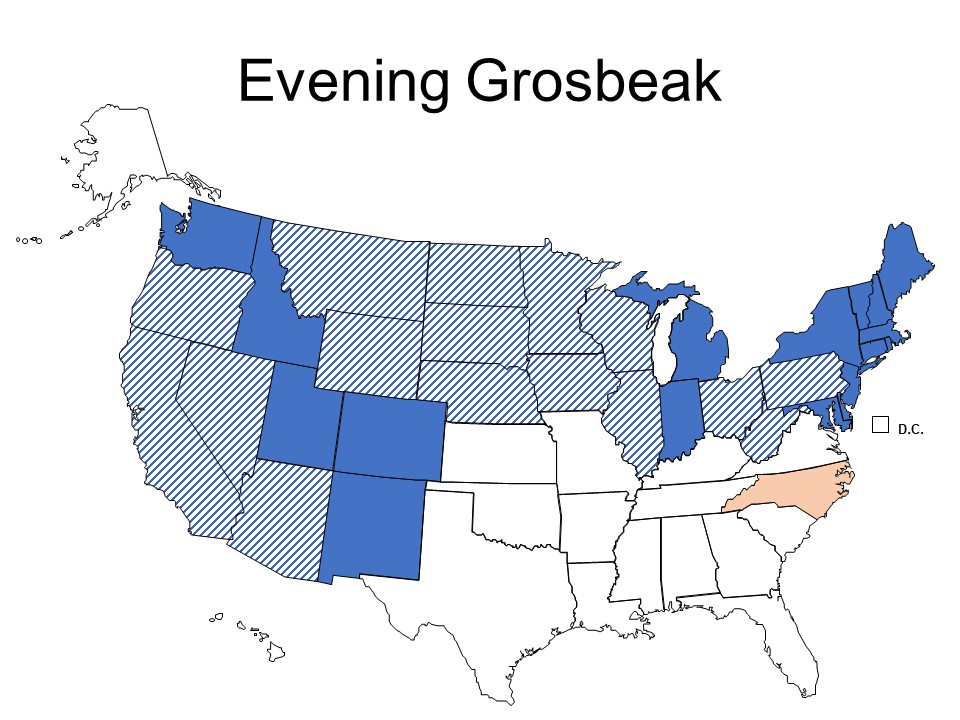
Evening Grosbeak was yard bird #137, and NC statebird #308.  My statebird map for Evening Grosbeak is provided below – the blue-shaded states are those where I’ve seen this species; the cross-hatched states are those where it is regular but I haven’t yet seen it.  Or at least in the East, those are states where Evening Grosbeak used to be regular.  Alas…  And now NC is the single tan-shaded state where I’ve seen this species as a rarity.


Could Redpolls be the next irrupter to be found in the Carolinas this winter?  As of early November, the southernmost reports were from MD.  But then came 2 NC reports - one on 11/13 in Granville County and one on 11/20 not too far away in Avery County.  It’s certainly one to keep your eyes and ears open for. 

Friday, December 27, 2019

Purple Finch and Fox Sparrow, Spartanburg, SC December 6, 2019

Saturday December 6th was a day for Michael Robertson to introduce me to some of his preferred birding sites in Spartanburg.  It was my first trip to the area, so everything was new for me.  Our first stop was Croft State Park which is a former army training base, including 7,000 acres of excellent woodland habitat.  And imbedded in those rolling hills are two large manmade lakes – Lake Johnson and Lake Craig, which were our 2 key hotspots in the park.

First we headed to Lake Johnson, with our initial stop being at one arm of the lake.  We had a few Canadas, Mallards, and Bufflehead on the lake, and many of the regular expected landbirds – a nice stop but nothing unusual.  Next we headed a bit farther down the road to a picnic area on the Lake.  As soon as we got out of the car we heard the soft “pik” calls of at least one Purple Finch flying by.  There have been almost no reports of Purple Finches in the area this winter so we were very happy to have heard one. 

My statebird map for Purple Finch is inserted below – solid shaded states are those where I’ve seen this species; cross-hatched states are those where it is regular but I haven’t yet seen it.  I just need it in a few more states as a migrant or wintering bird.


Later we headed to Lake Craig and found where we found a flock of 10 Red-breasted Mergansers.  A rarity for the SC Upstate, but not new for my SC statelist.

Next we were on to local hotspot Cottonwood Trail.  Although located in a suburban portion of Spartanburg, this trail has some excellent riparian and woodland habitat.  And then later the trail took us to a nice wetland – more excellent habitat.  At one point I heard a brief portion of a song that sounded like a Fox Sparrow.  But since I still needed this one for my SC list I didn’t want to jump to any conclusions based on just a partial song.  But then later I heard the song again – and both of us independently thought it was indeed a Fox Sparrow.  A bit further down the trail we heard it giving its sharp call notes, and then finally we got a visual of the target as it perched in the underbrush.  I still need this wide-ranging species in a number of states across the country.


Nice to check off a couple more SC target species, albeit ones that typically quite regular.  That gives me 252 on my statelist.  And thanks to Michael for showing me these locations.

Friday, February 24, 2017

8 Statebirds in Southwestern Louisiana, Including Some Nice Rarities – February 2017


Back in January I took a successful 1-day statebirding trip to southwestern LA, adding 6 new birds to my list (summarized in an earlier blog post).  While doing research for that trip I noticed quite a number of reliable rarities and other more common targets being seen in the southeastern part of the state.  Certainly too far away to try for during my brief January trip.  But when a rare business trip to New Orleans and Baton Rouge came up in February I was already excited about those possibilities before even starting on my local research.


Of course my first step was to set up a Needs Alert, focusing my attention not only on Baton Rouge and New Orleans but also on the north side of Lake Ponchartrain.  Several apparently reliable rarities stood out like 2 Western and 1 Couch’s Kingbirds at Fontainebleau State Park, and several Ash-throated Flycatchers and older sightings of a Brown-crested Flycatcher at Bayou Sauvage NWR.  There were also numerous reports of Purple Finches and Woodcocks throughout the area, though I couldn’t find what seemed to be reliable sites for these targets.  And then there were the ever-present, but difficult to spot, Brown Boobies at the Lake Ponchartrain causeway.  On the waterfowl front, I needed Redhead and Common Goldeneye, but the few sightings in the area were now pretty old.

Then there are the hummingbirds.  LA is well-known for its nice collection of western hummingbirds that winter at feeding stations.  Although I already had 6 hummingbird species on my LA state list, the eBird report included 2 more that I needed – Calliope at 4 locations, and 1 banded Allen’s.  Another good resource for information on LA’s wintering hummingbirds is HUMNET which provides a detailed compilation of species by parish.  Although these sources provided general locations for the birds, I still needed specific addresses, and most importantly invitations from the homeowners to be able to bird at these feeders.  I reached out to Erik Johnson who compiles HUMNET to see if he could assist in my searches.  Erik was able to get me access to 3 of the feeders with Calliopes, and connected me with the birder that had the Allen’s.  Unfortunately I found out that the Allen’s had moved on, so that one was off my target list.  Erik also gave me tips for a site for Redheads, and a spot for both Woodcocks and Henslow’s Sparrows.  The Henslow’s hadn’t even been on my radar screen so that was a nice additional target.  But the observations Erik mentioned were from Christmas Counts, so they were now getting quite old.

Next I reached out to my LA birding friend Marty Guidry.  Although he couldn’t bird with me on this trip, he had tips for a couple spots around Baton Rouge, including a feeding station with both Calliope Hummingbird and Purple Finch.  And if I struck out on the Finch there, Marty had them at his feeder.  Marty also checked on an older Goldeneye sighting in the area, and confirmed that that bird had moved on, saving me time to do a search for the bird.

Chasing after these targets efficiently would be important on this trip, because as usual I had limited time and lots of potential birds to chase after.  I would be free a couple hours before work and after work on the first day of the trip.  And given how many targets I had, I decided to take the afternoon off on the second day.  My plan was to bird near Baton Rouge in the morning of Day 1 to try for the Calliope, Purple Finch and Redheads.  Then late in the day near Covington I would try for Woodcock, Henslow’s and Redheads again (if necessary).  Then in the afternoon of Day 2 I would try for the 4 flycatcher rarities at Fountainbleau SP and Bayou Sauvage NWR.  And depending on my earlier luck with Calliope I could either end the day with another Calliope try, or take a trip on the causeway for the Boobies.  That itinerary would give me 10 targets to try for. 

But there was one additional concern to be aware of – mid-February in LA isn’t exactly very winter-like.  For instance with 80 degree temperatures the week before I arrived, I had heard that the Purple Finches were now more likely to be feeding on tree buds rather than at feeders.  And the most recent flycatcher posts were all now at least 2 weeks old.  Plus of course Christmas Count reports were 45 days old.  So I worried that many of the “wintering” targets might have already started to head north (or west!).  So I tempered my enthusiasm and hoped for maybe 4 or 5 new statebirds for the trip.

Day 1 – Early AM

At dawn I was pulling into Donna Dittmann’s and Steve Cardiff’s property outside Baton Rouge.  Marty had told me that they had purchased the property years ago and had been managing it to for wildlife, and of course for birds, ever since.  Donna took me on a quick tour which featured dozens of hummingbird feeders scattered throughout their amazing “yard”.  She described how each hummingbird has a wintering territory, and pointed out which feeder was preferred by each of their hummingbirds.  Along the way we spotted a female Ruby-throat, a male Black-chinned, a couple Rufous, and the first of 3 Buff-bellieds.  Then we got to the preferred feeders of their female Calliope and soon heard the chip notes that Donna recognized as the Calliope.  A few second later there was the target hummingbird, looking downright tiny compared to the other species (LA statebird #1).  Not only was it nice to check that one off, but it also meant I would not have to spend time looking for it at other feeders the next day.  LA is my fifth state for Calliope outside its normal breeding and migration ranges.


We then headed back to the house to try for the Purple Finches.  Although they had been seen at the seed feeders the day before, they were becoming less regular as spring approached.  As I stood out on the deck the feeders had a pretty constant stream of visitors, including Cowbirds, Cardinals, House Finches, White-throated Sparrows, and a lone Red-breasted Nuthatch.  But no Purple Finches, nor Goldfinches with which they were frequently associating.  Then I heard a short warbling song coming from high above me in the trees overhead – a singing Purple Finch (LA statebird #2).  I heard it sing 2 more times, then the bird gave several of its “pik” notes, though I never saw it.  Good thing I know its song and call.  I just need this species in a couple more southeastern states in its wintering range.
 

I waited a bit longer to try to get a visual on the Finch but with no luck.  So with enough time for one more brief stop before work I thanked Donna and Steve and was back on the road.  The next stop was a speculative one for Redhead – the Denham Springs wastewater treatment plant where one lone report 3 weeks earlier featured 20 Redheads.  But a quick look from the road yielded only a small flock of Shovelers.  Unfortunately there was no access to the much more reliable spot for Redheads in the area - nearby LSU Aquaculture Research Station (which also featured an Ash-throated Flycatcher).  So striking out here left me with just 1 more iffy spot for Redheads I would try to visit that evening.

Day 1 - Evening

I got out of work right on time and soon was on my way east to the Lake Ramsay WMA.  After Erik’s tip for Henslow’s Sparrows there, I did some eBird research and found quite a number of posts with up to 21 Henslow’s reported, though there were no reports in the last 2 weeks.  I had pretty specific directions to search in one area of wet savannah, and even more specific suggestions to especially bird areas with scattered small brush rather than just open grasslands.  But it would be difficult to find these secretive birds on my own.  That is if they were still there in the first place.

With duck boots on I was ready to walk through the wet grasslands.  But on the first 100 yards of my walk the ground was actually pretty dry, so I wondered if the area was still wet enough to attract the Henslow’s.  Though calling Brown-headed Nuthatches were a nice consolation.  Then I finally reached some wetter areas, including remains of last year’s pitcher plants among the grasses.  But I was still in open savannah, so I headed to an area with some scattered bushes as recommended.  And as soon as I got to that patch I flushed a large dark sparrow.  It landed in the bush and just sat there – a most cooperative Henslow’s Sparrow (LA statebird #3).  I don’t know which was more beautiful – the greenish color to the face or the rusty patterned back and scapulars.  I can’t remember having better views of a Henslow’s.  My statebird map for Henslow’s is pretty spotty for this bird, where LA is only my third state in its wintering range (hmm – I need it in TX in winter…).


Later I would flush a second Henslow’s though this one wasn’t nearly as cooperative.  The next target here was Woodcock that Erik had as a flyby at dawn on the Christmas Count.  I figured a flyby at dusk was just as likely.  And now that it was later in the year perhaps they could be calling, assuming they all hadn’t headed north by now.  But it was still more than an hour before sunset, so I had some time to kill.  I then though about the spot Erik had mentioned where Redheads had been reported on a Christmas Count – a small man-made lake along Ochsner Blvd in Covington.  It was about 20 minutes away so I had just enough time for a short stop there before heading back to try for the Woodcocks at dusk.  But with no Redhead eBird reports from this spot at all, I wasn’t very optimistic.

I arrived at the lake on Ochsner Blvd and unfortunately found that it was fenced off.  As a result I could only find one limited viewing spot looking through the fence, and worse yet I was looking right into the setting sun.  I set up the scope and scanned the small portion of the lake without the sun glare, and only found a couple Pied-billed Grebes.  This was turning out to be a waste of time and I started to wonder why I didn’t just continue to bird the Lake Ramsey area.  Then I noticed some waterfowl in the sun glare.  I did my best to look at them in the scope and thought I was seeing red color on the heads of some of the birds, but couldn’t be sure.  Then a few birds swam to the left out of the brightest sun and they were indeed Redheads.  I eventually counted an amazing 46 birds (LA statebird #4).  Boy was I lucky – if they had stayed in the part of the lake in the sun glare I wouldn’t have noticed them.  I only need Redhead in 3 more states to completely fill in my statebird map for this species.


I made my way back to Lake Ramsay WMA and stayed till dark but had no luck either seeing or hearing Woodcocks.  On a whim I even tried some tape for Whip-poor-will and Chuck-will’s-widow while waiting in what seemed like good habitat for these wintering and/or migrant birds, but to no avail.  Though I did have numerous Sedge Wrens that serenaded me during my wait.

Day 2 – Afternoon

My first stop after work was the Fontainebleau SP where 2 Western Kingbirds and 1 Couch’s Kingbird had spent much of the winter.  After poring through all the eBird reports I was able to piece together some pretty specific information on their locations – most often seen near the group cabins and sometimes at the nearby individual cabins.  And although all 3 birds were often seen together, the Westerns seemed to be the easiest ones to find.  One last important tip was that they often responded to playback.  So although I was optimistic, the last report (positive or negative) was 2 weeks earlier.  In fact, recent posts on the listserve from the park focused on King Rails and not Kingbirds.

After arriving at the park I drove right to the cabins, and first took a slow walk around the entire area where the Kingbirds had been reported.  I decided to not play any tape at first, hoping to find them without playback.  It was a pretty birdy area with many Yellow-rumps flitting about, and I found a perched Shrike and a couple perched Mockingbirds, but no Kingbirds.  With no success on my first loop through the area I started to play tape – both of Couch’s and Western.  I had passed through almost all the area again but still had no luck.  Then at the edge of a clearing I spotted a larger bird fly up from the ground to perch in a tree what showed quite a bit of yellow.  My first thought was it was a Flicker “anting”, but when I put it in the binocs I realized it was one of the Kingbirds.  But which one?  It cooperatively perched nearby and showed a yellow (not gray) chest.  With a bit more time I could see the tail was rusty brown and not black, and lacked white outer tail feathers.  It was the Couch’s Kingbird .

Or was it?  Once I started to hear it call it didn’t sound anything like the taped calls I had been playing.  In fact the calls were more like a Western than a Couch’s.  Then I heard it sing and the song was nothing like the tape.  Then I looked down at my BirdTunes app and realized all along I had been playing Cassin’s Kingbird calls instead of Couch’s Kingbird.  When I started playing the calls of the correct Kingbird species the bird came right in to investigate.  And the song was a perfect match.  So I could finally count it as a Couch’s Kingbird and LA statebird #5 – only my second state for this species in addition to TX.

The bird was most cooperative, in view or calling for most of the rest of my 3 hour visit to the site.  I got this picture holding my phone up to my binocs.


Now I needed to find what had been the more reliable Western Kingbirds.  But despite 2 more hours of walking through the area, and playing the correct Kingbird calls, I never found them.  Although I wanted to stay longer, I still needed to bird Bayou Sauvage, so I headed out of the park assuming that the Westerns had moved on.  As I drove away I was disappointed to have missed the Westerns, but I was happy to have found the rarer of the 2 species.  [As I write this post, since my visit there the Couch’s has been reported again on eBird but not the Westerns, so likely the latter have indeed left their wintering site.] 

The key target birds at Bayou Sauvage NWR were up to 3 Ash-throated Flycatchers that had been seen in the area since November.  There had also been a Brown-crested Flycatcher at the refuge, also with sightings going back to November, but the last sighting of this bird was 45 days ago.  Then again, a more recent eBird post suggested that the observer may well have seen the Brown-crested associating with an Ash-throated.  In any case it was an additional bird to watch for.

The next step was to figure out the locations of the past sightings of these birds.  One might think that with all the many posts on eBird it would be easy to figure out microdirections for the locations of these birds.  But most sightings had few if any details as to location (remember eBird asks for ID details on rarities and not info on the locations of these birds).  In fact, many of the posts were associated with the general hotspot for the entire Bayou Sauvage NWR, which covers a very large area.  And some mentioned locations that might be obvious if you had birded the area before, but not specific enough to birders who were new to this spot (e.g., “across from the hog trap”).  I finally figured out that most sightings were along Recovery Road, but then couldn’t find this road on GoogleMaps.  Luckily it was shown on the pdf map of the refuge that I found online, so that was a start.  And several mentioned the southwest corner of the landfill, and some mentioned south of the railroad tracks.  These features also showed up on the refuge map – the tracks were about ½ mile south of US 90, and the landfill was another ½ mile south, all along Recovery Road.  I finally felt like I knew where to go.

After a drive around the eastern side of Lake Ponchartrain I arrived at the Bayou Sauvage NWR and parked at the north end of Recovery Road.  This turned out to be quite a “seedy” spot, with a number of present and former industrial activities in the area.  In fact, Recovery Road was a gated road with trash dumped on both sides.  And now my research was starting to make sense – what used to be Recovery Road dead-ended at what was likely a former industrial landfill built in the middle of a large wetlands.  Certainly not a spot anyone would want to live, but the kind of area that frequently provides some good birding habitat.  (We’ve all birded at spots like these…) 

I started my walk south along Recovery Road and started to get my bearings.  A canal ran along the west side of the road, likely the source of soil used to build up the land to make the road itself.  And in between the road and canal was a line of low trees and brush.  Most of the rest of the area was marsh and other wetlands.  The “woodlands” north of the railroad tracks was full of Yellow-rumps, and although I wanted to stop to check them out, all the flycatcher sightings had apparently been south of the tracks, so I kept going.  After waiting for a train to pass by, I crossed the tracks and started to bird the brushy habitat.  Again I ran into flocks of Yellow-rumps, and soon started to find a number of Phoebes, but couldn’t turn any of them into a Myiarchus of any species.

I continued walking slowly south, birding along the way, and soon reached what looked to be the landfill to the east.  (I also found the hog trap nearby.)  Although the road continued farther south, all the sightings seemed to be no farther south than the landfill, so I turned around here and slowly starting walking back to the north.  At this point I heard a series of single notes off to the east toward the landfill that I couldn’t place - sort of sounded like “preep”.  Although I wanted to turn it into one of my targets, they didn’t really match calls of either the Ash-throated or the Brown-crested.  In any case the bird soon stopped calling, so I continued my walk north.  Now I was playing tape of both species, but got no responses.  By the time I reached the tracks I had seen several Phoebes, but nothing new. 

I made this round-trip circuit 2 more times but still found none of my targets.  Though one more time I heard the “preep” calls coming from the landfill in the distance.  And after 2 hours of trying, I was starting to wonder if these birds had moved on, just like the Western Kingbirds at my earlier stop.  Afterall the most recent Ash-throated report was now 11 days old, so maybe I was too late. 

I was now on Recovery Road near the southwest corner of the landfill, and was about to give up.  But then on a whim I thought about trying at the actual southwest corner of the landfill, not on the road near that spot.  The landfill was only 50 yards to the east, but it was worth the try.  I walked up the berm to the edge of the landfill and played Ash-throated calls.  Instantly I started to hear the same “preep” calls I heard earlier.  And just then a flycatcher flew in – it was a Myiarchus.  My first gut feel was that it was a big bird – too big to be the diminutive Ash-throated.  And then the bill seemed too big.  I started to play Brown-crested calls and the bird became very agitated.  It continued to call, and although these calls weren’t a perfect match, they were certainly closer to Brown-crested than Ash-throated.  The bird occasionally came out into the open, and I tried to get phonescoped pictures of the bird, but with limited success.  At one point when the bird out of view I quickly checked my photos on my phone and looked at this photo that I initially thought was miserably out of focus. 


But then with a closer look I realized that I had gotten a good photograph of the underside of the tail – the tip is rufous red with only dark corners.  That confirms the ID as a Brown-crested.  I also was able to get this "video" of the bird calling.


That was my 6th LA statebird of the trip; LA is my 5th state for this typically southwestern species.


The bird then flew to the trees along the road, and slowly made its way north, calling almost non-stop.  After 15 minutes with the bird, I parted ways and started my walk back to the car.  I looked back and could hear the bird still calling in the distance – the same sounds I heard earlier from the landfill.  I smiled as I realized that I had actually been hearing this bird all along.  And just then I noticed a small Dove fly from the landfill over the road and out of site to the west.  It had red wing-linings making it a Ground or Inca Dove, and given the short tail, it had to be a Ground Dove.  Although I didn’t think much of it at first, I realized that I might need this one for LA.  Sure enough it was new for my LA statelist, my 7th of the trip, though not even on my radar screen as a possible target.  After the fact I checked eBird and noticed that there had been a few Ground Doves reported from the landfill area – one I had overlooked in my research.  LA is my 9th state for this species, and although a rare bird in LA, not nearly as rare as the one I recently saw in MA.


As I continued back north up Recovery Road toward my car I realized that, like my experience with the Kingbirds earlier, I had found the rarer of the two targets, but not the comparatively more common species.  A disappointment, but still nice to get the rarer one.  I was now nearing the railroad tracks and spotted a flycatcher up ahead perched near the road.  I initially took a cavalier attitude toward it, and assumed it was one of the many Phoebes I had spotted in that area.  But I put my binoculars on it and it was an Ash-throated Flycatcher (LA statebird #8).  I had been in this area several times over the last 3 hours without spotting it - wonder where it had been.  LA is a nice addition to my statebird map for this species, which includes 5 New England states where I’ve also seen it as a rarity.
 

Ash-throated was my 7th flycatcher species I had seen in 2 trips to LA this winter – Eastern Phoebe, Say’s Phoebe, Scissor-tailed, Vermillion, Couch’s Kingbird, Brown-crested, and Ash-throated.  That’s quite a nice collection of rarities more typically seen in the southwest.  And also a nice way to end my stop at Bayou Sauvage.  To think just 30 minutes earlier I was ready to leave the area without any of my targets.

With a little time to spare, and having checked off the Calliope Hummingbird the day before, I decided to make a try for the Brown Boobies on the Lake Ponchartrain causeway.  Booby sightings along the causeway go back to 2015, with up to 35 reported on eBird.  That all makes it sound like they would be easy to find.  But - these birds roost under the bridge, and principally only under one short stretch of the bridge.  So when looking for them by car, you have to hope that one or more happens to be flying by along the bridge close enough to ID while you’re driving by at 60+ mph.  And by the way, there is no stopping on the bridge either.  As a result, not surprisingly the 35 birds were reported from a boat.  I made 3 unsuccessful round-trip attempts for the Boobies last year, so I knew the drill.  Alas this one was no different.  Best I could find was a few Pelicans, Gulls, and Terns.  It’s frustrating to think that the Boobies are likely no more than 20 feet below you but invisible as you pass by overhead.  At least the toll is only $3.

Despite the Booby frustration I was very happy to have added 8 new birds to my LA statelist, 5 of which were rarities requiring documentation in eBird.  That brings my LA statelist to 270 – a nice respectable total for a northeasterner.

Friday, January 8, 2016

5 “State" Birds in Washington, D.C. and 2 More in VA, December 2015


On most of my recent trips to Baltimore to visit relatives I’ve done at least a little birding in Washington, DC, VA, and/or WV to try to fill gaps in those “state” lists.  Although I had exceeded the old ABA reportable threshold in all 3 some years back, my key goal was to be at least 15 over the threshold in each location.  I reached the “reportable plus 15” goal in WV in 2014, but I was still short by 2 in DC and 3 in VA.  So that meant I needed to focus my Baltimore-area birding on DC and VA on future trips.

With an upcoming trip to Baltimore in December 2015, I set up eBird Needs Alerts for both DC and VA to see what might be around.  I was surprised to see that recent reports included no less than 7 possible “state” birds in DC and another 5 possible state birds in northern VA.  And many had been seen multiple days so they might well be chaseable.  I also sent a note to local DC birder Paul Pisano and he was most helpful giving me some micro-directions on each of the DC targets.  But as the trip neared, the reports on all but 3 species stopped coming in, and even a few negative reports were posted.  I was now less optimistic, but still hoped for 2 new birds each in DC and VA.  Armed with the latest information I set up an itinerary starting with birding in 5 locations in DC, followed by birding at 3 locations in northern VA, which would give me a chance at all 12 recently, or at least somewhat recently, reported target birds.

I started my trip at the Kenilworth Aquatic Gardens in the northeast corner of DC, arriving there about 20 minutes before dawn.  The prime targets here were an American Bittern, Purple Finches, and Ravens.  Although all had been reported regularly a week earlier, there were negative reports for all 3 species in the last 5 days.  In fact, given the negative reports I even wondered if I should make a stop here at all.  But ever the optimist, I began to walk slowly along the main trail in the pre-dawn light making my way toward some ponds that had been the favorite spot for the Bittern.  I was only part way down the trail toward the ponds when I stopped to check out some gulls flying overhead.  Just then a bird flushed from a small area of cattails not a few feet away – it was the Bittern.  I probably would have walked right by it had I not stopped for the gulls.  A nice rarity for DC (a “write-in” in eBird) and my first new DC bird.  This has been an elusive species for me across the country, even though it is regular throughout most regions (see my statebird map below).


I continued out to the boardwalk listening intently for calling Ravens or Finches but to no avail.  I then headed back toward a spot where an unconfirmed Orange-crowned Warbler had been reported the previous day.  There was a nice flock of White-throats and Juncos there, but no warbler, though a singing (!) Hermit Thrush was nice.  And then I heard the faint “tick” calls of Purple Finch overhead, and looking up I saw 2 birds passing by (#2).  Not a rarity but still a tough bird in DC, filling in the last gap in the northeast portion of my statebird map.


I headed out of Kenilworth very happy to have seen 2 of my 3 targets, which frankly were 2 more than I expected.

Next stop was the Rock Creek Golf Course where a Red-headed Woodpecker had been reported for 2 consecutive days a week ago, though there were no updates in the last 7 days.  Luckily a specific location was mentioned, and I was able to quickly find the dead tree where the bird had been seen.  But the best I could do was to find a Pileated in the distance.  I walked a bit farther down the fairway and heard a Red-belly and a Flicker  Then in the distance I heard several familiar Red-headed call notes that the BirdTunes app calls “rattle calls” (#3).  DC was the last gap in the eastern part of my statebird map for this species.


The next target bird was a Mute Swan that had been reliably seen around Theodore Roosevelt Island in the Potomac River.  It had most recently been seen on the east side of the island, viewable from Rock Creek Parkway, and Paul Pisano’s suggestion was to drive slowly down the Parkway and look toward the island as I drove past the Kennedy Center.  Sounded simple enough, as long as I could look for the bird safely in DC traffic (when was the last time anyone drove slowly down any parkway in DC?).  As I neared the island I hoped for a place to pull over, or that there would be a red light to stop traffic - but it wasn’t to be.  Luckily as I got to the Kennedy Center I was able to slow down a bit, looked to the right, and there was the Swan swimming close to the island (#4).  DC was the last northeast “state” where I needed this species.


Then I was on to Hain’s Point where a recent report included 7 Lesser Black-backed Gulls mixed in Ring-billed Gull flocks.  I drove around the perimeter of the park and saw very few gulls at all.  The best I could do was to find a late Laughing Gull in a small mixed gull flock.  So lacking the critical mass of gulls, I headed out of the park rather than searching any further.

My last DC stop was the LBJ Memorial Grove, which is on an island on the western edge of the Potomac River, just barely in DC.  For about 10 days an Orange-crowned Warbler had been seen here with a mixed Chickadee/Kinglet flock.  Amazingly an American Redstart had also been seen in this or a nearby flock.  The Orange-crowned was reported to be rather easy to find in brush immediately north of the parking lot, while the Redstart was only seen infrequently in the same general area.  Within a minute of getting out of my car I heard some Chickadee calls and quickly found a mixed flock of Chickadees and Kinglets in the brush just north of the parking lot.  Fully expecting to find the Orange-crowned with them, I looked through the flock multiple times, presumably seeing each bird in the flock several times, but the target bird was nowhere in sight.  The flock moved on to the east, but was soon replaced in the brush by another mixed flock.  This group included the typically harder to find Redstart which gave excellent views.  Although the Redstart is a rarer bird in winter than the Orange-crowned, I have seen Redstart in DC in the warmer seasons, and needed the Orange-crowned for my DC list.  So I decided to try to re-find the first Chickadee/Kinglet flock to see if the target bird had joined them.  I eventually re-found the flock in some pines to the east, and after a little searching found the Orange-crowned Warbler mixed in (#5).  How did I miss it when I first looked through that flock?  My statebird map for this species is very spotty in the east where it is uncommon or rare, though not surprisingly I’ve seen it in most of its regular western states.


I left DC with 5 new birds – much better than the 2 that I expected.  And 4 of these (Bittern, Red-headed Woodpecker, Swan, and Orange-crowned), along with the Redstart, were “write-ins” on eBird.  It was a nice start for the day, and now it was on to VA.

The first VA stop was at the Belle Haven area along the Potomac River in Fairfax County, where there had been 2 recent reports of Lesser Black-backed Gulls, and one of a cooperative Merlin.  When I arrived at midday the tide was high but falling and I could only find about 50 gulls, and nothing unusual.  Over the next 45 minutes more gulls flew in, but they were just the regular suspects.  And there was no Merlin in sight.  I considered staying longer in hopes that more gulls might arrive as the tide continued to drop, and maybe even the Merlin might appear.  But with 2 other stops to go, I decided to head out.  Interestingly, I made a stop here at Belle Haven on my last trip to northern VA in January 2015, and searched for but missed these same 2 species on that trip as well.

Next on my itinerary was Huntley Meadows Park where multiple Rusty Blackbirds had been reported most every day over the last couple weeks.  I had birded this park a couple times before, and knew that there were lots of wet swampy woodlands that would be ideal for Rusty Blackbirds.  But since no specific locations for the Rusty’s were mentioned in the eBird posts, I was concerned about how long it might take me to find them – if I found them at all.  As I arrived I went to the nature center thinking that I might find a park worker who might be able to give me some suggestions on the Rusty’s.  But before I could ask the worker behind the desk I noticed another birder and asked him about the birds.  It turned out that he had just completed leading a birdwalk at the park, and had had several Rusty’s that morning.  He took me to the spot where he had seen Rusty’s mixed in with Red-wings perched in some low trees, but we only found 1 Red-wing.  I decided to wait at this spot hoping the birds might return.  Over the next 15 minutes small groups of Red-wings flew in, and finally a lone female Rusty Blackbird joined them (VA statebird #1).  That fills a big gap in my statebird map, though I still need this species in 3 other states where they are regular.


My planned final stop was to be at turf farms in Fauquier County, about a 90-minute ride to the southwest.  There had been a recent post from Grassdale Road in the middle of the turf farms with 26 American Pipits and 5 Vesper Sparrows – 2 of my target birds.  But I had had reservations about heading to this spot from the beginning – the sightings were listed in just one post, there were no details on the birds, and it was a long ride away.  And now with my misses as Belle Haven, I wondered if I should head back there to see if my luck might improve instead of heading to the turf farms.  But the turf farm post was only 3 days old.  Plus I had birded a nearby spot at the turf farms last winter and had had good luck there with Horned Larks and Lapland Longspurs.  So I decided to stick with my original plans and headed to the turf farms.

The first thing I did when I arrived was to slowly drive the mile-long road to get the lay of the land, with car windows open to listen for Pipits, and also watching for sparrows that might flush from grasses along the roadside.  But I heard just 1 Horned Lark and found no sparrows at all.  On my way back I stopped several times to listen even more intently, but only heard one sparrow which turned out to be a Song.  I was now close to the beginning of the road sitting in my car wondering what to do next.  Then I heard a couple call notes that sounded Pipit-like coming from quite close to the car.  I got out and scanned the grass and found an otherwise silent flock of 14 Pipits foraging in the grass near the road (#2).  If that bird hadn’t called I likely would have missed them altogether.  I now only need American Pipit in 6 more mainland states.


With a few more minutes before I had to head back, I took the short drive to the spot I birded last winter with long-shot hopes I might run into Vesper Sparrows there.  And although I found a flock of at least 20 Savannah Sparrows, none had white outer tail feathers.  So Vesper Sparrow would have to wait for future VA trip.

I ended up with about 65 species for the day, including 5 additions for my DC list and 2 for my VA list.  My DC total is now 183, 18 over the old 2011 ABA threshold of 165 – of course exceeding my somewhat arbitrary “reportable plus 15” goal.  But a more up-to-date threshold could be calculated if one could find the total DC list.  With some research on the web I found out that the total DC list as of 4/19/15 was 334.  Dividing that number by 2 as the ABA used to do to calculate the thresholds, that would equate to a new threshold of 167.  In other words, 4 more species have been added to the DC list since 2011.  I would imagine my 183 will be safely over newly calculated DC thresholds for many years to come. 

My VA list is now 246, which is 14 over the 2011 ABA threshold of 232.  As of December 2015, the total VA list had increased to 471 resulting in a new threshold of 235.5.  So the VA list would have to increase by 22 before I would no longer reach the “reportable” threshold.  And although that sounds like a big number, the VA list increased by 7 from 2011 to 2015.  At that rate the threshold would pass my total in about 15 years.  Seems like even 15 over the old threshold might not be enough in VA.