Showing posts with label Golden Eagle. Show all posts

Sunday, March 17, 2019

Golden Eagle - But Just Barely, Montague, MA, February 2019


One of the best ways to find Golden Eagles in New England is to spend time at fall hawk watches and get lucky to see one of the small number of birds that pass by each year.  But I’ve never done much in the way of birding at fall hawk migration spots so my chances to find Golden Eagles as fall migrants have been limited.  The other option is to be able to find a wintering bird.  Often a wintering Golden will stick around in a general area for a few days, though these birds will frequently cover large areas and may not be very reliable.  However needless to say, even an unreliable wintering bird will be more chaseable than a fall migrant that’s just passing through.   

As a result of these challenges, I have a rather checkered history with Golden Eagle in New England.  On the positive side, I have seen this species in NH and VT based on the sighting of a single bird on 3/25/14.  The bird had been reported in VT the previous couple days, and I was lucky enough to not only find the bird, but also to watch it fly back and forth over the stateline to add it to both statelists (I happened to be standing in Vernon, VT at the time).  Can’t get much better than that!  At the other end of the spectrum was a frustrating fall sighting I had years earlier as I was birding on Mount Agamenticus in Maine.  The bird was very far to the west and little more than a speck, though it seemed like it could have been an immature Golden.  Then there was the 7-hour roundtrip I made up the Maine coast in January 2013 to Flood Brothers Dairy in Clinton for what was generally described as a reliable wintering bird.  Alas the bird was totally unreliable the day I was there.  Ugh. 

Then on February 15, 2019 came reports of a Golden Eagle in central MA in the town of Montague, feeding on a cow carcass with numerous Bald Eagles.  Two consecutive days of sightings and photographs meant that the Golden was quite reliable.  But I couldn’t get out until after church on the 17th, so I crossed my fingers that it would stick around till that afternoon.   

The actual location where the birds were feeding wasn’t very clear from the posts, but many sightings were from Will’s Ferry Rd.  So when I finally arrived in the area a bit before 2 PM, I drove right to Will’s Ferry Rd to begin my search.  And within a few seconds I saw a large mixed flock of Ravens and Crows milling about.  After just a few seconds I realized most of the activity was focused around a distant field which was the likely location of the carcass (maybe it was a good thing that a slight rise in the field obscured the actual site of the cow’s remains).  Then I started noticing a few Bald Eagles in the area – first one, then two more, then a group of at least six.  And just then I spotted a pair of Eagles flying low over the field – one seemed a bit smaller than the other.  Both then rose up to head to the distant tree line along the Connecticut River and the slightly smaller bird had a white tail with a dark terminal band, and white patches at the base of the primaries on the otherwise dark wings.  I had the Golden Eagle!  I watched it for just a few seconds before it went behind the trees, and then followed it along the river for a few more seconds, mostly obscured by the branches, until it disappeared in the distance to the southwest. 

Now I just waited for it to return to give me better looks.  But over the next 2 hours I never did see the Golden again.  Though I had great views of Bald Eagles, with 10 in view at one time.  Plus I had a calling Fish Crow to give me a sweep of the Corvids.  And a small flock of Redpolls feeding nearby was a nice addition. 

I have to admit that as I continued to wait in vain for the Golden Eagle I began to doubt my sighting.  On the negative side, no one else spotted the Golden that day, and my sighting was brief.  But I was able to see every key field mark except for the golden hind-neck.  And the bird seemed to be passing through the area and then flying off to the south down the Connecticut River, instead of feeding at the carcass.  In other words, perhaps it wasn’t in the area for long that day, giving other birders next to no time to spot it.  So rather than doubting my brief but good sighting, I decided to stick with my initial ID and added it to my MA statelist. 

Golden Eagle was number 415 for MA.  And although MA was my 20th state for this species (the dark shaded states in my statebird map below), I still need it in quite a number of other states especially in the eastern and central portions of its regular range (the cross-hatched states). 


Statebird map

Sunday, June 7, 2015

Seven Statebirds in Reno/Carson City, NV, and One in the San Francisco Bay Area, May 2015


My work travels take me to the San Francisco Bay Area frequently, and on several of those trips I’ve added a vacation day to either chase after a rarity (Falcated Duck no less than 5 times - all unsuccessfully) or pursue other statebirds.  Twice I’ve headed east to NV to work on that statelist, specifically to the greater Reno/Carson City area.  There I’ve teamed up with local birder Rob Lowry who really knows the local area, and has given me some excellent advice to help me find my targets.  Since I still need a number of birds for my NV statelist that summer in that area, I thought I’d add a day during my upcoming May trip to the Bay Area to try to fill in some of those gaps.

Before this trip I had 242 species in NV which is exactly the old ABA reporting threshold, last updated in 2010.  The most recent NV checklist published on-line (as of March 2015) by the Nevada Bird Records Committee is 492.  Using the old ABA formula that the threshold is half of the total statelist, the new threshold for NV would be 246.  So saying I’ve reached the old ABA threshold is a rather hollow victory in NV, and a good example of why I’ve set a somewhat arbitrary goal of being 15 over the old ABA thresholds in each state.  So with a number of potential targets, advice from Rob, and a lot of research on eBird, I was optimistic that I could make good progress on reaching the “Reportable Plus 15” goal for NV.  Realistically I hoped for at least 5 new statebirds on the trip.

The first stop was in the little town of Verdi just barely east of the CA/NV border to try for Acorn Woodpeckers.  There were several recent sightings with a pretty specific location given (the Bridge St. bridge over the Truckee River).  But a 45-minute stop yielded only a pair of Red-breasted Sapsuckers and a pair Flickers nesting in the dead cottonwood snags.  And even a quick stop at a nearby patch of woods where one was seen the day before was unsuccessful.  Interestingly, I never saw a single oak tree at these locations.  Not a very good start to the day.

Then it was on to Pyramid Lake to try for a number of waterbirds and migrants.  The route to the lake passed through some desert which had had a number of recent Golden Eagle sightings.  Although most appeared to be just lucky sightings of birds passing through the area, there was one eBird post of a pair carrying food at a nest.  A specific location was given, though of course you never know how accurate the eBird locations are.  I got to the reported nest location and scanned the mountainside with my binoculars, but did not see a nest.  But then I noticed a bump on one of the rocks, and with a scope view confirmed it was an adult Golden Eagle – statebird #1.  Hats off to the eBirder for putting in a very accurate location of the nesting spot!  I’ve now seen this species in 15 western states but only 4 states in the east.  (see my statebird map below)


The next stop was a spot called The Willows on the west shore of Pyramid Lake.  This is an oasis consisting of a thick stand of mature willow trees that can be quite a magnet for migrants.  I spent about 90 minutes there and found a number of passerine migrants, but they were all the regulars – like Wilson’s, MacGillivray’s, Yellow-rumped (both Audubon’s and Myrtle), and Yellow Warblers; Dusky and Ash-throated Flycatchers, Western Pewee, and Black-headed Grosbeaks.  Nothing new here, though a Great Horned Owl was nice.  Then I spent some time at the lake where late Greater Scaup and a Red-necked Grebe had been reported a couple weeks earlier.  But they were long gone, though the lake was teaming with Western Grebes. 

Then it was on to the southern end of Pyramid Lake in hopes of Long-billed Curlew and other shorebirds.  Although there had been no recent Curlew sightings here or elsewhere in the area, this had been a location for several sightings at this time last year.  But no luck here – the only shorebirds were 4 Red-necked Phalaropes.  I’ve looked for Curlew on all 3 of my trips to this area without success.  I also spent some time trying to find a summering odd gull but could only find California and Ring-billed.  On a brighter note a rare Common Tern mixed in with the Forster’s and Caspian Terns was nice. 

It was now past noon, and I only had 1 statebird in four stops.  Things had to pick up, right?

Then I was on to Mira Loma Pond in the Reno suburbs where a Common Goldeneye had been reported 2 weeks earlier.  Of course there was a good chance that this was a late migrant duck that was long gone (like the Greater Scaup and Red-necked Grebe at Pyramid Lake).  But over the years I’ve picked up a number of normally wintering waterfowl as statebirds during summer, so I was hopeful that this bird too might have decided not to migrate north for the summer.  And besides, this was a small pond and right on my route to the next location so it would be a quick stop.  When I arrived I scanned the far side and got some nice dabblers, a late Bufflehead, and several families of Canada Geese, but no Goldeneye.  Then I noticed a small group of waterfowl practically at my feet and there was the female Common Goldeneye (statebird #2).  I’ve now seen this species in 43 states across the country.

 
The next stop was Davis Creek Regional Park which is the spot for Calliope Hummingbird in the area.  It seems a male Calliope likes to perch on one specific bare branch where the nature trail crosses the road near the group picnic area.  That sure is a specific set of directions – though when I was in the area last year I spent over an hour at this spot without finding the bird.  So I gave myself at least an hour to try for the bird this time.  I arrived at the spot and didn’t see the bird at first, but then looked a few feet away and noticed what almost looked like a small bump on a nearby bare branch.  With binoculars it was obviously the very tiny Calliope Hummingbird (#3).  I go this phone-scoped picture of this most cooperative bird – where was it last year?


And then the bird flew off and was replaced by this bird with a remarkable gorget.


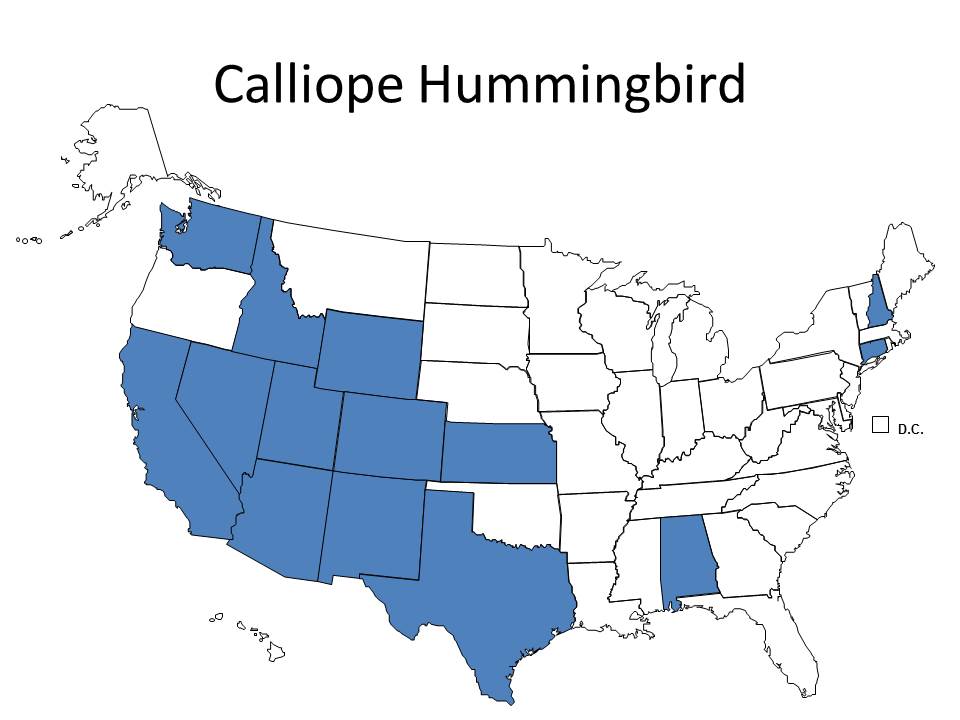
I still need Calliope in OR and MT in its regular breeding range, though I’ve seen it in four eastern and central states as a vagrant.


Then I was off to meet up with Rob Lowry so he could take me to a nest box southeast of Carson City where he had a Western Screech-Owl nesting.  After a short walk we arrived at the nest box, and Rob opened a panel of the box to reveal an owlet inside the box (#4).  Very cute.  A nice addition to my statebird map, but I still have several gaps for this species.


The last stop of the day was at Mason Valley WMA which was about a 90-minute drive to the southeast.  A couple weeks earlier Rob had had two of my targets there – American Bittern and Black Tern.  He gave me excellent directions to the two locations of these birds, but I wondered if they were just migrants and likely long gone, or would they be nesting locally.  Rob’s hand-drawn map to the spot was perfect, and I first went to the marsh where the American Bittern had been seen.  I’ve never had much luck getting bitterns to reply to taped calls, so I wasn’t sure how this one would go.  I started playing tape but got no response.  While I waited I noticed several terns flying around the marsh, but they were all Forster’s.  Now I wondered if I would miss both birds.  I walked a little bit farther along the marsh and played some more tape – still no response.  Then I thought I heard a faint call in the distance.  I turned off the tape and sure enough it was a distant calling American Bittern (#5).   

Now I needed to focus on the terns. This time I did a more thorough scan of the marsh but once again only came up with Forster’s.  But then I re-checked Rob’s map and realized he actually had the Black Terns in an adjacent marsh, not the one I was looking at.  So I redirected my attention to the neighboring marsh and instantly saw 3 Black Terns flying over the reeds (#6).  Things usually turn out better when you follow directions!  I’ve now seen this species in 41 states across the US, with the biggest gaps being in the Midwest. 

 
The next morning I woke up early to try for a pair of owls recently reported nearby – Flammulated and Saw-whet.  Both were reported more than 2 weeks earlier pre-dawn at Chimney Beach along the eastern shore of Lake Tahoe, barely in NV.  This is the spot where last year I got Pacific Wren and Pileated Woodpecker – two great birds for NV.  I arrived a bit before 4 and walked a short distance to the north to get into the conifers.  It was extremely quiet with no wind, so conditions were great.  Soon after arriving I started to hear Poor-wills calling – likely 3 different birds.  But there were no owls.  I started to play Flammulated tape and within a minute one was calling back (#7).  It continued to call the entire time I was there.  That was only my 3rd time hearing a Flammulated (CA and UT are my other states); I’ve still never seen one.  I also played some tape of Saw-whet but couldn’t coax one into responding.

That gave me 7 new NV statebirds and 90 species for this brief outing - a most successful trip.  And now with a statelist of 249 in NV, I’m 7 over the old ABA threshold and well on my way to “Reportable Plus 15”.  Or more accurately, I’m 3 over the calculated threshold based on the recently published NV statelist.  I’m tentatively planning a trip to northeast NV in summer 2016 to look for the Himalayan Snowcock and spend at least a day working on my NV statelist.  I’m hoping that after that trip I’ll be over the threshold to stay.

And now onto California –

After my mini-vacation in NV I returned to the Bay Area for my business trip.  One morning I had a couple free hours so I checked the eBird CA Needs Alert for local possibilities.  I keyed in on nearby Coyote Hills Regional Park which regularly had reports of American Bittern, and recently had a report of Black Rail.  I spent 2 hours there early that morning, and although I dipped on Black Rail, I did have a flyover American Bittern - #376 for me in CA.  I really like the eBird Needs Alerts!  Even after adding American Bittern in CA and NV my coverage for this species is still very spotty - like I said I've not had a lot of luck getting bitterns to respond to tapes.


Saturday, April 5, 2014

Golden Eagle in Vernon, VT AND Hinsdale, NH, March 2014


A few years ago I missed the one and only record of Pink-footed Goose in NH, a bird in spring migration in the Connecticut River valley.  Ever since, I’ve watched the reports of the spring goose migration in New England in hopes of being around for the next NH record, and/or maybe the first record for VT.  So I was of course very excited to read posts of a Pink-footed being seen in MA in the Connecticut River valley.  After all, it has to go through NH or VT on the next leg of its migration, right?  That same day there was a post from Hector Galbraith of 3,000 Canada Geese in Vernon, VT right along the Connecticut River, just about 25 miles to the north as the Pink-footed Goose flies.  So there was great habitat for the target goose in VT should it decide to head north.  The next morning I checked the MA listserve and read an early morning post that the Pink-footed was not being seen in MA.  Minutes later I was heading out the door to hopefully find the first record of Pink-footed Goose in VT.

By the time I got to the cornfields in Vernon there was another post that the bird was being seen again in MA, so at least that one wasn’t going to be feasible in VT that day.  Maybe there would be others to look for.  Unfortunately, I didn’t see any geese of any type in the fields.  So I called Hector who suggested trying for them above the dam in Vernon.  He also told me to keep an eye out for the Golden Eagle he had seen the day before.  Although I read about it in his post, I didn’t really think that it might be a target since they are frequently one-day wonders.  But Hector thought it might not have been migrating through, and could actually stick around with all the ducks and geese as eagle food in the area.

When I got to the dam I ran into James Smith and another birder he was with, and we walked down to the water’s edge where we found at least 1,000 Canada Geese.  Despite our efforts we found nothing else of interest.  The three of us then went to another spot north of the dam but only had a few more geese there.  James then went down to the cornfields to chase down a Carolina Wren I had there earlier, and I decided to go back to the dam to try there again.  Just as I was arriving at the dam I got a call from Hector – James had just called him to say he had the Golden Eagle at the Carolina Wren spot, the same general area where Hector had the bird the day before.  It took me just 5 minutes to get where James was, but by then the bird had disappeared.  He said it was being dive-bombed by a Red-tail, and then took a steep dive down toward the river and out of sight.  I joked with James that since we were within a few feet of the NH/VT line, maybe I could get the Eagle for both statelists (I’ve never seen Golden Eagle in any New England state).  Though I lamented that it would be more likely that I wouldn’t get it in either state.  But since there were no rare geese to chase, I may as well spend some time looking for the Eagle.  So I selected a spot with a good view of the sky in most every direction, and started my vigil.

In the next 2 hours I had quite a number of birds fly by, but no Golden Eagle.  At one point I got really excited when an adult Bald Eagle came into view until I realized it was right size but wrong species.  A distant Peregrine Falcon was nice, as were several Ravens both in VT and in NH.  And several Red-tails and Turkey Vultures were visible in both states as well.  I also had a number of singing landbirds like Red-bellied Woodpecker, Tufted Titmouse, and Cardinal – none of which would have been in this area a few decades ago.  A bit later Hector arrived to join me in the search.  Just minutes after he set up his scope we noticed a distant flock of 500+ Canada Geese to the south coming our way.  I put my binocs on the flock and noticed a very distant pair of raptors up above the geese – one was dive-bombing the other, and they were two different sizes.  Could this be the Golden Eagle?  I put my scope on it, and even though it was at least a mile away to the SSE, I could see the tail was white with a dark terminal band, there were white patches at the base of the primaries, and flat wings – it was the Golden Eagle.  Hector was on it too, and we both agreed it was in VT air space.  We watched it as it lazily made its way toward us traveling NNE.  As it got closer it eventually was almost directly east of us, and we both agreed it was now over Hinsdale, NH.  A little later we lost it behind some trees, and we gave each other high fives in celebration of some excellent sightings.  I can’t thank James Smith enough for trying to contact me about refinding the bird, and then Hector Galbraith for contacting me with the latest report.

This was my third time that I’ve been able to get two different state ticks by seeing one individual bird.  The first time was a Common Raven over the NC/TN state line in the Smoky Mountains.  The second time was right in this same spot in Vernon where I watched a group of four Cackling Geese fly back and forth between VT and NH.  It’s not important where you are standing – it’s where the bird is located that counts.

Golden Eagle was species number 424 for me in New England, and number 351 in NH and 260 in VT.  These two ticks give me 1,963 in the 6 New England states - I’m closing in on my 2,000 goal!  And my 9 New England ticks through March 2014 are an excellent pace so far.  I now have Golden Eagle in 4 Eastern states, where it can be a difficult bird to find, along with many of its regular states out west.