Showing posts with label American Bittern. Show all posts

Wednesday, November 6, 2019

10 North Carolina Statebirds in October 2019


October was a great birding month for me in my new home in the mountains of western North Carolina.  I birded several days a week at nearby hotspots, and most every day just in my own yard.  I added 10 new species to my NC list in October, about half being rarities needing details in eBird.  Short summaries of each of my additions are provided below.

10/1 – Nashville Warbler, Philadelphia Vireo – Yard

My yard continues to be an excellent birding spot, with many migrants passing through the yard virtually every day.  The month started off with a bang with additions of both Nashville Warbler and a Philadelphia Vireo, the latter considered to be rare per eBird.  I had 1 or 2 Philadelphia’s in the yard each day for the next 3 days.  My statebird map for Nashville Warbler is inserted below – I’ve seen it in the shaded states, and still need it in the cross-hatched states where it is a regular species.


10/6 – Northern Waterthrush – Jackson Park

My first birding trip in the area was a birdwalk run by the local Elisha Mitchell Audubon Society (EMAS) at the Beaver Lake sanctuary.  A couple of the folks in my group spotted a Northern Waterthrush but I missed it.  Hence it was a bit of a nemesis bird for a couple months until I finally caught up with one on my first trip to Jackson Park.  It turned out to be the first of several I had in the month.

10/9 – Peregrine Falcon, Dickcissel – Warren Wilson College

A Dickcissel spotted in a sunflower field at Warren Wilson College provided my first opportunity to chase after a local rarity.  Luckily I had attended an EMAS field trip to this spot so I knew where the field was and how to bird the site.  I arrived early the next morning and met up with a couple other birders also searching for the target bird.  There were many Indigo Buntings, and a couple Blue Grosbeaks, but no Dickcissel.  Most of the birds would be seen either flying out of the field to the adjacent trees, or flying back into the sunflower field.  But in most cases the birds would frustratingly instantly disappear into the vegetation; only occasionally would a few individuals sit out into the open for even a quick view. 

After an hour of searching I thought about leaving the sunflower field and birding elsewhere, but decided to focus on my real target – the Dickcissel.  I continued to try to ID the birds coming and going from the field from various vantage points, and at one point spotted a Peregrine Falcon overhead – a nice consolation prize, but still not the target.  Then at the 2-hour point I again thought about calling it quits.  But then I realized that the Buntings that were flying into the field were changing their MO and were actually sitting in the open for a while – maybe the Dickcissel might do the same I thought.  And sure enough, just a couple minutes later the 2 other birders and I all spotted the Dickcissel perched atop a sunflower.  Then again it might not have been “the” Dickcissel – this bird seemed to be paler below than the one photographed the day before.  A second bird perhaps?  In any case, my strategy to focus on my target rarity, rather than to divert my attention to more general birding, proved to be the right one.  As shown in my statebird map below I’ve seen Dickcissel in most of its regular range generally in the central portions of the country, and have found it as a rarity in a number of eastern states.


10/10 – Connecticut Warbler – Jackson Park

Local birder Dave Minnich and I were planning a birding trip for the 10th, and decided to try Jackson Park based on a couple reports of a Connecticut Warbler there.  The bird had been reported near the southern end of the Warbler Trail, so that’s where we started our trip.  But it was pretty slow in that area, and we continued our walk along the trail all the way to its northern end.  Shortly after we turned around and started our walk south back down the trail we heard a set of odd chip notes.  And just then I spotted a Connecticut Warbler just off the trail.  This was perhaps a half mile from the earlier sighting so likely a different bird.  The bird was seen again later that day by several other birders, and in fact continued to be seen for over a week – though as is often the case with these skulkers, it was not seen by everyone.

10/12 – Warbling Vireo – Yard

During one of my nearly daily stints birding in my yard I spotted a Vireo that instantly caught my eye – brownish back, faint eyeline, white throat, and only a bit of yellowish wash on the flanks.  Earlier in the month I spent a lot of time watching Philadelphia Vireos to make sure they weren’t Warbling Vireos.  And today’s bird was definitely a Warbling and not a Philadelphia, or Red-eyed for that matter.  This species is not only rare for NC, but it was also quite late for one, so it was a nice find.  I just need to see this wide-ranging species in a couple more southeastern states. 


10/18 - Lincoln’s Sparrow – Warren Wilson College

My targets on this trip to Warren Wilson were fall sparrows.  Earlier in the month a Nelson’s had been reported from a wet ditch in the middle of the fields (why didn’t I chase it?), plus it was time for Lincoln’s to be arriving.  So a sparrow search was on!  I headed to the ditch as soon as I got to the site and soon had a number of Songs, Swamps and Savannahs.  Then in the distance a Lincoln’s popped out and gave nice views.  Later I had several other Lincoln’s there – I guessed at least 3.  I also had another at the nearby gardens, and 2 at the sunflower field.  Interesting that this species is considered to be a rarity in eBird.

10/24 – American Bittern, Vesper Sparrow – Hooper Lane

A Vesper Sparrow was reported at the sod farms at Hooper Lane, though without a specific location.  There are numerous weedy ditches throughout the site so I planned to work the ditches and hope I ran into the Vesper, or maybe I should say a Vesper.  But shortly after I arrived at the farm I heard a Greater Yellowlegs in the distance.  I located it in a wet area in the distance, and decided to get closer to it to grab a photo, and look for other shorebirds.  I snapped this passable photo holding my phone up to my binocs. 


A bit later I spotted a pair of shorebirds overhead which turned out to be a White-rumped Sandpiper and an American Golden-Plover – both eBird rarities.  But neither was new for my NC statelist.  Unfortunately, by the time I went back to looking for my target Vesper Sparrow I had run out of time.  Though the shorebirds were certainly a nice consolation.

So I was back a couple days later to give it another try.  This time I started at the southernmost ditch and started heading west, flushing sparrows along the way.  But it was just the regulars – lots of Savannahs, a few Songs, and a couple Swamps – so my interest started to wane.  I was just about to give up when I flushed an American Bittern from the ditch – this addition wasn’t even on my radar screen.  I still need this reasonably common species in quite a number of states across the country.


Later in that same ditch I spotted a sparrow in the distance with a white eye-ring.  I initially thought I had a Vesper, but realized it was too small.  Then it turned to face me and it had a buffy chest with no striping – a Grasshopper Sparrow.  Nice!  But still no Vesper.

Next it was on to another ditch, with more Savannahs and Songs.  Then I spotted another Grasshopper Sparrow – only my second and third I’ve ever found in fall migration.  And the hits kept coming – I turned to look at the pool where the Yellowlegs had been a couple days earlier and spotted 4 shorebirds.  I needed to get closer to identify them as Pectoral Sandpipers – my 6th shorebird species there that week.

I was out of time and started to head back to the car along the ditch I birded earlier.  I wasn’t watching the sparrows too closely since I had seen them all on my first pass.  But just then I spotted a larger sparrow fly into the ditch from the nearby field.  And after just a couple seconds it popped into the open and was a Vesper Sparrow.  Although it took me a while to finally get my target, I’m not complaining since I found so many other goodies along the way.


I ended the month with a NC statelist of 270 – I’ve added 19 new birds to my list since moving here just over 2 months ago.  I continue to be amazed at how many good birding spots there are within 45 minutes of my house.  And speaking of my house, my yard list as of 10/31 stands at an amazing 92 species.  This includes 22 species of warblers and 6 vireo species as the fall migration through my yard was outstanding.  What a tremendous start to my time here in the Carolinas!

Wednesday, April 13, 2016

Three TX Statebirds – Swallow-tailed Kite, Heermann’s Gull, and American Bittern, March 2016


Although my TX state list is my largest, I continue to set up eBird Needs Alerts for TX on each of my monthly trips to the state.  And those Needs Alerts keep pointing me toward at least a few possible new statebirds for my TX list.  The first bird I looked for in the Needs Alert for my upcoming March trip was Swallow-tailed Kite.  Back in summer 2015 when I started to do TX Needs Alerts I realized that the Kite was especially regular at one location (Port-o-call Street) a bit east of Houston in Crosby, but was only seen there in spring and early summer.  But by the time I knew about this spot, and realized I actually needed Swallow-tailed Kite for my TX list, it was too late in the year.  Though I did try for them in the heat of on late afternoon in July 2015.  So I made a mental note to check the Needs Alerts for the Kite on my first spring trip in 2016.  Sure enough, the Kites had just started to show up, and there were a couple sightings at Port-o-call Street.  Since my flight was to arrive around dinner time, I would have time to try for the Kites the evening I arrived.

But as they say in the infomercials – “But wait there’s more…”  The Needs Alert also mentioned several American Bitterns spotted recently at Sheldon Lake State Park.  Since that’s a pretty common wintering bird in TX, I was a bit surprised that I still needed it for my state list.  The park was only a short distance off my route from the airport to the Kite location, so I figured I would have enough time to quickly try for the Bitterns first, then head a bit farther east to try for the Kite.  Two possible statebirds in one evening of birding – not bad.

My flight landed 20 minutes early, giving me lots of time to try for both of my targets.  Less than 20 minutes after leaving the airport I neared the entrance to Sheldon Lake State Park, only to find that the park closed at 5 PM.  That was a surprise, and a disappointment as well.  So I headed over to Port-o-call Street to look for the Kites.  I’m not sure what is so special about this location, except that it offers a good panoramic view of the sky.  I started my vigil scanning the sky with no luck for the first 30 minutes.  Then I noticed something soaring in the distance.  Despite harsh lighting looking toward the setting sun I could pick out all the field marks of a Swallow-tailed Kite.  While watching it another passed through my binocular field, and then another.  Soon I had a flock of at least 6 birds soaring in the distance.  TX was my fifth southeast state for this species, plus I’ve seen it as a rarity in RI.


As my Houston trip progressed a couple of my meetings got cancelled, giving me a bit of spare time in the early morning one day.  With some free time on my hands, I checked the Needs Alerts again and noticed multiple sightings of an extremely rare immature Heermann’s Gull at the Texas City Dike.  Plus a Glaucous Gull was spotted there as well.  I had never birded there before, and just assumed it was pretty far away.  But it turned out to be just an hour southeast of Houston.  And if I arrived there at dawn, I would have enough time to be back in the city in plenty of time for work by mid-morning.  And if the gulls were really cooperative, I could even make a short side trip to Brazos Bend State Park where multiple American Bitterns had been reported recently. 

The Heermann’s Gull was being seen quite cooperatively among a flock of Laughing and Ring-billed Gulls at the westernmost parking lot on the Texas City Dike.  And the Glaucous Gull was seen in the immediate area as well.  Those directions were very explicit so I knew exactly where to search.  However, both gulls were only seen there for 1 day (the Heermann’s was seen several days earlier in nearby Galveston), so I was a bit worried about how reliable they might be.  If they were one-day wonders at this site I would make the long drive for nothing.  But despite a few misgivings, given how rare the Heermann’s was, I decided to take a few hours off and give it a try.

I arrived at the Texas City Dike right at dawn and quickly found the parking lot where the target gulls had been reported.  There were a number of Laughing and Ring-billed Gulls loafing around, with a few Herring Gulls sprinkled in, but no rarities.  I drove a 100 yards farther east to check out another small gull flock but again just saw Laughing and Ring-billed.  Suddenly I had that sinking feeling – had I made the trek for nothing?  Then I scanned back to the west and noticed an all-dark gull on the rip-rap – it was the Herrmann’s!  Within a couple minutes it flew to the parking lot and took its place among the other more common gulls likely looking for handouts.  I took a few record shots of this tame bird with my iPhone. 


I’ve now seen this species as a rarity in TX and FL, along with its regular West Coast states.  And come to think of it, I remember seeing flocks of Heermann’s acting just as tame on the CA coast, loafing in mixed flocks in coastal parking lots. And the FL bird I saw was quite tame as well.


Just then I ran into a couple other birders who were there the previous day and had seen the Glaucous Gull.  They mentioned that the Glaucous was there all morning perched on light poles around the parking lot.  But the bird was not seen there the rest of the day despite many searches.  With those tips, I did a couple scans around the area especially focused on birds perched on the light poles.  But there was no Glaucous in site.  Now it was decision time.  Since the Herrmann’s was so cooperative, if I left now I still had time to try for the American Bittern.  Or I could stay longer to hope that the rarer Glaucous would return, but that would mean passing on the more regular Bittern.  Despite my preferences to try for the rarer bird, I had a feeling that the Glaucous was not going to cooperate, and decided to head to Brazos Bend State Part to try for the Bittern.  As a side note it turns out I made the right decision since the Glaucous was apparently not seen at all that day.

The reports of American Bitterns at Brazos Bend State Park were pretty amazing.  Just in the past week this shy and elusive bird had been reported daily on eBird, with 3 birds seen the day before and one report of 11 birds earlier in the week.  Looking back at earlier posts I saw one birder remark - “continuing and obvious". So the good news was there were a number of Bitterns in the park.  However, the bad news was that no locations were given in the recent posts.  I had downloaded a park map the night before and there were numerous wetlands that could be suitable for Bitterns, so I would need some advice where to look for these birds, especially given that I had limited time.  Finally I decided to look back into older eBird reports and started seeing a couple locations given repeatedly – 40 Acre Lake and Elm Lake.  So I was hopeful that my detective work would be sufficient to finally check this bird off my TX list.

I arrived at the State Park and went right to 40 Acre Lake near the entrance.  The lake had a long boardwalk surrounded by low wetland vegetation that I hoped would harbor a Bittern.  As I neared the lake I noticed a photographer out on the boardwalk and I crossed my fingers that he could help me with my search.  It turned out that he was a volunteer at the park, and was very familiar with all the Bittern sightings – he mentioned one birder counted 26 there last week!  Instead of birding the middle of 40 Acre Lake along the boardwalk he directed me to a trail along the north side of the lake and told me to check the edge of the wild rice to the north of the trail.  A few minutes later I was slowly walking along the trail and something caught my eye at the edge of the marsh – it was a nearly motionless American Bittern.  Here’s a shot of the bird taken with my iPhone – can you pick out the bird?


A couple minutes later I had two other Bitterns in flight chasing each other.  I would have really liked to continue down the trail and see how many Bitterns I could find, but I had to get back to work.  And even though I was just there for five minutes, I probably saw more Bitterns that day than almost any other day of birding.

Although American Bittern is a rather common bird seen virtually throughout the country, I’ve usually found this to be a very elusive bird, mostly because it can stay motionless for such a long period of time.  As a result I still need it in 16 mainland states.


With three additions to my TX list that gives me 429 for the state, 20 more than my next highest statelist.  Though since the total possible TX list is so large, I’ll undoubtedly still have many more possible statebirds to try for on future trips to TX.

Friday, January 8, 2016

5 “State" Birds in Washington, D.C. and 2 More in VA, December 2015


On most of my recent trips to Baltimore to visit relatives I’ve done at least a little birding in Washington, DC, VA, and/or WV to try to fill gaps in those “state” lists.  Although I had exceeded the old ABA reportable threshold in all 3 some years back, my key goal was to be at least 15 over the threshold in each location.  I reached the “reportable plus 15” goal in WV in 2014, but I was still short by 2 in DC and 3 in VA.  So that meant I needed to focus my Baltimore-area birding on DC and VA on future trips.

With an upcoming trip to Baltimore in December 2015, I set up eBird Needs Alerts for both DC and VA to see what might be around.  I was surprised to see that recent reports included no less than 7 possible “state” birds in DC and another 5 possible state birds in northern VA.  And many had been seen multiple days so they might well be chaseable.  I also sent a note to local DC birder Paul Pisano and he was most helpful giving me some micro-directions on each of the DC targets.  But as the trip neared, the reports on all but 3 species stopped coming in, and even a few negative reports were posted.  I was now less optimistic, but still hoped for 2 new birds each in DC and VA.  Armed with the latest information I set up an itinerary starting with birding in 5 locations in DC, followed by birding at 3 locations in northern VA, which would give me a chance at all 12 recently, or at least somewhat recently, reported target birds.

I started my trip at the Kenilworth Aquatic Gardens in the northeast corner of DC, arriving there about 20 minutes before dawn.  The prime targets here were an American Bittern, Purple Finches, and Ravens.  Although all had been reported regularly a week earlier, there were negative reports for all 3 species in the last 5 days.  In fact, given the negative reports I even wondered if I should make a stop here at all.  But ever the optimist, I began to walk slowly along the main trail in the pre-dawn light making my way toward some ponds that had been the favorite spot for the Bittern.  I was only part way down the trail toward the ponds when I stopped to check out some gulls flying overhead.  Just then a bird flushed from a small area of cattails not a few feet away – it was the Bittern.  I probably would have walked right by it had I not stopped for the gulls.  A nice rarity for DC (a “write-in” in eBird) and my first new DC bird.  This has been an elusive species for me across the country, even though it is regular throughout most regions (see my statebird map below).


I continued out to the boardwalk listening intently for calling Ravens or Finches but to no avail.  I then headed back toward a spot where an unconfirmed Orange-crowned Warbler had been reported the previous day.  There was a nice flock of White-throats and Juncos there, but no warbler, though a singing (!) Hermit Thrush was nice.  And then I heard the faint “tick” calls of Purple Finch overhead, and looking up I saw 2 birds passing by (#2).  Not a rarity but still a tough bird in DC, filling in the last gap in the northeast portion of my statebird map.


I headed out of Kenilworth very happy to have seen 2 of my 3 targets, which frankly were 2 more than I expected.

Next stop was the Rock Creek Golf Course where a Red-headed Woodpecker had been reported for 2 consecutive days a week ago, though there were no updates in the last 7 days.  Luckily a specific location was mentioned, and I was able to quickly find the dead tree where the bird had been seen.  But the best I could do was to find a Pileated in the distance.  I walked a bit farther down the fairway and heard a Red-belly and a Flicker  Then in the distance I heard several familiar Red-headed call notes that the BirdTunes app calls “rattle calls” (#3).  DC was the last gap in the eastern part of my statebird map for this species.


The next target bird was a Mute Swan that had been reliably seen around Theodore Roosevelt Island in the Potomac River.  It had most recently been seen on the east side of the island, viewable from Rock Creek Parkway, and Paul Pisano’s suggestion was to drive slowly down the Parkway and look toward the island as I drove past the Kennedy Center.  Sounded simple enough, as long as I could look for the bird safely in DC traffic (when was the last time anyone drove slowly down any parkway in DC?).  As I neared the island I hoped for a place to pull over, or that there would be a red light to stop traffic - but it wasn’t to be.  Luckily as I got to the Kennedy Center I was able to slow down a bit, looked to the right, and there was the Swan swimming close to the island (#4).  DC was the last northeast “state” where I needed this species.


Then I was on to Hain’s Point where a recent report included 7 Lesser Black-backed Gulls mixed in Ring-billed Gull flocks.  I drove around the perimeter of the park and saw very few gulls at all.  The best I could do was to find a late Laughing Gull in a small mixed gull flock.  So lacking the critical mass of gulls, I headed out of the park rather than searching any further.

My last DC stop was the LBJ Memorial Grove, which is on an island on the western edge of the Potomac River, just barely in DC.  For about 10 days an Orange-crowned Warbler had been seen here with a mixed Chickadee/Kinglet flock.  Amazingly an American Redstart had also been seen in this or a nearby flock.  The Orange-crowned was reported to be rather easy to find in brush immediately north of the parking lot, while the Redstart was only seen infrequently in the same general area.  Within a minute of getting out of my car I heard some Chickadee calls and quickly found a mixed flock of Chickadees and Kinglets in the brush just north of the parking lot.  Fully expecting to find the Orange-crowned with them, I looked through the flock multiple times, presumably seeing each bird in the flock several times, but the target bird was nowhere in sight.  The flock moved on to the east, but was soon replaced in the brush by another mixed flock.  This group included the typically harder to find Redstart which gave excellent views.  Although the Redstart is a rarer bird in winter than the Orange-crowned, I have seen Redstart in DC in the warmer seasons, and needed the Orange-crowned for my DC list.  So I decided to try to re-find the first Chickadee/Kinglet flock to see if the target bird had joined them.  I eventually re-found the flock in some pines to the east, and after a little searching found the Orange-crowned Warbler mixed in (#5).  How did I miss it when I first looked through that flock?  My statebird map for this species is very spotty in the east where it is uncommon or rare, though not surprisingly I’ve seen it in most of its regular western states.


I left DC with 5 new birds – much better than the 2 that I expected.  And 4 of these (Bittern, Red-headed Woodpecker, Swan, and Orange-crowned), along with the Redstart, were “write-ins” on eBird.  It was a nice start for the day, and now it was on to VA.

The first VA stop was at the Belle Haven area along the Potomac River in Fairfax County, where there had been 2 recent reports of Lesser Black-backed Gulls, and one of a cooperative Merlin.  When I arrived at midday the tide was high but falling and I could only find about 50 gulls, and nothing unusual.  Over the next 45 minutes more gulls flew in, but they were just the regular suspects.  And there was no Merlin in sight.  I considered staying longer in hopes that more gulls might arrive as the tide continued to drop, and maybe even the Merlin might appear.  But with 2 other stops to go, I decided to head out.  Interestingly, I made a stop here at Belle Haven on my last trip to northern VA in January 2015, and searched for but missed these same 2 species on that trip as well.

Next on my itinerary was Huntley Meadows Park where multiple Rusty Blackbirds had been reported most every day over the last couple weeks.  I had birded this park a couple times before, and knew that there were lots of wet swampy woodlands that would be ideal for Rusty Blackbirds.  But since no specific locations for the Rusty’s were mentioned in the eBird posts, I was concerned about how long it might take me to find them – if I found them at all.  As I arrived I went to the nature center thinking that I might find a park worker who might be able to give me some suggestions on the Rusty’s.  But before I could ask the worker behind the desk I noticed another birder and asked him about the birds.  It turned out that he had just completed leading a birdwalk at the park, and had had several Rusty’s that morning.  He took me to the spot where he had seen Rusty’s mixed in with Red-wings perched in some low trees, but we only found 1 Red-wing.  I decided to wait at this spot hoping the birds might return.  Over the next 15 minutes small groups of Red-wings flew in, and finally a lone female Rusty Blackbird joined them (VA statebird #1).  That fills a big gap in my statebird map, though I still need this species in 3 other states where they are regular.


My planned final stop was to be at turf farms in Fauquier County, about a 90-minute ride to the southwest.  There had been a recent post from Grassdale Road in the middle of the turf farms with 26 American Pipits and 5 Vesper Sparrows – 2 of my target birds.  But I had had reservations about heading to this spot from the beginning – the sightings were listed in just one post, there were no details on the birds, and it was a long ride away.  And now with my misses as Belle Haven, I wondered if I should head back there to see if my luck might improve instead of heading to the turf farms.  But the turf farm post was only 3 days old.  Plus I had birded a nearby spot at the turf farms last winter and had had good luck there with Horned Larks and Lapland Longspurs.  So I decided to stick with my original plans and headed to the turf farms.

The first thing I did when I arrived was to slowly drive the mile-long road to get the lay of the land, with car windows open to listen for Pipits, and also watching for sparrows that might flush from grasses along the roadside.  But I heard just 1 Horned Lark and found no sparrows at all.  On my way back I stopped several times to listen even more intently, but only heard one sparrow which turned out to be a Song.  I was now close to the beginning of the road sitting in my car wondering what to do next.  Then I heard a couple call notes that sounded Pipit-like coming from quite close to the car.  I got out and scanned the grass and found an otherwise silent flock of 14 Pipits foraging in the grass near the road (#2).  If that bird hadn’t called I likely would have missed them altogether.  I now only need American Pipit in 6 more mainland states.


With a few more minutes before I had to head back, I took the short drive to the spot I birded last winter with long-shot hopes I might run into Vesper Sparrows there.  And although I found a flock of at least 20 Savannah Sparrows, none had white outer tail feathers.  So Vesper Sparrow would have to wait for future VA trip.

I ended up with about 65 species for the day, including 5 additions for my DC list and 2 for my VA list.  My DC total is now 183, 18 over the old 2011 ABA threshold of 165 – of course exceeding my somewhat arbitrary “reportable plus 15” goal.  But a more up-to-date threshold could be calculated if one could find the total DC list.  With some research on the web I found out that the total DC list as of 4/19/15 was 334.  Dividing that number by 2 as the ABA used to do to calculate the thresholds, that would equate to a new threshold of 167.  In other words, 4 more species have been added to the DC list since 2011.  I would imagine my 183 will be safely over newly calculated DC thresholds for many years to come. 

My VA list is now 246, which is 14 over the 2011 ABA threshold of 232.  As of December 2015, the total VA list had increased to 471 resulting in a new threshold of 235.5.  So the VA list would have to increase by 22 before I would no longer reach the “reportable” threshold.  And although that sounds like a big number, the VA list increased by 7 from 2011 to 2015.  At that rate the threshold would pass my total in about 15 years.  Seems like even 15 over the old threshold might not be enough in VA.

Sunday, June 7, 2015

Seven Statebirds in Reno/Carson City, NV, and One in the San Francisco Bay Area, May 2015


My work travels take me to the San Francisco Bay Area frequently, and on several of those trips I’ve added a vacation day to either chase after a rarity (Falcated Duck no less than 5 times - all unsuccessfully) or pursue other statebirds.  Twice I’ve headed east to NV to work on that statelist, specifically to the greater Reno/Carson City area.  There I’ve teamed up with local birder Rob Lowry who really knows the local area, and has given me some excellent advice to help me find my targets.  Since I still need a number of birds for my NV statelist that summer in that area, I thought I’d add a day during my upcoming May trip to the Bay Area to try to fill in some of those gaps.

Before this trip I had 242 species in NV which is exactly the old ABA reporting threshold, last updated in 2010.  The most recent NV checklist published on-line (as of March 2015) by the Nevada Bird Records Committee is 492.  Using the old ABA formula that the threshold is half of the total statelist, the new threshold for NV would be 246.  So saying I’ve reached the old ABA threshold is a rather hollow victory in NV, and a good example of why I’ve set a somewhat arbitrary goal of being 15 over the old ABA thresholds in each state.  So with a number of potential targets, advice from Rob, and a lot of research on eBird, I was optimistic that I could make good progress on reaching the “Reportable Plus 15” goal for NV.  Realistically I hoped for at least 5 new statebirds on the trip.

The first stop was in the little town of Verdi just barely east of the CA/NV border to try for Acorn Woodpeckers.  There were several recent sightings with a pretty specific location given (the Bridge St. bridge over the Truckee River).  But a 45-minute stop yielded only a pair of Red-breasted Sapsuckers and a pair Flickers nesting in the dead cottonwood snags.  And even a quick stop at a nearby patch of woods where one was seen the day before was unsuccessful.  Interestingly, I never saw a single oak tree at these locations.  Not a very good start to the day.

Then it was on to Pyramid Lake to try for a number of waterbirds and migrants.  The route to the lake passed through some desert which had had a number of recent Golden Eagle sightings.  Although most appeared to be just lucky sightings of birds passing through the area, there was one eBird post of a pair carrying food at a nest.  A specific location was given, though of course you never know how accurate the eBird locations are.  I got to the reported nest location and scanned the mountainside with my binoculars, but did not see a nest.  But then I noticed a bump on one of the rocks, and with a scope view confirmed it was an adult Golden Eagle – statebird #1.  Hats off to the eBirder for putting in a very accurate location of the nesting spot!  I’ve now seen this species in 15 western states but only 4 states in the east.  (see my statebird map below)


The next stop was a spot called The Willows on the west shore of Pyramid Lake.  This is an oasis consisting of a thick stand of mature willow trees that can be quite a magnet for migrants.  I spent about 90 minutes there and found a number of passerine migrants, but they were all the regulars – like Wilson’s, MacGillivray’s, Yellow-rumped (both Audubon’s and Myrtle), and Yellow Warblers; Dusky and Ash-throated Flycatchers, Western Pewee, and Black-headed Grosbeaks.  Nothing new here, though a Great Horned Owl was nice.  Then I spent some time at the lake where late Greater Scaup and a Red-necked Grebe had been reported a couple weeks earlier.  But they were long gone, though the lake was teaming with Western Grebes. 

Then it was on to the southern end of Pyramid Lake in hopes of Long-billed Curlew and other shorebirds.  Although there had been no recent Curlew sightings here or elsewhere in the area, this had been a location for several sightings at this time last year.  But no luck here – the only shorebirds were 4 Red-necked Phalaropes.  I’ve looked for Curlew on all 3 of my trips to this area without success.  I also spent some time trying to find a summering odd gull but could only find California and Ring-billed.  On a brighter note a rare Common Tern mixed in with the Forster’s and Caspian Terns was nice. 

It was now past noon, and I only had 1 statebird in four stops.  Things had to pick up, right?

Then I was on to Mira Loma Pond in the Reno suburbs where a Common Goldeneye had been reported 2 weeks earlier.  Of course there was a good chance that this was a late migrant duck that was long gone (like the Greater Scaup and Red-necked Grebe at Pyramid Lake).  But over the years I’ve picked up a number of normally wintering waterfowl as statebirds during summer, so I was hopeful that this bird too might have decided not to migrate north for the summer.  And besides, this was a small pond and right on my route to the next location so it would be a quick stop.  When I arrived I scanned the far side and got some nice dabblers, a late Bufflehead, and several families of Canada Geese, but no Goldeneye.  Then I noticed a small group of waterfowl practically at my feet and there was the female Common Goldeneye (statebird #2).  I’ve now seen this species in 43 states across the country.

 
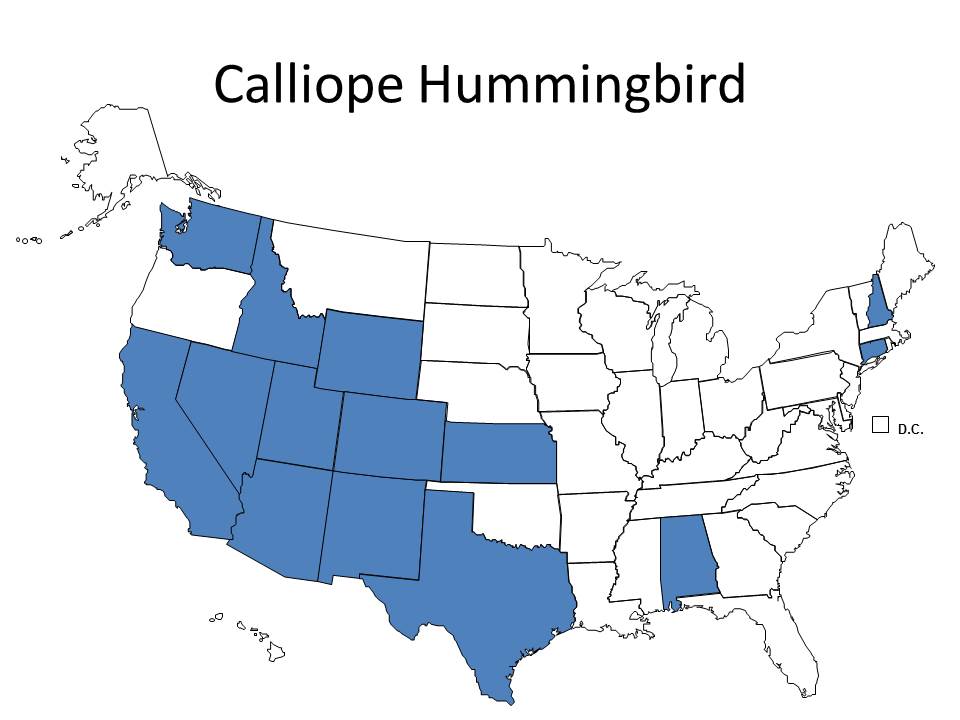
The next stop was Davis Creek Regional Park which is the spot for Calliope Hummingbird in the area.  It seems a male Calliope likes to perch on one specific bare branch where the nature trail crosses the road near the group picnic area.  That sure is a specific set of directions – though when I was in the area last year I spent over an hour at this spot without finding the bird.  So I gave myself at least an hour to try for the bird this time.  I arrived at the spot and didn’t see the bird at first, but then looked a few feet away and noticed what almost looked like a small bump on a nearby bare branch.  With binoculars it was obviously the very tiny Calliope Hummingbird (#3).  I go this phone-scoped picture of this most cooperative bird – where was it last year?


And then the bird flew off and was replaced by this bird with a remarkable gorget.


I still need Calliope in OR and MT in its regular breeding range, though I’ve seen it in four eastern and central states as a vagrant.


Then I was off to meet up with Rob Lowry so he could take me to a nest box southeast of Carson City where he had a Western Screech-Owl nesting.  After a short walk we arrived at the nest box, and Rob opened a panel of the box to reveal an owlet inside the box (#4).  Very cute.  A nice addition to my statebird map, but I still have several gaps for this species.


The last stop of the day was at Mason Valley WMA which was about a 90-minute drive to the southeast.  A couple weeks earlier Rob had had two of my targets there – American Bittern and Black Tern.  He gave me excellent directions to the two locations of these birds, but I wondered if they were just migrants and likely long gone, or would they be nesting locally.  Rob’s hand-drawn map to the spot was perfect, and I first went to the marsh where the American Bittern had been seen.  I’ve never had much luck getting bitterns to reply to taped calls, so I wasn’t sure how this one would go.  I started playing tape but got no response.  While I waited I noticed several terns flying around the marsh, but they were all Forster’s.  Now I wondered if I would miss both birds.  I walked a little bit farther along the marsh and played some more tape – still no response.  Then I thought I heard a faint call in the distance.  I turned off the tape and sure enough it was a distant calling American Bittern (#5).   

Now I needed to focus on the terns. This time I did a more thorough scan of the marsh but once again only came up with Forster’s.  But then I re-checked Rob’s map and realized he actually had the Black Terns in an adjacent marsh, not the one I was looking at.  So I redirected my attention to the neighboring marsh and instantly saw 3 Black Terns flying over the reeds (#6).  Things usually turn out better when you follow directions!  I’ve now seen this species in 41 states across the US, with the biggest gaps being in the Midwest. 

 
The next morning I woke up early to try for a pair of owls recently reported nearby – Flammulated and Saw-whet.  Both were reported more than 2 weeks earlier pre-dawn at Chimney Beach along the eastern shore of Lake Tahoe, barely in NV.  This is the spot where last year I got Pacific Wren and Pileated Woodpecker – two great birds for NV.  I arrived a bit before 4 and walked a short distance to the north to get into the conifers.  It was extremely quiet with no wind, so conditions were great.  Soon after arriving I started to hear Poor-wills calling – likely 3 different birds.  But there were no owls.  I started to play Flammulated tape and within a minute one was calling back (#7).  It continued to call the entire time I was there.  That was only my 3rd time hearing a Flammulated (CA and UT are my other states); I’ve still never seen one.  I also played some tape of Saw-whet but couldn’t coax one into responding.

That gave me 7 new NV statebirds and 90 species for this brief outing - a most successful trip.  And now with a statelist of 249 in NV, I’m 7 over the old ABA threshold and well on my way to “Reportable Plus 15”.  Or more accurately, I’m 3 over the calculated threshold based on the recently published NV statelist.  I’m tentatively planning a trip to northeast NV in summer 2016 to look for the Himalayan Snowcock and spend at least a day working on my NV statelist.  I’m hoping that after that trip I’ll be over the threshold to stay.

And now onto California –

After my mini-vacation in NV I returned to the Bay Area for my business trip.  One morning I had a couple free hours so I checked the eBird CA Needs Alert for local possibilities.  I keyed in on nearby Coyote Hills Regional Park which regularly had reports of American Bittern, and recently had a report of Black Rail.  I spent 2 hours there early that morning, and although I dipped on Black Rail, I did have a flyover American Bittern - #376 for me in CA.  I really like the eBird Needs Alerts!  Even after adding American Bittern in CA and NV my coverage for this species is still very spotty - like I said I've not had a lot of luck getting bitterns to respond to tapes.