Showing posts with label birding. Show all posts

Wednesday, October 16, 2013

Palm Warbler and Gray-cheeked Thrush, Central Park, NY, October 2013


The family is in the midst of the college search process for my daughter, and she has picked a number of possible universities in New York City.  So over the Columbus Day weekend we planned a trip to Manhattan to visit several of them.  And with no schools to tour on Sunday, that would give us some free time to visit some of the local attractions.  I had never been to Central Park, but of course had heard a lot about the birding potential in this urban oasis.  So with everyone likely to sleep in that day, I decided to plan an early morning trip to the park to try for some New York statebirds.  I’ve got a pretty good list for NY (264), but still have a number of fairly easy birds to target that had been seen recently in Central Park (per e-Bird) including Palm and Pine Warblers, White-eyed Vireo, and Gray-cheeked Thrush.

Now I needed to figure out where to go in the park.  Central Park is very large, and I would only have chance to bird a very small portion in one morning.  With some research on the web I found a bit of information about possible birding spots, and there were indeed many spots mentioned.  Though I couldn’t find any good site guides for birding the park (maybe I just wasn’t looking in the right places).  I also found that there are regular birdwalks in the park on Sundays, but they charge $10 to participate.  I’ve never been fond of paying to participate in a birdwalk that is in a publicly accessible spot, so I decided to go it alone.  I would have a taxi drop me off near the middle of the park and I’d wander around from there looking for good habitat.

After a short taxi ride I arrived at 79th and 5th Avenue at dawn and began to walk to the west.  Most of the immediate area consisted of manicured lawns and isolated trees, though there was some patches of brush here and there.  Not surprisingly the brush contained the most birds (mostly White-throated and Song Sparrows) and the lawns had quite a number of Robins.  But I needed to find better habitat.  A bit to the west I noticed a more extensive brushy area so I headed there and found some very good habitat.  Highlights were a skulking Winter Wren and a berry-laden bush with a couple Hermit Thrushes.  I turned the corner and found even better habitat in a place which was called the Maintenance Field.  Notable birds here were flocks of 50+ sparrows of 5 species (including 2 Fields), Blue-headed Vireo, more Hermit Thrushes with a couple Swainson’s, a very late “Traill’s” Flycatcher, and a late flyover flock of Chimney Swifts.  In one berry bush I got a brief glimpse of a Catharus thrush that could have been a Gray-cheeked.  But it disappeared in the bush not to be seen again.  Here I ran into a birder who was most helpful and he advised me to head into The Ramble which is an extensive area that is more natural with significant undergrowth and mature deciduous trees, along with some streams and ponds. 

At my first stop in The Ramble I ran into more of the same – sparrows, a couple Sapsuckers, and more Hermit Thrushes.  Then I saw a flash of yellow fly by and it turned out to be a Palm Warbler – a new NY statebird.  As shown in my statebird map below, I’ve seen this species in most of its normal range though still need it in WV.


 Other warblers that morning were numerous Yellow-rumps, a Yellowthroat, a late Black-throated Blue, and a very late Ovenbird.  And along with 3 Blue-headed Vireos that was a pretty good mix of late warblers and vireos.

Maybe the best highlight of the morning was the thrushes.  In addition to many Robins I had an estimated 15 Hermits and 2 Swainson’s Thrushes feeding in the numerous berry bushes in the area.  And at one spot I found a very late Wood Thrush foraging on the ground.  But the best sighting was at a small spring with adjacent berry bushes.  I had run into a novice birder at this spot and was helping him identify the Hermit Thrushes feeding there.  And just then another thrush flew in and posed very cooperatively at the top of the bush – a Gray-cheeked; a second new statebird.  I haven’t seen too many Gray-cheeks – and my statebird map shows that I still need this uncommon migrant in many eastern states.


In my 4 hours birding I ended up with 50 species in this very birdy area, and only had a few Starlings, House Sparrows, and Rock Pigeons.  Birding really slowed down quite a bit after about 10 as more people filled the park so I’m glad I got there early.  I spent almost the entire time in The Ramble, and still only birded less than half of that area.  There will likely be more college trips to NYC so maybe there will be more opportunities to fill gaps in my NY statelist.  And many more areas in Central Park to explore. 

View of "The Lake" looking west
 

Saturday, May 11, 2013

Spectacular New Mexico Migrant Fallout, May 2013

I had about a half day of free time as part of a business trip to Midland, TX, and started to wonder if that would be enough time to get into New Mexico and work on that state list.  The stateline is only 90 minutes from Midland, so if I stayed in the southeast corner of NM I should have enough time to try for at least few new statebirds.  But now the question was whether there would be any worthwhile places to bird just across the stateline.  Lea County is the southeastern-most county in NM, and the NM birdfinding guide did suggest some locations in that county.  But they seemed to be a bit marginal.  I reached out to some local birding contacts, and although they offered a couple sites to try, they stressed that birding Lea County can be bleak.  I put together a very modest list of just 4 possible new statebirds that were regular in the area - Scaled Quail, Scissor-tailed Fly, Bronzed Cowbird, and Common Grackle, with only the Scissor-tail being likely.  Plus there was the possibility to get lucky with some passerine and shorebird migrants coming through.  Though again the problem would be finding suitable habitat in this very arid location.  I planned my stops to especially focus on possible migrant traps, hoping to get lucky both with the migrants and the local nesters I needed.  As I completed my planning I felt like I would be very happy with 5 new birds for my NM list.

By getting a slightly earlier flight than originally planned I was able to arrive in NM just an hour before sunset before my planned morning of birding.  So I decided to go to the closest migrant trap – a cemetery outside of Eunice – to try to get a little headstart on the birding adventure.  The birdfinding guide suggested that this area could be good for Scissor-tails and Bronzed Cowbirds, and surrounded by Quail habitat, so it seemed like a good place to start.  It was actually a very nice spot, with many deciduous trees and conifers, and several acres in size.  But there were very few migrants there (3 Audubon’s Warblers), though the cemetery was full of bird song – principally House Finches and Western Kingbirds.  Plus a couple Blue Grosbeaks, and a family of Curve-billed Thrashers were nice.  But the highlight was a sapsucker that got away – one flew in from the desert directly over my head and disappeared in the trees.  Despite a lot of searching, I could not refind it.  The field guide maps suggest a Red-naped could winter in southeast NM, but this was too late for a wintering sapsucker I would think.  And a Yellow-bellied could possibly be that far west as a migrant.  Either species would be a good bird for southeast NM in May.  But it will just go down as a Sapsucker, sp.  So no new statebirds and very few migrants on an evening stop even though I was in good habitat.  Plus on my ride west from Midland I hadn’t seen any Scissor-tailed Flycatchers at all – the only likely bird on my target list.  Now I was starting to rethink my trip.  Although I could get lucky and get at least a few new birds, a strikeout on the first stop had me wondering.  With no real guaranteed birds, I could actually finish this short trip with no new birds at all.

The plan for the next day was to start at dawn at a potential migrant trap which was a small roadside rest stop in Maljamar.  Then I would work my way back toward Midland for my afternoon meetings.  The rest stop is a small park-like site, about an acre and a half in size, but full of well-watered trees, and surrounded by desert.  I arrived at Maljamar about 30 minutes before dawn and was overwhelmed by the raucous calls of Western Kingbirds.  Although at first I thought they were just nesters, I soon realized that there were way too many for such a small park.  The next thing I noticed in the dim early light was a large wading bird that made several attempts to land in the trees – it turned out to be a Black-crowned Night-Heron.  What was that bird doing in the middle of the desert?  Maybe I was in for a good morning fallout!  As the light improved, I noticed a couple thrushes on the ground.  In the dim light I identified a couple Hermit Thrushes, and the first of an estimated 5 Swainson’s Thrushes (#1 new statebird for NM). 

Soon after the 6 AM sunrise I started hearing warbler chips from the trees – small waves of 3-5 birds seemed to be working their way northward through the rest stop, and then flying out to the desert.  Most would stop in native brush just outside the rest stop, or fly back in to the trees.  So I situated myself on the north side of the rest stop and tried for glimpses of the migrants as they passed by.  The first thing I noticed was 3’ tall bush with 3 male Western Tanagers – nice!  Then a few Wilson’s Warblers and the first of many Yellow Warblers (#2).  NM was my last state for Yellow Warbler – my 13th bird in all the mainland US states and DC.


A couple minutes later I found a bush “adorned” with Audubon’s Warblers and a Cassin’s Vireo (#3).  A bit later I noticed a number of birds perched in a small bush – I counted 3 orioles, a couple Audubon’s, and then a gorgeous male Rose-Breasted Grosbeak (#4).  A minute later a male Indigo Bunting landed out in the desert – not a new statebird but spectacular plumage.  I then turned back to the rest stop and saw some movement in a pine tree.  Although several got away before I could ID them, one was more cooperative and turned out to be a male Northern Parula (#5).  Wow!  It wasn’t even 6:30 yet and I had already found 2 pretty rare birds for NM.  NM is now my 2nd state seeing Parula as a rarity away from the east.


The next hour or so featured even more migrants.  I would watch them fly in from the desert, land in the trees for a short time, and then they would fly back out into the desert.  The most common (and most vocal) birds were Bullock’s Orioles and Western Kingbirds, and the most common warbler being Audubon’s.  I also had a calling Scrub Jay at one point, which is apparently another rarity for the area.  The next three new statebirds weren’t nearly as rare.  #6 was a lone Common Grackle that I first heard call from the trees, and then saw it fly out to the desert.  #7 was the first of several MacGillivray’s Warblers – interesting that there were none of these earlier on.  And #8 was the first of two Warbling Vireos.  My statebird map for Warbling Vireo pretty closely matches the range maps for this species – I’ve seen it in only a few southeast states though most all the other states.


Later I found a Rose-breasted Grosbeak sitting in the same spot in the same bush as earlier.  But this one was a different bird - a young male and not quite in full alternate plumage – ho hum, just another Rose-breast.  A few minutes later I found both grosbeaks sitting next to each other in a deciduous tree. 

The next two statebirds were quite a bit more exciting.  At 7:30 I noticed some movement in some thick pines when I caught a glimpse of the side of a small bird with a yellowish wash.  My first thought was it was going to be another Cassin’s Vireo.  But then I saw it’s head – it was a White-eyed Vireo! (#9)  Likely the rarest of all the rarities I would find that day.  It was most cooperative, offering long views as it foraged 15 ft up in the pine.  Don’t think I’ve ever seen a White-eye that high off the ground.  I would end up seeing it 15 minutes later in just about the same spot.  The next new statebird never even made it to the rest stop – a calling Catbird a short distance out in the desert (#10). 

It was now 8:30 and I was way behind schedule with lots of other stops on my itinerary.  But each time I tried to leave I would see a new bird that I hadn’t found earlier.  I even had my car keys in hand when I found a group of 3 buntings – 2 Indigos and a Lazuli (#11).  I actually even got in my car and began to pull out when I decided I shouldn’t leave quite yet.  Good thing too – just afterwards a pair of Bronzed Cowbirds flew in for a drink (#12).  I’ve now seen Bronzed Cowbird throughout the southwest and a few Gulf Coast states.


In 2 hours in this 1-acre oasis I had 49 species including several rarities.  My tallies are conservative since it was hard to say how many birds flew out to the desert and returned.  And many warblers escaped without ID.  But here are my best guesses on numbers –
·         Western Kingbird – 50 (plus 1 Cassin’s Kingbird)
·         Bullock’s Oriole – 50
·         4 Vireo species – 2 Plumbeous, 2 Warbling, 1 Cassin’s, 1 White-eyed
·         7 Warbler Species - 60 Yellow-rumps (including 1 Myrtle), 20 Yellows, 8 Wilson’s, 5 Orange-crowns, 5 MacGillivrays, 1 Yellowthroat, 1 Parula
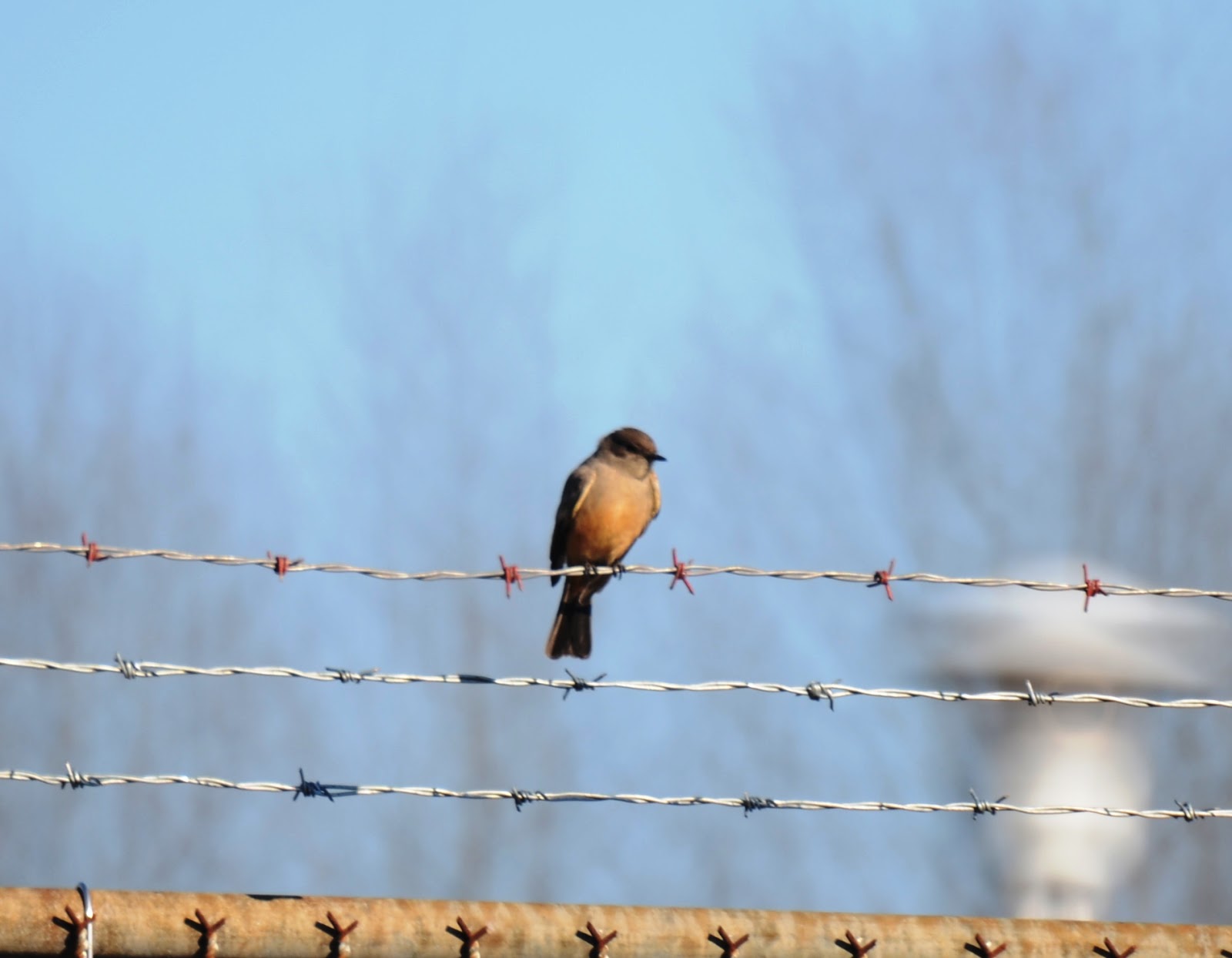
·         3 Flycatchers – 3 Ash-throated, 3 Western Pewees, 1 Say’s Phoebe
Then there were the odds and ends like small flocks of Yellow-headed Blackbirds, Great-tailed Grackles, Siskins, American Goldfinches, Chipping Sparrows, etc.

Next stop was at a nearby oasis called Conoco Pond – this appeared to be a natural artesian pond with tules and surrounded by some deciduous trees.  With a quick walk into the pond I heard another Catbird calling from the brush and a handful of migrants in the trees.  The first warbler I spotted was a Nashville (#13) – I saw 2 others later.  The trees had a number of Yellow-rumps, Wilson’s, and Orange-crowns, along with Western Tanagers and Orioles here and there.  I bet this spot was hopping at dawn as well.  One area had a number of White-crowned Sparrows foraging on the ground, which were joined by a single Clay-colored Sparrow (#14).  As I was turning the car around to leave I noticed a bird in the trees a short distance ahead with a lemon-yellow wash below.  Thinking it was just another tanager I looked at it in the binocs through the windshield and realized it was warbler/vireo sized.  So I hopped and got great views of a Philadelphia Vireo (#15)!  Another rarity.  What a day.  My Philly Vireo map is really spotty – it’s not an easy bird in most of the east let alone as a rarity in the west.


Next stop was off to Chaparral Park in Lovington.  This is a large town park with a number of widely spaced trees and a lake.  I was way behind on my schedule so wasn’t planning to spend too much time there, and was pretty much thinking I had found all the migrant passerine species I was likely to get for the day.  So I headed to the lake to try for shorebirds.  I scanned the water’s edge and only found a few Spotted Sandpipers.  But then I noticed a smaller darker bird at the waterline – bobbing up and down – it was a Northern Waterthrush (#16), giving me great views to make sure it wasn’t a Louisiana.  After high fiving myself over finding yet another rarity, I realized there were a number of warblers in the trees overhead – mostly Audubon’s, Yellows, Wilson’s and Orange-crowns.  I was about to leave the lake when I saw some movement ahead in a reasonably bare tree – and without binoculars I realized it was a Black-and-White Warbler (#17).  A beautiful male that was searching for food on the bark of the branches.  NM is now my 3rd western state for this eastern species.


Now I was really leaving the lake and flushed 2 small peeps which returned to land virtually at my feet – 2 Semipalmated Sandpipers (#18).  They were later joined by a Western and a couple Leasts for good comparisons.

The next stop was to be the Lovington sewage treatment plant adjacent to the park.  But the gate was closed – too bad since that is supposed to be the best shorebird habitat in the county.  While I was standing at the gate wondering if there was some other access point, 2 Black-necked Stilts flew out of the plant.  Oh well, next time. 

I decided to skip the Eunice cemetery which was to be the next stop since I was there the day before without much luck, and Stephen’s Park in Eunice.  Instead I headed to the southeast corner of the state and the town of Jal, which is to be the best area for Scissor-tailed Flycatchers.  Sure enough a few miles north of Jal I saw a couple along the wires (#19).  I’ve now seen NM in each of the states in its regular breeding range, along with FL as a wintering bird, TN and KY as an expanding breeder, and MD and MA as a regular eastern vagrant.


The last stop was the Jal town park, which like Chaparral Park has a few trees and a good-sized lake.  The first place I headed to was the lake again to look for shorebirds.  En route I walked past the obligatory flock of domestic ducks and geese, but stopped in my tracks when I noticed a wild Snow Goose in the flock.  And it was next to a wild White-fronted Goose (#20).  I was able to get this photo holding my iPhone up to my binoculars.  Quite a number of times now I've found late lingering migrant geese in with domestic ducks/geese in town parks.  Also at the park was one lone Least Tern.  Although not a new statebird for me, a good one for NM. 


In my roughly 5 hours of birding I saw 88 species, 20 of which were new for my NM statelist.  And of course many of them were rarities for this location.  What a day!  And now with 252 on my NM list, I’m just 12 shy of the recent ABA reporting threshold for the state.

Friday, November 30, 2012

Calliope and Broad-Billed Hummingbirds, Houston, Texas, November 2012

In preparing for a business trip I typically check the local listserves to see if any rarities are being seen nearby.  In advance of my November trip to Houston I noticed that both a Calliope and a Broad-Billed Hummingbird were being seen in Russ Pitman Park right in Houston – both would be new for my TX list.  After a little internet searching I found that the park was only 10 minutes from my hotel, and was quite tiny.  And with good local information from the listserve it seemed like a no-brainer to give it a try before work one morning.

I arrived at the park at 6:40 AM – about 20 minutes before dawn but definitely bright enough to see if any hummingbirds were around.  A cold front had come through the day before and it was in the mid 40’s which was quite cold for Houston.  I only had until about 8:00 before heading off to work, so I was a bit worried that the hummers wouldn’t start their visits in the cold morning temperatures before I had to leave.  Nonetheless, I situated myself close to a bed of shrimp plants near the entrance of the park where the Calliope was apparently most reliable, and waited.  As the time passed I picked up a few good birds like a flyover Pine Siskin, a calling Bobwhite, a Wilson’s Warbler, and a calling Monk Parakeet, but no hummingbirds.  Finally at 7:40 I heard sharp chip notes of a hummingbird coming from a short distance away.  [Many of the wintering hummers I’ve seen have been quite vocal.]  It took me a couple minutes to finally find the Calliope perched in a small tree just a few feet from the flowers - a stunning adult male!  Over the next several minutes it visited the flowers a couple times, always returning to the same perch.  Since it was being so cooperative, I spent a couple minutes trying to take some photos of the bird holding my iPhone up against my binocs.  The best of my miserable pictures is pasted in below – probably would have turned out better if it had perched in the sun. 


A short time later another birder arrived and I was able to get him on the Calliope.  He mentioned that the Broad-billed was most reliable at other patches of shrimp plants in the tiny park, and he gave me directions to those spots.  I decided to head to one patch that was likely in the warm early morning sun, and as soon as I arrived I heard an unfamiliar double-note chattering sound – it was the Broad-Billed!  The bird looked gigantic compared to the tiny Calliope.  It was a young male bird – grayish below with a little blue color in the throat, broad white eye stripe, and only restricted red at the base of the bill.  A long way from adult plumage, but still an attractive bird.  I watched it feed there for a couple minutes, at which point it flew low directly over my head in the general direction of a second patch of shrimp plants.  So I walked over to that garden and I instantly found the bird chipping away there too.  I looked at my watch – it was exactly 8:00.  Perfect timing to add 2 statebirds to my TX list and still be at my first work meeting on time.

My statebird maps for these hummingbirds are starting to show the pattern of vagrancy that these and most of the other hummers exhibit.  I’ve seen Calliope in 10 states – 7 are in its normal range in the west and now 3 are in Gulf Coast or Eastern states.   

And I now have Broad-billed in 6 states –only 1 is in its normal range (AZ).

That gives me 12 species of hummingbirds in Texas – 1 more than for my Arizona list.  And my total Texas statelist is 412 which is my largest single state total.  However, a better way to rank the statelists is to compare them by their relative percentages of the ABA reporting thresholds.  In that regard, I have 8 statelists that are a higher percentage of the ABA reportable limits, led by NH at 175% of reportable compared to TX at 131% of reportable.

Great Cormorant and Hoary Redpoll, Vermont, November 2012

Much of the best birding in Vermont is in the northwestern part of the state at or close to Lake Champlain, which is a long drive from home.  Only occasionally does a possible new statebird show up much closer in southern or eastern VT.  So of course I had to chase after a Great Cormorant when it was found in eastern VT in Windsor in a small freshwater lake named Lake Runnymede.  The Cormorant was quite reliable, preferring to perch on a branch near a gazebo in the adjacent park.  Making things even more interesting was that several birders mentioned seeing a large flock of redpolls in a pumpkin field right next to the lake.  I need Hoary Redpoll for my VT list so certainly worthwhile to scan through the flock if I have time after searching for the Cormorant.

Armed with excellent micro-directions to the Cormorant I took the 2-hour drive to Windsor.  As soon as I arrived at the lake I could see the gazebo in the distance, and right next to it was a bird perched on a low snag.  With the scope I could tell it was a cormorant, and of course most likely the Great Cormorant, but since I was looking into the sun I couldn’t eliminate Double-Crested.  So I took the short walk to the gazebo to get a closer look.  En route I passed along the edge of the pumpkin field and kept my eyes and ears open for redpolls, but with no luck.  When I arrived at the gazebo I took one step inside and instantly saw the Great Cormorant sitting no more than 20 feet away.  Great views of an exceptionally rare bird in Vermont!


Great Cormorant was the 216th species that I’ve seen in all 6 New England states.  I’ve also seen this species in each Atlantic Coast state except Georgia. 

I had very limited time but thought that since I got the Cormorant so quickly I had at least a few minutes to look for redpolls.  So I went back to the pumpkin patch and quickly noticed a small flock of redpolls as they flew into some weeds in the middle of the field.  I walked out toward the birds but saw they were all Commons.  But a few seconds later a few more flew into those weeds, and then some more.  Soon there were at least 70 birds in a small patch of weeds just about 30 feet away.  A few were quite pale, so I set up the scope and had great closeup views.  The first 3 pale birds I checked all had varying amounts of dark feathers in the undertail coverts so I didn’t jump to any conclusions on them.  But then I looked up and noticed a fourth bird that was even paler.  I put that one in the scope, and with at least 3 minutes of viewing time I saw that it was paler both below and on the scapulars and wings, had pure white undertail coverts, was a bit bigger than the others, and a bit fluffier too.  The only thing that kept me from calling it a Hoary was that I couldn’t tell that it had a shorter bill.  I took a couple phone-scoped photos of the bird which unfortunately were so miserable that they were of no use for the ID.  The next day I spent some time looking at Hoary photos on line and on many their bills were not visibly shorter than the Commons.  So with that last hesitation removed, I concluded that my bird was indeed a Hoary Redpoll.  The next day I contacted Denny Abbott, my NH birding buddy, and he was able to find 2 Hoaries in the flock.

Vermont is my 8th state for Hoary Redpoll – 4 of which are in New England.  This is shaping up to be a big year for redpolls in New England, so maybe I’ll be able see them in ME and CT and sweep the region. 

Thursday, November 22, 2012

Say’s Phoebe, Penacook, NH – November 2012 – First State Record

The theme of this post is – flexibility. 

As the weekend neared my birding plans first focused on getting to Nantucket to look for the Lapwings present for several weeks.  Those plans changed when I was able to see one much more easily that was refound on the mainland in Bridgewater, MA.  So then my plans changed to travel into southern Maine to try for a Western Kingbird that had been present for some time, though the most recent post was now several days old.  I contacted Denny Abbott and made plans to meet him at his house and travel together to Biddeford, ME. 

En route to Denny’s house my phone rang and it was Denny – a Say’s Phoebe had just been found in central NH in the small town of Penacook.  A first NH state record!  No one was sure of precise directions, but I figured that I should change my route to get to Penacook and by the time I arrived directions would be available.  I got off 495, charted a route with my GPS, and soon was heading north instead of northeast to central NH.  A few minutes later I got directions to the bird’s location and was good to go.

I arrived at the Penacook sewage treatment plant within an hour of the news, and found about a half dozen birders there but no one had seen the bird for a few minutes.  It was great habitat for a flycatcher – open fields, lots of low posts to perch on, and a cattle farm and sewage treatment plant with presumably lots of insects even for mid-November.  So the bird was likely still in the area.  A few minutes later came word that the bird was respotted and I joined a group of now nearly 20 birders watching the bird cooperatively perched in the open. 


Other birds in the area included a cooperative flock of at least 30 Common Redpolls and a flyover Lapland Longspur in a flock of Horned Larks.

That was my second Say’s Phoebe for New England – my first was a MA bird in May 2003.  That gives me 348 in NH, out of a total statelist of 402.  At 87% of the total, NH is by far my best statelist.


Wednesday, November 21, 2012

Northern Lapwing, Bridgewater, MA, November 2012

Shortly after Superstorm Sandy came through, a small number of Northern Lapwings were found in the northeast, especially in MA.  These included 1 on Cape Cod and 2 on Nantucket discovered the day after the storm, and 1 seen briefly in southern Maine a couple days later.  Although the Cape Cod and Maine birds were just one-day wonders, the 2 on Nantucket are still being seen weeks later.  I sure wished I could go after the Nantucket birds, though getting to Nantucket is not a trivial endeavor consisting of a 2-hour drive to Hyannis and then an hour boat ride.  And then you still have to get transportation while on the island.  So I decided that I wouldn’t chase the Nantucket birds, despite the nearly daily posts of how reliable they are.

Then came posts on the MA listserve that 2 different Lapwings were discovered on the same day very close to each other in southeastern MA (on the mainland!) in farm fields in Bridgewater and Middleboro.  However, these posts came across the day I left for a 5-day business trip – the same business trip described in my previous post on the RI Mountain Bluebird.  So there were two mega-rarities being seen in New England that I couldn’t chase because of work.  Would the mainland Lapwings stick around till I got back like the Nantucket birds, or would they move on like the Cape Cod and Maine birds?  Both birds continued to be seen through the first 3 days of the trip.  But on day 4, there were no posts at all – negative or positive.  It’s not often that birders post negative news, so it seemed like no news was bad news.  Prompted by a request I put out on the listserve, there were two responses that no one saw the birds on day 4.  And there was negative news on day 5 as well, so the birds had likely moved on, or at least moved to other undiscovered locations.  And there had been no news on the Nantucket birds for several days.  But in this latter case, no news was just no news.  I called birders on the island and the birds were still being seen, and offers were made to pick me up on the island to get me to the lapwing spot if I came out.  That was all I needed – I made arrangements to head to Nantucket in 2 days.

The day before heading to Nantucket was my day to chase after the RI Mountain Bluebird.  After finding it in the morning, I headed over to Allen’s Pond in Dartmouth, MA to try for MA Cave Swallows.  I arrived there about noon and planned to spend a couple hours on the beach hoping for a flyby, before having to leave to get home for family commitments.  Shortly after I arrived a swallow approached me from the west – as it flew over my head I got clear views of a Tree Swallow.  Not a Cave, but any swallow in mid November is a good bird.  A couple minutes later I happened to check e-mails on my phone and someone had just posted that the Bridgewater Lapwing had just been refound!!  Instantly I started to run back to the car – or as best as you can run with a scope, binocs and camera, and wearing wellies.  But did I have enough time to get to Bridgewater, look for the bird, and still make it home on time?  On my way back to the car I plotted directions to the spot, and directions back home – I had about 90 minutes to look for the bird.  So the chase was on!

I arrived at the Bridgewater spot at 1:10 – about 50 minutes after leaving Allen’s Pond and 75 minutes after the bird was re-spotted.  There were 2 cars on the side of the road and 3 people a short distance out in the field with scopes.  A minute later I was with the birders who said they thought it was still out there behind a small rise, but hadn’t seen the bird for a couple minutes.  With a bit of repositioning there was the bird – feeding in a wet field with Ring-billed Gulls.  I snapped off a couple phone-scoped pictures of the distant bird, including one next to a Ring-bill for size comparisons.  It was great to watch it feed somewhat plover-like, including seeing the orange undertail coverts.


About 20 minutes later there was some kind of comotion off to the left and the Lapwing and most of the Ring-bills took off to the north.  I had great views of the bird in flight, seeing the black wing linings on the broad wings, and deep wingbeats that reminded me somewhat of a Green Heron or Short-eared Owl in flight.  Amazing views!  The bird dropped into the next field to the north over a tree line out of view.

That saved me the trip out to Nantucket!  Since seeng the Bridgewater bird it has once again become reliable, and the Nantucket birds continue as well.  Plus another Lapwing has been discovered in Virginia.

That was my second ever Northern Lapwing in the ABA - the first was in CT in November 2010. 


Monday, November 12, 2012

Allen’s Hummingbird, Great Barrington, MA, November 2012

For a few weeks a Selasphorus hummingbird had been coming to a feeder in Great Barrington in western MA.  Although it was originally thought to be a Rufous, a bander was called in to band it and be sure of the ID.  After reviewing the measurements it turned out to be a hatch-year male Allen’s Hummingbird.  There sure aren’t many records of Allen’s in MA.  The last one was one on the Cape a couple years ago which I missed by a day due to some poor planning on my part.  So I was happy to have a second chance to try for this very rare bird in MA.

While en route I got a call from the homeowner who said the bird was seen that morning, coming in every 20 minutes or so.  So I was cautiously optimistic when I arrived at 9:20.  At about 9:50 I saw it fly in to perch on a nearby shrub, then it fed briefly at the feeder, before flying off as it was chased away by a chickadee.  About 10 minutes later it flew back in, drank for quite a while, then perched in view in a nearby shrub for several minutes.  This was a strikingly colorful Selasphorus, including a few colorful feathers in the gorget.  Wish I could have gotten a picture.

That was my 421st species in New England.  The only other place I’ve seen Allen’s Hummingbird is southern CA.  Though I have also seen it on Santa Cruz Island which might well be a different species. 


Post Sandy Birding #3 – White Pelican in CT, November 2012

One of the more unexpected fallouts of Hurricane Sandy were a significant number of White Pelicans reported in New England – one in ME, 3 in NH, 2 in MA, and several sightings of at least 1 in CT.  I’ve only had White Pelican in MA, so all those other sightings are pretty exciting.  But most are of flybys or are otherwise not readily chaseable.  But one seemed to be quite reliable at Rocky Neck State Park in CT.  So I called my NH birding buddy Denny Abbott early in the morning and told him of the pelican sighting - he needed it for CT too.  So we hatched a plan that if the bird was seen again that morning we would make the trek south.  And sure enough the bird was reported early in the morning on the listserve, so within a few minutes Denny, Davis Finch, and I were heading south. 

With excellent directions from some local birders we went right to the correct spot in the park and instantly saw the bird.  It was sleeping in the marsh, apparently in the same spot it had been for a couple days.  Was it sick or injured due to the storm?  I’ve inserted below a couple less than exciting phone-scoped photos. 


I’ve seen White Pelican in most central and western states where it’s pretty easy to find (but what’s up with OR?), and I’ve seen it in a number of eastern states where it’s a regular wanderer. 

Post-Sandy Birding #2 – Western Kingbird, Yellow-throated Warbler, Cave Swallows – Rhode Island, November 2012

This is the second year in a row when a close brush by a hurricane has brought some good birds to New England.  Most of the best birds were seen along the CT and RI coastlines and the MA islands, including a Magnificent Frigatebird seen on the coast at the RI/MA stateline for 2 consecutive days.  That would be a key target for most New England birders – including my NH friends Denny Abbott and Davis Finch.  A Brown Pelican had also been seen there.  So we planned to meet at a park-and-ride pre-dawn and get to the RI coast by first light.

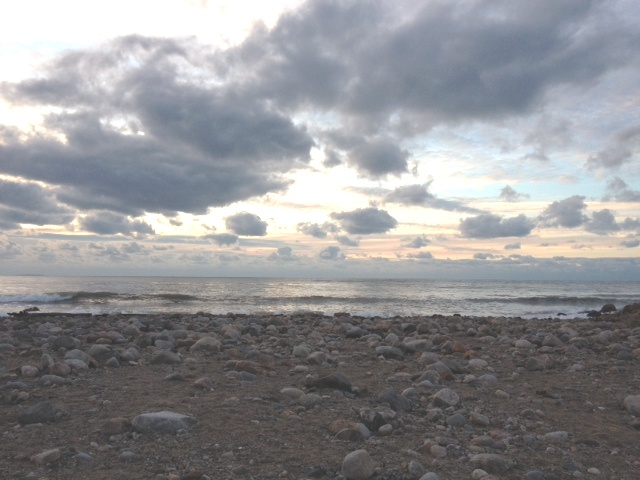
We arrived a bit before 7 AM to a spectacular sunrise, and started our vigil to await the Frigatebird.  Note all the rocks in the foreground which were pushed ashore by the hurricane. 


After a couple hours with no Frigatebird we took a walk to the east to Quicksand Pond, a large freshwater lake just barely west of the MA/RI stateline.  Soon after we arrived I picked out 1 and then 3 more distant swallows which I was able to identify as Caves.  Good birds in any New England state, though I already had them in RI.  But I need them in MA – and these birds were just a few hundred yards west of the state line and heading east.  I continued to follow them to the eastern edge of the lake when they gained a bit of altitude and I unfortunately lost sight of them.  I continued to scan the lake but they were gone so they must have gone into MA airspace.  But I never saw them in MA so can’t add them to my list.  One that got away…

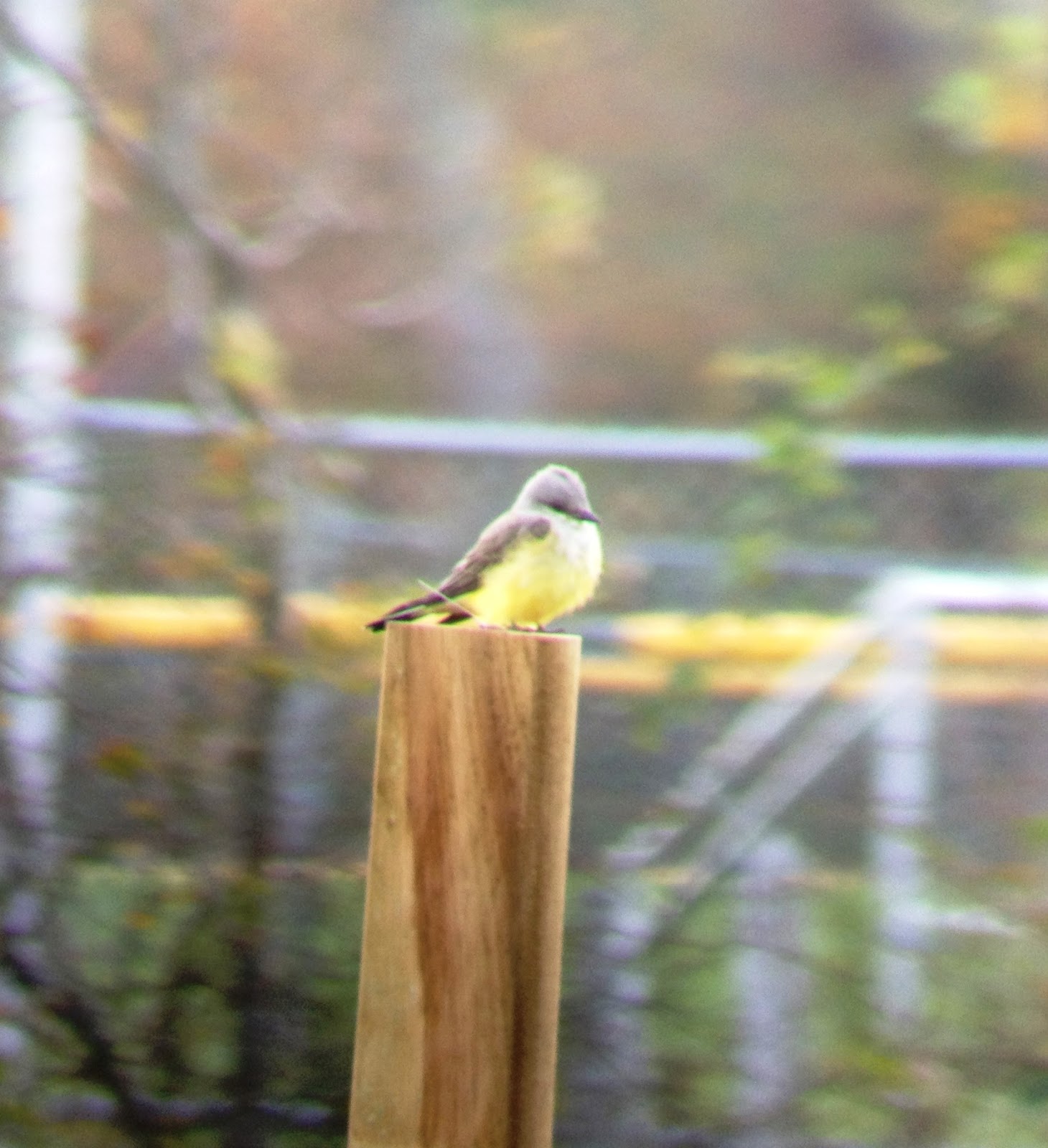
There was nothing else of interest on the coast, but there seemed to be a lot of birds moving well out to sea.  So we thought we might head to a south facing peninsula like Point Judith to check out the seabird migration.  Just after we left I got a call from local RI birder Jan St. Jean that she had just found a Western Kingbird just a short distance away in Tiverton.  A couple minutes later we caught up to Jan and she had the kingbird perched on a post along the road.  It was a most cooperative bird providing great phone-scoping opportunities.  A statebird for me and for Davis, but not for Denny.


RI is my third New England state with Western Kingbird (though I’ve also chased after it unsuccessfully in CT and ME).  I now have it in most every western state in its regular range (though OR is an obvious gap), and now 5 eastern states as a vagrant.  And Western Kingbird was #300 for me in RI!
We were just about to get back on the road when Jan got a call of a Cave Swallow at the south end of Scarborough Beach State Park in Narragansett.  A short ride later we were at the park but had no swallow.  We decided to leave the park and head to Point Judith.  But just as we did, Jan called again and said she had found a Cave Swallow at the north end of the park.  So we turned around and within a couple minutes we got great looks at a Cave Swallow right overhead, along with a Tree and 3 Barn Swallows.  A statebird for Davis, but not for Denny or me.

It was now early afternoon and we were starting to run short on time.  We discussed the options, but Denny didn’t care which choice we made because, as he put it, “There are no statebirds for me to go for.”  To which Davis reminded Denny that he shouldn’t be so negative.  Instead of heading south to Point Judith we headed north to Barrington to try for a Ruff that had been reliable for a number of days, but had not been reported since the hurricane. 

About 20 minutes after we left Scarborough Jan called yet again – there was a Yellow-throated Warbler at Scarborough within a few feet of where we had the swallows!  That would be a RI statebird for all of us!  So we turned around made our way back to Scarborough yet again.  As we arrived we could see Jan in the distance so I called her to get the micro-directions.  As she was directing us to a small group of pines here comes a small bird flying out of those trees to another couple pines – it was the Yellow-throated Warbler!  We got great views but only for a minute or so before it flew off toward another set of pines in the distance.  If we had been more than a few seconds later the bird might have flown off to that other part of the park and we might have missed it.  I’m sure Denny was happy to eat his words about not being able to get a new statebird.

That was my fifth New England state for Yellow-throated Warbler – but only my second away from a winter feeder.  I’ve now seen this species through most of its range though it would be nice to fill the gaps in NY and IN.