Sunday, January 14, 2018

2017 Birding Year Celebrating 2 Milestones – 750 in the ABA Continental Area and 50 Years of Birding


By far the biggest highlight of my birding year was reaching a big milestone – #750 in the ABA Continental area (not including Hawaii).  And it happened as I celebrated my 50th year of birding.  I also made excellent progress toward my goal of 15,000 Total Ticks in the US and Canada, and reached the old ABA reportable threshold in my 46th and 47th states.  But before summarizing my 2017 sightings, a few reflections on reaching my big life-long milestones.
 
50 Years of Birding
 
In August 1967 my parents bought me my first pair of binoculars when I was just 8 years old.  I can still remember the very first time I used them in my grandmother’s urban backyard in Baltimore, MD.  The first bird I looked at through those binoculars was probably nothing more exciting than a House Sparrow or a Starling, but my early interest in birding was sparked that day.  Soon thereafter I remember my parents buying me my first Golden Guide written by Chan Robbins which I began to study even before I left the store.  I even got it photographed by the author!  And I can also remember earning merit badges in Cub Scouts by identifying 10 species of birds. 
 
But most of what I learned in those early days I did on my own.  I grew up in a household that appreciated the outdoors, but I was the only birder in the family.  It wasn’t until I got to college that my birding skills truly blossomed, thanks to birding time with several grad students that were excellent birders.  Two memorable watershed moments were trips with one of my mentors, Jim Stasz - a summer day to coastal DE when I got 10 lifebirds; and a cold, windy winter day when we hunkered down amongst the rocks on the jetty at Ocean City, MD when Jim said something like I had just become a hardcore birder. 
 
With 50 years of birding I’ve been able to log many hours in many locations – I’ve birded in all 50 states and 9 Canadian provinces.  My statebirding interests have taken me to a lot of unique birding locations that few tourists, let alone birders, can say they’ve been to.  Some of my favorite less well-known birding locations have included –
  • Fall migration in the suburban “oases” of western KS with numerous western rarities;
  • Summer dawn chorus in the northern tip of NH;
  • Berrien County in the southwestern corner of MI with numerous “southern” breeders and migrant rarities;
  • East Point on Prince Edward Island with amazing seawatches;
  • Memphis, TN sewage lagoons birding often with the “Ol’ Coot” himself Jeff Wilson – the best field birder I’ve ever birded with;
  • The prairies of the upper Midwest with their native Sparrows and Longspurs;
  • Fall in Neah Bay, WA with a dizzying number of rarities; and
  • Winter in southwestern LA with an outstanding list of birds seemingly from any season and any geography.
 
And although I haven’t done too much international birding, I’ve birded in Brazil, England, Italy, Czech Republic, and Hong Kong over the years.  Plus Puerto Rico and Guam. 
 
And finally one of the key facets of my birding these days is to “pay forward” all that great support and advice I’ve received over the years.  I really enjoy helping other birders find that rarity that everyone is chasing after.  And I especially enjoy helping younger birders learn some of the finer points in birding.
 
Fifty years down, and fifty more to go.
 
750 in the ABA Continental Area
On 9/12/17 I saw a staked-out Common Ringed Plover at Gooseberry Neck in Westport, MA.  Not only was it a lifebird, but it was ABA #750.
 

I’d like to say that reaching 750 in the ABA Continental Area has been a long-term goal of mine.  However in reality, throughout most of my birding years, I’ve been much more focused on total ticks and state and province birding than chasing after life birds.  Only 3 times have I taken trips just to pursue potential new lifebirds –
  • 2009 trip to AZ for Sinaloa Wren, Rufous-capped Warbler, and Black-capped Gnatcatcher(Jacana was also a target for that trip but it had moved on before I could get there); 
  • 2012 AK trip adding Arctic Loon, Yellow Wagtail, Bristle-thighed Curlew, Bluethroat, and Spectacled Eider; and
  • 2013 trip to AZ for Nutting’s Flycatcher and Rosy-faced Lovebird. 
 
I’ve reached 750 without having been to Attu or Gambell to look for those tantalizing Asian vagrants.  As a result my Lower 48 list is a very respectable 729 - I’ve only seen 19 species in AK and 2 species in Canada that I haven’t seen in the Lower 48.  In a lot of ways I’m more proud of my Lower 48 total than in my ABA total.  For instance the ABA Listing Central has me in 73rd place in the Lower 48 but only 158th in ABA Continental area.  (Of course I realize that there are many birders who don’t publish their lists on the ABA site.)
 
And I’ve almost never used paid guides.  The notable exceptions being a couple AZ trips and the 2012 AK trip where guides were indeed most helpful.  I typically do my own research and often obtain micro-directions from local birders.  That intelligence has almost always proven to be invaluable.
 
The key sources of most of my new lifebirds these days have been short extensions to business trips to search for staked-out rarities.  On most of these trips I only get one new bird at a time.  For instance in 2015 I added one lifebird in each of 4 different business trips –
  • Common Crane in Roswell, NM after a business trip to Midland, TX;
  • Rustic Bunting in San Francisco prior to a business trip to the Bay Area;
  • Aplomado Falcon in Cameron County, TX before a business trip to Houston; and
  • Collared Plover in Hargill, TX following another Houston trip (though that was my second try for that bird).
 
Then there are the local extreme rarities that have not only been new ticks for one of my New England lists, but lifebirds as well.  Recent New England lifebirds include –
  • 2012 – Red-billed Tropicbird – Seal Island, ME
  • 2013 – Fieldfare – Carlisle, MA
  • 2016 – Redwing – Hollis, NH (15 minutes from my home!)
  • 2016 – Graylag Goose – East Providence, RI
  • 2017 – Common Ringed Plover – Westport, MA
And perhaps the 2017 NH Shelduck will be added to that list as well.
 
A graph of my ABA total over time, starting with my first lifelist total I recorded (140 as of June 1972), is inserted below.
 
 
750 birds over 50 years – that’s an average of 15 per year.  If only I could expect 15 more in 2018.
 
Now onto some of the highlights of 2017 -
 
New Brunswick, Nova Scotia, Prince Edward Island Total Ticks Trip
 
This was the second year in a row where my big “Total Ticks Trip” was to Canada, making a big 11-day, 10-night loop through New Brunswick, Prince Edward Island, and Nova Scotia before returning to the States on the Yarmouth- to-Portland ferry.  But before I go through any of results of this most successful trip, I have to recognize the tremendous help I received from local birders in all 3 provinces –Gilles Belliveau in New Brunswick, Dan McAskill in PEI, and Keith Lowe in Nova Scotia.  Many thanks to Gilles, Dan and Keith, without whom my trip would not have been nearly so successful!
 
The itinerary for this May/June trip was very similar to the one I took in September 2015, though of course this time it was focused on breeding birds throughout the region.  And with more time in the field in 2017, I added numerous stops, some for just 1 or 2 local specialties.  Of note, that included successful searches for several species that are near the northeastern limits of their ranges, like Black Tern, Great Crested Flycatcher, Eastern Phoebe, Baltimore Oriole, and Purple Martin.
 
With all that birding time, it was not too surprising to find several rarities, including -
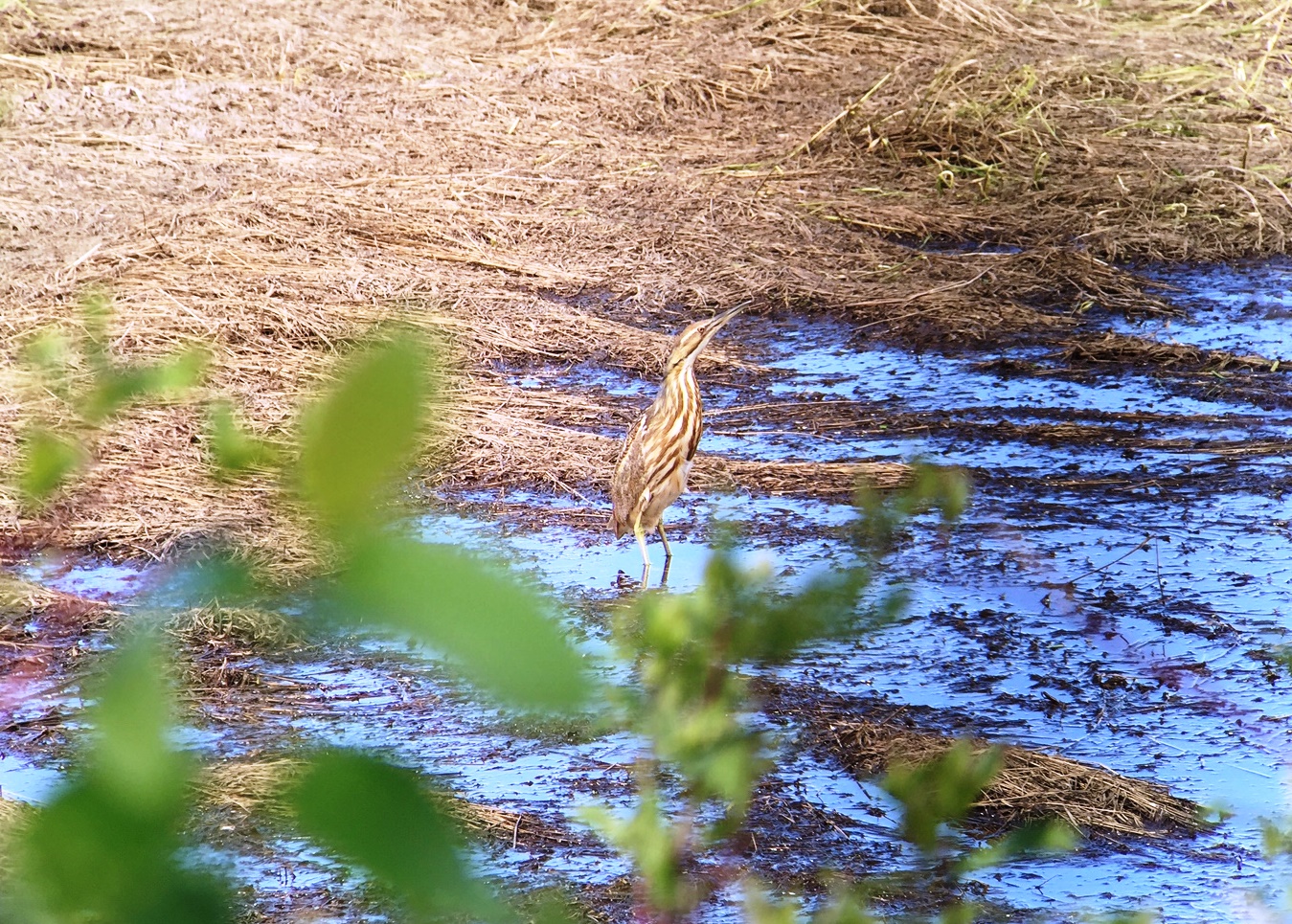
  • New Brunswick – Common Gallinule, Iceland Gull, Least Bittern
  • PEI – Wilson’s Phalarope, Little Gull, Glaucous Gull, Thick-billed Murre in a flock of Razorbills, Kittiwake
  • Nova Scotia –Glaucous Gull, Common Gallinule, South Polar Skua from the ferry
 
Perhaps at the other end of the spectrum were the species associated with urban areas or human activity in general that are common in the States but difficult to find in the Maritimes.  For instance I was able to add Killdeer (NB and NS), Nighthawk (NB and NS), Chimney Swift (NB, NS), Cowbird (NB, PEI), House Finch (NB and NS), and House Sparrow (all 3 provinces).  Maybe that’s the only time I actually got excited about finding House Sparrows!
 
I took a few pictures along the way.  Here is a phonescoped photo of the distant Wilson’s Phalarope in PEI.


And just a little while later Dan spotted this Harlequin Duck at one of my favorite birding spots, East Point in PEI.


And although not rarities, these New Brunswick birds were most cooperative.


I would be remiss if I didn’t throw in a couple scenery shots, like these from the Liscomb River and the West River in Nova Scotia.


Then there was spot in Jolicure, New Brunswick which is a local stronghold for House Sparrows – a spot where only House Sparrows would be at home. 


Leaving the best for last - my favorite picture was this one at the Sackville waterfowl park in New Brunswick.


The trip by the numbers -
  • 193 new ticks, greatly exceeding my goals of 133 for the 3 provinces, and a remarkable 70% of my targets. 
  • 175 species including 21 warblers and 20 waterfowl.
  • Excellent boreal species including Gray Jays in 2 provinces, Boreal Chickadees in 2 provinces, Philadelphia Vireos, Red Crossbills in 2 provinces, and multiple White-winged Crossbills.  Though I couldn’t find Spruce Grouse or Black-backed Woodpeckers.
  • 13 new species for Canada
  • 60 miles walked (according to my Fitbit)
  • Ticks in 3 provinces in 1 day (started the day birding in NS, then added my last tick in NB, then birded the evening in PEI).  Only twice before have I added ticks in 3 jurisdictions in 1 day – TN, AR, and MS; and MA, NH, and ME.
 
Smaller Statebirding Trips
 
In addition to my big total ticks trip I added birds in 12 states outside of New England, most with short additions to work trips across the country.  That included adding 2 new ABA reportable states in 2017, while on other trips I was just trying to fill in gaps in my statelists, frequently using eBird Needs Alerts as an invaluable tool.  Highlights included –
 
Iowa and South Dakota, May – A rare business trip to Minneapolis provided an opportunity to bird in both IA and SD near the height of spring migration.  I was 3 below the old ABA reportable threshold in IA, and 13 below the SD threshold, both of which seemed to be within reach with a bit of effort.  My “Reportable Plus 15” goal (my somewhat arbitrary goal of at least 15 over the old ABA threshold) would be a bigger stretch, but I also hoped to reach those higher goals in both states.
 
In IA I contacted local birders Lee Schoenewe and Joe Jungers who had been so instrumental in helping me find my targets in northwestern IA during my July 2016 trip.  I teamed up with Lee and Joe on an amazing day and a half of birding resulting in 24 new IA statebirds (compared to a goal of 18) and a total of 143 species.  Some of my favorite sightings were a migrant flock of about 50 Golden Plovers flying over a farmfield, and seeing nearly 1,000 migrant Black Terns throughout the 2 days.  My new IA statelist is now at 232 – 21 over the old reportable threshold and 18 over a newly calculated threshold based on the present IA state list. 
 
Our IA results were so good that I shortened the IA portion of the trip to be able to spend more time in eastern SD.  That additional time would prove to be most helpful given the weather forecast – rain, strong north winds, and cold temperatures, for the entire next 3 days!  Certainly not conducive for finding many migrant passerines.  While doing my SD research I connected up with SD birder David Swanson who was in the process of publishing a guide to birding in SD.  David forwarded me site guides for many of the sites I planned to visit which proved to be most valuable supplementing eBird reports.  Despite extremely challenging weather (wind chills as low as the 20’s at times) I ended up with 150 species in SD, 36 of which were new for my statelist – most of which I had to work hard for.  Some of the highlights included –
  • Least Terns and Piping Plovers on sandbars on the Missouri River;
  • A migrant flock of 4 species of Terns – Forster’s, Common, Black, and Caspian;
  • A flock of 15 Hudsonian Godwits in a wet field (interestingly finding migrant shorebirds was tough because they were too spread out among the many flooded fields) ; and
  • A Lazuli Bunting rare in eastern SD but not new to my SD statelist.
 
That makes IA and SD my 46th and 47th states over the old ABA threshold, and my 39th and 40th states over my Reportable Plus 15 goal.  Combining my IA and NE results, I added 61 new statebirds on the trip, and had an amazing 178 species total.  That includes 20 species of shorebirds, and 21 warbler species.  Excellent results for a short 5-day trip under difficult weather conditions.
 
Louisiana, Multiple Short Trips – I had several work trips to the New Orleans area in 2017, plus birded in southwestern LA as extensions to a couple Houston trips.  These trips netted 20 new birds for my LA list, featuring quite a number of stakeout rarities, though several were just regular species that filled key gaps in my statelist.  Highlights included -
  • 7 Flycatcher species over 2 trips in January and February – Eastern Phoebe, Say’s Phoebe, Scissor-tailed, Vermillion, Couch’s Kingbird, Brown-crested, and Ash-throated (I missed the Western Kingbird)
  • 5 hummingbird species in February at Donna Dittmann’s and Steve Cardiff’s property outside Baton Rouge - Ruby-throated, Black-chinned, Rufous, Buff-bellied, and my first Calliope
  • Yellow Rail near Thornwell in November – flushed from a tractor cutting a grassy field (I couldn’t find any rice fields being harvested)
  • Finding a rare Wood Thrush in January (but not a new statebird)
  • Brown Booby along the Lake Pontchartrain Causeway in November – on my 9th try!
 
Here is a phonescoped photo of the Couch’s Kingbird, and a miserable shot of the Brown-crested Flycatcher, though it provided a definitive view of the under-tail pattern.


California Bay Area Rarities – With the help of eBird Needs Alerts, short extensions to business trips to the Bay Area netted 5 new ticks –
  • Glaucous Gull, Lesser Black-backed Gull, and Red-naped Sapsucker in March
  • Baird’s Sandpiper and a Gannet (on my second try) in August
Here is a phonescoped photo of 1 of my 2 Glaucous Gulls.


Plus a trip to the LA area which didn’t net any new birds, but did include a very cooperative Ridgeway’s Rail.


Texas Targets near Houston – I have nearly monthly business trips to Houston, and for most trips in the cooler months I try to add at least a little time to fill some gaps in my statelist.  Trips in 2017 featured Pacific Loon, Black Rail, and Nelson’s Sparrow in Galveston; Bachman’s Sparrow in Boykin Springs; and a rare Swainson’s Warbler close to Houston.  Plus somehow I had overlooked a reliable colony of Red-cockaded Woodpeckers close to the Bush Airport in Houston, which I saw in February.  Just goes to show that even though I have over 430 birds on my TX list, there are still some pretty easy targets to pursue.
 
Mississippi Coastal Low-hanging Fruit – A quick business trip to the MS coast in May gave me a short window of free time one late afternoon and evening.  I had a pretty good list in MS, but somehow I lacked a fair number of pretty easy birds at or close to the coast.  I came up with 8 feasible target birds - 3 on the coast (American Oystercatcher, Sandwich Tern, and Seaside Sparrow); 2 generally a bit inland (Black-bellied Whistling-Duck, and Anhinga) and 3 even farther inland (Chuck-will’s-Widow, Red-cockaded Woodpecker, and Bachman’s Sparrow) luckily all in the same general location at DeSoto National Forest.  Amazingly, this turned out to be one of my most successful birding trips ever, finding 7 of my 8 targets (only missing the Oystercatcher).  In fact, given my limited time, I wasn’t even sure that I’d have time to try for all 8 of the targets.  Here are photos of some of the birds in the Red-cockaded Woodpecker colony – one bird foraging high in the pines and another at an active nest illuminated by the setting sun.


Mid-Atlantic Opportunistic Birding – Several trips to visit relatives in MD yielded chances to chase after a few new statebirds nearby.  Most were species that are now regular but were less likely when I was growing up in the region, or were otherwise just gaps in my statelists, like –
  • Cackling Goose, Ross’s Goose, and Trumpeter Swan in MD;
  • Cackling Goose, Common Merganser, Sandhill Crane, Black-capped Chickadee, and Raven in DE; and
  • Redhead in PA
Then there were 2 rarities that just happened to be around when I got to MD which I was lucky enough to be able to chase after successfully – Black-throated Gray Warbler and Shiny Cowbird.
 
All in all some nice additions to my already pretty good lists in the region.
 
New England Birding
 
Even though I reached my goal of 2,000 total ticks in New England 2 years ago, I continue to spend a lot of time chasing after rarities in the 6 New England states.  In 2017 I was successful in finding 15 of the 21 the birds I chased after (71%), including a lifebird – Common Ringed Plover in Westport, MA.  Then there was the long-staying Shelduck in NH which I haven’t counted, but could become a lifebird if accepted by the NH Rare Bird Committee. 


Plus I found 2 pretty significant rarities on my own – Sabine’s Gull in VT (and NY), and South Polar Skua in RI.  On the negative side, I had to subtract Thayer’s Gull from 5 of my New England statelists.  Even without subtracting the Gull, my 16 new birds was by far my lowest total in any year since I moved to MA in 1993.  This continues the downward trend started in 2016.  I guess I’m a victim of my own success. 
 
Total Ticks
 
With 193 ticks in Canada and another 125 ticks in the US in 2017, and adding my whopping total of 7 in Hawaii (now in the ABA), that increased my total ticks to an even 14,500.  I’m well on my way to my goal of 15,000 with a manageable 500 to go.  As of January 1st my list continues to be the highest reported on the ABA website – a lead of more than 900.
 
ABA Area Totals
 
  • A net of 1 new ABA lifebird –
    • Common Ringed Plover – Westport, MA
    • Cassia Crossbill - an ABA split from Red Crossbill, based on birds I saw and heard in the South Hills of ID in 2012
    • Removal of Thayer’s Gull as a result of an ABA lump with Iceland Gull
  • ABA Continental (not including Hawaii) total at 750
  • ABA (including Hawaii) total of 753
  • Lower 48 at 729
  • US (including Hawaii) at 754
  • Canada at 369
 
State and Province Birding Totals (see my statebird and province maps below with totals for each state and province) -
  • ABA reportable in 46 states plus DC (adding 2 in 2017)
  • “Reportable Plus 15” in 39 states plus DC (adding 2 in 2017)
  • 325 new state birds and province birds.  New ticks in 17 states and 3 provinces.
  • 11 new statebirds in New England (16 new birds added less 5 for the Thayer’s Gull lump) – 2,055 total ticks now in New England
  • Total Ticks – now at 14,500, with 13,153 of those in the U.S.


2018 and Beyond
 
I’m continuing to work on 2 big goals – 15,000 Total Ticks, and Reportable Plus 15 throughout the Lower 48 states.  The latter goal includes being reportable in my last 2 remaining Lower 48 states (MT and OR).  Here’s a possible path to reach all these goals -
  • Lower 48 Reportable Plus 15 - I only have 9 states left in the Lower 48 where I haven’t reached Reportable Plus 15.  Reaching that goal in each of those states would add 119 ticks (I only need an average of 13 birds per state). 
  • Hawaii – now that Hawaii is part of the ABA, even a short tourist-related trip could add 33 ticks to increase my state total to 40.
  • New England – I think I can realistically get at least 12 new ticks per year.
  • Canada – If I got to 125 each in Saskatchewan, Manitoba, and Newfoundland, plus 50 in Saint Pierre et Miguelon; that would give me 337 more ticks. 
If I could reach all these goals, likely over the next 4 years, that would give me 537 new ticks, or 15,037 total ticks.  Not to mention I’ll undoubtedly add a few additional ticks here and there.  All in all quite feasible with a little travel.
 
That would require only about 4 or 5 big trips to reach most all of these goals –
  • Eastern OR and southern ID,
  • Western MT and the panhandle of ID,
  • Canadian prairies of Saskatchewan and Manitoba along with North Dakota (or is that 2 trips?), and
  • Maritimes of Newfoundland and Saint Pierre et Miguelon.
 
Finally, with a lot of business travel across the country, I’ll likely continue to do some opportunistic chasing of statebirds and lifers with an extra vacation day or two.  And this year I might finally head to south FL to pursue Purple Swamphen and Egyptian Goose, both not-so-new additions to the ABA list.  (I’ve seen both in FL but before the ABA deemed they were countable.)   And speaking of new ABA additions, we will all have to watch pending lumps and splits in the New Year to see how they affect our lists, crossing our fingers for more splits than lumps.


Thursday, December 28, 2017

Snowy Search Yields one RI Rarity but not Two, December 2017


With a quick scan of late evening e-mails I noticed reports of a Le Conte’s Sparrow seen that morning in Warren, RI by local resident Tom Seiter.  Three times I’ve chased after Le Conte’s Sparrow in late fall or winter in New England and each time the bird stuck around for a while.  So I was hopeful that this one might too.  I couldn’t head out the next day but could go on the third day, so I closely watched for updates.  Unfortunately the only update that came across was that there was no available parking in the area.  That likely meant that few if any birders gave it a try, so there were no further updates on the status of the Sparrow that day.

Then later that day came a post that there was a White-winged Dove coming to a feeder at the Norman Bird Sanctuary in Middletown, RI – only the 4th record for RI.  With multiple posts during the day it appeared that the Dove was being seen reliably at the feeder.  Middletown is less than a half hour’s drive from Warren, so it would certainly be feasible to chase after both the Le Conte’s and the Dove the next day.  However, White-winged Doves are often 1-day wonders in New England.  Although I’ve seen this species twice in New England which were long-staying birds in MA and CT, I’ve chased after two different birds in NH and two others in ME unsuccessfully.  And there were no positive reports on the Sparrow, though at least that species has a track record of staying around for a while. 

Hmm, what to do…  Despite some misgivings, I decided to try for both birds the next day.  And with a quick e-mail exchange from Tom, he agreed to meet me the next morning to search for the Sparrow, greatly increasing my chances for his bird.  I would start early morning in Warren to try for the Le Conte’s, then head south to the Norman Bird Sanctuary to try for the Dove.  Although I tried to stay positive and hope for 2 new RI birds, I was realistically expecting just 1, and realized that there was more than a fair chance that I could miss both targets. 

As I headed out the door the next morning I made one last check of the forecast - seasonably cold weather, light winds, with maybe a quick hit of an inch of snow in southern RI.  That would certainly be manageable.  Though as I started my drive south I ran into light snow in southern MA.  And by the time I hit northern RI the roads were already white.  When I finally made it to Warren a couple inches had fallen and it was still coming down quite hard.  I made it to Tom’s house and his unplowed road was quite a challenge.  But snow on the roads was likely to be a minor problem compared to looking for a skulking Sparrow with a deep snow cover on the ground.  We walked down to the marsh where Tom had seen the sparrow and now had a good 3 inches of snow covering the ground.  We started to walk along the marsh edges where he had the bird 2 days earlier but with no luck.  We were soon joined by 4 other birders, and all of us first walked along the edges, then trudged through the adjacent marsh, but didn’t see a single bird.  I also tried to play some tape of the Le Conte’s call note (the bird I saw in ME was quite tape responsive) but got no replies.  After about an hour we called it quits.  Maybe the bird was still around and skulking under the new snow.  Or then again, maybe it was just a 1-day wonder.

And speaking of 1-day wonders, as I headed back to my car I checked my e-mails to see if the White-winged Dove had been reported that morning.  But there were no posts at all.  Typically no news was bad news, though I tried to be optimistic - it was still early and maybe the snow had deterred birders from looking for it that morning.  Plus maybe everyone who wanted to add it to their RI state lists had already seen it the day before.  So I called the Sanctuary to ask for updates but they said that no one had looked for the Dove yet.  At least that wasn’t a negative report.  So I started the drive south luckily with just lighter snow falling.

The previous day the Dove was always seen at or above the feeder to the right of the walkway as you headed to the welcome center.  This feeding station was obvious when I got to the Sanctuary, but the only birds in the area were 5 Crows.  So after a quick look I headed in to the main building to check in, and to ask if anyone had seen the Dove yet.  The good news was that the bird had indeed been seen that morning, but it was seen all around the building not just at the feeder at the entrance. 

I headed back out and checked the entrance feeder east of the building but it still just had Crows.  Then I headed around to the south and found another feeding station with a bunch of birds, including a couple Mourning Doves, but no White-winged Dove.  I noticed more activity behind the building to the west, and found yet another feeder with more activity, and another Mourning Dove.  But still no target bird.  Now I understood why the Dove could be seen all around the building.  Now I just needed to re-find it. 

I retraced my steps and returned to the south of the building and watched that feeder for a couple minutes.  Then I noticed a large bird fly in to the top of a tree on the other side of the building.  I knew right away that was a Dove, but it took a few seconds to see enough field marks to confirm it was my target White-winged Dove.  Wonder where it flew in from?  Just a couple seconds later it dropped down out of view near the east feeder.  I headed back there and spotted it again perched above the feeder it frequented yesterday.  Then a couple minutes later it flew back behind the building to the west.  After a bit of searching I spotted the White-winged Dove perched deep inside a honeysuckle thicket just below a Mourning Dove.  I got this photo of both Doves by holding my phone up to my binocs.  Unfortunately the White-winged had just fallen asleep so I missed getting a shot of the bird’s red iris.


Good thing at least one of my targets wasn’t a 1-day wonder!  Though a bit surprising that the target that has a track record of sticking around was the one that couldn’t be re-found.  The White-winged Dove was #328 for me in RI, which was my 17th state for this species.  I’ve now seen it in most of the southwestern and Gulf Coast states in its normal range, and now in several Midwest and New England states where it is a rare but regular vagrant (see my statebird map below).


And on a bigger picture note – that was my Total Tick #14,500.  If you’re unfamiliar with the term, “Total Ticks” is the sum of your state and province lists.  Many years ago I hoped to get to 10,000 Total Ticks but blew by that milestone back in 2003.  More recently I’ve set my eyes on 15,000 – just 500 more to go!

Sunday, December 24, 2017

Shiny Cowbird, Bethesda, MD – First State Record, December 2017


Having grown up in MD my state list is pretty good at 329.  And with relatives still in MD, visits with the family can sometimes provide opportunities to add to that list, though target birds pretty much have to be rarities at this point.  A few days before a December trip to Baltimore I set up a Maryland Needs Alert in eBird.  Several species popped up, though most were too far away to try for given my small windows of available time.  But then at the bottom of the list I noticed numerous posts of a Shiny Cowbird being seen in Bethesda, MD, just north of DC.  Reports went back at least 3 weeks so the bird appeared to be rather reliable.  And Bethesda wasn’t too far from the BWI Airport.  So with a species as rare as this one (a first record for MD), I made plans to make a quick stop to try for the Cowbird before heading to the airport on my last day in MD.

Now I needed to compile the micro-directions.  The Cowbird was being seen in a small suburban neighborhood, and many sightings were of the bird perched high in a tree.  In most cases the Shiny Cowbird was associating with groups of Brown-headed Cowbirds.  And perhaps most importantly, recent sightings mentioned that the target bird was re-growing all of its tail feathers, so its tail was now much shorter than normal.  Several specific locations were mentioned, though access appeared to be limited.  Several posts mentioned seeing the bird from the driveway of the birder who first spotted the bird at 9901 Parkwood.  And 4804 Edgefield was mentioned several times.  Plus a feeder in the front yard of 9918 Parkwood was mentioned once.  So my plan was to at least bird these 3 locations, keeping an eye out for Cowbirds in general.  And needless to say my goal was to not get arrested peering into suburban backyards with binoculars.

I arrived at the neighborhood midday and instantly spotted 3 birders up ahead on Parkwood.  They mentioned that the bird had been seen a few minutes earlier, but was not visible now.  They also suggested that going over to Edgefield was best at this point.  A minute later I parked on Edgefield and found another small group of birders in front of 4804 Edgefield.  They provided a similar story – they had the bird earlier but not at the moment.  As we all waited for the Shiny Cowbird to reappear, I began to see lots of activity around this house.  Several times small groups of Brown-headed Cowbirds would fly in above the house, and then drop down in the backyard.  There must be feeders in the back, but the yard was not visible from the road.  Now I started to understand why many of the sightings were of the bird high in trees – it must be flying in from elsewhere, perching momentarily above the feeders when birders spot it, then dropping out of sight to feed.

We continued to wait for at least 30 minutes, and had lots of activity but now Shiny Cowbird.  I decided to walk over to Parkwood to see if my luck was any better there, trading cellphone numbers with a birder remaining at Edgefield in case the bird was spotted.  When I got to 9901 Parkwood I noticed a feeder in the back yard with a few House Sparrows and 1 Brown-headed Cowbird, but little activity in general.  Then I walked to 9918 Parkwood and found the feeders in the front yard but there were no birds at all.  So I returned to 9901 Parkwood to wait a bit longer there.  A couple minutes later a flock of about 10 Cowbirds flew in to a tree a short distance away – could the Shiny be in this group?  I scanned the group but they all looked like Brown-headed’s.  One by one they dropped down out of view into a thick stand of bamboo apparently near the backyard of 4804 Edgefield.  With just a couple birds left from that flock still perched in the tree I noticed that one bird had a short tail – and it was all dark including its head – I had the Shiny Cowbird!  Just then it too dropped down into the bamboo.  I called the birder back at Edgefield and told him I just had the bird, and it likely just dropped into their general location.  He responded by saying that they got access to the backyard with all the feeders so they would be waiting for it.

I quickly ran over to 4804 Edgefield and found out that one of the birders talked to the homeowner, and she was fine with us sitting in her back yard to watch the feeders.  I joined 3 other birders behind the house and found multiple feeding stations full of seed.  Within a minute a flock of Cowbirds dropped in and one was the Shiny Cowbird.  The flock was very skittish, but the target bird kept returning, and each time the easiest way to pick it out among its Brown-headed cousins was to look for the Shiny’s shorter tail. 

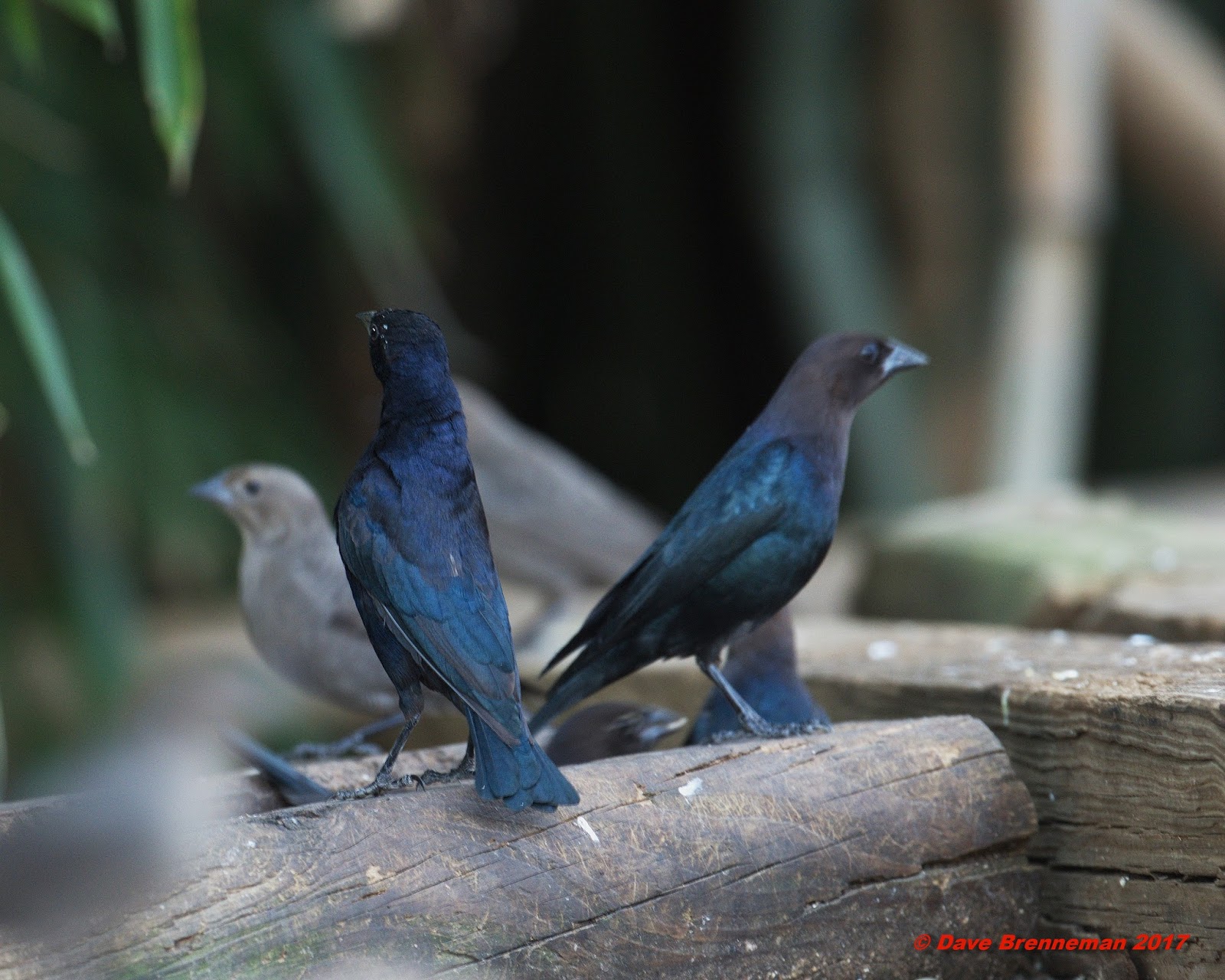
One of the birders I met there, Dave Brenneman, had a monster lens and he took numerous shots of the bird.  He shared this one with me, providing great comparisons with a male Brown-headed, not only showing the iridescent purple head of the Shiny Cowbird, but also its shorter tail. 


A couple minutes later I was back in my car and heading to the airport with plenty of time to spare.  On my way I reflected on what turned out to be a very satisfying chase – finding the target bird after about an hour’s search, and eventually getting great looks at an extreme rarity. 

That was my third sighting of Shiny Cowbird in the ABA area – I’ve also seen it in south FL and in LA where it is reported with increasing frequency these days.  All our local passerines need is yet another species of parasitic Cowbird to contend with.

Saturday, December 23, 2017

King Eider, Lake Champlain, VT (and NY), November, 2017


Either Eider is a rarity in VT, so when a female Common Eider was reported in mid-November at the Champlain Bridge on Lake Champlain that really got my attention.  Then later in the day came additional posts that the bird was actually a King Eider.  And then a couple days later the news got even better - a pair of King Eiders, a female and young male, were spotted a short distance to the north from the DAR State Park in Addison.  King Eider is an exceptionally rare bird in Vermont, with sightings not surprisingly mostly coming from Lake Champlain.  There are only 5 records in eBird since 1990, with the most recent being birds seen at two different spots on the lake in 2006.  Given how rare this species is in this inland state, it sure would be great to chase after them.  But that’s more than 3 ½ hours from home which is beyond my normal driving distance, so I decided to pass on them.

As the days progressed, sightings of the Eiders continued both on the listserve and eBird- they were sticking around!  And with each additional post I got more and more interested in trying for them.  Then finally I decided to make the run up there, opting to get a rental car (using one of my free days), rather than putting all those miles on my car.  Now I needed to do some research to get the micro-directions.  All the recent sightings were similar – the pair of Eiders were sticking closely together, and they were most often associating with a flock of about 30 Long-tailed Ducks.  (Those are rare birds for VT as well, though not nearly as rare as the Eiders.)  Seemed easy enough – look for the Long-tailed Ducks and you would find the Eiders, right?  One challenge was the reports from the day before my trip said the Eiders were way out on the lake, maybe in NY waters.  As a result I was less worried about finding my target birds than I was in finding them in VT (I already have King Eider for my NY list).

The day of my trip finally arrived and the weather was quite good – not too cold and only light breezes from the south.  That should make for good viewing conditions even if the birds were far out on the lake.  I arrived at the closed gate to DAR (the park is closed this time of year), parked on the shoulder, and started the short walk to the lake.  Although there was another person in the park, he wasn’t a birder, so I was on my own.  I set up my scope and casually scanned the lake but could only find a small flock of Mallards.  I scanned 2 or 3 more times, each time looking more closely than the previous search, but still came up empty. 

My vantage point next to a picnic shelter a short distance above the lake gave me a great view of most of the lake, but I couldn’t see too far to the north.  I remembered passing a sign for a trail to the shore, so I decided to take that trail to see if it gave me a different viewing angle.  The trail ended right at the shoreline, and it gave me views directly west and most importantly to the north, so I was hopeful I would find my targets.  Though now down low to the lake meant I had to deal with some heat shimmer.  But despite my different viewing angle, my scans again were not only negative for the Eiders, but I found no waterfowl at all.  Then finally on the next scan I thought I noticed tiny white dots far out on the water.  I concentrated on this area and eventually realized these were the reported flock of Long-tailed Ducks – so the Eiders couldn’t be far away.  After a couple more anxious minutes of peering across the lake I finally noticed a couple larger brown ducks close to the Long-tails.  They were really far away, but eventually I got some details on the birds, including the orange bill of the young male, and confirmed they were indeed the King Eiders.  Amazing that they were still around more than 2 weeks after first being seen off DAR.  Success, but - they were so far out that I thought that they were in NY and not VT. 

The birds were slowly making their way to the south which should make them visible from my original viewing spot.  And from that higher vantage point I would have less heat shimmer to deal with so maybe that was now the better vantage point.  So I headed back to the first spot and eventually re-found the Eiders.  Viewing was indeed better from here, and the Eiders were not only swimming south, but also a bit to the east.  Three other birders arrived, and I was able to get them on the birds, though the extreme distance made it difficult.  Over the next 30 minutes the birds continued to move a bit south and east, and all of us agreed the Eiders were eventually in VT waters, though still pretty far out.  I could finally check King Eider off my VT list.  But perhaps the crowning moment of my visit was when a group of high school students arrived on a science field trip and we were able to get all of them on the birds.  Even though they likely didn’t appreciate how rare these birds were, their reactions when they finally spotted the birds in the scopes were priceless.

King Eider was #281 for my VT list, and the 247th species I’ve seen in each of the 6 New England states.  I’ve also seen this species in 5 other northeast states as well as in AK (see my statebird map below).


As a postscript, I and the other birders at DAR that morning started to theorize about why the Eiders had stayed in this area so long.  And also why such a large flock of rare Long-tailed Ducks were in the area as well.  The local birders suggested that this spot must be a good feeding area for Zebra Mussels.  Perhaps this is also why a large flock of diving ducks typically congregates here most winters as freeze-up approaches.  So the Zebra Mussels may be an unfortunate invader to Lake Champlain, but at least they attract some good diving ducks to the state.

Saturday, December 16, 2017

Townsend’s Warbler, Trustom Pond, RI, November 2017


Townsend’s Warbler is a very rare vagrant in New England, with birds typically being spotted in late fall or winter.  My first ever New England Townsend’s was a bird I found at Odiorne Point State Park in NH over Thanksgiving weekend in 1993 – the first year I moved to New England.  Unfortunately that bird was a 1-day wonder which no one else saw.  At the other end of the spectrum sometimes Townsend’s will appear at feeding stations, spending much of the winter returning to the same location, which was the case for the one I saw in Cambridge, MA in 2007. 

So when a Townsend’s Warbler was reported at Trustom Pond NWR in RI, only the third record for the state, I really wanted to chase after it.  But as with most of these chases I had to be able to clear my calendar and hope that this non-feeder bird would stick around until I was free.  Luckily this one was reported for the next couple days, hanging out in the same location at Trustom Pond, and seen by a bunch of birders (though some needed several hours to find the bird).  Despite numerous posts, directions were at best confusing, especially since I wasn’t too familiar with the nooks and crannies of the refuge.  Several reports mentioned the bird was seen along the Red Maple Trail near the old windmill and near a bench that was dedicated to local birder Phil Budlong.  Other reports just said near the windmill.  I thought that meant there was a stretch of trail between the windmill and bench to look for the bird.  So my plan was to start walking the Red Maple Trail and look for the bench and windmill, and hopefully look for other birders too.

When I arrived at the refuge early in the morning I was happy to see a dozen cars in the parking lot - undoubtedly these were birders already searching for the same target bird.  My plan was coming together - I could get close to the bird’s location along Red Maple Trail and then look for the birders to tell me the correct spot.  “Bird the birders” as I say.  Perfect…  I started down the Red Maple Trail and quickly found the bench dedicated to Phil Budlong.  But there were no birders to be seen.  My first thought was that I wasn’t in the correct spot and all those birders were somewhere else looking at the target bird.  So I decided to check my e-mail for updates and sure enough there was a new post that the bird was seen in the original spot about 20 minutes earlier “near the windmill”.  But I couldn’t find any windmill.  Again that made me think that I was in the wrong location.

I was about to head farther down the trail to look for windmill and the birders, but quickly realized there was a major flock of passerines there.  What should I do – hope I was in the right spot and search through the birds (perhaps including the Townsends’), or should I keep searching for the birders (and the windmill) instead?  Although I also heard some distant chip notes that made me think I might have been hearing the Townsend’s, I decided to keep looking for the birders.  Just when I started farther down the trail I spotted a greenish-yellow bird fly by and got excellent looks at an Orange-crowned Warbler!  A great bird for RI and only my second for the state, but it wasn’t my target bird.  So I kept walking a bit farther and didn’t see anyone.  At this point I decided to head back to the original spot to search through the flock I briefly saw earlier.

I got back to initial location just a couple minutes later but by now most of the birds were gone - ugh.  So I concentrated on the area where I heard the potential Townsend’s chip notes and heard the calls again.  And then I heard them again, this time closer nearby.  A few seconds later I spotted a bird high in a deciduous tree – it was the Townsend’s!  I bet the bird was in the area as soon as I got to the spot.  Luckily it stayed put while I tried to figure everything out.  And while looking at the Townsend’s I noticed the windmill – no more than 30 ft from the bench tucked back into the woods hidden from the trail.  Like I always say – chasing down my target birds often requires a lot of detective work.

So there I was looking at Townsend’s at its key location (within a few feet of both the bench and the windmill), and there were at least a dozen birders in the park searching for it, but I was the only one there.  So much for “bird the birders”!  A minute later 3 other birders arrived and I got them on the bird.  But by the time others arrived the bird had flown off.

I stayed in the park another hour and had the bird one other time, though unfortunately again not all the birders had looks at it.

Townsend’s Warbler was #327 for me in RI.  I’ve now seen this species throughout most of its regular range in the western US and Canada, as well as in 3 New England states as rarities (see my state and province maps below).


Since I was able to find my target bird so quickly I decided to make a quick stop at nearby hotspot Mud Pond, which often has a nice group of ducks and shorebirds, and then do a brief sea watch as well.  But first I had to take a work call, and I had just enough time to drive to Mud Pond to take the call from there inside my car.  As I started on the call another birder drove up and set up his scope about 50 ft away to check out the ducks on the pond.  A minute later I noticed a bright yellow bird fly over the road in front of me and land in a bush on the other side about 10 ft behind the birder.  I put my binocs on it and it was a Yellow Warbler.  Unfortunately the other birder never even knew it was there.  I was told that that may have been the latest record for Yellow Warbler in the state.

Then just a few minutes later, while still on my call, I spotted a small bird drop in from a bush next to the road to drink from a small pool right in front of my car.  It was a Cape May Warbler, not 25 ft away from me.  An amazing pair of birds seen through my windshield while on a conference call.  Not bad…

After the call was over I headed over to Mud Pond and found a nice flock of Pintails, and a group of Dunlin foraging on the edge.  And a short stop at the beach yielded a nice Gannet show not too far offshore.  But I was actually more interested in looking for other late passerines, so I turned around and started walking north up Moonstone Beach Road to see what else I might find. 

I began a slow walk up the road, not finding too much.  But just then I noticed a large flycatcher fly over the road.  It was only a quick view and I never got the bird in my binocs.  But the “jizz” of the bird was that of a Myiarchus flycatcher.  The view was too short to eliminate a Phoebe, but I would bet it was an Ash-throated Flycatcher.  If I had still been in my car on my call I probably would have had a better view of it through the windshield as it flew by.  Go figure.  Who needs to beat the bush to go birding…  I spent the next 15 minutes in the area hoping to refind the bird, but with no luck.  At least I don’t need that one for my RI list. 

Along with numerous Yellow-rumps, I ended the morning with 5 species of warblers.  Not to mention the mystery flycatcher.  The Trustom Pond area can be good for fall migrants, though I’m not sure if I’ve ever had as many as 5 warbler species there in a single day before, even during the peak of migration.

Tuesday, December 12, 2017

Yellow Rail But No Other Targets, Southwestern, LA – November 2017


As my upcoming November business trip to Houston began to take shape it was looking like I might have a free day.  So I decided to take a day of vacation and do some local birding in the area – which would be cheaper than incurring change fees to fly home a day earlier.  However, with some eBird research I wasn’t finding any possible TX statebirds nearby to chase after.  So I set my sights on southwestern LA, and found recent reports of several possible statebirds, many of which were associated with rice harvesting in the Thornwell area.  Specifically quite a number of Yellow Rails were being seen, along with a few American Bitterns (alas I still need this common bird for my LA list).  My first ever Yellow Rails were 2 I saw in AR in October 2000 when I was lucky enough to find a combine harvesting rice.  That was a tremendous day, when I spent almost the entire time walking alongside the combine, also finding 2 extremely rare Black Rails, and hundreds each of Soras and Virginias.  With those fond memories I was really looking forward to another opportunity to watch rice being harvested.

Now I had to do my detailed research.  I noticed that several of the eBird reports were from Donna Dittmann and Steve Cardiff.  In February 2017 I birded in their Baton Rouge yard to add Calliope Hummingbird and Purple Finch to my LA list.  So I reached out to them again, this time to get advice on their Rails.  Unfortunately it turns out that they had coordinated in advance with a rice farmer to be at his fields when he was harvesting, so instead I would have to drive around the fields in the area and be lucky enough to find a field that was being harvested when I was there.  That approach worked for me in AR – hopefully it would work for me in LA as well.

Rice harvesting doesn’t happen until later in the day to allow for the morning dew to evaporate, so I could make at least one other stop before heading to the Thornwell rice fields.  I decided to start at dawn at Peveto Woods - a remnant patch of woods along the coast which can be a great migrant trap.  There had been several recent reports of late fall warblers there that I still need for LA.  There were also a number of recent records of Franklin’s Gulls at various spots along the coast.  And then there was a spot not too far away in Calcasieu Parish where a pair of White-tailed Hawks had been seen for nearly a month.  So along with watching the rice harvest, that would make for a full day of birding (and driving).  My plans were set.

I arrived at Peveto Woods right at sunrise and began to bird the woodlands.  There were good numbers of birds present, but all were wintering birds.  I found several Orange-crowned and Yellow-rumped Warblers, but couldn’t find any late migrants.  A quick stop at the nearby beach yielded a nice Piping Plover, and a couple Western Willets, but nothing else.  So with visions of flushing Rails dancing in my head (it wasn’t yet the season for sugarplum visions), I headed out of Peveto to make my way to Thornwell.  Along the way I stopped at each flock of Gulls and Terns I spotted roosting along the coast to look for Franklin’s, but with no luck.  Things had to pick up when I got to Thornwell, right?

As I neared Thornwell I started to see numerous rice fields, though almost all had already been harvested.  As I got closer I spotted a large flock of white Geese flushing from a field in the distance - I guessed there could be 1,500 birds in the flock, which included a number of White-fronts.  But rather than stopping to check out the Geese, I needed to focus on finding a rice field being harvested.  As I started to crisscross the back roads I began to find quite a number of fields that hadn’t yet been harvested.  But I couldn’t find any activity in any of the fields.  I spent at least an hour driving around the area, checking out fields along maybe 15 miles of roadways, but with no luck.  At 11:30 I had to stop to take a work call, so I pulled over at what seemed to be a nice location and began the call.  Just then I noticed a small Flycatcher fly from a nearby tree – it was an immature Vermillion Flycatcher.  Not a new LA statebird (it was my 3rd for LA), but a nice bird nonetheless.  I got this record phonescoped shot of the bird, which had a yellow belly rather than a more typical pink or red.


My call ended a few minutes later, and I decided to call it quits on looking for a rice field being harvested.  Just then a large tractor appeared over a small rise in the distance.  It was apparently cutting the tall grass growing in this field.  I put my binocs on it and noticed its tires were wet.  Maybe this field would be wet enough to harbor a few Rails too.  So I trained my binocs on the tractor as it cut the field.  Soon a large flock of Cattle Egrets appeared out of nowhere to feed in the newly cut grass.  Then three Caracaras dropped in to eat.  Then I spotted a small dark Rail fly out of the grass which I think was a Sora – a quick 2-second view and the distance made for a difficult ID.  A minute later a couple more likely Soras flew out.  And just then a Rail flew out which luckily fluttered low over the grass for maybe 10 to 15 seconds.  At one point as it banked a bit I caught flashes of white wing patches – it was a Yellow Rail.  Not the best of views, but good enough to check it off.  I’m glad it wasn’t a life bird – I’ve also heard it as a nester in MN and of course saw the migrants in the rice fields in AR.

The tractor disappeared over the small ridge and headed to the north.  I tried to re-find it but could never get close enough to it to watch for more Rails.  The consolation was while looking for the tractor I found another large flock of Geese and a flock of dark Ibis that included both Glossy and White-faced.  I decided to call it quits, with a nice list of 45 species for the area, including a wild guess of 3,000 Snow Geese, along with at least 5 Ross’ and 500 White-fronts, and an estimated 300 dark Ibis.

Next I was off to try for the White-tailed Hawks.  Recent sightings had mentioned both an adult and an immature, and eBird reports seemed to suggest they were pretty regular in the area.  So I was optimistic.  When I arrived I quickly found a pair of large raptors perched in the distance in low trees along the back side of a cattle pasture.  Very typical habitat for White-tails, and typical roosts as well.  The one bird was facing me, and with scope views I could see it was all white below.  I was about to tick it off as a White-tailed, but decided to get better views first.  A few minutes later it took off and one of the first things I spotted was white at the base of the tail – but then I saw red nearer the tip.  It was a Krider’s Red-tailed Hawk – reasonably similar to an adult White-tailed, but no cigar.  Later the other perched raptor flew from its perch and it too was a Red-tailed.  I then went to another part of the prairie and spotted an all dark Buteo with its back to me.  I instantly thought it was the immature White-tailed, but with a scope view I saw white feathering on the shoulders.  Soon it turned a bit and I could see it was a rare Harlan’s Red-tailed Hawk.  I spent at least another hour in the area, spotting other Red-tails, several Harriers and Turkey Vultures, but no White-tailed Hawks.  Although I wouldn’t question anyone’s IDs, I wouldn’t be surprised if a few birders spotted the Krider’s thinking it was the adult White-tail, and the Harlan’s might be the immature White-tail, especially if they were distant.

It was a long day which yielded just one new LA statebird, giving me 276 for my state list.  And although I hoped for more, I ended up with a nice tally of 90 species for the day.  Plus finding the Vermillion Flycatcher and the Harlan’s and Krider’s Red-tails was fun.  If only I had found a rice field being harvested…