Saturday, October 6, 2018

Roseate Spoonbill, First State Record, Milford, CT, September 2018


Just 3 weeks after the Wood Stork and Neotropic Cormorant showed up in NH, and the Great Black Hawk appeared in Maine, a Roseate Spoonbill was spotted way up in Sebec, ME.  This first state record was apparently very reliably seen starting on August 27 on a small farm pond far from the coast.  Although I would have loved to go after the Spoonbill, Sebec would be a nearly 5-hour one-way drive for me.  So despite my temptations, I never went to chase after it.

While reviewing posts on the ME listserve one day I noticed a report that the Spoonbill was no longer being found at its usual location.  It was last seen on September 9 after 14 days of daily sightings.  I always wonder if these long-lost species find their way back home, or whether they continue to head even further in the wrong direction.  For instance the Great Black Hawk was spotted leaving its southern ME home-away-from-home flying northeast out to sea – perhaps its next stop was even farther afield in Nova Scotia or Newfoundland.

But back to the Spoonbill…  Then amazingly 8 days later on September 17 came a report of a Roseate Spoonbill on the CT coast – yet another first state record!  Was it the ME bird or yet another Spoonbill visiting New England?  Unlike the ME bird, this one wasn’t very sedentary.  It was first reported on the Stratford side of the Housatonic River at Raven Pond, then it would not be found at all for a time, despite numerous birders searching from land and by boat.  Then the Spoonbill seemed to prefer Wheeler Marsh visible from the Audubon Coastal Center at Milford Point, though it would also return to Raven Pond especially to join a nighttime Egret roost there, and would be seen elsewhere in Stratford as well.  It was still covering a pretty large area. 

Unlike the ME bird, this one was within my chasing distance, “only” 2 ½ hours from home.  So I definitely wanted to give it a try.  Unfortunately I was too busy to head out, so I needed it to stick around a few days until I could finally break free early on Saturday morning the 22nd.  Luckily its wanderings had become more predictable by now.  It would typically show up at Wheeler Marsh soon after sunrise, and then be seen sporadically at the marsh during the day.  A complication was that it would often be seen flying into the marsh only to drop in and disappear out of view for hours.  So you had to keep a close eye out for it.  Friday morning the bird appeared at 7:40 AM, so I planned to arrive at the Milford Audubon Center no later than 7 AM the next day to give it a try.  That meant a 4:30 AM departure – anything for a rarity!

Luckily there was next to no traffic as I made my way to the CT coast early on Saturday morning.  As I arrived at the Audubon Center a few minutes before 7 I could see about 10 birders already on site.  There had been no sightings yet that morning, though one birder had the Spoonbill there in the marsh the night before all the way up until nearly total darkness.  Maybe our target never left the marsh the night before and was right out in front of us hidden by the marsh vegetation. 

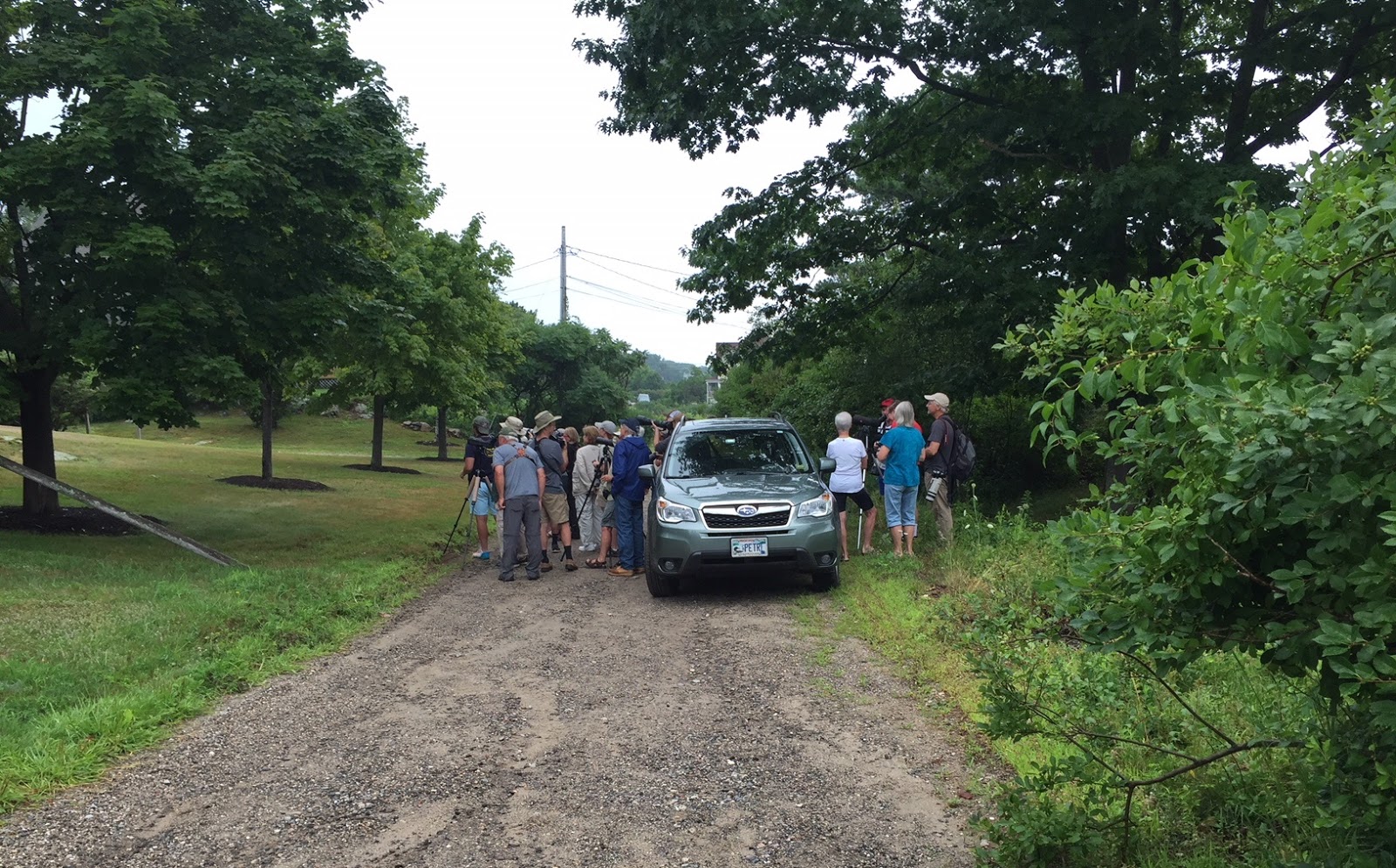
By 7:40, the time it arrived the day before, there were at least 20 birders on site scoping the marsh, but to no avail.  You wouldn’t think a large pink wading bird would be so difficult to find.  As 7:40 came and went I mentioned to everyone that the yesterday’s 7:40 tide would be duplicated today at about 8:30 – so maybe that would be the more likely time for it to return.  We all had to stay optimistic, right?  At least while we were waiting I spotted at least 1 “Western” Willet – perhaps soon to be a separate species.

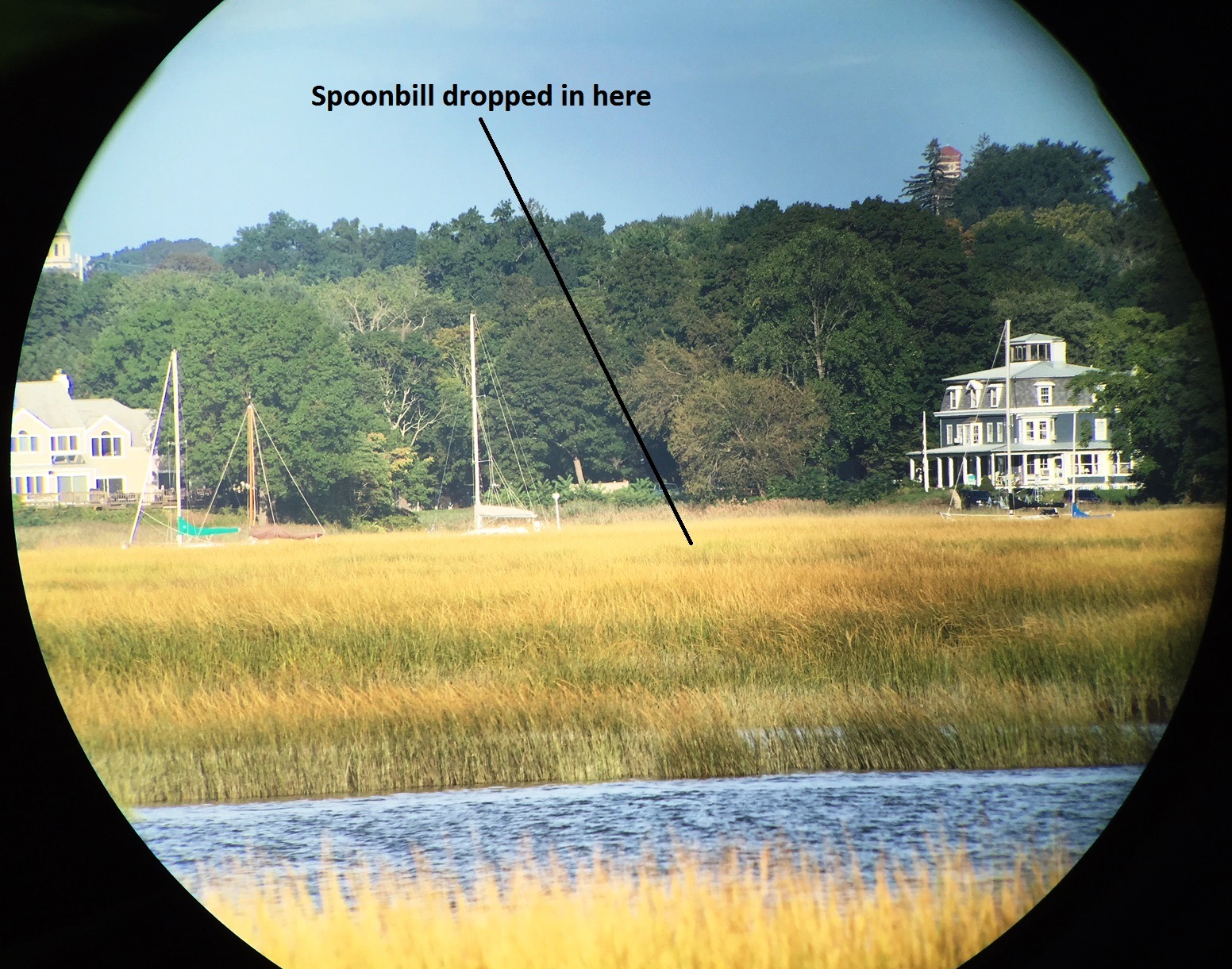
And then at 8:28 one of the birders yelled – “I have the Spoonbill!”  There it was flying over the marsh at a considerable distance coming in from the west.  At first it was quite high, then it slowly got lower to the marsh, circled a couple times, then dropped in out of site.  Although it was quite distant the whole time, and total viewing time was maybe only 30 seconds, everyone was able to see all the fieldmarks including of course the pink color and the large spatulate bill.  Good enough for a state “tick” – though if it had been a lifebird I would have wanted a better view.  Here is a picture of the marsh where it dropped in, perhaps nearly a mile away.


Roseate Spoonbill was #332 for me in CT, and the 440th species I’ve seen anywhere in the 6 New England states.  CT was only my 4th state for this species typically only found in the deep south.

 
It turns out that comparison of photos of the ME and CT birds revealed that they were the same individual.  Amazingly, 8 days after leaving Sebec, ME it was re-found in Stratford and Milford, CT, some 345 miles away “as the Spoonbill flies”.  Wonder if it took a direct route and passed over NH and MA on the way.  In fact, if it flew on a straight line it would have passed nearly directly over my house here in Pepperell, MA.  I guess I didn’t look up at the right time. 

“But wait there’s more…”  There were also reports of Spoonbills all across the Midwest and Northeast this year, including IN, OH, WV, PA, MD, NJ, NY and DE.  And it turns out that the ME and CT bird was also the one spotted at the Walkill River NWR along the NJ / NY line from July 22 to August 5.  And then there was a Spoonbill spotted in southeastern Quebec on August 7.  Was this also the same bird?  Unfortunately the photos weren’t of sufficient quality to tell.  This was only 85 miles northwest of its Sebec, ME location where it was first spotted 20 days later – certainly a feasible trip.  But the Quebec spot is 375 miles northeast of its NJ/NY location – could it have traveled that far is just 2 days?  I guess we’ll never know for sure. 

It has truly been an amazing year for vagrant Roseate Spoonbills!

Sunday, September 30, 2018

Two Province Birds in Quebec – September 2018


Each of the last several years I’ve taken a boat trip out on Lake Champlain to look for pelagic species that migrate down the lake in small numbers.  This “pelagic” trip leaves out of Burlington, a good 3 ½ hour drive from home.  So given the long driving time I like to make these into 2-day trips, adding some birding time in the area the day before heading out on the boat.  This year I had one possible VT target statebird to try for – a Marbled Godwit reported for a couple days at the mouth of the Missisquoi River near Highgate.  But this bird was seen from a boat in the middle of the bay so the likelihood of seeing it from shore was not good.  However, it was still worth the try since I was in the area.
But the greatest opportunity to add “ticks” to my lists was not in VT, but instead in Quebec.  Just barely north of northwestern VT, just over the US-Canada line, is Baie Missisquoi.  In late summer, as the lake level drops in Lake Champlain, this bay can be an excellent spot for shorebirds.  I had birded there once before in 2016, adding several species to my Quebec list including Sanderling, White-rumped Sandpiper, Red-necked Phalarope, Baird’s Sandpiper, and a Peregrine harassing them all.  But the best bird was a very rare Western Sandpiper I discovered in with the peeps.  This year as I planned my trip the eBird reports were once again full of potential new province birds like Black-bellied Plover, Knot, Dunlin, Short-billed Dowitcher (I already have Long-billed for the province), Turnstone, Wilson’s Phalarope, Solitary Sandpiper, and Caspian Tern.  Plus there were a few migrant passerines seen in the area that I needed as well.  Lots of potential new province birds.
However, the shorebird diversity dropped as my trip neared, and the last couple reports only featured one new possible province bird – Caspian Tern.  Undeterred, and ever the optimist, I kept with my original plans to spend some time birding in Quebec.  Plus I still had the Godwit to try for in VT.  The weather forecasters talked about a cold front that would pass through the area the morning of the day I would bird in Quebec, so I was hopeful additional shorebirds would arrive by the time I got there.  Plus that would bode well for Jaegers and other species that might migrate into Lake Champlain the next day.  So I was quite optimistic as I made the final preparations for the trip.
The next morning I was out of the house early and rode through a heavy line of showers that preceded the passage of the cold front – just as the meteorologists had predicted.  It was lunchtime when I finally arrived at Shipyard Road in Highgate.  Looking nearly a half-mile west toward the distant mudflats there were very few shorebirds – I could only find a few Yellowlegs and peeps, and no Godwit.  Though I counted at least 4 Caspian Terns, increasing my optimism that I might find them later in the day in Quebec as well.  From there I went a short distance to the north to the mouth of the Rock River where I found a nice collection of shorebirds including 3 Stilt Sandpipers (I’ve only had 1 other Stilt Sand in VT), and 2 Short-billed Dowitchers (another one I need in Quebec).  Things were looking up.
A few minutes later I headed north, passed through customs, and then entered the Philipsburg “campground” overlooking Baie Missisquoi.  The flats were extensive, and as soon as I stepped onto the mud I was nearly surrounded by feeding peeps.  The first couple I identified were Baird’s Sandpipers, including this cooperative bird.
And then a short distance away I picked out 2 Sanderlings – an excellent start.  Unfortunately try as I may, I couldn’t find anything else of interest.  I estimated about 300 total peeps on the flats, including 6 Baird’s, but none of my targets.  Finally I did spot one Caspian Tern in the distance so at least I added 1 new bird to my province list.  Quebec is my 5th province for this species (see my province map below).
There were a couple other birders at the flats and I checked in with them to make sure I hadn’t missed anything.  Alas, there was nothing I had overlooked.  Then the one birder, in broken English, asked where I was from.  When I told him Massachusetts, he asked my name.  He quickly recognized me, saying “You were the birder that found the Alaskan Sandpiper here in September 2016”.  (The French name for Western Sandpiper is Becasseau d'Alaska - Sandpiper of Alaska - since it only nests in Alaska.)  Wow – that was a surprise, and the highlight of the trip.
Before I left the campground I made a brief tour through the adjacent woodlands, but didn’t find a single migrant.  Ugh…
I made a few other stops around the bay, working my way counter-clockwise around the northern and western edges, but still couldn’t find any targets.  That included a 3-mile round-trip walk on the flats from the Florent campground, where I found both Yellowlegs and counted 14 Caspian Terns, but had very few peeps.  Perhaps the most interesting sightings here were 2 Bonaparte’s Gulls in rare juvenile plumage that I tried unsuccessfully to turn into Little Gulls.
My last potential target was Solitary Sandpiper.  Although this species had been reported a couple times at the bay, not surprisingly it was being seen more frequently inland, though at scattered locations.  A couple sightings were at Rang des Cotes, where a road passed over a small river.  After a short drive I pulled up to this site and took a look at the riverbanks below.  With a quick binoc scan I noticed a couple potential candidates in the distance downstream.  I scurried back to the car to get the scope, and then with a more detailed look I realized they were just Lesser Yellowlegs – 3 of them, with 2 Killdeer.  So much for the initial excitement.  But then I looked upstream on the other side of the bridge and there was a Solitary Sandpiper just a few feet away.  Success!  Quebec was my 6th province for this species.
That gave me 198 for my Quebec list – maybe I’ll get to 200 the next time I head out on a Lake Champlain pelagic trip.
 
P.S.  Despite the passage of the cold front, this year’s Lake Champlain trip was pretty slow.  My only Jaeger was a very distant “Jaeger, sp.”, which was far enough away that it could have actually been in NY.  Next time…

Sunday, September 2, 2018

A First State Record and Three Pelagic Species in One Day in CT, August 2018

It all started with an absolutely amazing set of sightings in Long Island Sound off the CT coast.  First there were reports of a large number of Shearwaters at the eastern end of the Sound, with Great, Cory’s and Sooty Shearwaters seen in record numbers from the New London-Orient Point ferry.  Unfortunately I couldn’t break free to get out on the ferry during that time.  And when I finally could get out, the Shearwaters had mostly moved on.  The best I could do was add Great Shearwater to my NY list on one leg of one of these ferry trips. 
Then came CT reports of multiple Parasitic Jaegers seen from land, principally from Hammonasset Beach State Park.  And several of these reports included an occasional Shearwater.  All sightings were apparently associated with feeding frenzies including hundreds, if not thousands, of Terns.  I didn’t try chasing after these birds since the sightings were a bit hit or miss, apparently depending on whether there were schools of fish nearby to attract these pelagic species. 
All in all, this was perhaps an unprecedented set of pelagic sightings in Long Island Sound.  Unfortunately one that I hadn’t been able to experience.
That is until a report of a Black-bellied Whistling-Duck in Essex, CT came across the listserve.  Photos confirmed the ID of this first state record, and many birders were able to see this most cooperative bird later that same day.  When the bird continued to cooperate the next morning, though seen in multiple spots in the immediate vicinity, I cleared my schedule to be able to make the trip to Essex on Day 3.  And since Hammonasset was within 30 minutes of Essex, I could combine the 2 locations into one trip with lots of statebird potential. 
But as I was piecing together the directions to the spots where the Whistling-Duck had been seen, I noticed a post that a birder watched it fly north around Noon and he did not refind it.  I posted to the listserve asking for other updates and unfortunately only received negative reports.  I tried to remain positive that it would return since vagrant BBWDs will often stay in one spot for quite a while, and decided to keep with my plans.  And just before closing the computer that night a post came across that the bird returned at 6:30 PM.  The chase was on!
I was out of the house before 6, arriving in downtown Essex by 7:45.  The Whistling-Duck seemed to prefer a small tidal pool in a suburban backyard at the corner of Ferry and Pratt Streets, so that was my first destination.  As I drove down Ferry Street nearing the intersection I looked to the left toward the pool and there was a lone duck standing in the lawn at the edge of the pool – it was the Black-bellied Whistling Duck.  I parked on Pratt Street and got crippling views of this extreme rarity, including these phonescoped shots as it fed in the mud.


CT was my 9th state for this species, most of which as a vagrant.


I was happy that my first target was so cooperative because I needed to move on to Hammonasset to try for my next objectives – pelagics on the Sound.  Within a half hour I was at the park gate and realized this was the first time I had ever been there “in season” requiring an entrance fee.  The $15 day pass seemed steep, but I hoped it would be worthwhile.
Minutes later I was at Meig’s Point and walked up to the observation platform.  Two birders were already there, and they mentioned they had just had a couple Jaegers.  And one birder had a Cory’s Shearwater.  That made me hopeful for what might lie ahead, though I wished I could have been there a bit earlier.  With a first scope scan I could see a large flock of Terns flying low over the water – we had a feeding frenzy with critical mass for the pelagics.  And sure enough within a couple minutes I picked out a slim Jaeger which was very most likely a Parasitic.  Then I spotted another, and another, and soon had a group of 6 Jaegers all in one scope field!  Over the next 45 minutes the feeding frenzy continued nearly directly off the point, and we had at least one Jaeger in sight nearly the entire time.  And we all agreed that at least a few we could positively ID as Parasitics, with all the others most likely Parasitics as well.  CT was my 12th state for this species – I only need it in VT to complete the sweep of all 6 New England states.


Over the next couple hours the feeding frenzy would die down, and sometimes completely stop.  And then a few minutes later we would find the big flock of Terns a short distance to the east or west, again accompanied by multiple Jaegers.  I conservatively reported 6 Parasitics in my eBird checklist, since I had 6 in view at once, but the total could well have been more.  Then there was one that got away - at one point I spotted a Jaeger to the west of us, and watched it fly by eventually out of sight to the east.  It was not associating with any of the Terns as all the other Jaegers were, and was apparently just migrating through the area.  Most interestingly, I could not see any white in the primaries.  Could it have been a Long-tailed?  Unfortunately it was too far away for a definitive ID of these very tricky species.
By 11 the activity had slowed dramatically and the other two birders left the point.  I thought about calling it quits myself, very content to have found my second CT statebird for the day.  But then another couple birders arrived, and I decided to stay a bit longer to compare notes.  A little later one of those birders spotted a Shearwater flying west.  Although it was distant we could ID it as a Great.  Finally had my first Shearwater for CT after many unsuccessful trips on the Ferry.  And then a bit later while searching through another Tern flock I spotted another Shearwater gliding by – this one was a Cory’s.  A few minutes later I spotted another Great actively feeding in the Tern flock.  Amazing!  Good thing I didn’t leave earlier!
My statebird maps for Great and Cory’s Shearwaters are very similar – all the coastal states from NY north, plus a few mid-Atlantic states.  I’ve also seen both species in Nova Scotia and Newfoundland.


On a comparatively minor note, I also had excellent results with Black Terns during my seawatch.  In my last hour there twice I had a single flyby of a Black Tern heading west, once had a pair heading west, and twice I spotted a group of 4 birds feeding in with the Common Terns.  I initially reported 8 Black Terns for the morning, only counting the group of 4 once.  But later I was notified that 8 would be a new record for a single location in CT, so I decided to be overly conservative and revised the total to just 4.  Those were only my second Black Terns for the state.
I guess the $15 entrance fee to Hammonasset was a worthwhile investment after all.
A first CT state record, then not 1 but 3 pelagic species all from land.  That brings my CT statelist to 331.  What a day!

Sunday, August 19, 2018

Best 2 Days of Birding Ever, August 2018


It all started with reports of a Little Egret in Westerly, RI – that’s only the 2nd record for the state based on eBird data, so it would be a great one to chase after.  And although the Egret was reported for a few consecutive days, it was only being seen between 5:30AM and 6 AM before flying off to points unknown with a flock of Snowy’s and Greats.  That was way too early for me to try for given my 2+ hour drive time.  But then the bird was found to be feeding during the day in marshes and perched in trees in the Winnapaug Pond area along Atlantic Avenue in Westerly.  So now it was very much chaseable.
And as I was putting my plans together to try for the Egret, a post came across the CT listserve from Tom Robben that he was able to see the continuing Bridled Tern on Great Gull Island in NY from a Lighthouse Cruise out of New London, CT.  This was presumably the same Bridled Tern that spent much of last summer on Falkner Island in CT.  Many birders got to see this reliable bird – that is the bird was reliable for almost everyone except for me.  I tried twice for the Tern without success.  And since this would be a life bird, I was still very interested in trying to see it this summer, even if it was in NY instead of CT.  Though Tom stressed that even if you were lucky enough to see the bird while on the Lighthouse Cruise it would still be very distant. 
So I started to revise my plans to start early morning in Westerly to try for the Egret, then head to New London to take the Lighthouse Cruise to try for the Tern.  While researching times for the cruise I noticed several e-mails regarding identification of a Hawk seen in Maine.  It took a while to unravel the story, but it was eventually ID’d as an amazing Great Black Hawk, native to Central and South America.  And despite some initial questions as to the location of the bird, it was verified to be in Biddeford, ME.  The bird was first seen two days earlier, but not re-found the next day.  What an exciting second ABA record!  But apparently no longer around.
And as they say on the infomercials – “But wait there’s more…”  I had just finished figuring out the Black Hawk story when an eBird NH Needs Alert came across with a Neotropic Cormorant seen in Gorham, NH 6 days earlier, complete with photos!  That would be a first record for NH and likely for all of New England.  But that was 6 days ago and a good 3 hours north of me.  So although there were now reports of 2 truly amazing birds north of me, both were now a bit dated, so I went back to continue my planning efforts to head south into RI and CT. 
Then minutes later came a report that the Great Black Hawk was re-found in Biddeford.  That certainly changed the equation.  And as I was piecing that together an e-mail arrived reporting that the Cormorant was still at the same location in Gorham.  I was having trouble keeping up…  Although the Little Egret and Bridled Tern were rare, they were not nearly as rare as the Great Black Hawk and Neotropic Cormorant.  So I changed my plans, and decided to start the day in Biddeford, then head north to Gorham.  The Egret and Tern could wait till the next day.
The Great Black Hawk was first reported two days earlier, though not surprisingly the observer needed help to identify this immature bird.  It was spotted in a small neighborhood along Maddox Pond Road just off the coast.  When the Hawk was re-found it was on nearby Lily Pond Avenue, with agitated Robins giving away its location.  So when I arrived at 7:30 that morning I headed right to Lily Pond Road and found at least 30 birders already milling about looking for our target bird.  No sightings yet.  But just a couple minutes later I could hear some Robins squawking a short distance to the south.  Could they have the Hawk?  I pointed out the calls to other birders, and many of us headed in that direction to check it out.  But before I could find the Robins here was another birder heading towards us to spread the word that he had the Black Hawk up ahead.  A minute later I came upon the squawking Robins, and there was the Great Black Hawk.  An amazing bird with such long legs and large bill.  It put on a great show, thanks to those marauding Robins.  Here are a couple phonescoped photos of the bird.


And a shot of the many happy birders who were there.


I spent about a half hour with the bird taking in all the great views, before it flew off a short distance back into the woods out of sight.  During this time I ran into Davis Finch, a long-time birding friend from NH.  I told him of my plans to try for the Neotropic Cormorant next, and he quickly accepted my offer to come along and make the trek up to Gorham.  After a short review of the maps, we planned our 2 ½ hour route, and at 8 AM our 2-car convoy started out through the country side.  About half way to Gorham I received a text with even more amazing news – a Wood Stork had just been spotted in southern NH at Pickering Ponds in Rochester!  There was only 1 previous hypothetical record for this species in NH, so it would be great to go after that bird too.  But we still needed to drive another hour north to try for the Cormorant.  And then it would take another 2-hour drive south before we could get to Rochester.  I shared the news with Davis when we arrived in Gorham, and we both crossed our fingers that the Stork would remain until we could get to Rochester.
But first we needed to focus on the Cormorant.  The eBird report included photos showing the bird perched on a line of orange buoys just upstream of a hydroelectric dam on the Androscoggin River.  Although directions in the first eBird report were cryptic at best, the new posts included good details, and after a short walk Davis and I approached the river where the Cormorant had been roosting.  As we crested the dike there was NH birder Steve Mirick already looking at our target bird.  I got these distant phonescoped photos of the Cormorant.


Interestingly the last Neotropic Cormorant I saw was earlier this year at Lake Mead near Las Vegas – also a rarity though certainly not as rare as this NH bird.  The NV Cormorant liked to perch on a floating “jetty” similar to our Gorham bird.  NH was my 8th state for this species which is increasingly prone to wandering from its regular range.


Although I was tempted to walk closer and get better views, both Davis and I were anxious to get back on the road to try for the Stork.  So by 10:30 our little convoy was heading south to Rochester, happily receiving updates that the Stork was still there.
Two hours later we pulled into the parking lot at Pickering Ponds, and within a couple minutes we walked up the dike to get a view of the impoundments.  There was a small group of birders up ahead, and they had the bird in their scopes.  Here’s a phonescoped picture of this most cooperative bird.


That was my second Wood Stork in New England – the first being in Barnstable, MA in November 1994.  And NH is now my 11th state overall for this species.


What an outstanding day!  I sure was glad I changed my priorities to head north to chase after these 3 extreme rarities.  And glad I went after the Hawk first because it was last seen at about 2 PM that day.
When I got home that afternoon I reviewed my e-mails and the Little Egret was seen again in Westerly, RI that day.  So that one was still in play.  And then I noticed an e-mail from a boat captain out of CT (Captain Ian Devlin) offering to take birders to Great Gull Island to try for the Bridled Tern.  That approach would certainly give me a much better chance of seeing the Tern compared to a “drive by” while on a Lighthouse Cruise.  I quickly replied back to him saying I would like to try for the Tern the next afternoon.  I also reached out to a CT birder Maggie Peretto who unfortunately was along with me on those same 2 unsuccessful attempts for the bird last summer, hoping that she might want to share the ride with me.  I got a quick reply from Maggie that she was interested, and she too sent an e-mail to Ian saying she wanted to go the next day.  But as the day progressed neither Maggie nor I had received a reply from Ian.  So despite the lack of responses, I planned to head out early the next morning to try for the Little Egret, then hopefully hear back from Ian to take his boat to try for the Bridled Tern.  But just in case I didn’t connect with Ian, I researched the times of the Lighthouse Cruise, as well as the regular New London to Orient Point ferries as fall back options. 
I was out of the house bright and early for the second consecutive day and arrived at Winnapaug Pond at about 8.  I was pretty familiar with this spot having seen 2 RI rarities there in the past – Ruff and White Ibis.  As I pulled up I could see another birder already there scoping the marshes.  Although he hadn’t found the Little Egret yet, he had found a flock of Snowy and Great Egrets about a quarter mile to the north feeding at the edge of the river channel.  This could well be the flock that the Little was associating with, so we spent the next few minutes trying to find out target.  But given the distance and all the tall vegetation we were unsuccessful picking out the Little Egret among those other white waders.
And then a couple of the Egrets left the flock and began flying toward us.  Then seconds later a few more took off.  I put a couple of these in my scope and initially thought in the distance that both were Greats based on size.  Then I realized one of them had a dark bill.  Now as they got closer I could see the dark-billed bird was a little smaller than the Great, and it had dark lores – I had the Little Egret!  The other birder spotted it in flight as well.  Interestingly, since the bird was flying nearly directly at us, neither of us saw the long head plume of the Little Egret.  Just goes to show you often need to focus on multiple field marks to make an ID.  I followed the target all the way to a nearby grove of trees, where it landed on the back side unfortunately out of view.  I waited another hour for the bird to drop down into the marsh to feed.  But it never came out into the open, nor were we able to re-spot it in the trees.  With the heat and humidity on the rise, I called it quits at 9:30, happy to have had at least a limited view of the Egret.  Good thing it wasn’t a lifer – I’ve also seen this species in ME, NH, and MA – otherwise I would have wanted better views.
Now I turned my attention to trying to get out to see the Bridled Tern.  I still hadn’t heard from Ian, so I gave him another call, but could only leave him another message.  It wasn’t looking like I would hear back from him, so I called the ferry company to see if they still had spaces open on the lighthouse cruise later that day.  Unfortunately the lighthouse cruise was canceled for the day.  This was bringing back awful memories of my futile attempts to try to get a boat out to see the bird last summer when it was in CT.  Although birders were heading out daily and seeing the Tern it took me a week to find a boat and captain to take me, and by then the bird was gone.  I probably spent more time trying to find a boat than my time actually on the water looking for the Tern.  Very frustrating…  But rather than head home, since I was already on the coast, I decided to just take a regular round-trip ferry ride out of New London to bird the Sound hoping for pelagics from the ferry.  Of course I would have next to no chance for the Bridled Tern – that would have to wait till another day. 
The next ferry with good viewing didn’t depart until 1 PM, so I had lots of time to kill.  I drove to New London, and parked in my regular garage, arriving at 10:30.  I relaxed in my car for a while, then headed into town and found a quaint sandwich shop for lunch.  It was now about Noon and just as I was about to head to the ferry to buy my ticket my phone rang – it was Captain Ian.  He could take me out at 2:30 that afternoon departing from Waterford a short distance to the west.  Next I tried to reach Maggie to see if she could go along with me.  Not only would it be great for her to have an opportunity to see the bird, but she could share the cost of the boat - $150 for 2 hours regardless of how many birders were on-board.  Unfortunately I didn’t have her phone number so could just send her an e-mail.
Now I had more time to kill, though first I had to find an ATM to get extra cash in case I was the only birder on board.  Within a few minutes I was at the boat ramp parking lot waiting for my trip to Great Gull Island.  Eventually I was able to connect with Maggie, but unfortunately she was unable to go along.  I was on my own, both with respect to paying for the boat as well as searching for the Bridled Tern.
Ian ended up being delayed in traffic, so we didn’t leave the dock until 3:45.  Luckily the water was quite calm because Ian’s boat seemed a bit small to head all the way across the Sound.  But after just a few rougher spots on our 20-minute ride, we neared Great Gull Island.  I had done quite a bit of research on the Tern, and thanks to info in blogs managed by Tom Robben (trips33.blogspot.com) and Joe DiCostanzo (inwoodbirder.blogspot.com), I knew that the Tern preferred to roost on rocks at the northeast corner of the island.  We headed right to that spot and I quickly started to scan the rocks.  There were quite a number of Common Terns scattered about, but no Bridled.  Then I did another scan, and then another scan – still no target bird.  I expanded my scans further to the east and west but still no Bridled.  This was bringing back most unpleasant memories from last summer. 
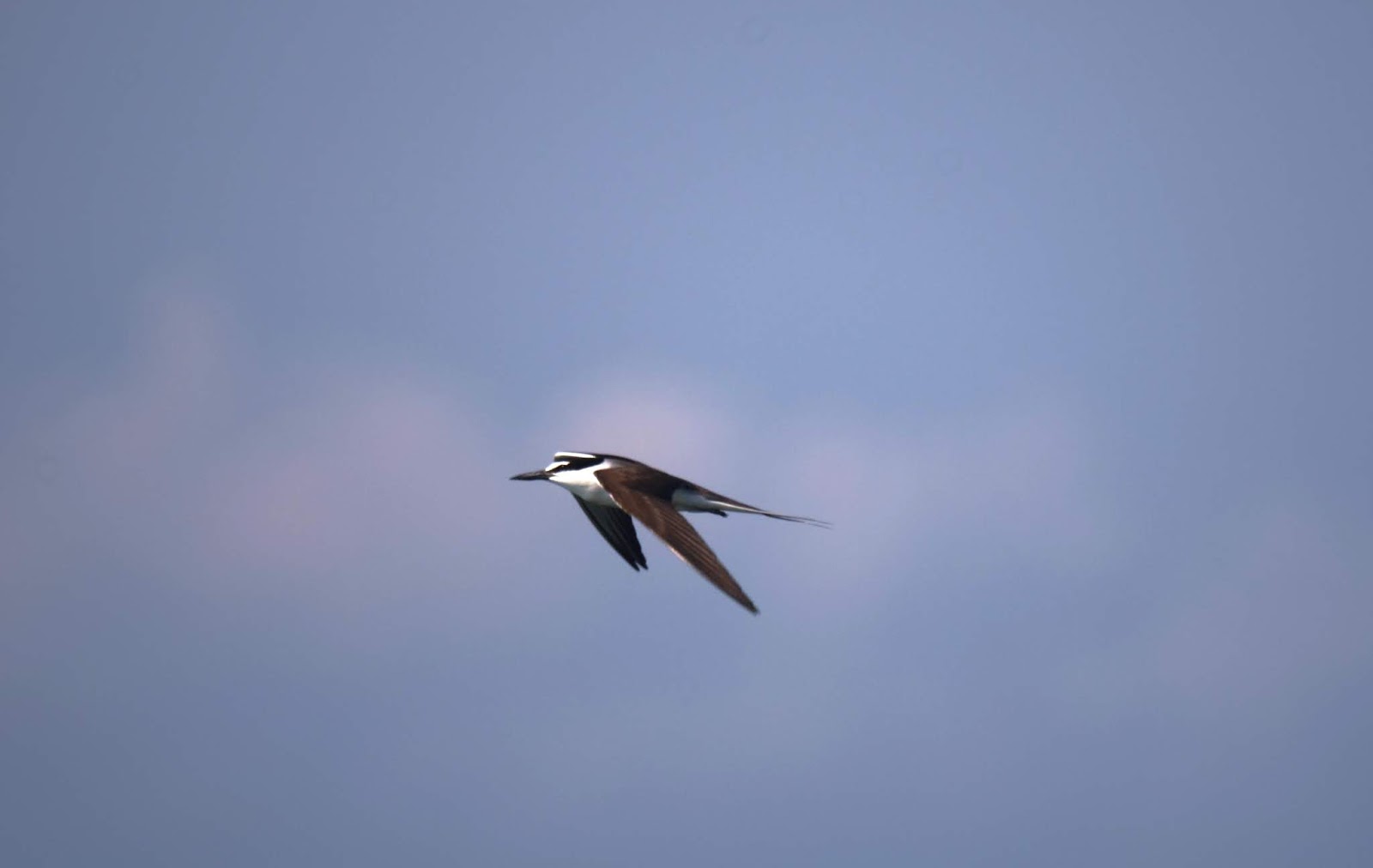
We had been at the island for maybe 5 minutes when seemingly all the Terns took off out over the water.  Ian spotted a Peregrine buzzing over the island and all the Terns were in chase.  I looked east into a boiling flock of maybe 500 or 1,000 Common and Roseate Terns low over the water and almost instantly picked out a darker-backed bird – I had the Bridled Tern!!!  We continued to follow the bird for a couple minutes as it flew around the boat, and I was able to get these pretty nice photos.


And later I got this shot of the Peregrine flying away, still mobbed by the Terns. 


At one point I watched the Bridled Tern land on the island, but it took off seconds later heading back out over the water.  We stayed at the island for the next 45 minutes but we never re-spotted the bird over the water nor perched, despite expanding our scans to nearby parts of the island.  The bird was obviously not perching in its favorite location.  Thank goodness for that Peregrine!  Otherwise I doubt we would have seen the Bridled Tern.


Before we headed back I spotted a Parasitic Jaeger harassing a Common Tern – in NY waters though.  I still need Parasitic for CT, which is the case for all the Shearwaters as well.  I had hoped that we might get lucky with other pelagics while motoring through the CT portion of the Sound on Ian’s boat, but it was too rough to scan while traveling along.  Though I certainly wasn’t going to be disappointed – after almost seeing a Bridled Tern while on a pelagic out of MA, having to pass on getting a boat to see one in ME, and 2 failed attempts last summer in CT, I finally had my life Bridled Tern!
What an ending to an outstanding 2 days of birding, not only seeing all 5 of my targets, but all 5 were also extreme rarities -

Day 1 –
    Great Black Hawk – life bird, first ME 2nd ABA record, bringing my ME list to 342
    Neotropic Cormorant – first New England record, NH bird #366
    Wood Stork – first confirmed NH record, NH bird #367
Day 2 –
    Little Egret – perhaps 2nd RI record, RI bird #330
    Bridled Tern – life bird, NY bird #284
My life lists now stand at 756 in the ABA Continental region (not including Hawaii), and 736 in the Lower 48.
In all my 51 years of birding, those were most definitely my best 2 consecutive days of birding ever!
Sunday, August 12, 2018

Great Shearwaters in NY - But Still not in CT, August 2018


I’ve taken the Cross Sound Ferry out of New London, CT numerous times over the last several years in hopes of seeing various pelagic species.  The ferries travel from New London to Orient Point, NY and back, so obviously it’s important to know which state you’re in when you’re crossing.  On my first trip ever in August 2015 I had a pair of Cory’s Shearwaters but they were in NY, though just barely based on my best guess of where the state line was.  You see at the time I didn’t realize that the Apple map app would show the state line.  So ever since, that sighting has haunted me – could those Cory’s have actually been in CT and I didn’t realize it?
Since that trip I’ve accumulated a nice list of pelagics from the ferry.  In NY I’ve seen Wilson’s Storm-Petrel, Cory’s Shearwater, Parasitic and Pomarine Jaegers, and Common Murre – all 5 being new for my NY statelist.  My list of sightings in CT waters is much shorter – Wilson’s Storm-Petrel and Pomarine Jaeger, with only the Pomarine being a new statebird.  (I watched that Pomarine as it, and the ferry, passed from CT to NY adding it to both statelists.)  Hence I still need all the Shearwaters for my CT list.
Fast forward to earlier this summer - a large influx of Shearwaters made it into the Sound, with Great, Sooty, and Cory’s being spotted in both states on multiple ferries.  Unfortunately I had to stick around the home at that time and couldn’t get out.  And by the time I had a free day, pelagic sightings were once again very hit or miss – the large numbers were gone.  Undeterred, I decided to take a round-trip after all, feeling like I would be happy even if I had a single pelagic bird.  And of course finding it in CT would make me even happier.  So I researched which ships were scheduled for the next day (some boats don’t offer very good viewing), and selected that 10 AM departure on the Mary Ellen.  My plan was set.
Just before I boarded the boat I ran into a couple other birders.  They were out of NY, and had just been on the boat heading to New London.  They had a Parasitic Jaeger in NY waters, but no Shearwaters.  Later 2 other birders arrived, so 5 sets of eyes would surely increase our chances to find some good birds on the crossing.  But it was not to be – the best bird we had on the way to NY was a Roseate Tern.
But there’s always the trip back, though unfortunately I was the only birder on-board.  Thank goodness my luck improved on the trip back.  Not 5 minutes after leaving Orient Point I spotted a Shearwater sitting on the water – it was a Great.  A couple minutes later I spotted another Great in flight, then a Great on the water, and then a 4th bird in flight.  All were single birds, all east of the ship, and all in NY.  Here are a couple photos of the first Shearwater.


But this boded well for CT, right?  Unfortunately after we crossed the stateline I didn’t see any more pelagic species.  The Great Shearwater was a new bird for my NY list, #283, and finding 4 Shearwaters of any species was good for the ferry these days.  But I was still without any Shearwaters in CT.
NY was my 6th state for Great Shearwater, plus I’ve seen it in 2 Canadian provinces (see my state bird and province bird maps below).


One last thought on viewing pelagics from the ferry-  Virtually all my sightings of pelagics over the years have been to the east.  And on a sunny day, scanning to the east means scanning into considerable sun glare.  For instance on my 10 AM trip to NY this day the sun glare made viewing to the east very difficult.  Though on the Noon trip back to CT there was almost no glare to the east at all.  I wonder if midday or afternoon trips are the best options on a sunny day?

Saturday, August 11, 2018

Black Rail, Alviso Marina County Park, CA, August, 2018


Another business trip to the San Francisco Bay Area meant another opportunity for adding a statebird or two to my CA list.  As with most of my trips, my birding time is limited to short treks after work, so targets need to be pretty close nearby.  With that limitation, and given that I’ve birded in the area quite a bit, my possibilities are usually pretty limited.  In fact, there were no possible statebirds at all on my last couple trips to the Bay Area.
Prior to this trip I set up an eBird Needs Alert for CA, and after wading through the numerous sightings of uncountable Egyptian Goose, Indian Peafowl, and many Parrot species, I eventually found a number of recent reports of Black Rails in Santa Clara County.  Black Rails have popped up on several of my previous CA Needs Alerts, but they were never close enough to be able to give them a try.  However, this time they were being seen at Alviso Marina County Park which is just 40 minutes from work, so definitely within striking distance.  I had my target.
Now it was time to do my detailed detective work.  Up to 5 Black Rails were being heard and seen (!) daily at this small park.  Many of the reports mentioned that the Rails were giving a growl call which I was unfamiliar with.  But that was one of the calls included in my iBird Pro app, so I was able to study this less typical call.  As for location, they were most often at the end of the shortest boardwalk “next to the Gatorade bottle”.  I found a map of the park on-line, and quickly found the location of the boardwalk, and a couple photos showed birds next to a Gatorade bottle that had been tossed into the marsh.  So I had a good handle on where to look and listen.  However most reports were in the early morning, and I wouldn’t be free to try for them until after work, so I was a bit worried whether the time of day would reduce my chances.  Nevertheless, I felt well-prepared to give this tiny, secretive bird a try.
Work was over right on time on my last day of the trip, and I headed south toward Alviso Marina County Park.  Luckily most of the rush hour traffic was heading the other direction, so I made it to the park pretty quickly.  I made my way to the short boardwalk, walked to the end, and spotted the Gatorade bottle down below. 


I had the right location, now I just needed the birds to cooperate.  I waited at least 15 minutes hearing no calls, nor seeing any activity in the marsh down below.  Did I need to be there in the early morning?  Then finally I heard a Black Rail giving its growl call off to the left.  Then a second bird joined in.  Eventually the calls were closer, seemingly right below me.  Then I started to hear a different call sounding like “keek keek keek”, similar to the cadence of the “kic kee doo” call, but all on one pitch.  And then I spotted a brief glimpse of a bird a few inches away from the infamous Gatorade bottle.
I was able to get this recording of the “keek keek keek” call on my iPhone.


CA was my 9th state for Black Rail, and the 4th time I’ve seen this elusive species (see my statebird map below).


With a couple hours of light remaining, my attention turned to a second possible target – Semipalmated Sandpiper.  One had been seen the last couple of days at Yosemite Slough, a restored wetlands on the waterfront in San Francisco.  I hadn’t brought my scope with me, but I thought maybe I could arrive at the right location, find other birders with scopes, and get views of the bird through their optics.  And since my hotel that night was close to the airport a short distance from Yosemite Slough, I figured it was worth a try. 

After a not-so-bad rush hour drive I exited Route 101 in San Francisco and started winding my way through the city on surface streets to get to the waterfront.  On GoogleMaps I could see 3 possible access points to the Slough – at the ends of Wallace, Van Dyke, or Griffith Streets.  But as I got closer to the area I left suburban neighborhoods and soon entered a really rough-looking industrial area.  I went right on by Wallace and Van Dyke Streets not wanting to stop even if there was access.  And at the end of Griffith Street I found a closed gate and chain link fence with a no trespassing sign.  That’s probably a good thing because even if I did find access there and left my car to go birding I’m not sure it would have been in 1 piece when I returned.  I quickly turned my car around and left the area, with no regrets.  There must be safe access to this spot from somewhere.  As it turns out the last sighting of the Semi Sand was the day before I was there so I probably didn’t miss it that day after all.
As I made my way to the hotel I reflected on that evening’s birding adventures - although I was happy to have added a new statebird to my CA list, bringing my total to 392, I was even happier to have returned from the San Francisco waterfront unscathed.