Thursday, October 4, 2012

Clay-Colored Sparrow, Common Gallinule, Sora in Connecticut – October 2012

It has seemed like forever since I had added a new statebird to any of my New England lists.  In reality it was back on back on July 28th when I saw the Red-billed Tropicbird in Maine, which meant I was in one of my biggest dry spells for adding New England statebirds.  During much of this time I was in a period of lots of travel for work, so I couldn’t easily break free to chase after some local birds.  So when my travel schedule finally lightened up, I decided to go after a couple rarities seen for about a week in CT – 2 Clay-colored Sparrows on the coast and a Common Gallinule at the White Memorial in northwestern CT.  Though of course when rarities have been around for a while, I always wonder if I have waited too long to go after them.  And right on cue, the day before my trip a birder was not able to find the 2 sparrows at their coastal location.  But with a little more research I found another post of a Clay-Colored in central CT – now 3 days old but worth a try since it was almost on my route to the Gallinule spot.  Plus I’ve been told that the marshes at the White Memorial can be good for Sora – my biggest nemesis bird in CT.  So that gave me 3 possible statebirds to try for.  And with excellent micro-directions from several local CT birders, I was excited to finally get back to New England statebirding.

I arrived at Nod Road in Simsbury at 9 AM where the Clay-colored Sparrow had been reported earlier.  Although there were no sparrows in sight, I noticed a weedy field a short distance to the north that could be good for sparrows.  I headed over there and started to flush quite a number of Savannahs and a few Songs, and decided to try to push them toward some brush where they would hopefully tee up and give cooperative views.  This seemed to work as more and more headed to the bushes, giving at least brief views before disappearing into the thicket.  At one point I got a brief view of a Spizella sparrow before it dropped back into the field.  Could that have been it?  I walked closer to the spot where it dropped in and flushed it out again.  It perched in the open giving great views – it had a strong white supercilium and moustache but it had a pretty strong reddish cap (though with a white median stripe).  In the field I decided the reddish cap meant it had to be a Chipping in winter plumage.  I continued to work the field, and later got a Vesper Sparrow and a late Magnolia Warbler, but nothing else of interest.  The next morning while looking at the field guides I realized that the Spizella wasn’t a Chipping at all but was indeed the Clay-Colored.  It’s embarrassing to get the ID wrong, but I guess better to be conservative then to incorrectly conclude that you found a rarity.  My map for Clay-Colored Sparrow below shows an interesting story – I’ve seen it in a number of central US states where this species is a common migrant or nester, as well as quite a number of states where it is an accidental migrant or wintering bird including 5 New England states. 

My next stop was Little Pond in the White Memorial in Litchfield.  With excellent directions I headed to the gallinule spot, set up the scope, and almost instantly found the bird swimming at the edge of the cattails.  I was pretty lucky on this one since others had mentioned it took up to 2 hours to get the bird in view.  A distant but identifiable phone-scoped picture (with the scope at 50X) is inserted below – you’ll likely need to click on the picture and then expand it to see the bird.  The pale gray throat and head indicates it’s an immature bird.

That was number 300 for my CT statelist – my 8th state with at least 300 species.  It also gives me a sweep of the 6 New England states for Common Gallinule which is diminishing in the northeast.  And the map of the states where I’ve seen this bird pretty well matches its range – Southeast, Midwest, and Southwest – though I still have a few gaps to fill. 

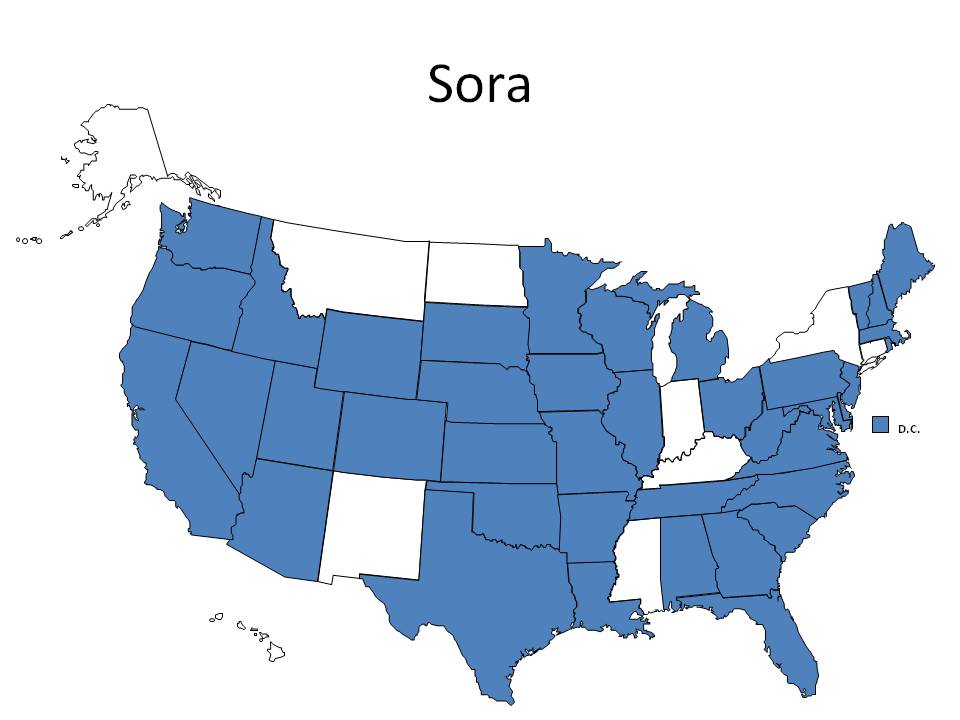
Then on to try for my nemesis bird – the Sora.  The marsh throughout the northern end of Little Pond was full of cattails, which should be ideal for Sora.  I played a bit of tape and instantly saw the cattails move just a short distance away.  But no visuals and no calls.  I walked a bit farther down the boardwalk and played a little more tape with no luck.  So I walked back to my original spot and a Sora flushed from the marsh right next to the boardwalk!  And I noticed some more movement a short distance away and got a visual on a second Sora.  Pretty exciting since I don’t think they had been reported from the spot recently.  A distant calling Virginia Rail and 3 Marsh Wrens chattering in the marsh completed the experience.  My Sora map is a bit spotty – this is a pretty common bird across the US so I don’t have many excuses for missing it in most states (except for MT and ND where my lists are puny).  And Sora is now my 214th species that I’ve seen in each of the 6 New England states.

That was 3 New England statebirds in one morning - good way to end a dry spell!

Saturday, September 22, 2012

Reportable in Idaho – Though Just Barely – September 2012

Through 2011 I had birded in Idaho just five days, but had tallied 189 species – just 19 short of the ABA reporting threshold.  My ID state list had almost no migrant shorebirds, so when a business trip to Salt Lake City in September came up, I decided to add a couple days to work on my ID list – especially to try for those shorebirds.  Though I knew the second week of September was well past the peak of shorebird migration. 

My birding started at the American Falls Reservoir in southeast ID with local birding expert Chuck Trost.  This spot is well-known as a shorebird magnet, and Chuck has birded the area for many years.  We started just above the dam and quickly ticked off Marbled Godwit (statebird #1), Black-necked Stilt (#2), and Greater Yellowlegs (#3).  With a couple short hikes we added Common Tern (#4), Pectoral Sandpiper (#5), Baird’s Sandpiper (#6), and Western Sandpiper (#7).  We then drove down over the location of the original town of American Falls (which is typically under water in spring but surrounded by mud in the fall), right down to the water at the dam.  Statebird #8 was an American Pipit bobbing its tail from its perch right on the foundation of one of the old buildings.  Then while scanning the lake Chuck picked out an odd grebe which turned out to be an early Horned Grebe (#9).  That was a great start to the trip.

Before Chuck headed home he gave me some suggestions for birding along the western side of the lake.  The first stop was at Sportsman Park which had a bunch of Avocets but nothing else.  Then I headed farther north stopping along the bluffs on Yuma Road.  In addition to many geese, there was a flock of about 25 Long-billed Dowitchers (#10), and a small number of peeps running among the vegetation.  One turned out to be an immature Semi Sand (#11) – smaller than the Westerns, shorter bill, capped look, no rusty scapulars.  Nothing but Canada Geese at Bower Road near Sterling.  Then off to Danielson Creek Waterfall.  It took me some time to find this spot, but it was loaded with birds, including 3 Great Egrets (#12), 125 Long-billed Dowitchers, 15 mixed Yellowlegs, and >500 Franklin’s Gulls.  I looked for other gulls mixed in but with no luck.  The trees in the area had quite a number of passerine migrants, so I spent some time with them and found a Nashville Warbler (#13), along with Yellow-rumps, Orange-crowneds, and Western Tanagers.  I was now up to 13 new statebirds for the American Falls area and 12 species of shorebirds – 8 of them were new for my state list.  Not bad for mid September.

Then I headed west toward that night's hotel in Twin Falls.  Along the way I stopped at a spot southwest of Burley on Golden Valley Road where a Burrowing Owl was reported on e-bird back in June 2010.  I knew 2-year-old data would be a long shot, and mid September is pretty late for them to be still around, but it was practically on my way.  After just a few seconds of scanning I saw a distant lump in the field.  With the scope it was clear that it was a distant Burrowing Owl – and a little more scanning revealed 2 others nearby.  New bird #14.  I love e-bird!  I ended the day at dusk looking unsuccessfully for Barn Owls.  That made for a late arrival at the hotel and a long, but very productive, birding day.

The next day I started in the South Hills, dipping once again on Barn Owls pre-dawn, and Chukars in the early morning hours in the canyons along the way.  I then made it up to the conifers of Red Crossbill country, and decided to start at the ski slope area since it was right along Rock Creek Canyon Road and I could see several nearby groves of lodgepole pines (which were full of cones!).  I took a short hike up hill to get among the pines, and just a few minutes after I arrived a flock of 4 Crossbills flew by giving their “kip – kip – kip” call – much softer than the race (species?) I’m used to in New England.  A little later another flock of 8 went by, then a heard-only bird flew overhead (#15).  It only took me 45 minutes to find them this time – back in May 2010 I spent a half day in the right habitat with no luck. 

That afternoon I was back east in Pocatello and quickly found both Pinyon and Western Scrub Jays in some juniper habitat east of town (#16 and #17).  I then spent the late afternoon/evening at Mink Creek without seeing much.

The next morning I was at Camas NWR pre-dawn, hoping for some good migrants.  As I waited for the sun to come up, I had a nighthawk flying around my car, was serenaded by Great Horned Owls, and saw several Sharpies come in off the fields.  It was shaping up to be a good morning.  I then went over to a double row of cottonwoods which is well-known as a magnet for passerine migrants.  Although the Chestnut-sided Warbler seen the day before was not around, I had a pretty good fallout including –
                Yellow-rumps -52
                Wilson’s - 40
                Orange-crowneds – 7
                Townsend’s – 3 (#18)
                MacGillivray’s – 1
                Yellow – 1
Nashville – 1
W Pewee – 1
Hammond’s Fly - 2
                Cassin’s Vireo – 4 (#19)
                Solitaire – 1
                Western Tanager – 2
                Black-headed Grosbeak- 2

I was just about done birding the cottonwoods when a newly arriving birder mentioned he had Gray Partridges (one of my targets) by the ranger’s house about an hour earlier.  I went right over there and started playing some tape – one bird called back almost instantly (#20), apparently quite close in the sagebrush though I never saw it.  I had the same experience getting Gray Partridges to respond to tape in Iowa earlier in the year.  Later I was back at the HQ area and flushed 6 Gray Partridges in the dry grass just south of the HQ – right where they were the day before.  Though I had walked through that same small patch of grass twice earlier in the morning and didn’t have them there.

After a few minutes unsuccessfully looking for a Mockingbird that had been seen off and on during the summer east of Camus, I went down to Market Lake WMA.  Not much around in the wetlands nor much in the west shelter belt (my visit there in 2010 had similar results). 

Next it was off to the Curlew Grasslands in southern Idaho.  My first stop was at the Grandine Ranger Station SE of Stone Reservoir – at least I think it was the ranger station.  The location matched the e-bird location, but it was just a couple abandoned buildings.  The only other buildings there were residences so I hoped I had the right spot.  I walked around a bit and played some tape, but with no luck.  A flock of Mountain Bluebirds were nice, and the trees were full of migrants including two Solitaires.  Next it was on to the west to try for Ash-throated Flycatcher and Scott’s Oriole in the junipers.  One road en route was lined with sunflowers, complete with a fair number of goldfinches.  One group flushed as I approached, leaving a single bird behind on the sunflower plant.  It turned out to be a Lesser Goldfinch (#21).  It was soon rejoined by the Americans giving lots of great comparisons.

When I finally got to the area where the Ash-throated and Scott’s were noted on e-bird along W 8500 S I found that the location was about a half mile behind a barbed wire fence.  And the roads to get there were just 2-tracks.  That area was heavily wooded in junipers, so it looked like it could be a good spot.  If I were to take this location literally off of e-bird then it would mean crossing (trespassing?) past a barbed wire fence, with a long round-trip hike.  At the time I decided e-bird’s location was just a general one, and instead drove along farther west on W 8500 S until I found other good patches of junipers. Since coming back from my trip I’ve heard the e-bird location was correct and it is BLM land.  So apparently it would have been OK to cross the fence to bird there.   I made short hikes into two juniper patches along the road and didn’t find much of anything except for 1 Pinyon Jay, a calling Great Horned Owl, and a Gnatcatcher which was my 124th species for the 3-day trip.  I would imagine the Ash-throated and Scott’s, along with the Grosbeak, had already headed south.  Although I missed my targets at the last stop of the trip, my last birds were several Vesper Sparrows teed-up on the fence along the road which are always nice to see.

So now I’ve met my goal to be reportable in Idaho - my 41st reportable state (see map below).  But I can’t rest on my laurels in ID.  Being only 2 over the threshold could easily mean that the threshold could creep up over my total.  I usually try to get at least 15 over threshold in a state to ensure that I stay reportable.  So I’ve tentatively planned a birding trip in summer 2013 to include some time up in the ID panhandle and maybe some time in southwest ID.  That should get me into some new ID habitats and hopefully some new ID species, getting me safely over the threshold.  On that trip I’ll also be working on my NV, OR, and WA lists.

I’ve inserted four statebird maps below (shaded states are those where I’ve seen that species).  The first is for Great Egret – a pretty common bird in almost every state.  ID had been one of three remaining gaps for this species – I guess I need to work on that MT list.  And not sure how I missed it in NE where I have a pretty good reportable list.


The next map is for Lesser Goldfinch which is typically a bird of the southwest, which barely gets to southern ID.


The third one is Burrowing Owl which is seen throughout the west.  But my map is pretty spotty as I’ve struggled to find it in a number of states.  It seems that their numbers are on the decline in many parts of its range.


And finally there’s the Red Crossbill map.  I’ve had it in a number of western states and all of the New England states.  And now I have the South Hills race (?).  Will ABA someday decide this is a new species?

White Ibis and 2 Other “State” Birds in Washington, DC, September 2012


First some general information on birding in DC - Yes Washington, D.C. is considered by the ABA to be a reportable geography, just like the 50 United States.  And birding in DC can be extremely challenging.  First it is a tiny area – many counties are bigger than the District.  Secondly, the areas of good habitat are few and far between given its very urban nature.  And some of the better sites are in some pretty seedy locations.  As a result, the ABA reporting threshold for DC is lower than for any of the 49 mainland states.  After many days of birding in the District I’m very proud to say that I’m reportable in DC.  Because of the birding challenges in DC I’m more excited about my DC list than of any of my lists for the 50 states. 

Now on to the new “state” birds - While in the area visiting relatives, I decided to take an early morning to try to add to my DC list.  Ordinarily September would be a good month to try for some migrant passerines, but there were strong southerly winds, and weather was warm and very warm.  So not conducive for migrants.  Instead I decided to try for some DC shorebirds.  The best (only?) shorebird habitat is along the Anacostia River during low tide.  Although no shorebirds had been reported recently, I decided to give it a try, starting at dawn at the Kenilworth Aquatic Gardens.  Located on the Anacostia, it also has the only nice wetlands that I’ve found in the District.  Dawn coincided with the low tide that day, so I arrived at first light and made my way to the river’s edge.  It was not yet dawn when I arrived to find lots of mud, but no birds.  In the dim light I noticed something big sitting on a dead snag in the marsh – it was an immature White Ibis!  Even some of the common waders can be tough in DC – let alone a rarity like a White Ibis.  It gave great views even in the dim light.  A little distance ahead I got to another area of mudflats but still no shorebirds.  A small cattail marsh was nearby, so I decided to play some Sora tape – one called back almost instantly!  I had had Virginia Rail in the Kenilworth marshes years ago, and now had my first DC Sora.  On my way back into the park I passed by where I had the Ibis and it was feeding on the mud close nearby.  I was able to get this sketchy photo holding my phone up to my binocs.  I guess it’s not too bad given the technology I was using. 


Back in the park I focused on trying to find migrant passerines but found almost none.  Until I noticed a flycatcher on a distant high snag – an Olive-sided Flycatcher.  “State” bird #3.  So in 3 hours in the park I found just 1 shorebird (a Spotted Sand) – miserable results for my intended objective.  But I got 3 really good new state birds which was more than I had hoped for.

That gives me 175 for my DC list – now safely 10 over the threshold.  I’ve inserted 2 of my state bird maps below – the first is for White Ibis where I’ve seen it in all the states in its regular range and now as a vagrant in 4 states in the Mid-Atlantic and 2 in the Northeast.  By comparison the Sora map shows that I’ve seen it in many states across the US, though I’ve got some big misses here and there.


Saturday, August 18, 2012

Eurasian Collared-Doves in PA and MD, and White Ibis in PA, August 2012

A trip to visit relatives in PA and MD has to include at least a little birding time, right?  Of course it does for a "total ticker".  Though since I grew up in the area I've got pretty good lists for all the mid-atlantic states (and especially MD), and there's not much in the way of likely state birds.  I started off spending a little time checking the listserves and didn't see much to chase.  Then on to e-bird where I started to research Eurasian Collared-Doves - I need them for every mid-atlantic state except DE.  There has been a colony of ECDs in the little town of Shady Grove, PA for some time, and recent e-bird reports included up to 4 birds.  Plus there were a number of recent e-bird sightings of 1-2 birds just to the south across the stateline into MD.  Two possible statebirds within a 90 minute drive of the relatives - certainly critical mass and worth the try. 

I got up early on my first available morning only to find that it was raining heavily in the general vicinity of the doves.  So I decided to make that trip the next day.  But I had free time on my hands that morning before anyone else was awake.  What to do...  I checked the PA listserve and read that an immature White Ibis had been found the previous day just an hour away with pretty good local directions.  After a few minutes of looking at the map, I was off to the Susquehanna River a bit northeast of York to try for the ibis. 

The bird had been found in a small stream channel a short distance from the Susquehanna.  When I arrived I found some excellent riparian habitat along a small dirt road, and realized that the stream channel was at least a mile and half long.  And some of it was obscured by trees.  This could be a challenge.  I slowly drove along the channel 2 times checking at each opening in the trees, but with no luck.  A calling Screech Owl was a nice find though.  I decided to give it one last try, and as I reached the mouth of the channel I noticed a small wader on the rocks - it was the White Ibis.  Wonder where it was on my first 2 passes?  PA is now my 13th state for White Ibis (see the map below) - 8 southeast states in its normal range, along with 3 in the mid-atlantic and 2 in the northeast as a vagrant.


And the next day I was off for an early morning try for the ECDs.  After a pleasant drive through the beautiful PA countryside I neared the small town of Shady Grove, en route to Kline's Grocery in the middle of town which has been the center of dove activity.  One of the first birds I noticed on the eastern edge of town was a chunky dove on the wires - a most cooperative Eurasian Collared-Dove.  I drove a 1/2 mile to Kline's Grocery and had another 4 ECDs within just a couple minutes.  A nice colony of doves!

Next was a quick drive across the MD line to the small crossroads of Reidtown where ECDs had been reported this year.  Just 5 miles "as the dove flies" from Shady Grove, perhaps this is the beginnings of a satellite colony.  Soon after I arrived I found many Mourning Doves on the wires but no ECDs.  Then I noticed a dove in flight and got a brief view of a chunky square-tailed bird flying away.  A couple minutes later I saw the same bird in flight, and again at the same angle, as it flew off to the northwest out of sight.  I had wished for better views, but the bird didn't return in the next 2 hours.  So that would have to do to add Eurasian Collared-Dove to my MD list. 

Those are my 33rd and 34th states for ECD, with most being in the southeast and out west.  (I haven't birded in NM and MT since ECDs arrived there.)  And now I have them in MD, PA, DE, and VT in the northeast.  Just as it did in Europe, this species expands its range to the northwest before colonizing to the northeast.  And for statelists - that gives me 326 in MD and 238 in PA.

Saturday, August 4, 2012

Red-Billed Tropicbird, Seal Island, ME July 2012

In the summer of 2006, a wayward Red-Billed Tropicbird was reported among the nesting terns on Matinicus Rock off the Maine coast.  Maine Audubon runs trips to that island to show off the nesting tern and puffin colonies, and the Tropicbird was seen on each of their first 3 trips that summer.  I went on the fourth trip in 2006, which turned out to be the first Maine Audubon boat that did not see the bird that year.  As the bird continued to be seen over the next couple years, my interest continued to grow.  In 2008, I took another Maine Audubon boat trip to Matinicus Rock.  When we arrived a worker from the island rowed out to our boat to report on the results of that year’s nesting activities.  When I asked about the Tropicbird she said that it had relocated to nearby Seal Island.  Although that island was visible from our boat, it wasn’t on our itinerary so no attempt was made to look for the bird.  The following year I signed up for another Maine Audubon trip but ended up not going due to a prediction of rough seas.  It turns out they didn’t see the Tropicbird on that trip anyway.  That meant through 2009 I was 0 for 3 (or maybe just 0 for 2) on attempts at seeing this tropical vagrant. 

Although I didn’t make any other attempts at seeing the Tropicbird the next couple years, I kept watching for reports from the islands to see if it was still around.  It continued to return each summer to Seal Island, though most reports were from the staff working on the island.  Many (most?) birders who tried for it from a boat were not successful.  But then came word of a new way to try for it – John Drury, an owner of a converted lobster boat, would take birders from Vinalhaven to Seal Island, for a reasonable fee of $80/hr.  Better yet, with all his runs to the island, he had become an expert on the bird, knowing the best times and places to see it.  Then came an e-mail in early summer 2012 mentioning that it was back again for its 7th year, but who knows how much longer it would return.  That gave me the sufficient “activation energy” to give it yet another try.  I contacted my birding friend Don Mairs from Maine to see if he had seen the bird yet.  It turns out he had missed it no less than 9 times, but was willing to try again.  So along with another Maine birder, Louis Bevier who had tried unsuccessfully 5 times, we made plans for another trip to Seal Island.

We took the 10:30 ferry from Rockland, arriving at Vinalhaven at about noon.  John said there was no need to get there before 3 PM, so he met us at the dock in Vinalhaven at 2, and we headed to sea.  Winds were almost calm, and the ocean was as smooth as glass – which was most appreciated given that we had to cross 12 miles of ocean in a lobster boat.  We made a couple stops along the way for things like a pair of Parasitic Jaegers and some most cooperative Gannets on the water. 


 As we neared Seal Island we began to see puffins flying toward the island with fish in their bills to feed their young.  And small groups of puffins were lounging on the water providing some great “Kodak moments”.


We arrived at Seal Island at about 3:30 and headed toward the spot where the Tropicbird hangs out.  Within a couple minutes, John motioned that he had the bird.  A minute later there was the Tropicbird – sitting on the water among the bathing Common and Arctic Terns.  Over the next hour we had the bird in sight virtually non-stop as it seemed to have fun harassing the terns.  It would interrupt their bathing time by flying amongst the birds on the water, fly over the colony which put them all into the air, and strafe the small freshwater pond where they bathed (it called during two of these strafing runs).  A couple times it even harassed a cormorant.  Maybe after 7 summers without a mate it was in a foul mood. 


On the way back to Vinalhaven we stopped at one of the islands to check out a leucistic Great Black-backed Gull that John had found.  At least I don’t think it was an albino.


The Red-Billed Tropicbird was #730 for my ABA list, and #320 for me in Maine. 


Tuesday, July 31, 2012

Southern Ontario - 45 New Province Birds, July 2012

I’ve never really made Canada birding and province listing one of my priorities since my principal birding goal is to reach the ABA threshold in each US state.  But the province lists do count as part of the ABA Total Tick category.  So when a trip to Buffalo, NY came up, I figured why not take a day to bird across the line into Ontario and add to my province list.  And since my ON list was just 102, there was lots of potential.  Though mid-July isn’t exactly the best time of year for birding – too late for most passerine song, and too early for most shorebird migrants.  Undeterred, I contacted a couple local ABA birders for birdfinding advice, and one graciously offered to spend the day taking me around. 

I birded with five very knowledgeable and friendly Ontario birders from 6 AM to 3 PM, hitting varied habitats from Fort Erie to Port Colburne, stopping in woodlands, wetlands, farm fields, and along the north shore of Lake Erie.  We ended up with 96 species, including 45 new species for my Ontario list.  Highlights were many including –

·         13 species of shorebirds (12 were new), including a breeding plumage Stilt Sandpiper.  Most stops were at rocky shorelines of Lake Erie.  Shorebirds that normally are seen on mudflats were attracted to rocky pools with algae and other smelly organic matter.
·         A Red-headed Woodpecker family coming to a feeder – they're stunning birds at normal distances let alone when they’re only 15 feet away!
·         4 Empids – Willow, Alder Least, Acadian
·         8 species of sparrows including two calling Henslow’s which are apparently quite a rarity locally

I can’t say enough about the excellent help from the local Ontario birders.  They sure knew the area well, and were great to bird with.

That raises my ON province list all the way up to 147, with a Canada list of 185.  And of my 12,327 total ticks, just 230 are in Canada.  Like I said – Canada listing hasn’t exactly been a priority. 

Saturday, July 21, 2012

Black-Bellied Whistling Duck, Massachusetts, July 2012

Late on July 3rd a post came across the MA listserve that a Black-Bellied Whistling Duck was being seen at Great Meadows NWR in Concord, MA.  I couldn’t quite get there before dark that evening, so I decided to go to Great Meadows at dawn the next morning – seemed like a good way to start the 4th.  But although I arrived at 5:15 and stayed till 10, there was no whistling duck to be seen. 

Was this going to be yet another 1-day wonder for this species?  There have been a number of recent examples where whistling ducks have shown up in the northeast, but in most every case they were gone by the next day.  In each of these cases these were small flocks of birds – in fact the same flock appeared in different locations several times.  On the other hand, I and other birders there that day discussed a number of examples where a single Black-Bellied Whistling Duck had shown up as a vagrant and had stuck around in that location for quite a while.  For instance my DE sighting was of a bird that spent many months in one freshwater lake.

So I wasn’t too surprised when 2 weeks later another post came across that the Whistling Duck was once again back at Great Meadows.  Since the e-mail came across virtually real time (thanks to the marvels of smartphones!), and I noticed the e-mail quickly, I was able to drop everything and get to Great Meadows less than 2 hours after the initial sighting.  As I arrived along the main dike I saw several birders in the distance standing around and chatting quietly – didn’t look too positive I’m afraid.  When I got up to them and asked if the bird had been seen recently, they pointed to the other side of the dike.  There was the Whistling Duck sitting on the bank at the water’s edge just 15 feet away!  As is typically the case for these birds, it was very tame and seemingly unphased by the group of birders standing nearby.  The only time it appeared to be unhappy about its surroundings was when a small jet from Hanscom flew low overhead – the duck gave its interesting call in response to the jet noise. 

Although I didn’t bring my camera with me, I was able to get a couple passable phonescoped pictures of the Whistling Duck under some harsh lighting conditions (bird was sitting in the shade with sunlit water in the background).  My statebird map for Black-Bellied Whistling Duck is also inserted below – MA is now my 5th state for this species.