Tuesday, March 16, 2021

Exciting Second Trip to Tennessee in a Week – Not to Mention a Short Side Trip into Virginia, February 20, 2021

On February 17th I made my first birding trip to eastern TN since moving to western NC, breaking the ice so to speak.  That was a most successful trip to an area northwest of home, netting three new birds for my TN list.  While doing research for that trip I found several other targets I needed near the northeast corner of TN in an area north of home, but that would have been too much ground to cover for one day.  So while driving back from my most successful initial TN trip I was already starting to plan my next TN trip, this one to northeast TN.

There were 3 key targets being seen north of me near I-26.  The first 2 were seen at South Holston Lake, specifically from the boat launch along Route 421.  First there was a White-winged Scoter reported along with a Long-tailed Duck (since I got a Long-tailed on my previous TN trip that one was no longer a target).  Then there was a Red-throated Loon seen along with several Common Loons.  The Scoter was reported multiple times, though the Loon was only reported once.  So I was hopeful for the Scoter but realistic that my chances were low on the Red-throated.  Though I’m always up for a long-distance Loon search – it’s almost like my beloved seawatches.  The third target was perhaps even a longer-shot – a pair of Common Mergansers reported just once on the Watauga River in Johnson City, and that was nearly a week earlier.  But that spot would only require a short side-trip on my route home, so certainly worth a try.

And then there’s another twist – the South Holston Lake boat ramp is less than 10 minutes from the TN/VA state line.  My VA statelist was a respectable 249, but I still had many gaps.  I set up an eBird Needs Alert for VA and found only one recently reported target near the state line – Wild Turkey, and they’re almost never reliable.  With a bit more research I found very few hotspots nearby, and few recent checklists submitted in the area.  With no reliable targets to chase after my thoughts turned to doing a bit of speculative birding in the area.  One of my possible VA statebirds was the Pine Siskin.  This has been a great winter for Siskins, with many moving through earlier in the season.  So ordinarily I would think that this would be the year for me to add that species to my VA list.  But lately the reports from southwestern VA had been pretty limited, with none being reliable.  (Actually, the closest recent Siskin report was from the Holston Lake boat ramp in TN – but I didn’t need Siskin for my TN list.)  Maybe I could get lucky and just run into a flock.  One of the closest hotspots was Washington County Park on South Holston Lake.  It had a nice wooded area which looked like it could be birdy.  So I decided to make a short side-trip to the park and hope to get lucky birding the woodlands and brushy edges.

The night before my trip I checked eBird one last time for updates.  Unfortunately, there was a report from the boat ramp with no Scoter or Oldsquaw, and still no Red-throated Loon.  And no new Common Merganser sightings.  Had they all moved on?  I was realistically thinking that I might not get any new statebirds on this trip.  But even if that were the case, it would give me a chance to visit a new area. 

The morning of the 20th was a cold one – 24 degrees when I left the house.  And when I crested the mountains near the TN/NC line the temp had dropped to 18 degrees.  The clouds near the top looked a bit ominous, and were spitting a few snow flurries, but I wasn’t too concerned about road conditions.  Shortly after I crossed into TN I spotted an immature Bald Eagle flying overhead – not new for my list but perhaps an omen of good things to come.

I arrived at the Holston Lake boat launch area around 8:45 and started to get my bearings.  First there were long views like this one out on the lake in several directions where searches for Loons might be fruitful.


But the photos of the Scoter and Long-tailed Duck looked to be in more protected waters and from a closer distance.  The area between the boat ramp and the marina toward the west was quite protected, so I started my search there.  Unfortunately, the only waterfowl there were 2 Canada Geese.  I started to wonder if it might be worthwhile to try to access the marina and look for the ducks among the boat slips.  There was also a somewhat protected area to the southeast, but that area came up empty for waterfowl.  The only birds were a small flock of Ring-billed Gulls with a couple Bonaparte’s mixed in. 

Then I turned my focus to a search for Loons farther out on the lake.  It was rather breezy, which put a bit of a chop on the reservoir.  My first scan came up empty.  Then on the next scan I found a Loon which was obviously a Common.  And then on a later scan I found 2 others together but again they were just Commons – though they were a considerable distance out making the IDs challenging. 

I was coming up empty on both of my targets, but I didn’t feel good that I had found the right spot for the Scoter.  I started to wonder if there was another cove with protected waters nearby that I hadn’t found yet.  I walked a short distance north toward the main road, and looking off to the northeast found a small protected cove.  Could this be the right spot? 


 As I set up my scope a Red-breasted Nuthatch called from the pines overhead.  One of the checklists with the Scoter also had a Red Nut – maybe I was finally in the right spot.  On the first scan I saw only a Bufflehead.  Then with binocs I spotted a dark duck on the water a short distance away.  I put it in my scope and I had the female White-winged Scoter.  And with another scan I spotted the Long-tailed Duck.  A bit later all 3 divers where swimming together providing this phonescoped moment.


It’s amazing how looking in the right spot can increase your chances of finding your target birds.  While I was there a local birder arrived also looking for the Scoter and Long-tailed and I was able to point her toward this protected cove.  Looks like I wasn’t the only one who didn’t know where to look.  I made sure when completing my eBird checklist for this spot to add some specific directions to this cove.

My statebird map for White-winged Scoter is inserted below.  The blue-shaded states are those where I’ve seen this species in its regular range – principally on the Pacific coast, northern Atlantic coast, and along the Great Lakes.  The cross-hatched states are those where it is regular but I haven’t yet seen it.  And now TN was the 7th state where I’ve seen this species as an inland or southern rarity. 


So with one target under my belt I returned to my original spot to spend more time looking for Loons.  My first couple scans came up empty – no Loons at all, just a flyby Bufflehead.  But the water was pretty rough, and there was a bit of heat shimmer so distant viewing wasn’t exactly easy.  Then I picked up one Common Loon in the distance, and a short distance away spotted a second Loon, both diving frequently.  My initial take on this second bird was that it was noticeably smaller than the Common.  Did I have the Red-throated?  The overall appearance seemed to be that it was a browner bird, a bit lighter than the nearby Common.  Then I focused on the head - the bill was smaller than the Common and the head was more rounded.  I did not notice that its head and bill were more upturned typical of a Red-throated, but given the considerable distance (likely over a half mile) and its limited time above water, I felt like that wasn’t a deal breaker.  After 30 minutes of studying this bird I concluded I had found the Red-throated Loon.  Unfortunately, it was way too far away for photos. 

In my statebird map below I’ve seen Red-throated Loon in all its regular coastal states, but still need it in several states in the Great Lakes region.  And TN was my second state (after VT) where I’ve seen it as a rarity. 


Now it was off to VA and my speculative search for Pine Siskins.  Just a couple minutes after crossing the stateline I arrived at the gate to Washington County Park, only to find out that it was closed.  Mind you, it was not just a pole across the road to keep cars out but you could still walk in.  No, it was a gate in a chain-link fence blocking all access to the park.  That was disappointing.  At least there was also a boat ramp down to South Holston Lake that I could explore.  I set up my scope and only found a couple Ring-billed Gulls flying about.  There was a little passerine activity along the shoreline but not much else.  I was just about to call it quits on the VA part of my trip when I noticed a medium-sized red passerine fly past me along the shoreline.  I put my binoculars on it and was shocked to realize it was a male Red Crossbill!  I followed it to a grove of pine trees a short distance away and realized there was a whole flock of Crossbills up there.  I guessed perhaps 8 or 10 birds flitting about, complete with their “kip kip” call notes.  Just then the whole flock dropped down to the water’s edge to drink – I counted 14 Crossbills, more than half red adult males.  I snapped this phonescoped photo unfortunately a second after most of the flock took of – at least 2 birds remained for the shot.


Red Crossbill was #250 for my VA list – my 24th state with at least 250 species.  And VA was my third state where I’ve added this species to my state list since moving to the area (along with NC and SC).  I’m still hoping to see Crossbills in TN most likely in the highest mountains along the Blue Ridge, where they are typically much more common than in VA.


A bit later I had a calling Brown-headed Nuthatch in those same pines.  And a Palm Warbler foraging on the lawn below.  A very nice stop.  On my way back to TN I drove some of the back roads still hoping to find a Siskin flock but to no avail.  Though I’m certainly not disappointed - I’ll take Red Crossbill over Pine Siskin any time!  Maybe I can get back to the area in early spring and get Siskins as they are heading back north.  

My next planned stops on my way south were a couple areas along South Holston Lake hoping to find other waterfowl or gulls.  A couple stops along the river below the dam yielded an amazing 152 Bufflehead, along with 20 Wigeon.  It was a fast-flowing river that looked good for Common Mergansers, but not today.  And a stop at the dam overlook offered this nice scenic view, though I didn’t have a single bird on the water.


Next I was off to the Johnson City area to try for the Common Mergansers.  The birds had been seen on the Watauga River, which meanders through the area for quite a number of miles.  The eBird report mentioned “Seen multiple times flying up/downstream.  Landed in water in front of us”.  There was only limited access to the river, providing a view of only one small portion of river habitat likely suitable for Mergansers.  And along with the fact that the sighting was now 6 days old, this would be a long-shot to say the least. 

I arrived at the pinned eBird location to find a small park and fishing pier with a nice view of the river.  Certainly seemed suitable for Mergansers.  But the problem was I saw no waterfowl at all.  I scanned upstream and down, and waited at least 10 minutes, but still no waterfowl.  Then on one scan I noticed a Great Blue Heron standing on a grassy bank a short distance downstream.  On closer look I thought I could see the dark head of a duck, likely a Mallard, sitting in the grass nearby.  I put them in the scope – it wasn’t a Mallard, it was a male Common Merganser! 


I was able to drive down closer to the roosting Merganser now barely visible over a small rise, and realized a female was by his side.


Later when I looked back at my photo of the Heron in the distance I realized you could see the reddish head of the female Merganser right behind the legs of the Great Blue.  Not sure I would have spotted my targets if the Great Blue hadn’t been perched there.  And if the birds had been resting along the shoreline just a short distance farther downstream they would have been around the bend and out of view.  Certainly an element of luck involved with birding.

I’ve seen Common Merganser throughout most of its range, though I still need it in 3 northern states, as well as 5 southeastern states where this species might be better called the “Not So Common Merganser”.


That brings my TN list up to 243 – a nice addition of 6 birds over 2 trips in the same week.  An excellent way to start my birding in eastern TN.  I’ve come up with a list of another 34 possible targets along the eastern edge of TN to hope for in the future.  Plus, another 32 additional targets in southwestern VA.  Can’t wait for more trips to explore these new regions.

Tuesday, February 23, 2021

First Birding Trip to Eastern Tennessee - Breaking the Ice, Sevier and Jefferson Counties, TN, February 17, 2021

This has been a great winter for Evening Grosbeaks in the south.  Earlier in the winter most sightings were flybys of a small number of birds.  For instance I heard 2 birds fly over my yard on November 8, 2020, and a single bird on November 20.  As the winter progressed small flocks were reported at a few feeding stations here and there.  Several photos of these showy birds were posted on the local listserves providing some nice eye candy.

All the recent reports I noticed were from locations in NC – luckily I no longer needed this one for my NC list.  But then on February 9th Galen Goodrum posted an excellent photo of an Evening Grosbeak he saw in Sevierville, TN.  That was just under 2 hours away.  Since it may be a long time before Evening Grosbeaks irrupt into the area again, this may be my last chance to try to add them to my TN list.  When I moved to the area I had planned on traveling to eastern TN to work on that statelist, with the state line just an hour away.  But I had never quite gotten around to doing the research needed to bird in TN.  Maybe the nearby Grosbeaks would give me the impetus I needed to expand my horizons into TN.

I used to travel to Memphis, TN very frequently for work in the late 90’s and 2000’s.  I birded in the area many times with Jeff Wilson who was the best field birder I’ve ever met – I learned a lot from Jeff.  And along with a couple trips to the eastern part of the state over the years, I had amassed a nice state list of 237.  But of course I still needed Evening Grosbeak, along with a few regular species , not to mention numerous rarities.  As a first step to see what statebird targets might be around not too far from home, I set up an eBird Needs Alert for TN.  Quite a number of “needs” popped up, but many were way too far away.  So I needed to sort the long list to focus on counties that are closest to the NC/TN line.  Luckily there was still a considerable list of targets reasonably close to home.  Then I divided the list into those from counties northwest of me near I-40, and those toward the north near I-26. 

There were recent Evening Grosbeak sightings in both areas, but the more recent ones were from the northern counties.  So I initially leaned toward heading north.  But then several new Grosbeak sightings were posted from the Sevierville site to the northwest, including over 100 birds at one feeder.  So with my top target now looking like it was most likely in Sevierville, I focused my final research on the northwestern counties.  There were 2 additional recent targets in nearby Jefferson county – a Long-tailed Duck was seen for a couple days amazingly in a shallow farm pond along Falcon Road in White Pine.  And along that same road there were numerous reports of Sandhill Cranes – up to 55 from one report.  There was also one cryptic report of a pair of Mute Swans quite close to the Grosbeaks.  I say “cryptic” because the location was not shown accurately in the post, and the details mentioned a site that didn’t quite make sense.  Plus given that the post was now a few days old, I decided to pass on that one.  Lastly, I reached out to Galen and learned a bit more about his Evening Grosbeak sighting.

I had completed my research.  My plan was to first head to Sevierville for my highest priority Evening Grosbeaks, staying as long as needed to hopefully find them.  Then I would head to the Falcon Road area to hope for the Long-tailed Duck and Sandhill Cranes.  Now I needed to choose a day with good weather.  The biggest concern was the potential for snow showers or even heavier snow as I crossed over the mountains into TN.  I picked the 17th as a clear day.  Plus, as a bonus, seasonal temps were predicted.  I checked the eBird reports one last time for the latest updates just before I headed out the door – unfortunately the Long-tailed Duck was not found there on the 16th, and the last Crane report was from the 15th.  My optimism was waning a bit, though I’d be happy if I was just able to find the Grosbeaks.

I left the house predawn on the 17th and neared Sevierville at 8:30.  Photos on eBird reports seemed to suggest the Grosbeaks were coming to feeders on Rex Lane at a house with a large railing across the back deck.  And most sightings were from a location that looked to be a roadside pulloff between houses.  After taking a wrong turn that took me on a scary narrow mountain road, I made it to Rex Lane and came to that roadside pulloff.  Just as I pulled in I noticed some movement in trees right in front of me.  With a quick binocular view even through the distortion of my windshield I could tell I had Evening Grosbeaks.  I hopped out of the car and estimated at least 25 birds in the trees right in front of me.  Here’s a photo of a cooperative bird I took holding my phone up to my binocs.


And I could hear more Grosbeaks calling a short distance uphill.  I looked to the house up above me and there were maybe 50 more birds perched on the porch railing.  I got this tape of the flock as they milled about along the railing  The air was full of their raucous calls too - unfortunately I couldn't get the sound to come across.


 That was amazingly easy!  I stayed for 15 or 20 minutes to take it all in.  It reminded my of my time growing up in Maryland when large flocks like this would descend on my feeders every few years.  But that was a different time some 30 or 40 years ago when the eastern population of the Evening Grosbeak was much more common.  In fact, in April 2016 the Committee on the Status of Endangered Wildlife in Canada (COSEWIC) listed the Evening Grosbeak as a species of Special Concern due to strong population declines occurring mainly in central and eastern Canada.

My statebird map for Evening Grosbeak is inserted below – the blue-shaded states are those where I’ve seen this species; the cross-hatched states are those where it is regular but I haven’t yet seen it.  Or at least in the East, those are states where Evening Grosbeak used to be regular.  And now NC and TN are the two tan-shaded states where I’ve seen this species as a rarity.


Next it was off to Falcon Road in Jefferson County.  Although I was happy to have found my top priority target, I was still hopeful that the Long-tailed Duck and Sandhill Cranes might still be around.  Falcon Road cuts through an extensive area of farmland, with several farm ponds nearby.  One eBird report mentioned the Long-tailed Duck was in the “largest pond” – GoogleMaps showed a larger pond adjacent to the road on the west side so I assumed this was the one.  And all recent checklists had good numbers of multiple waterfowl species.  I drove up to what I thought was the key pond and did a quick scan – no waterfowl at all.  I looked more closely and all I could I could fine were a couple Buffleheads.  Perhaps the Long-tailed had indeed moved on.  Or maybe I had the wrong pond – there were other larger ponds a bit farther off the road that could be possible candidates.  I drove a bit farther to the north and came to another pond that was a bit smaller – this one had quite a number of ducks so I was hopeful.  Although I had 7 Shovelers and 23 Green-winged Teal, I could find no diving ducks at all.  It wasn’t looking good. 

There were two ponds on the east side of the road that I had driven by earlier without checking because they were so small.  But with no luck at the larger ponds, I needed to check these last 2 smallest ones.  I turned around and checked the first one – not surprisingly no birds.  Then I got to the next one and saw something floating in the middle.  I put it in my binocs – it was the Long-tailed Duck!  It was close enough that I got this photo holding my phone up to my binocs.


I would have never expected a diving duck on such a small pond.  I guess it too decided this wasn’t the best location because it soon took off and flew back over to its preferred larger pond. 

TN was now the third state where I’ve seen Long-tailed Duck as a rarity, along with CO and NE.  I’ve also seen this species in most of its regular states on the Pacific coast, northeast Atlantic coast, and along the Great Lakes.


Not to be greedy, but now my attention turned to my third target – Sandhill Crane.  There was suitable habitat all around me – rolling hills covered in hayfields and harvested row crops.  I slowly did a 360 scan but didn’t find any tall gray birds walking through the fields.  But with all the hills, there could easily be Cranes nearby that were hiding just out of view.  I drove a bit farther south to get a different angle but again came up empty.  Then I spotted a flock of large birds flying low over one of the fields.  I first thought they were Canada Geese but realized they weren’t quite right.  With a closer look I realized they were Sandhill Cranes – a flock of 9 birds.  They passed over the road and disappeared behind a nearby hill to the west.  A couple minutes later another flock of 15 Cranes flew by, nicely giving their bugling calls - you can see them in the distance near the top of the hill.


 TN was my 38th state for this wide-ranging species, including 12 states on the East Coast where it is a rarity.


That’s 3 for 3 for my targets - what an amazing first trip to eastern TN!  That brings my TN state list to 240. 

Now that I live in western NC, I realize that pursuing statebirds in TN is actually very similar to my old statebirding trips to several New England states when I lived in MA.  Back then it was about an hour drive for me to cross into ME, VT, RI, and CT, and I found many new statebirds in each of those states within 2 hours of home.  So now that I’ve broken the ice for TN birding, I’m looking forward to many more trips to the Volunteer State.  In fact, when researching this trip to the northwest along I-40, I found several other TN targets to the north along I-26.  Hopefully I can make a trip to that part of the state in the near future.

I love statebirding!

Sunday, February 21, 2021

Bullock’s Oriole - After a Bit of Prodding, Mecklenburg County, NC, February 12, 2021

This winter there have been no less than 3 Bullock’s Orioles in NC.  Each has been a long-staying feeder bird which eventually became quite reliable.  But the closest was nearly a 2-hour drive away near Charlotte.  Couldn’t quite justify the long ride and standing out in the cold staring at a feeder.  I’ve had a lot of experience looking for rarities at feeders and have decided it’s typically my least favorite type of birding.  Often you have to spend an extended amount of time staring at a boring feeder looking at chickadees and titmice.  And even if the target does show up, it’s not like the bird is unexpected.  Not to mention your emotions if the bird doesn’t show up.  For example, twice I’ve spent an entire day unsuccessfully looking for a Bullock’s Oriole at a feeder (in NH and ME.)  It’s a no-win kind of situation. 

But then again, as hockey great Wayne Gretzky once said – “You miss 100% of the shots you don’t take”.  Or if Wayne Gretzky was a birder he might have said – “You miss 100% of the birds you don’t chase after”.  Despite the Great One's advice, I decided I’d just wait for one to show up somewhere closer.

But then on February 11 Simon Thompson posted an excellent picture of a Bullock’s Oriole in Mecklenburg County saying “this fellow is super reliable”.  If I were to chase after it I’d have to figure out how to look for the bird.  With some quick eBird research I found that the bird was at an eBird hotspot very nicely titled – “stakeout Bullock's Oriole, Huntersville (2020-2021) Call or text 704-578-4671 for Permission”.  I texted the homeowner to get permission, and found out that the feeders were visible from outside – no need to enter their house during these Covid times.  And I noticed that my birding friend Bill Hooker had just seen the bird as well.  Bill had been trying to talk me into go after an earlier Bullock's, and said this bird was truly quite reliable.  I finally had exceeded the “activation energy” needed to chase after the bird. 

I was out of the house early on the 12th and pulled into the stakeout spot by 8 AM.  I drove around back and was greeted by a large flock of least 75 Pine Siskins at the feeders.  Pretty impressive!  The Oriole was being seen feeding on an orange attached to one of the feeder poles, and sometimes seen perched in trees nearby.  It was raining a bit so luckily I could see the feeders right from the driver’s seat in the dry and warm car.  I positioned my car to see the orange feeder as well as all the rest of the feeding station to begin my vigil.  With no Oriole at the feeder, I scanned the trees, but with no luck.  Then I looked back at the orange and there was the male Bullock’s Oriole chowing down.  I only had to wait 5 minutes before the bird arrived.  It stayed there for several minutes before it flew off around the corner of the house.  Talk about being reliable…

Bullock’s Oriole was #311 for my NC statelist.  In my statebird map below the blue-shaded states are those where I’ve seen this species in its regular range.  And NC is now my 6th eastern state where I’ve seen it as a rarity (the tan states).


 After spending more time watching the Siskins, including finding a Purple Finch mixed in, I contacted Bill Hooker and met up with him for some quick birding in Rutherford County on the way home.  We are both working on our county lists there, and picked up 2 rare Eurasian Collared-Doves in “downtown” Ellenboro, and Coot and Ruddy Duck at the lake at Isothermal Community College.  A nice ending to a very nice morning.

Monday, February 15, 2021

More Rarities at Dobbins Farm – But Not the Expected One, Anderson County, SC, February 10, 2021

Ross’s Goose is one of my favorite birds, dating back to my numerous work trips to the Memphis area in the late 90s and 2000’s.  During the colder months I would enjoy seeing large flocks of white geese either migrating through or wintering in the area.  The vast majority were Snows, but with close examination I would spot occasional Ross’s Geese mixed in.  In flight, a Ross’s would often be at the head of the line.  It was fun to play “Where’s Waldo” looking for those diminutive geese among their larger cousins.  Over the years I would end up adding Ross’s to my lists in 31 states and 1 Canadian province as this species rapidly increased in numbers. 

When I moved to the Carolinas I needed Ross’s Goose for my statelists in both NC and SC, as well as Snow Goose in South Carolina.  I was able to see Ross’s in NC within just a few months of moving to the region in 12/19.  And finally got Snow Goose in SC about a year later in 11/20 at Dobbins Farm in Anderson County.  And although there were several more Ross’s records in the mountains of NC, there were no nearby records of Ross’s in SC.

That is until late January 2021 when Ross’s and Snows appeared at not 1 but 2 farm ponds in Anderson County.  Remarkably the sites were just 11 miles apart “as the goose flies”.  Unfortunately, I had commitments at home that prevented me from getting out at that time.  But the reports continued at both spots for a couple weeks, until I was finally able to make a run to the area on February 10.  The last report from the first site, Clemson University Simpson Research Station, was on the 7th – 2 Ross’s were seen with 5 Snows.  And from the other site, Dobbins Farm where I’ve seen several rarities since moving to the area, the last report was on the 8th with 1 each Ross’s and Snow.  There were no reports positive or negative from the 9th.  But I was still quite optimistic that the birds that had been around at the Clemson site for 13 days, and at Dobbins Farm for 11 days, would still be around when I was finally able to look for them.

My plan for the 10th was to first head to the Clemson site since it was closer, then bird the Dobbins Farm area.  I got out of the house early on the 10th and arrived at the Clemson site at about 9 AM.  The Ross’s and Snow Geese were sometimes seen with Canadas on the farm pond there, and sometimes seen foraging in fields nearby.  As I pulled up to the pond I hoped (dare I say expected) to see some white dots on the water which would be my target birds – but I didn’t see a single goose.  I got out and with a quick binocular view couldn’t find any waterfowl at all.  They must be feeding in the fields I surmised.  There was suitable grazing habitat all around me, so I did a 360-degree search but still found no geese.  I drove east a short distance and looked from that different vantage point but again found no geese.  At least I still had Dobbins Farm to search for my target.

Twenty minutes later I arrived at Dobbins Farm again hoping to see those white dots on the ponds in the distance.  First I arrived at the upper pond – no geese at all.  Then I pulled down to the lower pond – no geese again.  I checked both ponds more closely, but there’s next to no way a white goose could hide on these relatively small farm ponds.  To say that I was upset would be an understatement – saying a number of things to myself that I can’t put in print here on my blog.  I had gotten there just a day or 2 too late.

I was tempted to just get back in the car and drive home, but decided to do at least a little birding at Dobbins before heading back.  One of my other targets at that farm has been Brewer’s Blackbirds that are occasionally reported from the site.  In fact a male/female pair were spotted there a few days earlier.  The cows were feeding in their troughs along the road so I though perhaps a blackbird might be there feeding on some spilled grain.  I quickly searched the area but came up empty.  Then I heard a couple blackbird call notes in the distance.  The recent report mentioned the Brewer’s were “Seen in top of trees behind lower pond”, so I looked into those trees in the distance and sure enough there was a blackbird perched near the top.  Too far to ID with binoculars, so I quickly got out my scope.  The bird was very glossy, with a yellow eye, and short tail – I had myself a male Brewer’s Blackbird!  Here’s a picture of those trees in the background behind the lower pond.


And a phonescoped view of the bird, though admittedly too distant to confirm the ID in this less-than-ideal photo.


 While studying the Brewer’s I realized that there was a nearby meadowlark singing an odd song.  I focused on the call and realized it was the singing Western Meadowlark, a bird I first heard here back in November and was now being occasionally heard and seen yet again among all the Eastern Meadowlarks.  Who knows how long it had been singing and I hadn’t noticed it while concentrating on the blackbird.  Then I turned back to the blackbird and realized there was a second one in the trees – another male Brewer’s.  Nice consolation prizes – a new SC statebird in the Brewer’s, and an even rarer Western Meadowlark.

Here’s my statebird map for Brewer’s Blackbird – the blue-shaded states are those where I’ve seen this species in its regular range.  The cross-hatched states are those in its regular range where I’ve yet to see this species.  The 4 tan states are those where I’ve seen it as a rarity.


I drove back to the upper pond hoping against hope that I might still find those white geese.  At the northeastern end of the pond I spotted a few Canada Geese at the edge of the pond.  While scanning through them I noticed a pair of geese flying overhead.  They circled and pitched in right in front of me – it was a pair of Greater White-fronted Geese.  I got these passable phonescoped photos of the pair.


White-fronts are actually rarer in the region than Ross’s.  Over the last 6 years in the SC Upstate there have been 15 reports of Ross’s while just 11 reports of White-fronts.

I’ve now seen White-fronted Goose throughout most of the states in its regular range, along with most east coast states where it’s a rarity.  Most of those northeast sightings are of birds from the Greenland flavirostris race, while sightings from the western Carolinas are most likely from the inland frontalis race.


That gave me 2 additions to my SC state list, bringing my total to 284.  Not to mention my second observation of the Western Meadowlark – only the second SC state record.  So even though I missed my target (and expected) Ross’s Goose, I’ll gladly take this great set of consolation prizes.  I’ll just have to get the Ross’s Goose in the future – maybe on a future trip to Dobbins Farm.

Thursday, January 14, 2021

2020 Year in Review

It was 2020…  Need I say anything more?  The concern over Covid exposure changed my focus from large statebirding trips, or even travelling to chase a single new statebird a short distance away, to birding quite locally.  Don’t get me wrong - exploring local birding spots was still fun, especially as I continued to learn more about my new area in western NC.  Plus I found a number of really nice birds nearby.  But my first love continues to be adding birds to my state (and province) lists.  And with my recent retirement I had plenty of time to take a lot of short- and longer-distance trips.  But all of that will have to wait till we can return to more normal times.

There were still some nice highlights in my nearly daily birding trips.  All results were entered in eBird, with 672 checklists entered in 2020.  Key highlights are summarized below.

Statebirds

The year started off quite well with a January trip to the SC and NC coasts in conjunction with the annual winter meeting of the Carolina Bird Club.  I added 8 in NC and 9 in SC including a number of rarities.  But then Covid hit, eliminating any trip longer than 90 minutes or so.  I ended up adding 75 birds to my state and province lists during the year to bring my “total ticks” tally to 14,849.  (Total ticks is the sum of my state and province lists.)  I saw new birds in just 3 states – 35 in NC, 29 in SC, and 1 in GA.  Key NC additions among birds I found – Pacific Loon on the coast, Lapland Longspur, Wilson’s Phalarope, and Common Redpoll.  Notable SC additions were the 2nd state record of Western Meadowlark, a rare Bullock’s Oriole at a feeder on the coast, and I was lucky enough to be in the right place at the right time to be one of the few to see the first state record of Sage Thrasher.  With these 2020 additions, my NC and SC lists are now my 10th and 11th best state lists.  I also had additions or deletions to 9 other state lists and 1 province list due to ABA lumps, splits, and changes in how exotics can be counted.

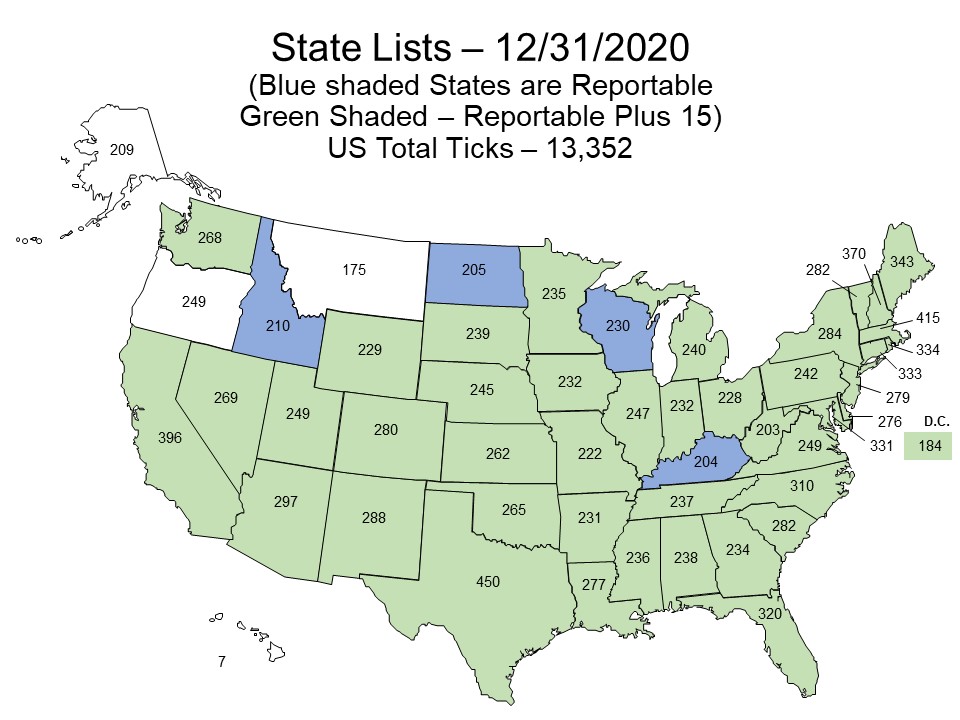
Maps of my state and province lists are inserted below.


Yard Birding

Birding in my yard continues to be amazing – which is certainly helpful during these Covid times when travel is limited.  By the end of the year my yard list was at 141 in just 16 months, adding 45 during the year.  I’m now up to 31 species of warblers, with notable additions being a singing Louisiana Waterthrush in August (there is no water nearby), and a Wilson’s Warbler at my feeder in December.  I was also lucky enough to find a couple rarities in the yard.  First and foremost was a White-winged Dove that called briefly for 3 days starting on 6/8 – unfortunately I was never able to see it.  Then came a migrant Dickcissel on 9/7, a flyover pair of Evening Grosbeaks on 11/8, and then a Selasphorus, sp. hummingbird (most likely a Rufous) feeding on camellia flowers in the yard for 2 days on 11/30-12/1. 

On 8/25/20, my 1-year anniversary of moving to NC, I put together a wish list of 44 potential new birds for the yard.  Since then, I’ve seen 9 of these targets in the yard, and 2 others that weren’t even on my radar screen.

County Listing

I never was into county listing before I moved to NC.  But with such limited travel opportunities during these Covid times, county listing gives you another thing to look forward to.  Plus many local birders are not only into county listing, but county year listing as well.  It’s contagious!  I especially focused on my home county of Henderson, where I finished with the 2nd highest count this year, even though I wasn’t bitten by the county listing bug till well into the year.  I’m also tracking county lists in 4 other NC counties and 2 in SC.  And my county listing trips yielded some good birds as well – the first eBird records of Red Crossbill in Rutherford County and Forster’s Tern in Polk County.

Life List

2020 was the second year in a row that I didn’t see a new species for my life lists – the only 2 years in my 50+ years of birding without seeing a new species.  Not coincidentally, these past 2 years were the only recent years when I haven’t taken any significant birding trips.  But there were 3 revisions to ABA’s official lists in 2020 from which I netted 1 new life bird – I lost Northwestern Crow when it was lumped with American Crow, added one when Mexican Duck was split from Mallard, and added another when Red-vented Bulbul was determined to be countable based on an introduced population in Houston, TX.  That gives me 759 in the ABA Continental and US regions, and 739 in the Lower 48.

Here’s to 2021 and Beyond

I would still like to pursue my life-long goal of seeing at least half of the total species of each state in the Lower 48 (that was the old ABA threshold to be able to report your state total).  I’ve exceeded that threshold in 46 states – only MT and OR remain.  I had planned a summer trip to MT and ID in 2019 but had to cancel to prepare for our move to NC.  And I hoped to do that same trip again in 2020 but Covid got in the way.  Now it’s looking like it could be iffy in summer 2021 as well.  I’d also like to reach 15,000 total ticks – just 151 to go.  In order to reach that goal, I’d need more than just trips to MT and OR.  The next low hanging fruit are Manitoba and Saskatchewan where my province lists are less than 50 in each case.  Certainly doable once I can get back on the road and into the air.

Then I hope to pursue more statebirds in the region in coastal NC, SC and VA, as well as northern GA, eastern TN, and southwestern VA.  There were a dizzying number of rarities in the region at the end of 2020 that I just couldn’t head out to pursue.  Not to mention a number of potential new life birds that would require a plane flight to chase.  Most frustrating. 

Definitely looking forward to those post-Covid times...

Saturday, January 2, 2021

Eared Grebe, Lake Julian, NC, December 15, 2020

When I moved to western NC in August 2019 I developed a list of possible new NC statebird targets.  The list had 36 species that were reported on at least 1% of checklists in any week of the year in the 15 westernmost NC counties.  In October 2020 I added Mourning Warbler to my NC statelist which was the 35th of these targets.  Only Long-tailed Duck remains from my initial target list.  That pretty much means that any further additions to my NC list in the mountains will be rare for the region – some rarer than others.

And one of those rarer species was discovered on 12/15, starting with this text from Aaron Steed on the Blue Ridge Birders text list– “Probable Eared Grebe at Lake Julian”.  I was already heading out the door minutes later when Aaron confirmed the ID as the first eBird record for Eared Grebe in Buncombe County.  And only the 4th record for western NC.

When I arrived at Lake Julian I was surprised to not find any other birders.  I would have thought that a bird this rare would have attracted lots of folks.  I set up my scope and started scanning the lake.  A distant flock of about 60 Ring-billed Gulls with a Bonaparte’s was nice, but the only diving waterfowl I could find were 2 Ruddy’s and a Bufflehead.  Just then another birder came by who had seen the Grebe earlier.  He recounted how it was actually quite close feeding in a small arm of the reservoir right in front of us.  And then right on cue a Grebe swam by practically at our feet.  I was about to check it off as a new statebird when I looked at it in my binocs and realized it was just a Horned Grebe, not yet reported at the lake that morning.  That certainly complicates things.  I looked back at the Grebe to make sure, but no matter how hard I tried I couldn’t turn it into the Eared Grebe. 

Then Bob Butler came by.  He too had seen the target bird earlier and described how it was feeding along the edges of the reservoir arm, rather than toward the middle.  Plus it was diving often.  So I did a very slow scan of the water edges but came up empty.  If it was preferring the edges of this arm of the reservoir, I wondered if it had moved on to the edges of another arm of water.  There is another larger arm just to the east, so I walked over in that direction and started to scan.  On a first scan I didn’t find anything on the water.  Then on a next pass I spotted a Grebe along the far shore which dove just after I spotted it.  It was too short a view to see many field marks, and certainly not enough to tell if I had my target, or whether it was just the Horned Grebe.  It popped up about 25 seconds later, and on this brief view before it dove I noticed that the back end of the bird appeared “fluffy” with expanded feathers on its flanks.  The next time it came up I got a better view and could see darker cheeks and longer, thin neck – I had the Eared Grebe.  Unfortunately it was too far, and spent too little time above water, for a phonescoped photo.  Here’s a photo of the arm of the lake where it fed, and in fact where it continued at least until the end of December.


Eared Grebe was #310 for my NC list – the 7th eastern state where I’ve seen this species as a rarity.  This western species is certainly known for its vagrancy in the east.  The blue states are those where I’ve seen it across its regular range in the west, with cross-hatched Missouri as the last state where I still need it in its regular range.


Thursday, December 24, 2020

The Rarest of the Rare Winter Finches, Fletcher Community Park, NC, December 10, 2020

The Fall and Winter 2020 seasons have been punctuated by irruptions of many species of northern finches.  Even as far south as here in NC!  First there were Red Crossbills nesting in white pines at lower elevations away from the higher NC mountains where they are more typically seen.  More recently there have been occasional flyover Crossbills passing over areas even farther from the mountains – I’ve been lucky enough to have one each in Polk (3rd county record) and Rutherford Counties (2nd county record).  Then came large numbers of Pine Siskins and Purple Finches, along with Red-breasted Nuthatches, pouring through the area.  Next were Evening Grosbeaks that came come through in very small numbers.  Once again luck was on my side when a pair of Grosbeaks flew over as I was doing a “Big Sit” in my yard in November. 

And finally, there is the rarest of this winter’s finches – Common Redpoll.  Early in the Fall there was a considerable Redpoll irruption in the northeast, which expanded to a few sightings in the Mid-Atlantic.  Could this northernmost of the finches make it all the way to the Carolinas?  The answer is a resounding “Yes”.  The first sighting of a Redpoll in NC came on 11/13 in the north-central part of the state.  And then there was another sighting on 11/20 in the northern NC mountains.  Just 50 miles away as the winter finch flies. 

That’s definitely one to keep an eye out for.  Or perhaps more importantly to keep an ear out for.  Redpolls have pretty characteristic calls, although they are similar to some of the calls of Siskins.  For the next several weeks my nearly daily birding efforts really focused on trying to find Redpolls.  I especially birded weedy fields that might attract finch flocks.  And then I looked in stands of birch trees and wetter smooth alder thickets.  This year both are loaded with catkins, and some seeds, which are favorite foods for Redpolls.  All the while keeping my ears open for an isolated flyover bird.  Not too surprisingly I didn’t come up with a Redpoll, or even a Siskin for that matter as it appears that most of this irrupter have already passed through.

Then on 12/10 I took a trip to the Fletcher Community Park which is part of my territory on the Henderson County Christmas Count.  The park has a nice diverse set of habitats, including woodlands, shrubby edge, and adjacent agricultural fields.  Plus one of the more unique birding spots is a small pond in the middle of the park that often hosts a surprising array of waterfowl.  The pond is surrounded by a thick stand of birch trees with smooth alder as an understory, making it quite difficult to see the waterfowl.  I’ve found the only way to try to get an accurate count of the ducks is to walk slowly around the entire circumference of the pond peering through to the water wherever there are gaps in the vegetation. 

On the 10th I was about half-way around the pond picking out good numbers of Hooded Mergansers when I heard a distinct dry “chit chit chit” call low overhead – I had my Redpoll!  It sounded as if I flushed it from the birch trees or alder thickets and it flew off toward the west.  Unfortunately it was a heard-only bird, despite efforts to re-find it in the vegetation off to the west.  I wasn’t at the park just to look for Redpolls, but in hindsight, the vegetation around the pond is about as perfect as you can get for these wayward finches.  So maybe it should have been my key target after all. 

Common Redpoll was #309 for my NC statelist, and a first eBird record for Henderson County.  NC was my 15th state for this species – 12 it in its regular range (the blue-shaded states in my statebird map below), and the 3 brown states where it’s a rarity.  I still need it in quite a number of northern tier states where it’s regular, albeit typically only in irruption years (the cross-hatched states).